
The Growing Interdependence of the Internet and Climate

- Slides: 43
“The Growing Interdependence of the Internet and Climate Change” Scientific Computing and Imaging (SCI) Institute Distinguished Lecture University of Utah April 30, 2010 Dr. Larry Smarr Director, California Institute for Telecommunications and Information Technology Harry E. Gruber Professor, Dept. of Computer Science and Engineering Jacobs School of Engineering, UCSD Twitter: lsmarr
Abstract Greenhouse gas (GHG) emissions continue their relentless rise, even though the global CO 2 level is already considerably higher than it has been on earth for over two million years. The Information and Communication Technology (ICT) industry currently produces ~2 -3 % of global GHG emissions and will nearly triple, in a business as usual scenario, from 2002 to 2020. On the other hand, the Climate Group estimates that transformative application of ICT to electricity grids, logistic chains, intelligent transportation and building infrastructure, and other social systems can reduce global GHG emissions by ~15%, five times ICT's own footprint! I will discuss three campus testbeds for exploring these complex tradeoffs. The first testbed is the NSF-funded Green. Light Project deployed at UCSD, which creates an instrumented data center that can guide users who wish to lower the energy cost of computation and storage. The second testbed is the campus itself, in which the move to centralized computing and storage can greatly reduce the GHG emissions of the current distributed set of clusters and storage. The third testbed is the global set of dedicated optical networks (operating at 10, 000 Mbps), coupled to large tiled wall Opt. IPortals (with fractions of a billion pixels) and high definition (2 Mpixel/frame) or digital cinema (8 Mpixel/frame), to create next generation "telepresence" systems for "sewing remote rooms together" as a way to reduce the need for transportation for national or global collaboration.
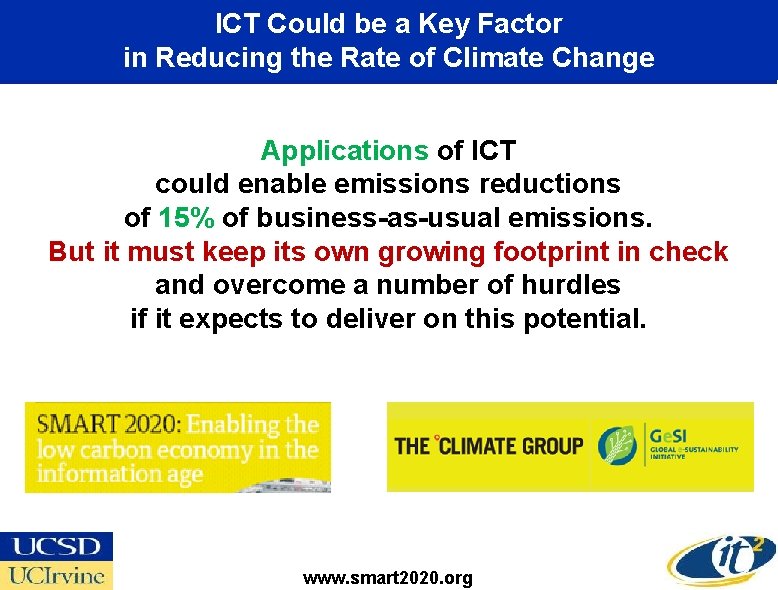
ICT Could be a Key Factor in Reducing the Rate of Climate Change Applications of ICT could enable emissions reductions of 15% of business-as-usual emissions. But it must keep its own growing footprint in check and overcome a number of hurdles if it expects to deliver on this potential. www. smart 2020. org
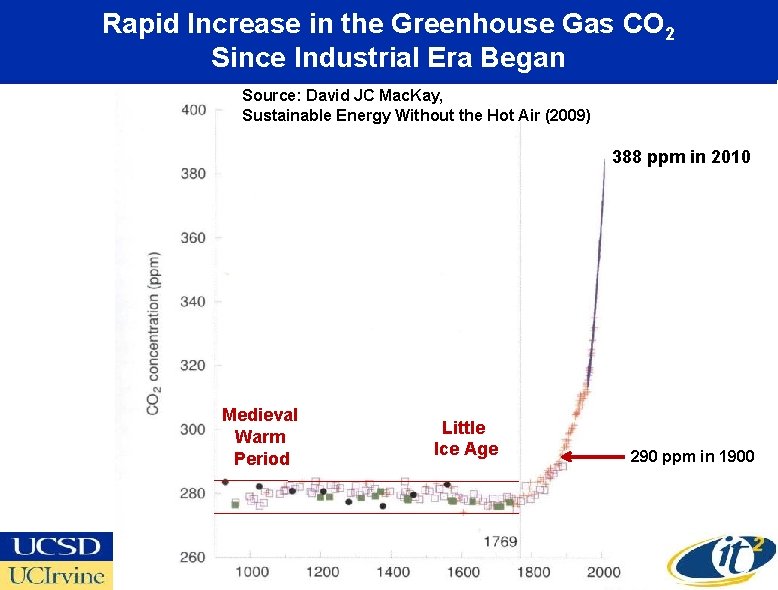
Rapid Increase in the Greenhouse Gas CO 2 Since Industrial Era Began Source: David JC Mac. Kay, Sustainable Energy Without the Hot Air (2009) 388 ppm in 2010 Medieval Warm Period Little Ice Age 290 ppm in 1900
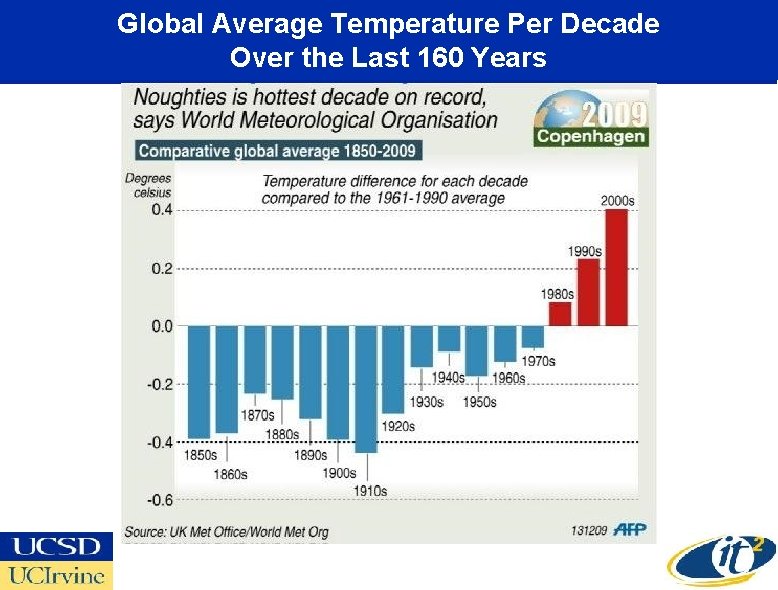
Global Average Temperature Per Decade Over the Last 160 Years
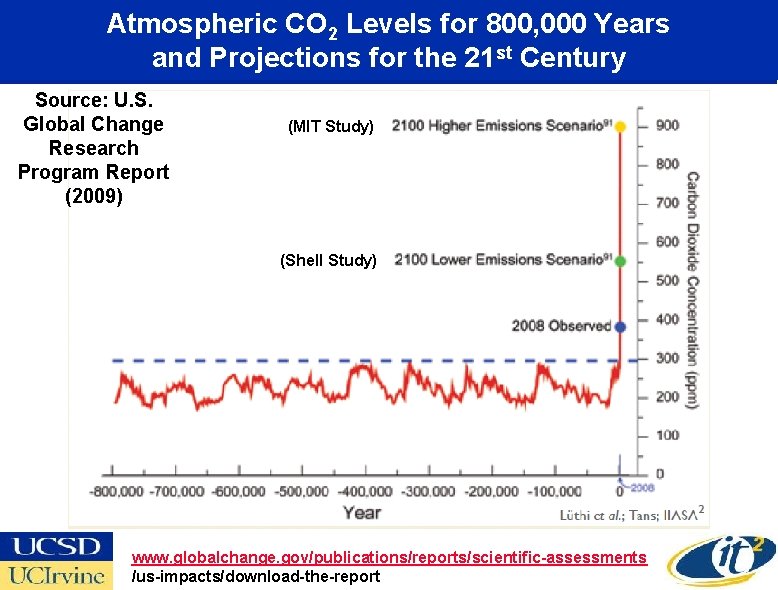
Atmospheric CO 2 Levels for 800, 000 Years and Projections for the 21 st Century Source: U. S. Global Change Research Program Report (2009) (MIT Study) (Shell Study) www. globalchange. gov/publications/reports/scientific-assessments /us-impacts/download-the-report
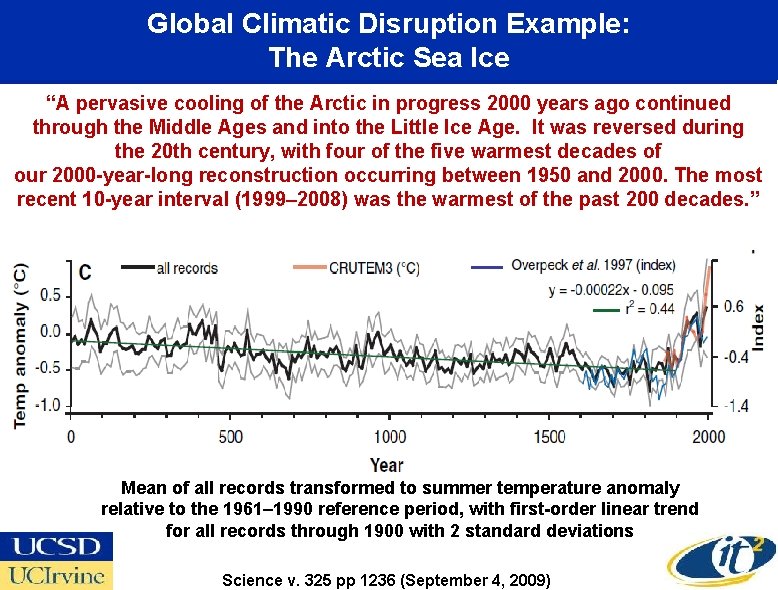
Global Climatic Disruption Example: The Arctic Sea Ice “A pervasive cooling of the Arctic in progress 2000 years ago continued through the Middle Ages and into the Little Ice Age. It was reversed during the 20 th century, with four of the five warmest decades of our 2000 -year-long reconstruction occurring between 1950 and 2000. The most recent 10 -year interval (1999– 2008) was the warmest of the past 200 decades. ” Mean of all records transformed to summer temperature anomaly relative to the 1961– 1990 reference period, with first-order linear trend for all records through 1900 with 2 standard deviations Science v. 325 pp 1236 (September 4, 2009)
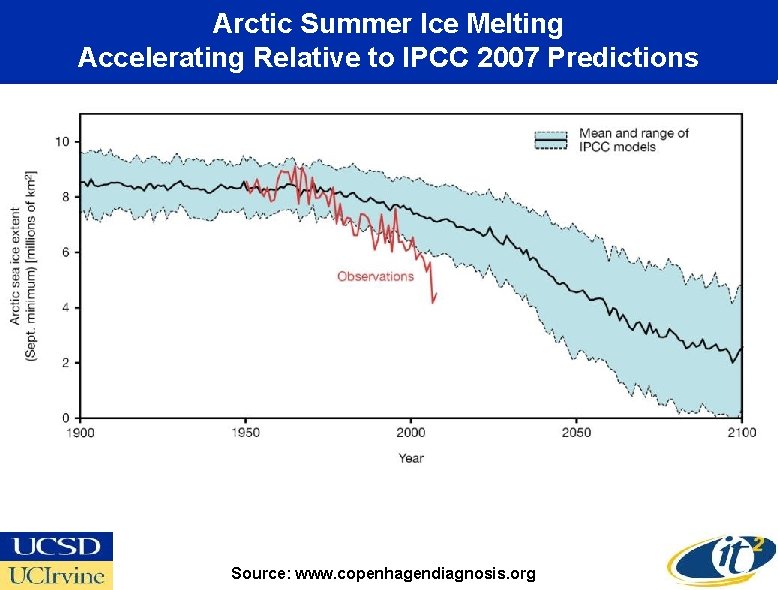
Arctic Summer Ice Melting Accelerating Relative to IPCC 2007 Predictions Source: www. copenhagendiagnosis. org
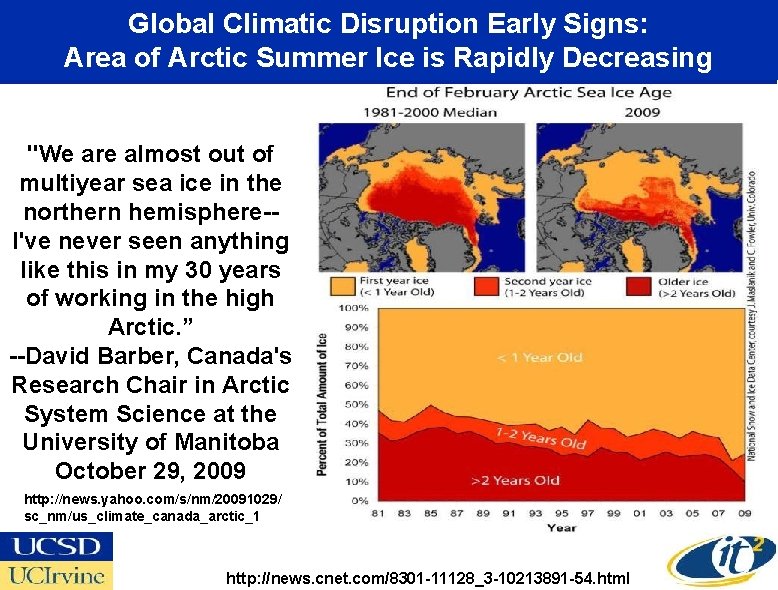
Global Climatic Disruption Early Signs: Area of Arctic Summer Ice is Rapidly Decreasing "We are almost out of multiyear sea ice in the northern hemisphere-I've never seen anything like this in my 30 years of working in the high Arctic. ” --David Barber, Canada's Research Chair in Arctic System Science at the University of Manitoba October 29, 2009 http: //news. yahoo. com/s/nm/20091029/ sc_nm/us_climate_canada_arctic_1 http: //news. cnet. com/8301 -11128_3 -10213891 -54. html
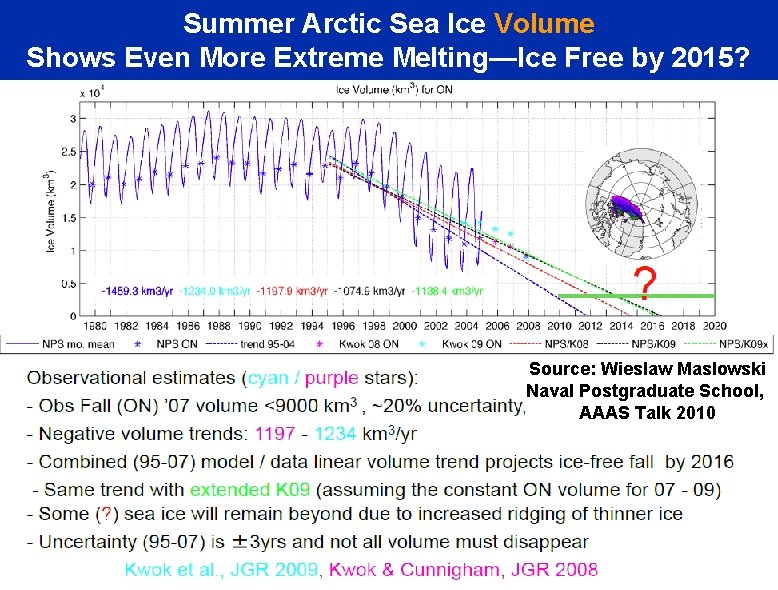
Summer Arctic Sea Ice Volume Shows Even More Extreme Melting—Ice Free by 2015? Source: Wieslaw Maslowski Naval Postgraduate School, AAAS Talk 2010
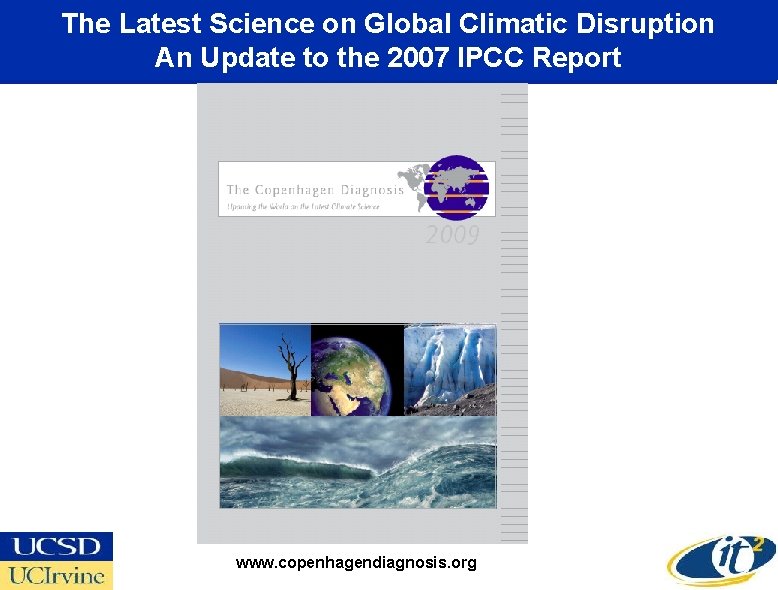
The Latest Science on Global Climatic Disruption An Update to the 2007 IPCC Report www. copenhagendiagnosis. org
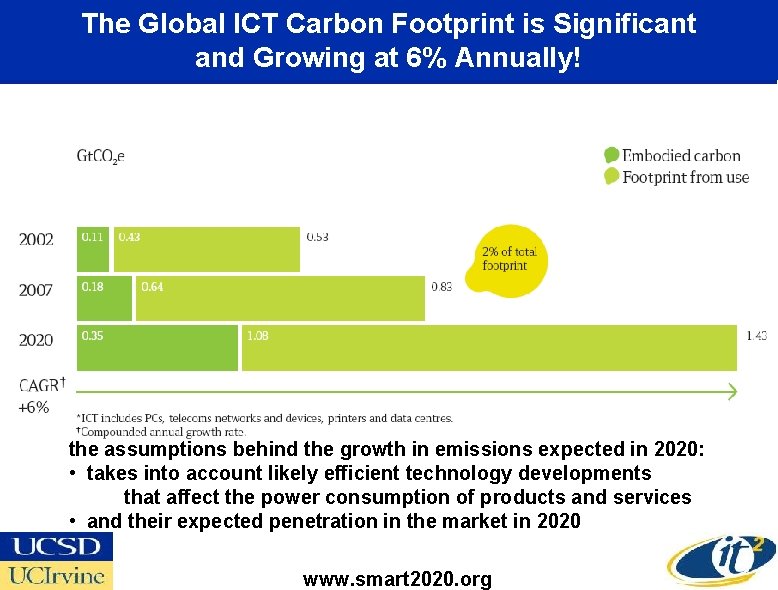
The Global ICT Carbon Footprint is Significant and Growing at 6% Annually! the assumptions behind the growth in emissions expected in 2020: • takes into account likely efficient technology developments that affect the power consumption of products and services • and their expected penetration in the market in 2020 www. smart 2020. org
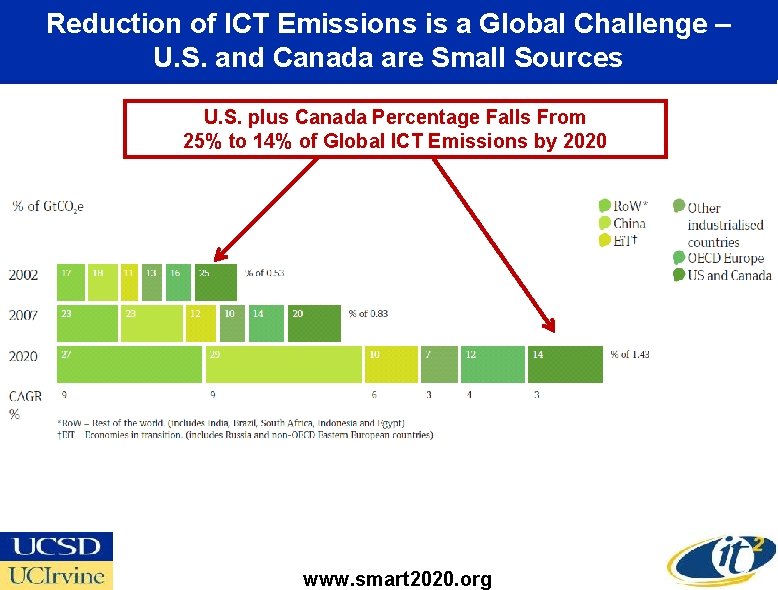
Reduction of ICT Emissions is a Global Challenge – U. S. and Canada are Small Sources U. S. plus Canada Percentage Falls From 25% to 14% of Global ICT Emissions by 2020 www. smart 2020. org
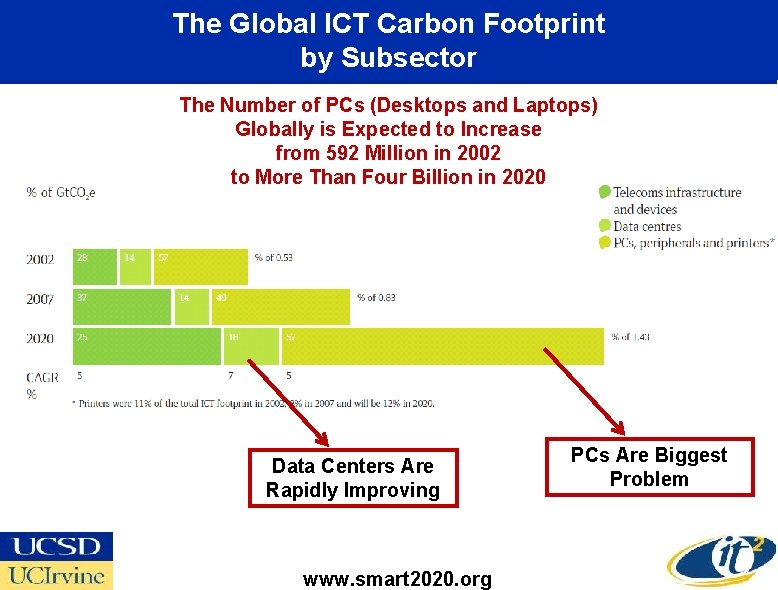
The Global ICT Carbon Footprint by Subsector The Number of PCs (Desktops and Laptops) Globally is Expected to Increase from 592 Million in 2002 to More Than Four Billion in 2020 Data Centers Are Rapidly Improving www. smart 2020. org PCs Are Biggest Problem
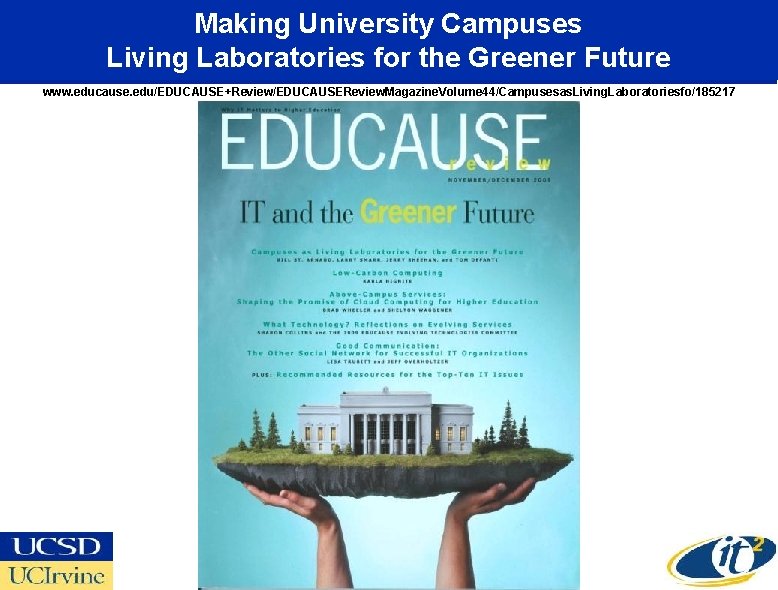
Making University Campuses Living Laboratories for the Greener Future www. educause. edu/EDUCAUSE+Review/EDUCAUSEReview. Magazine. Volume 44/Campusesas. Living. Laboratoriesfo/185217
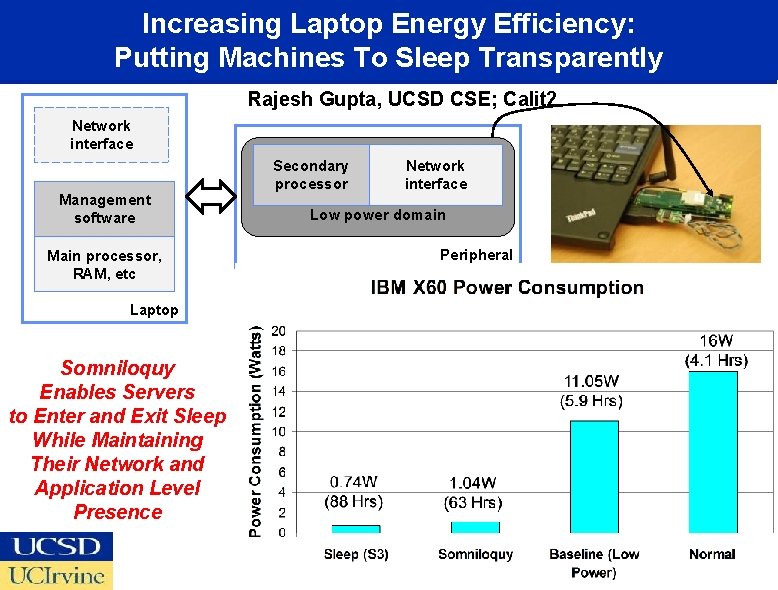
Increasing Laptop Energy Efficiency: Putting Machines To Sleep Transparently Rajesh Gupta, UCSD CSE; Calit 2 Network interface Management software Main processor, RAM, etc Secondary processor Network interface Low power domain Peripheral Laptop Somniloquy Enables Servers to Enter and Exit Sleep While Maintaining Their Network and Application Level Presence 16
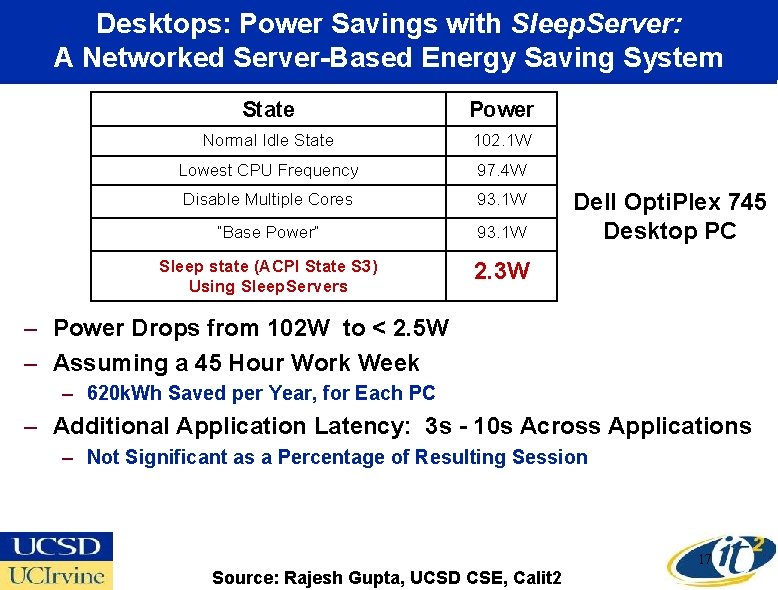
Desktops: Power Savings with Sleep. Server: A Networked Server-Based Energy Saving System State Power Normal Idle State 102. 1 W Lowest CPU Frequency 97. 4 W Disable Multiple Cores 93. 1 W “Base Power” 93. 1 W Sleep state (ACPI State S 3) Using Sleep. Servers 2. 3 W Dell Opti. Plex 745 Desktop PC – Power Drops from 102 W to < 2. 5 W – Assuming a 45 Hour Work Week – 620 k. Wh Saved per Year, for Each PC – Additional Application Latency: 3 s - 10 s Across Applications – Not Significant as a Percentage of Resulting Session 17 Source: Rajesh Gupta, UCSD CSE, Calit 2
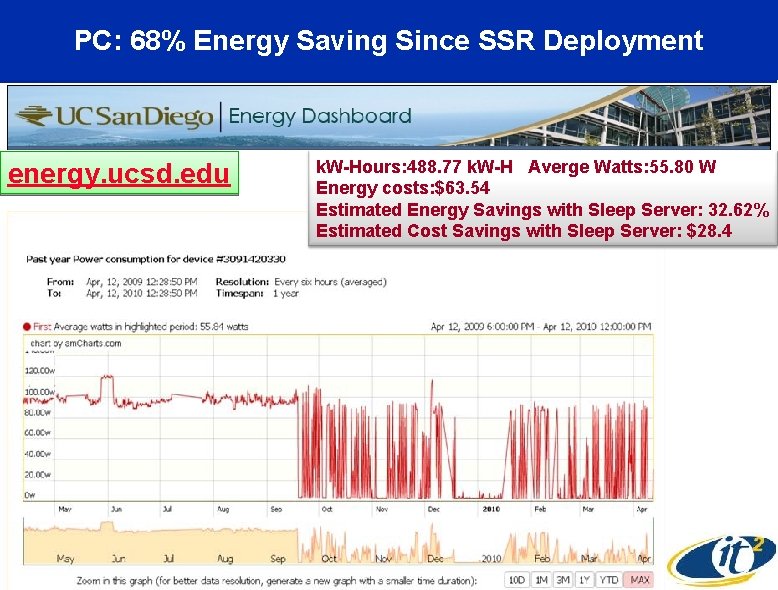
PC: 68% Energy Saving Since SSR Deployment energy. ucsd. edu k. W-Hours: 488. 77 k. W-H Averge Watts: 55. 80 W Energy costs: $63. 54 Estimated Energy Savings with Sleep Server: 32. 62% Estimated Cost Savings with Sleep Server: $28. 4
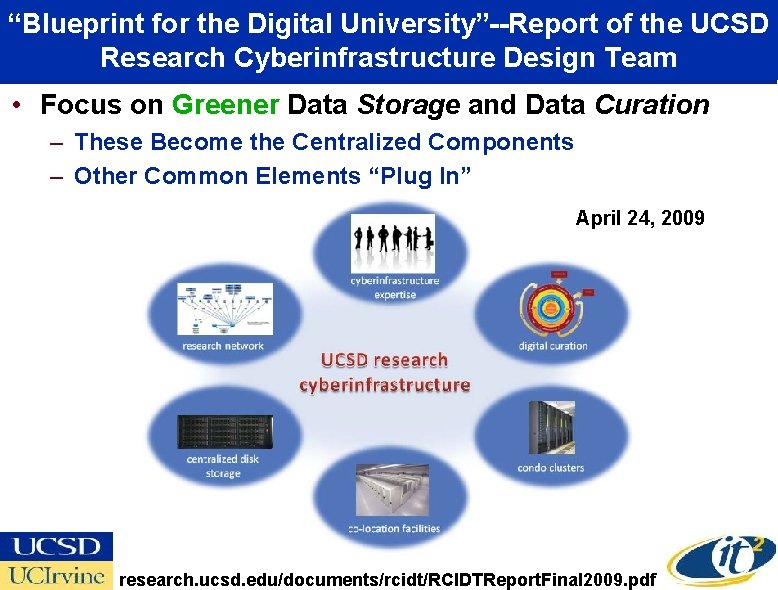
“Blueprint for the Digital University”--Report of the UCSD Research Cyberinfrastructure Design Team • Focus on Greener Data Storage and Data Curation – These Become the Centralized Components – Other Common Elements “Plug In” April 24, 2009 research. ucsd. edu/documents/rcidt/RCIDTReport. Final 2009. pdf
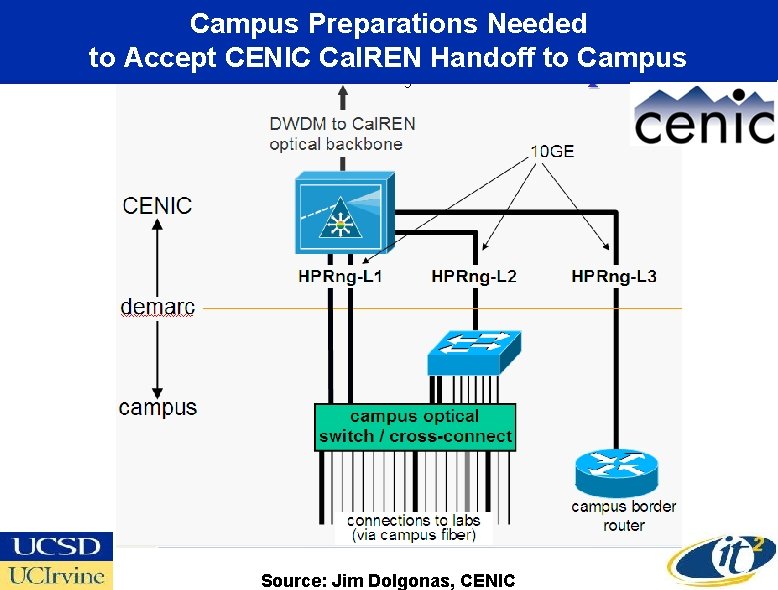
Campus Preparations Needed to Accept CENIC Cal. REN Handoff to Campus Source: Jim Dolgonas, CENIC
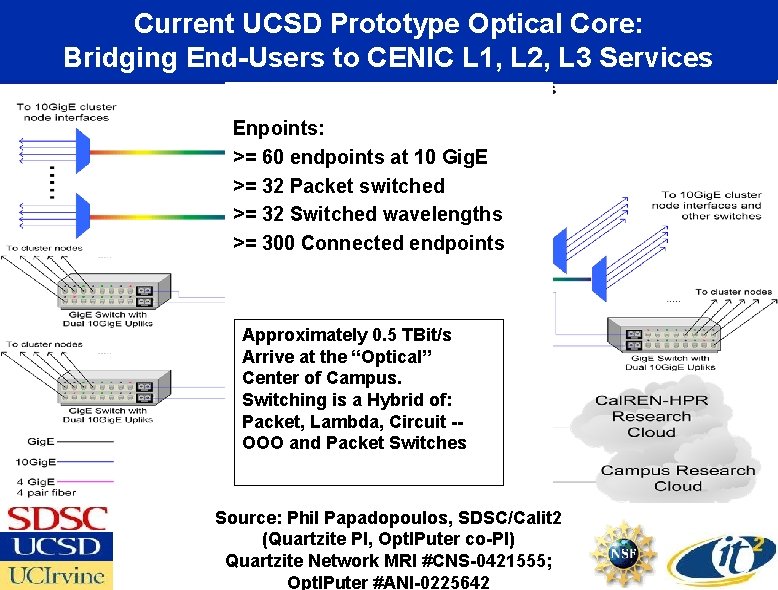
Current UCSD Prototype Optical Core: Bridging End-Users to CENIC L 1, L 2, L 3 Services Enpoints: >= 60 endpoints at 10 Gig. E >= 32 Packet switched Lucent >= 32 Switched wavelengths >= 300 Connected endpoints Glimmerglass Approximately 0. 5 TBit/s Arrive at the “Optical” Force 10 Center of Campus. Switching is a Hybrid of: Packet, Lambda, Circuit -OOO and Packet Switches Source: Phil Papadopoulos, SDSC/Calit 2 (Quartzite PI, Opt. IPuter co-PI) Quartzite Network MRI #CNS-0421555; Opt. IPuter #ANI-0225642
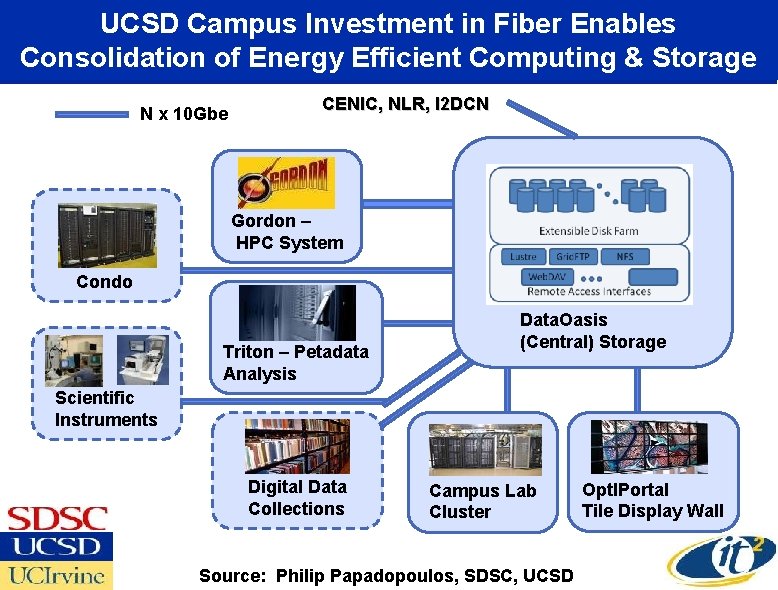
UCSD Campus Investment in Fiber Enables Consolidation of Energy Efficient Computing & Storage N x 10 Gbe Cluster Condo CENIC, NLR, I 2 DCN Gordon – HPC System Triton – Petadata Analysis Data. Oasis (Central) Storage Scientific Instruments Digital Data Collections Campus Lab Cluster Source: Philip Papadopoulos, SDSC, UCSD Opt. IPortal Tile Display Wall
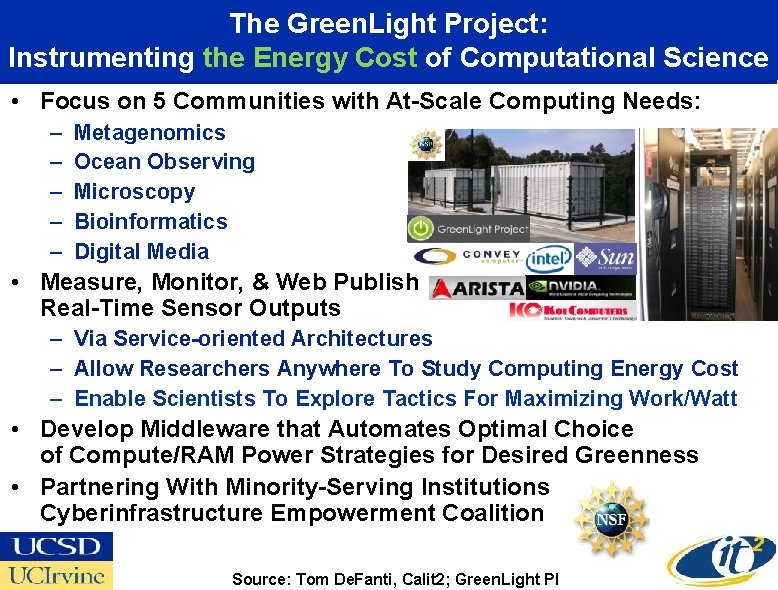
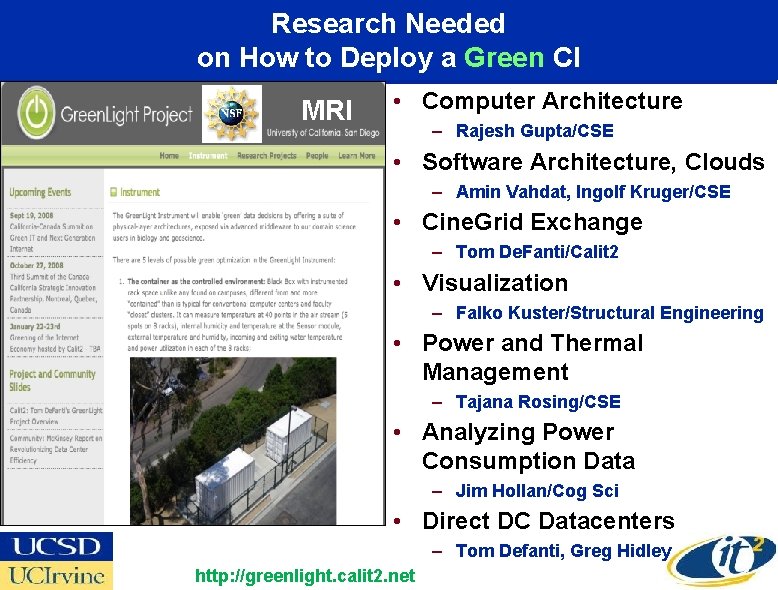
The Green. Light Project: Instrumenting the Energy Cost of Computational Science • Focus on 5 Communities with At-Scale Computing Needs: – – – Metagenomics Ocean Observing Microscopy Bioinformatics Digital Media • Measure, Monitor, & Web Publish Real-Time Sensor Outputs – Via Service-oriented Architectures – Allow Researchers Anywhere To Study Computing Energy Cost – Enable Scientists To Explore Tactics For Maximizing Work/Watt • Develop Middleware that Automates Optimal Choice of Compute/RAM Power Strategies for Desired Greenness • Partnering With Minority-Serving Institutions Cyberinfrastructure Empowerment Coalition Source: Tom De. Fanti, Calit 2; Green. Light PI
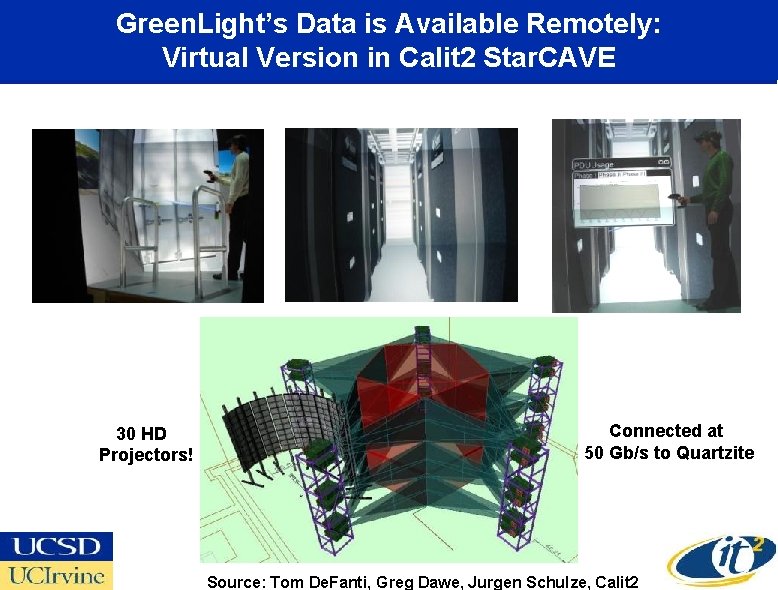
Green. Light’s Data is Available Remotely: Virtual Version in Calit 2 Star. CAVE 30 HD Projectors! Connected at 50 Gb/s to Quartzite Source: Tom De. Fanti, Greg Dawe, Jurgen Schulze, Calit 2
Research Needed on How to Deploy a Green CI MRI • Computer Architecture – Rajesh Gupta/CSE • Software Architecture, Clouds – Amin Vahdat, Ingolf Kruger/CSE • Cine. Grid Exchange – Tom De. Fanti/Calit 2 • Visualization – Falko Kuster/Structural Engineering • Power and Thermal Management – Tajana Rosing/CSE • Analyzing Power Consumption Data – Jim Hollan/Cog Sci • Direct DC Datacenters – Tom Defanti, Greg Hidley http: //greenlight. calit 2. net
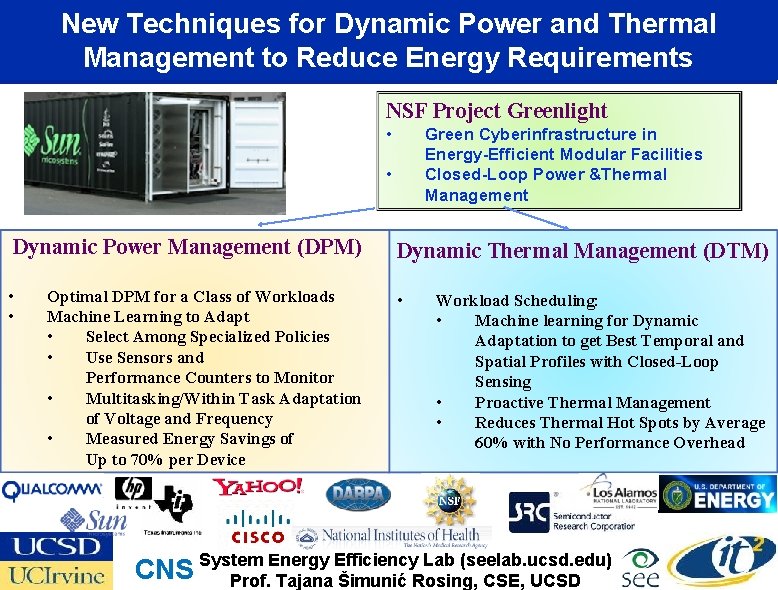
New Techniques for Dynamic Power and Thermal Management to Reduce Energy Requirements NSF Project Greenlight • Green Cyberinfrastructure in Energy-Efficient Modular Facilities Closed-Loop Power &Thermal Management • Dynamic Power Management (DPM) • • Optimal DPM for a Class of Workloads Machine Learning to Adapt • Select Among Specialized Policies • Use Sensors and Performance Counters to Monitor • Multitasking/Within Task Adaptation of Voltage and Frequency • Measured Energy Savings of Up to 70% per Device Dynamic Thermal Management (DTM) • Workload Scheduling: • Machine learning for Dynamic Adaptation to get Best Temporal and Spatial Profiles with Closed-Loop Sensing • Proactive Thermal Management • Reduces Thermal Hot Spots by Average 60% with No Performance Overhead Energy Efficiency Lab (seelab. ucsd. edu) CNS System Prof. Tajana Šimunić Rosing, CSE, UCSD
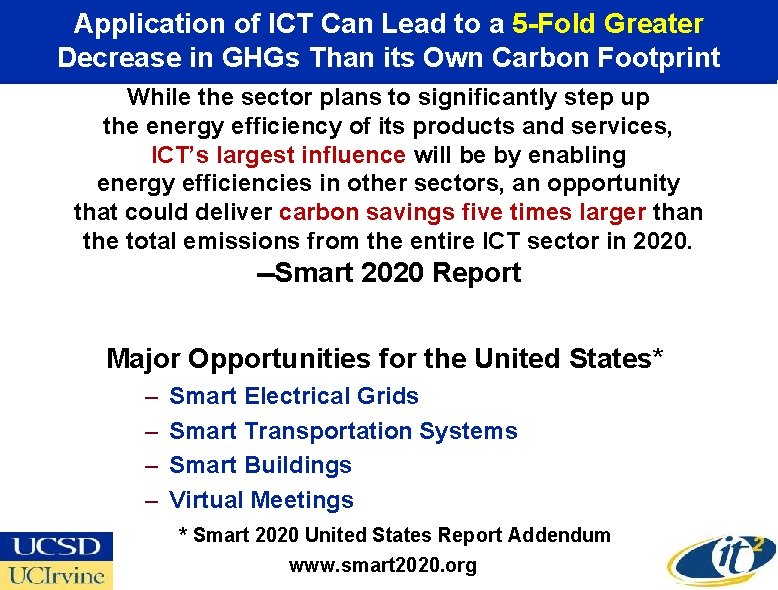
Application of ICT Can Lead to a 5 -Fold Greater Decrease in GHGs Than its Own Carbon Footprint While the sector plans to significantly step up the energy efficiency of its products and services, ICT’s largest influence will be by enabling energy efficiencies in other sectors, an opportunity that could deliver carbon savings five times larger than the total emissions from the entire ICT sector in 2020. --Smart 2020 Report Major Opportunities for the United States* – – Smart Electrical Grids Smart Transportation Systems Smart Buildings Virtual Meetings * Smart 2020 United States Report Addendum www. smart 2020. org
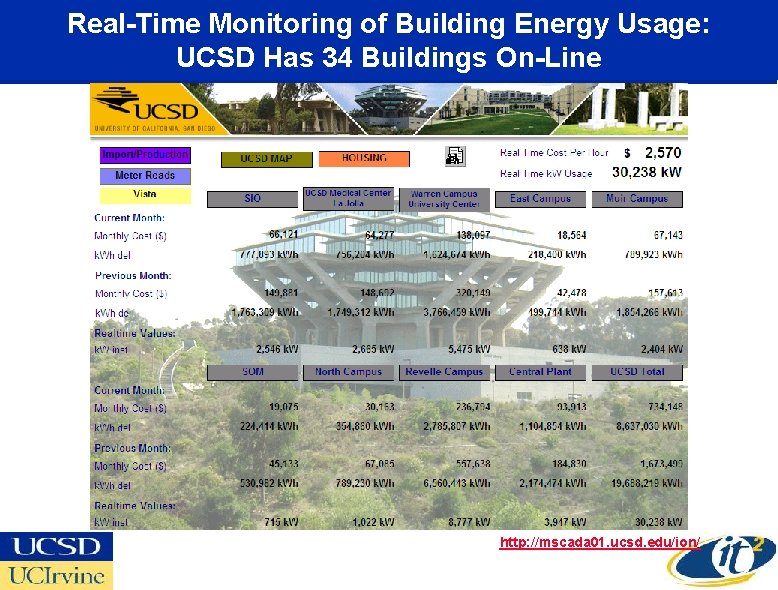
Real-Time Monitoring of Building Energy Usage: UCSD Has 34 Buildings On-Line http: //mscada 01. ucsd. edu/ion/
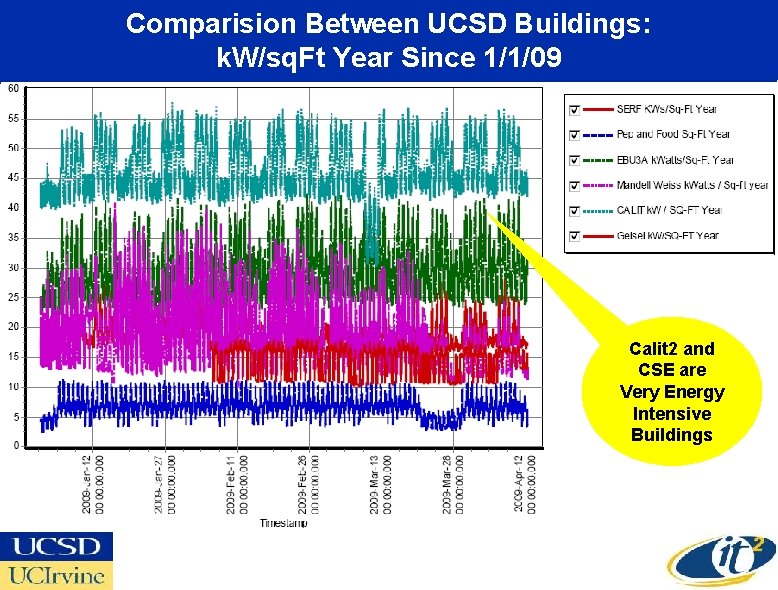
Comparision Between UCSD Buildings: k. W/sq. Ft Year Since 1/1/09 Calit 2 and CSE are Very Energy Intensive Buildings
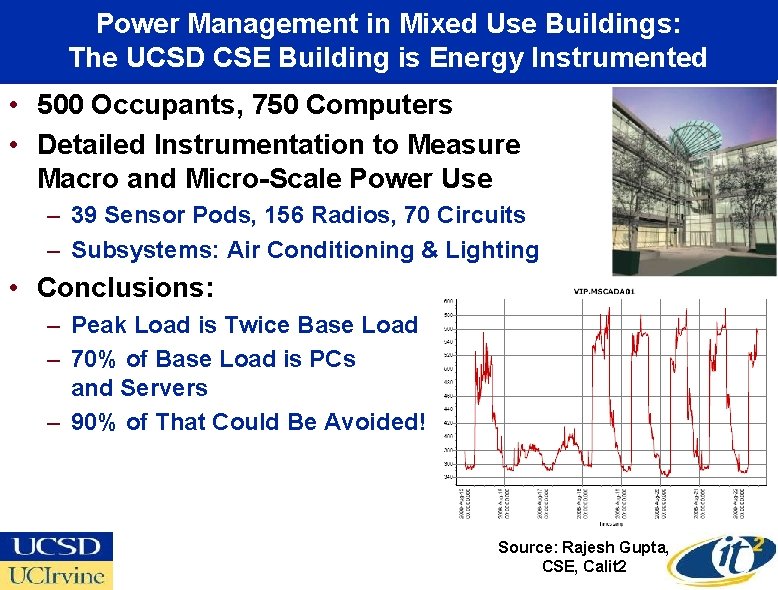
Power Management in Mixed Use Buildings: The UCSD CSE Building is Energy Instrumented • 500 Occupants, 750 Computers • Detailed Instrumentation to Measure Macro and Micro-Scale Power Use – 39 Sensor Pods, 156 Radios, 70 Circuits – Subsystems: Air Conditioning & Lighting • Conclusions: – Peak Load is Twice Base Load – 70% of Base Load is PCs and Servers – 90% of That Could Be Avoided! Source: Rajesh Gupta, CSE, Calit 2
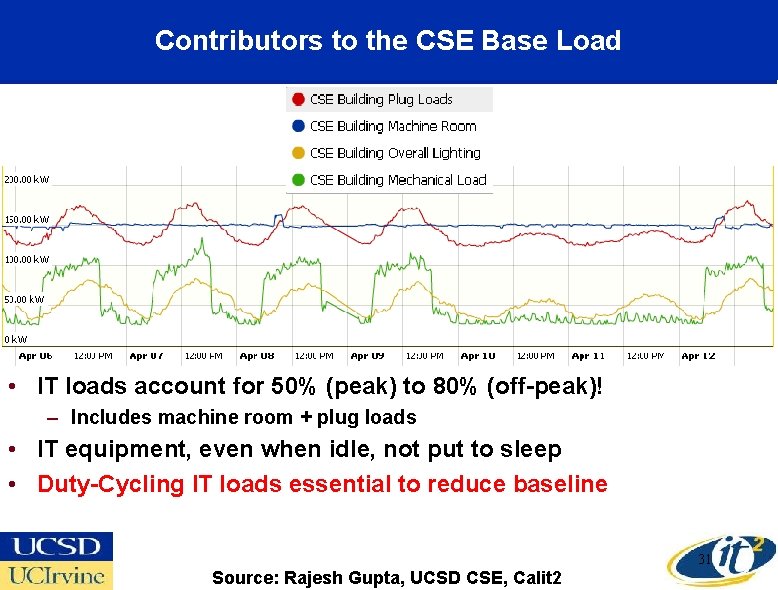
Contributors to the CSE Base Load • IT loads account for 50% (peak) to 80% (off-peak)! – Includes machine room + plug loads • IT equipment, even when idle, not put to sleep • Duty-Cycling IT loads essential to reduce baseline 31 Source: Rajesh Gupta, UCSD CSE, Calit 2
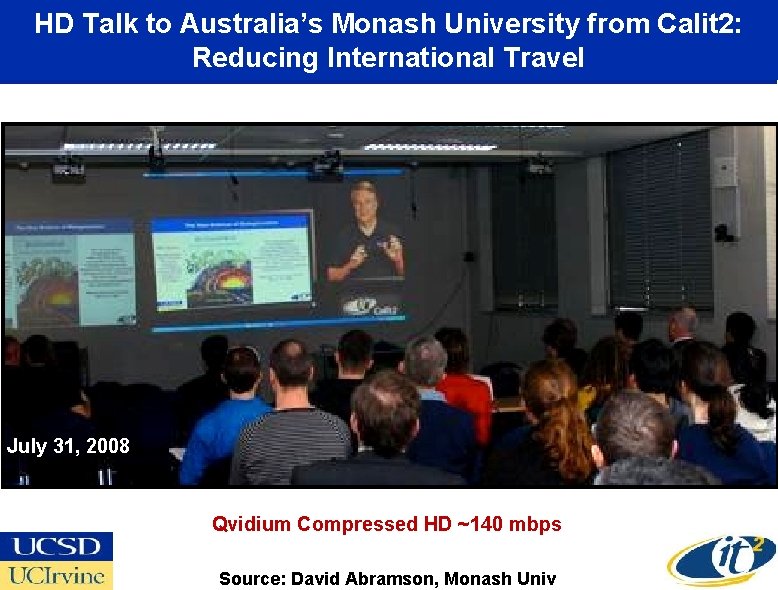
HD Talk to Australia’s Monash University from Calit 2: Reducing International Travel July 31, 2008 Qvidium Compressed HD ~140 mbps Source: David Abramson, Monash Univ
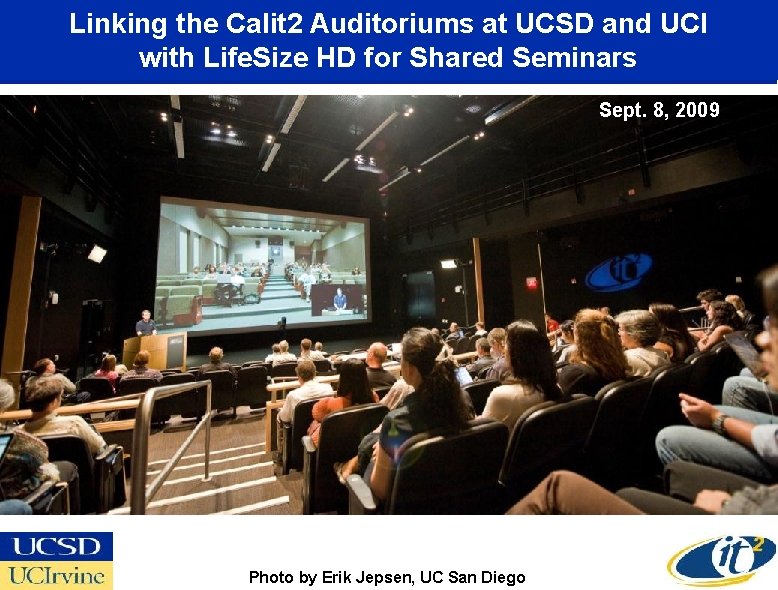
Linking the Calit 2 Auditoriums at UCSD and UCI with Life. Size HD for Shared Seminars September 8, 2009 Sept. 8, 2009 Photo by Erik Jepsen, UC San Diego
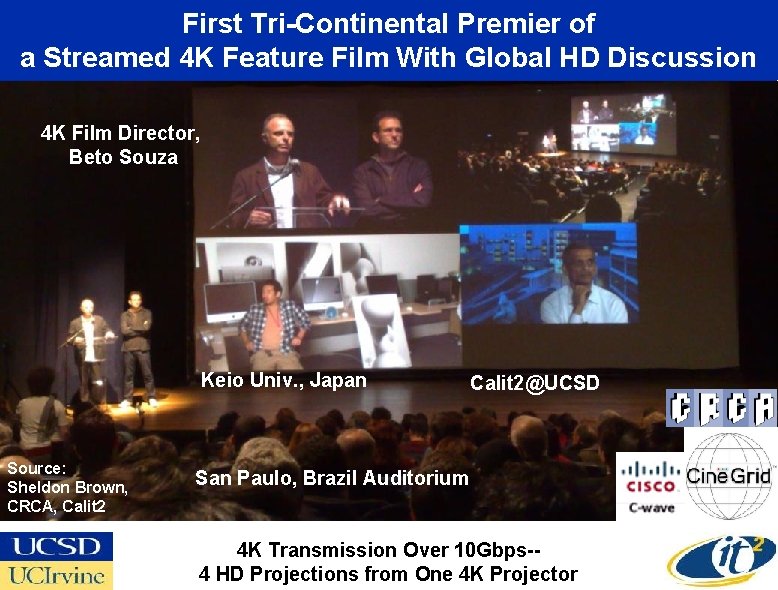
First Tri-Continental Premier of a Streamed 4 K Feature Film With Global HD Discussion 4 K Film Director, Beto Souza Keio Univ. , Japan Source: Sheldon Brown, CRCA, Calit 2@UCSD San Paulo, Brazil Auditorium 4 K Transmission Over 10 Gbps-4 HD Projections from One 4 K Projector
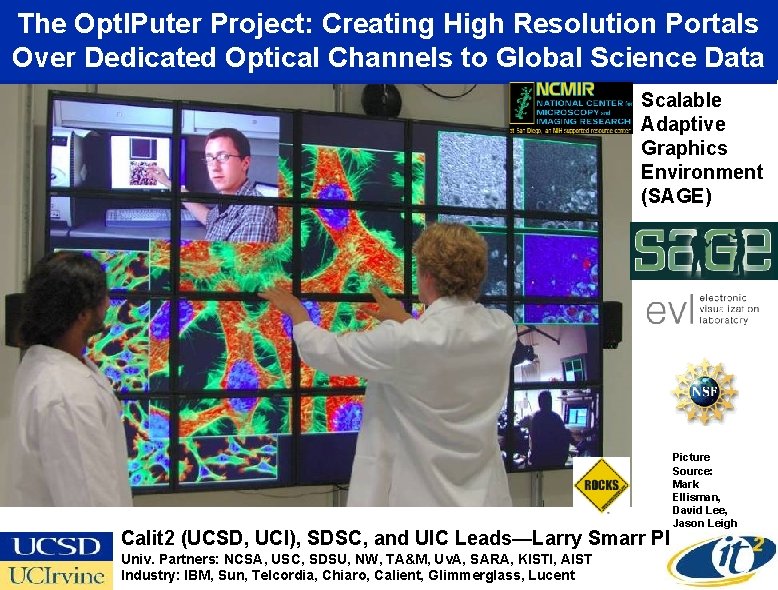
The Opt. IPuter Project: Creating High Resolution Portals Over Dedicated Optical Channels to Global Science Data Scalable Adaptive Graphics Environment (SAGE) Calit 2 (UCSD, UCI), SDSC, and UIC Leads—Larry Smarr PI Univ. Partners: NCSA, USC, SDSU, NW, TA&M, Uv. A, SARA, KISTI, AIST Industry: IBM, Sun, Telcordia, Chiaro, Calient, Glimmerglass, Lucent Picture Source: Mark Ellisman, David Lee, Jason Leigh
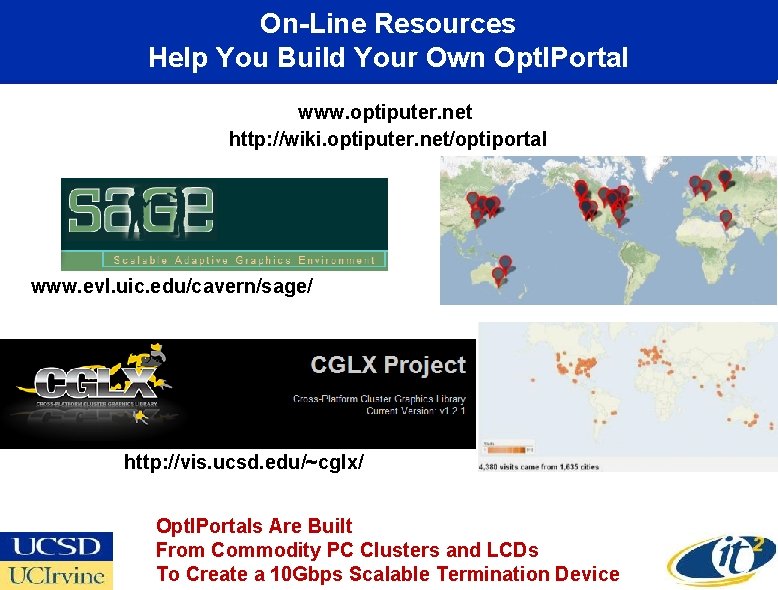
On-Line Resources Help You Build Your Own Opt. IPortal www. optiputer. net http: //wiki. optiputer. net/optiportal www. evl. uic. edu/cavern/sage/ http: //vis. ucsd. edu/~cglx/ Opt. IPortals Are Built From Commodity PC Clusters and LCDs To Create a 10 Gbps Scalable Termination Device
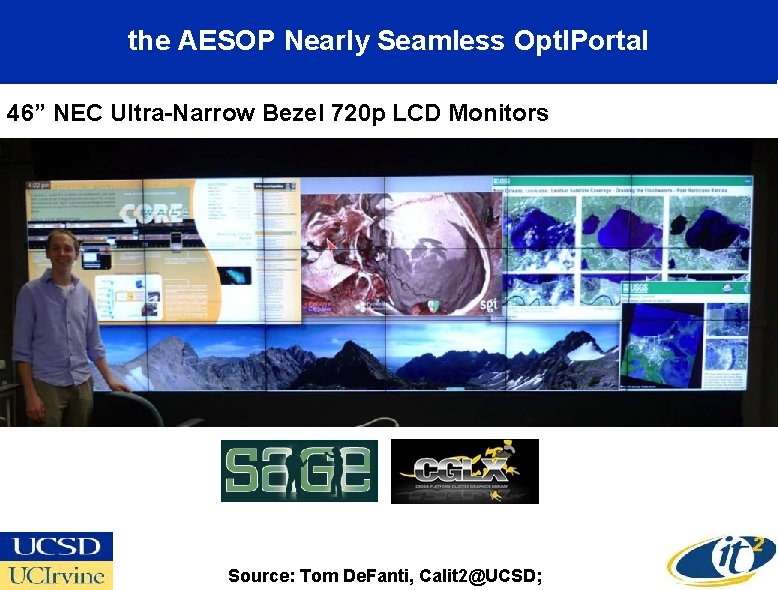
the AESOP Nearly Seamless Opt. IPortal 46” NEC Ultra-Narrow Bezel 720 p LCD Monitors Source: Tom De. Fanti, Calit 2@UCSD;
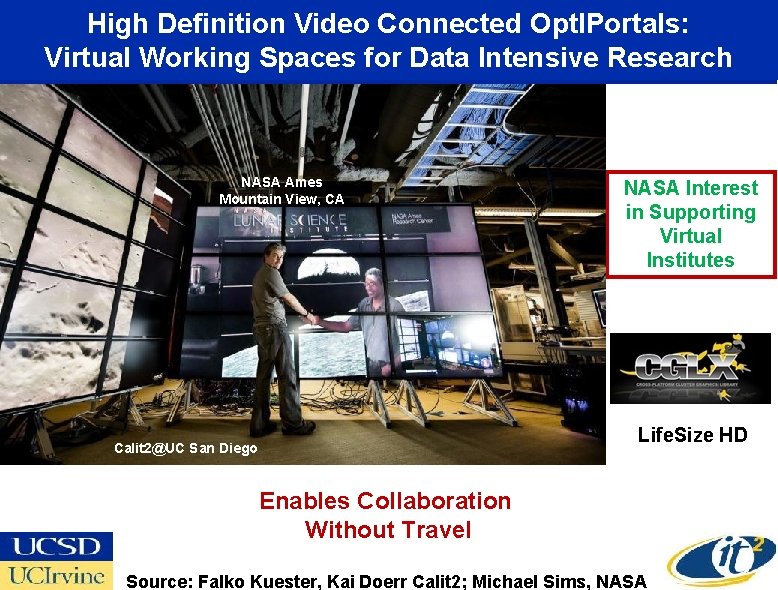
High Definition Video Connected Opt. IPortals: Virtual Working Spaces for Data Intensive Research NASA Ames Mountain View, CA NASA Interest in Supporting Virtual Institutes Life. Size HD Calit 2@UC San Diego Enables Collaboration Without Travel Source: Falko Kuester, Kai Doerr Calit 2; Michael Sims, NASA
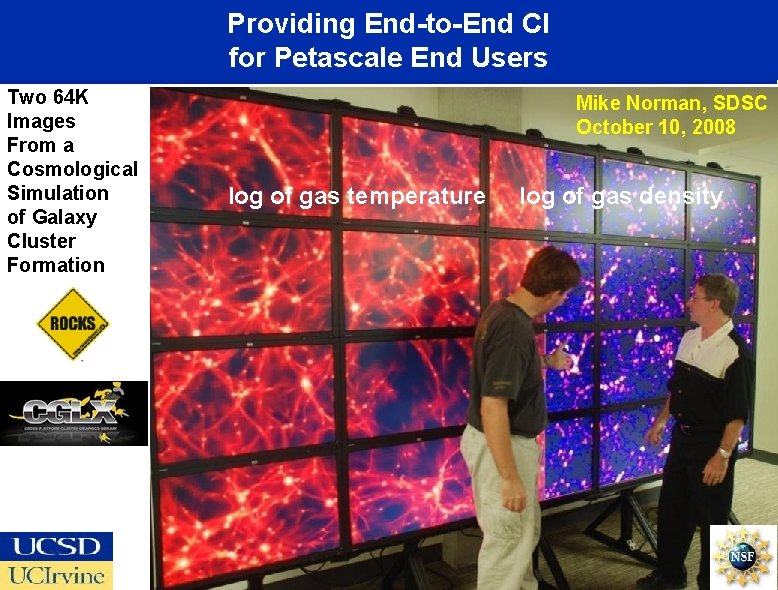
Providing End-to-End CI for Petascale End Users Two 64 K Images From a Cosmological Simulation of Galaxy Cluster Formation Mike Norman, SDSC October 10, 2008 log of gas temperature log of gas density
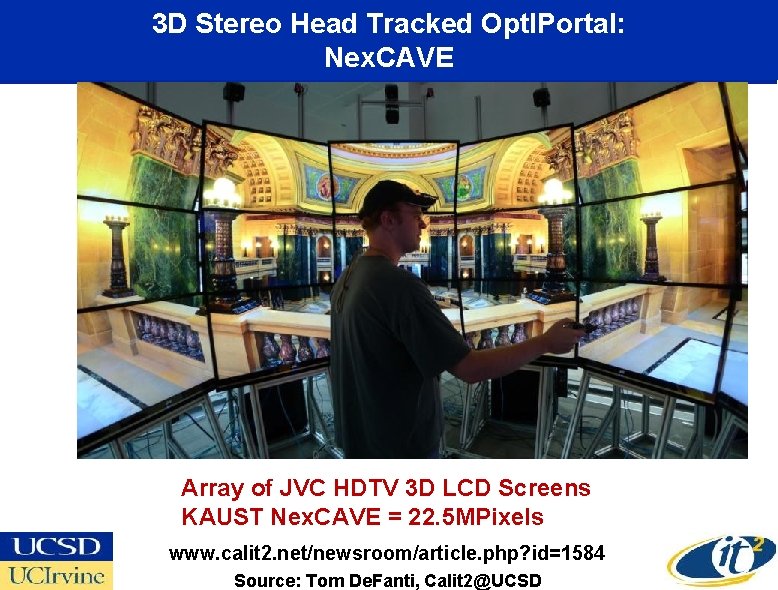
3 D Stereo Head Tracked Opt. IPortal: Nex. CAVE Array of JVC HDTV 3 D LCD Screens KAUST Nex. CAVE = 22. 5 MPixels www. calit 2. net/newsroom/article. php? id=1584 Source: Tom De. Fanti, Calit 2@UCSD
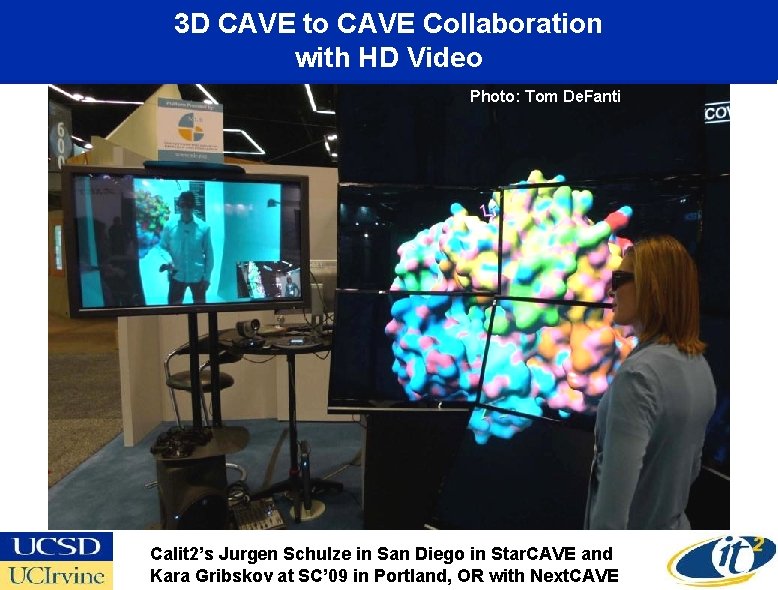
3 D CAVE to CAVE Collaboration with HD Video Photo: Tom De. Fanti Calit 2’s Jurgen Schulze in San Diego in Star. CAVE and Kara Gribskov at SC’ 09 in Portland, OR with Next. CAVE
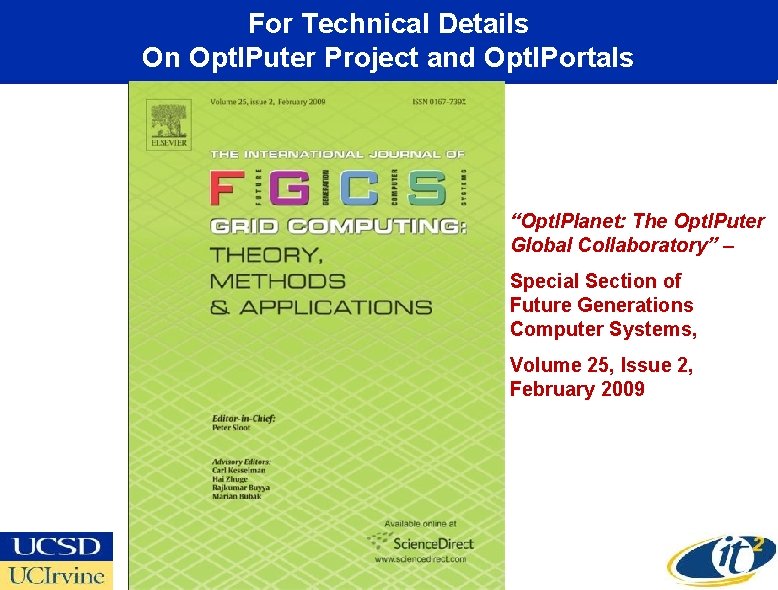
For Technical Details On Opt. IPuter Project and Opt. IPortals “Opt. IPlanet: The Opt. IPuter Global Collaboratory” – Special Section of Future Generations Computer Systems, Volume 25, Issue 2, February 2009
Follow My Talks and Tweets at lsmarr. calit 2. net