
The GRIPE Model For Precepting Chronic Disease Ambulatory
The GRIPE Model For Precepting Chronic Disease Ambulatory Visits Dean A. Seehusen MD, MPH Aaron Saguil MD, MPH 30 April, 2009
Precepting Ambulatory Encounters High volume n Short time allowed for teaching n Variety of learners n Variety of patients n Variety of medical problems n Multiple additional duties at the same time n
Chronic Disease Ambulatory Visits n May be viewed as easier visits Diagnosis known n Already being treated n Little urgency n Viewed as “bread and butter” n These patients often come with additional issues which distract from chronic issue n
Key Ingredients of Good Precepting Diagnose the learner n Diagnose the patient n Treat the patient n Provide feedback n

Key Ingredients of Good Precepting Diagnose the learner n Diagnose the patient n Treat the patient n Provide feedback n n Do it all FAST
Using Teaching Models Improves efficiency n Reduces anxiety n Increases the likelihood that good precepting principles are followed n Irby and Wilkerson (BMJ 2008) suggest having multiple models available and choosing the best one for a particular situation n
Existing Models The One Minute Preceptor (OMP) n The Aunt Minnie model n The SNAPPS model n Activated demonstrations n
The One Minute Preceptor (OMP) Get a commitment n Probe for underlying reasoning n Teach general principles n Provide positive feedback n Correct mistakes n
OMP Evidence Consistently found to improve learner and educator satisfaction with precepting n Increases the amount of feedback given n Improved ability to correctly diagnose the patient n Teaching points tend to be more disease specific when OMP used n
The Aunt Minnie model “If the woman on the other side of the street dresses and walks like Aunt Minnie, it probably is Aunt Minnie. ” n The learner presents the chief complaints and presumptive diagnosis n The preceptor sees the patient while the learner writes their note n Discussion occurs afterwards n
The SNAPPS model Summarize the H&P n Narrow down the differential diagnosis n Analyze the differential n Probe the preceptor about difficulties n Plan patient management n Select an issue for self-directed learning n n Learner-driven
SNAPPS Evidence Limited n Generally liked by learners and preceptors n Enhanced ability to express diagnostic reasoning n
Activated demonstrations The learner presents the case n The preceptor sees the patient while the learner watches n The preceptor “activates” the learner to watch a particular aspect of the encounter n Discussion afterwards n
Others Models or Methods? n Please share your practices
The Need for a New Model Existing models work best for the undifferentiated acute visit n Existing models do not cover essential aspects of chronic disease care n Clinical guidelines n Pain management n Preventive measures n Patient education needs n End-of-life or palliative care n
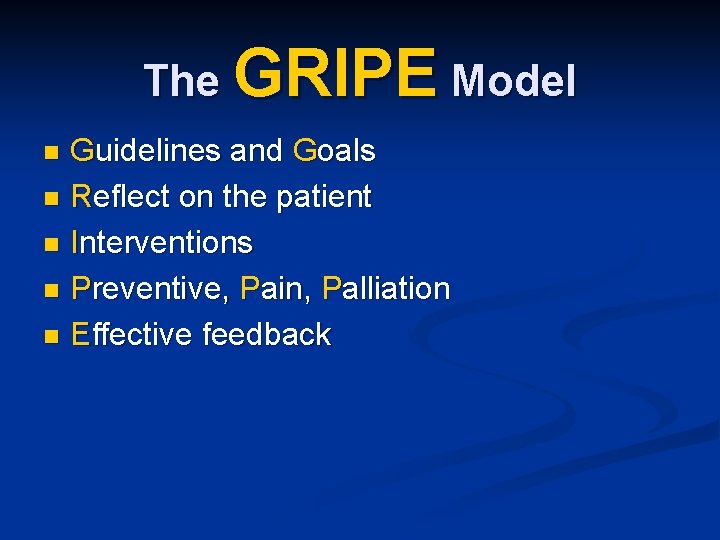
The GRIPE Model Guidelines and Goals n Reflect on the patient n Interventions n Preventive, Pain, Palliation n Effective feedback n
Guidelines and Goals A learning needs assessment Diagnosing the learner n Does the learner know any guidelines? n Does the learner know a staging system? n Does the learner have individualized goals for this patient? n
Reflect on the patient Steps RIP allow the preceptor to evaluate the learner’s patient care skills Correct diagnosis? n Disease well controlled? n Supporting data? n Psychosocial factors at play? n Patient partnered and compliant? n
Interventions Uncovers the learner’s thought process and knowledge of management options Therapeutic changes needed? n Lifestyle recommendations? n Ancillary services required? n Team approach utilized? n Patient education needed? n
Preventive, Pain, Palliation Can the learner address other important aspects of the patient’s care? Preventive services or screening tests indicated? n Pain addressed? n Palliative care indicated? n End-of-life issues addressed? n
Effective feedback This step allows for constructive feedback and a few key teaching points Praise positive features n Provide brief, specific, corrective feedback n Give teaching pearls n
ACGME Competencies Patient care n Medical knowledge n Practice-based learning and improvement n Interpersonal and communication skills n Professionalism n System-based practice n
ACGME Competencies Patient care n Medical knowledge n Practice-based learning and improvement n Interpersonal and communication skills n Professionalism n System-based practice n
ACGME Competencies Patient care n Medical knowledge n Practice-based learning and improvement n Interpersonal and communication skills n Professionalism n System-based practice n
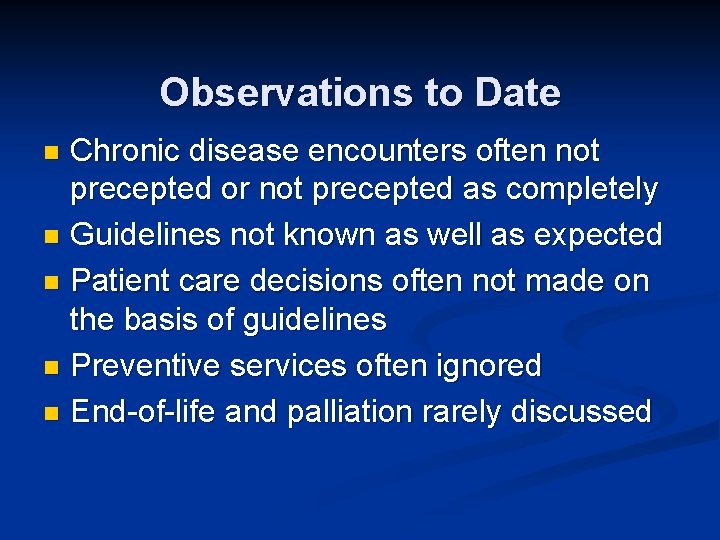
Observations to Date Chronic disease encounters often not precepted or not precepted as completely n Guidelines not known as well as expected n Patient care decisions often not made on the basis of guidelines n Preventive services often ignored n End-of-life and palliation rarely discussed n
Pilot Study Design Three Army residency programs n 25 encounters per program for baseline n Anonymous survey of resident after precepting a chronic disease visit n Educational program for faculty n 25 encounters per program after education n
Outcomes of interest Overall quality n Frequency of discussion of guidelines n Frequency of discussion of disease goals n Frequency of discussion of preventive care n Frequency of discussion of pain control n Extent of discussion of management options n Quantity of feedback n Quantity of teaching points n
Demonstration n We need a volunteer to act as a preceptor n Discussion afterwards

Questions?
- Slides: 29