
THE GREEN REVOLUTION Defining the Green Revolution Walt


- Slides: 105
THE GREEN REVOLUTION Defining the Green Revolution Walt Parks UGA Crop & Soil Science http: //wparks. myweb. uga. edu/ppt/green/index. htm
The Green Revolution: Criticisms Sources: http: //www. lastfirst. net/images/product/R 004548. jpg
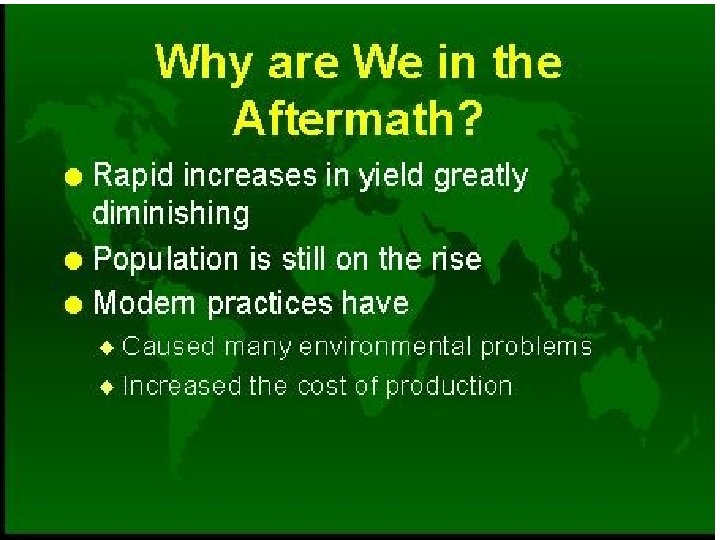
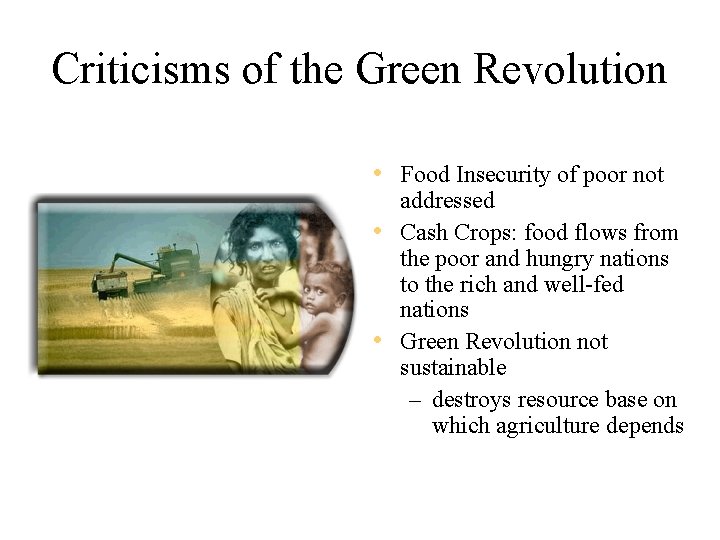
Criticisms of the Green Revolution • Food Insecurity of poor not addressed • Cash Crops: food flows from the poor and hungry nations to the rich and well-fed nations • Green Revolution not sustainable – destroys resource base on which agriculture depends
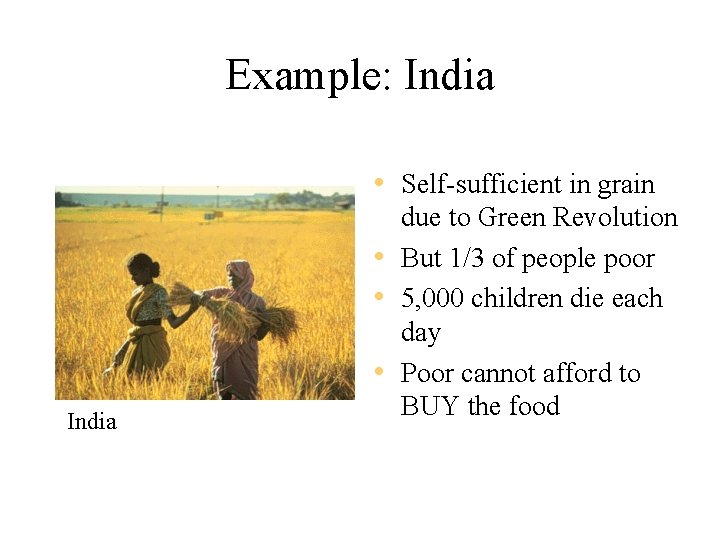
Example: India • Self-sufficient in grain India due to Green Revolution • But 1/3 of people poor • 5, 000 children die each day • Poor cannot afford to BUY the food
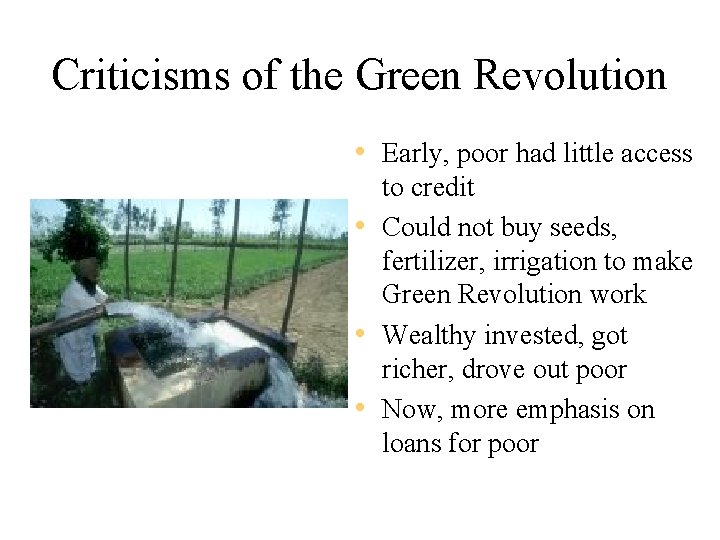
Criticisms of the Green Revolution • Early, poor had little access to credit • Could not buy seeds, fertilizer, irrigation to make Green Revolution work • Wealthy invested, got richer, drove out poor • Now, more emphasis on loans for poor
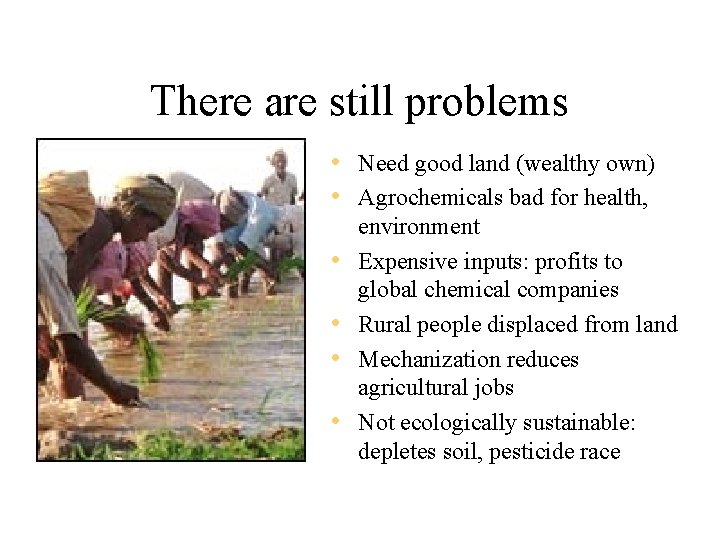
There are still problems • Need good land (wealthy own) • Agrochemicals bad for health, • • environment Expensive inputs: profits to global chemical companies Rural people displaced from land Mechanization reduces agricultural jobs Not ecologically sustainable: depletes soil, pesticide race
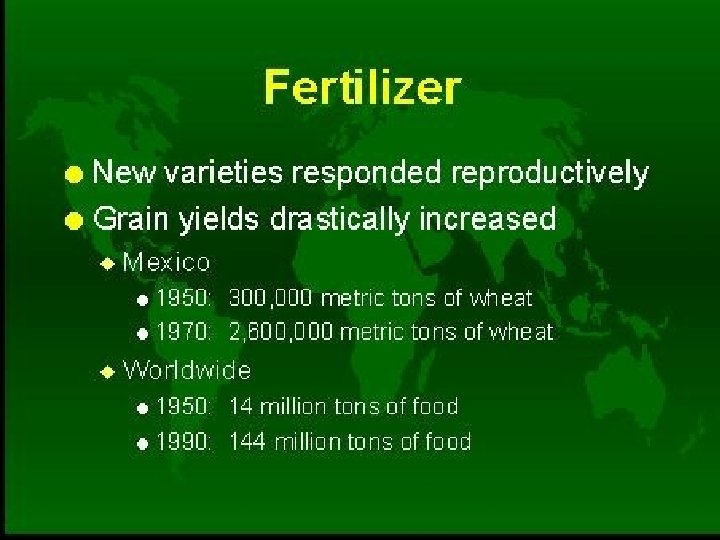
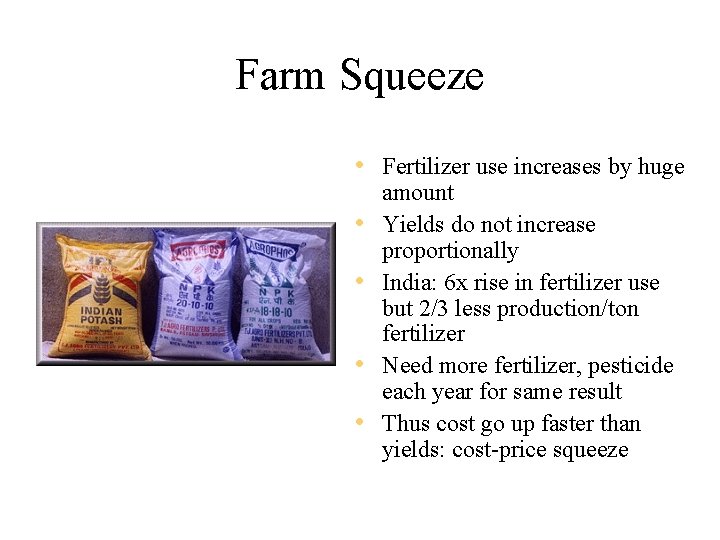
Farm Squeeze • Fertilizer use increases by huge • • amount Yields do not increase proportionally India: 6 x rise in fertilizer use but 2/3 less production/ton fertilizer Need more fertilizer, pesticide each year for same result Thus cost go up faster than yields: cost-price squeeze
Farm Squeeze • U. S. true home of Green Revolution • Yields up 3 x – but prices down • To survive, must expand acreage – to make up for lower per acre profit.
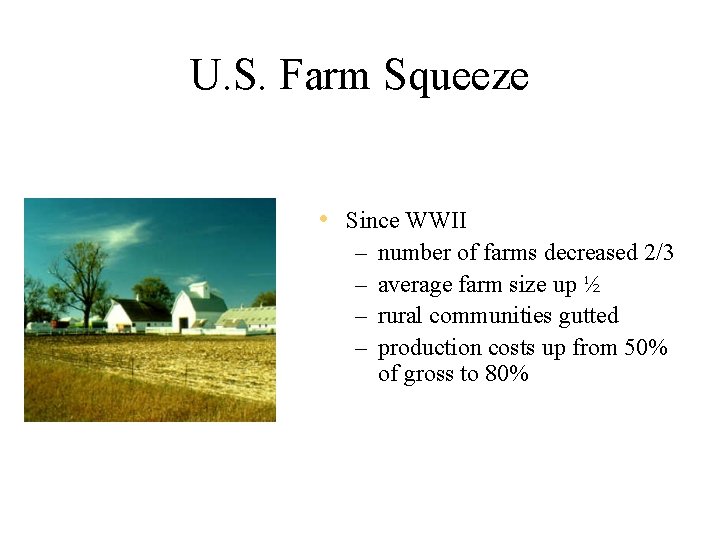
U. S. Farm Squeeze • Since WWII – – number of farms decreased 2/3 average farm size up ½ rural communities gutted production costs up from 50% of gross to 80%
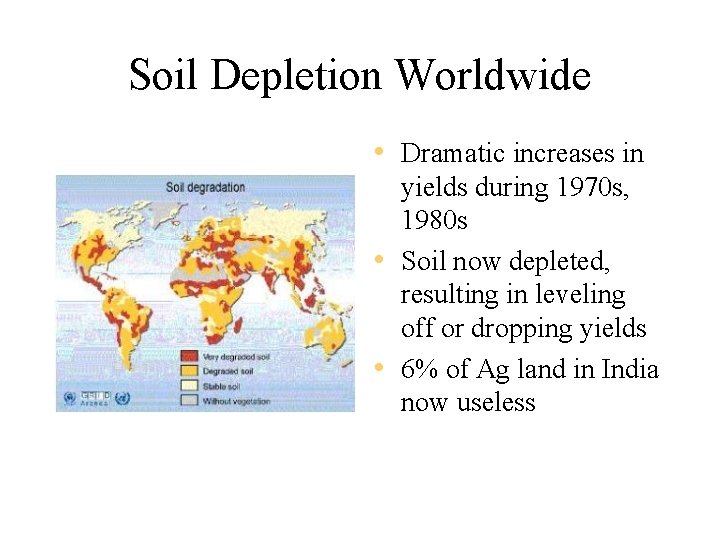
Soil Depletion Worldwide • Dramatic increases in yields during 1970 s, 1980 s • Soil now depleted, resulting in leveling off or dropping yields • 6% of Ag land in India now useless
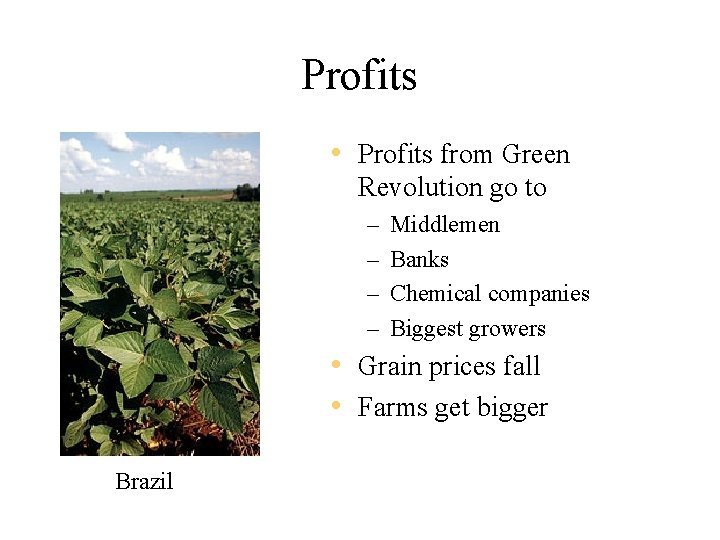
Profits • Profits from Green Revolution go to – – Middlemen Banks Chemical companies Biggest growers • Grain prices fall • Farms get bigger Brazil
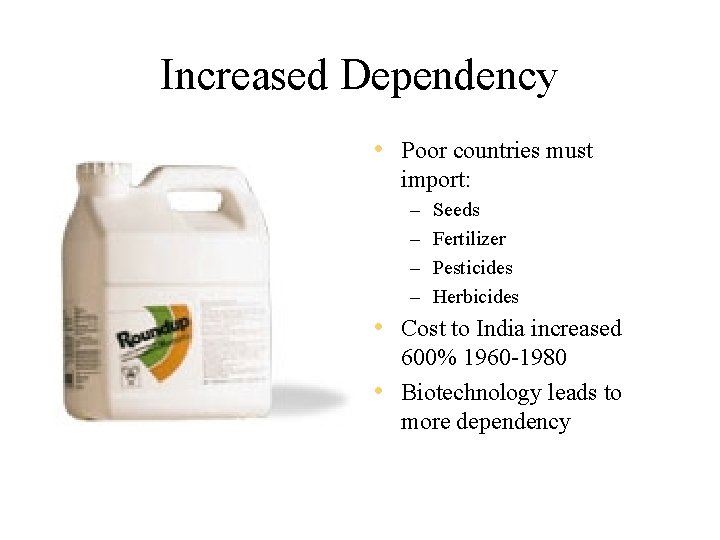
Increased Dependency • Poor countries must import: – – Seeds Fertilizer Pesticides Herbicides • Cost to India increased 600% 1960 -1980 • Biotechnology leads to more dependency
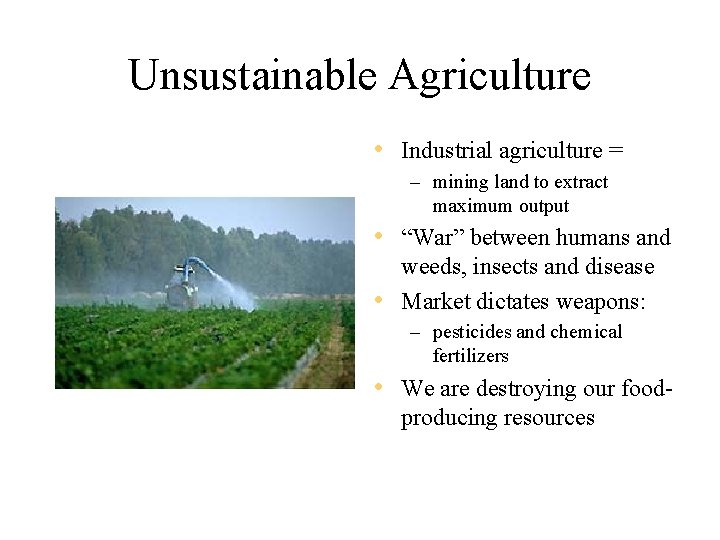
Unsustainable Agriculture • Industrial agriculture = – mining land to extract maximum output • “War” between humans and weeds, insects and disease • Market dictates weapons: – pesticides and chemical fertilizers • We are destroying our foodproducing resources
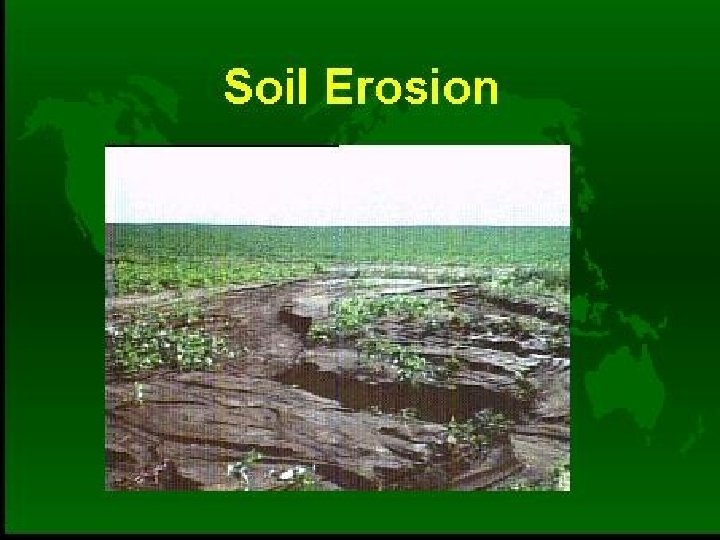
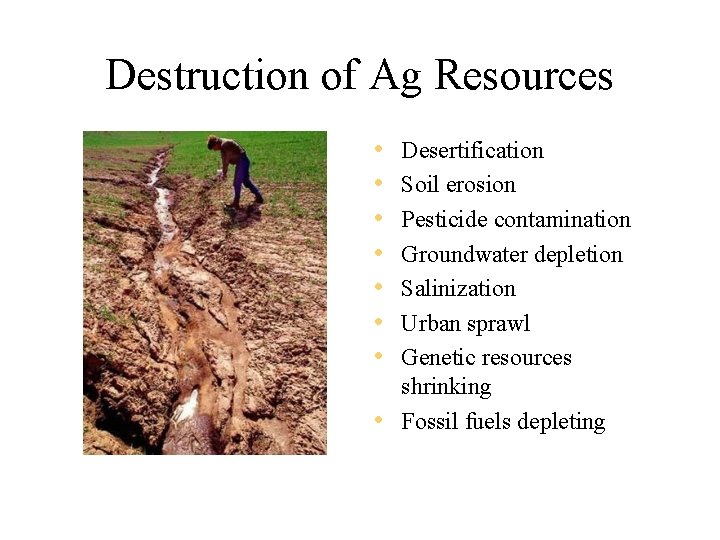
Destruction of Ag Resources • • Desertification Soil erosion Pesticide contamination Groundwater depletion Salinization Urban sprawl Genetic resources shrinking • Fossil fuels depleting
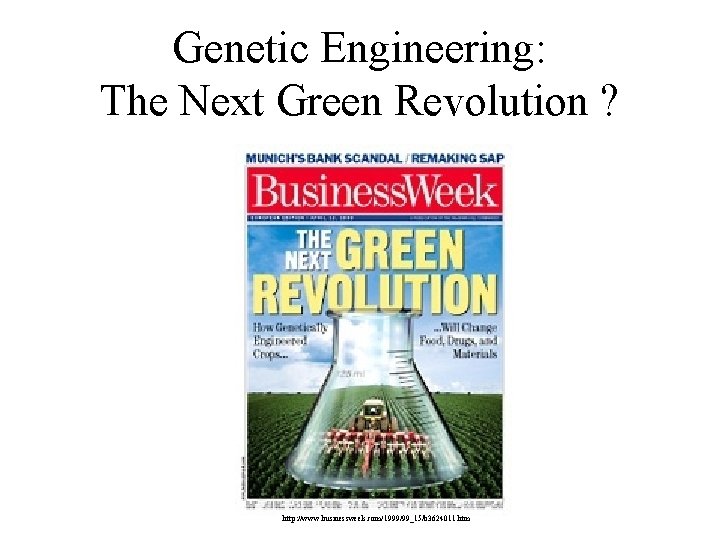
Genetic Engineering: The Next Green Revolution ? http: //www. businessweek. com/1999/99_15/b 3624011. htm
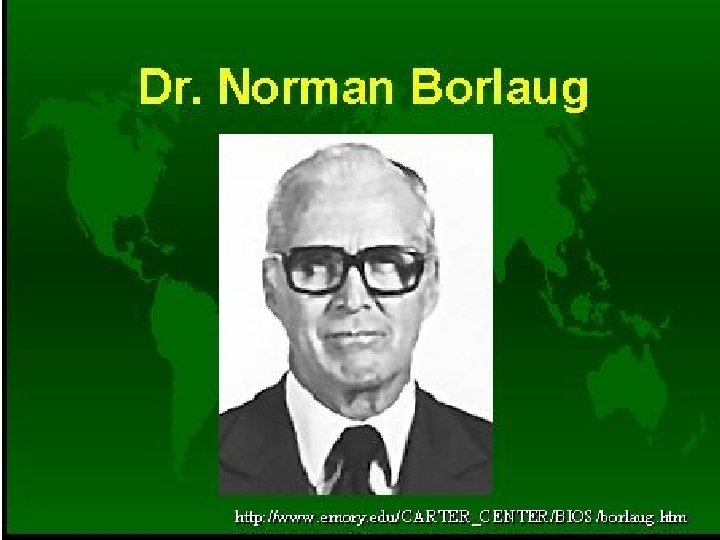
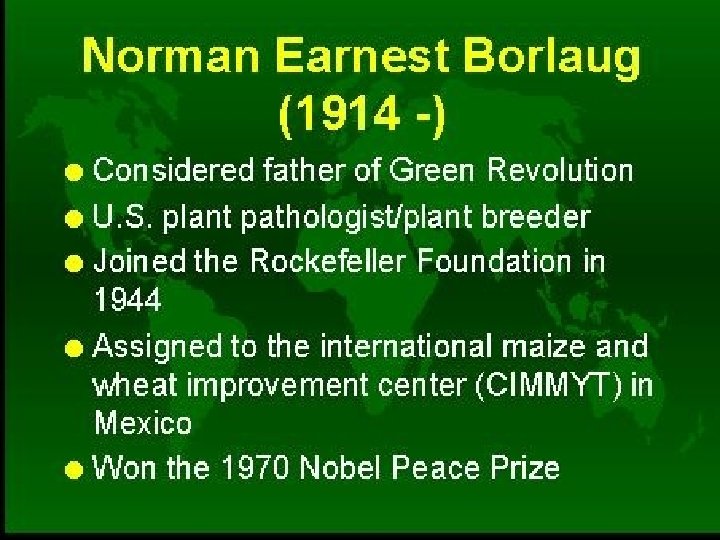
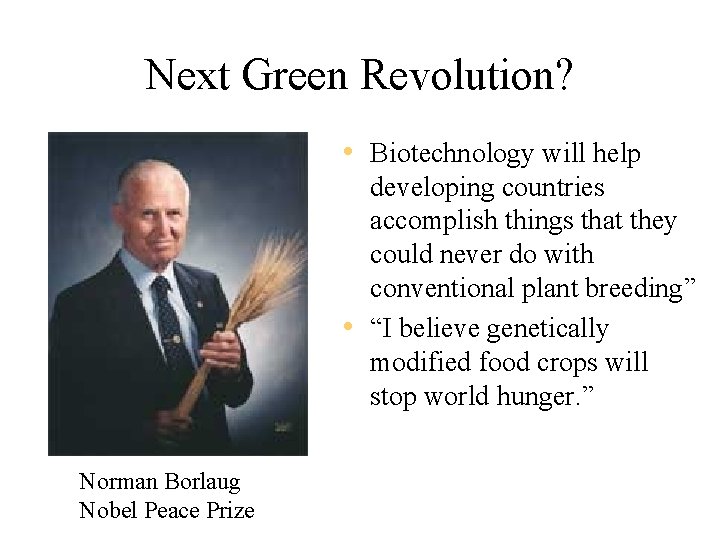
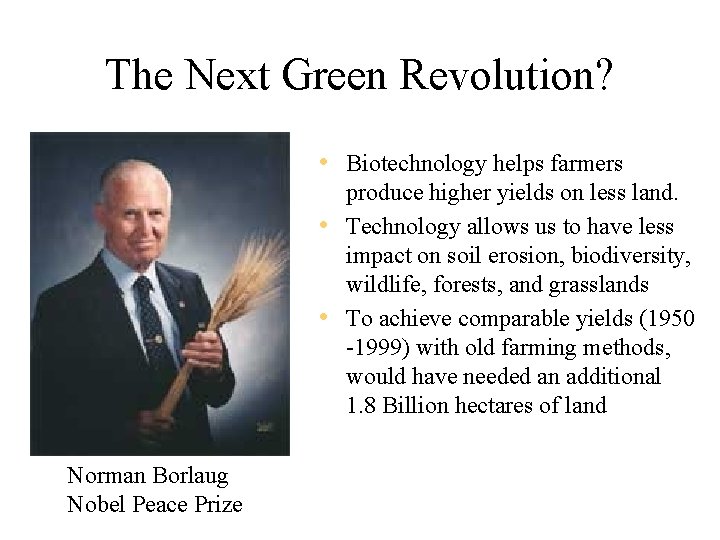
Next Green Revolution? • Biotechnology will help developing countries accomplish things that they could never do with conventional plant breeding” • “I believe genetically modified food crops will stop world hunger. ” Norman Borlaug Nobel Peace Prize
The Next Green Revolution? • Biotechnology helps farmers produce higher yields on less land. • Technology allows us to have less impact on soil erosion, biodiversity, wildlife, forests, and grasslands • To achieve comparable yields (1950 -1999) with old farming methods, would have needed an additional 1. 8 Billion hectares of land Norman Borlaug Nobel Peace Prize
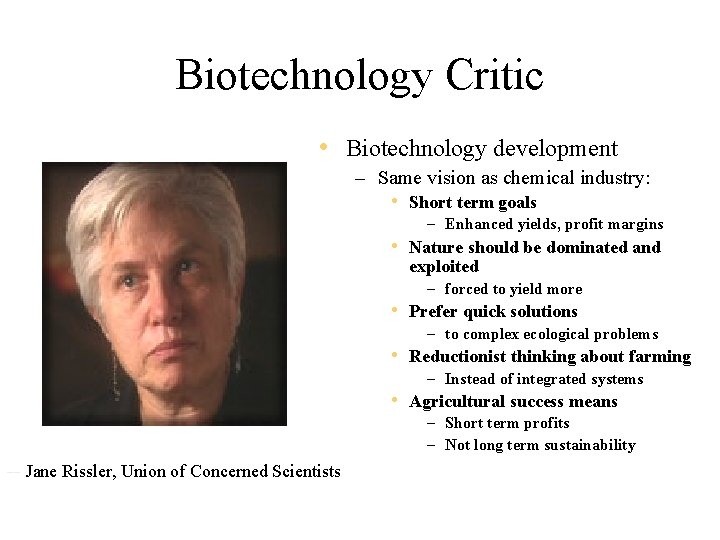
Biotechnology Critic • Biotechnology development – Same vision as chemical industry: • Short term goals – Enhanced yields, profit margins • Nature should be dominated and exploited – forced to yield more • Prefer quick solutions – to complex ecological problems • Reductionist thinking about farming – Instead of integrated systems • Agricultural success means – Short term profits – Not long term sustainability -- Jane Rissler, Union of Concerned Scientists
Review • History of theory in anthropology • Unilinear, relativism, symbolism, materialism, humanism • Flat Earth – Positive aspects of globalization? • Falling Flat – Negative aspects of globalization?
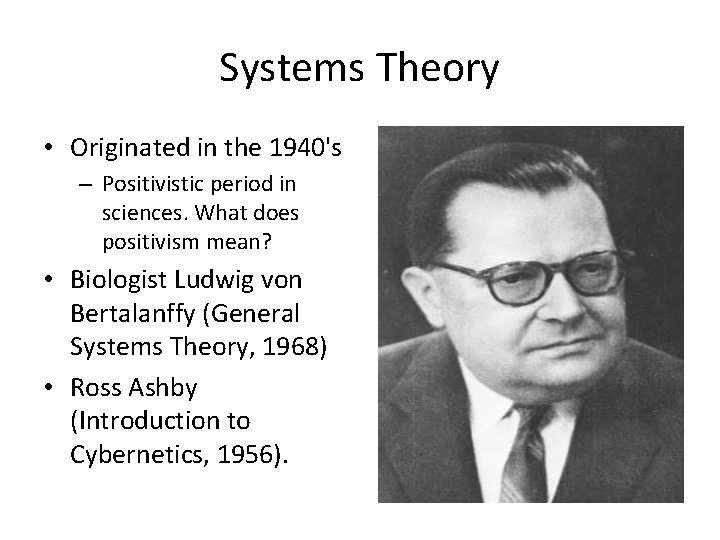
Systems Theory • Originated in the 1940's – Positivistic period in sciences. What does positivism mean? • Biologist Ludwig von Bertalanffy (General Systems Theory, 1968) • Ross Ashby (Introduction to Cybernetics, 1956).
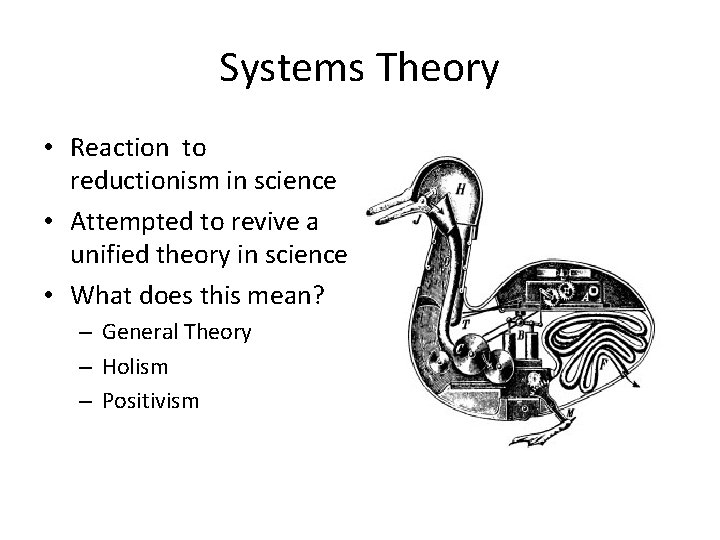
Systems Theory • Reaction to reductionism in science • Attempted to revive a unified theory in science • What does this mean? – General Theory – Holism – Positivism
Systems Theory, What is it? • Systems are sets of covariant entities no subset of which is unrelated to any other subset • Systems Theory is the trans-disciplinary study of the abstract organization of phenomena, independent of their substance, type, or spatial or temporal scale of existence
Systems Theory, What is it? • To be a system requires organization and interdependence • An grouping of functioning parts that are not interdependent is described as a Heap
Systems theory, what is it? • Systems theory looks beyond functional cause and effect models • It portrays human adaptation in terms of wellspecified webs of mutual causality. • Is a way of looking at the relationships among variables
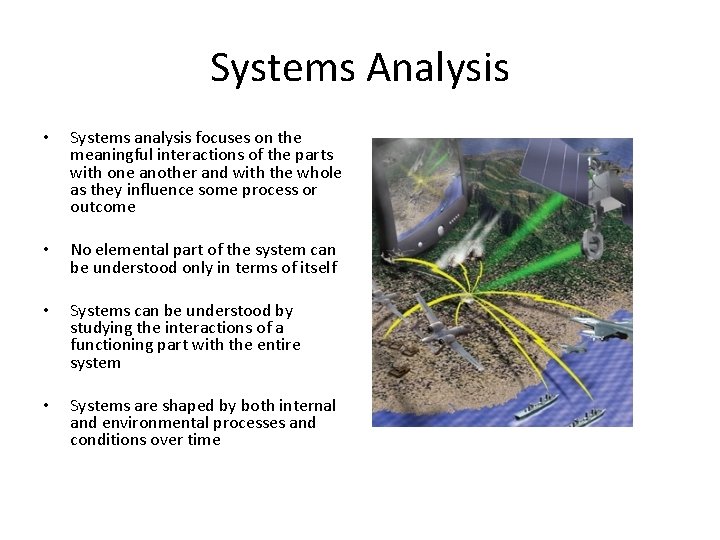
Systems Analysis • Systems analysis focuses on the meaningful interactions of the parts with one another and with the whole as they influence some process or outcome • No elemental part of the system can be understood only in terms of itself • Systems can be understood by studying the interactions of a functioning part with the entire system • Systems are shaped by both internal and environmental processes and conditions over time
Systems Analysis in Anthropology • Excellent theory for describing flows • Excellent for describing closed systems • Problems? • No closed cultural system • What does this mean? • Systems thinking tends to be processual (time and space), conditional, and probabilistic
The Idea of a System • System in its everyday sense • Nervous system • Legal system • Cooling/Heating system – Automobile cooling system Radiator Fan Water pump Thermostat Cooling jacket around the cylinder head • Hoses/clamps • • •
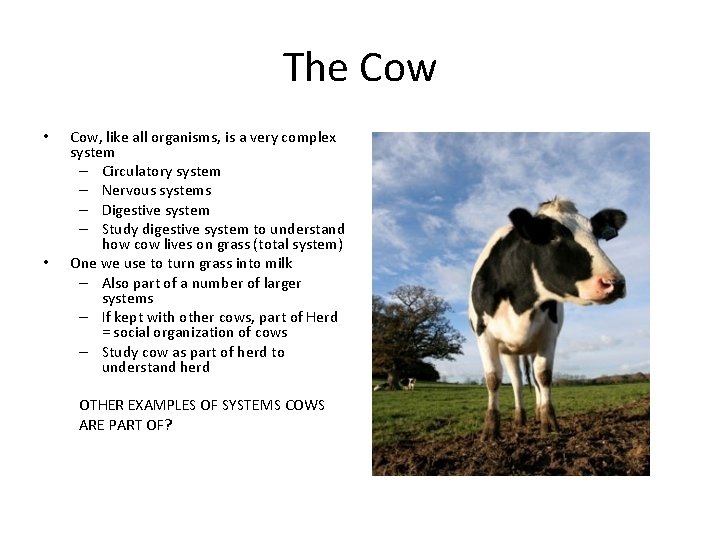
The Cow • • Cow, like all organisms, is a very complex system – Circulatory system – Nervous systems – Digestive system – Study digestive system to understand how cow lives on grass (total system) One we use to turn grass into milk – Also part of a number of larger systems – If kept with other cows, part of Herd = social organization of cows – Study cow as part of herd to understand herd OTHER EXAMPLES OF SYSTEMS COWS ARE PART OF?
Stable Systems? • Collection of smaller parts more stable over time than one large operational part – Scientists made atoms of bigger and bigger size, and they became more unstable the larger they were
What systems need • Energy and information is needed to fuel systems • The more complex the system, the more energy and information is needed • Inputs and Outputs
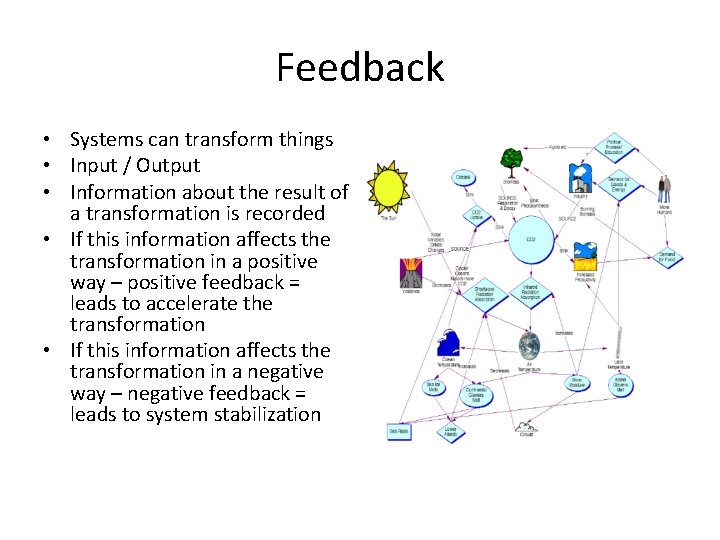
Feedback • Systems can transform things • Input / Output • Information about the result of a transformation is recorded • If this information affects the transformation in a positive way – positive feedback = leads to accelerate the transformation • If this information affects the transformation in a negative way – negative feedback = leads to system stabilization
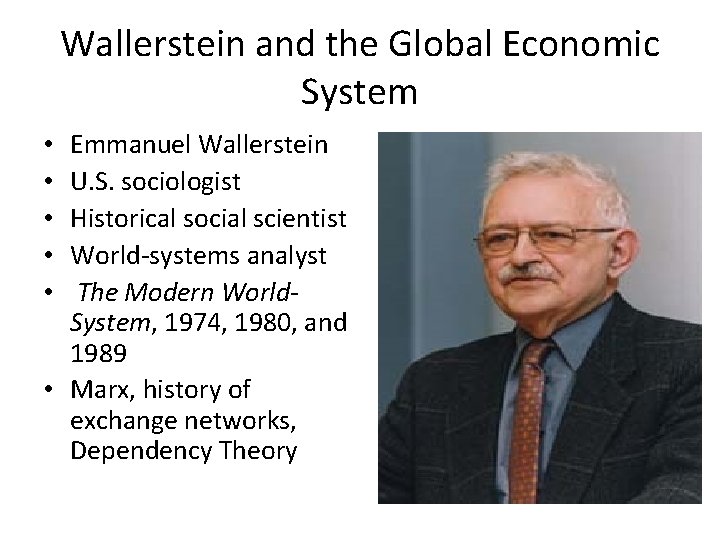
Wallerstein and the Global Economic System Emmanuel Wallerstein U. S. sociologist Historical social scientist World-systems analyst The Modern World. System, 1974, 1980, and 1989 • Marx, history of exchange networks, Dependency Theory • • •
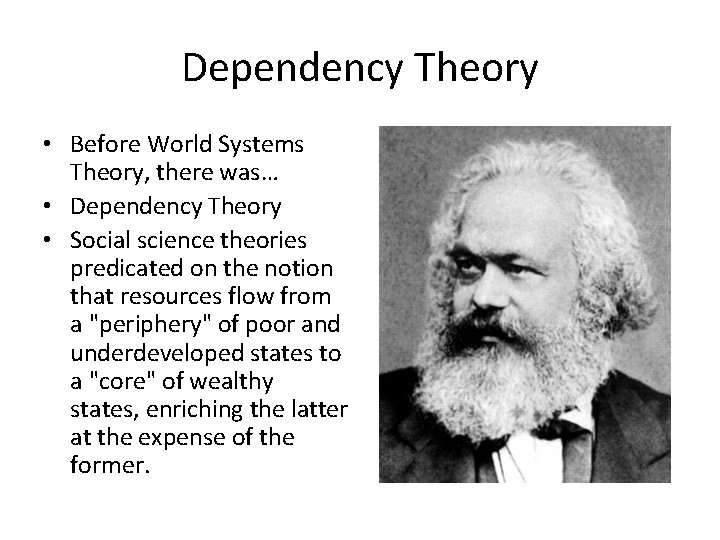
Dependency Theory • Before World Systems Theory, there was… • Dependency Theory • Social science theories predicated on the notion that resources flow from a "periphery" of poor and underdeveloped states to a "core" of wealthy states, enriching the latter at the expense of the former.
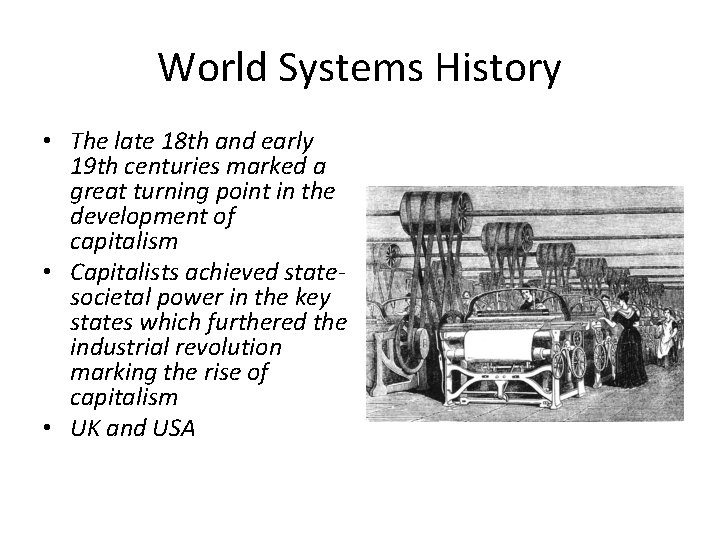
World Systems History • The late 18 th and early 19 th centuries marked a great turning point in the development of capitalism • Capitalists achieved statesocietal power in the key states which furthered the industrial revolution marking the rise of capitalism • UK and USA
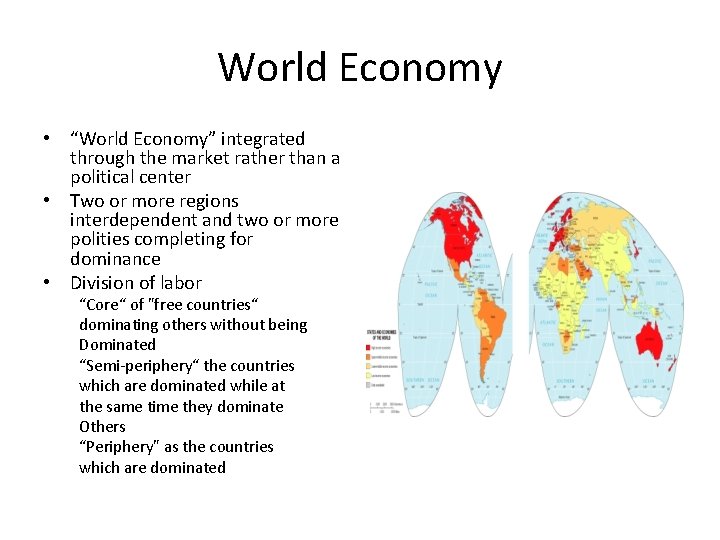
World Economy • “World Economy” integrated through the market rather than a political center • Two or more regions interdependent and two or more polities completing for dominance • Division of labor “Core“ of "free countries“ dominating others without being Dominated “Semi-periphery“ the countries which are dominated while at the same time they dominate Others “Periphery" as the countries which are dominated
World System • Multicultural territorial division of labor in which the production and exchange of basic goods and raw materials is necessary for the everyday life of its inhabitants • Division of labor: the forces and relations of production of the world economy as a whole • Leads to the existence of two interdependent regions: core and periphery.
World System Theory • World-system theory is a macrosociological perspective that seeks to explain the dynamics of the “capitalist world economy” as a “total social system” • “Man’s ability to participate intelligently in the evolution of his own system is dependent on his ability to perceive the whole” (Wallerstein 1974: 10)
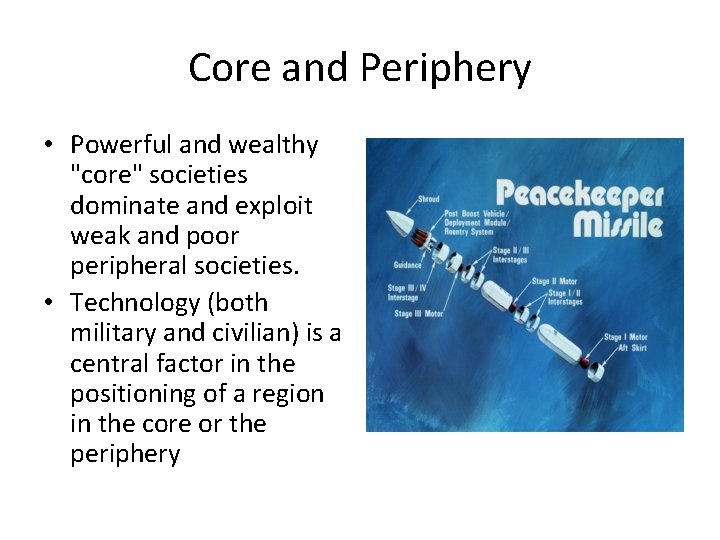
Core and Periphery • Powerful and wealthy "core" societies dominate and exploit weak and poor peripheral societies. • Technology (both military and civilian) is a central factor in the positioning of a region in the core or the periphery
World-systems analysis • Capitalism, as a historical social system, has always integrated a variety of labor forms within a functioning division of labor • Countries do not have economies, but are part of the world-economy.
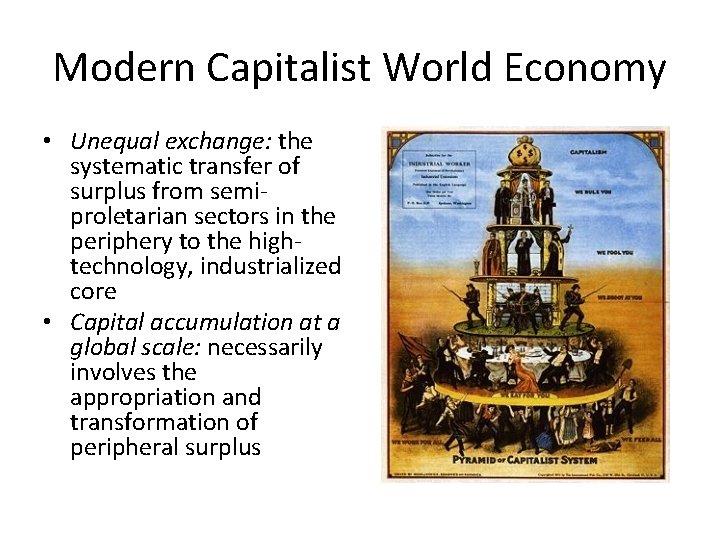
Modern Capitalist World Economy • Unequal exchange: the systematic transfer of surplus from semiproletarian sectors in the periphery to the hightechnology, industrialized core • Capital accumulation at a global scale: necessarily involves the appropriation and transformation of peripheral surplus
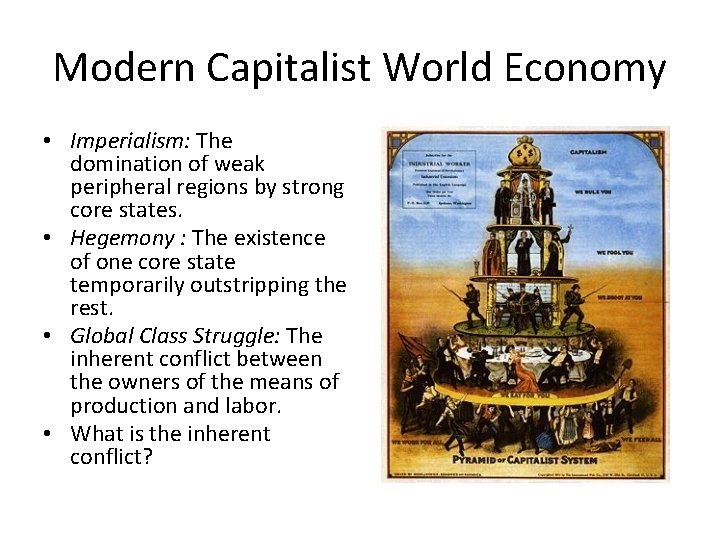
Modern Capitalist World Economy • Imperialism: The domination of weak peripheral regions by strong core states. • Hegemony : The existence of one core state temporarily outstripping the rest. • Global Class Struggle: The inherent conflict between the owners of the means of production and labor. • What is the inherent conflict?
World Systems Theory as a Criticism • Criticisms to modernization • (1) the reification of the nationstate as the sole unit of analysis, • (2) assumption that all countries can follow only a single path of evolutionary development, • (3) disregard of the worldhistorical development of transnational structures that constrain local and national development, • (4) explaining in terms of ahistorical ideal types of “tradition” versus “modernity”,
Present State of the Theory • SUNY Binghamton, at the Fernand Braudel Center for the Study of Economies, Historical Systems and Civilizations • Journal of World Systems Research • Greatest impact among intellectuals in the periphery countries • Used to analyze development dynamics and to understand the relationship between developed and developing regions