
The Green Grids Data Center Maturity Model November

The Green Grid’s Data Center Maturity Model November 18, 2015

DCMM – an introduction • DCMM: a multi-dimensional tool to evaluate resource efficiency of individual data centers • Target: owner/operators assessing the performance of both facilities and IT functions in their data centers • Goal: drive self-improvement through goal-setting and targeted changes • The rating scheme is reassessed every ~4 years to ensure relevance Copyright © 2015, The Green Grid
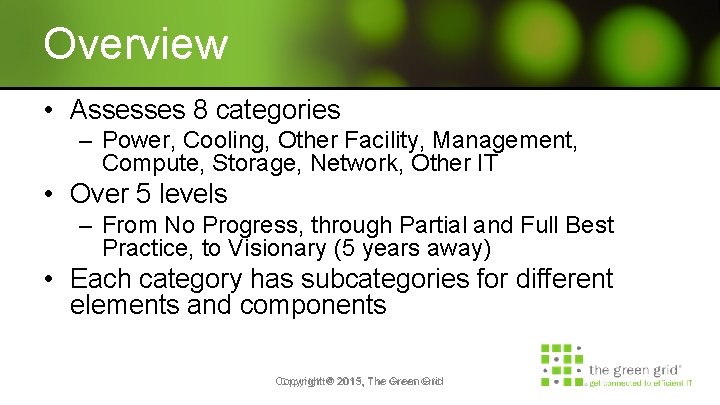
Overview • Assesses 8 categories – Power, Cooling, Other Facility, Management, Compute, Storage, Network, Other IT • Over 5 levels – From No Progress, through Partial and Full Best Practice, to Visionary (5 years away) • Each category has subcategories for different elements and components Copyright The Green. Grid Copyright © © 2015, 2013, The
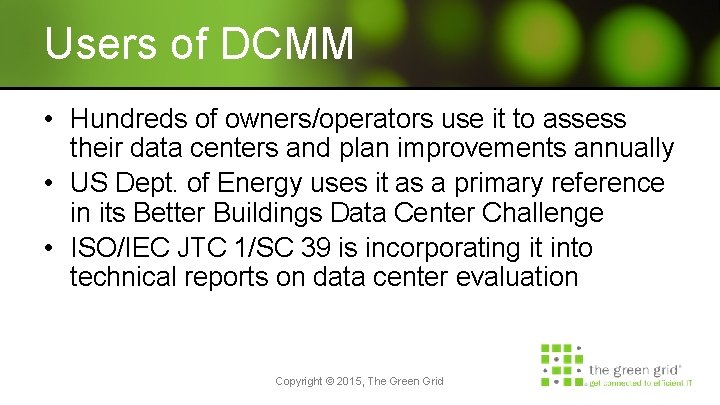
Users of DCMM • Hundreds of owners/operators use it to assess their data centers and plan improvements annually • US Dept. of Energy uses it as a primary reference in its Better Buildings Data Center Challenge • ISO/IEC JTC 1/SC 39 is incorporating it into technical reports on data center evaluation Copyright © 2015, The Green Grid
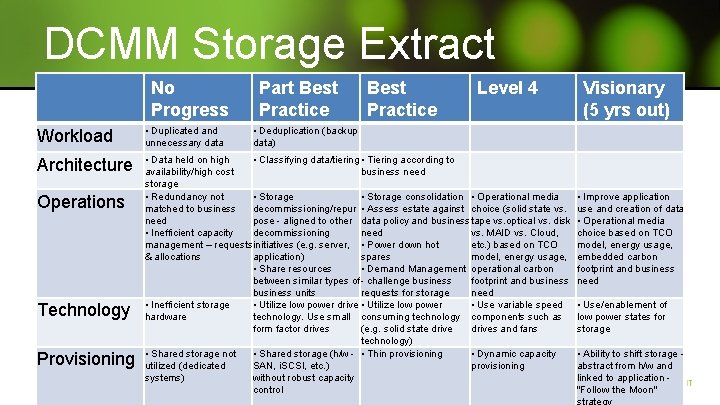
DCMM Storage Extract No Progress Part Best Practice Level 4 Workload • Duplicated and unnecessary data Architecture • Data held on high • Classifying data/tiering • Tiering according to availability/high cost business need storage • Redundancy not • Storage consolidation • Operational media matched to business decommissioning/repur • Assess estate against choice (solid state vs. need pose - aligned to other data policy and business tape vs. optical vs. disk • Inefficient capacity decommissioning need vs. MAID vs. Cloud, management – requestsinitiatives (e. g. server, • Power down hot etc. ) based on TCO & allocations application) spares model, energy usage, • Share resources • Demand Management operational carbon between similar types of - challenge business footprint and business units requests for storage need • Inefficient storage • Utilize low power drive • Utilize low power • Use variable speed hardware technology. Use small consuming technology components such as form factor drives (e. g. solid state drives and fans technology) • Shared storage not • Shared storage (h/w - • Thin provisioning • Dynamic capacity utilized (dedicated SAN, i. SCSI, etc. ) provisioning systems) without robust capacity Copyright © 2015, The Green Grid control Operations Technology Provisioning Visionary (5 yrs out) • Deduplication (backup data) • Improve application use and creation of data • Operational media choice based on TCO model, energy usage, embedded carbon footprint and business need • Use/enablement of low power states for storage • Ability to shift storage abstract from h/w and linked to application "Follow the Moon"
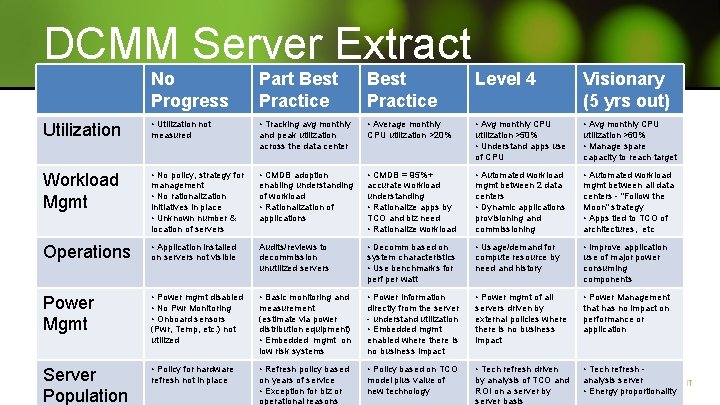
DCMM Server Extract No Progress Part Best Practice Level 4 Visionary (5 yrs out) Utilization • Utilization not measured • Tracking avg monthly and peak utilization across the data center • Average monthly CPU utilization >20% • Avg monthly CPU utilization >50% • Understand apps use of CPU • Avg monthly CPU utilization >60% • Manage spare capacity to reach target Workload Mgmt • No policy, strategy for management • No rationalization initiatives in place • Unknown number & location of servers • CMDB adoption enabling understanding of workload • Rationalization of applications • CMDB = 95%+ accurate workload understanding • Rationalize apps by TCO and biz need • Rationalize workload • Automated workload mgmt between 2 data centers • Dynamic applications provisioning and commissioning • Automated workload mgmt between all data centers - "Follow the Moon" strategy • Apps tied to TCO of architectures, etc Operations • Application installed on servers not visible Audits/reviews to decommission unutilized servers • Decomm based on system characteristics • Use benchmarks for perf per watt • Usage/demand for compute resource by need and history • Improve application use of major power consuming components Power Mgmt • Power mgmt disabled • No Pwr Monitoring • Onboard sensors (Pwr, Temp, etc. ) not utilized • Basic monitoring and measurement (estimate via power distribution equipment) • Embedded mgmt on low risk systems • Power information directly from the server - understand utilization • Embedded mgmt enabled where there is no business impact • Power mgmt of all servers driven by external policies where there is no business impact • Power Management that has no impact on performance or application Server Population • Policy for hardware refresh not in place • Refresh policy based • Policy based on TCO on years of service plus value of Copyright © 2015, model The Green Grid • Exception for biz or new technology operational reasons • Tech refresh driven by analysis of TCO and ROI on a server by server basis • Tech refresh analysis server • Energy proportionality
- Slides: 6