
The Green Economy National Climate Change Response Strategy
- Slides: 27
The Green Economy National Climate Change Response Strategy Click to edit Master subtitle style Status Report Briefing Note to Portfolio Committee of Water and Environmental Affairs 07 June 2012 Cape Town 11
Climate Change: an EDD Perspective The Mandate of the Economic Development Department Promote economic planning and co-ordination through economic planning proposals • Provide oversight and policy co-ordination of identified development finance institutions and economic regulatory bodies. • Contribute to the development of the Green Economy • Purpose: The Green Economy provides a unique opportunity for South Africa to create a large number of sustainable jobs by, developing new industrial sectors, while addressing concerns about climate change. Process: The country can draw on its technological research and manufacturing base to generate new process and products, it is the responsibility of government to create an enabling environment and for citizens and business to do things differently Outcome: Combined efforts of all constituents will be harnessed to achieve the goals of creating at least 300 000 jobs in the Green Economy by 2020. (green economy accord, EDD, 2011) 22
The Challenge to Green Economy 33
Managing the Transition • • Fundamental Problem: The transition to greener growth is economically costly for South Africa, because, alternatives to externality intensive production are few and expensive. Policy should focus on reducing externalities (carbon intensity, water use) of economic activities through the development and diffusion of low carbon technologies (carbon taxing vs tax credits, incentives, rebates) All new policies should be assessed in terms of their likely impact on growth, employment and resource use to ensure coherence in policy design and implementation Policies should be phased out over time to permit adaptation to ensure change in long-term behaviour without overburden on current economic output. (balance between jobs, economic growth and climate change mitigation) (The cost of going green vs not going green) In South Africa, market-based approaches alone are insufficient due to unequal impact of on stakeholders such as the poor. Need to focus on complementary polices such as regulations & standards, R&D investment, labelling. - dissagregation 44
Managing the Transition Time to phase out, time to market, time to innovate 55
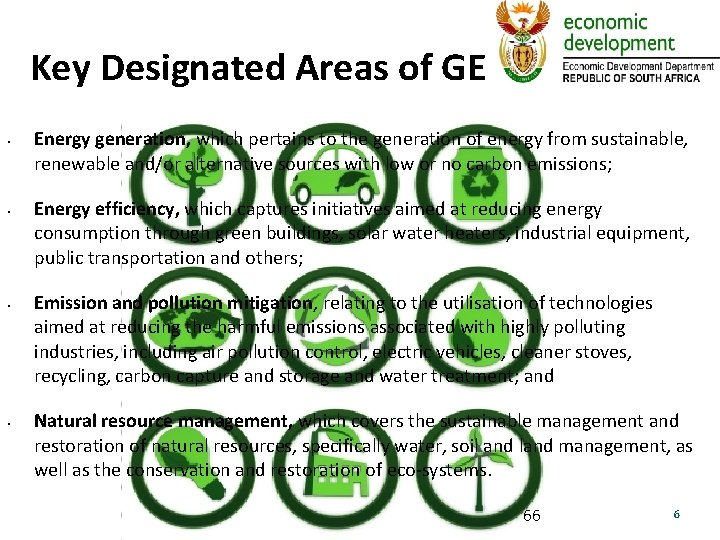
Key Designated Areas of GE • • Energy generation, which pertains to the generation of energy from sustainable, renewable and/or alternative sources with low or no carbon emissions; Energy efficiency, which captures initiatives aimed at reducing energy consumption through green buildings, solar water heaters, industrial equipment, public transportation and others; Emission and pollution mitigation, relating to the utilisation of technologies aimed at reducing the harmful emissions associated with highly polluting industries, including air pollution control, electric vehicles, cleaner stoves, recycling, carbon capture and storage and water treatment; and Natural resource management, which covers the sustainable management and restoration of natural resources, specifically water, soil and land management, as well as the conservation and restoration of eco-systems. 66 6
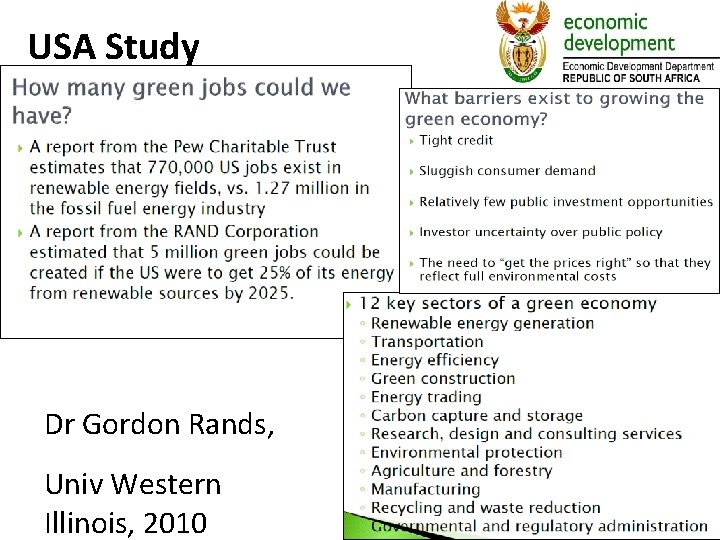
USA Study Dr Gordon Rands, Univ Western Illinois, 2010 77 7
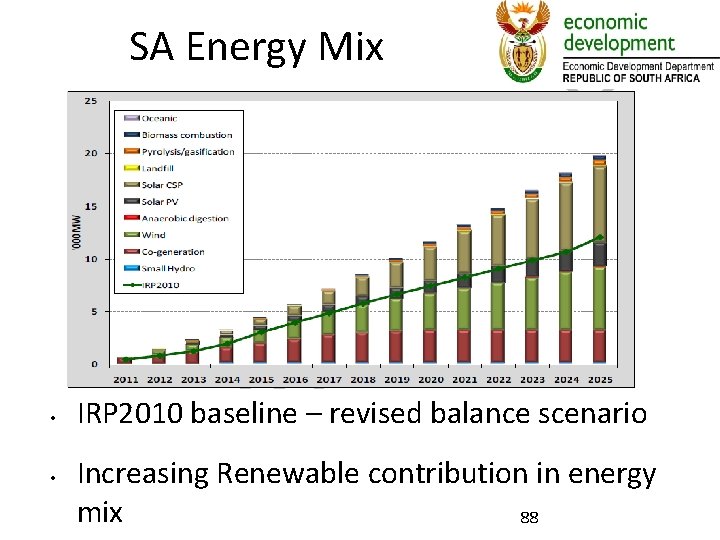
SA Energy Mix • • IRP 2010 baseline – revised balance scenario Increasing Renewable contribution in energy mix 88
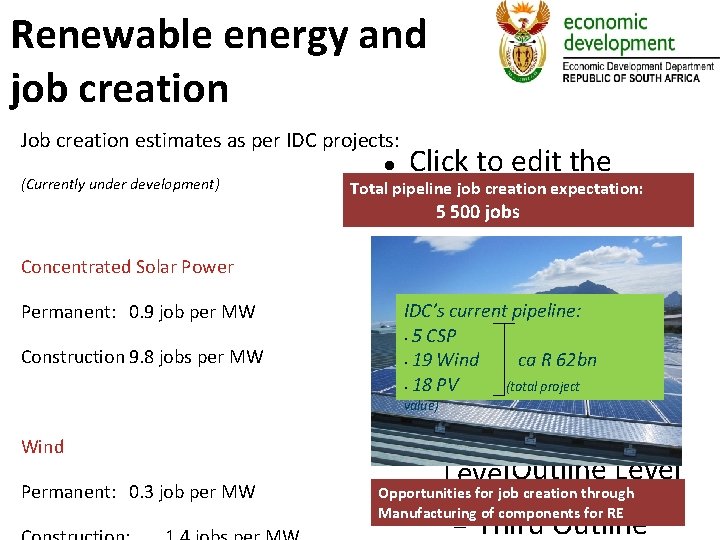
Renewable energy and job creation Job creation estimates as per IDC projects: (Currently under development) Click to edit the Total pipeline job creation expectation: outline text format 5 500 jobs Second Outline Level IDC’s current pipeline: Concentrated Solar Power Permanent: 0. 9 job per MW Construction 9. 8 jobs per MW 5 CSP to edit the Click Third Outline 19 Wind ca R 62 bn outline text format 18 PV Level (total project value) Fourth Second Outline Level Opportunities for job creation through Manufacturing of components for RE Fifth Third Outline • • • Wind Permanent: 0. 3 job per MW
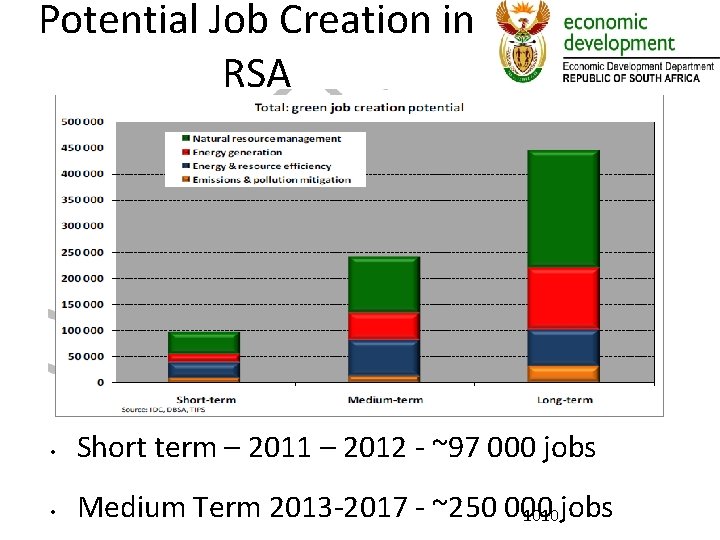
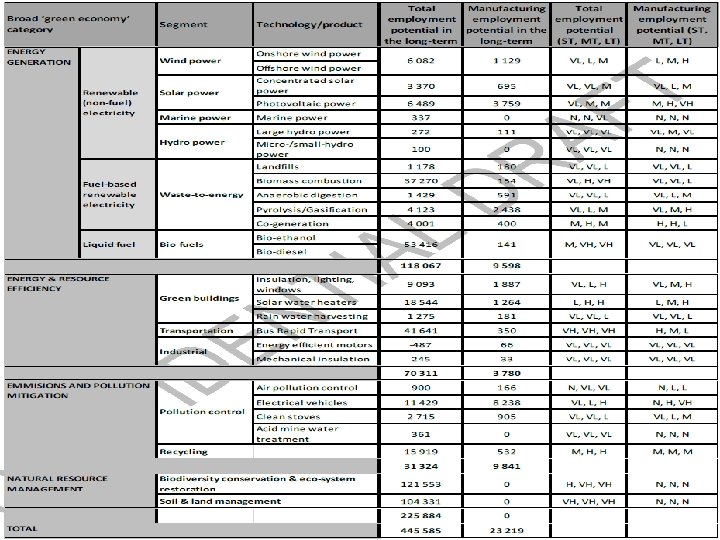
Potential Job Creation in RSA • Short term – 2011 – 2012 - ~97 000 jobs • Medium Term 2013 -2017 - ~250 000 1010 jobs
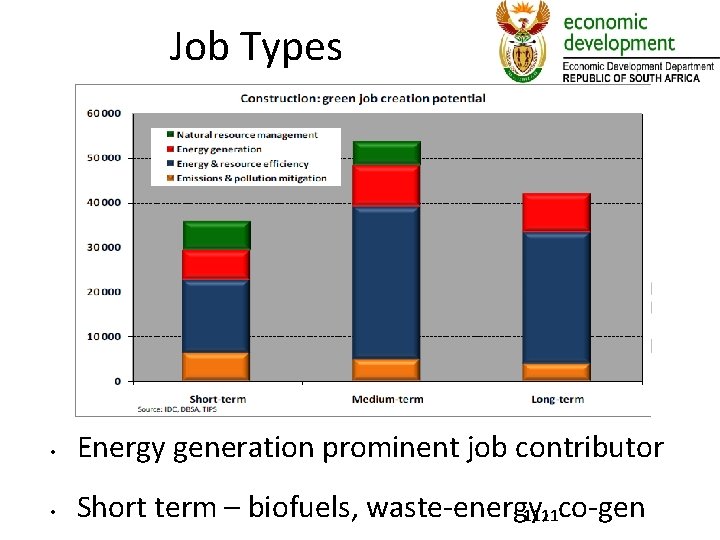
Job Types • Energy generation prominent job contributor • Short term – biofuels, waste-energy, 1111 co-gen
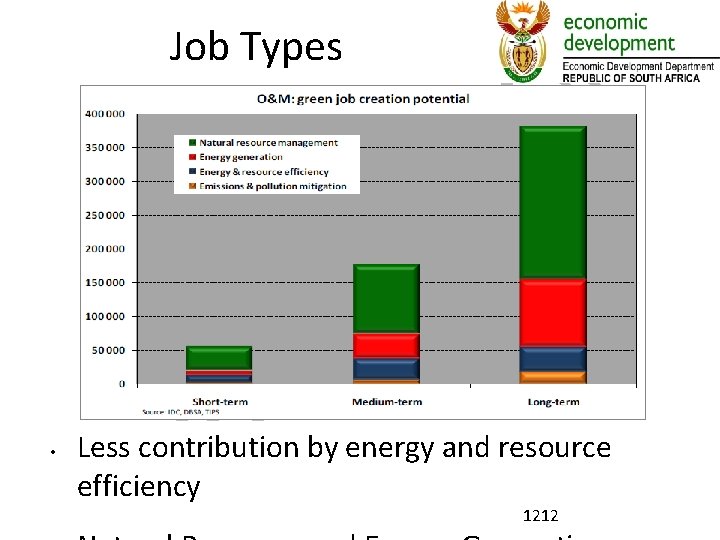
Job Types • Less contribution by energy and resource efficiency 1212
1313
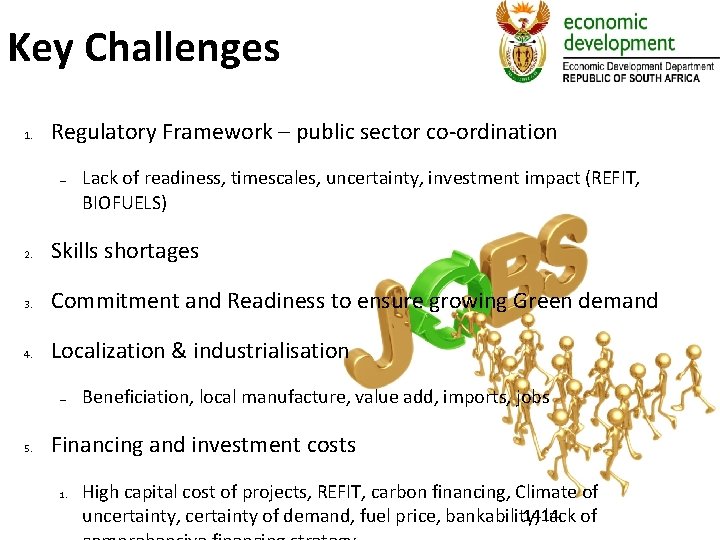
Key Challenges 1. Regulatory Framework – public sector co-ordination – Lack of readiness, timescales, uncertainty, investment impact (REFIT, BIOFUELS) 2. Skills shortages 3. Commitment and Readiness to ensure growing Green demand 4. Localization & industrialisation – 5. Beneficiation, local manufacture, value add, imports, jobs Financing and investment costs 1. High capital cost of projects, REFIT, carbon financing, Climate of 1414 uncertainty, certainty of demand, fuel price, bankability, lack of
Actions • • • EDD is increasing its activity and function in national projects and programs under the purview of the NGP in activities such as, SARi- South African Renewable Energy Initiative with dti , DOE and NT as part of the oversight steering committee- Lead departments are preparing a draft declaration being compiled with ODAs by COP 17. Strategic support for Provincial Climate Innovation 1515 innovation Centre by Gauteng for SMME and green
EDD Actions • • • Signing of national green economy accord- pledge by business labour, government and communities @ COP 17, Dec 2011. Green Jobs Report commissioned by IDC and DBSA launched December 2011 outlining key job areas in green economy over next 20 years including renewable energy generation, energy efficiency activities and waste and water management technologies, including biofuels and bio-technologies as key areas. Green Growth Economic Cluster Committee formed in Q 1 2012 policy leadership- objective to formulate an economic green growth strategy including implementation of national climate change response strategy – NT, dti, EDD, DEA 1616
SWH implementation • • Project Steering Committee established (EDD, DOE, DTI, DPE, DST, DPW, Eskom, IDC, NT, DHET) Committee discussed the following issues/challenges: – Localisation plans – Even provincial distribution – Youth employment – Funding proposals – Amendments to regulations/regulatory interventions – Guarantees for installed solar heaters (in event installers go out of business) – Set-asides for cooperatives (installation) 1717 17
SWH workstreams 1818
Designation • • • Cabinet Approved – minister can designate for special strategic support key sectors. Influence state procurement programs in order to effect required impact December 2011, first round of Designated (sub)sectors Dti –Department of Trade and Industry mandated area- study completed May 2012 Seek to apply for new round of 1 million geyser rollout Study completed- identifies component and system 1919 designation potential 19
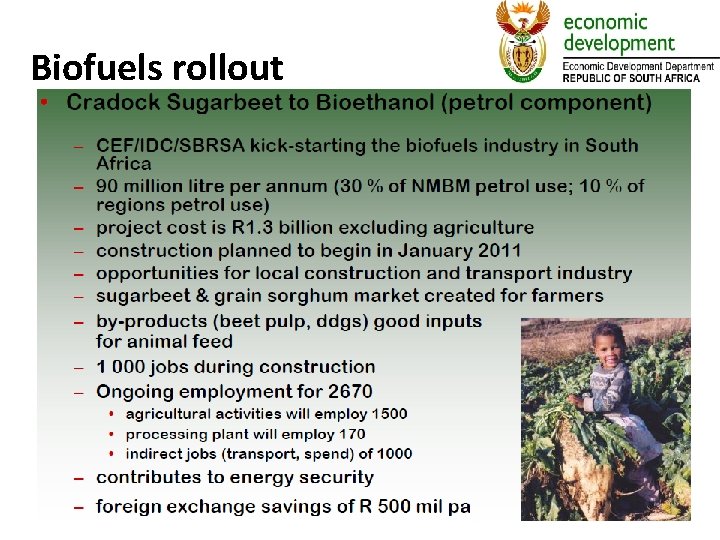
Biofuels rollout • The Biofuels Industrial Strategy aims to facilitate job creation and rural development • Cabinet memo October 2011 in support of the dti and other departments. • Bio-ethanol - Cradock project • – IDC partnership in pilot project – Phase 1 - 6000 hectares of grain sorghum and sugar beet (2 nd phase) – DRDLR land – Creation of in excess of 2000 jobs – Phase 2 – double capacity and create up to 20 000 in total Implementation issues – Feedstock – Regulations on blend mix published for public comment – Agricultural vs Industrial Water Licenses 2020 20
Biofuels rollout 2121 21
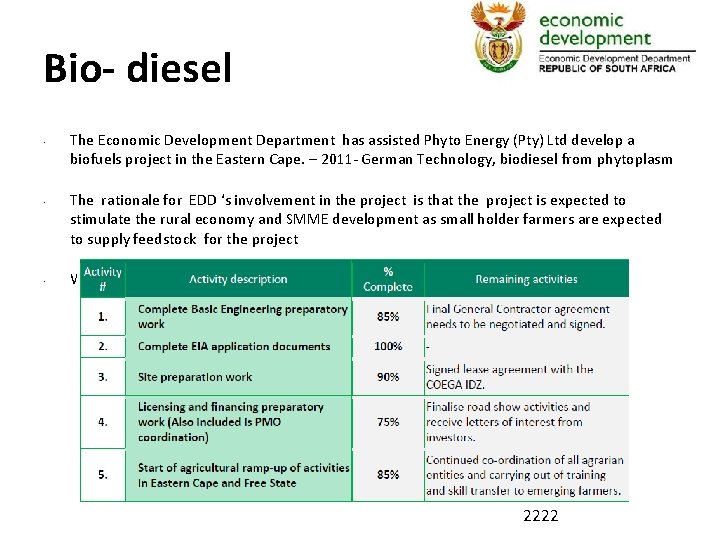
Bio- diesel • • • The Economic Development Department has assisted Phyto Energy (Pty) Ltd develop a biofuels project in the Eastern Cape. – 2011 - German Technology, biodiesel from phytoplasm The rationale for EDD ‘s involvement in the project is that the project is expected to stimulate the rural economy and SMME development as small holder farmers are expected to supply feedstock for the project Working with DRDLR – small scale co-operative feedstock farming 2222
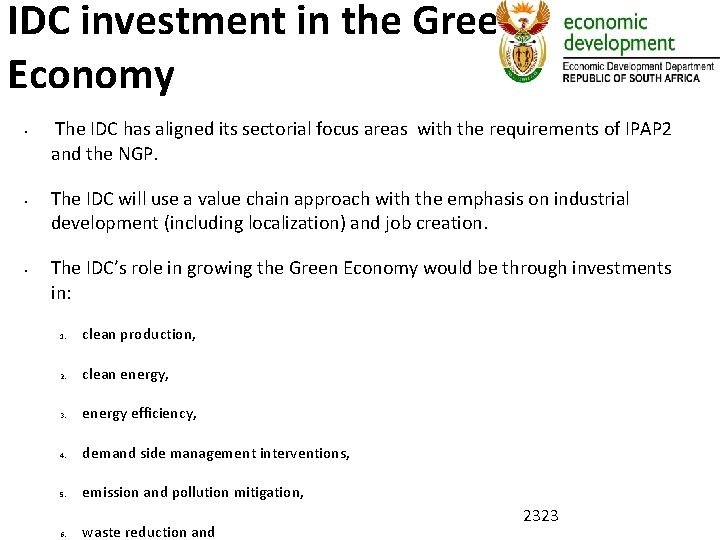
IDC investment in the Green Economy • • • The IDC has aligned its sectorial focus areas with the requirements of IPAP 2 and the NGP. The IDC will use a value chain approach with the emphasis on industrial development (including localization) and job creation. The IDC’s role in growing the Green Economy would be through investments in: 1. clean production, 2. clean energy, 3. energy efficiency, 4. demand side management interventions, 5. emission and pollution mitigation, 6. waste reduction and 2323
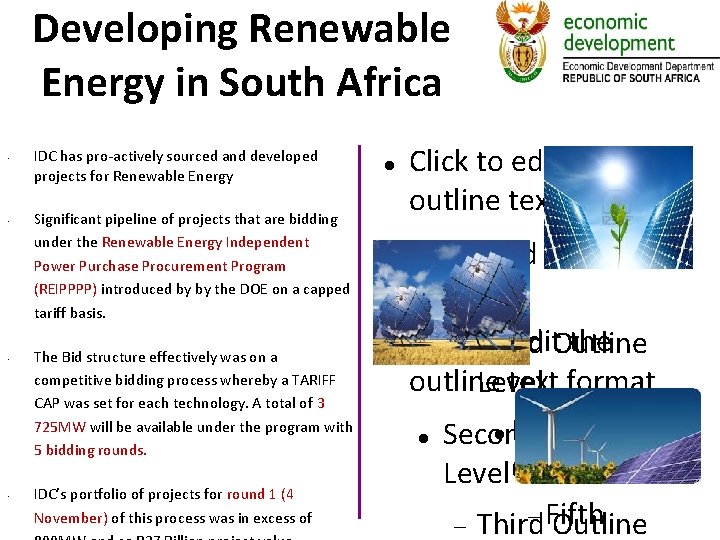
Developing Renewable Energy in South Africa • • IDC has pro-actively sourced and developed projects for Renewable Energy Significant pipeline of projects that are bidding under the Renewable Energy Independent Power Purchase Procurement Program (REIPPPP) introduced by by the DOE on a capped tariff basis. The Bid structure effectively was on a competitive bidding process whereby a TARIFF CAP was set for each technology. A total of 3 725 MW will be available under the program with 5 bidding rounds. IDC’s portfolio of projects for round 1 (4 November) of this process was in excess of Click to edit the outline text format Second Outline Level Click to edit. Outline the Third outline text format Level Fourth Second Outline Level Fifth Third Outline
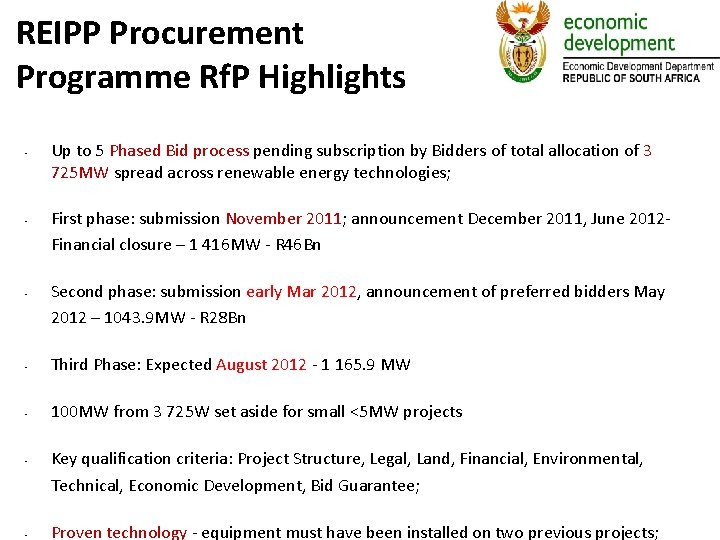
REIPP Procurement Programme Rf. P Highlights • • • Up to 5 Phased Bid process pending subscription by Bidders of total allocation of 3 725 MW spread across renewable energy technologies; First phase: submission November 2011; announcement December 2011, June 2012 Financial closure – 1 416 MW - R 46 Bn Second phase: submission early Mar 2012, announcement of preferred bidders May 2012 – 1043. 9 MW - R 28 Bn • Third Phase: Expected August 2012 - 1 165. 9 MW • 100 MW from 3 725 W set aside for small <5 MW projects • • Key qualification criteria: Project Structure, Legal, Land, Financial, Environmental, Technical, Economic Development, Bid Guarantee; Proven technology - equipment must have been installed on two previous projects;
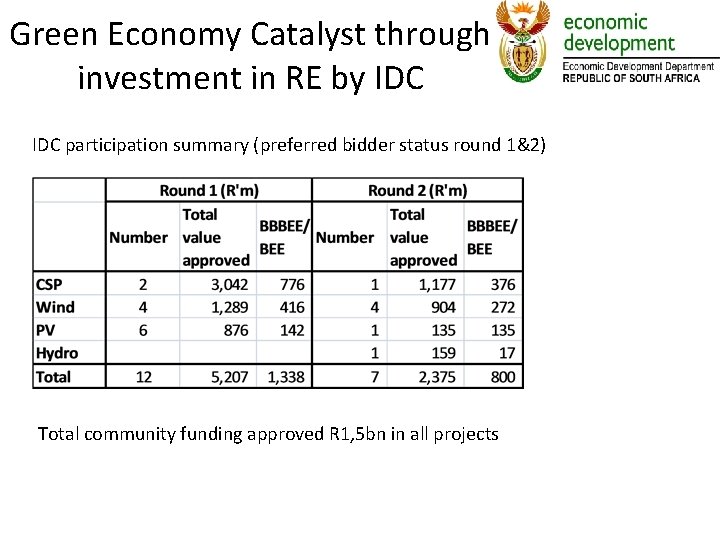
Green Economy Catalyst through investment in RE by IDC participation summary (preferred bidder status round 1&2) Total community funding approved R 1, 5 bn in all projects
Thank you/Siyabonga! 2727