
The green economy matching longterm ambitions with shortterm
The green economy: matching long-term ambitions with short-term actions Dr Hans Bruyninckx EEA Executive Director Informal Council of Environment Ministers Milan, 16 th July 2014
The 7 th EAP: a long term vision of sustainability “In 2050, we live well, within the planet's ecological limits. Our prosperity and healthy environment stem from an innovative, circular economy where nothing is wasted and where natural resources are managed sustainably, and biodiversity is protected, valued and restored in ways that enhance our society's resilience. Our low-carbon growth has long been decoupled from resource use, setting the pace for a global, safe and sustainable society. ” Source: 7 th Environmental Action Programme Other EU policies offer similar perspectives: Europe 2020 Strategy, EU Energy Roadmap 2050, Roadmap to a Resource Efficient Europe, Roadmap for a competitive low-carbon economy in 2050, etc.
The 2050 vision requires Europe to adopt a systemic approach & foster transitions ‘Systemic risks’ (persistent problems) require fundamental solutions § “Regular policies” offer no fundamental solutions: § Incremental institutionalism is too slow and often doesn’t touch the core issues § Market creation and commodification in itself is not a solution § Resource efficiency gains are necessary, but are not sufficient for ecosystem, economic and societal resilience → Transitions = fundamental shifts in the systems that fulfil societal needs, through profound changes in dominant structures, practices, technologies, policies, lifestyles, thinking …
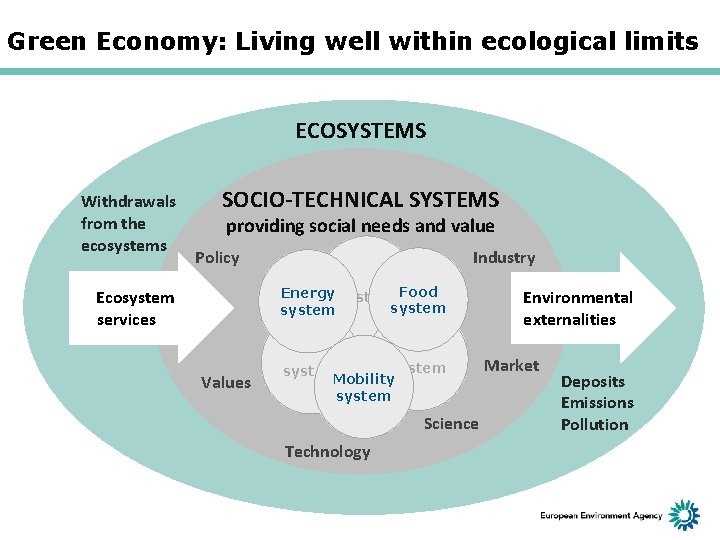
Green Economy: Living well within ecological limits ECOSYSTEMS Withdrawals from the ecosystems SOCIO-TECHNICAL SYSTEMS providing social needs and value Policy Industry Energy system Food system Ecosystem services Values system Mobility system Science Technology Environmental externalities Market Deposits Emissions Pollution
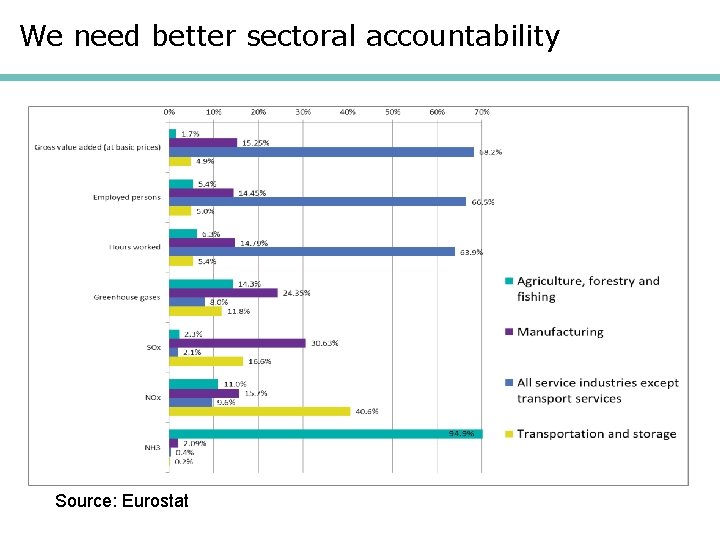
We need better sectoral accountability Source: Eurostat
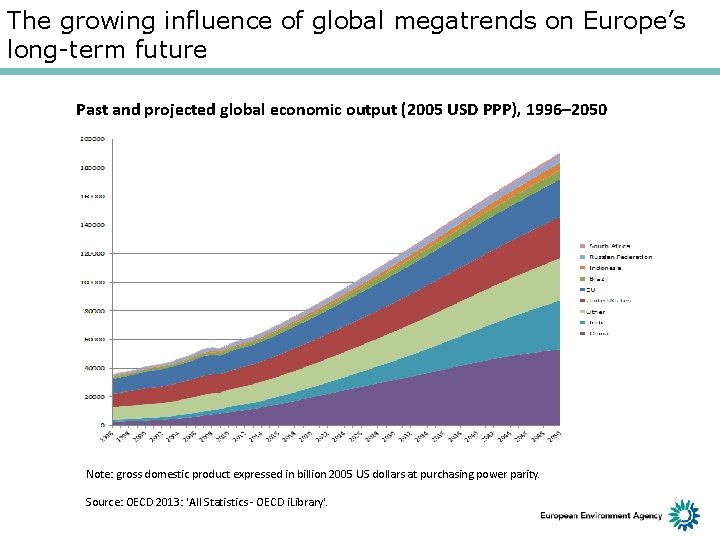
The growing influence of global megatrends on Europe’s long-term future Past and projected global economic output (2005 USD PPP), 1996– 2050 Note: gross domestic product expressed in billion 2005 US dollars at purchasing power parity. Source: OECD 2013: 'All Statistics - OECD i. Library'.
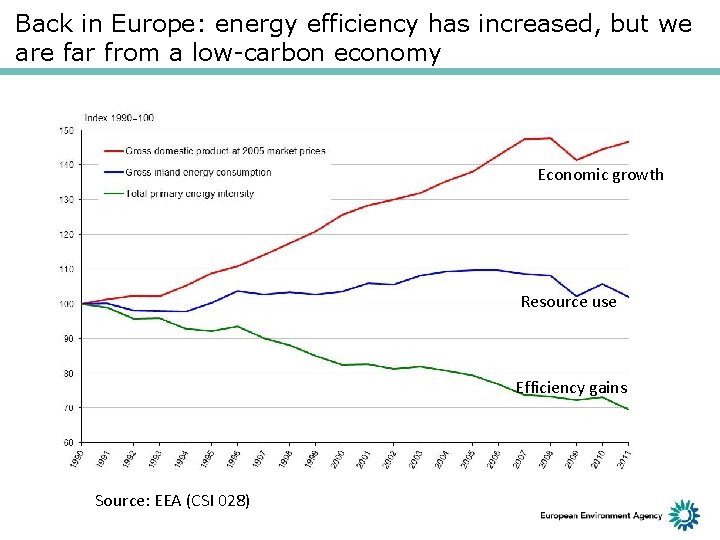
Back in Europe: energy efficiency has increased, but we are far from a low-carbon economy Economic growth Resource use Efficiency gains Source: EEA (CSI 028)
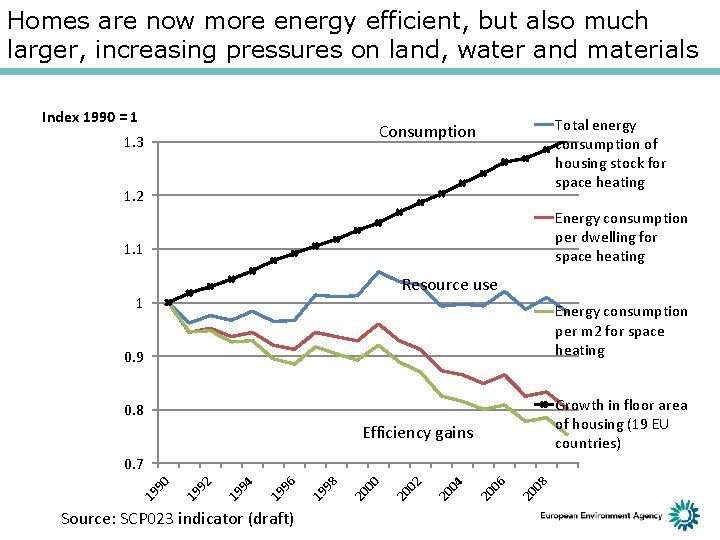
Homes are now more energy efficient, but also much larger, increasing pressures on land, water and materials Index 1990 = 1 Total energy consumption of housing stock for space heating Consumption 1. 3 1. 2 Energy consumption per dwelling for space heating 1. 1 Resource use 1 Energy consumption per m 2 for space heating 0. 9 Growth in floor area of housing (19 EU countries) 0. 8 Efficiency gains Source: SCP 023 indicator (draft) 08 20 06 20 04 20 02 20 00 20 98 19 96 19 94 19 92 19 19 90 0. 7
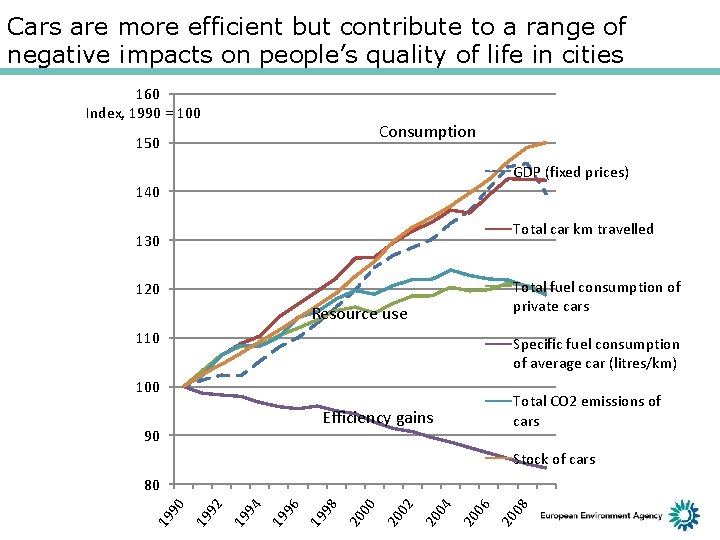
Cars are more efficient but contribute to a range of negative impacts on people’s quality of life in cities 160 Index, 1990 = 100 Consumption 150 GDP (fixed prices) 140 Total car km travelled 130 Total fuel consumption of private cars 120 Resource use 110 Specific fuel consumption of average car (litres/km) 100 Total CO 2 emissions of cars Efficiency gains 90 Stock of cars 08 20 06 20 04 20 02 20 00 20 98 19 96 19 94 19 92 19 19 90 80
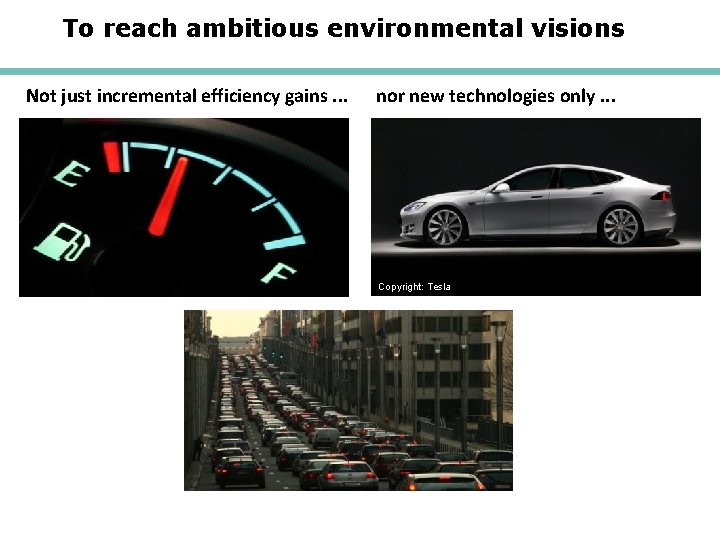
To reach ambitious environmental visions Not just incremental efficiency gains. . . nor new technologies only. . . Copyright: Tesla
Environment and climate policies can be engines driving future economic performance “Our actions must leave us better placed for the future through smart investment in greening and new technologies. ” Jose-Manuel Barroso, March 2009 “In the EU, we have developed the world's most ambitious climate policies for 2020 whilst in the midst of an economic crisis! It shows that we believe in a new growth model: green growth, sustainable growth. ” Hermann van Rompuy, May 2011
Policy tools that can help achieve 2020 targets in line with 2050 visions • Regulation • Fiscal reform • Financing tools
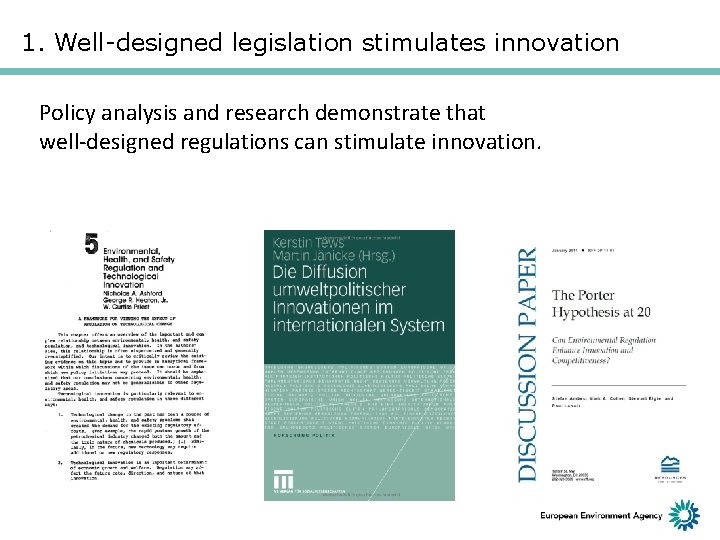
1. Well-designed legislation stimulates innovation Policy analysis and research demonstrate that well-designed regulations can stimulate innovation.
Legislation supports the global ‘race to the top’ • Legislation ‘export’ gives European businesses a head start in global markets. • Environmental policy is regarded in some quarters as Europe’s most successful foreign policy. • The EURO emission standards and REACH legislation are examples of European regulation ‘export’. This spreads higher environmental standards around the world.
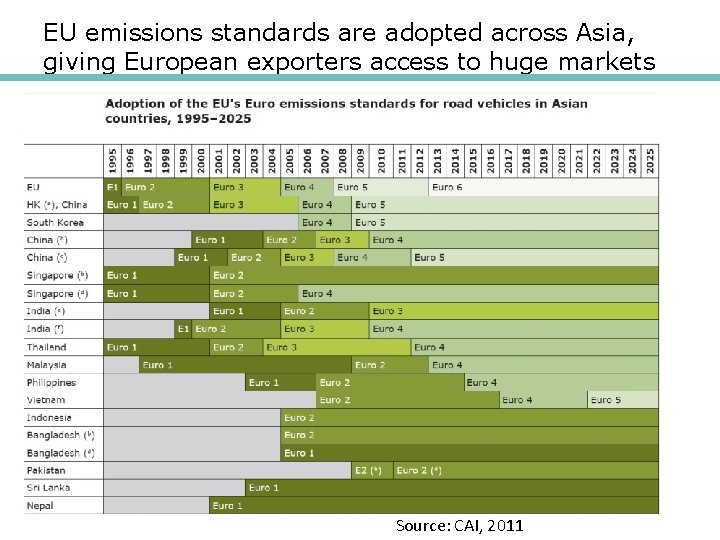
EU emissions standards are adopted across Asia, giving European exporters access to huge markets Source: CAI, 2011
2. Environmental fiscal reform • Shifting taxes from societal goods – employment, investment – to societal bads – pollution and overconsumption • Taxation shift puts a price on environmental externalities, thereby reducing pressures on human and ecosystem health while also supporting economic efficiency and jobs. • Removing harmful subsidies
Environmental taxes are an under-used tool “Labour taxation is still too high, while growth-friendly bases, such as environmental taxes, are under-used in many countries. The tax shift away from labour, which we have consistently called for to allow our businesses to regain competitiveness, still has to materialise. ” Statement by Commissioner Šemeta on Taxation Trends in Europe June 2014
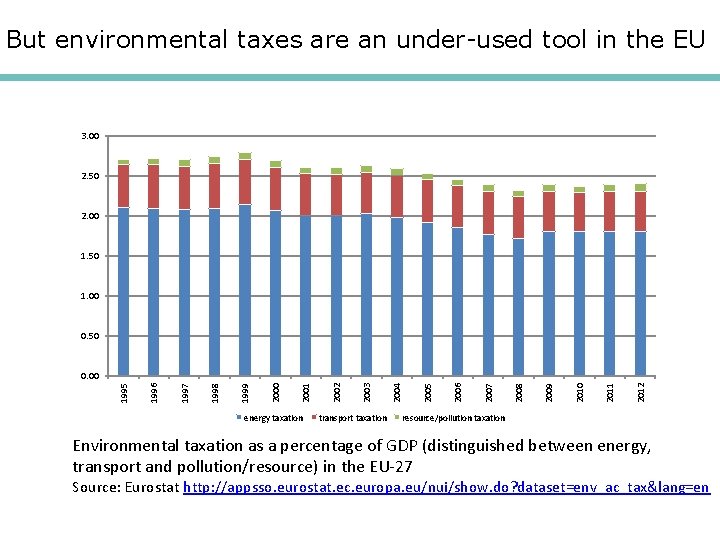
But environmental taxes are an under-used tool in the EU 3. 00 2. 50 2. 00 1. 50 1. 00 0. 50 energy taxation transport taxation 2012 2011 2010 2009 2008 2007 2006 2005 2004 2003 2002 2001 2000 1999 1998 1997 1996 1995 0. 00 resource/pollution taxation Environmental taxation as a percentage of GDP (distinguished between energy, transport and pollution/resource) in the EU-27 Source: Eurostat http: //appsso. eurostat. ec. europa. eu/nui/show. do? dataset=env_ac_tax&lang=en
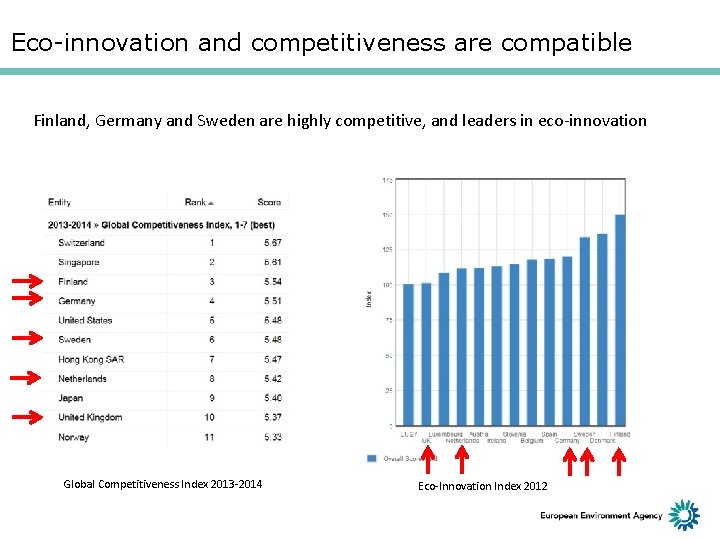
Eco-innovation and competitiveness are compatible Finland, Germany and Sweden are highly competitive, and leaders in eco-innovation Global Competitiveness Index 2013 -2014 Eco-Innovation Index 2012
3. Several sources of financing the green economy shift • Estimates for the financing needs of the green economy range from between US$70 bn and several trillion dollars per year. • Public funding: European Commission, European Investment Bank, the Green Climate Fund. • Private funding: pension funds and insurance companies. • Mixed public/private sources: ‘green bonds’, the Project Bond Initiative.
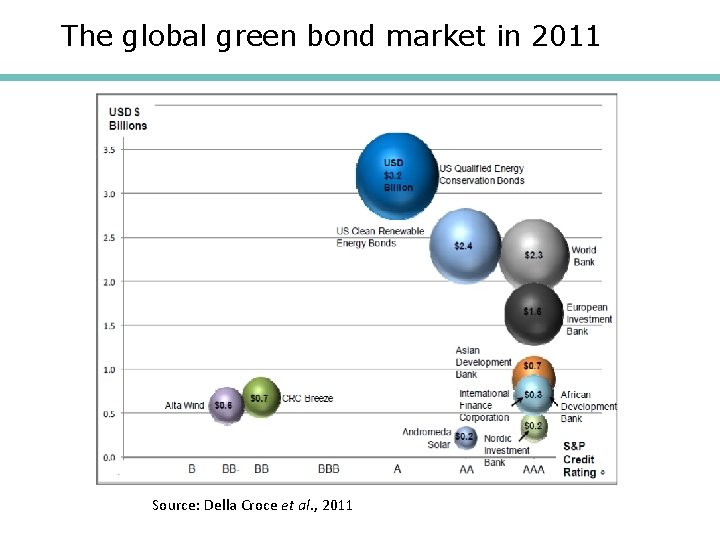
The global green bond market in 2011 Source: Della Croce et al. , 2011
Some final reflections • Is Europe making enough use of the tools at its disposal to create a green economy? • The 7 th EAP is a critical element of the transition to a circular economy. • The EEA will provide the tools and knowledge base to inform the transition to a green, circular economy. • Our five-year Multiannual Work Programme has identified theme of transitions to a green, circular economy as a priority area.
- Slides: 22