
The Greek World Crash Course World History Perisans
























- Slides: 95
The Greek World Crash Course World History: Perisans and Greeks
Take the “How Greek Are You Survey” Add up your score and check against the scale.
If you scored between 60 and 80 60 – 80 – Socrates, Plato, Aristotle, Archimedes, and Homer are you best buds! You value scepticism and have a healthy questioning of authority. You are a romantic that can see the beauty of all things, even painful or hurtful things and you emphasize dialogue and discussion rather than force and action.
If you scored between 40 and 60 40 – 60 – You are very much like a modern person. You are a product of the modern world’s blending and exposure to other philosophies and experiences. Some of the Greek ways of thinking are just not possible in a polis the size of Winnipeg and even less possible in a country the size of Canada so it’s understandable you are not totally Greek.
If you scored between 20 and 40 20 – 40 – Still somewhat in the “Dark Ages”, you are more action oriented and living in the here and now. You are focussed and efficient and that which does not concern your daily life does not clutter your attention.
If you scored less than 20 0 – 20 – You, sir, are a barbarian. You live a life of hedonism and action, you are totally in the moment and you do not worry about the past and even less about the future. Peter Griffin, Bart Simpson, and Steve-O are more your philosophical inspirations. Get your finger out of your nose and open a window cause you are all about the party!
The Mediterranean Civilizations – Greece and Rome Part 1 – The Greek World
Geography Greece – rugged rocky terrain, variable rainfall amounts – unpredictable growing conditions Only 10% of land is arable, and it must be fallowed often. Poor, chalky, acidic soil. Heavy reliance on the “Mediterranean Triad” – grains, olives, wine – specifically, beans, barley, and wheat.
Maritime Culture No place in the islands or the southern mainland is more than 32 miles from the sea Relatively calm waters and inlets along the coast make sailing relatively safe and reliable. This means that trade becomes important. This combination of terrain, weather, and soil conditions leads to the formation of separate, small, farming communities that are periodically forced to trade amongst each other – early forms of city-states
The history of settlement in Greece can be divided into 8 distinct periods: Stone Age – 1000, 000 – c 3500 BCE Early Bronze Age (Cycladic) – c 3500 BCE – 2000 BCE Middle Bronze Age (Minoan) – c 2000 BCE – 1600 BCE Late Bronze Age (Mycenaean) - 1600 BCE – 1100 BCE Dark Ages – 1100 BCE – 700 BCE Archaic Period – 700 BCE – 480 BCE Classical Period – 480 BCE – 323 BCE Hellenistic Period – 323 – 31 BCE
Stone Age �Divided into three eras – Paleolithic, Mesolithic, and Neolithic �Paleolithic – hunting and gathering, no permanent settlements and stone tools. �Mesolithic – agriculture begins – gradual formation of permanent settlements – Francthi �Neolithic – agricultural revolution is complete, permanent settlements begin to form, social stratification develops, political class is formed, public works indicate civic organization – palaces
The Bronze Age There are three dominant Bronze Age cultures found in ancient Greece: Cycladic – 2500 BCE to 1900 BCE Minoan – 2000 BCE to 1400 BCE Mycenaean - 1600 BCE to 1100 BCE
Early Bronze Age Development of metallurgy Bronze multiplier effect – a single event that triggers a chain reaction of developments in a society Arms race begins and trade follows – city-states fight and trade for new innovations in weaponry
Social changes – Early Bronze Age Craft specialization – trade skills for staples allows for specialized craftsmen in urban centers. New professions New social strata Power/wealth shifts Spatial distribution of settlements change – fewer, larger settlements that control larger areas markets
Social changes of the Early Bronze Age Social stratification becomes more complex Accumulations of wealth occur As trade becomes more important, certain settlements along the coast become more important than others. Urbanization increases Commerce emphasized The cities begin to rise – Aegean Sea and the west coast of Turkey - Troy
Cycladic Period Centered in the scattered, rocky islands in the Eastern Mediterranean Ios, Naxos, Melos Skilled metalworkers and craftsmen Not concentrated in towns, not warlike – had no defences for their settlements Religion focussed on female deities No emphasis on scale – all art is small, figurines, etc.
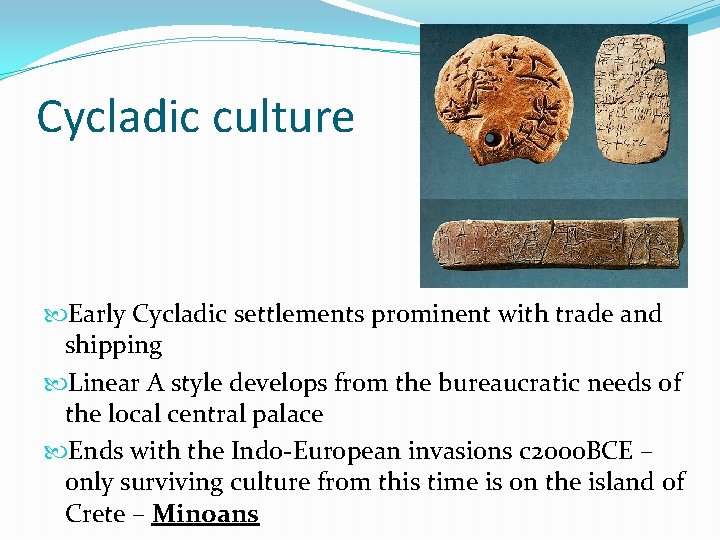
Cycladic culture Early Cycladic settlements prominent with trade and shipping Linear A style develops from the bureaucratic needs of the local central palace Ends with the Indo-European invasions c 2000 BCE – only surviving culture from this time is on the island of Crete – Minoans
Middle Bronze Age Cycladic society faded slowly but had great influence on the cultures that would follow. Gradually pushed out from an invasion from the north Indo-European tribes – linguists show that this infiltration was gradual and assimilative – they blended with local populations to form Achaeans (proto-Greeks) Only the Minoans survive on Crete Eventually, Minoans retake the mainland – culture flourishes/spreads Linear A style found - simplified form of Egyptian hieroglyphics – indicating trade and contact Emphasis on animals and nature loving in art
Minoan Centered on the island of Crete – last of the Cycladic islands, resisted the Indo-European invasion Remarkably sophisticated culture – largely unknown until 1899 Arthur Evans – Discovered a massive palace at Knossos – held 6000 people, over 800 rooms, no organized floorplan – palace appears to have been added to over time – labyrinthine Palace at Knossos
Minoan Culture Assumed to be the palace of King Minos from Homeric poetry. Some walls still had frescoes on them depicting bulls – the bull figured prominently in Minoan culture – Minotaur Prominent traders – Crete lies along trade routes between mainland Europe, Egypt, and the Middle East.
Minoan Culture Other large centers have been discovered on Crete at Phaestus and Hagia Triada. Depictions of Cretan life showed a peaceful people with a fully developed and prosperous middle class. Women were depicted topless, indicating they held a high status. Their style of their art emphasized time, place, and individuality over idealized and essential in Egyptian art. Naturalistic rather than stylized.
Minoan Religion �Minoan religion was centred on worship of the bull. Young females were often shown “bull vaulting” – presumably showing reverence and mastery of the savagery and power of nature. �No depictions of the warrior class, no walls or fortifications for major cities, there are no monumental depictions of the ruler and the cult of the king is absent – possibly due to the high status of women in the culture �There is, however, some evidence of child sacrifice �Minoan Civilization
Linear A/B �Minoans developed their own style of writing called Linear A –this indicated a bureaucratic class that controlled trade and taxation. �Well developed road systems crossed the island. Towns had streetplans, drainage, and habitations show a social stratification between upper and lower classes. First flush toilets are found in Knossos �Levies and taxes were paid in the form of goods and flowed through regional centers before ending up at Knossos. �A second style of writing Linear B, was found at Knossos, this later style indicated to Evans that Knossos Palace had changed hands.
Minoan Collapse Beginning around 1450 BCE, Minoan civilization began to die out with the final destruction of Knossos in 1375 BCE. There are several theories as to the cause: Eruption of the volcano at Thera – causing massive devastation all over the Cyclades Invasion from mainland Greeks – Mycenaeans Minoan Collapse
Late Bronze Age Myceneans capture Knossos – conquer Minoans in c 1450 BCE Dynamic pottery becomes static as Minoan influence ends Greece becomes divided into loose federation of city-states subject to federal capital at Mycenae Development of Linear B style Accumulation of wealth as capital gains control of trade routes through conquest/piracy
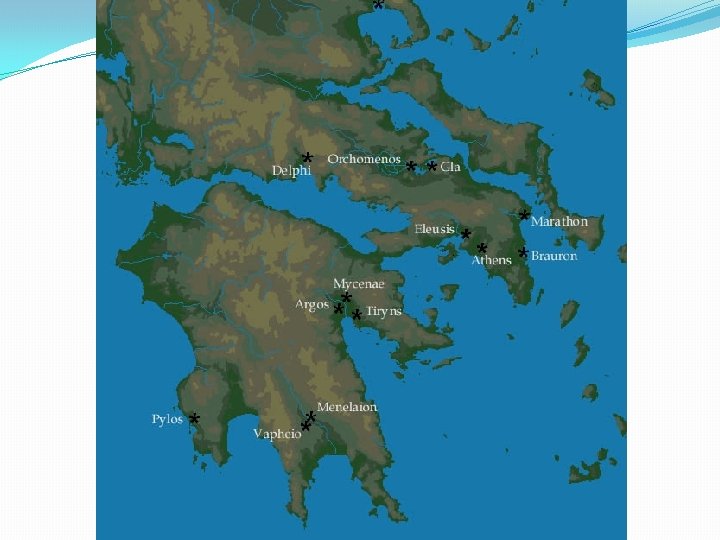
Mycenae Dominated the eastern Mediterranean from 1600 BCE to 1100 BCE – become one of the three dominant Mediterranean cultures: 1) Egyptians 2) Hittites 3) Mycenaeans Dynasty founded in c 1600 BCE Perseus (? ) City is named in Homeric epics – Agamemnon, Odysseus, Atreus Mycenaean History and Archeology
Mycenaean culture The Mycenaean economy was based on small scale agriculture, including the “Mediterranean Triad” as well as metalworkers and craftsmen. The most important industry was textiles – wool and linen. Above all, while the Minoans were based on trade and commerce, the Mycenaeans were based on piracy and conquest. The palace was the administrative center for the surrounding countryside. It would house the warrior king and their bureaucracy as well as the service craftsmen required to run the capital. Land surrounding the palace was either owned by the king and worked by slaves or leased to free farmers.
Mycenaean religion Classical Greek gods begin to arise – Poseidon, Zeus. Hera Role of women is prominent Borrowed heavily from Minoan culture Priest class subjugated to the king Sanctuary found at Mycenae for a snake-goddess
Mycenae Reached the peak of it’s power after to came to dominate the gold trade routes from Eastern Europe 1400’s – construction of the citadel: Massive “Lion’s Gate” above the main entrance to the city Cyclopean walls – massive stone block construction Cistern dug under the city – water supply could withstand long sieges
Mycenaean burials Peribolos walls surround a series of graveshafts – 2 circles Capital city discovered in 1870’s by Heinrich Schliemann He thought he had found the grave of Agamemnon himself due to the amount of gold it contained. 2 grave circles contained 19 bodies – 8 men, 4 women, 7 children – men were all wearing gold, approx. 6 ft. Tall- indicating high wealth, status, and good nutrition throughout their lives.
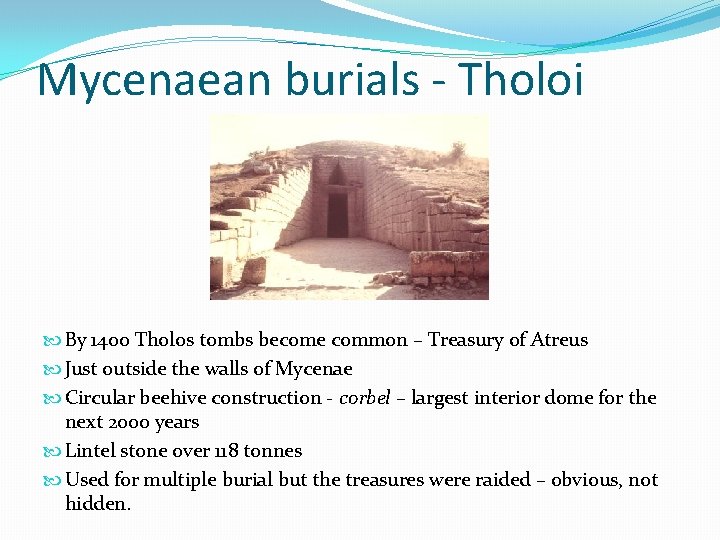
Mycenaean burials - Tholoi By 1400 Tholos tombs become common – Treasury of Atreus Just outside the walls of Mycenae Circular beehive construction - corbel – largest interior dome for the next 2000 years Lintel stone over 118 tonnes Used for multiple burial but the treasures were raided – obvious, not hidden.
Mycenae 2500 BCE – earliest evidence of settlement at Mycenae 1600 BCE – Wealth comes to Mycenae, probably result of mercenary activity hired by Egyptians 1200 BCE – economic recession, loss of markets, force Myceneans to attack northern allies – Trojans 1180 BCE – according to Homer – Helen, a Mycenaean priestess and wife of Menelaus, brother of Agamemnon is abducted by Paris of Troy – sparking the Trojan War.
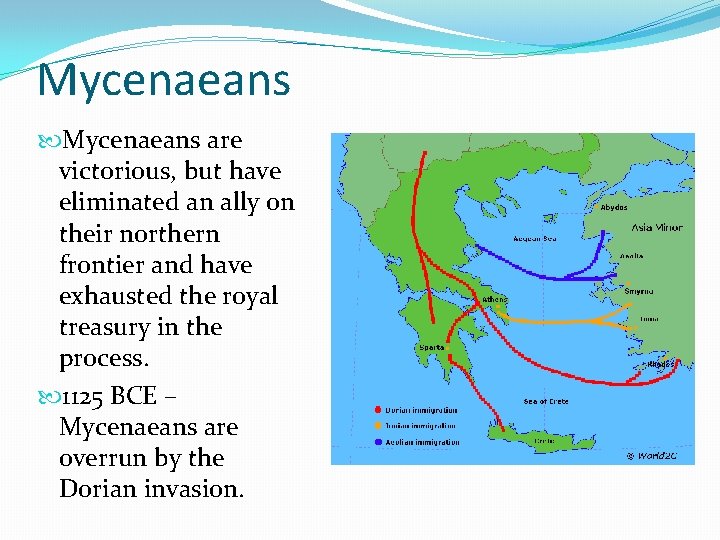
Mycenaeans are victorious, but have eliminated an ally on their northern frontier and have exhausted the royal treasury in the process. 1125 BCE – Mycenaeans are overrun by the Dorian invasion.
Bronze Age ends Trojan War develops 1180 – begins the decline in power of Mycenae as settlements are raided and destroyed eg. Palace of Nestor at Pylos – 1200 BCE Mycenaean collapse – 1100 BCE The Truth About Troy
Dark Ages c 1200 BCE to 480 BCE �After the fall of Mycenae – a Dark Age begins in Greece. �No culture surviving, no written records �Federal system is destroyed – palaces burned, Knossos, Mycenae, Pylos civilization drops significantly, very few historical records exist because writing stopped sometime between 1100 and 1000 BCE
Dark Age society Aristocratic Age – heroes, great men honour becomes social focus and prime motivation. Stress of the type not the individual. Trade collapses – produces closed household economies. Each household aims to consume all it produces. Exceptions – iron, salt Social stratification diminishes – becomes more simple Similar to Egyptians, idealized conceptual art dominates the Greek world. Geometric design develops.
Population Collapse Eg. Pylos – population falls to 10% of Late Bronze Age levels Centralized government, population, literacy, urbanization, all disappear from Greek life for 400 years Exact cause is still unknown
Possible Causes? Dorian Invasion from the north – possible but not sufficient to destroy the entire culture Decline in Hittite and Egyptian kingdoms – would disrupt trading networks that made Mycenae so powerful Volcanic or other natural disasters – could have caused agricultural failures
Historians now think that the Mycenaean Collapse was internal: Fragile culture based on military elites dominating maritime commerce Overpopulation in a land that could not support too many people Overspecialization on certain cash crops like sheep and wheat Rivalry among city states lead to mutual sacking of city palaces
Father will have no common bond with son Neither will guest with host, nor friend with friend The brother-love of past days will be gone. . . Men will destroy the towns of other men. . . Hesiod (c 800 BCE) What kind of society is depicted here? How reliable is this as a source?
The Greeks scatter across the Mediterranean Evidence of mercenary service in the Egyptian military Many turned to piracy. Many migrated out of mainland Greece to the islands and west coast of Asia Minor (Turkey) Each of these migrations develops a separate nationality for their region. Different dialect of Greek is spoken: Dorian - Peloponesse Ionion – West coast of Asia Minor and islands Aeolian – Attica and scattered mainland settlements
Technology Iron replaces bronze as copper and tin become difficult to import. Quality of iron tools begins to improve as techniques are mastered over time. Pottery quality declines, decoration is simple and geometric Pictorial representations of humans and animals almost disappear and there is little to no luxury items being produced. What gold from this period that has been found dates from the Mycenaean Period and was probably robbed from original tombs.
Cultural contributions All that is known from this period comes from archaeology and from epic poetry: Iliad – older poem, dating from the 8 th c BCE Odyssey – dating from c 750 BCE Both are oral histories that originate in the previous Late Bronze Age Mycenaean period – harkening back to the “good old days” where society was in a more perfect state. These oral histories transmit a desire to return to previous culture from generation to generation. The societies depicted in Homeric poetry are not truly Mycenaean, but more Dark Age.
Literature begins in the Dark Ages – essential in formation of Greek nationalism. word of mouth, historical accounts passed on from Mycenean ages as mythology in an effort to recapture the past. Heroic poetry – Homer: Illiad and Oddessy – Trojan War and Odysseus’ return to Ithica – becomes the first exploration of human nature and the human condition
Philosophy emerges… Didactic poetry – Hesiod – cosmogony/theogeny Philosophy’s first attempt to explain/understand the world around them Near the end of the period, the realization that religion and epic poetry are inadequate for this purpose. More is needed.
Social Structure Social distinctions were based on ownership and military prowess. Aristocrats would own farmland engage in combat with their own weapons and horses in coalitions with other aristocrats. Petty kings would dominate small populations of farmers, herders, kin and military alliances. Tensions were indicated in literature between emerging middle class peasants and aristocratic warrior classes.
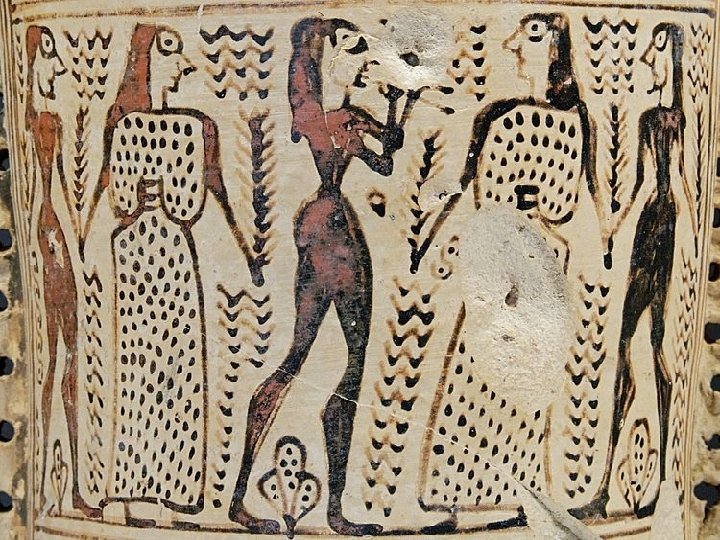
Change begins… Beginning in the 11 th century – influences from beyond the borders of Greek civilization begin to appear. Geometric pottery designs – Egyptian? Iron works that have no precedent in mainland or island Greek culture Greek forms of tomb burial change and cremation becomes common
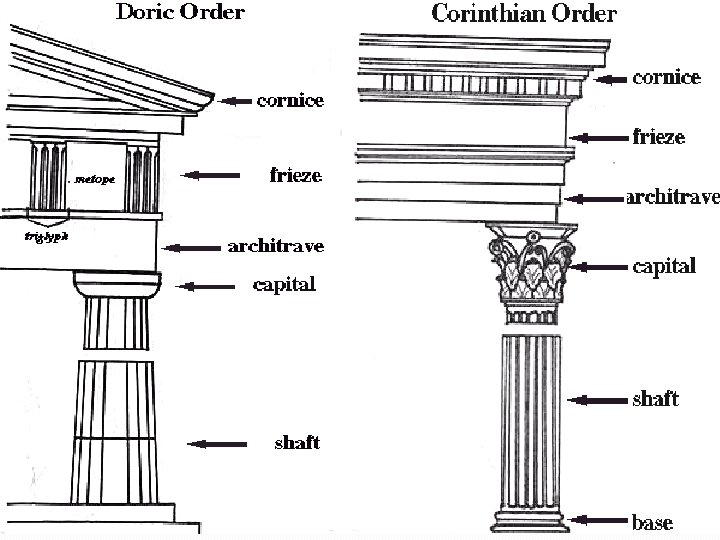
Changes in art forms throughout the Dark Ages begins to indicate that it is coming to an end: Geometric Period – 900 -700 BCE Geometric style dominates Humans and animals appear for the first time Depictions of humans in funerals and mourning Orientalising Period – 700 – 600 BCE Rendering of human form becomes more naturalistic Egyptian influence prominent in sculpture, pose, size, materials 2 styles – Attic – mythological/fantastic stories Corinthian – imaginary/mythological animals Development of Doric and Ionic architectural styles
Doric Corinthian
Doric columns on the Greek temple at Segesta, Sicily, c. 424– 416 bc
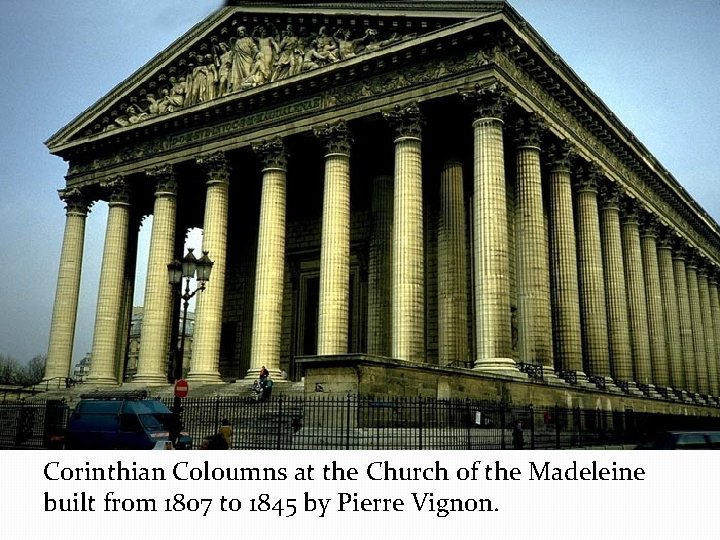
Corinthian Coloumns at the Church of the Madeleine built from 1807 to 1845 by Pierre Vignon.
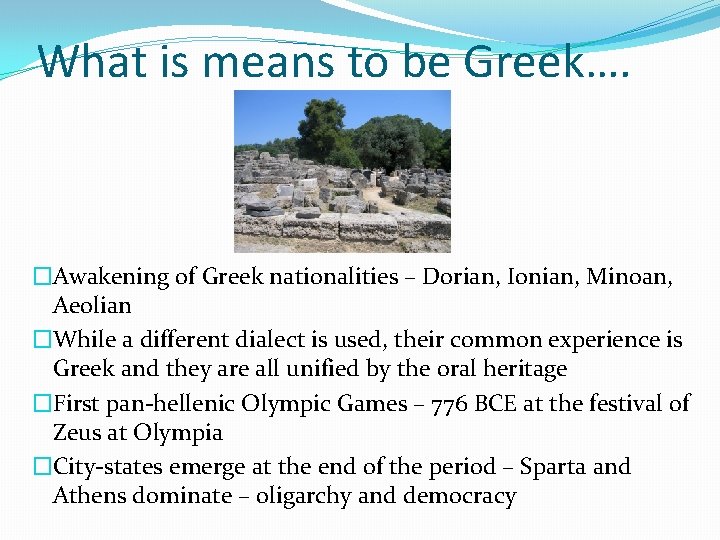
What is means to be Greek…. �Awakening of Greek nationalities – Dorian, Ionian, Minoan, Aeolian �While a different dialect is used, their common experience is Greek and they are all unified by the oral heritage �First pan-hellenic Olympic Games – 776 BCE at the festival of Zeus at Olympia �City-states emerge at the end of the period – Sparta and Athens dominate – oligarchy and democracy
Archaic Period - c 700 BCE– c 500 BCE Out of the Dark Age social structure of farmers and herdsmen loosely ruled by petty kings develops a radically new social structure New political organization New military organization New artistic traditions New intellectual approaches New alphabet
C 800 BCE – Archaic Period begins Population begins to increase, this stresses the land capacity. Coinage appears – money. This intensifies social stratification, slavery appears Growing sense of individualism emerges – manifested in the appearance of lyric poetry – Sappho, women characters and emotional poetry is in stark contrast to male dominated epic poetry Drama appears as well. Artwork scale increases, figures become more lifelike and less Egyptian. 3 dimensional
Bust inscribed Sappho of Eressos, Roman copy of a Greek original of the 5 th century BC
Emphasis on the individual as valuable and distinct from their social role or position More spare time and stability allowing for abstract intellectual pursuits – politics and philosophy. All of these developments become major themes in the development of Western Civilization
Signs of a rapid change in Greek society Huge population increase – in some regions (Attica – 7 x) Shift in herding to stable agriculture Increased urbanization, larger settlements Population soon outstrips carrying capacity of arable land Increased division of labour
Politics The old social structure of chieftains and tribes becomes inadequate for this more complex society These changes, combined with the geography of the region lead to a broad social class with the wealth and leisure time to pursue intellectual innovation – included outside influences through trade. 2 kinds of political organization emerge: Ethnos – Peloponnesian/oligarchy Polis – Aegean/ democracy
Polis – habitation, house, collective group. The citystate arises out of these. Organized settlements separated by landforms and connected by the sea and trade. The result is a grouping of small administrations – the city state, dominated by a large central permanent settlement.
Polis Like a large extended family: Athens – 1000 sq miles, ½ the size of P. E. I. Crete – 3000 sq miles, 43 different poleis Lesbos – 6 different poleis Winnipeg would have 4 poleis for its size Each polis would have its own army, administration, leadership, social mores, its own religion, regional dialect, system of weights and measurements and its own calendar. Polis – root of the word politics
Social Hierarchy These populations got even smaller – only adult males were given full citizenship. . Women – subjugated to males Metics – resident aliens, also don’t count. Displaced from one polis to another Slaves – did not have citizenship. Children
The Emergence of Political Life Athens – 250, 000 people – 20, 000 free adult males By far the biggest polis Overall, Greek life takes place in a very small scale. Everything occurs on a public setting/family setting. Out of this environment comes political life – a new development
Social Stratification Vast wealth accumulations were rare in Greece – gap between rich and poor is very small. With the climate, there is an abundance of leisure time – a totally new development this leading to “public life” – interaction among relatively equal members of small communities, political life develops. Small farms, a focus on individual cultivation, no mass agriculture is possible – horticulture not agriculture. Silver mines are one of the only large scale industries – Laurium – just outside of Athens – worked by slaves.
Ostracism – some individuals’ personal characteristics warrant extreme social isolation and segregation; people could be “voted off the polis” Ostracism becomes necessary to maintain social order and to reduce tensions. There may be crime or guilt involved, simply social volatility could warrant ostracism. Aristotle – man is a political animal Ostracised individuals would be banished from their home polis and would be forced to live in exile or try to join another polis.
All of these developments lead to political and social stasis – normal flows of political life are blocked. Tensions begin to build Solutions: Infanticide – killing of the less desirable young to curb population growth. Colonization – finding new breathing spaces to support higher numbers – up to 1500 are established all over the Mediterranean and parts of Persia – brings Greeks into new conflicts. Colonization period – 750 BCE to 550 BCE Tyranny – someone who forces their way into power from outside the social structure, a sudden and radical political change from one order to another Religion – when faced with difficult social pressures, religion begins to pervade daily life more and more.
Social Development Frederick Jackson Turner – American frontier historian – developed the Turner Thesis of social development The frontier is where innovations take place in a society – social, technological, political, etc. The frontier culture and setting make the best laboratory for these kinds of developments. They are then passed into the central culture. This effect is exhibited in ancient Greek civilization in the Dark Ages as population pressures lead to colonization and the creation of a frontier culture in
Greek religion during the Dark Ages – polytheistic spectrum Apollo – calm acceptance: “Know thyself” Vs Dionysius- Abandon self control “Forget thyself”
Dionysian approach to religion – rooted in the notion of life cycle – rebirth Dualistic religion like the Egyptians Based on mystery and religious hierarchy. Acceptance into the religion was granted only after approval and included ceremonies that were kept secret. This created a mechanism for compensation for deindividualization of economically strained eras Eleusinian Mysteries – based in the temple of Dionysus in Eleusis – place where mysterious rites were performed that were fabled to grant eternal life.
Classical Greece (480 BCE – 323 BCE) This period lasts through the creation of a Greek empire, by Alexander the Great. Characterized by most of the cultural wonders that we associate with ancient Greece. The period of the height of democracy, the flowering of Greek Tragedy, and the architectural marvels at Athens Begins either with the fall of the Athenian tyrant Hippias, in 510 B. C. , or the Persian Wars, which the Greeks fought against the Persians in Greece and Asia Minor from 490 -479 B. C. When you think of the movie 300, you're thinking of one of the battles fought during the Persian Wars. This period ends with the death of Alexander the Great in 323 B. C.
The Rise of Democracy didn’t happen overnight. The process developed and changed over time. Besides war and conquest, in the Classical period the Greeks produced great literature, poetry, philosophy, drama, and art. the genre of history was first established. It also produced the institution we know of as Athenian democracy. Democracy lasted beyond the Classical period and had its roots in the earlier time, but it still characterized the Classical age.
Oligarchy vs. Democracy In the Archaic Age, Athens and Sparta had followed different paths. Sparta had two kings and an oligarchic (rule by a few) government A Spartan woman had the right to own property, whereas in Athens, she had few freedoms. In Sparta, men and women served the state; in Athens, they served the oikos 'household/family'. Oligarchy oligos 'few' + arche 'rule' Democracy demos 'the people of a country' + krateo 'rule'
Democracy Oligarchy
Tyranny Monarchy
Anarchy
Economy = oikos 'home' + nomos 'custom, usage, ordinance' Men were trained in Sparta to be laconic warriors and in Athens to be public speakers.
Persian Wars Despite an almost endless series of differences, the Hellenes from Sparta, Athens, and elsewhere fought together against the monarchical Persian Empire. In 479 they repelled the numerically mightier Persian force from the Greek mainland.
Peloponnesian and Delian Alliances For the next few decades after the end of the Persian Wars, relations between the 2 major poleis'city-states' deteriorates The Spartans, who had earlier been the unquestioned leaders of the Greeks, suspected Athens (a new naval power) of trying to take control of all of Greece. Most of the poleis on the Peloponnese allied with Sparta. Athens was at the head of the poleis in the Delian League. Its members were along the coast of the Aegean Sea and on islands in it. The Delian League initially had been formed against the Persian Empire, but finding it lucrative, Athens transformed it into its own empire.
Public Office Pericles, foremost statesman of Athens from 461 -429, introduced payment for public offices so more of the population than just the rich could hold them. Pericles initiated the building of the Parthenon, which was supervised by the famed Athenian sculptor Pheidias. Drama and philosophy flourish
The Aftermath of Peloponnesian War Tensions between the Peloponnesian and Delian alliances mount The Peloponnesian War breaks out in 431 and lasted for 27 years. Pericles, along with many others, dies of plague early in the war. Even after the end of the Peloponnesian War, which Athens lost, Thebes, Sparta, and Athens continued to take turns as the dominant Greek powers Instead of one of them becoming the clear leader, they dissipated their strength and fell prey to the empire-building Macedonian king Phillip II and his son Alexander the Great.
Alexander the Great Philip II and his son Alexander (of Macedonia) put an end to the power of the individual city-states and spread the culture of Greece all the way to the Indian Sea. Born around July 20, 356 B. C. E. Tutored by Leonidas (possibly his uncle) and the great Greek philosopher Aristotle. During his youth, Alexander showed great observational powers when he tamed the wild horse Bucephalus. In 326, when his beloved horse died, he renamed a city in India/Pakistan, on the banks of the Hydaspes (Jhelum) river, for Bucephalus. In 340 B. C. E. , while his father Philip went off to fight rebels, Alexander was made regent in Macedonia. During his regency, the Maedi of northern Macedonia revolted. Alexander put down the revolt and renamed their city after himself. In 336 after his father was assassinated, he became ruler of Macedonia.
The Gordian Knot One legend about Alexander the Great is that when he was in Gordium, Turkey, in 333, he undid the Gordian Knot. This knot had been tied by the legendary, fabulously wealthy King Midas. The prophecy about the Gordian knot was that the person who untied it would rule all of Asia. Alexander the Great is said to have undone the Gordian Knot by unraveling it, but by slashing through it with a sword.
Death In 323, he returned to Babylonia and becomes suddenly ill and dies. cause is unknown. It could have been disease or poison. It might have had to do with a wound inflicted in India. Alexander the Great Iron Maiden: Alexander the Great