
The Great Schism of 1054 What was the
- Slides: 8
The Great Schism of 1054
What was the Big Deal? • There was already tension between the Byzantine and old Roman Empire. • The Eastern priests could marry before they became priests. Rome didn’t agree. • The Roman church used unleavened bread in their mass. The east thought this was too “Jewish”. • The Eastern church had Greek mass. The Roman Church used Latin. • The Eastern churches did not like how the Pope of Rome claimed himself to be the head of the Christian church. • If anyone, the Eastern church believed the patriarch (bishop) of Constantinople should be the head. • In 1054, the final straw came when the Western Church added the filioque to their creed which included the “Holy Spirit” in the Christian Trinity.
• In 1054, Pope Leo IX of Rome and the Patriarch/Bishop of Constantinople decided to excommunicate each other. • Excommunication is the worst punishment a member of the Christian Church can receive. • They are not allowed to receive sacraments and have no hope of entering heaven, according to Christian beliefs. The result of the 1054 Schism is the division between the Roman Catholic and Eastern Orthodox Church. The word Orthodox means dedication to the traditional faith. The Eastern church believed that they followed traditional Christian beliefs and unlike the Roman church with they viewed as greedy and too close to Judaism. Divided church for 100 years; final straw in the split Some believed icons to be worshipped, some saw them as symbols of God’s presence. AD 726 – Byzantine Emperor Leo III ends use of icons in church. Followers known as iconoclasts = image breakers. Many refused to follow; AD 787 church appeals decision
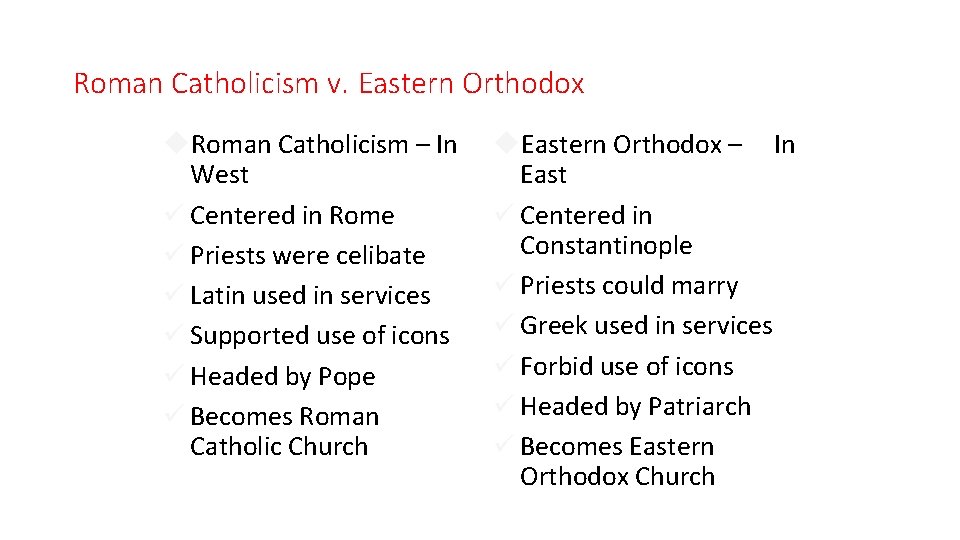
Roman Catholicism v. Eastern Orthodox Roman Catholicism – In West ü Centered in Rome ü Priests were celibate ü Latin used in services ü Supported use of icons ü Headed by Pope ü Becomes Roman Catholic Church Eastern Orthodox – In East ü Centered in Constantinople ü Priests could marry ü Greek used in services ü Forbid use of icons ü Headed by Patriarch ü Becomes Eastern Orthodox Church
• Protestantism • It is one of the three major branches of Christianity, along with Roman Catholicism and Eastern Orthodoxy. It shares with all other Christians core beliefs in the doctrines of the Trinity and the divinity of Jesus, the necessity of grace to save humans from the consequences of sin, and the centrality of Jesus' death and resurrection for salvation. Composed of hundreds of denominations with an expansive variety of doctrines, rituals, and religious practices, Protestantism formed from the split with Roman Catholicism during the Reformation in the 16 th century. Led by Martin Luther, John Calvin, and others, the reformers broke from the Roman Catholic Church due to abusive ecclesiological structures and theological differences. Protestants share an adherence to the centrality of scripture (both the Hebrew scriptures and the New Testament) as well as a doctrine of salvation through faith in Jesus Christ. Different Protestant denominations have to varying degrees maintained or rejected Roman Catholic forms of worship. Anglican and Lutheran churches have maintained liturgies and rituals similar to those of the Roman Catholic Church, whereas other denominations, such as Baptists, Presbyterians, Pentecostals, and United Church of Christ, have developed less liturgical forms of worship. Most Protestants practice baptism and communion as key rites of Christian initiation and ongoing devotion. Though originating in Europe, Protestant Christianity has spread across the globe through missionary activity and now has members from nearly every country, race, and ethnicity.
• Core of his teachings rest in three “alones” or “onlys. ” • Sola Fide—Salvation is “by faith alone. ” Faith is free and is a gift from God. • (Erasmus—an exercise of free will, people could choose to believe); • Sola Gratia—salvation depends on the grace of God alone—his gift is independent of human action—it is because of Christ’s death on the Cross—man need only have faith, believe, accept, and ask … • 3) Sola Scriptura—the “Bible alone” teaches all we need to know and is the single source of authority—Popes, councils, and traditions were sinful man-made inventions to keep people loyal to a human endeavor—not to God as it should be …
Sacramentalism • Sacramentalism is a central and vital component within Catholic theology. For Catholics, sacraments are “effective signs” of grace instituted by Christ. Catholicism’s seven sacraments (baptism, confirmation, Eucharist, penance, extreme unction[last rites], holy orders[ordination into the priesthood], and matrimony) both signify grace and cause it to happen ex opere operato (“they work by their own working”). • While various evangelical denominations differ in their acceptance and approach to sacraments (or ordinances), generally speaking evangelicals differ with the Catholic view in number, nature, and operation of the sacraments. The Eucharist and the sacrificial nature of the mass in particular engender great dispute between Catholics and evangelicals. Both of these areas of concern have direct Christological implications
• The Eucharist is the celebration of the death, burial and resurrection of Jesus. • In the Bible, it is called the Lord's Supper. • Christians are invited to celebrate the Eucharist every week during Mass. • Children usually make their First Holy Communion at the age of 7 or 8. • This is a formal affair, and children completing their First Holy Communion wear formal attire. • … Water baptism makes believers a part of the church. It is a custom of the Catholic Church to baptize infants.