
The Great Lakes St Lawrence River Basin Water
The Great Lakes – St. Lawrence River Basin Water Resources Compact September 7, 2006
Welcome § Council of Great Lakes Governors § § Founded in 1983. Mission: To encourage and facilitate environmentally responsible economic growth. Members: Governors of the eight Great Lakes States – Illinois, Indiana, Michigan, Minnesota, New York, Ohio, Pennsylvania, and Wisconsin. Associate Members: Premiers of Ontario and Québec. § Council of State Governments - Midwestern Office § § Founded in 1933. Mission: Focus on those issues of greatest interest to policymakers in our nation’s heartland – providing state leaders with the resources and tools they need to effectively address today’s public policy challenges.
Welcome § Agenda § § Introduction and Context Interstate Compacts Great Lakes Agreement and Compact Issues, Questions and Resources § Learning Objectives § Understand the general functions and use of compacts. § Learn about the history of the Great Lakes States’ and Provinces’ efforts to protect and manage Great Lakes water. § Become familiarized with the objectives of the recent agreements and the implementation process.
Introduction § Generate: Questions § Create a list of questions and concerns regarding the agreements. § The list will assist in making sure that all questions are addressed during the presentation. § Resources will be provided for additional information.
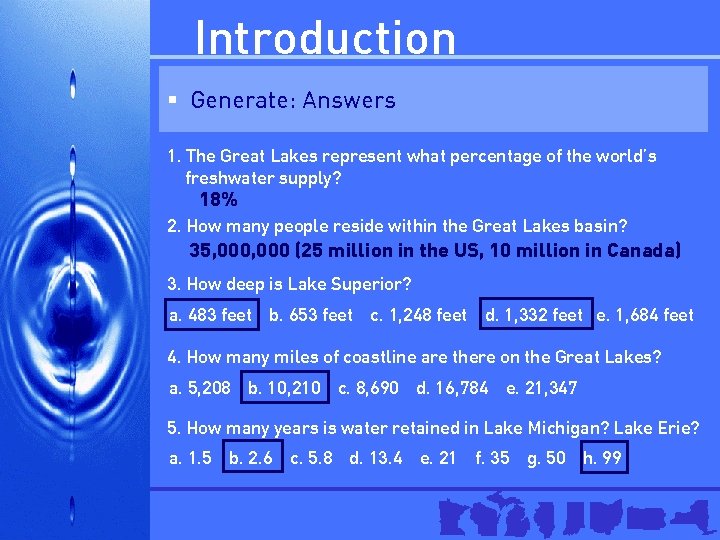
Introduction § Generate: Answers 1. The Great Lakes represent what percentage of the world’s freshwater supply? 18% 2. How many people reside within the Great Lakes basin? 35, 000 (25 million in the US, 10 million in Canada) 3. How deep is Lake Superior? a. 483 feet b. 653 feet c. 1, 248 feet d. 1, 332 feet e. 1, 684 feet 4. How many miles of coastline are there on the Great Lakes? a. 5, 208 b. 10, 210 c. 8, 690 d. 16, 784 e. 21, 347 5. How many years is water retained in Lake Michigan? Lake Erie? a. 1. 5 b. 2. 6 c. 5. 8 d. 13. 4 e. 21 f. 35 g. 50 h. 99
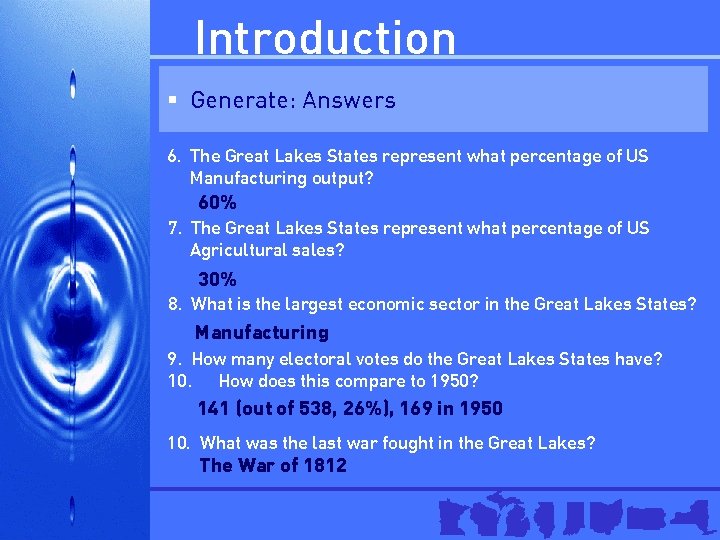
Introduction § Generate: Answers 6. The Great Lakes States represent what percentage of US Manufacturing output? 60% 7. The Great Lakes States represent what percentage of US Agricultural sales? 30% 8. What is the largest economic sector in the Great Lakes States? Manufacturing 9. How many electoral votes do the Great Lakes States have? 10. How does this compare to 1950? 141 (out of 538, 26%), 169 in 1950 10. What was the last war fought in the Great Lakes? The War of 1812
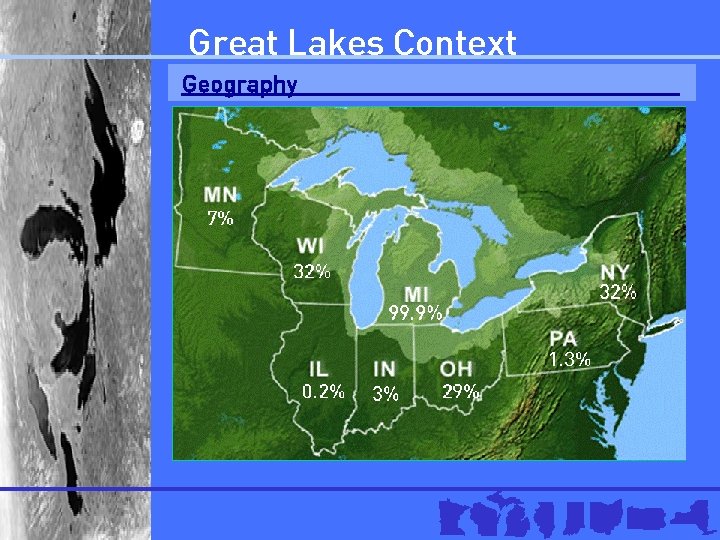
Great Lakes Context Geography
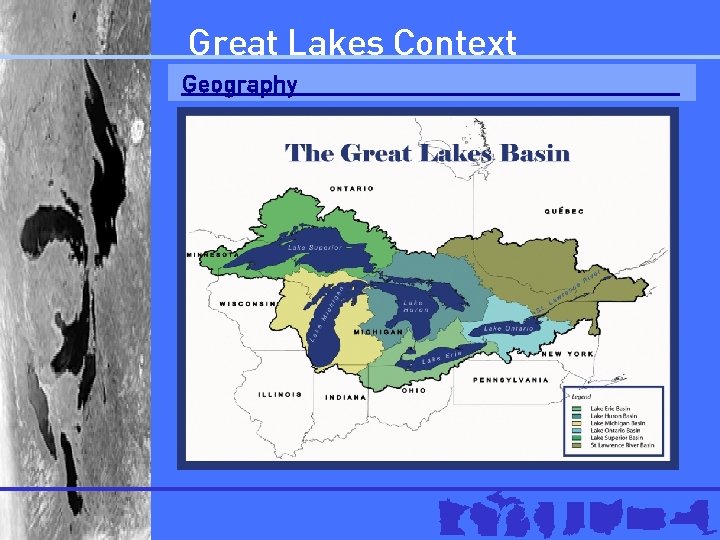
Great Lakes Context Geography
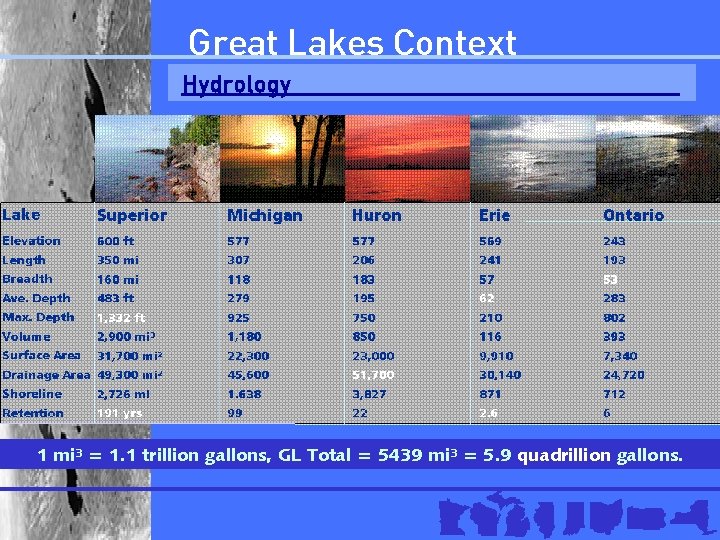
Great Lakes Context Hydrology 1 mi³ = 1. 1 trillion gallons, GL Total = 5439 mi³ = 5. 9 quadrillion gallons.
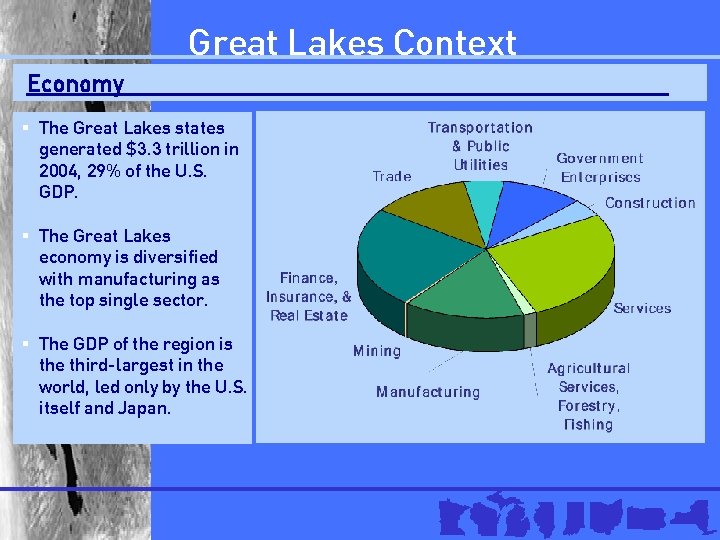
Great Lakes Context Economy § The Great Lakes states generated $3. 3 trillion in 2004, 29% of the U. S. GDP. § The Great Lakes economy is diversified with manufacturing as the top single sector. § The GDP of the region is the third-largest in the world, led only by the U. S. itself and Japan.
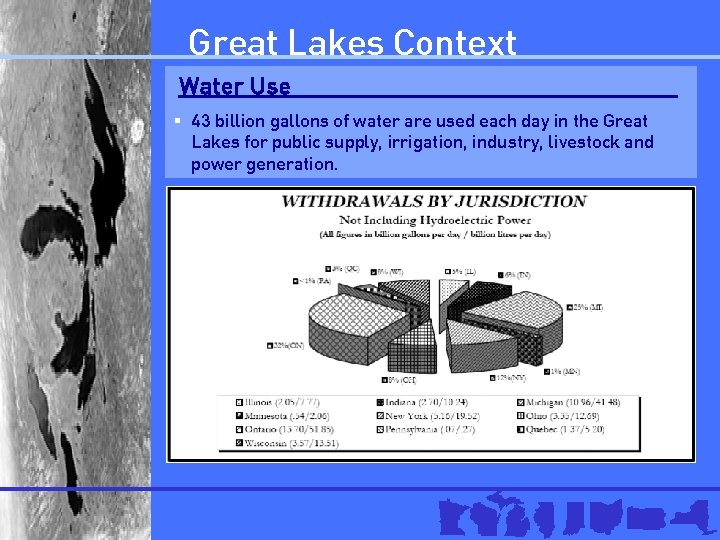
Great Lakes Context Water Use § 43 billion gallons of water are used each day in the Great Lakes for public supply, irrigation, industry, livestock and power generation.
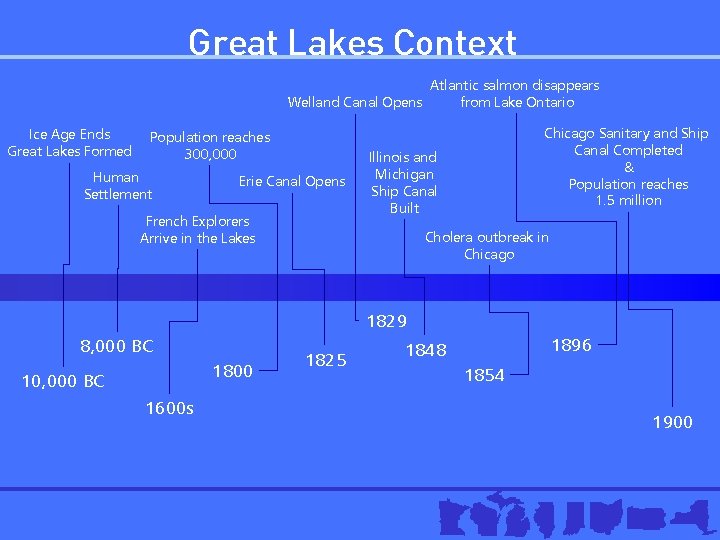
Great Lakes Context Atlantic salmon disappears from Lake Ontario Welland Canal Opens Ice Age Ends Great Lakes Formed Population reaches 300, 000 Human Settlement Erie Canal Opens French Explorers Arrive in the Lakes Chicago Sanitary and Ship Canal Completed & Population reaches 1. 5 million Illinois and Michigan Ship Canal Built Cholera outbreak in Chicago 1829 8, 000 BC 1800 10, 000 BC 1600 s 1825 1896 1848 1854 1900
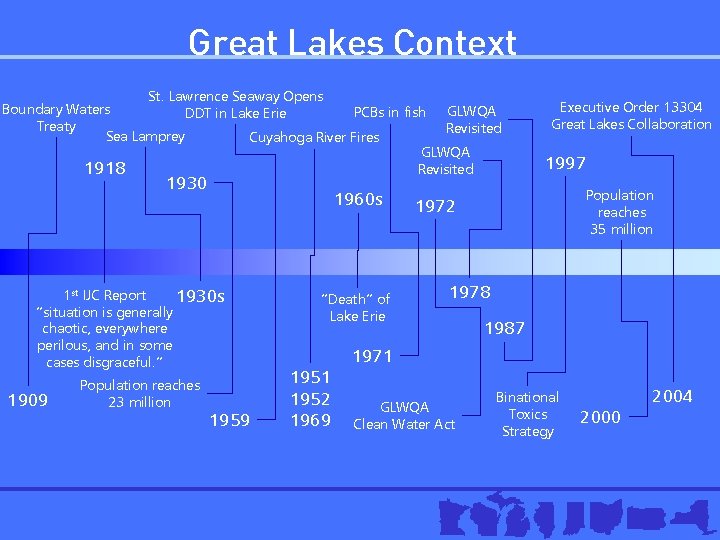
Great Lakes Context St. Lawrence Seaway Opens Boundary Waters PCBs in fish GLWQA DDT in Lake Erie Treaty Revisited Sea Lamprey Cuyahoga River Fires GLWQA Revisited 1918 1930 1960 s 1 st IJC Report 1930 s “situation is generally chaotic, everywhere perilous, and in some cases disgraceful. ” 1909 Population reaches 23 million 1959 “Death” of Lake Erie 1951 1952 1969 Executive Order 13304 Great Lakes Collaboration 1997 Population reaches 35 million 1972 1978 1987 1971 GLWQA Clean Water Act Binational Toxics Strategy 2000 2004
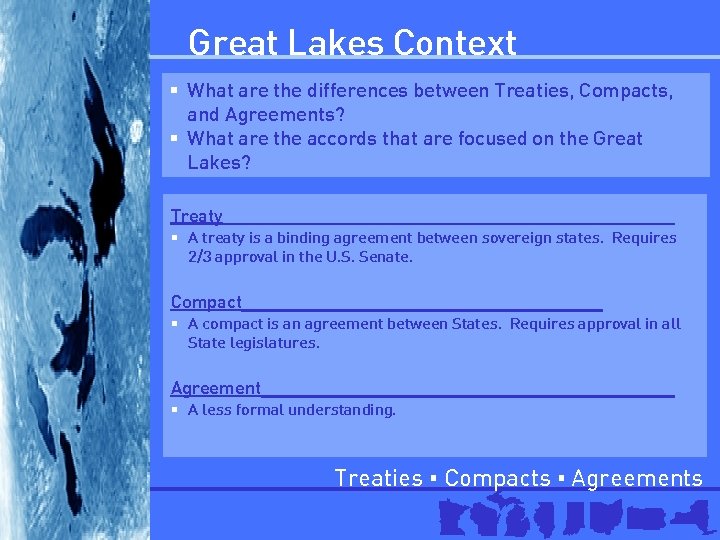
Great Lakes Context § What are the differences between Treaties, Compacts, and Agreements? § What are the accords that are focused on the Great Lakes? Treaty § A treaty is a binding agreement between sovereign states. Requires 2/3 approval in the U. S. Senate. Compact § A compact is an agreement between States. Requires approval in all State legislatures. Agreement § A less formal understanding. Treaties ▪ Compacts ▪ Agreements
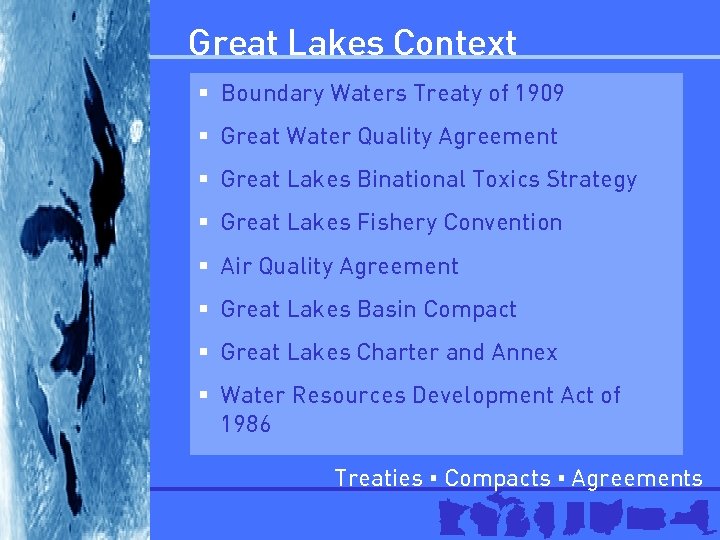
Great Lakes Context § Boundary Waters Treaty of 1909 § Great Water Quality Agreement § Great Lakes Binational Toxics Strategy § Great Lakes Fishery Convention § Air Quality Agreement § Great Lakes Basin Compact § Great Lakes Charter and Annex § Water Resources Development Act of 1986 Treaties ▪ Compacts ▪ Agreements
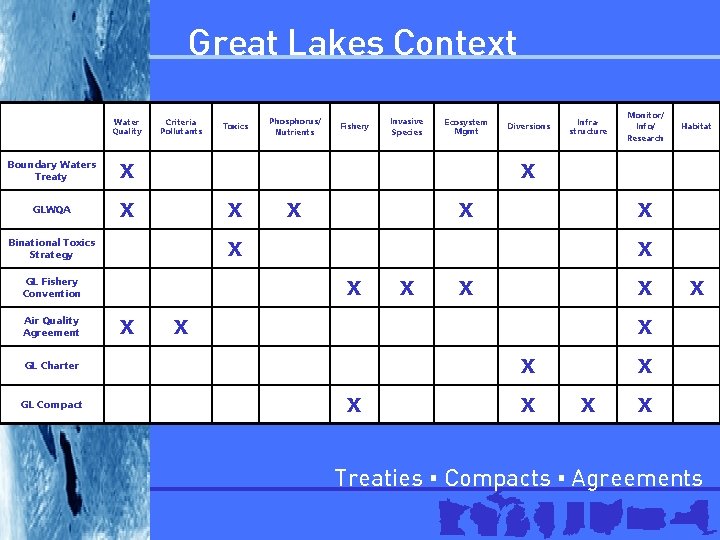
Great Lakes Context Water Quality Boundary Waters Treaty X GLWQA X Criteria Pollutants Phosphorus/ Nutrients Fishery X Ecosystem Mgmt Diversions Infrastructure X X Habitat X X X Monitor/ Info/ Research X X GL Fishery Convention X X X X GL Charter GL Compact Invasive Species X Binational Toxics Strategy Air Quality Agreement Toxics X X X Treaties ▪ Compacts ▪ Agreements
Great Lakes Context Boundary Waters Treaty of 1909 § Mechanism for preventing and resolving water disputes between U. S. and Canadian federal governments. § Created the International Joint Commission (IJC) to oversee the treaty and ensure levels and flows are not affected. § Limitations § Geographic scope: only applies to boundary waters. § Limited to managing uses affecting levels and flows.
Great Lakes Context Great Lakes Charter of 1985 § Good-faith agreement among the Great Lakes Governors and Premiers. § Created notice and consultation process for large new or increased diversions, in-Basin uses. § Commitment by States, Provinces to pass legislation to manage and regulate diversions, in-basin uses. § Limitations § Good-faith nature § Uneven implementation
Great Lakes Context Water Resources Development Act of 1986 § U. S. federal statute. § Subjected diversions to approval by the Governors (veto authority). § Limitations § Scope: does not include in-Basin uses. § Lack of definitions, decision-making standard and process. § Questionable applicability to groundwater. § Premiers not included in decision making.
Interstate Compacts § Legal Basis § Key Elements and Features § History and Examples Section Agenda
Interstate Compacts § Contracts between two or more States § Powerful, durable, and adaptive § State-developed structure for collaborative action § Provided for in the U. S. Constitution Legal Basis
Interstate Compacts § More than 200 interstate compacts currently. § On average, a State belongs to about 25 compacts. § Many are regional or national in scope. § Types: § Border § Advisory § Regulatory Scope and Types
Interstate Compacts § Establish a formal, legal relationship among States to address common problems. § Retain State sovereignty in matters traditionally reserved for the States. § Create a process for settling interstate disputes without having to go to courts or Congress. § May establish common guidelines, standards, or procedures. Key Elements and Features
Interstate Compacts § Examples § Great Lakes Basin Compact § Delaware and Susquehanna River Basin Compacts § Hazardous Waste Movement Compacts § Multiple state governmental authorities working together. § Value § Ratification Process § Congressional Consent History and Examples
Great Lakes Agreements § Impetus for New Protections § Agreements’ Development Process § Key Elements of Agreement and Compact Section Agenda
Great Lakes Agreements What is at Stake? § Maintaining regional control of Great Lakes water resources. § Ensuring water is available for future use and economic growth.
Great Lakes Agreements Impetus for New Protections § 1998 – Nova Group proposal § 1999 – Recurring lower Lake levels § 2000 – WRDA amendments, IJC report § 2001 – Great Lakes Charter Annex
Great Lakes Agreements’ Development Process § State and Provincial Leadership § Ten jurisdiction Working Group § Advisory Group/Resource Group/Observers § § Regional Stakeholders Federal Governments Ongoing Consultation Key Role in Development § Tribes and First Nations § Public Involvement
Great Lakes Agreements’ Development Process § Major Public Review § Public Notice – Two Rounds § Public Meetings in Each Jurisdiction § Website for Comments § Over 13, 000 E-mailed and Written Comments Received § Several Regional Forums
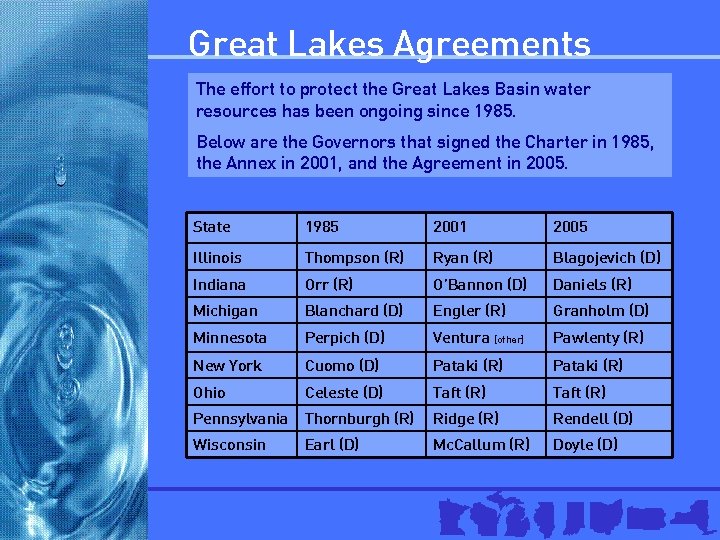
Great Lakes Agreements The effort to protect the Great Lakes Basin water resources has been ongoing since 1985. Below are the Governors that signed the Charter in 1985, the Annex in 2001, and the Agreement in 2005. State 1985 2001 2005 Illinois Thompson (R) Ryan (R) Blagojevich (D) Indiana Orr (R) O’Bannon (D) Daniels (R) Michigan Blanchard (D) Engler (R) Granholm (D) Minnesota Perpich (D) Ventura (other) Pawlenty (R) New York Cuomo (D) Pataki (R) Ohio Celeste (D) Taft (R) Pennsylvania Thornburgh (R) Ridge (R) Rendell (D) Wisconsin Earl (D) Mc. Callum (R) Doyle (D)
Great Lakes Agreements Key Elements of Agreement and Compact § Great Lakes-St. Lawrence River Basin Sustainable Water Resources Agreement § A good-faith agreement among the Great Lakes States, Ontario, and Québec. § Great Lakes—St. Lawrence River Basin Water Resources Compact § A legally enforceable contract among the Great Lakes States that will be passed into law through the State legislatures and consented by Congress.
Great Lakes Agreements Key Elements of Agreement and Compact Diversions § All new or increased diversions prohibited. § Exceptions: §Straddling communities §Communities in straddling counties §Intra-Basin transfers § Exemptions: §Ballast water §Short-term fire fighting §Humanitarian needs Details: Diversions
Great Lakes Agreements Key Elements of Agreement and Compact In-Basin Uses § State, Provincial management and regulation. § Use of common decision making standard. § State/Provincial flexibility for determining thresholds. § State/Provincial opportunity to comment on all large new or increased consumptive uses. Details: In-Basin Uses
Agreement Key Elements of Agreement and Compact Conservation and Efficiency § Regional goals and objectives § Development within 2 years. § State, Provincial goals, objectives, programs § Consistent with regional goals and objectives. § Regional review every 5 years. § Proposals § Conservation, efficiency measures. § Conservation, efficient use of existing water supplies. Details: Conservation and Efficiency
Great Lakes Agreements Great Lakes-St. Lawrence River Basin Water Resources Regional Body § Created when Agreement was signed by Governors and Premiers § Includes Governors, Premiers or designees § Oversees Agreement Implementation §Develops regional conservation and efficiency goals and objectives §Develops science strategy §Serves as a forum for consultation and coordination Signed Agreement
Next Steps ▪ Issues ▪ Resources § Goals § Logistics and Next Steps § Resource Kit Elements § Other Assistance Available § Revisit Opening Questions § Discussion Section Agenda
Next Steps ▪ Issues ▪ Resources Goals § Retain authority over water management system in the region. § Work together to ensure the shared Great Lakes resource is available for future use. § State commitments to management programs, conservation and efficiency. § Collect better information to improve scientific understanding. Goals
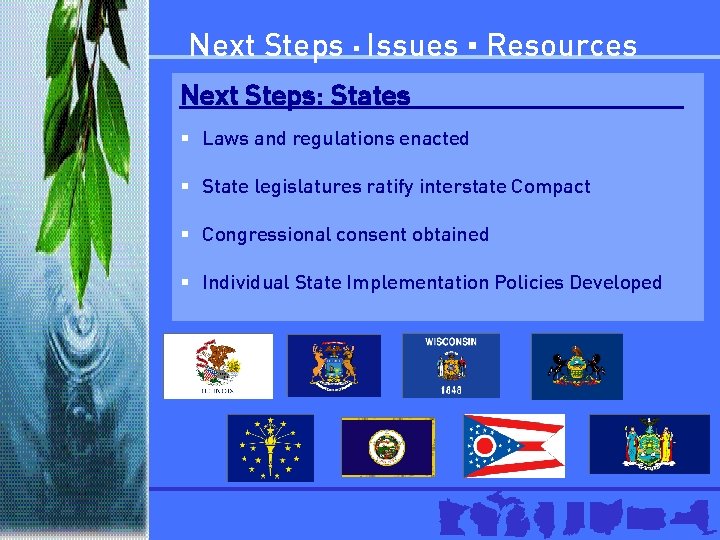
Next Steps ▪ Issues ▪ Resources Next Steps: States § Laws and regulations enacted § State legislatures ratify interstate Compact § Congressional consent obtained § Individual State Implementation Policies Developed
Next Steps ▪ Issues ▪ Resources Next Steps: State Legislation Introduced (2006) § IL: HB 4644 and SB 3077 introduced § NY: A 11968 passed on June 23. SO 8187 introduced § OH: HB 574 and SB 319 introduced and committee hearings held
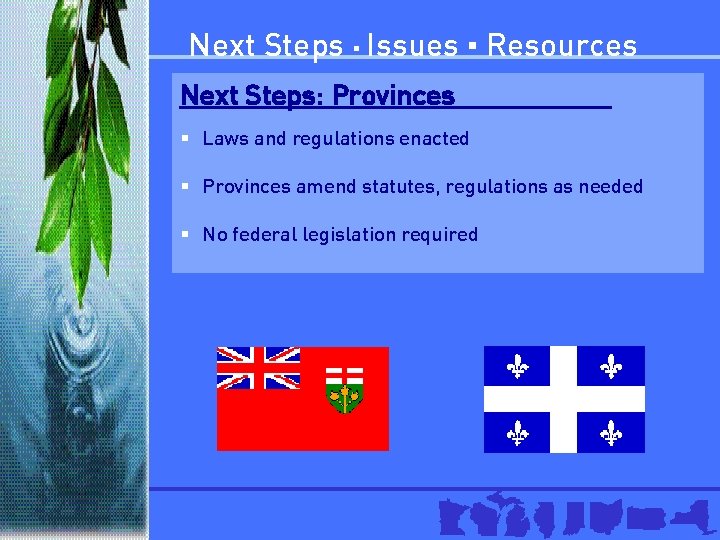
Next Steps ▪ Issues ▪ Resources Next Steps: Provinces § Laws and regulations enacted § Provinces amend statutes, regulations as needed § No federal legislation required
Next Steps ▪ Issues ▪ Resources Resource Kit Elements § Project Background, Organization and Development Process. § Agreement and Compact. § Frequently Asked Questions. § Agreement and Compact Development Roster. § Expressions of support. § Background on Interstate Compacts. § Existing laws, agreements, and other information. § Guide to resources. § Key contacts. § www. cglg. org/projects/water/Compact. Implentation. asp Resource Kit
Next Steps ▪ Issues ▪ Resources Assistance Available § Council of Great Lakes Governors § David Naftzger, Executive Director § Peter Johnson, Program Director § 312. 407. 0177 § Council of State Governments § Mike Mc. Cabe, Midwest Director § 630. 925. 1922 § State Participants Assistance
Next Steps ▪ Issues ▪ Resources Your Questions § Revisit Initial Questions § Answer Unanswered Questions § Additional Questions
Next Steps ▪ Issues ▪ Resources General Discussion § Feedback § Evaluation Discussion
Thank You Presentation prepared by The Delta Institute, Council of Great Lakes Governors and Council of State Governments Midwest Office with support from the Joyce Foundation.
- Slides: 45