
THE GREAT GATSBY SETTING WEST EGG Gatsbys house
THE GREAT GATSBY SETTING

WEST EGG
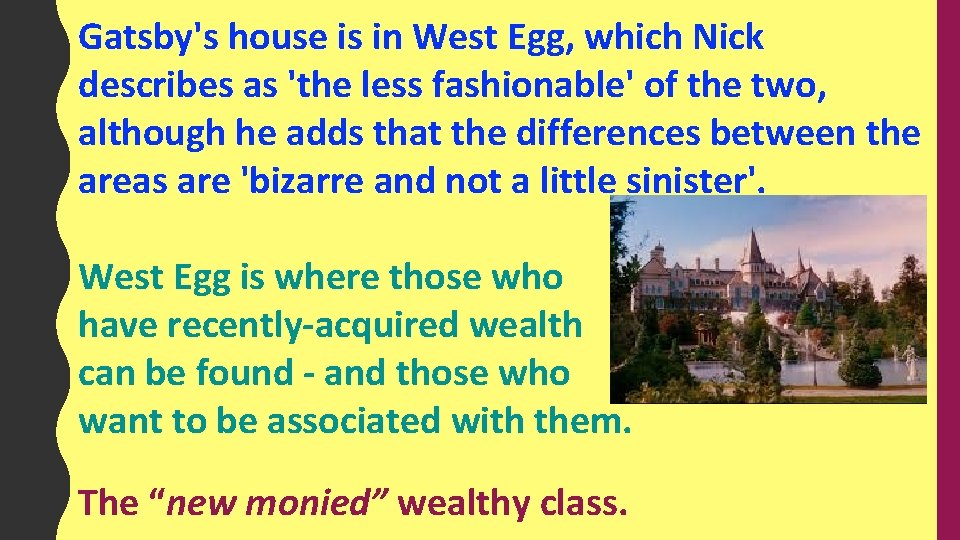
Gatsby's house is in West Egg, which Nick describes as 'the less fashionable' of the two, although he adds that the differences between the areas are 'bizarre and not a little sinister'. West Egg is where those who have recently-acquired wealth can be found - and those who want to be associated with them. The “new monied” wealthy class.
Gatsby built a house in West Egg. It is excessively large and lavishly decorated, but it lacks the taste of those in East Egg with their inherent sophistication and cultured style. Nick shows his scorn by noting that it is a copy of Normandy Hôtel de Ville. There is significance in the fact it is an IMITATION as Gatsby, himself is an imitation. There is also significance in the fact it is NEW. It is devoid of the HERITAGE so celebrated by Tom and a prerequisite of acceptance by the EAST EGG set. Gatsby is equally scorned by Tom for lack of heritage and he calls him, "Mr Nobody from Nowhere".
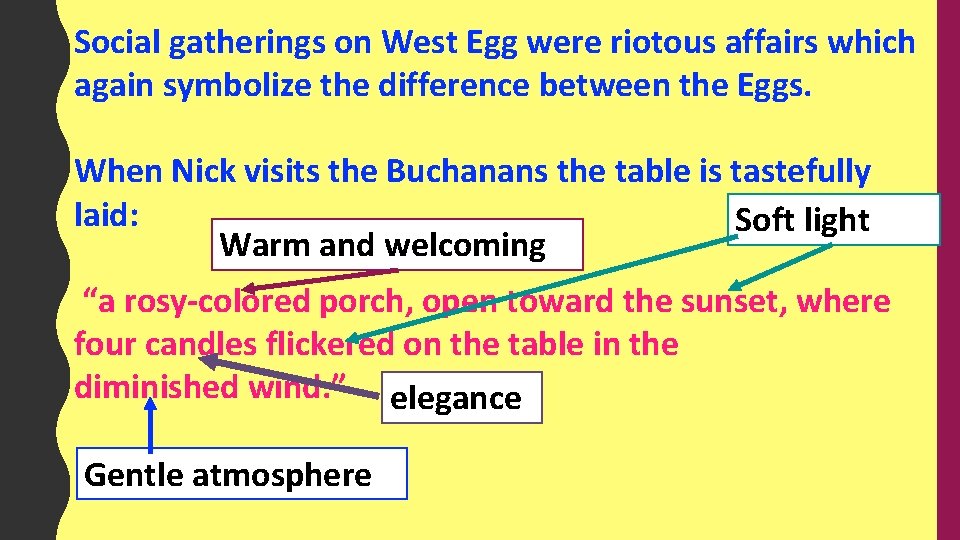
Social gatherings on West Egg were riotous affairs which again symbolize the difference between the Eggs. When Nick visits the Buchanans the table is tastefully laid: Soft light Warm and welcoming “a rosy-colored porch, open toward the sunset, where four candles flickered on the table in the diminished wind. ” elegance Gentle atmosphere
By comparison Gatsby’s parties were impersonal, carnival events based on excess and uninhibited boisterousness. There was dancing now on the canvas in the garden; old men pushing young girls backward in eternal graceless circles, superior couples holding each other tortuously, fashionably, and keeping in the corners — and a great number of single girls dancing individualistically or relieving the orchestra for a moment of the burden of the banjo or the traps. By midnight the hilarity had increased. A celebrated tenor had sung in Italian, and a notorious contralto had sung in jazz, and between the numbers people were doing “stunts” all over the garden, while happy, vacuous bursts of laughter rose toward the summer sky.
‘… men and girls came and went like moths among the whisperings and the champagne and the stars…” The moth image symbolises the guests moving towards Gatsby’s ‘light’. Although the imagery here seems delicately positive (whisperings, champagne and stars), Fitzgerald urges us in this chapter to peer beneath the false veneer, the guest are ultimately shown to be buzzing flies drawn to the detritus of Gatsby’s backyard. They flit from person to person with FAKE interest and superficial joviality – their only interest: to create the illusion of a notable social position.
People were not invited – they went there… and after that they conducted themselves according to the rules of behaviour associated with an amusement park. Gatsby’s parties are the epitome of anonymous, meaningless excess – so much so that people treat his house as a kind of public, or at least commercial, space rather than a private home. This is connected to the vulgarity of new money – you can’t imagine Tom and Daisy throwing a party like this. The random and meaningless indulgence of his parties further highlights Gatsby's isolation from true friends.
EAST EGG
• Daisy and Tom live in East Egg, which is much more exclusive and where the old money set live. • The phrase "indiscernible barbed wire" used in chapter eight sums up the social barrier between the two 'Eggs' which even money can't penetrate. • While East Egg is also expensive and luxurious, it is beautiful: “the white palaces of fashionable East Egg glittered along the water. . . ”
This connotes images of royalty and suggests the Buchanans are almost the aristocracy “the white palaces of fashionable East Egg glittered along the water. . . ” This suggests a dazzling beauty but also hints at an impenetrable and unyielding quality The use of plurals suggests that with the Buchanans, money is no object: following on from a huge lawn are "sundials and brick walks and burning gardens".
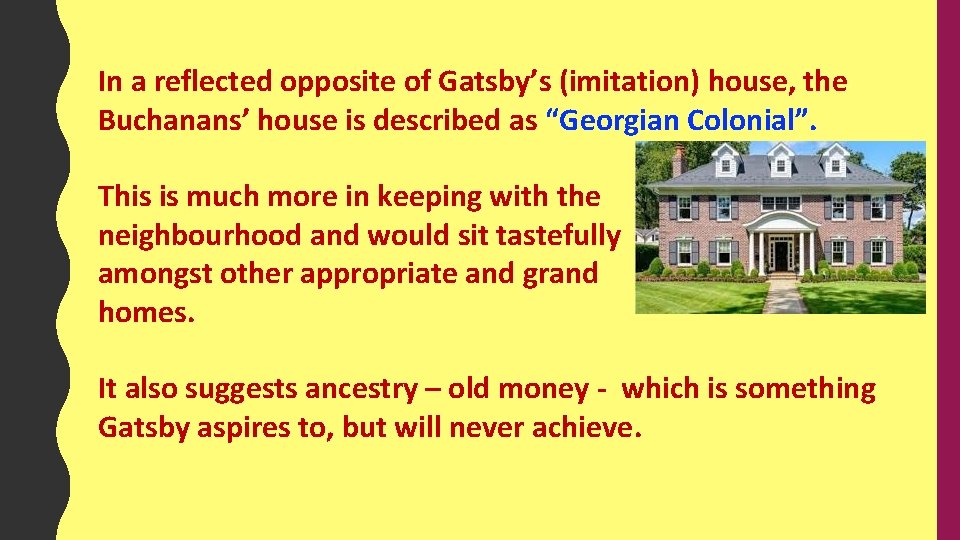
In a reflected opposite of Gatsby’s (imitation) house, the Buchanans’ house is described as “Georgian Colonial”. This is much more in keeping with the neighbourhood and would sit tastefully amongst other appropriate and grand homes. It also suggests ancestry – old money - which is something Gatsby aspires to, but will never achieve.
THE VALLEY OF ASHES
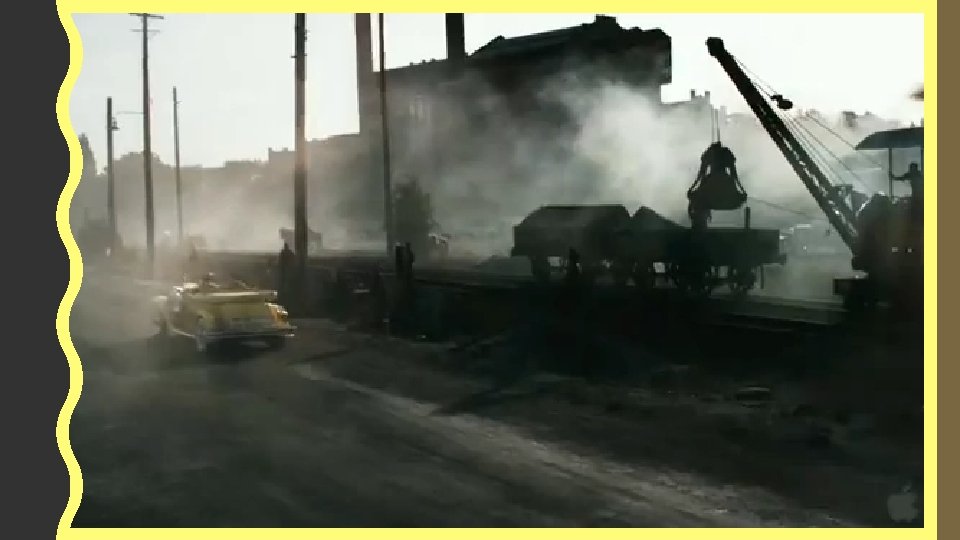
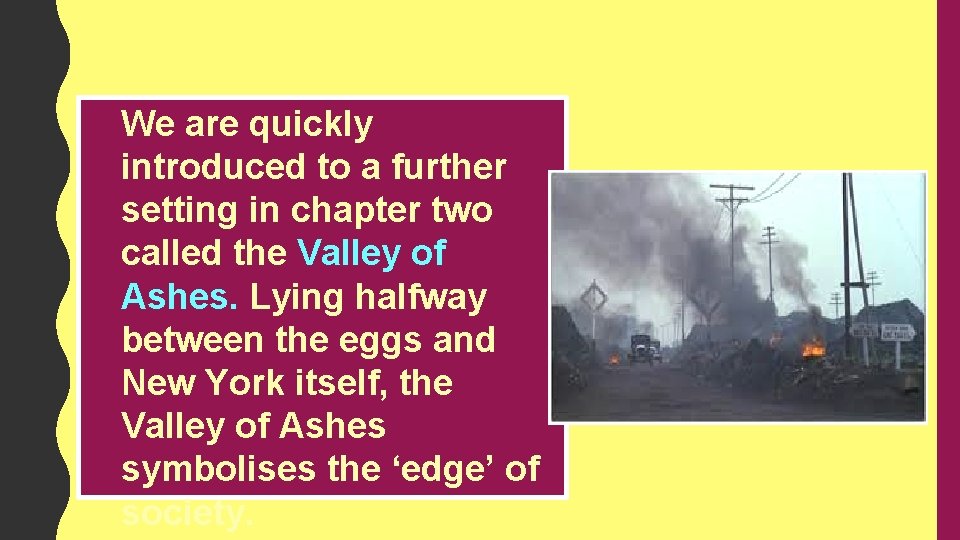
We are quickly introduced to a further setting in chapter two called the Valley of Ashes. Lying halfway between the eggs and New York itself, the Valley of Ashes symbolises the ‘edge’ of society.
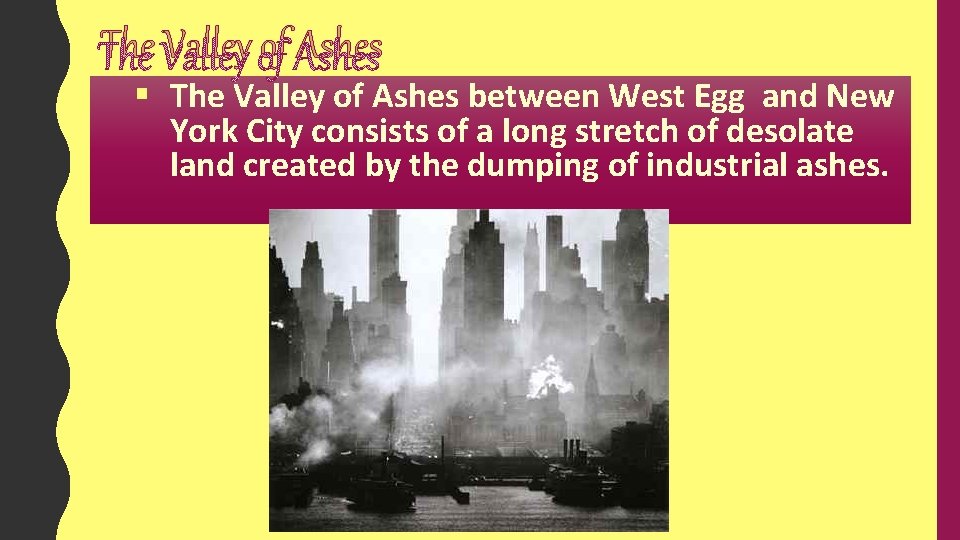
The Valley of Ashes § The Valley of Ashes between West Egg and New York City consists of a long stretch of desolate land created by the dumping of industrial ashes.
The Valley of Ashes § Represents a kind of purgatory – a place in limbo § It also symbolises the shameful underbelly of American capitalism. This is a dumping ground of all of the waste from the elaborate lifestyles of people like the Buchanans and Gatsby. § The UGLY BY-PRODUCT of CONSUMERISM § The men who work there are devoid of colour, working ceaselessly to maintain the lifestyle of the Buchanans, who don’t seem to work at all.
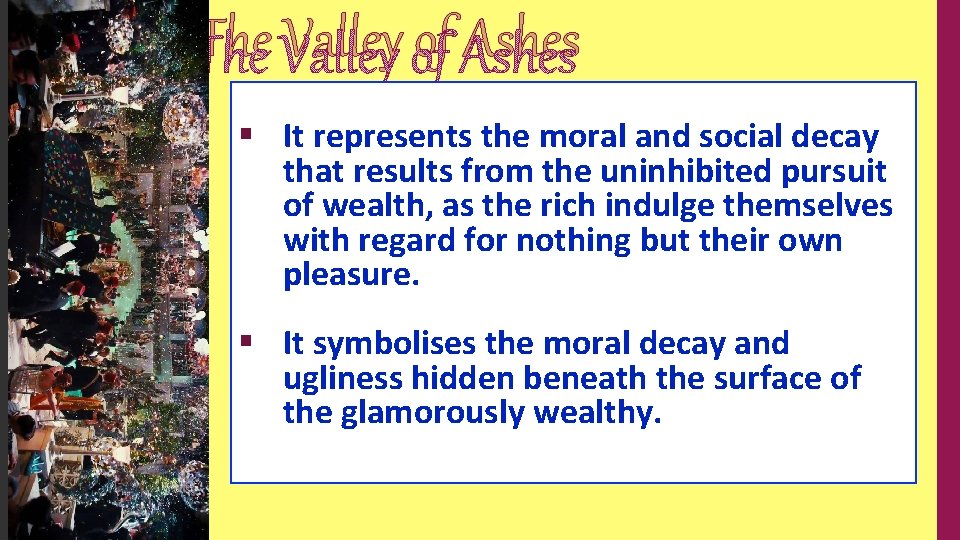
The Valley of Ashes § It represents the moral and social decay that results from the uninhibited pursuit of wealth, as the rich indulge themselves with regard for nothing but their own pleasure. § It symbolises the moral decay and ugliness hidden beneath the surface of the glamorously wealthy.
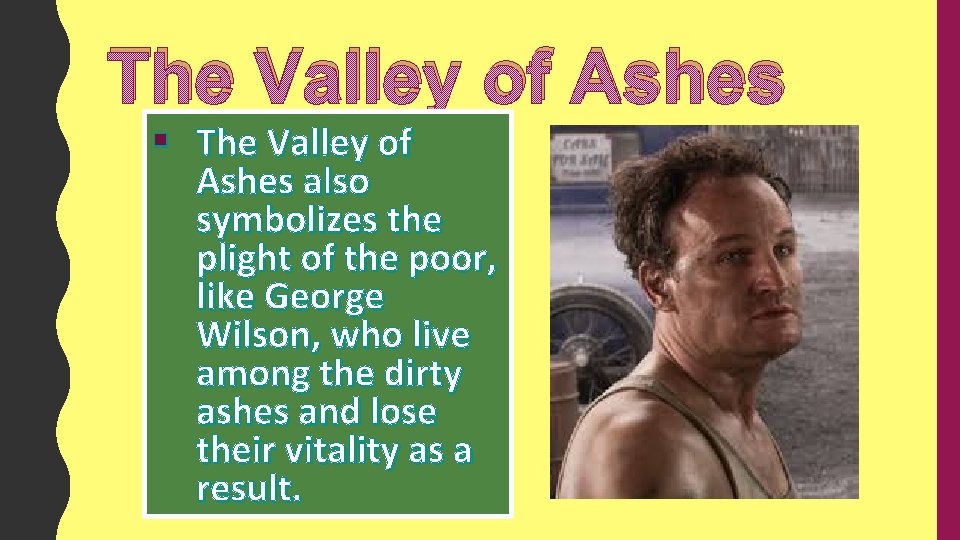
The Valley of Ashes § The Valley of Ashes also symbolizes the plight of the poor, like George Wilson, who live among the dirty ashes and lose their vitality as a result.

Language in Fitzgerald’s descriptions
“…a fantastic farm where ashes grow like wheat…grotesque gardens. ” • “wheat” and “gardens” are associated with life and nature. • “Ashes” are dead and depressing. • Combining the two shows that beauty has been destroyed.
“…where ashes take the forms of houses and chimneys and rising smoke and finally. . . ” • The use of the LIST emphasizes the scale of the decay. • REPETITION of “and” slows the pace down and symbolises the trudging drudgery of life in the valley.
“A white ashen dust veiled his dark suit…as it veiled everything…except his wife…” • The presence of the “ashen dust” coated everything in grey – the colour of death and decay. • Myrtle escapes this. She is not part of the decay – she is trying to rise above it.
“A line of grey cars crawls along an invisible track… immediately the ash-grey men swarm up with leaden spades and stir up an impenetrable cloud, which screens their obscure operations from your sight. ” This perhaps represents the idea that this section of society is deliberate hidden from view (notice how the train curls away from the Valley, as if it ‘shrinks away’ from having to confront it. ) In modern industrial society, the polarisation between the haves and havenots, between the slaves and the masters, grows ever stronger. By repeating images of greyness, obscuring cloud and blindness, Fitzgerald emphasises the tendency of the privileged to casually ‘overlook’ the reality of hellholes such as these.
Ash has a traditionally negative association with decay/waste/dirt – think of crematoriums, ‘ashes to ashes dust to dust’, cigarette trays. The ash-grey men at work in this place symbolise the downtrodden working class chained forever to industry and monotony. They move ‘dimly and already crumbling through the powdery air; . Living out a mere half-life, a million miles from the splendour and indulgence of the Buchanans’ environment.
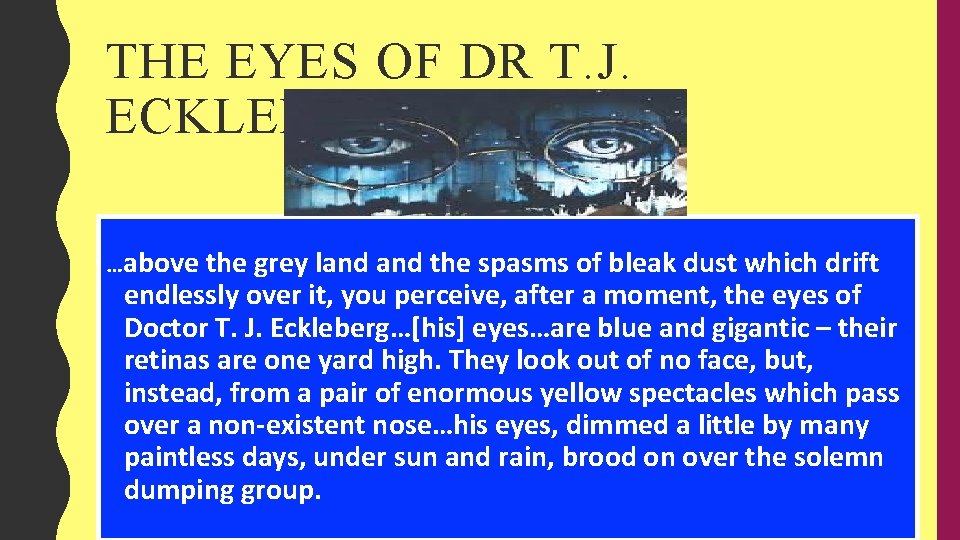
THE EYES OF DR T. J. ECKLEBERG …above the grey land the spasms of bleak dust which drift endlessly over it, you perceive, after a moment, the eyes of Doctor T. J. Eckleberg…[his] eyes…are blue and gigantic – their retinas are one yard high. They look out of no face, but, instead, from a pair of enormous yellow spectacles which pass over a non-existent nose…his eyes, dimmed a little by many paintless days, under sun and rain, brood on over the solemn dumping group.
Reminds us – by its sheer size and the incongruity of its surroundings – of the importance and influence of advertising in modern culture. These eyes have no natural place on the hillside, and yet they dominate the landscape, being its most prominent feature. Fitzgerald has deliberately chosen an advert for optometry in order to point out the modern man’s inability to see the corruption of our society and environment. This lack of vision applies to all of the characters in the book, each of all fail to ‘see’ the basic futility of their hopes and dreams. The billboard shows how consumerism and materialism has taken the place of traditional spiritual values. THE EYES OF DR T. J. ECKLEBERG
o They may represent God staring down upon and judging American society as a moral wasteland, though the novel never makes this point explicitly. THE EYES OF DR T. J. ECKLEBER G o Instead, throughout the novel, Fitzgerald suggests that symbols only have meaning because characters instil them with meaning. The connection between the eyes of Doctor T. J. Eckleburg and God exists only in George Wilson’s grief-stricken mind.
- Slides: 28