
The Great Depression President Herbert Hoover n n
The Great Depression
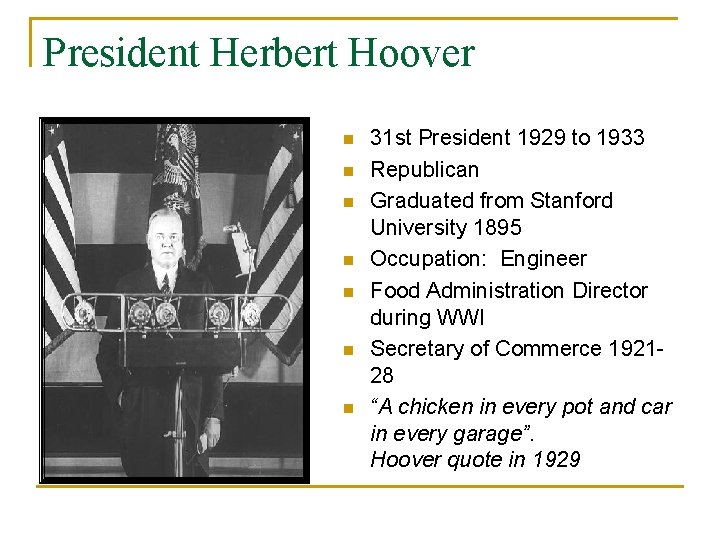
President Herbert Hoover n n n n 31 st President 1929 to 1933 Republican Graduated from Stanford University 1895 Occupation: Engineer Food Administration Director during WWI Secretary of Commerce 192128 “A chicken in every pot and car in every garage”. Hoover quote in 1929
About the Great Depression n n It was the worse economic calamity in the US and was part of a world-wide economic depression The US government radically changed its domesticeconomic policies Many Americans migrated within the US and left the US for the Soviet Union. The US government slowly became less isolationist in its foreign policy The Depression had a huge impact and legacy on the country.
Causes of Great Depression and Effects n n n n Overproduction Under Consumption Unequal Distribution of Wealth Problems in the Farm Sector Easy Credit Speculation and Stock Market Behavior Government Pursues Poor Economic Policy
Overproduction and Under Consumption n Overproduction: During WWI government encourages factories and farmers to produce as much as possible n n Under Consumption: After war, production is not reduced even though people aren’t buying goods. Decrease in consumer spending. Effects: Drop in prices of goods, and major reduction in buying of consumer products and services.
Unequal Distribution of Wealth n n n There were mainly two types of economy classes: Rich and Poor. There was a middle class but not many Americans were in it. Basically, you were either wealthy or poor. n Effect: q Families had limited income to purchase goods.
Problems in the Farm Sector n n Huge farm surpluses because of World War I. As people lost their jobs they were unable to buy food. n Effect: q q Led to a drop in farm prices Farmers cannot pay the mortgage on their farm.
Easy Credit n Increase in buying on margin (credit). q Buying on Margin: people would buy stock, but would only pay for 10% of it and would borrow the rest from the bank. n Effect: q Banks unable to get their money back so they would run out of money.
Speculation and Stock Market Behavior n Brokers would sell stock at a low price and then speculate how the price would go up so that people could make money even though the stock market was inconsistent.
Government Pursues Poor Economic Policies n n n The government took a hands off approach to the economy. They did very little to regulate the stock market. They allowed banks to loan out more than they had invested. n Effect: q The economy will crash: the stock market falls apart and banks go bankrupt.
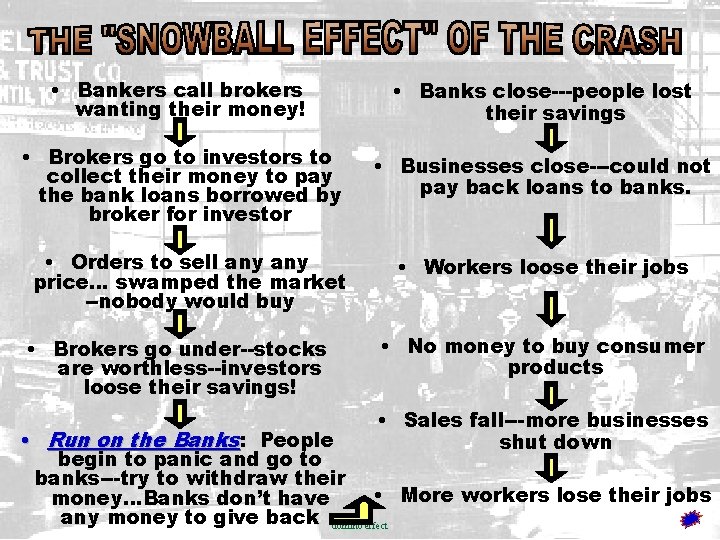
• Bankers call brokers wanting their money! • Banks close---people lost their savings • Brokers go to investors to collect their money to pay the bank loans borrowed by broker for investor • Businesses close---could not pay back loans to banks. • Orders to sell any price… swamped the market --nobody would buy • Brokers go under--stocks are worthless--investors loose their savings! • Workers loose their jobs • No money to buy consumer products • Sales fall---more businesses shut down • Run on the Banks: People begin to panic and go to banks---try to withdraw their • More workers lose their jobs money…Banks don’t have any money to give back domino effect
The Stock Market crashed on October 29, 1929 after days of heavy losses. The following days in major U. S. cities would be chaotic and shape the next 10+ years.
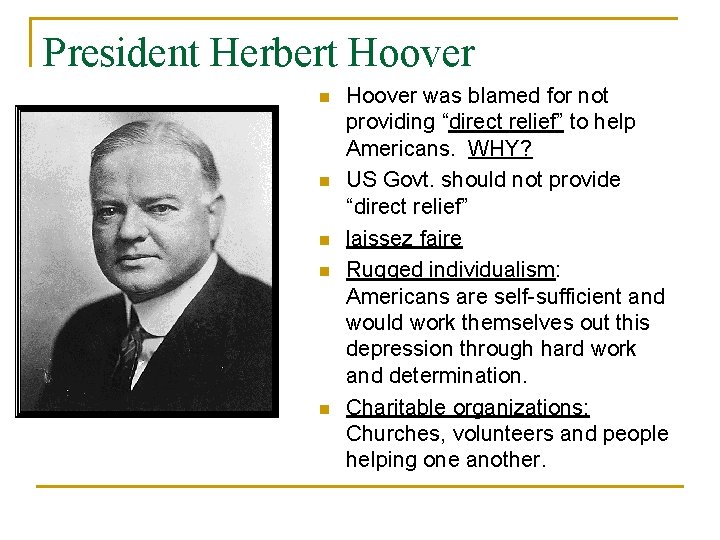
President Herbert Hoover n n n Hoover was blamed for not providing “direct relief” to help Americans. WHY? US Govt. should not provide “direct relief” laissez faire Rugged individualism: Americans are self-sufficient and would work themselves out this depression through hard work and determination. Charitable organizations: Churches, volunteers and people helping one another.
Hoover’s Attempt to Solve the Great Depression n Industry pledged to keep factories open and stop slashing wages. This did not work: by 1931 most businesses reneged. Next step was public works: q n government financed building projects. Hoover urged governors and mayors throughout the nation to increase public works spending. q q q Many governors and mayors did not choose to do this. WHY? Pay higher taxes or borrow money from banks (deficient spending) which leaves less money for banks to loan out to people. Hoover feared that deficient spending could delay an economic recovery.
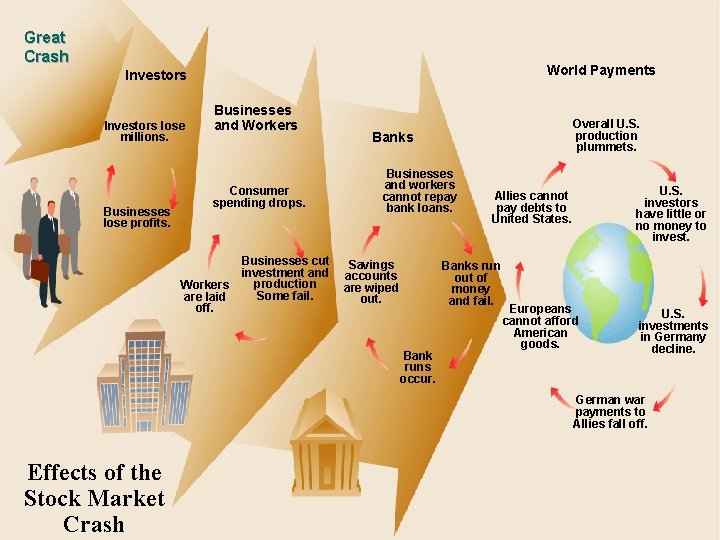
Great Crash World Payments Investors lose Investors lose millions. Businesses lose profits. Businesses and Workers Consumer spending drops. Overall. U. S. production plummets. Banks Businesses and workers cannot repay bank loans. Businesses cut cut Savings investment and investmentand and accounts production Some are production Workers production. are wiped Some fail. are are laid out. off. Bank runs occur. U. S. investors have little or no investors money have littletoor invest. to no money invest. Allies cannot pay debtstoto United. States. Banks run Banksrun out of outof of money and fail. Europeans cannot afford American goods. U. S. investments in investments Germany in Germany decline. Germanwar paymentstoto Alliesfalloff. Effects of the Stock Market Crash
Pumping Money into the Economy n Hoover asked the Federal Reserve Board to pump more money into circulation. n The National Credit Corporation was created to have a pool of money that would enable troubled banks to continue lending money in their communities q n he encouraged wealthy New Yorkers to contribute to this By 1932 he believed that this wasn’t going to be effective and the government had to do the lending in what was called the Reconstruction Finance Corporation. q q q The RFC lent out $238 million to approximately 160 banks. A total of $500 million the US Government provided “indirect” relief to assist insurance corporations, agricultural organizations, railroads and state and local governments. “Too little, too late”. It did not increase its loans in sufficient amounts to meet the need, and the economy continued its decline.
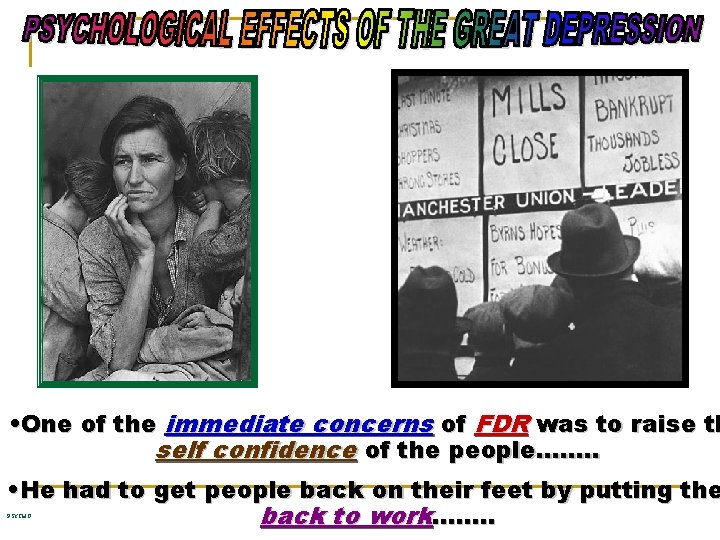
• One of the immediate concerns of FDR was to raise th self confidence of the people……. . • He had to get people back on their feet by putting the back to work……. . PSYCHO
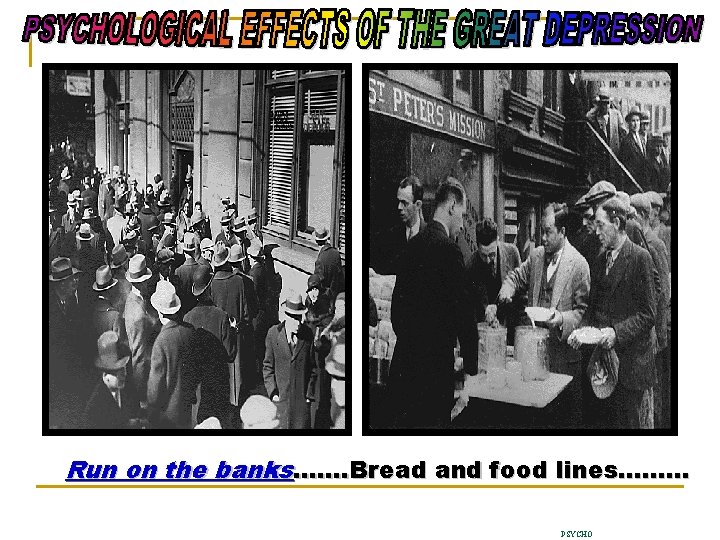
Run on the banks……. Bread and food lines……… PSYCHO
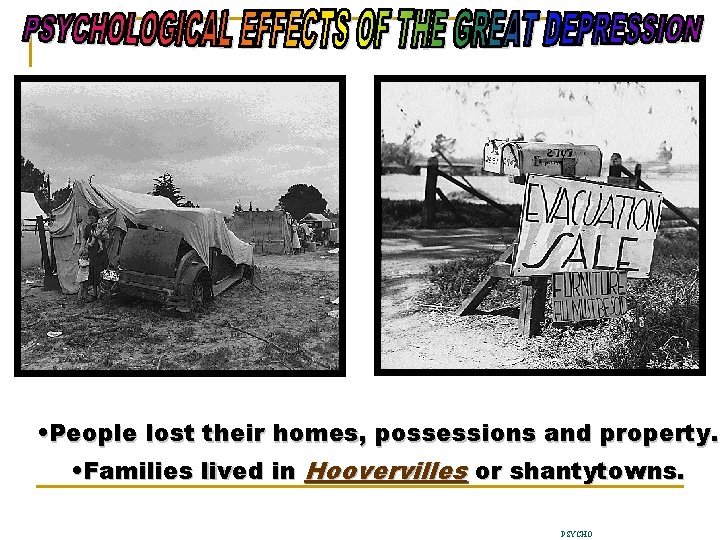
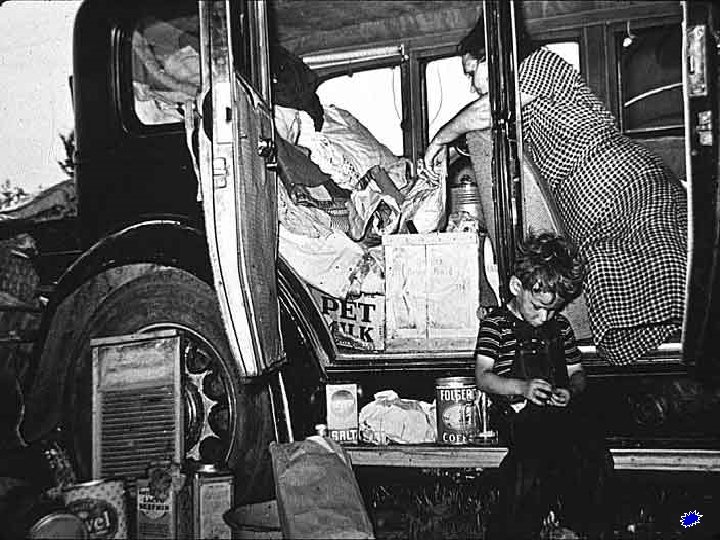
• People lost their homes, possessions and property. • Families lived in Hoovervilles or shantytowns. PSYCHO
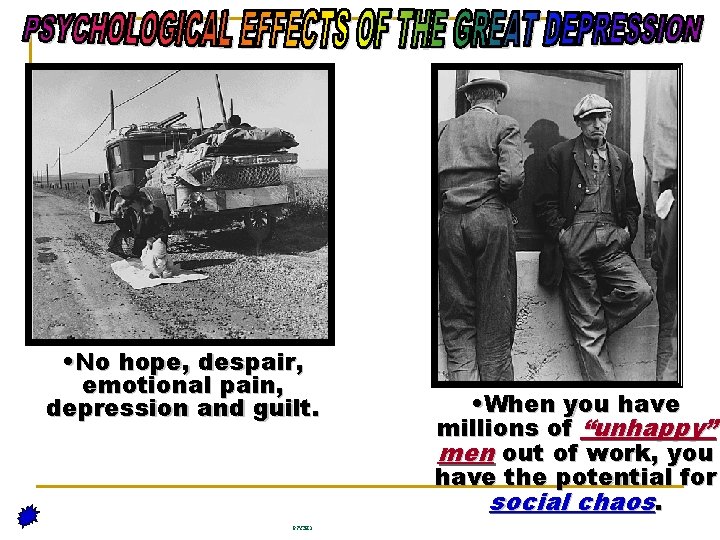
• No hope, despair, emotional pain, depression and guilt. PSYCHO • When you have millions of “unhappy” men out of work, you have the potential for social chaos.
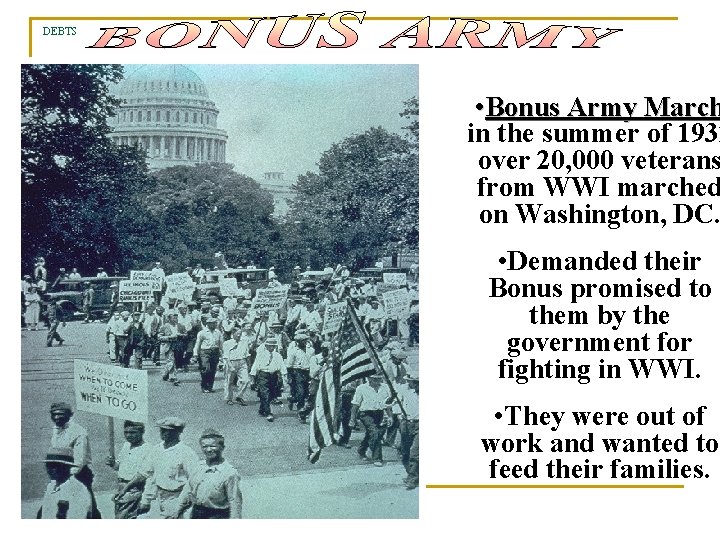
DEBTS • Bonus Army March in the summer of 1932 over 20, 000 veterans from WWI marched on Washington, DC. • Demanded their Bonus promised to them by the government for fighting in WWI. • They were out of work and wanted to feed their families.
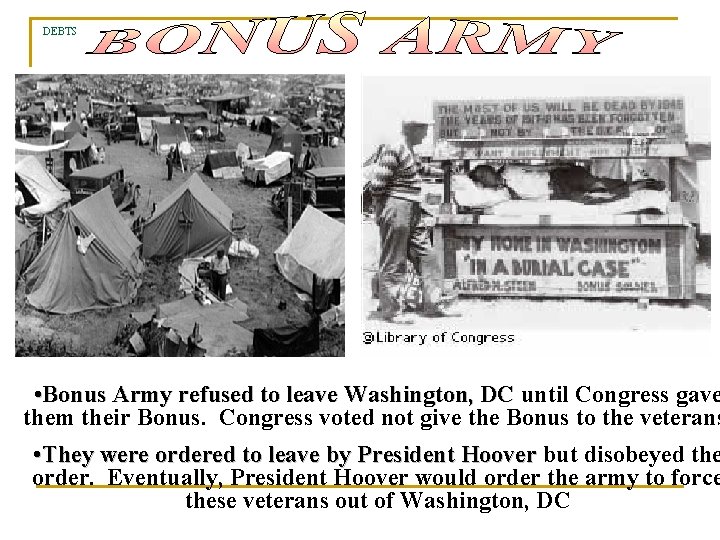
DEBTS • Bonus Army refused to leave Washington, DC until Congress gave them their Bonus. Congress voted not give the Bonus to the veterans • They were ordered to leave by President Hoover but disobeyed the order. Eventually, President Hoover would order the army to force these veterans out of Washington, DC
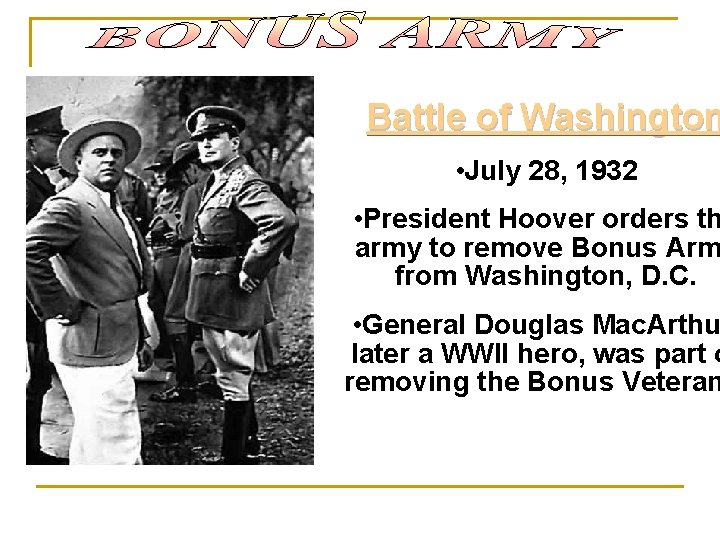
Battle of Washington • July 28, 1932 • President Hoover orders th army to remove Bonus Arm from Washington, D. C. • General Douglas Mac. Arthu later a WWII hero, was part o removing the Bonus Veteran
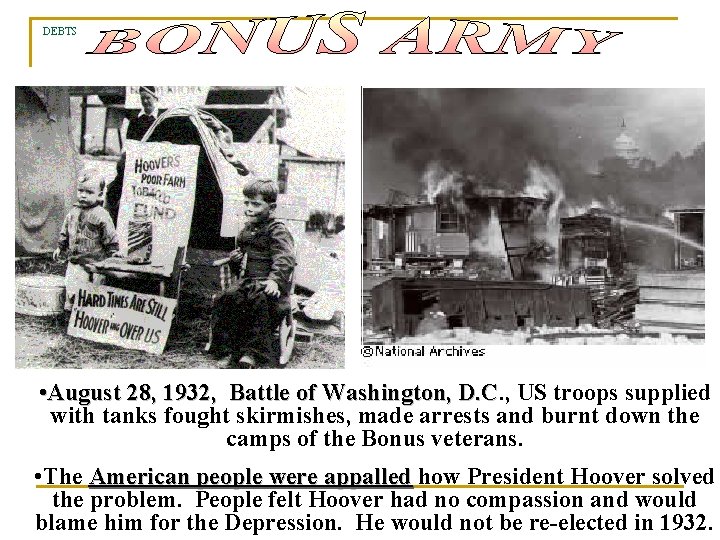
DEBTS • August 28, 1932, Battle of Washington, D. C US troops supplied with tanks fought skirmishes, made arrests and burnt down the camps of the Bonus veterans. • The American people were appalled how President Hoover solved the problem. People felt Hoover had no compassion and would blame him for the Depression. He would not be re-elected in 1932.
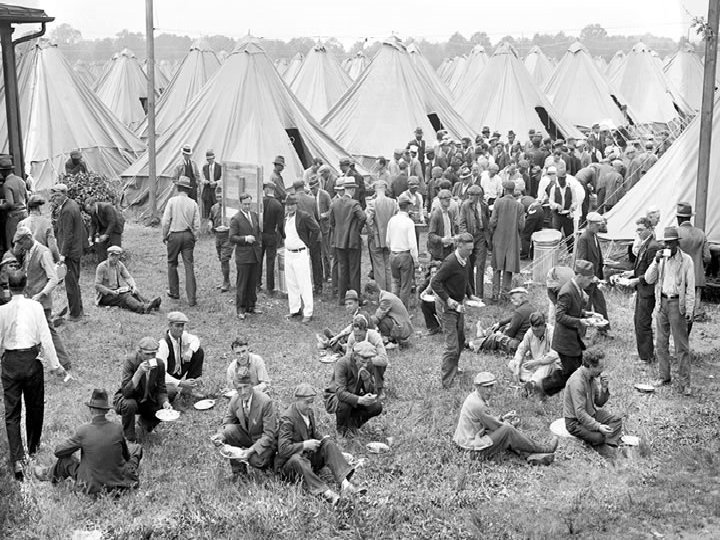
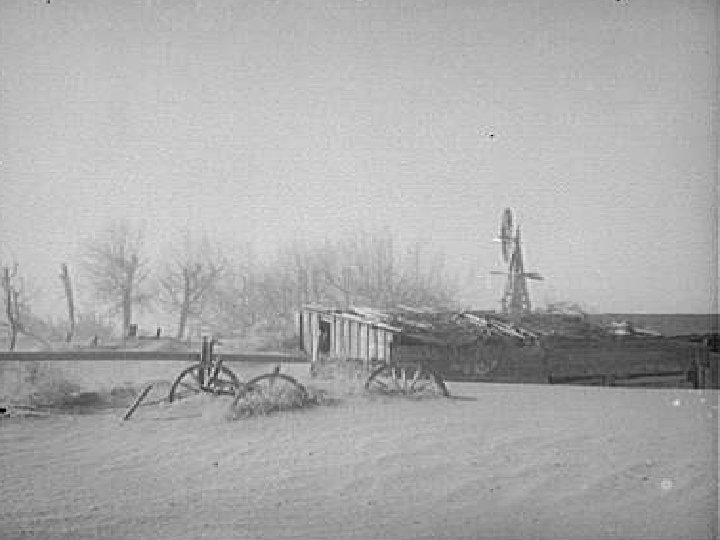
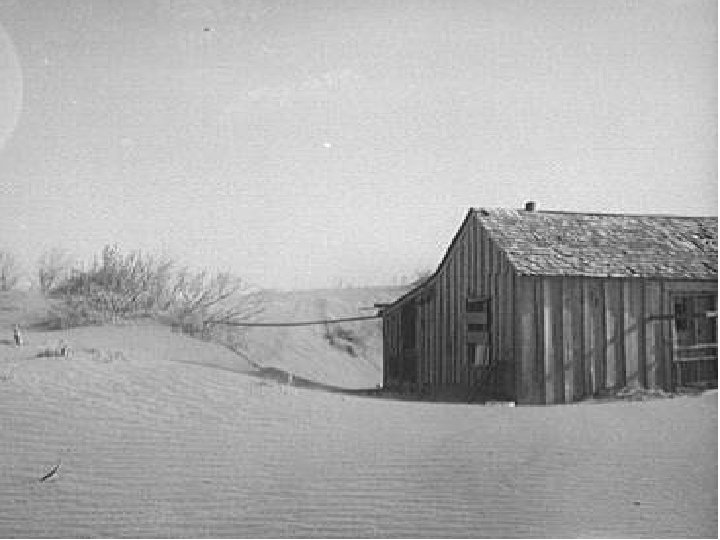
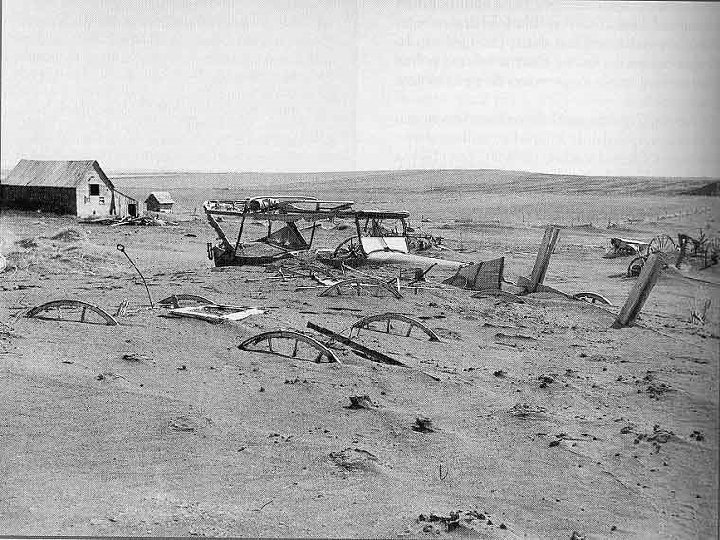
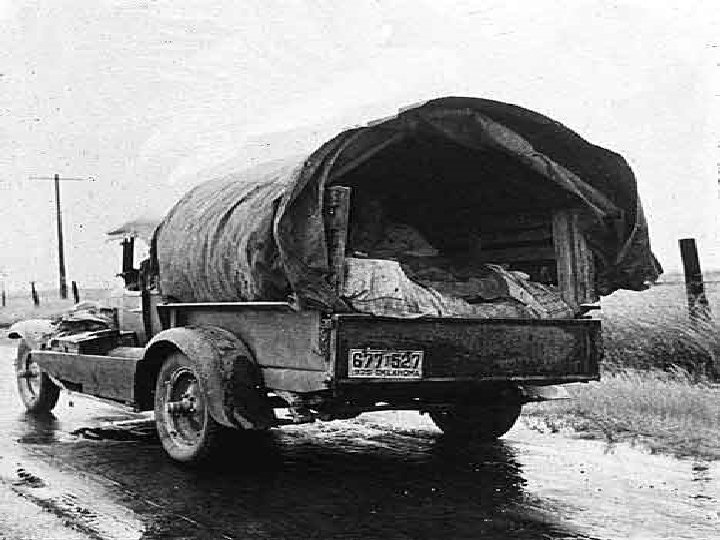
• The Dust Bowl was an ecological and human disaster that took place in the southwestern Great Plains region, including Oklahoma, in the 1930's. • It was caused by misuse of land years of sustained drought. • Millions of hectares of farmland became useless, and hundreds of thousands of people were forced to leave their homes----many migrated to California. • As the land dried up, great clouds of dust and sand, carried by the wind, covered everything and the word "Dust Bowl" was coined.
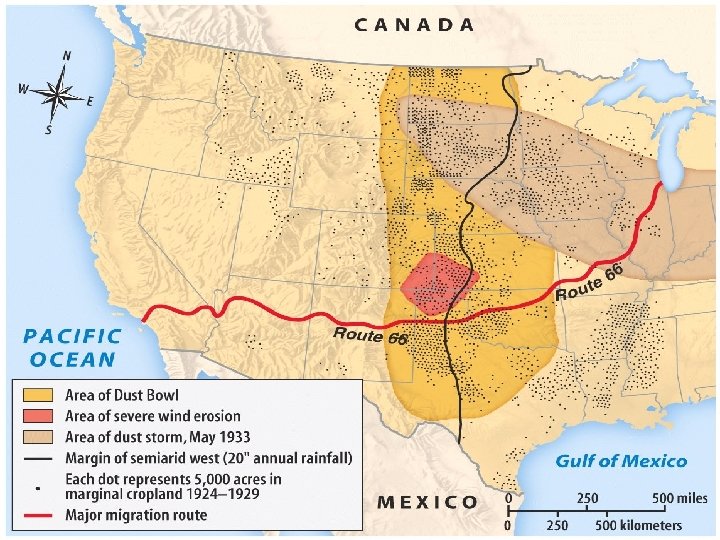
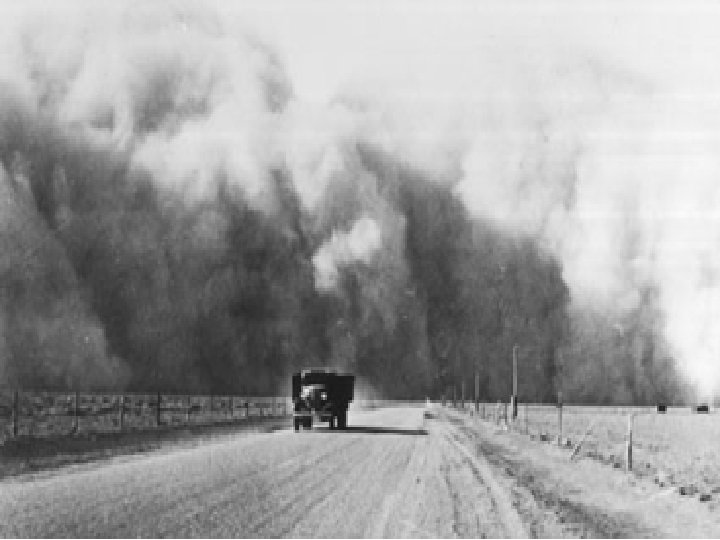
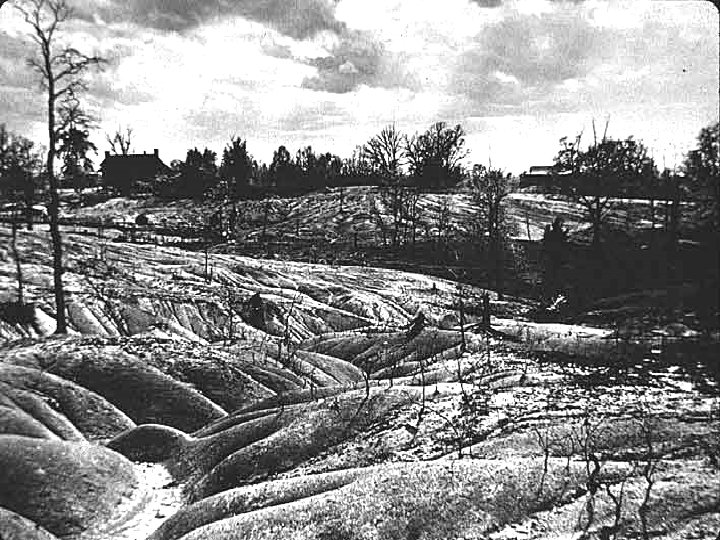
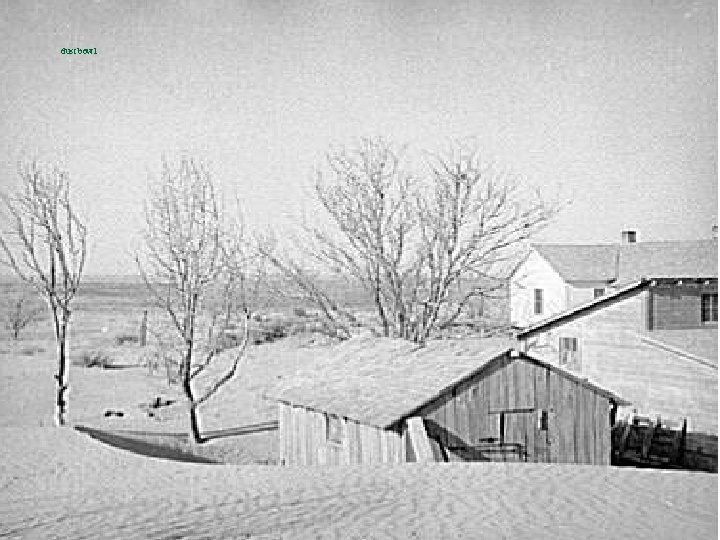
dust bowl
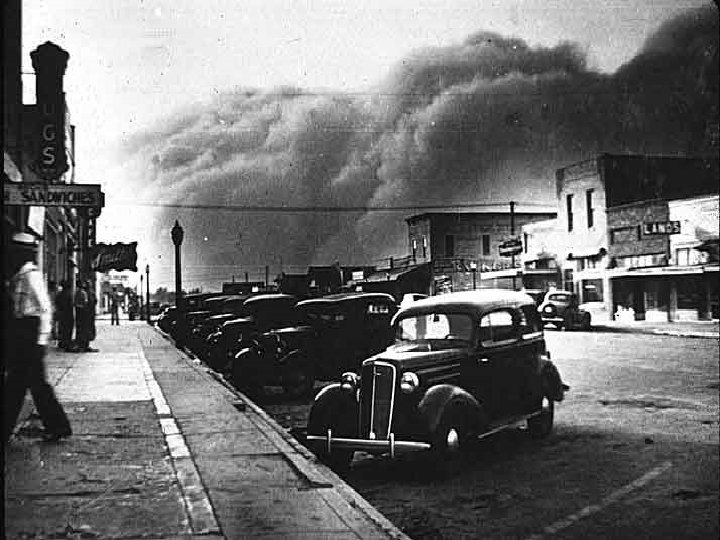
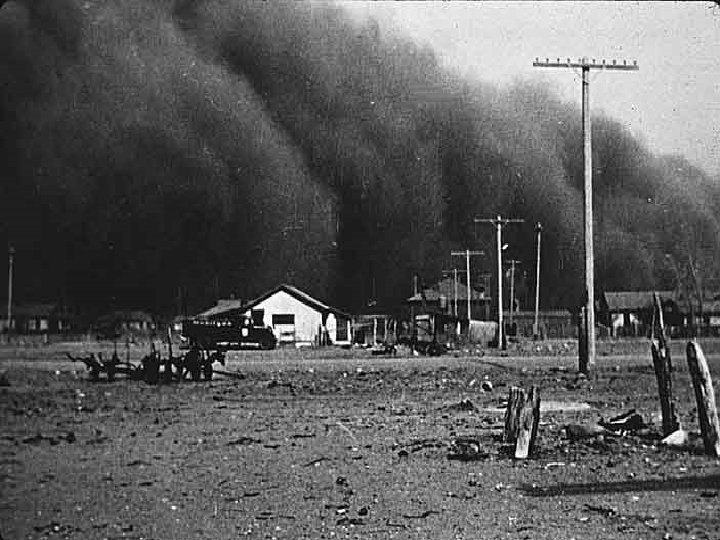
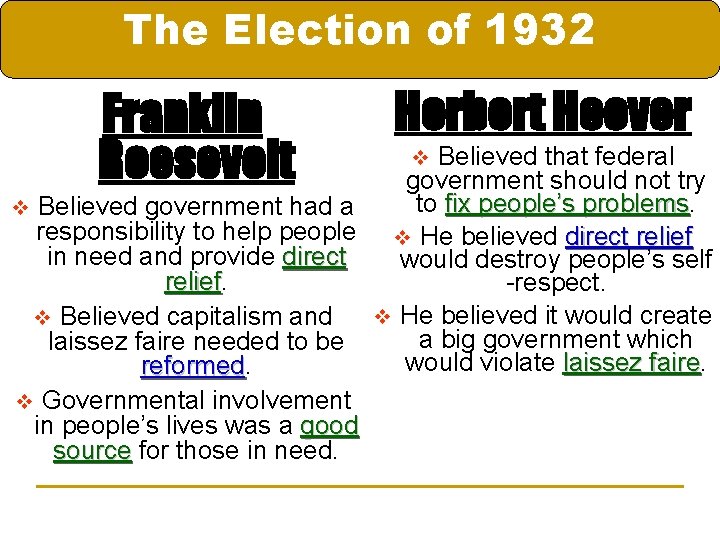
The Election of 1932 Franklin Roosevelt Herbert Hoover Believed that federal government should not try to fix people’s problems v Believed government had a responsibility to help people v He believed direct relief in need and provide direct would destroy people’s self relief -respect. v He believed it would create v Believed capitalism and a big government which laissez faire needed to be would violate laissez faire reformed v Governmental involvement in people’s lives was a good source for those in need. v
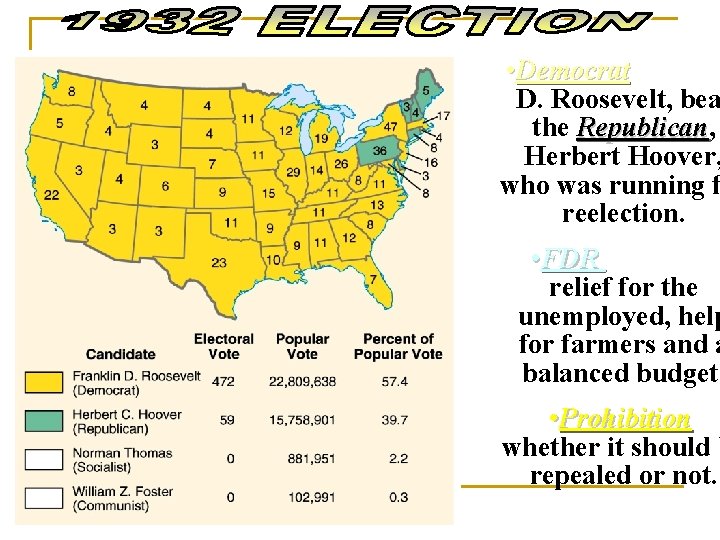
• Democrat Frankli D. Roosevelt, bea the Republican, Republican Herbert Hoover, who was running f reelection. • FDR promised relief for the unemployed, help for farmers and a balanced budget. • Prohibition, Prohibition whether it should b repealed or not.
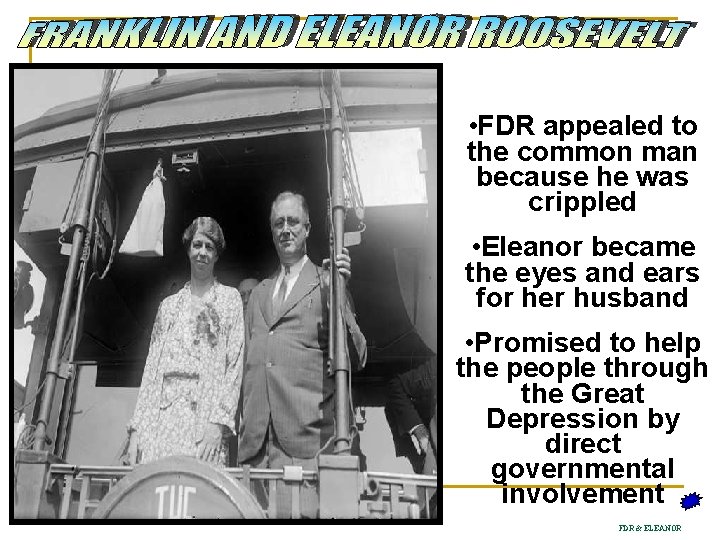
• FDR appealed to the common man because he was crippled • Eleanor became the eyes and ears for her husband • Promised to help the people through the Great Depression by direct governmental involvement FDR & ELEANOR
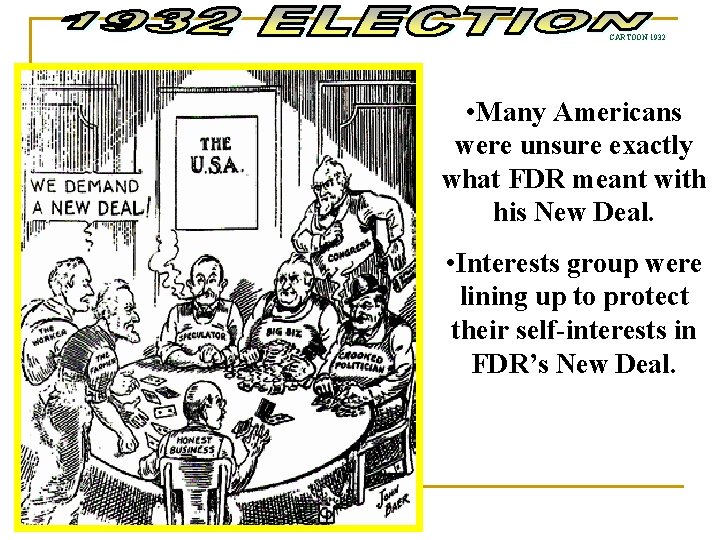
CARTOON 1932 • Many Americans were unsure exactly what FDR meant with his New Deal. • Interests group were lining up to protect their self-interests in FDR’s New Deal.
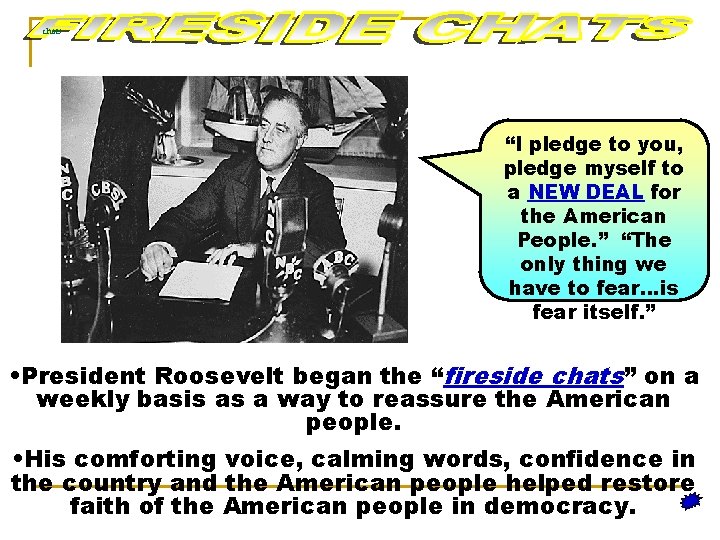
chats “I pledge to you, pledge myself to a NEW DEAL for the American People. ” “The only thing we have to fear…is fear itself. ” • President Roosevelt began the “fireside chats” on a weekly basis as a way to reassure the American people. • His comforting voice, calming words, confidence in the country and the American people helped restore faith of the American people in democracy.
- Slides: 42