
The Great Depression in Latin America IB History
The Great Depression in Latin America IB History of the Americas
Latin America Review • First 50 years after independence we see a largely self-sufficient society – hacienda system. • With the onset of industrialization in Europe and the US, LA commodities become more valuable. • Export market in LA is thriving so they fail to fully industrialize themselves. • In turn, industrialized countries become dependent on export demand for manufactured goods to keep up with domestic production. • *Dual Reliance on export-import trade.
Review continued • Rather than nurture local industrialization, the elites encourage foreign investment and ownership. • Weakness of this export-import model begins to show in WWI, and LA supply outstrips demand well before the Crash. • Commodity prices peaked before the crash: Argentine wheat peaks in 1927 Cuban sugar peaks in 1928 Brazilian coffee peaks in March 1929 • *The GD did not cause the decline in LA, it just made it much worse. *
Onset of the Depression - Overview • Between 1928 and 1932 the value of exports fell by more than 50%, (except in Venezuela – oil and Honduras – bananas… anomalies) • Initial effects similar to everywhere else: consumer demand declines, deflation, and mass unemployment. • With foreign capital/investment gone, LA countries begin defaulting on loans leading to a devaluation of currency. • Placing blame on existing governments, countries stimulated political change – coups d’etats. – Argentina, Brazil, Chile, Guatemala, Honduras, Peru • Military leaders (dictators) did not exactly respect the rights of the people, but they had the capacity to make swift and real change.
Addressing the Crisis • Latin America was hit hard by the Great Depression but responded with political reforms and an effort to gain greater economic independence • The response varied greatly across countries. • Banks were already closely tied to government – central banks established in the 20 s – so LA came through the worst years of the Depression with only modest damages to the financial system. • Government regulation – pricing and production levels. • ISI – Import Substitution Industrialization • Establish trade agreements to open up international markets.
Latin America and the Depression: Socialism By the 1930 s, the liberal governments of the 19 th C began to show failure…the middle class had forged alliances with elites and the military rather than expressing individual democratic beliefs as was done in the West • The “intelligentsia” in LA (intellectuals - artists and writers) reached out to Europe for inspiration and began to form Socialist parties, particularly after the Russian Revolution of 1917 • Egalitarian Revolution: revolt with the goal of making people more equal. • Socialist parties were not the only political entities decrying the unity of the middle and upper class elites…even the Roman Catholic church denounced this unity as “unholy”
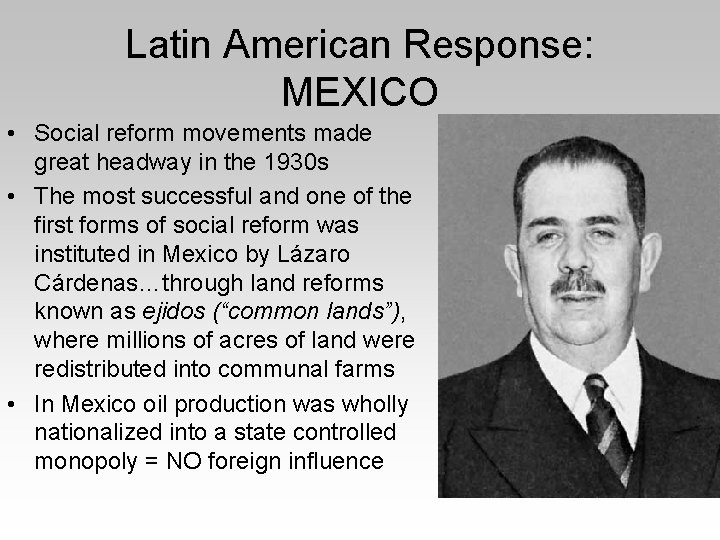
Latin American Response: MEXICO • Social reform movements made great headway in the 1930 s • The most successful and one of the first forms of social reform was instituted in Mexico by Lázaro Cárdenas…through land reforms known as ejidos (“common lands”), where millions of acres of land were redistributed into communal farms • In Mexico oil production was wholly nationalized into a state controlled monopoly = NO foreign influence
GD in LA: Big Ideas • Government regulation, ISI, trade agreements and government intervention to stabilize the financial sector all helped to bring LA out of the GD. • Social inequalities (class-based, labor and racial) not only persisted through the GD but were worsened. • Leaders were challenged to close the gap and improve the standard of living for the working and middle classes. • We will compare and contrast Brazil and Argentina.
Brazil: Essential Questions • What is Populism and Fascism and how to they relate to Vargas’ policy? • What is ISI? • To what extent did Vargas change the economy of Brazil during the 1930’s? • Compare and contrast the economic policies of Roosevelt and Vargas.
Populism defined • Cambridge dictionary: "political ideas and activities that are intended to represent ordinary people's needs and wishes" • Any political discourse that appeals to the general mass of the population, to the "people" regardless of race, class distinctions, and political partisanship • A common theme is "the people" rising up against "the elite" – The “haves” vs. the “have nots”
Fascism defined • Radical authoritarian political ideology founded during WWI by Italian nationalists (Mussolini) • Fascism seeks to purify the nation of foreign influences that are deemed to be causing degeneration of the nation or of not fitting into the national culture. • Promotes politically violent actions (war) to strengthen nationalism. To achieve its goals, the fascist state purges contradictory forces, ideas, people, and systems (fear). • State-directed and regulated economy that is dedicated to the service of the nation (strikes are criminal behavior) • “Fascism is Socialism with a Capitalist veneer. ” (Concise Encyclopedia of Economics)
ISI Defined • Import Substitution Industrialization (called ISI) is a trade and economic policy based on the premise that a country should attempt to reduce its foreign dependency through the local production of industrialized products. • ISI requires state-induced industrialization through government spending. -government grows and therefore the budget grows dramatically
ISI in Latin America • First steps: Countries placed protective tariffs on imports on products that it wanted to produce locally. • Protected industries were assisted by the government through subsidies, low interest loans, and tax incentives. • Populist government in Brazil (Vargas) modeled after a Fascist Italy as inspiration for state-induced industrialization.
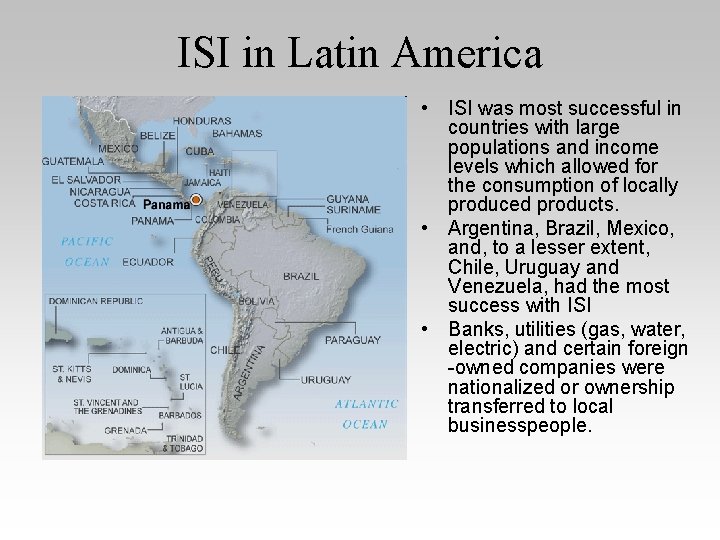
ISI in Latin America • ISI was most successful in countries with large populations and income levels which allowed for the consumption of locally produced products. • Argentina, Brazil, Mexico, and, to a lesser extent, Chile, Uruguay and Venezuela, had the most success with ISI • Banks, utilities (gas, water, electric) and certain foreign -owned companies were nationalized or ownership transferred to local businesspeople.
Brazil before the Great Depression The Old Republic: constitutional system of government that operated in Brazil from 1890 -1930 and ended with a coup d'état. Significant developments during this time included a growth in urban middle and working classes and a growing involvement of the military in politics. Both groups sought modernization and disdain for the old elites who were seen as an impediment to progress. Tenentes: Junior officers who wanted modernization and effective government (not necessarily democracy) in Brazil. In the 1920 s they took direct action in a series of rebellions with the goal of modernizing Brazil and strengthening the central government in the spirit of European fascism. Some are chosen to govern States or serve as advisors
Brazil’s economy before the Great Depression – Coffee was main export – Rural, illiterate population. 3% vote – elections rigged – Isolation of WWI created a growing demand for necessary items - invigorated economy • Profits derived from coffee provided resources to help create industry in Brazil. • Increased urbanization and industrialization strengthened both the industrial upper class and the working class.
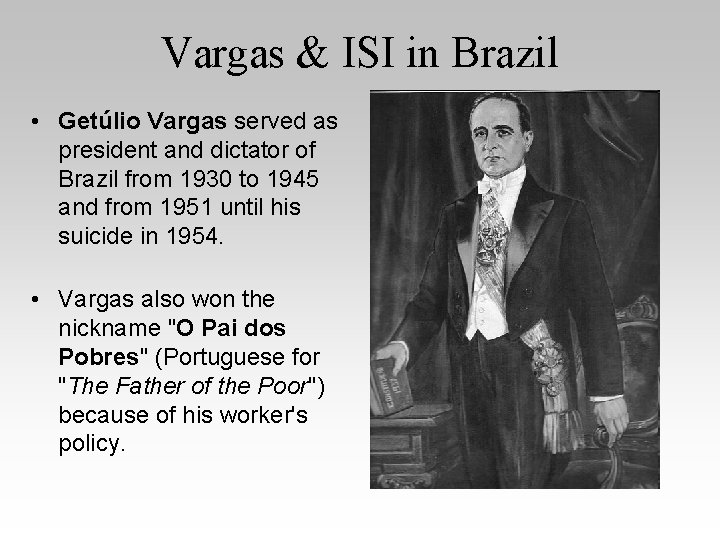
Vargas & ISI in Brazil • Getúlio Vargas served as president and dictator of Brazil from 1930 to 1945 and from 1951 until his suicide in 1954. • Vargas also won the nickname "O Pai dos Pobres" (Portuguese for "The Father of the Poor") because of his worker's policy.
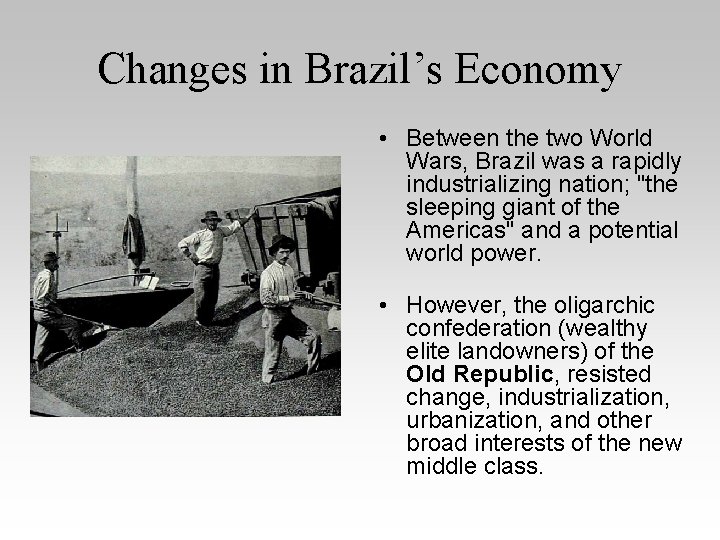
Changes in Brazil’s Economy • Between the two World Wars, Brazil was a rapidly industrializing nation; "the sleeping giant of the Americas" and a potential world power. • However, the oligarchic confederation (wealthy elite landowners) of the Old Republic, resisted change, industrialization, urbanization, and other broad interests of the new middle class.
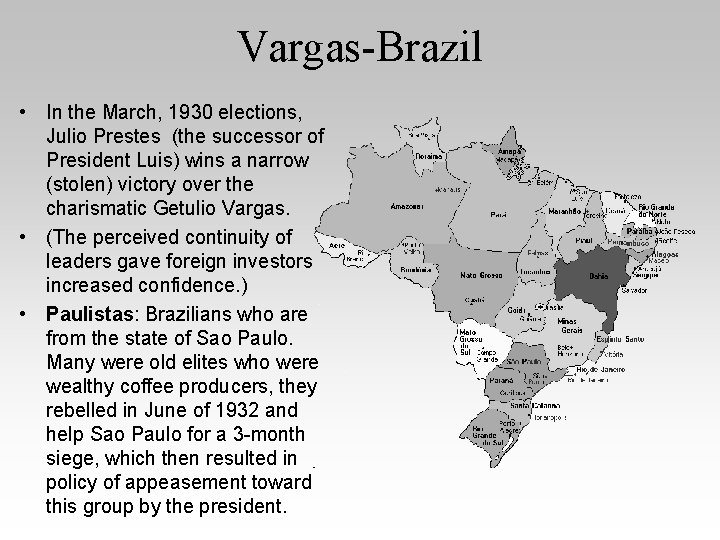
Vargas-Brazil • In the March, 1930 elections, Julio Prestes (the successor of President Luis) wins a narrow (stolen) victory over the charismatic Getulio Vargas. • (The perceived continuity of leaders gave foreign investors increased confidence. ) • Paulistas: Brazilians who are from the state of Sao Paulo. Many were old elites who were wealthy coffee producers, they rebelled in June of 1932 and help Sao Paulo for a 3 -month siege, which then resulted in policy of appeasement toward this group by the president.
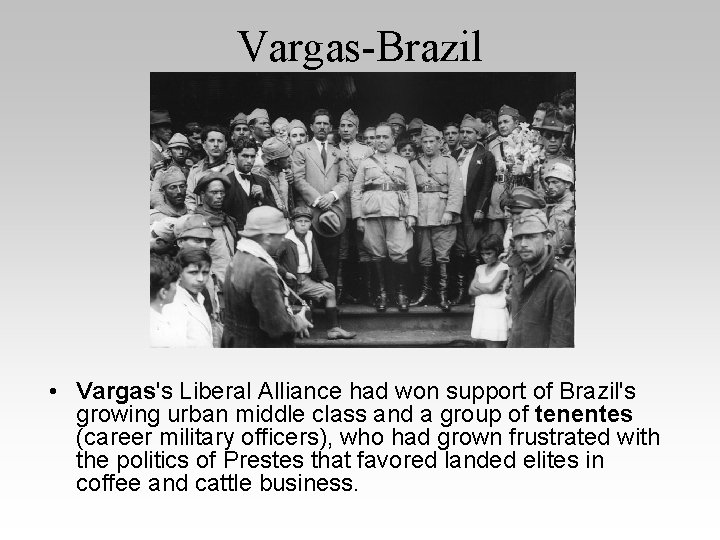
Vargas-Brazil • Vargas's Liberal Alliance had won support of Brazil's growing urban middle class and a group of tenentes (career military officers), who had grown frustrated with the politics of Prestes that favored landed elites in coffee and cattle business.
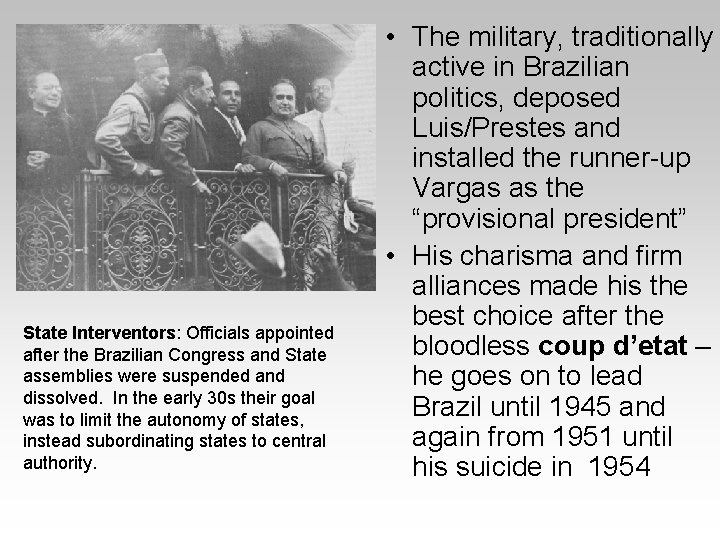
State Interventors: Officials appointed after the Brazilian Congress and State assemblies were suspended and dissolved. In the early 30 s their goal was to limit the autonomy of states, instead subordinating states to central authority. • The military, traditionally active in Brazilian politics, deposed Luis/Prestes and installed the runner-up Vargas as the “provisional president” • His charisma and firm alliances made his the best choice after the bloodless coup d’etat – he goes on to lead Brazil until 1945 and again from 1951 until his suicide in 1954
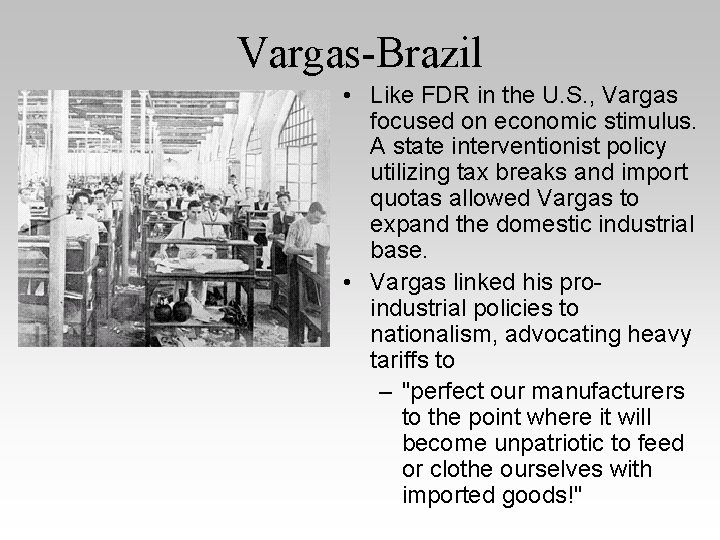
Vargas-Brazil • Like FDR in the U. S. , Vargas focused on economic stimulus. A state interventionist policy utilizing tax breaks and import quotas allowed Vargas to expand the domestic industrial base. • Vargas linked his proindustrial policies to nationalism, advocating heavy tariffs to – "perfect our manufacturers to the point where it will become unpatriotic to feed or clothe ourselves with imported goods!"

Vargas-Brazil Between 1929 and 1931, coffee prices fell from 22. 5 cents per pound to 8 cents per pound Coffee Valorization Program: price support program, a safety net in times of economic crisis Vargas attempted to bring it back on its feet through the National Department of Coffee: – Restriction of plantings – Purchase of surplus stocks – Burning excess coffee The coffee industry did not grow in the 30 s, only WWII really brought it back Production in other agricultural goods increased, (livestock and cotton) using similar valorization methods
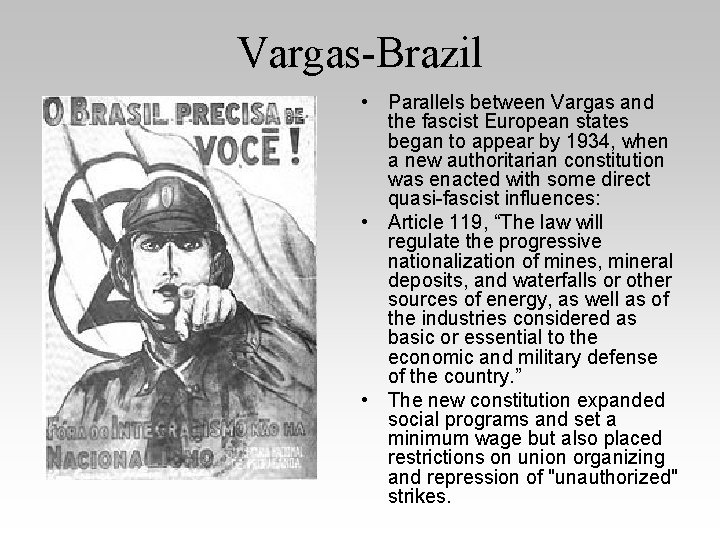
Vargas-Brazil • Parallels between Vargas and the fascist European states began to appear by 1934, when a new authoritarian constitution was enacted with some direct quasi-fascist influences: • Article 119, “The law will regulate the progressive nationalization of mines, mineral deposits, and waterfalls or other sources of energy, as well as of the industries considered as basic or essential to the economic and military defense of the country. ” • The new constitution expanded social programs and set a minimum wage but also placed restrictions on union organizing and repression of "unauthorized" strikes.
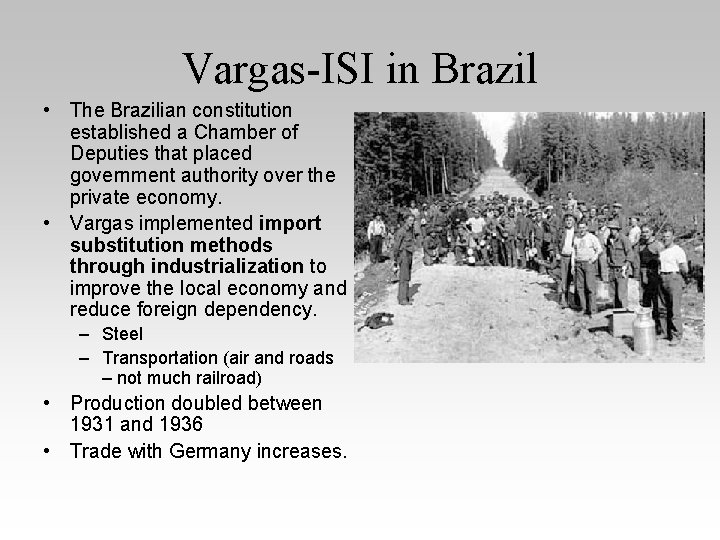
Vargas-ISI in Brazil • The Brazilian constitution established a Chamber of Deputies that placed government authority over the private economy. • Vargas implemented import substitution methods through industrialization to improve the local economy and reduce foreign dependency. – Steel – Transportation (air and roads – not much railroad) • Production doubled between 1931 and 1936 • Trade with Germany increases.
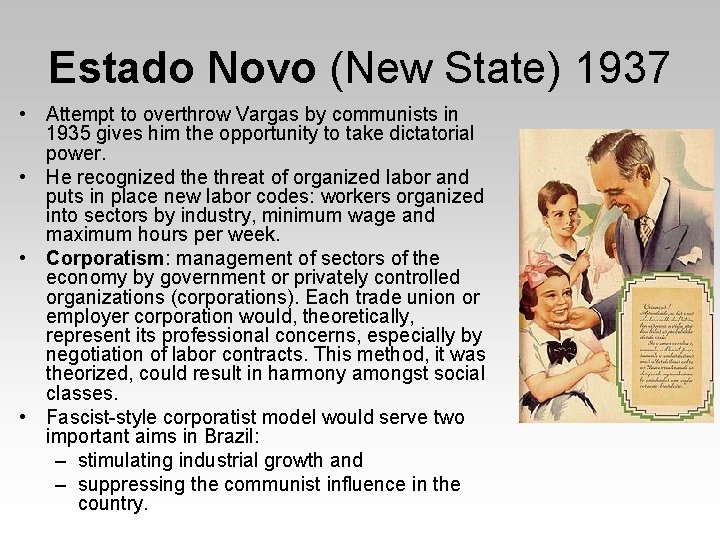
Estado Novo (New State) 1937 • Attempt to overthrow Vargas by communists in 1935 gives him the opportunity to take dictatorial power. • He recognized the threat of organized labor and puts in place new labor codes: workers organized into sectors by industry, minimum wage and maximum hours per week. • Corporatism: management of sectors of the economy by government or privately controlled organizations (corporations). Each trade union or employer corporation would, theoretically, represent its professional concerns, especially by negotiation of labor contracts. This method, it was theorized, could result in harmony amongst social classes. • Fascist-style corporatist model would serve two important aims in Brazil: – stimulating industrial growth and – suppressing the communist influence in the country.
Vargas - ISI successes • Industrial production increased by double from 1931 to 1936, even when the US was still in depression, Brazil’s national income had begun to rise. • The Brazilian Economy was no longer dependent on outside factors. • In 1940, a Five Year Plan was announced to expand the heavy industries and the railroad system: National Motor Company, National Steel Company, National Petroleum Company • In 1941 there were 44 K small-scale plants (hand labor) and these successfully provided substitute goods for previously imported products. • Most of the population was still rural working class peons who lived in debt to their hacienda owners. • New industry urban; Sao Paulo held most industrial wealth. • Vargas tried to encourage migration to the untouched interior of the country with land grants. • Achieved self-sufficiency; autocracy
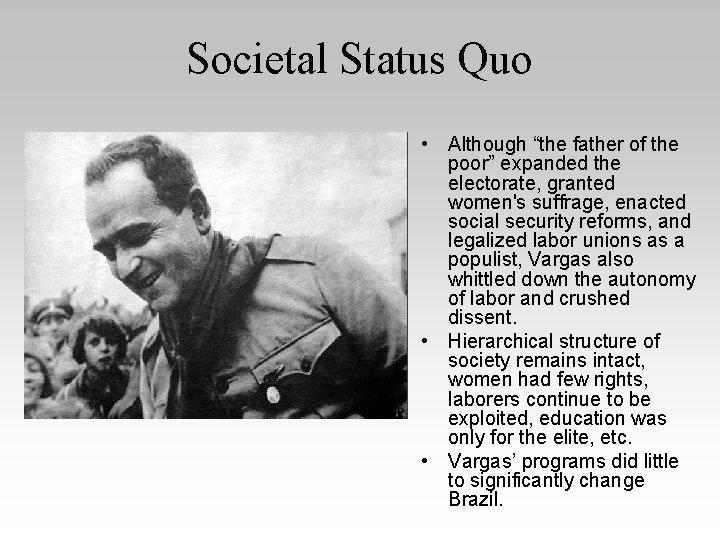
Societal Status Quo • Although “the father of the poor” expanded the electorate, granted women's suffrage, enacted social security reforms, and legalized labor unions as a populist, Vargas also whittled down the autonomy of labor and crushed dissent. • Hierarchical structure of society remains intact, women had few rights, laborers continue to be exploited, education was only for the elite, etc. • Vargas’ programs did little to significantly change Brazil.
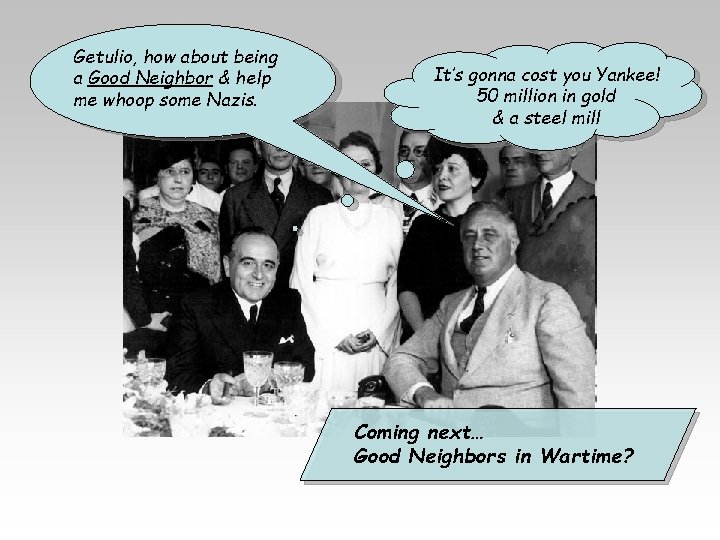
Getulio, how about being a Good Neighbor & help me whoop some Nazis. It’s gonna cost you Yankee! 50 million in gold & a steel mill Coming next… Good Neighbors in Wartime?
- Slides: 30