
The Great Depression and the New Deal 1933
- Slides: 50
The Great Depression and the New Deal (1933 -1941) Chapter 32, Rise of the American Nation
The New Deal measures provide relief and speed recovery 32. 1, pp. 606 -610
Three general aims of the New Deal • Relief • Recovery • Reform
Roosevelt restores confidence • First Inaugural Address • Called on Americans to rise above their fears: “We have nothing to fear but fear itself. ” • Promised “action, and action now” • Called a special session of Congress • First 100 days: 15 messages to congress which resulted in 15 major relief and recovery measures
Solving financial problems • President Roosevelt declared a “bank holiday, ” closing every bank in the nation for an indefinite period • Congress then rushed through emergency banking laws forbidding any bank to reopen until it could prove its ability to carry on business without endangering customers’ deposits. • Congress created the Federal Deposit Insurance Corporation (FDIC) to insure individual deposits up to $2, 500. (Now $250, 000) • Congress directed the Secretary of the Treasury to call in all gold coins and gold certificates, abandoning the gold standard. • This devalued the dollar. • Congress hoped cheaper dollars 9 inflation) would raise agricultural prices. • (It didn’t work. )
Solving financial problems: pump priming • Well analogy • Plan was to “pump’ money into the nation’s economy through federal loans and spending • The hope was that this would stimulate the flow of more money. • Reconstruction Finance Corporation (RFC) • Started under Hoover • Loans totaling $11 billion to railroads, banks, , insurance firms, and industrial enterprises
Direct relief for the unemployed • By 1933 nearly 14 million men and women were out of work. • In the next two years federal agencies distributed $3 billion to the states for direct relief. • Local authorities were allowed to use the money as they chose – to provide direct relief or jobs. • Few Americans liked this kind of help. They wanted jobs.
Work relief • 1933 -34 $1 billion in wages for “make-work” or “boondoggling, ” work of little value • Works Progress Administration (WPA), 1935 • Public projects, roads, bridges, buildings • Civilian Conservation Corps (CCC), 1933 • Rural work by men, 18 -25 years old, to clear trails, clear swamps, plant trees, clear land for public parks, etc. to help conserve our natural resources • National Youth Administration (NYA), 1935 • Urban work for school age students in and around their schools
Criticisms • Many mistakes were made. • Bad management and waste • New Dealers’ defense • No successful past examples of that scale to follow • Handicapped by lack of trained personnel to carry out the programs • The programs justified themselves by helping millions.
Recovery measures stimulate agriculture and industry 32. 2, pp. 610 -614
Basic New Deal plan to aid farmers • Farm credit programs by Farm Credit Administration (FCA), 1933 • Federal government made available lots of money that farmers could borrow at low interest rates • Farmers could borrow $5, 000 from Federal Land Banks to refinance mortgages • Raise prices of farm products to increase farmer income • Supply and demand- reduce supply • Agricultural Adjustment Administration (AAA): farmers volunteered to not use ¼ - ½ of land; paid – subsidy- by federal government from taxes on food processors
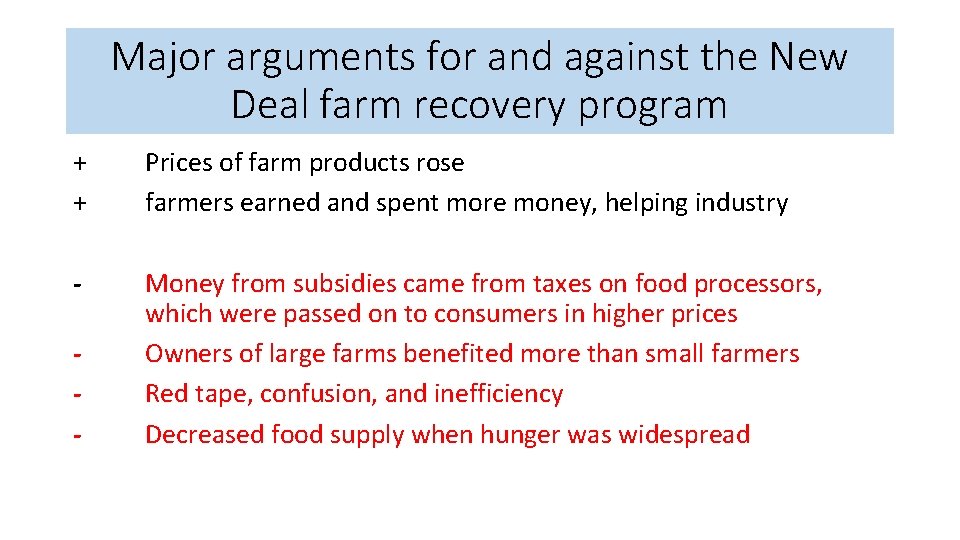
Major arguments for and against the New Deal farm recovery program + + Prices of farm products rose farmers earned and spent more money, helping industry - Money from subsidies came from taxes on food processors, which were passed on to consumers in higher prices Owners of large farms benefited more than small farmers Red tape, confusion, and inefficiency Decreased food supply when hunger was widespread -
Supreme Court declares the Agricultural Adjustment Act of 1933 unconstitutional • US v. Butler, 1936 • Congress had no constitutional right to regulate agricultural production (state responsibility) • Article I, section 8, clauses 1 -18 lists the powers of Congress, which includes the regulation of commerce between states, but not internal to states
Public works (p. 612, not on study guide) • Public Works Administration, 1933 • Built power plants, schools, hospitals, government buildings • Home Owner’s Loan Corporation • Provided low interest mortgage loans over longer periods of time • Federal Housing Administration • Encourage banks to lend money by insuring mortgage loans • Problem: the very poor were not helped
New Deal helps the transportation industry • Interstate Commerce Commission (ICC) ordered all railroads to reduce rates from 3. 2 to 2 cents/mile • Government loans to railroads for modern equipment • Government money to improve highways and waterways
National Industrial Recovery Act (NIRA) • Created in 1933 as two year emergency measure intended to aid industry, consumers and labor • Employers cooperate to stabilize prices, find employment for jobless, raise wages • Industries, with aid of National Recovery Administration, adopt “code of fair practices” + 95% industries adopted, limited production, controlled prices, improved work conditions Codes benefited large businesses, not small; difficult to enforce, courts refused to enforce; prices were raised to cover wage hikes, thus defeating purpose; stimulated unionization and collective bargaining
NIRA continued • Important and controversial: Guaranteed workers the right to bargain collectively • National Labor Relations Board (NLRB): created to conduct elections in plants, determine reps, and arbitrate disputesunpopular with businesses; usually sided with labor
Supreme Court declares the NIRA unconstitutional • Schechter v. U. S. 1935 • Limits on federal power • Constitution, in giving the federal government the right to regulate interstate commerce, did not give the government the power to regulate every aspect of business. • See Butler in slide 13 above
Wagner Act • National Labor Relations Act, 1935 • Passed by Congress after NIRA found unconstitutional • Guaranteed to labor the right to organize, bargain collectively, and to engage in “concerted activities. . . for other mutual aid. ” • MOST CONTROVERSIAL measure of New Deal
The New Deal carries out reform measures 32. 3, pp. 614 -616
Reform Measures • Federal Reserve System/Board expanded (FDIC) and Securities Exchange System created • Social Security • Rural Electrification Administration developed and distributed electricity to rural areas • Public Utilities- Regulate interstate production, transmission, and sale of energy • Tennessee Valley Authority
Purposes of the Social Security Act of 1935 • Unemployment insurance for individuals who lost their jobs – payroll tax • Old-age pensions for those over 65 – payroll and social security tax • Dependent children and handicapped (disabled, blind) – Federal and State funds
Tennessee Valley Authority • The purpose was to provide for the unified development of all resources in the seven state Tennessee River Valley region. This development was to improve economic and social conditions for the benefit of the people who lived there. • Region: 1935 -45 MS homes with electricity increased from 1% to 20% and rates were cut 1/3. • The dams also controlled floods. • Nationwide: the TVA set a standard for the cost of generating and distributing electrical power to benefit all Americans.
Arguments against the TVA • Private utility companies said it was an unnecessary federal intervention into private business. • The lower TVA rates were not due to efficiencies, but due to the lack of corporate taxes. • The TVA was an unfair standard; it was a gift from the national taxpayers to one region.
Opposition increases toward New Deal policies and programs 32. 4, pp. 617 -619
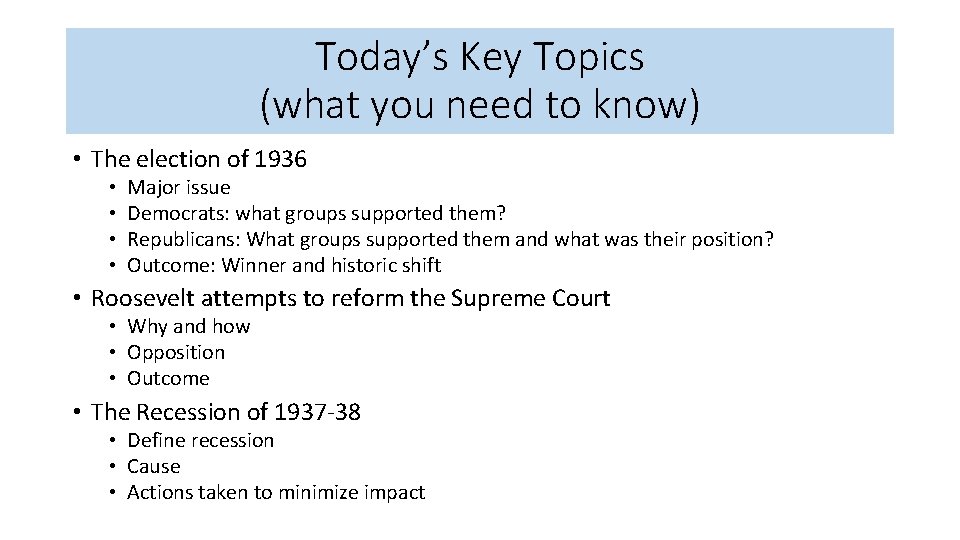
Today’s Key Topics (what you need to know) • The election of 1936 • • Major issue Democrats: what groups supported them? Republicans: What groups supported them and what was their position? Outcome: Winner and historic shift • Roosevelt attempts to reform the Supreme Court • Why and how • Opposition • Outcome • The Recession of 1937 -38 • Define recession • Cause • Actions taken to minimize impact
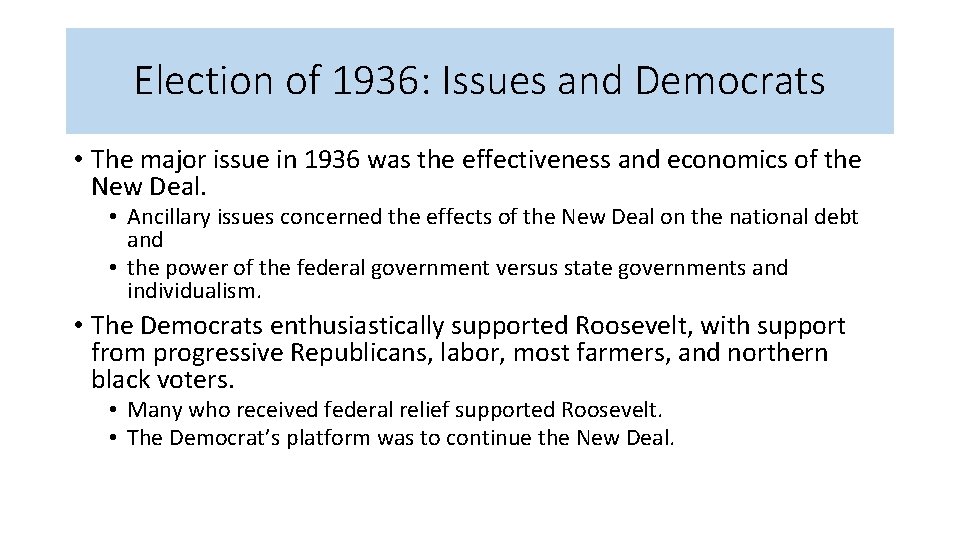
Election of 1936: Issues and Democrats • The major issue in 1936 was the effectiveness and economics of the New Deal. • Ancillary issues concerned the effects of the New Deal on the national debt and • the power of the federal government versus state governments and individualism. • The Democrats enthusiastically supported Roosevelt, with support from progressive Republicans, labor, most farmers, and northern black voters. • Many who received federal relief supported Roosevelt. • The Democrat’s platform was to continue the New Deal.
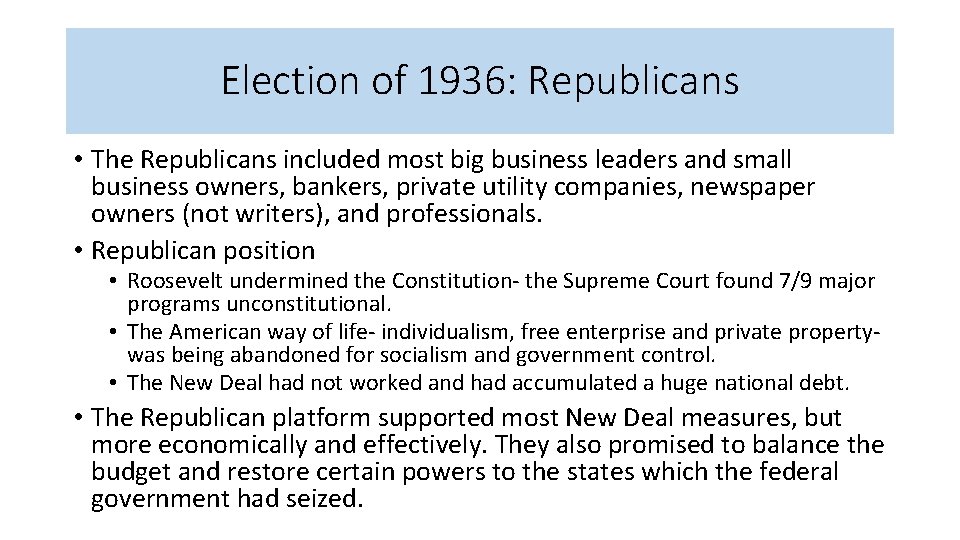
Election of 1936: Republicans • The Republicans included most big business leaders and small business owners, bankers, private utility companies, newspaper owners (not writers), and professionals. • Republican position • Roosevelt undermined the Constitution- the Supreme Court found 7/9 major programs unconstitutional. • The American way of life- individualism, free enterprise and private propertywas being abandoned for socialism and government control. • The New Deal had not worked and had accumulated a huge national debt. • The Republican platform supported most New Deal measures, but more economically and effectively. They also promised to balance the budget and restore certain powers to the states which the federal government had seized.
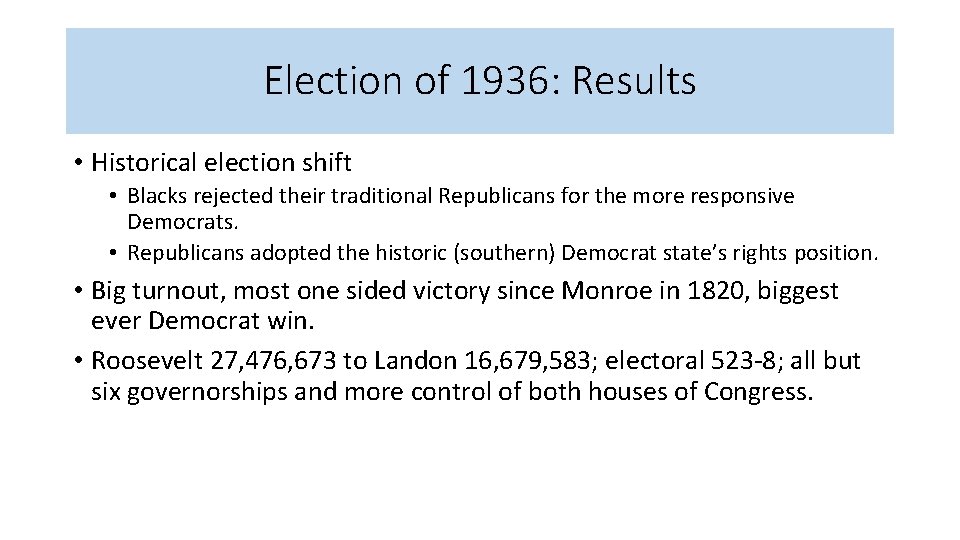
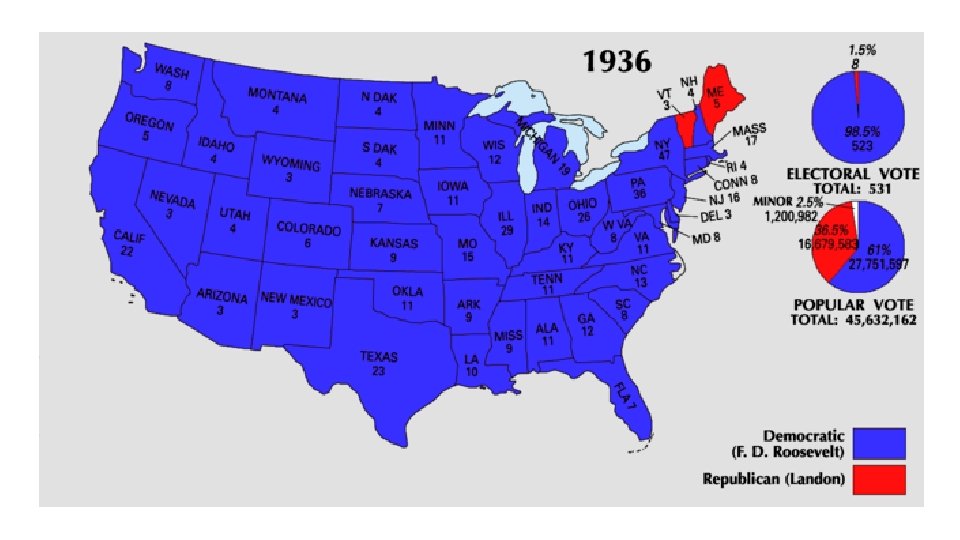
Election of 1936: Results • Historical election shift • Blacks rejected their traditional Republicans for the more responsive Democrats. • Republicans adopted the historic (southern) Democrat state’s rights position. • Big turnout, most one sided victory since Monroe in 1820, biggest ever Democrat win. • Roosevelt 27, 476, 673 to Landon 16, 679, 583; electoral 523 -8; all but six governorships and more control of both houses of Congress.
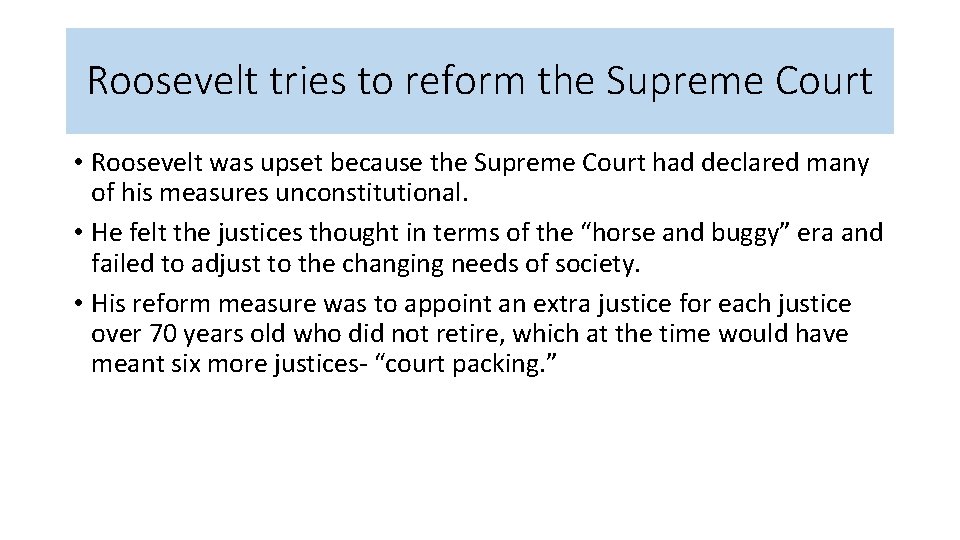
Roosevelt tries to reform the Supreme Court • Roosevelt was upset because the Supreme Court had declared many of his measures unconstitutional. • He felt the justices thought in terms of the “horse and buggy” era and failed to adjust to the changing needs of society. • His reform measure was to appoint an extra justice for each justice over 70 years old who did not retire, which at the time would have meant six more justices- “court packing. ”
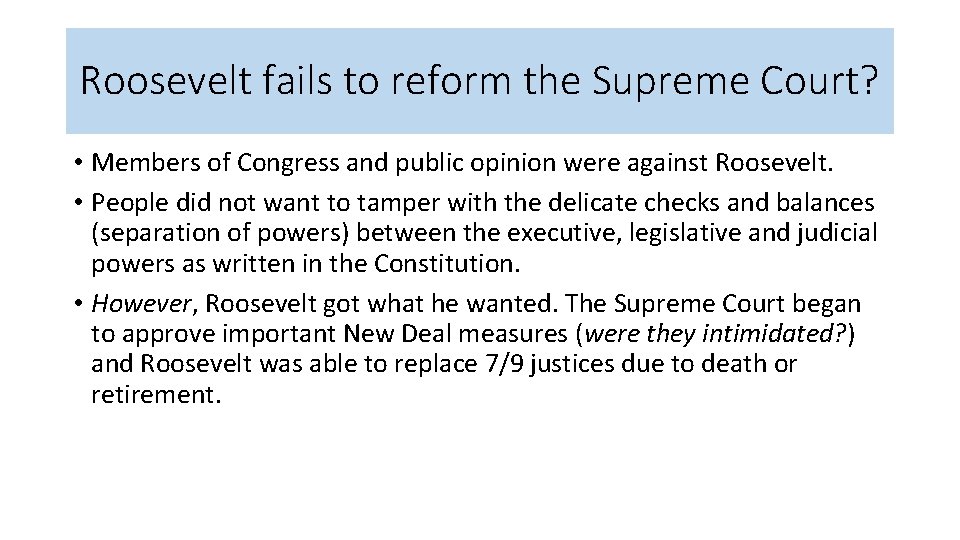
Roosevelt fails to reform the Supreme Court? • Members of Congress and public opinion were against Roosevelt. • People did not want to tamper with the delicate checks and balances (separation of powers) between the executive, legislative and judicial powers as written in the Constitution. • However, Roosevelt got what he wanted. The Supreme Court began to approve important New Deal measures (were they intimidated? ) and Roosevelt was able to replace 7/9 justices due to death or retirement.
Recession of 1937 -38 • Recession: Business slump less severe than a depression. • The Democrats called the 1937 -38 rise in factory closings and unemployment a recession, while the Republicans called it the “Roosevelt depression. ” • The recession was caused by the cuts in government spending (spurred by concern over the largest national debt in history) in 1936. The private sector was not yet strong enough to absorb the cut and suffered.
New Deal measures minimize the impacts of the recession of 1937 -38 • New Deal measures already enacted helped minimize the effects of the recession • Social Security unemployment checks • FDIC savings protection • available loans • Roosevelt also renewed pump priming, increasing lending and spending • RFC rescued troubled businesses • Doubled the workers in the WPA
New Deal reforms continue despite growing criticism 32. 5, pp. 619 -623
John L. Lewis • Leader of the United Mine Workers who helped organize the Committee (Congress) for Industrial Organization (CIO) in 1935 as an alternative to the slower moving American Federation of Labor (AFL). He became its first president in 1938. • Industrial unions, like the CIO, organized all workers, skilled and unskilled, in an industry. • An example is the united Automobile Workers (UAW). • Previously there were just separate unions for each craft of skill. • The CIO also encouraged inclusion of black workers, whom previously were denied union membership.
Sit down strike • First started in Nov 1936 at the General Motors plant in Flint, MI. • Workers simply sat down at their machines and refused to work rather than leaving and organizing picket lines. They refused to leave until management met their demands. • The sit down strike was very effective since it prevented management from bringing in strike breakers. • The SCOTUS ruled it unconstitutional in 1939.
A. F. of L. versus the CIO • Disputes between the A. F. of L. and CIO over who had jurisdiction, or the right to enroll a particular group of workers in their union, led to jurisdictional strikes. • The CIO was organized because the A. F. of L. was thought to act too slowly. Also the CIO was an industrial union. The A. F. of L. organized in 1881 as a federation of craft unions (though it included some industrial unions).
Fair Labor Standards Act • Passed as a reform measure in 1938 • It (Wages and Hours Law) provided a minimum wage scale and a maximum workweek for most workers. • It applied only to workers employed in interstate industries (Why? Constitution) but directly benefited 13 M workers by 1940, and indirectly helped others due to competition in the market place. • Critics saw this as another unneeded and unwise government interference and control over industry. • [It did not fix racial discrimination, thus A. Philip Randolf, a powerful and militant black leader threatened to march on the Capital in 1941. In response, Roosevelt established the Fair Employment Practices Committee (for federal contracts). ]
Measures taken from 1936 to 1938 to help improve the economic conditions of farmers • Soil Conservation and Domestic Allocation Act of 1936 set up a soil conservation program that paid farmers for “conserving” land. • Bankhead-Jones Farm Tenant Act of 1937 created the Farm Security Admin to provide low interest loans to tenant farmers, sharecroppers and migrant workers to buy farms. • (2 nd) Agricultural Adjustment Act of 1938 • provided payments to farmers in proportion to the number of acres withdrawn from production and planted in soil conserving crops (replaced SCDA Act of 1936 above) • authorized the government to decide the amount of various crops that could be marketed each year, with the approval of 2/3 of the local producers (violators fined) • government stored surpluses for use in lean years and gave the farmers loans • authorized the government to insure wheat crops against drought, flood, disease
Criticism of the farm programs • Critics said the increased farm income came from higher consumer prices and subsidies- taxpayers’ money. • Many farmers also resented government control and loss of independence. • They also felt the price support program hurt American farmers vs foreign competition.
Hatch Act • Passed in 1939, the Hatch Act placed restrictions on federal officeholders below the policy making level in the executive branch of government. • It prohibited such officeholders • from tanking an active part in political campaigns • from soliciting or accepting political contributions from workers on relief • from using their official positions to try to influence Presidential or Congressional elections • The 1940 amendment added state and local employees whose pay came partially from federal funds and also limited individual campaign contributions.
Other New Deal Programs • National Housing Act of 1937 to • stimulate business by government spending for house construction • remedy shortage of safe and satisfactory housing conditions in low income areas • created the U. S. Housing Authority • Food, Drug, and Cosmetic Act of 1938 • replaced the 1906 Pure Food and Drug Act • It, with the 1938 Wheeler-Lea Act, required adequate testing, labeling and advertising on food, drugs, and cosmetics.
The New Deal’s great experiment comes to an end 32. 6, pp. 623 -626
3 Methods used by New Dealers to raise money • Inflation- by taking the nation off the gold standard, Roosevelt cheapened the value of the dollar. • The government also spent more than it took in, or deficit spending, increasing the national debt from about $16 B to $40 B during the 1930’s. • Finally, Congress raised taxes to increase revenue. • Critics said these actions cheapened the dollar, caused a loss of confidence in the administration, and took money away from business expansion, investment and surpluses for depression years.
Deficit spending • Government spending where the amount spent exceeds the amount received in taxes and other revenues, leaving the budget unbalanced, or showing a deficit. Spending > Revenues ⇒ deficit • [The national debt is the total accumulation of annual deficits which have not been paid. During President Obama’s eight years in office the national debt almost doubled from $10. 6 trillion to $19. 9 trillion, due to an annual average deficit of almost $1. 2 trillion. Almost 1/3 of the federal government’s spending was deficit spending. Only 2/3 was covered by taxes and other revenues. ]
Election of 1940 • Roosevelt’s influence was decreasing by 1940 • The two-term tradition was widely accepted as part of the unwritten constitution. • In 1938, as a result of growing opposition to the New Deal, Congress began to reverse the taxation policy of the previous five years. • Wendell Willkie • Republican candidate for President in 1940 from NY • He was a powerful Wall Street lawyer with Democratic leanings and a long progressive record.
Roosevelt and Willkie disagree on domestic issues • The Democrats promised to extend social security, to stress the lowcost housing program, and to advance government ownership of private utilities. • The Republicans felt the New Deal was extravagant and administered in such a way as to endanger individualism, free enterprise, and democracy. • They promised to revise the tax system to stimulate private enterprise and to promote prosperity. • They promised to keep most New Deal reforms, but to administer them with more efficiency and less waste. • Finally, they demanded a constitutional amendment limiting Presidents to two terms.
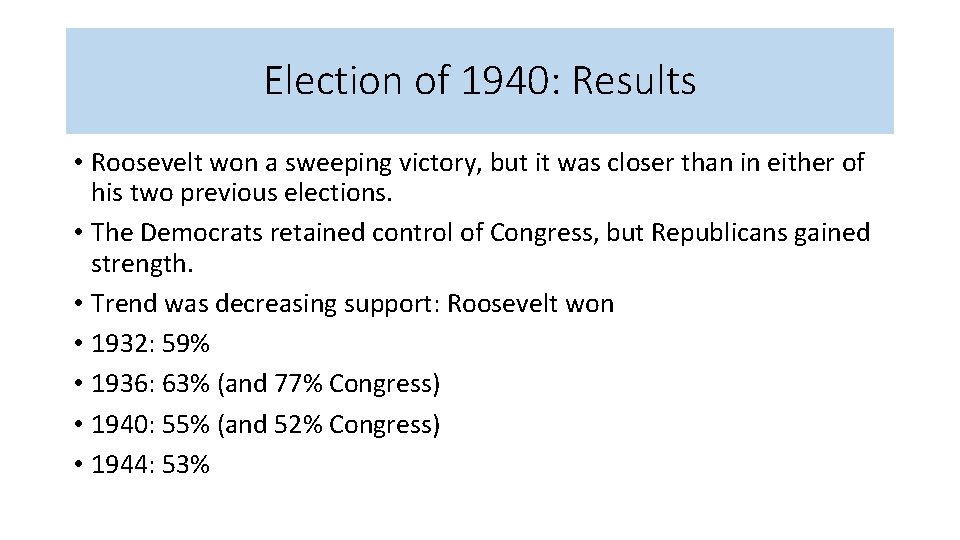
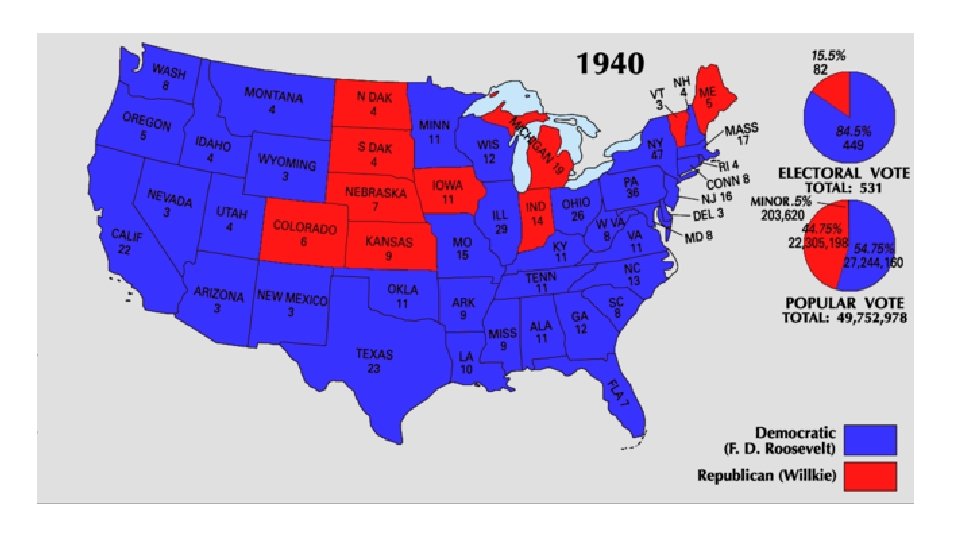
Election of 1940: Results • Roosevelt won a sweeping victory, but it was closer than in either of his two previous elections. • The Democrats retained control of Congress, but Republicans gained strength. • Trend was decreasing support: Roosevelt won • 1932: 59% • 1936: 63% (and 77% Congress) • 1940: 55% (and 52% Congress) • 1944: 53%