
THE GREAT CONVERGENCE Information technology and the New


- Slides: 59
THE GREAT CONVERGENCE Information technology and the New Globalization A NEW BOOK BY RICHARD BALDWIN PROFESSOR OF INTERNATIONAL ECONOMICS THE GRADUATE INSTITUTE I GENEVA University of Canberra 7 March 2017 © Richard Baldwin 2016
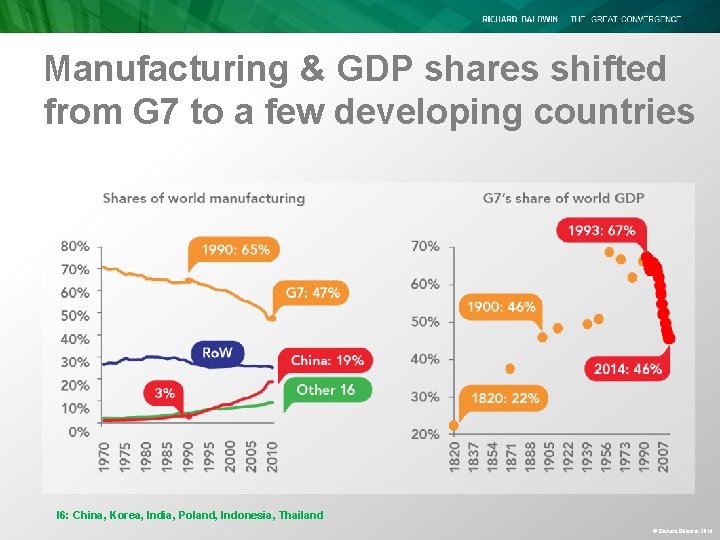
Manufacturing & GDP shares shifted from G 7 to a few developing countries I 6: China, Korea, India, Poland, Indonesia, Thailand © Richard Baldwin 2016
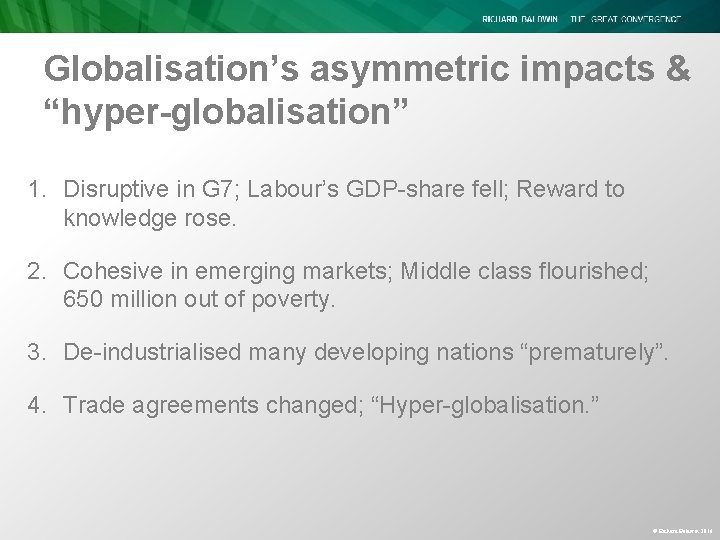
Globalisation’s asymmetric impacts & “hyper-globalisation” 1. Disruptive in G 7; Labour’s GDP-share fell; Reward to knowledge rose. 2. Cohesive in emerging markets; Middle class flourished; 650 million out of poverty. 3. De-industrialised many developing nations “prematurely”. 4. Trade agreements changed; “Hyper-globalisation. ” © Richard Baldwin 2016
What if globalisation were about knowledge flows instead of trade flows? © Richard Baldwin 2016
Be extreme to be extremely clear • Suppose everything is made from knowhow & labour. • Suppose trade costs & barriers unchanged since 1990. • Suppose in 1990 ‘pipelines’ opened that allowed knowhow to flow across borders. © Richard Baldwin 2016
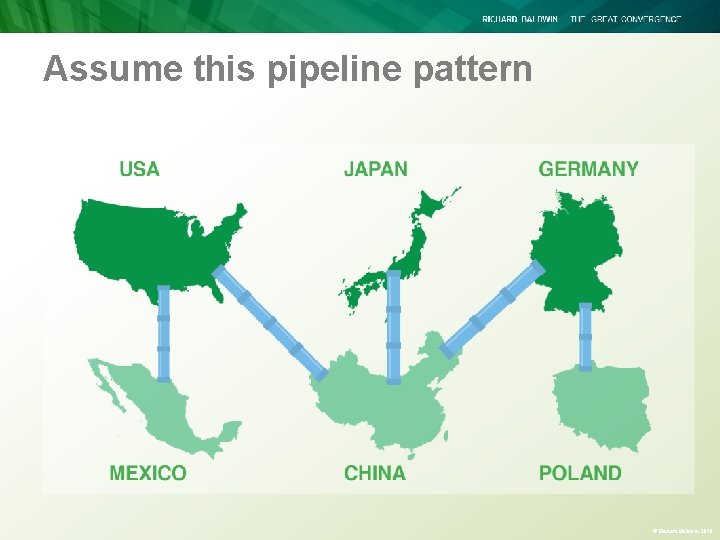
Assume this pipeline pattern © Richard Baldwin 2016
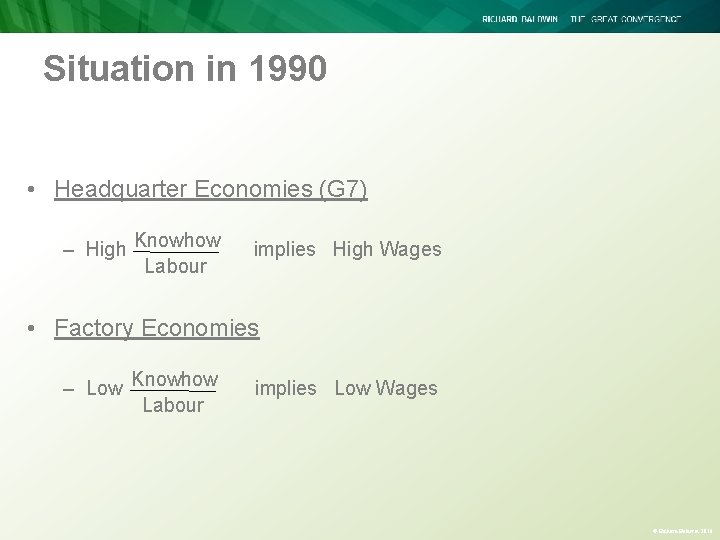
Situation in 1990 • Headquarter Economies (G 7) – High Knowhow Labour implies High Wages • Factory Economies – Low Knowhow Labour implies Low Wages © Richard Baldwin 2016
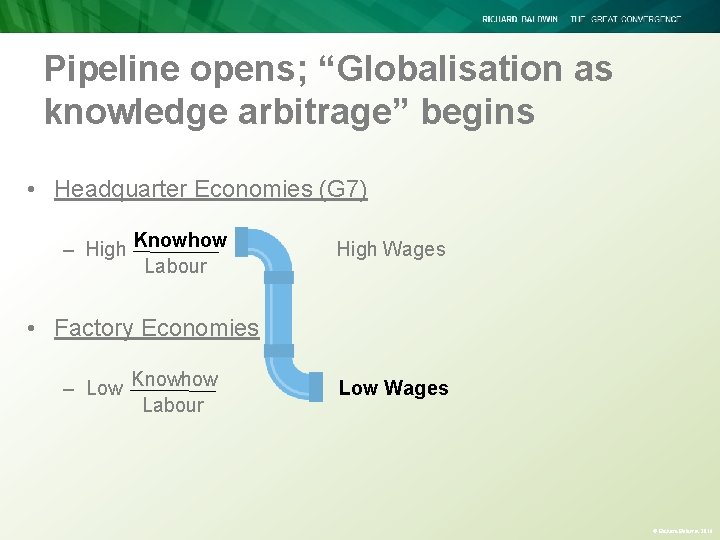
Pipeline opens; “Globalisation as knowledge arbitrage” begins • Headquarter Economies (G 7) – High Knowhow Labour High Wages • Factory Economies – Low Knowhow Labour Low Wages © Richard Baldwin 2016
What would international impact be? • Manufacturing shifts from G 7 to Factory Economies • Factory-Economy growth takes off (Great Convergence) • Factory Economies embrace policies that foster knowledge flows; HQ Economies embrace policies that protect them. ® Hyper-globalisation explained. • Other poor nations hurt by new competitiveness of I 6 – Premature deindustrialisation explained. © Richard Baldwin 2016
What would happen inside Headquarter & Factory Economies? • Headquarter Economies: Labour GDP share falls; Knowledge-owners’ shares rise. • Factory Economies: Middle class flourishes; 650 million rise out of poverty. © Richard Baldwin 2016
How do we put knowledge back in the box? © Richard Baldwin 2016
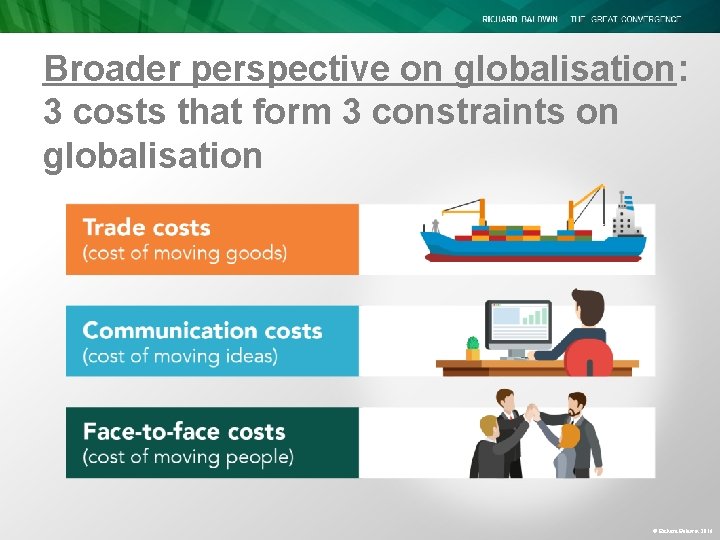
Broader perspective on globalisation: 3 costs that form 3 constraints on globalisation © Richard Baldwin 2016
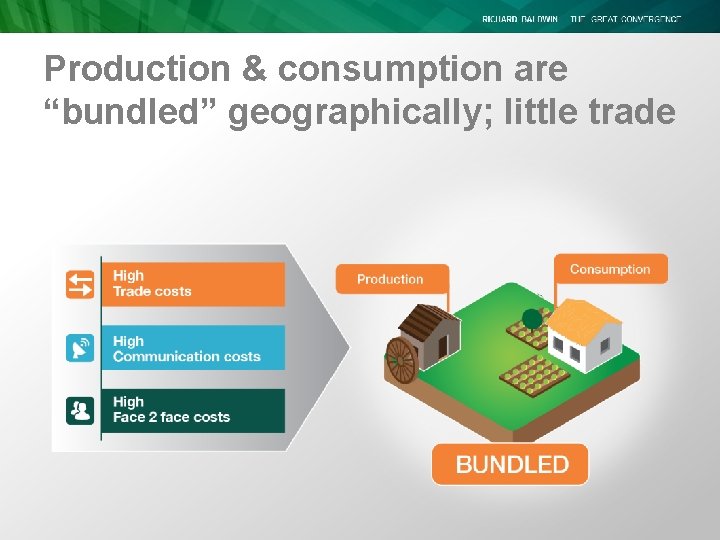
Production & consumption are “bundled” geographically; little trade
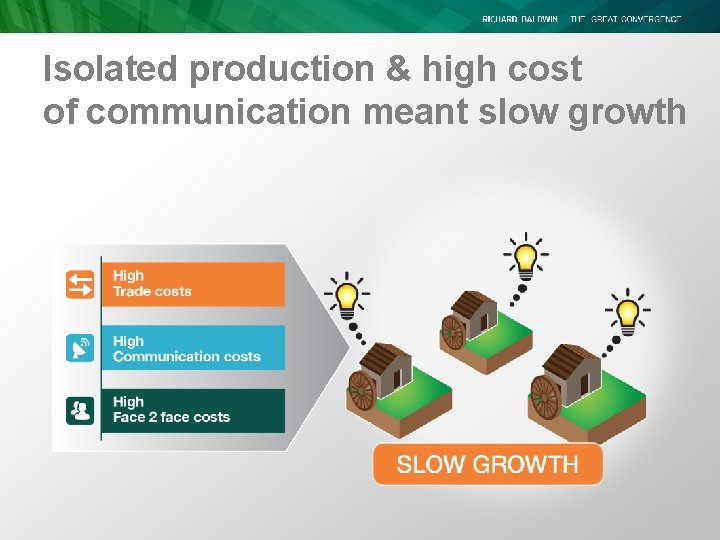
Isolated production & high cost of communication meant slow growth
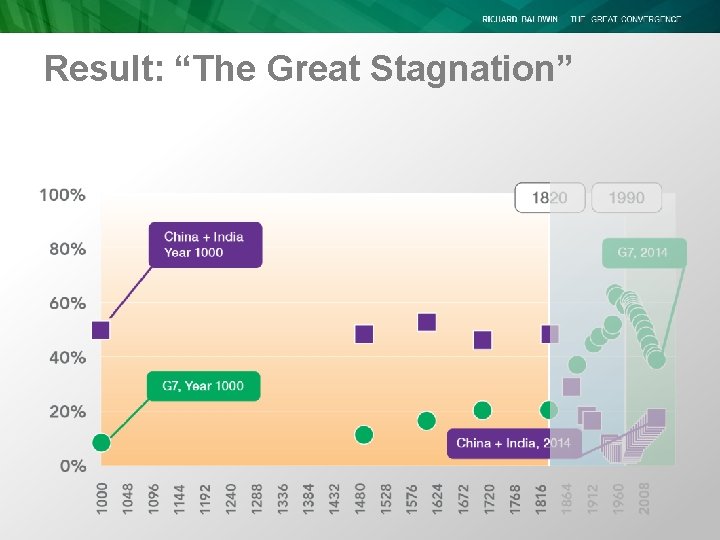
Result: “The Great Stagnation”
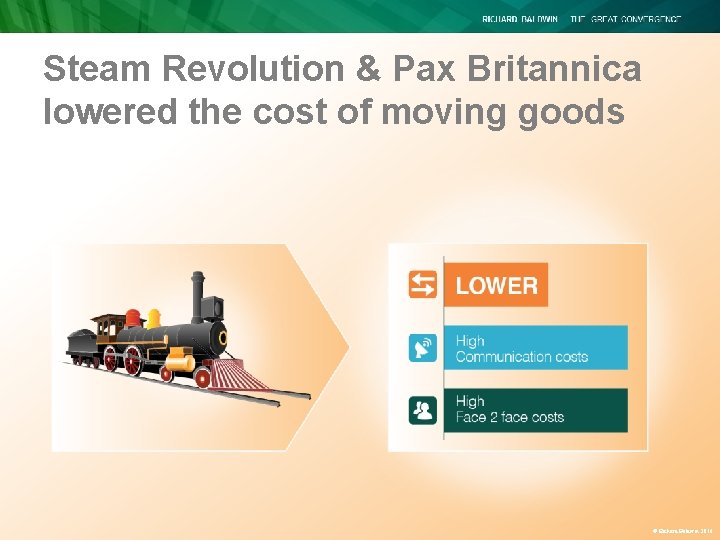
Steam Revolution & Pax Britannica lowered the cost of moving goods © Richard Baldwin 2016
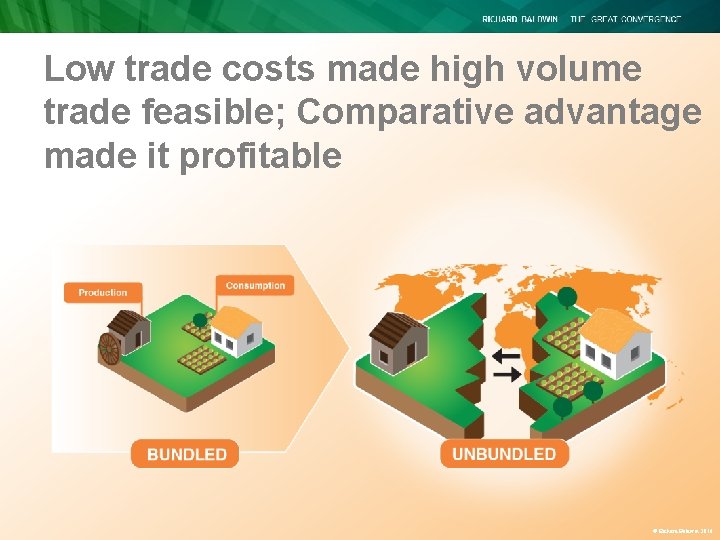
Low trade costs made high volume trade feasible; Comparative advantage made it profitable © Richard Baldwin 2016
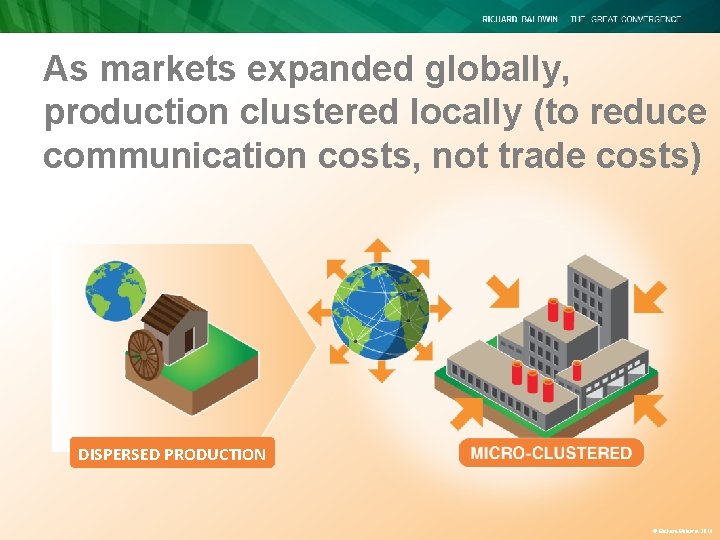
As markets expanded globally, production clustered locally (to reduce communication costs, not trade costs) DISPERSED PRODUCTION © Richard Baldwin 2016
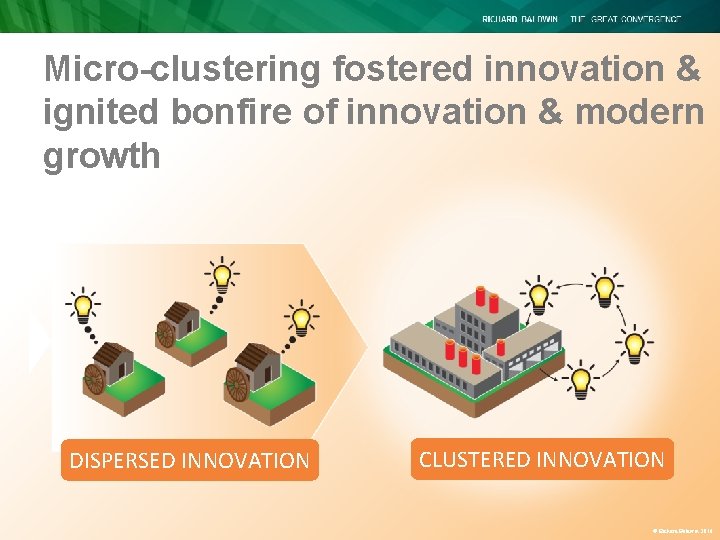
Micro-clustering fostered innovation & ignited bonfire of innovation & modern growth DISPERSED INNOVATION CLUSTERED INNOVATION © Richard Baldwin 2016
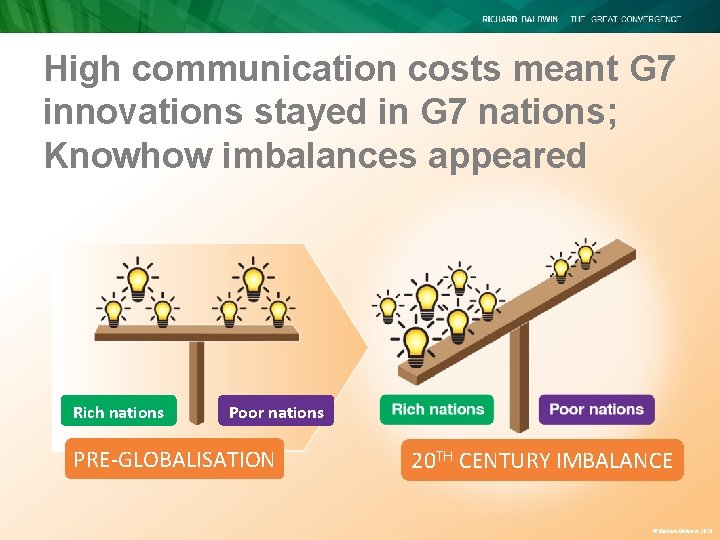
High communication costs meant G 7 innovations stayed in G 7 nations; Knowhow imbalances appeared Rich nations Poor nations PRE-GLOBALISATION 20 TH CENTURY IMBALANCE © Richard Baldwin 2016
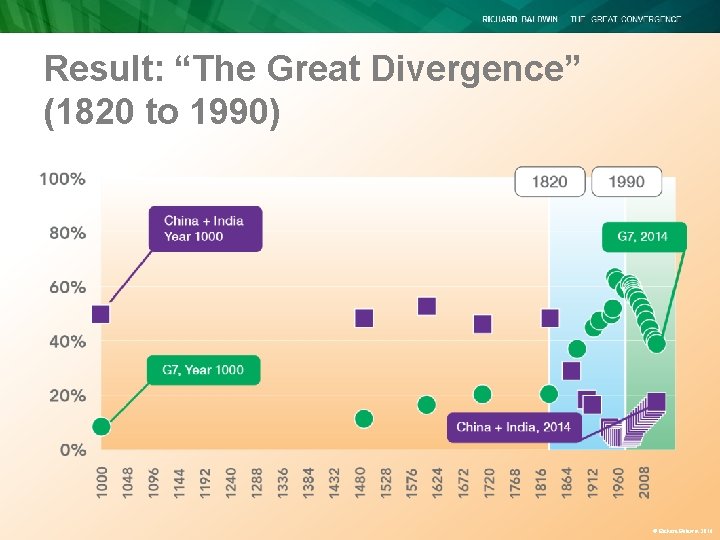
Result: “The Great Divergence” (1820 to 1990) © Richard Baldwin 2016
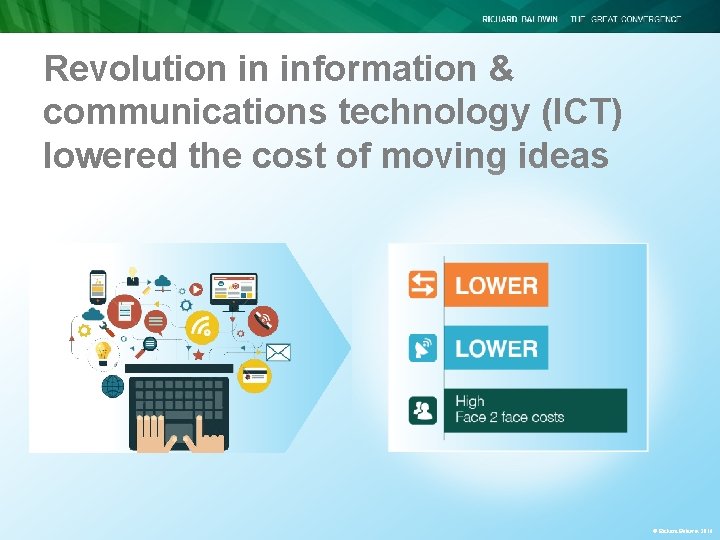
Revolution in information & communications technology (ICT) lowered the cost of moving ideas © Richard Baldwin 2016
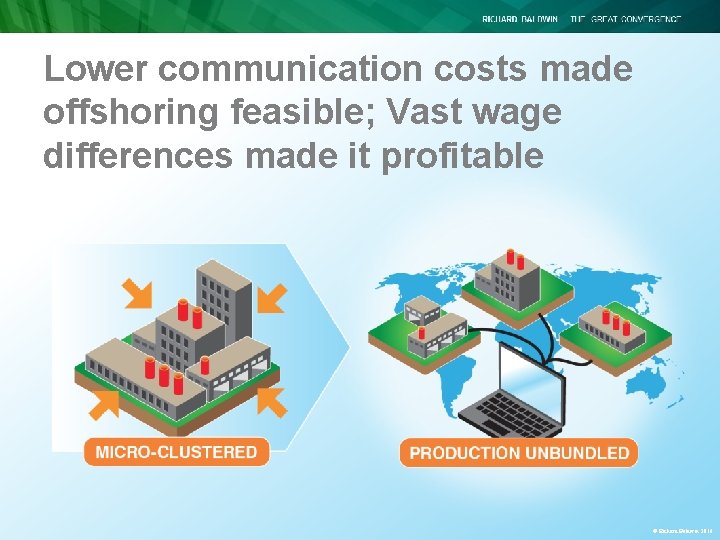
Lower communication costs made offshoring feasible; Vast wage differences made it profitable © Richard Baldwin 2016
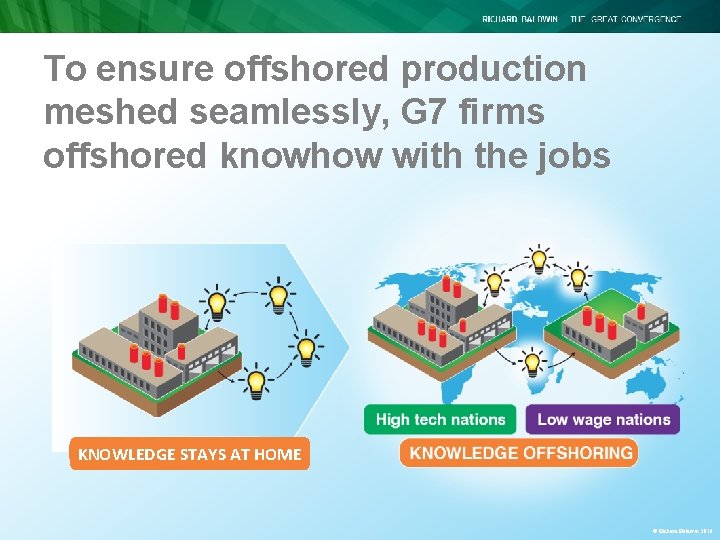
To ensure offshored production meshed seamlessly, G 7 firms offshored knowhow with the jobs KNOWLEDGE STAYS AT HOME © Richard Baldwin 2016
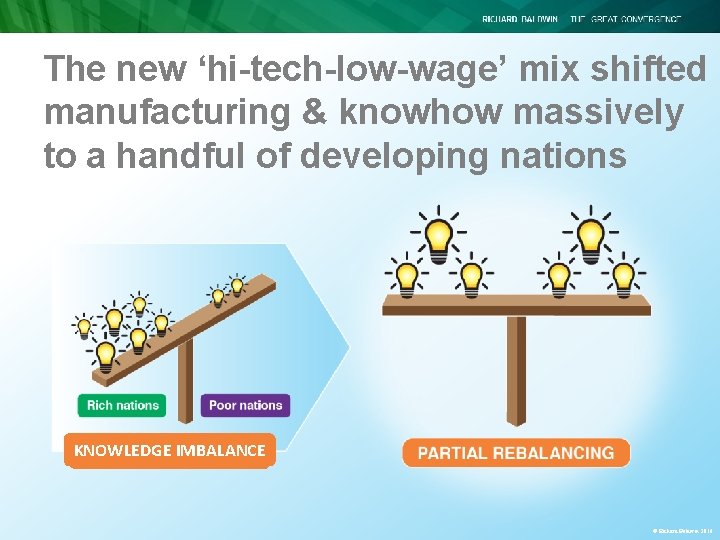
The new ‘hi-tech-low-wage’ mix shifted manufacturing & knowhow massively to a handful of developing nations KNOWLEDGE IMBALANCE PRE-1990 © Richard Baldwin 2016
Rapid industrialisation produced the “Commodity Super Cycle”
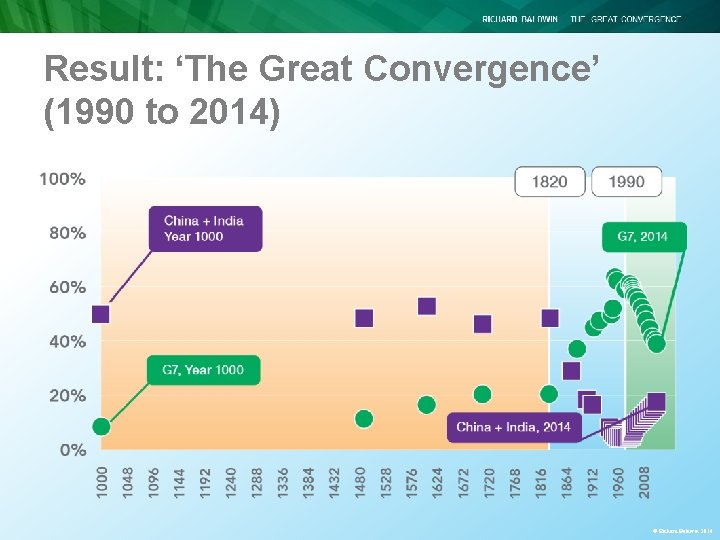
Result: ‘The Great Convergence’ (1990 to 2014) © Richard Baldwin 2016
How it explains today’s antiglobalisation in many rich nations © Richard Baldwin 2016
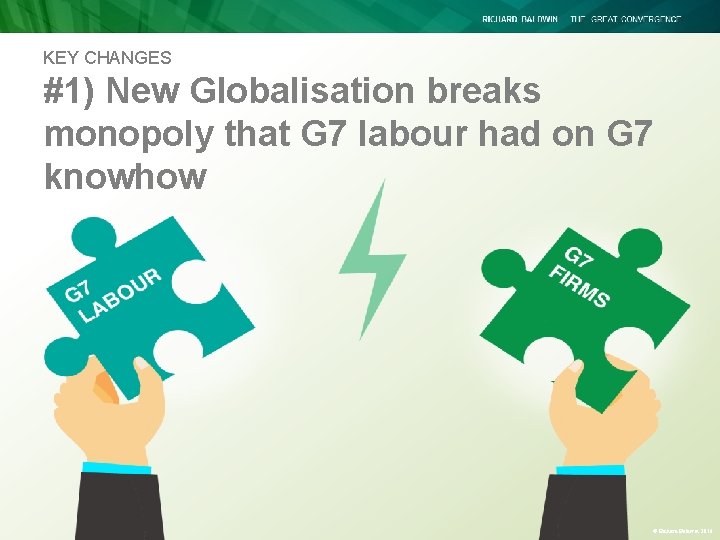
KEY CHANGES #1) New Globalisation breaks monopoly that G 7 labour had on G 7 knowhow © Richard Baldwin 2016
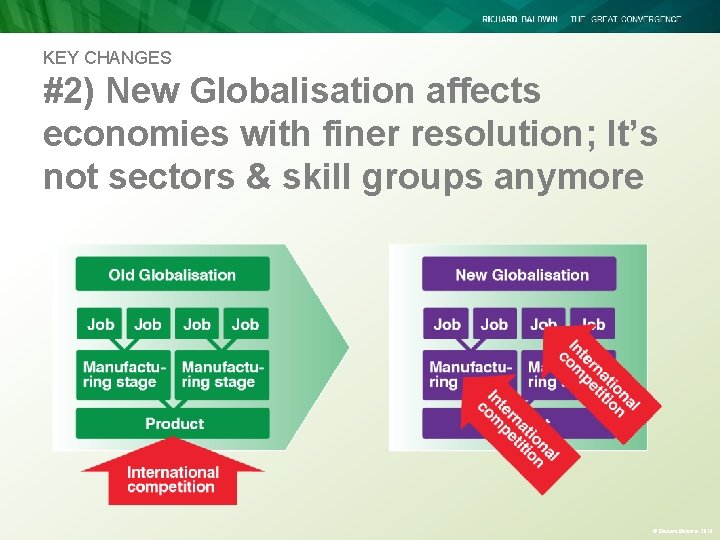
KEY CHANGES #2) New Globalisation affects economies with finer resolution; It’s not sectors & skill groups anymore © Richard Baldwin 2016
KEY CHANGES Result in most G 7 nations: Economic anxiety, fragility & disenfranchisement • #1 & #2 mean New Globalisation’s impact is: – – More sudden; More individual; More unpredictable; More uncontrollable. No matter what job or skills you have, you can’t really be sure your job won’t be next. © Richard Baldwin 2016
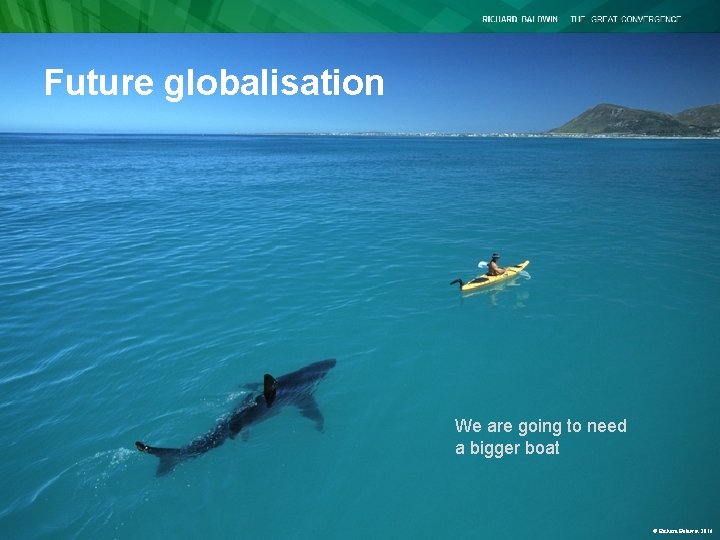
Future globalisation We are going to need a bigger boat © Richard Baldwin 2016
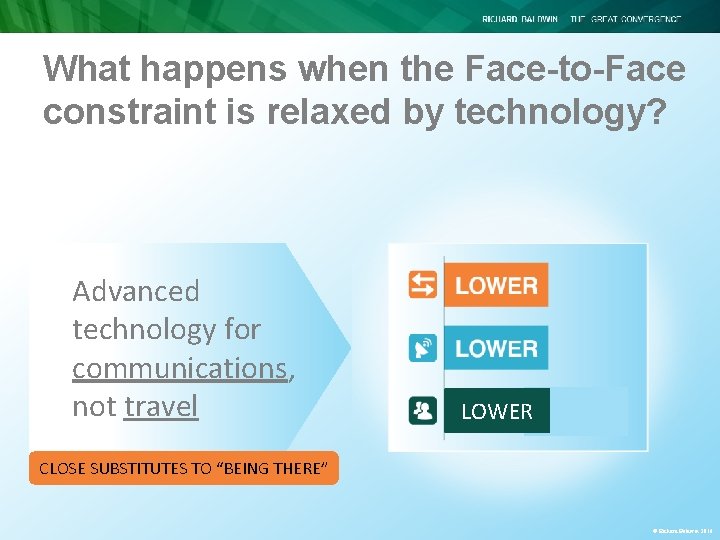
What happens when the Face-to-Face constraint is relaxed by technology? Advanced technology for communications, not travel LOWER CLOSE SUBSTITUTES TO “BEING THERE” © Richard Baldwin 2016
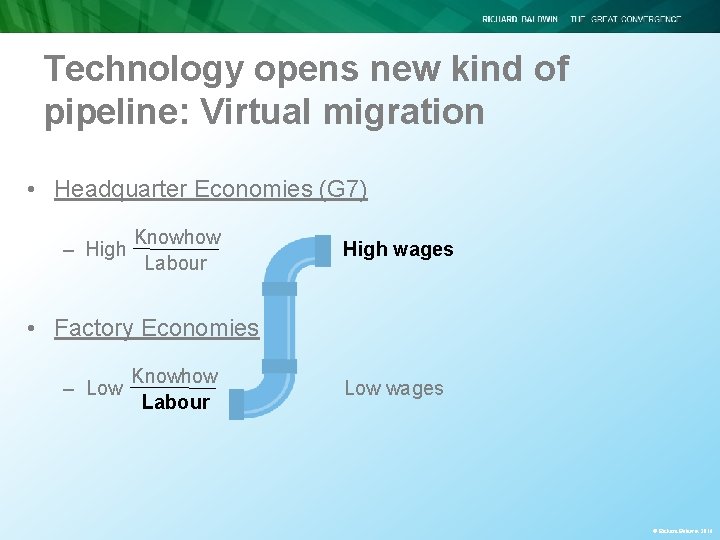
Technology opens new kind of pipeline: Virtual migration • Headquarter Economies (G 7) – High Knowhow Labour High wages • Factory Economies – Low Knowhow Labour Low wages © Richard Baldwin 2016
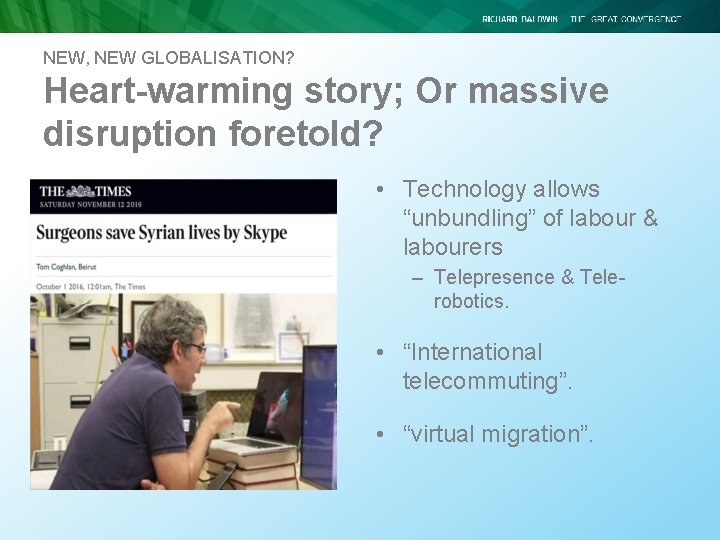
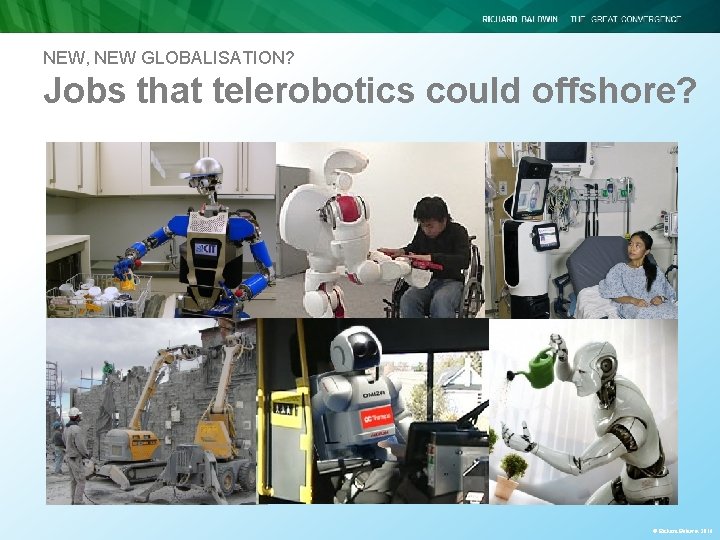
NEW, NEW GLOBALISATION? Heart-warming story; Or massive disruption foretold? • Technology allows “unbundling” of labour & labourers – Telepresence & Telerobotics. • “International telecommuting”. • “virtual migration”.
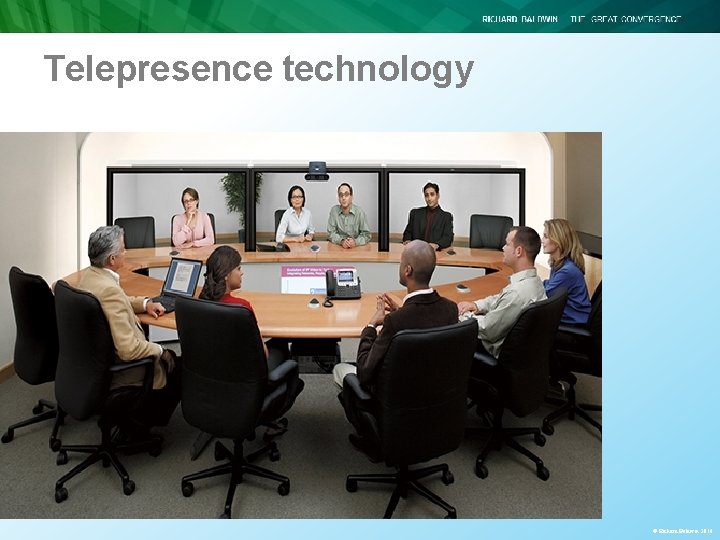
Telepresence technology © Richard Baldwin 2016
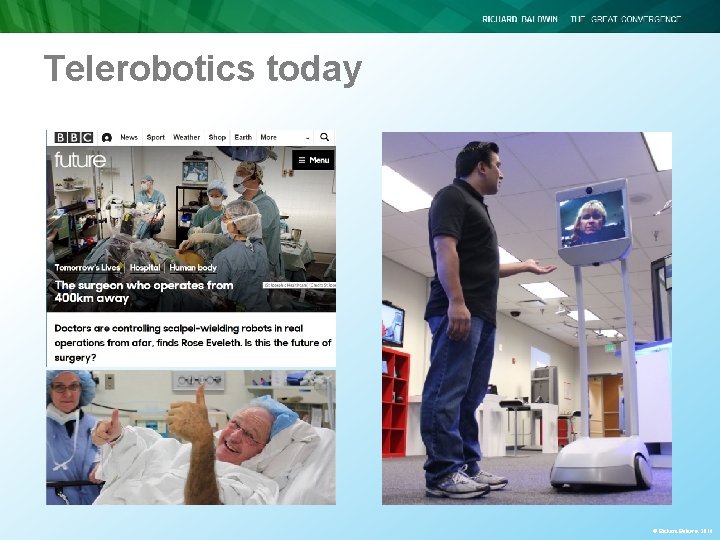
Telerobotics today © Richard Baldwin 2016
NEW, NEW GLOBALISATION? Jobs that telerobotics could offshore? © Richard Baldwin 2016
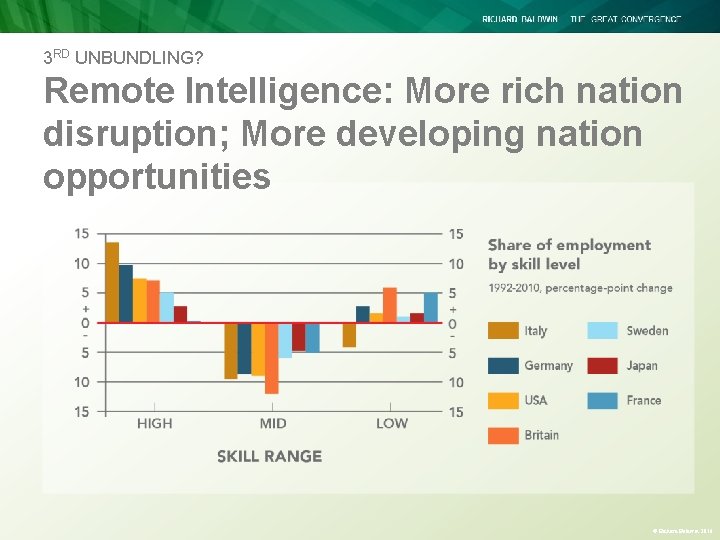
Remote Intelligence: More rich nation disruption; More developing nation opportunities © Richard Baldwin 2016
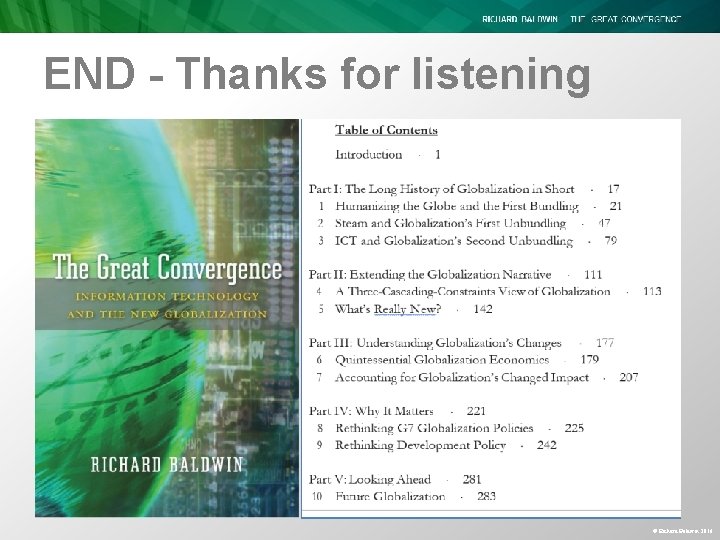
END - Thanks for listening © Richard Baldwin 2016
Extra slides for: © Richard Baldwin 2016
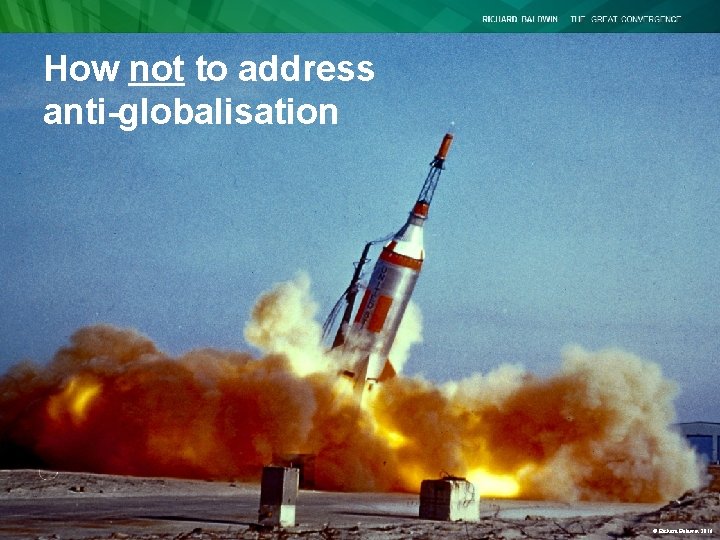
How not to address anti-globalisation © Richard Baldwin 2016
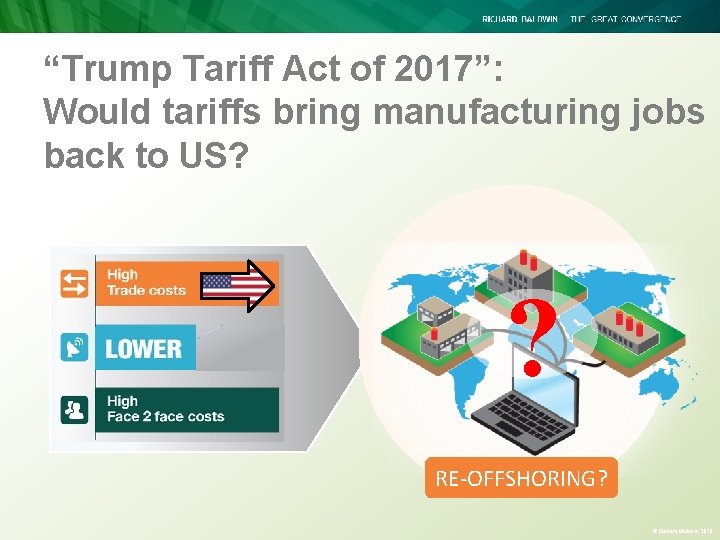
“Trump Tariff Act of 2017”: Would tariffs bring manufacturing jobs back to US? ? RE-OFFSHORING? © Richard Baldwin 2016
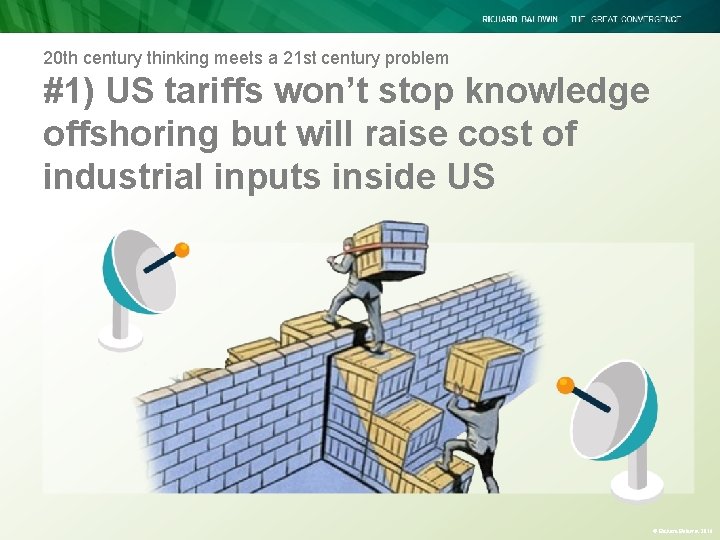
20 th century thinking meets a 21 st century problem #1) US tariffs won’t stop knowledge offshoring but will raise cost of industrial inputs inside US © Richard Baldwin 2016
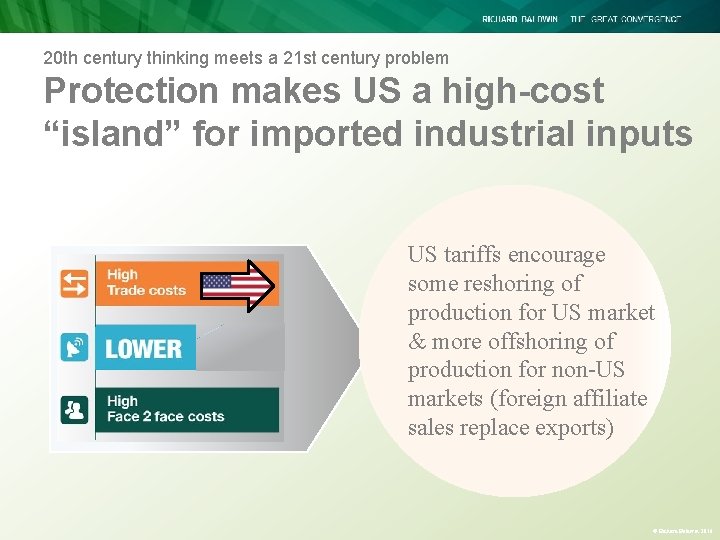
20 th century thinking meets a 21 st century problem Protection makes US a high-cost “island” for imported industrial inputs US tariffs encourage some reshoring of production for US market & more offshoring of production for non-US markets (foreign affiliate sales replace exports) © Richard Baldwin 2016
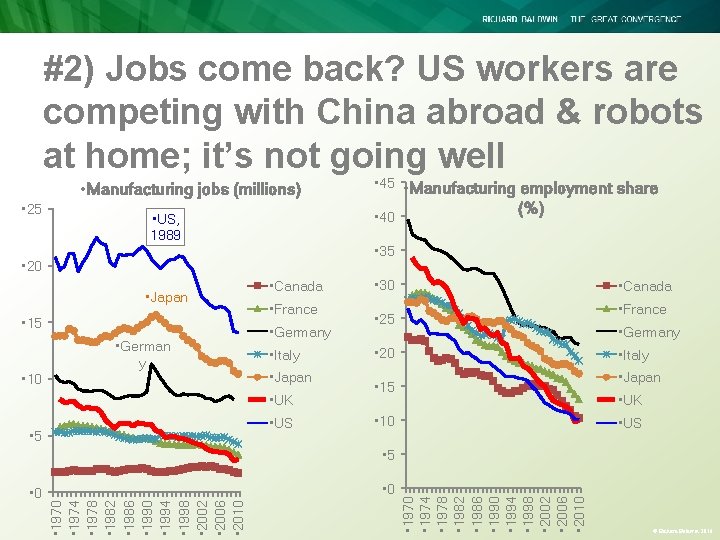
#2) Jobs come back? US workers are competing with China abroad & robots at home; it’s not going well • Manufacturing jobs (millions) • 25 • 40 • US, 1989 • 15 • German y • 10 • Canada • France • Germany • Italy • Japan • UK • US • 5 (%) • 35 • 20 • Japan • 45 • Manufacturing employment share • 30 • Canada • France • 25 • Germany • 20 • Italy • Japan • 15 • UK • 10 • US • 0 • 1974 • 1978 • 1982 • 1986 • 1990 • 1994 • 1998 • 2002 • 2006 • 2010 • 1970 • 1974 • 1978 • 1982 • 1986 • 1990 • 1994 • 1998 • 2002 • 2006 • 2010 • 5 © Richard Baldwin 2016
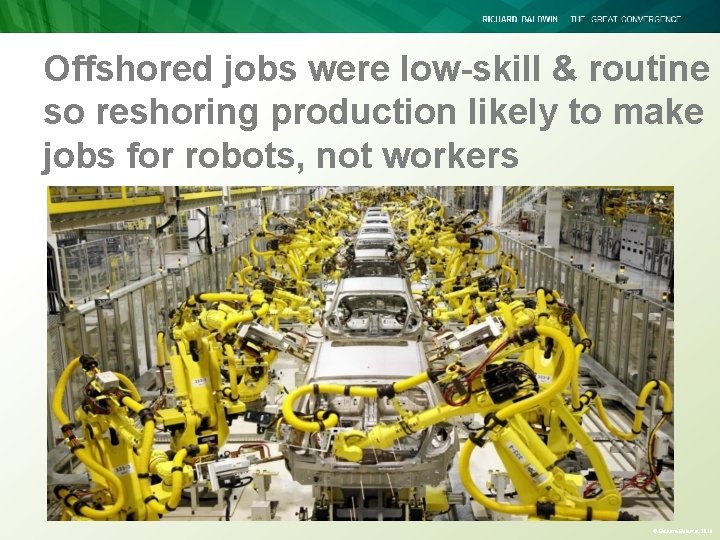
Offshored jobs were low-skill & routine so reshoring production likely to make jobs for robots, not workers © Richard Baldwin 2016
What way forward? Step 1: Accept 21 st century realities • New Globalisation isn’t something foreigners doing to US. • You can’t vote against the New Globalisation by voting against the agreements that shape & control it – When water is flowing thru your hands, making a fist doesn’t stop the flow. • Old Globalisation tools harm competitiveness in New Globalisation world – All manufacturing nations must import to export. © Richard Baldwin 2016
Step 2: Rebuild the team & package it politically • Rebuild the team: – Restore social cohesion with policies that protect individual workers, not individual jobs. • Retraining, education, mobility support, income support, maybe even active regional policy. • Package it politically: – “Trade policy in the service of society; ” – When proposing more open trade & international production share policies, also propose policies that help economically disenfranchised. © Richard Baldwin 2016
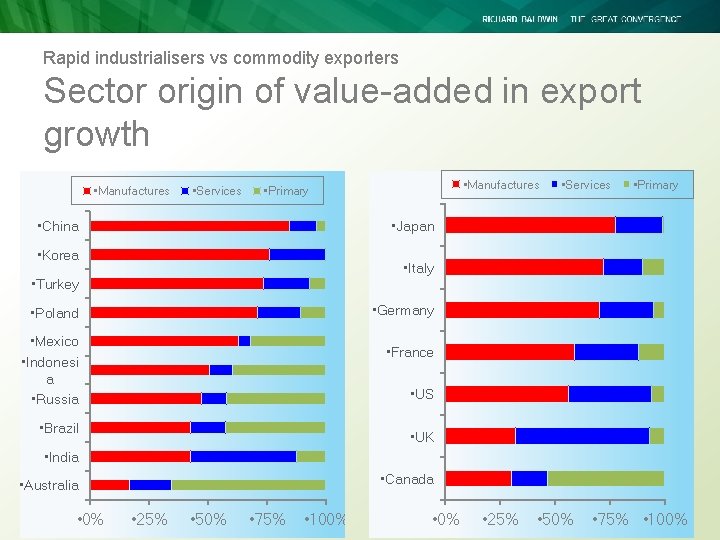
Rapid industrialisers vs commodity exporters Sector origin of value-added in export growth • Manufactures • Services • Manufactures • Primary • Services • Primary • Japan • China • Korea • Italy • Turkey • Germany • Poland • Mexico • Indonesi a • Russia • France • US • Brazil • UK • India • Canada • Australia • 0% • 25% • 50% • 75% • 100% • 25% • 50% • 75% • 100%
What does the New Globalisation mean for global trade governance? © Richard Baldwin 2016
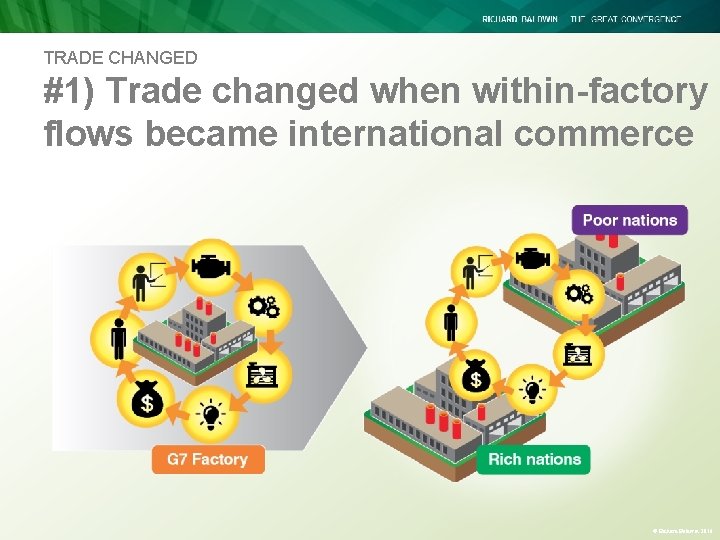
TRADE CHANGED #1) Trade changed when within-factory flows became international commerce © Richard Baldwin 2016
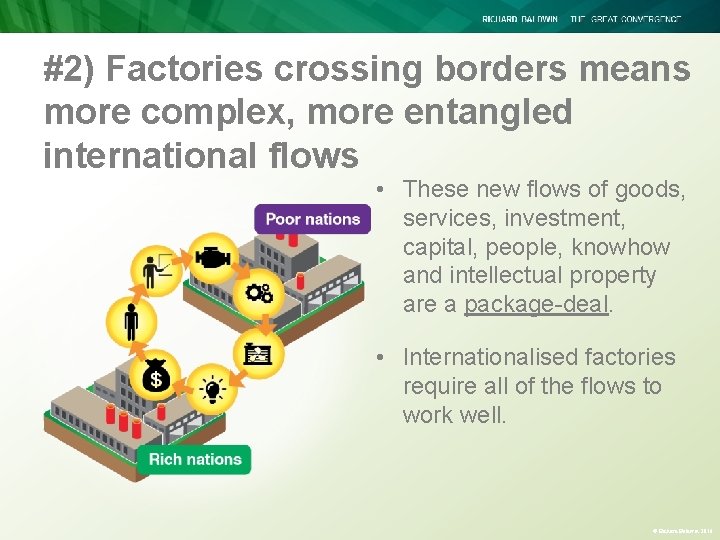
#2) Factories crossing borders means more complex, more entangled international flows • These new flows of goods, services, investment, capital, people, knowhow and intellectual property are a package-deal. • Internationalised factories require all of the flows to work well. © Richard Baldwin 2016
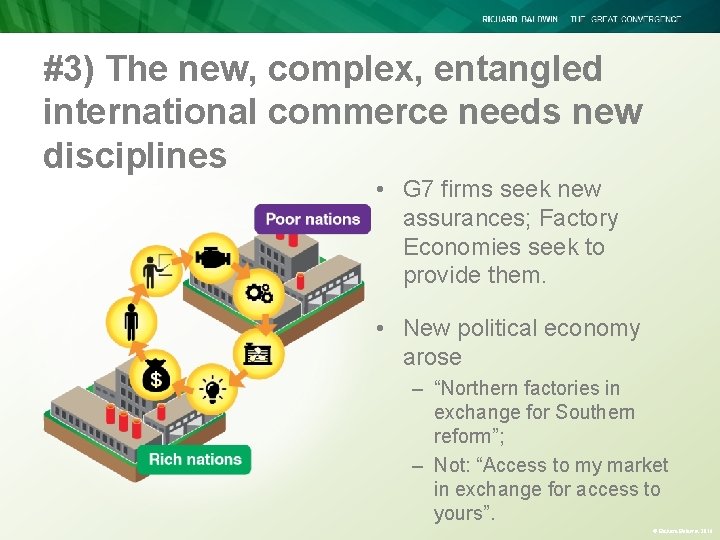
#3) The new, complex, entangled international commerce needs new disciplines • G 7 firms seek new assurances; Factory Economies seek to provide them. • New political economy arose – “Northern factories in exchange for Southern reform”; – Not: “Access to my market in exchange for access to yours”. © Richard Baldwin 2016
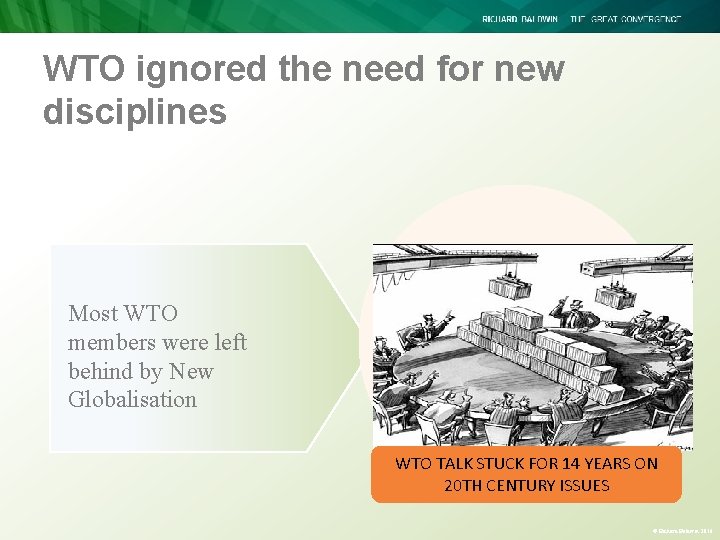
WTO ignored the need for new disciplines Most WTO members were left behind by New Globalisation WTO TALK STUCK FOR 14 YEARS ON 20 TH CENTURY ISSUES © Richard Baldwin 2016
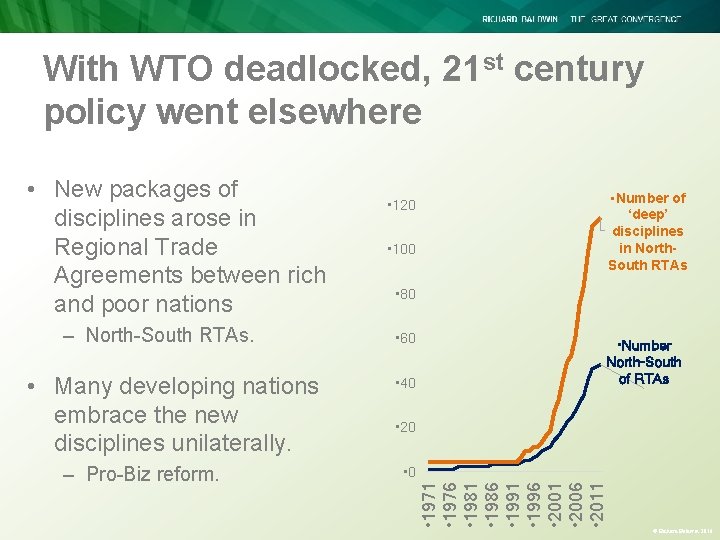
With WTO deadlocked, 21 st century policy went elsewhere – North-South RTAs. • Many developing nations embrace the new disciplines unilaterally. – Pro-Biz reform. • Number of ‘deep’ disciplines in North. South RTAs • 120 • 100 • 80 • 60 • 40 • Number North-South of RTAs • 20 • 0 • 1971 • 1976 • 1981 • 1986 • 1991 • 1996 • 2001 • 2006 • 2011 • New packages of disciplines arose in Regional Trade Agreements between rich and poor nations © Richard Baldwin 2016
LOOKING AHEAD Major mega-regional deals recently; Future is very uncertain • TPP & TTIP are dead – Trust in US trade leadership undermined for many years? • China likely to fill part of the vacuum – especially in Asia. • EU-Japan-Canada may emerge as a new leadership group. © Richard Baldwin 2016
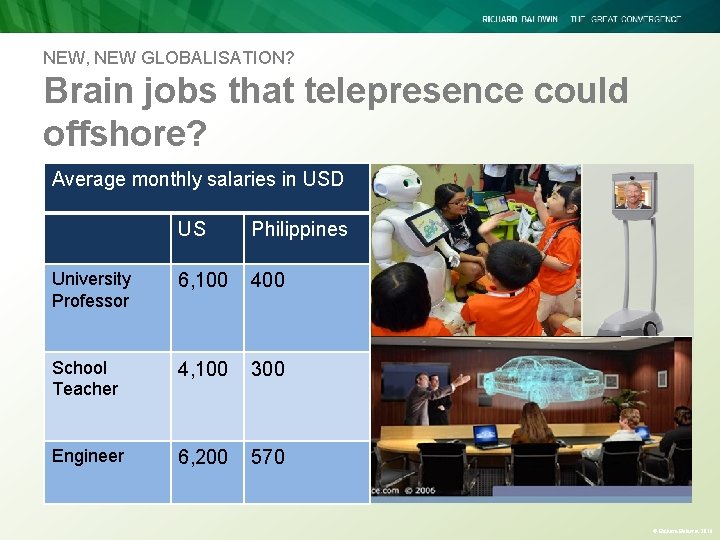
NEW, NEW GLOBALISATION? Brain jobs that telepresence could offshore? Average monthly salaries in USD US Philippines University Professor 6, 100 400 School Teacher 4, 100 300 Engineer 6, 200 570 © Richard Baldwin 2016
3 RD UNBUNDLING? Remote Intelligence: More rich nation disruption; More developing nation opportunities © Richard Baldwin 2016