
The Great Chicago Fire of 1871 Chicago before
The Great Chicago Fire of 1871
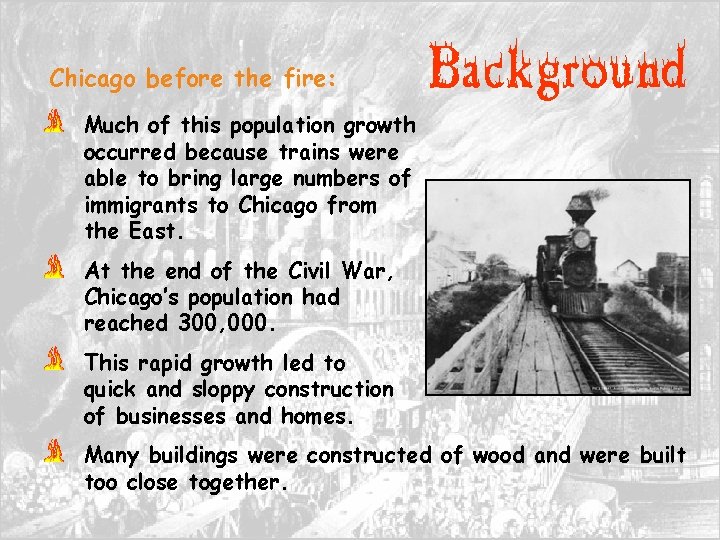
Chicago before the fire: Background Much of this population growth occurred because trains were able to bring large numbers of immigrants to Chicago from the East. At the end of the Civil War, Chicago’s population had reached 300, 000. This rapid growth led to quick and sloppy construction of businesses and homes. Many buildings were constructed of wood and were built too close together.
Background Leading up to the Great Chicago Fire: Chicago had already had a few large fires in 1839, 1849, and 1857. October of 1871 had been warmer and dryer than past Chicago Octobers. The year of the fire, the entire city of Chicago only had 185 fire fighters.
Background Chicago right before the fire: Chicago fire fighters had been complaining to the city that their equipment was inadequate and that they didn’t have enough men. Many of these fire fighters were tired from fighting a large fire October 7 th (the day before the Great Fire) that had demolished four blocks of the city. The city of Chicago had experienced 20 small fires in the week before the Great Fire.
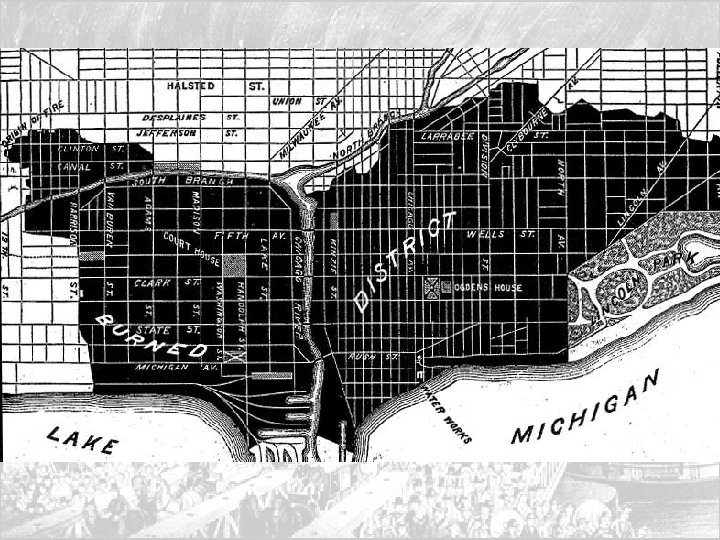
The Great Chicago Fire The fire begins: The fire began on October 8 th, 1871 between about 8: 30 and 10: 00 pm. The fire started in a barn owned by the O’Leary family that was located between De Koven Street and Jefferson Street. A combination of miscommunication and inadequate technology caused problems from the beginning of the fire.
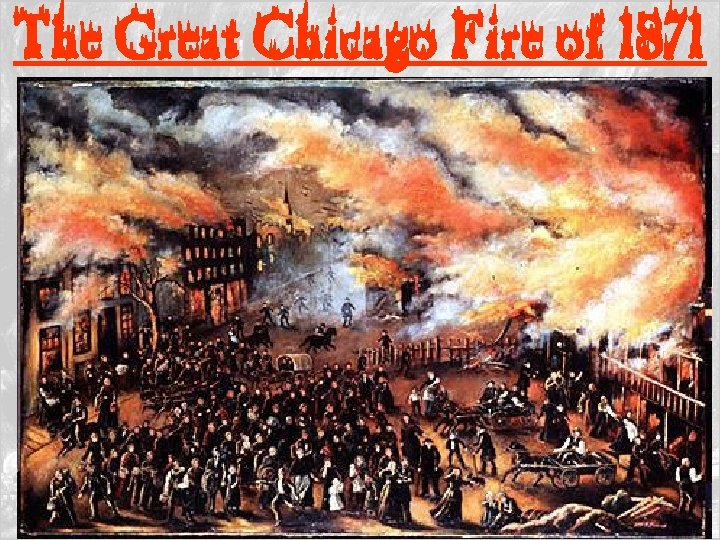
The Great Chicago Fire The fire began to spread quickly as it reached the Chicago River which was filled with oil and debris from nearby factories. Hard blowing winds from the southwest forced the fire towards the north and northeast parts of the city. In the first few hours of October 9 th, the fire devastated a lowerclass Irish neighborhood known as Conley’s Patch. At day break, as the fire continued to spread north, more and more buildings were consumed. “In less than ten minutes the fire embraced the area between Jefferson and Clinton for two blocks north, and rapidly pushed eastward to Canal Street. . ” -Chicago Tribune, October 10, 1871 Dewitt Cregier, later the mayor of Chicago, described the inferno as “a sea of fire. ” 0
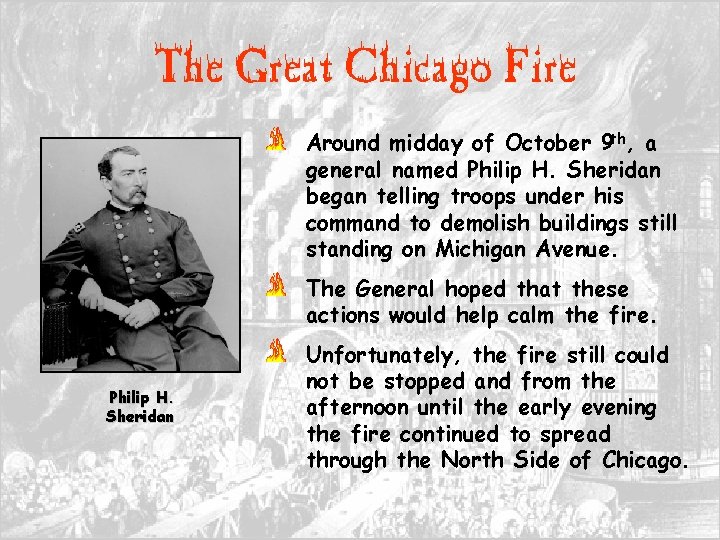
The Great Chicago Fire Around midday of October 9 th, a general named Philip H. Sheridan began telling troops under his command to demolish buildings still standing on Michigan Avenue. The General hoped that these actions would help calm the fire. Philip H. Sheridan Unfortunately, the fire still could not be stopped and from the afternoon until the early evening the fire continued to spread through the North Side of Chicago.
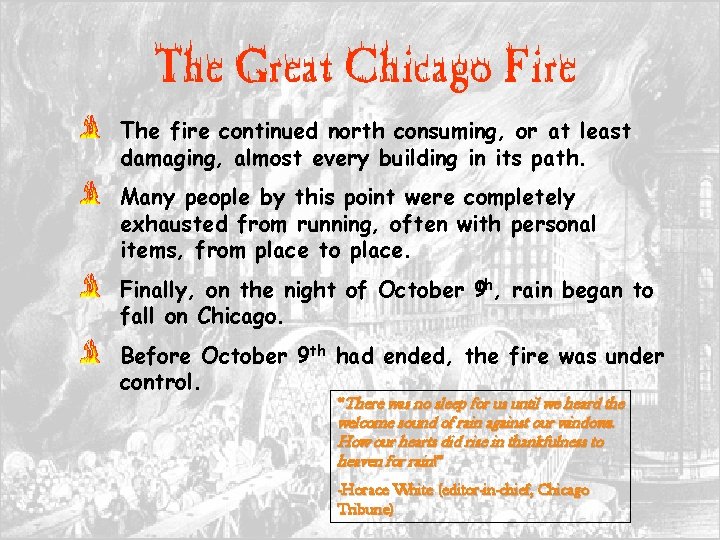
The Great Chicago Fire The fire continued north consuming, or at least damaging, almost every building in its path. Many people by this point were completely exhausted from running, often with personal items, from place to place. Finally, on the night of October 9 th, rain began to fall on Chicago. Before October 9 th had ended, the fire was under control. “There was no sleep for us until we heard the welcome sound of rain against our windows. How our hearts did rise in thankfulness to heaven for rain!” -Horace White (editor-in-chief, Chicago Tribune)
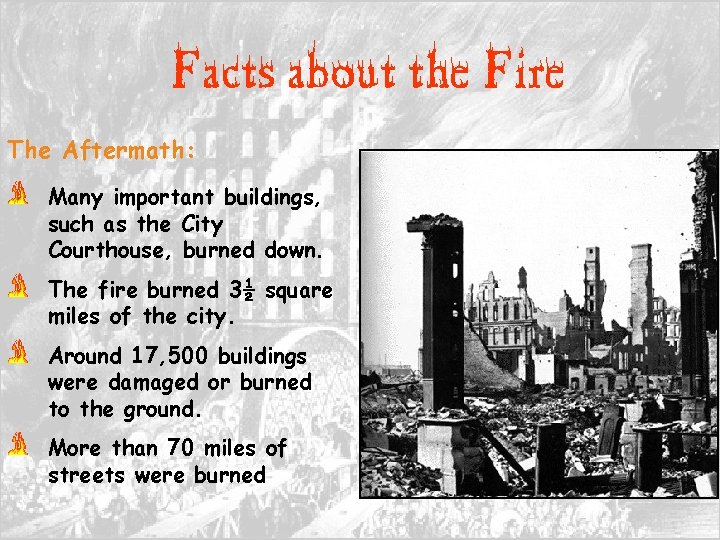
Facts about the Fire The Aftermath: Many important buildings, such as the City Courthouse, burned down. The fire burned 3½ square miles of the city. Around 17, 500 buildings were damaged or burned to the ground. More than 70 miles of streets were burned
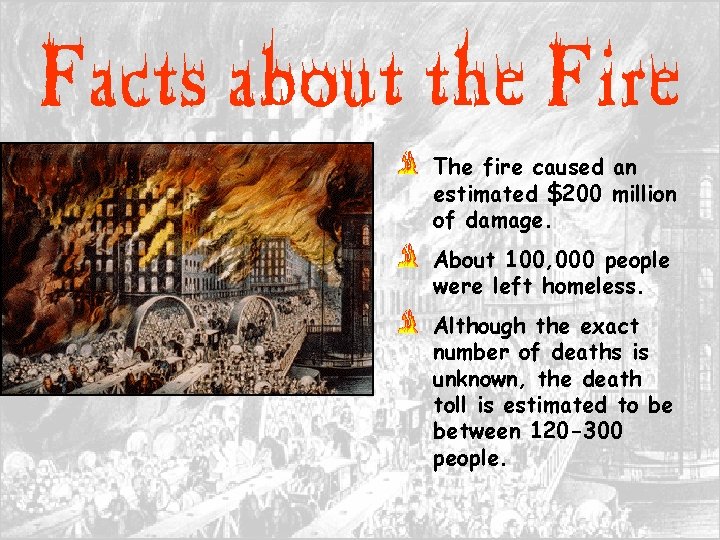
Facts about the Fire The fire caused an estimated $200 million of damage. About 100, 000 people were left homeless. Although the exact number of deaths is unknown, the death toll is estimated to be between 120 -300 people.
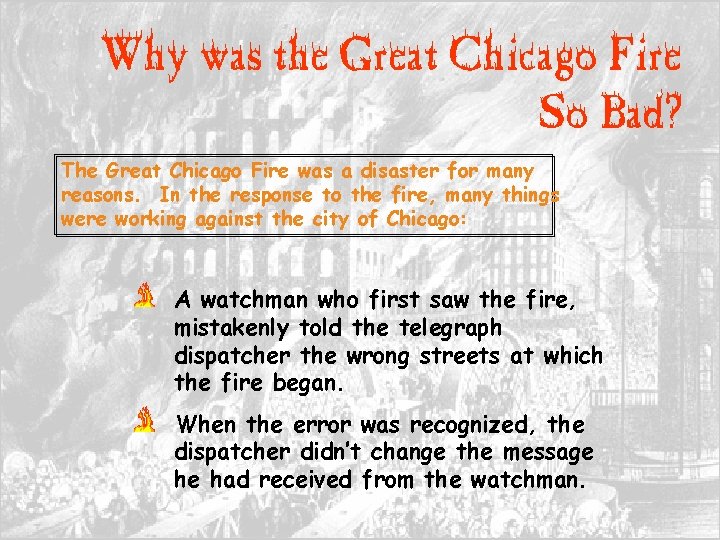
Why was the Great Chicago Fire So Bad? The Great Chicago Fire was a disaster for many reasons. In the response to the fire, many things were working against the city of Chicago: A watchman who first saw the fire, mistakenly told the telegraph dispatcher the wrong streets at which the fire began. When the error was recognized, the dispatcher didn’t change the message he had received from the watchman.
Why was the Great Chicago Fire So Bad? Also adding to the problem was a faulty firealarm box. The city of Chicago had installed the boxes so that people could immediately inform fire fighters of a fire. Unfortunately, the firealarm that a man close to the fire tried to use wouldn’t activate. When the fire fighters did reach the fire, they were so tired from fighting the night before they were unable to get a good jump on the fire.
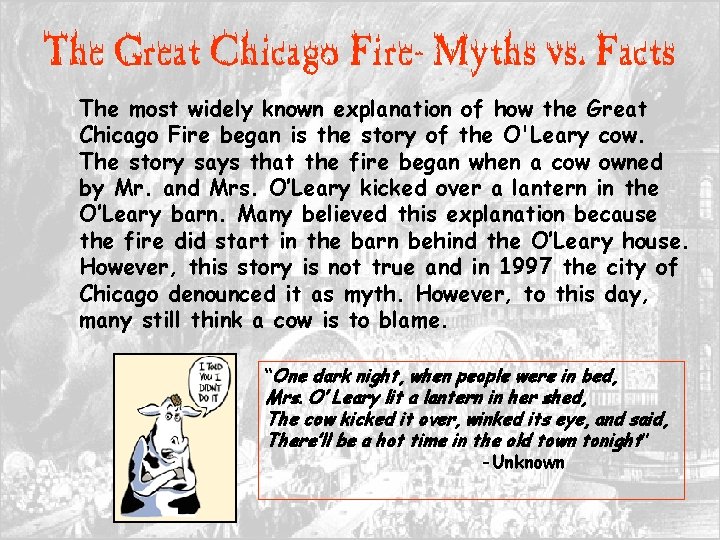
The Great Chicago Fire- Myths vs. Facts The most widely known explanation of how the Great Chicago Fire began is the story of the O'Leary cow. The story says that the fire began when a cow owned by Mr. and Mrs. O’Leary kicked over a lantern in the O’Leary barn. Many believed this explanation because the fire did start in the barn behind the O’Leary house. However, this story is not true and in 1997 the city of Chicago denounced it as myth. However, to this day, many still think a cow is to blame. “One dark night, when people were in bed, Mrs. O’ Leary lit a lantern in her shed, The cow kicked it over, winked its eye, and said, There’ll be a hot time in the old town tonight” -Unknown
The Great Chicago Fire- Myths vs. Facts There are many other hypothesis's as to how the fire began. The city of Chicago talked with different Chicagoans to figure out who started the fire. Many of the hypothesis’s are based on conflicting statements given during the investigation into the fire. Some believe a man who lived close to the O’Leary’s, Daniel Sullivan, began the fire by accident and didn’t want to be blamed for it. Others believe the fire was the fault of another man who lived in the neighborhood, Dennis Regan. Still others think that a meteor shower is to blame
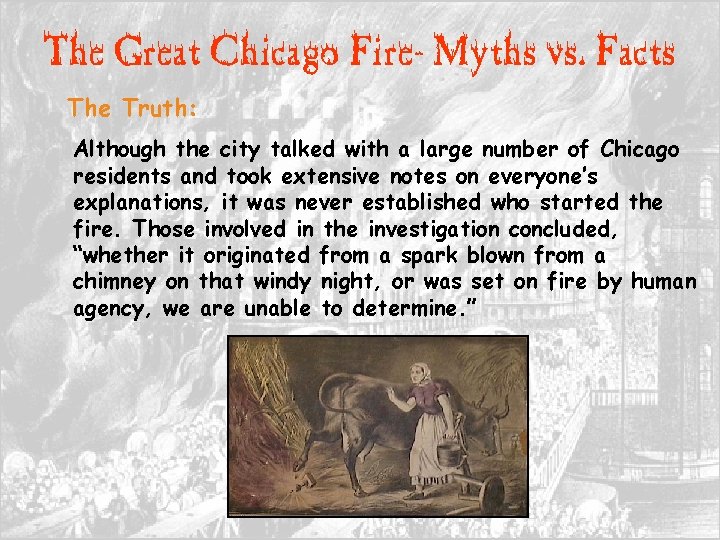
The Great Chicago Fire- Myths vs. Facts The Truth: Although the city talked with a large number of Chicago residents and took extensive notes on everyone’s explanations, it was never established who started the fire. Those involved in the investigation concluded, “whether it originated from a spark blown from a chimney on that windy night, or was set on fire by human agency, we are unable to determine. ”
What Was the City of Chicago’s Initial Reaction and Response? Chicagoans initial response to the fire was incredible. Many Chicago citizens worked day and night to get the city back up in running. With help and money pouring in from other American cities, Chicago was able to build 6, 000 makeshift buildings for the homeless within about a week. In many ways the fire, although devastating, was a necessary event to bring Chicagoans together. The fire single-handedly managed to change not only Chicago, but other American cities as well.
What Was the City of Chicago’s Initial Reaction and Response? Prevention: National Fire Protection Association The first thing the fire did was unite the city around a common cause. For the first time, a large number of people began arguing for better fire codes, fire precautions, and fire equipment for firemen. It was clear that no one wanted to go through another Great Chicago Fire. Because so many people rallied around the idea of safer conditions, the politics in Chicago began to change.
Physical Changes After the Fire Soon, Chicago’s streets were changed. Because Chicago had originally been built upon wet land, many of the early roads were made of wood. At the time, wood seemed like the smartest material to use to keep the city above the wet terrain. However, after the Great Fire, roads were no longer created of wood due to their flammable nature. Other cities took note of the Chicago change and by the 1900 s many major cities in America had steered away from wooden streets.
Structural Changes After the Fire Streets weren’t the only things remodeled in Chicago. The fire played a major role in changing the building materials of houses. After the Great Fire, people realized that nonflammable materials were needed for building homes and businesses. Soon many more buildings were created of brick rather than wood. The idea of using brick and other less flammable materials soon spread throughout America.
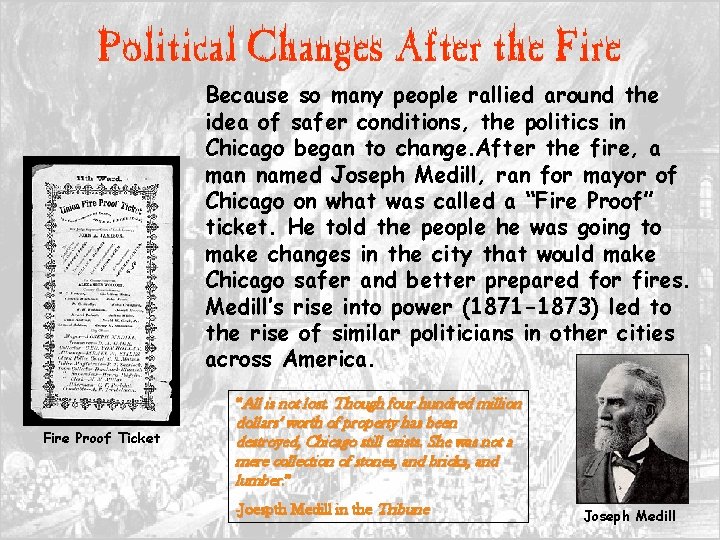
Political Changes After the Fire Because so many people rallied around the idea of safer conditions, the politics in Chicago began to change. After the fire, a man named Joseph Medill, ran for mayor of Chicago on what was called a “Fire Proof” ticket. He told the people he was going to make changes in the city that would make Chicago safer and better prepared for fires. Medill’s rise into power (1871 -1873) led to the rise of similar politicians in other cities across America. “All is not lost. Though four hundred million Fire Proof Ticket dollars’ worth of property has been destroyed, Chicago still exists. She was not a mere collection of stones, and bricks, and lumber. ” -Joespth Medill in the Tribune Joseph Medill
Social Changes The social classes separated more and more in large reason because of money. While the rich were able to rebuild with bricks and other nonflammable material, the poor were unable to afford these more expensive building materials. Many of the poor didn’t have fire insurance before the fire which left them completely vulnerable after the fire.
Eyewitness Accounts “We could see across the river at the cross streets that where yesterday was a populous city was now a mass of smoking ruins. All the way round we encountered thousands of people; but the excitement had given way to a terrible grief and desolation. ” - Alexander Frear (New York alderman) “…the immense piles of lumber on the south of us were all afire…. Dense clouds of smoke and cinder rolled over and enveloped us, and it seemed almost impossible to breathe…. ” - Lambert Tree (Cook County Circuit Court Judge) “There was a strip of fire between two and three miles long, and a mile wide, hurried along by a wind, sweeping through the business part of this city…. It was a grand sight, and yet an awful one. ” - William Gallagher (Student studying in Chicago)
An Optimistic Response After the fire, many were extremely optimistic that Chicago would return to glory. The following lines from the Tribune are possibly the most famous words written about the fire: “In the midst of a calamity without parallel in the world’s history, looking upon the ashes of thirty years’ accomplishments, the people of this once beautiful city have resolved that CHICAGO SHALL RISE AGAIN!” -Tribune Despite the terrible tragedy, Chicagoans were ready to take action and make the city more powerful and more respected than ever before.
An Optimistic Response “From the Ruins Our City Shall Rise!” a song by George Frederick Root: Dreary, dreary, the darkness falls, While the autumn winds moan through blackened walls. But see! The bright rift in the cloud and hear the great voice from the shore! Our city shall rise! Yes, she shall rise! Queen of the west once more!
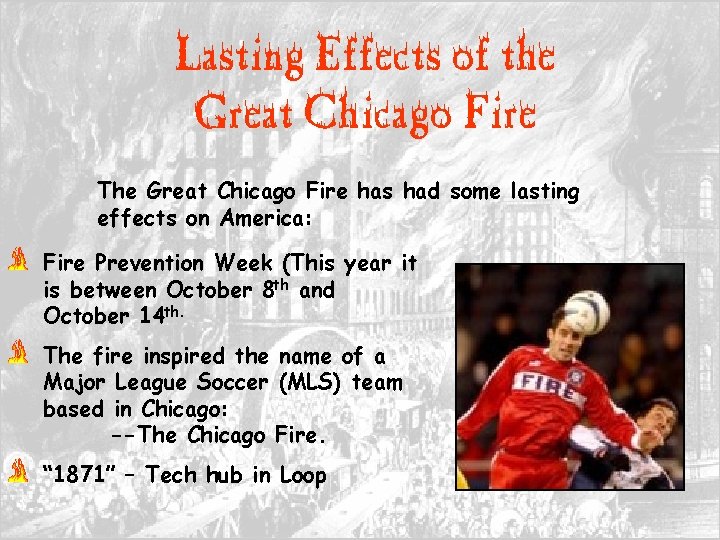
Lasting Effects of the Great Chicago Fire The Great Chicago Fire has had some lasting effects on America: Fire Prevention Week (This year it is between October 8 th and October 14 th. The fire inspired the name of a Major League Soccer (MLS) team based in Chicago: --The Chicago Fire. “ 1871” – Tech hub in Loop
- Slides: 26