
The Great British Outdoors Health WellBeing from our
The Great British Outdoors: Health & Well-Being from our Natural Environments Mathew White (Ph. D) Lecturer in Risk & Health British Destination Conference 4 th July 2013.
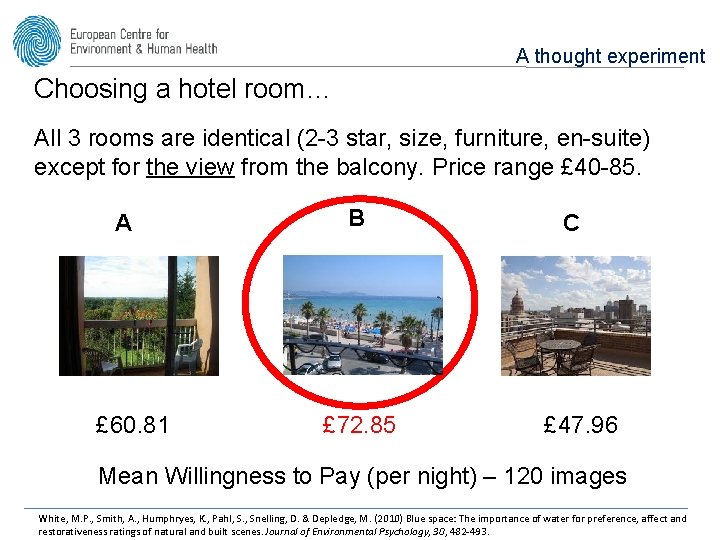
A thought experiment Choosing a hotel room… All 3 rooms are identical (2 -3 star, size, furniture, en-suite) except for the view from the balcony. Price range £ 40 -85. A £ 60. 81 B £ 72. 85 C £ 47. 96 Mean Willingness to Pay (per night) – 120 images White, M. P. , Smith, A. , Humphryes, K. , Pahl, S. , Snelling, D. & Depledge, M. (2010) Blue space: The importance of water for preference, affect and restorativeness ratings of natural and built scenes. Journal of Environmental Psychology, 30, 482 -493.
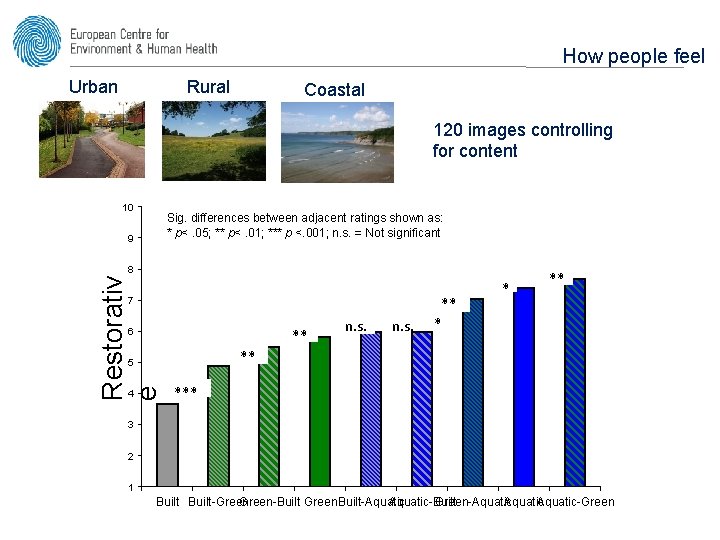
How people feel Urban Rural Coastal 120 images controlling for content 10 Sig. differences between adjacent ratings shown as: * p<. 05; ** p<. 01; *** p <. 001; n. s. = Not significant 9 Restorativ e 8 7 ** 6 n. s. ** ** 5 4 n. s. ** * * *** 3 2 1 Built-Green-Built Green. Built-Aquatic-Built Green-Aquatic-Green
MENE data Natural England’s: Monitoring Engagement with the Natural Environment (MENE) - Face-to-face interviews with 142, 031 individuals (2009 -2011). - 56, 777 (40%) people made ≥ 1 nature visit in last 7 days 1) Town or city (parks) = 43%; 2) Countryside = 43% 3) Seaside and coast = 13% - 70% of visits were local (<5 miles from home)
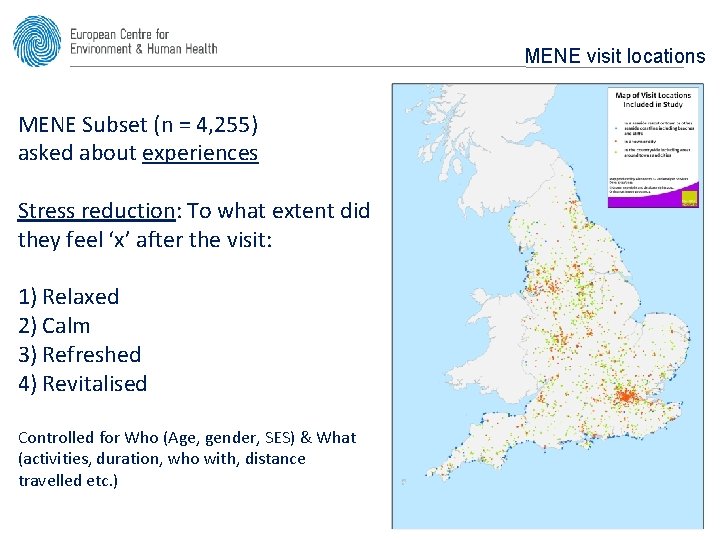
MENE visit locations MENE Subset (n = 4, 255) asked about experiences Stress reduction: To what extent did they feel ‘x’ after the visit: 1) Relaxed 2) Calm 3) Refreshed 4) Revitalised Controlled for Who (Age, gender, SES) & What (activities, duration, who with, distance travelled etc. )
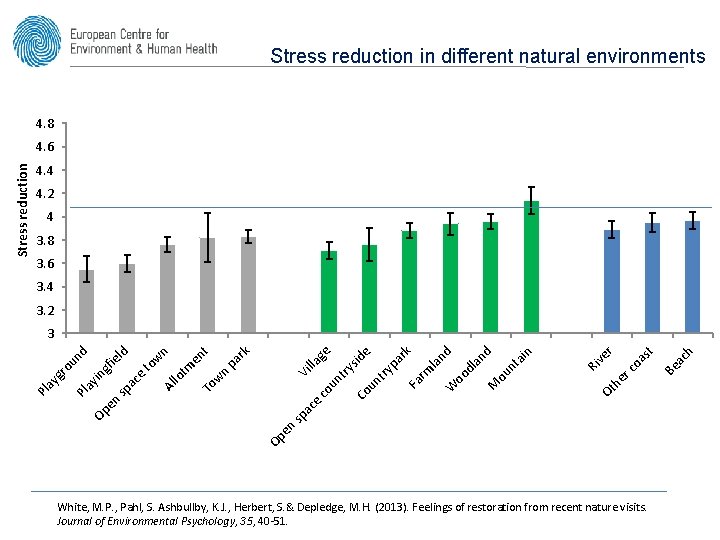
Stress reduction in different natural environments 4. 8 Stress reduction 4. 6 4. 4 4. 2 4 3. 8 3. 6 3. 4 3. 2 e he White, M. P. , Pahl, S. Ashbullby, K. J. , Herbert, S. & Depledge, M. H. (2013). Feelings of restoration from recent nature visits. Journal of Environmental Psychology, 35, 40 -51. ac h Be rc oa st r ve Ri Op en sp ac Ot sid Co e un try pa rk Fa rm la nd W oo dl an d M ou nt ai n co un t Vi lla pa n ry ge rk t w To tm lo Al ce to w en n ld ie Op en sp a in gf ay Pl Pl ay gr ou n d 3
Green Space & Mental Health British Household Panel Survey (1991 -2008) (n > 12, 000 for 18 years) Mental Ill-health: General Health Questionnaire (GHQ-12) “Compared to usual how have you been feeling in the last few weeks” e. g. “able to cope”, “stressed”. The higher the score, the higher the mental distress. Subjective well-being: Life Satisfaction (LS): “How dissatisfied or satisfied are you with your life overall? ” with responses ranging from 1 (Not satisfied at all) to 7 (Completely satisfied). % of Greenspace: Near their home (4 km 2) White, Alcock, Wheeler & Depledge (2013). Would you be happier living in a greener urban area? Psychological Science, 24, 920 -928
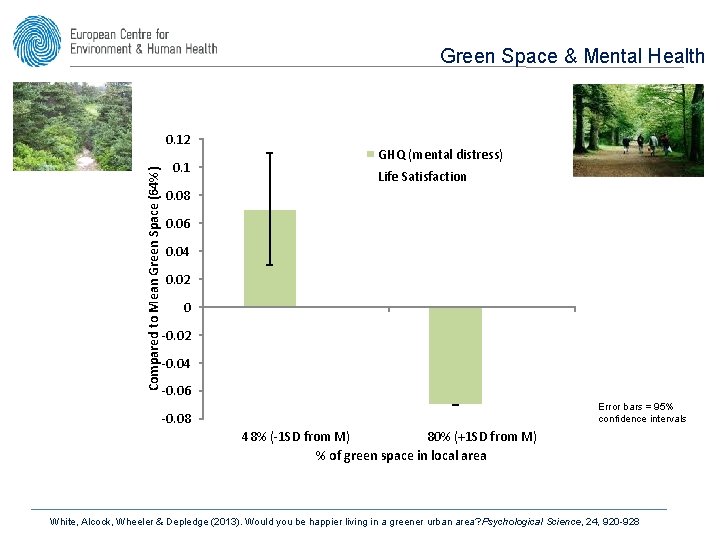
Green Space & Mental Health Compared to Mean Green Space (64%) 0. 12 0. 1 GHQ (mental distress) Life Satisfaction 0. 08 0. 06 0. 04 0. 02 0 -0. 02 -0. 04 -0. 06 Error bars = 95% confidence intervals -0. 08 48% (-1 SD from M) 80% (+1 SD from M) % of green space in local area White, Alcock, Wheeler & Depledge (2013). Would you be happier living in a greener urban area? Psychological Science, 24, 920 -928
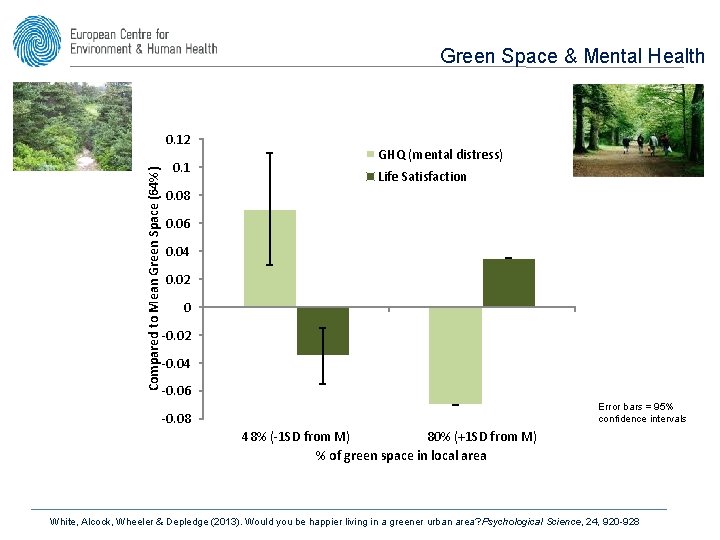
Green Space & Mental Health Compared to Mean Green Space (64%) 0. 12 0. 1 GHQ (mental distress) Life Satisfaction 0. 08 0. 06 0. 04 0. 02 0 -0. 02 -0. 04 -0. 06 Error bars = 95% confidence intervals -0. 08 48% (-1 SD from M) 80% (+1 SD from M) % of green space in local area White, Alcock, Wheeler & Depledge (2013). Would you be happier living in a greener urban area? Psychological Science, 24, 920 -928
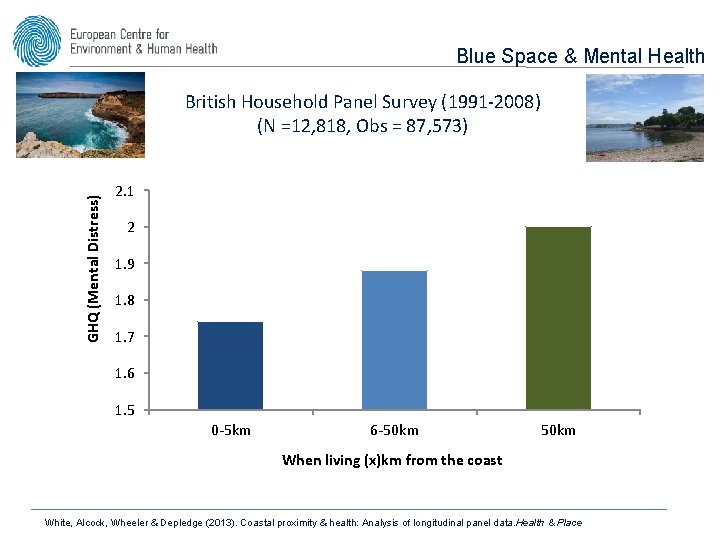
Blue Space & Mental Health GHQ (Mental Distress) British Household Panel Survey (1991 -2008) (N =12, 818, Obs = 87, 573) 2. 1 2 1. 9 1. 8 1. 7 1. 6 1. 5 0 -5 km 6 -50 km When living (x)km from the coast White, Alcock, Wheeler & Depledge (2013). Coastal proximity & health: Analysis of longitudinal panel data. Health & Place
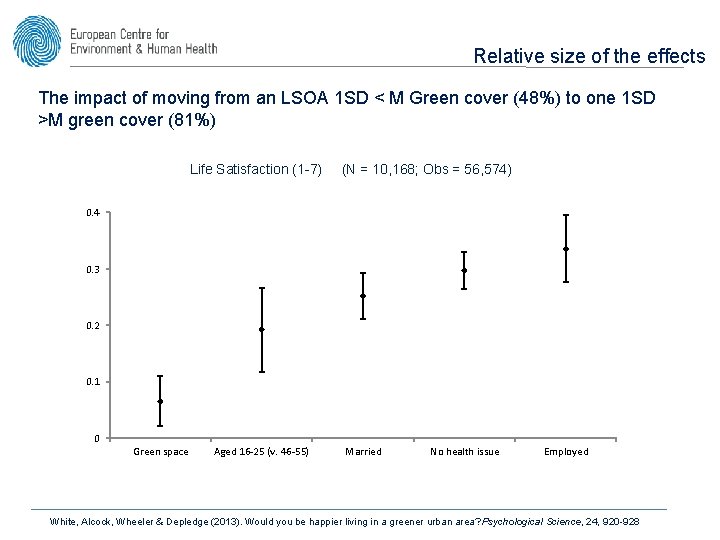
Relative size of the effects The impact of moving from an LSOA 1 SD < M Green cover (48%) to one 1 SD >M green cover (81%) Life Satisfaction (1 -7) (N = 10, 168; Obs = 56, 574) 0. 4 0. 3 0. 2 0. 1 0 Green space Aged 16 -25 (v. 46 -55) Married No health issue Employed White, Alcock, Wheeler & Depledge (2013). Would you be happier living in a greener urban area? Psychological Science, 24, 920 -928
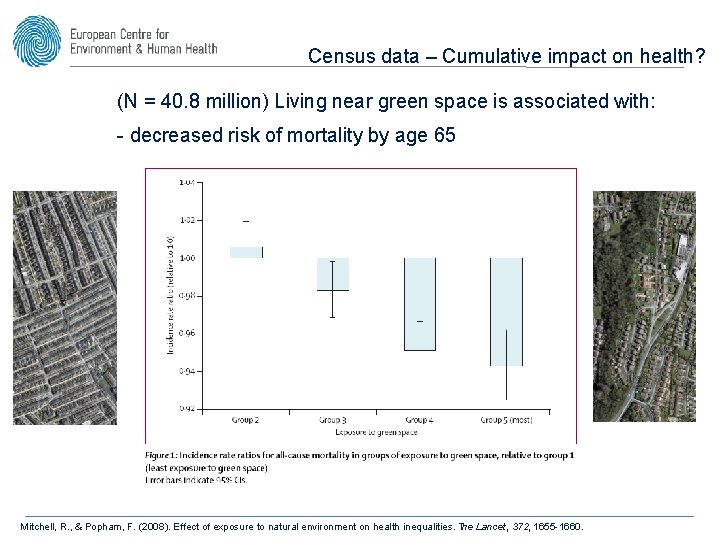
Census data – Cumulative impact on health? (N = 40. 8 million) Living near green space is associated with: - decreased risk of mortality by age 65 Mitchell, R. , & Popham, F. (2008). Effect of exposure to natural environment on health inequalities. The Lancet, 372, 1655 -1660.
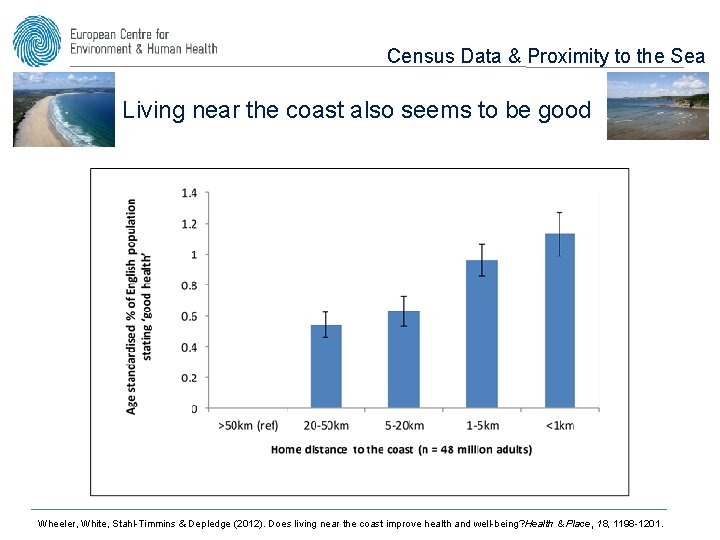
Census Data & Proximity to the Sea Living near the coast also seems to be good Wheeler, White, Stahl-Timmins & Depledge (2012). Does living near the coast improve health and well-being? Health & Place, 18, 1198 -1201.
Just some of the remaining questions 1) What is the optimal dose? 2) How long do effects last? (Amanda Hignett, Ph. D) 3) What about the weather (With Met Office) 4) Environmental impact? (Lewis Elliot, Ph. D) 5) What about children? (Becky Jenkin, Ph. D) 6) What about other countries? 7) Comparisons to drugs (e. g. depression)?
The Team ECEHH & Plymouth University Team: Ian Alcock, Debbie Cracknell, Michael Depledge, Karin Tanja-Dijkstra, Lewis Elliot, Josey Field, Amanda Hignett, Rebecca Jenkin, Sabine Pahl, Cassie Phoenix, Jo Ross, Ben Wheeler, Mat White, Kayleigh Wyles. For further details please contact: mathew. white@exeter. ac. uk Thanks very much for your attention!
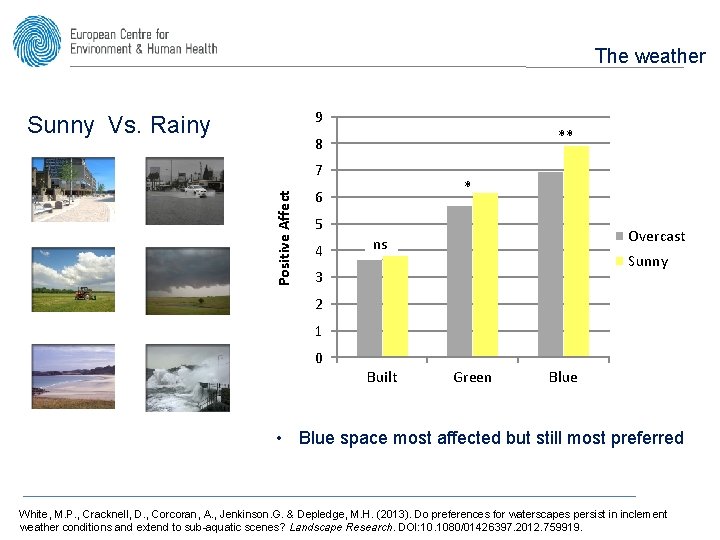
The weather 9 Sunny Vs. Rainy ** 8 Positive Affect 7 * 6 5 4 Overcast ns Sunny 3 2 1 0 Built Green Blue • Blue space most affected but still most preferred White, M. P. , Cracknell, D. , Corcoran, A. , Jenkinson. G. & Depledge, M. H. (2013). Do preferences for waterscapes persist in inclement weather conditions and extend to sub-aquatic scenes? Landscape Research. DOI: 10. 1080/01426397. 2012. 759919.
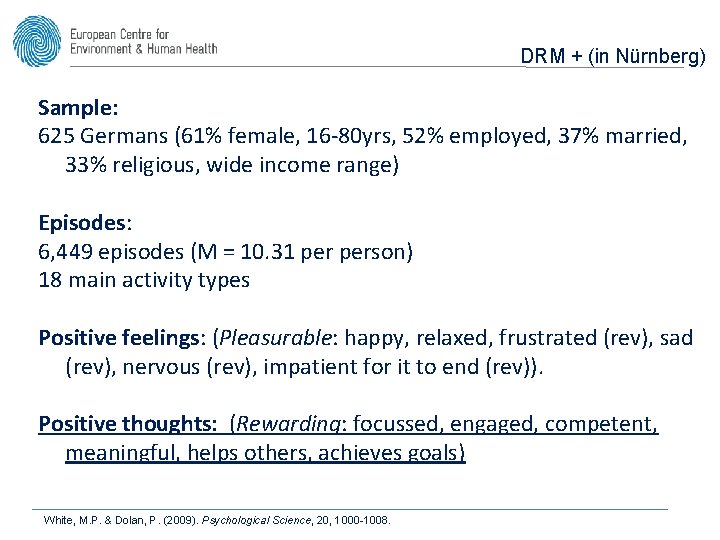
DRM + (in Nürnberg) Sample: 625 Germans (61% female, 16 -80 yrs, 52% employed, 37% married, 33% religious, wide income range) Episodes: 6, 449 episodes (M = 10. 31 person) 18 main activity types Positive feelings: (Pleasurable: happy, relaxed, frustrated (rev), sad (rev), nervous (rev), impatient for it to end (rev)). Positive thoughts: (Rewarding: focussed, engaged, competent, meaningful, helps others, achieves goals) White, M. P. & Dolan, P. (2009). Psychological Science, 20, 1000 -1008.
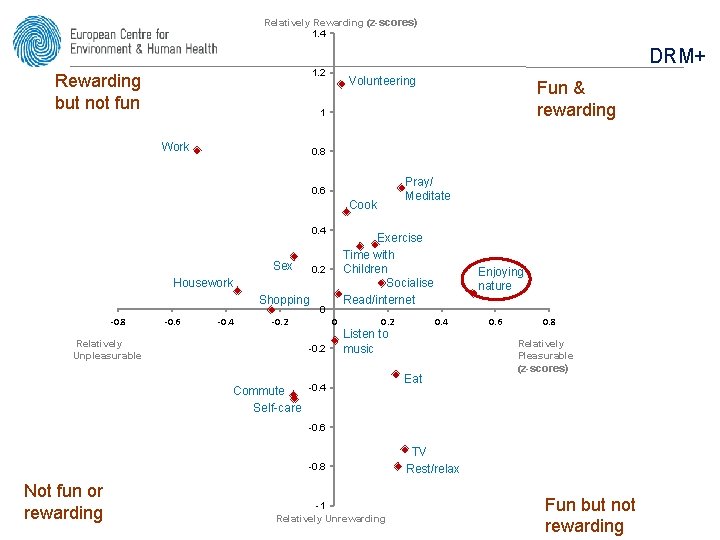
Relatively Rewarding (z-scores) 1. 4 DRM+ 1. 2 Rewarding but not fun Volunteering 1 Work 0. 8 Pray/ Meditate 0. 6 Cook 0. 4 Sex Exercise Time with Children Socialise Read/internet 0. 2 Housework Shopping -0. 8 Relatively Unpleasurable Fun & rewarding -0. 6 -0. 4 0 -0. 2 Enjoying nature 0. 4 Listen to music -0. 4 Commute Self-care Eat 0. 6 0. 8 Relatively Pleasurable (z-scores) -0. 6 -0. 8 Not fun or rewarding -1 Relatively Unrewarding TV Rest/relax Fun but not rewarding
- Slides: 18