
The Great Australian Silence The Portrayal of Aboriginal
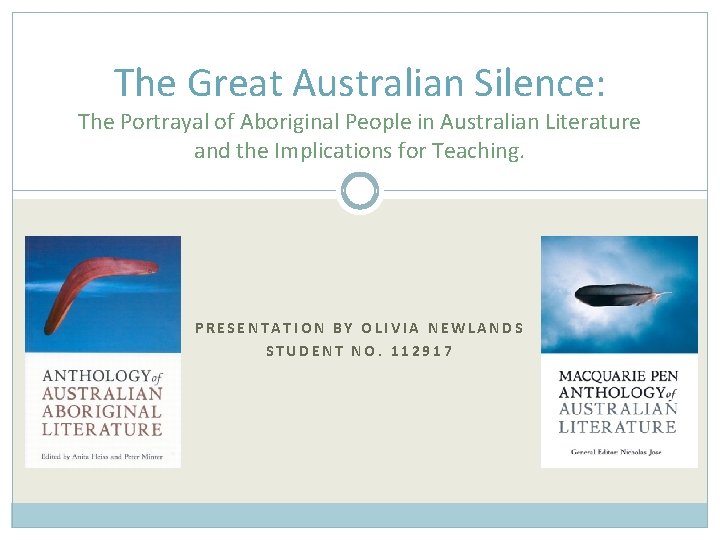
The Great Australian Silence: The Portrayal of Aboriginal People in Australian Literature and the Implications for Teaching. PRESENTATION BY OLIVIA NEWLANDS STUDENT NO. 112917
WARNING The following presentation contains an image of a deceased person, which may cause sadness or distress to some viewers. A copy of this presentation without the image can be provided if needed. Please contact me if this is the case.
Acknowledgement of Place Before beginning this presentation, I would like to pay respect to the traditional and original owners of this land; to pay respect to those that have passed before us and to acknowledge today’s Tasmanian Aboriginal community who are the custodians of this land. Tasmanian Government: Office of Aboriginal Affairs. (2014)
Summary The following presentation explores the way in which The Great Australian Silence operates in Australian literature, by examining historical and contemporary literary portrayals of Aboriginal people. The main points of this presentation are as follows: � The Great Australian Silence operates in Australian literature via the literary constructs of the master narrative and ‘The Whiteman’s Aborigine’. � The majority of historical literary portrayals of Aboriginal people in Australian literature were written by Non-Indigenous, white settlers. � Within contemporary Australian literature, two ‘strands’ of Indigenous representation exist; those portrayals written by Indigenous authors, and those written by non-Indigenous authors. In addition to covering these points, the presentation will also: � List the relevant cultural considerations/implications for teachers in relation to the representation of Aboriginal people in Australian literature. � Highlight the importance of including texts written by Indigenous authors in the classroom. � Present a learning activity that can be used in the classroom to teach students about the topic of ‘Literary representations of Aboriginal people in Australian literature’.
Historical Portrayals of Aboriginal People in Australian Literature For the first 150 years of Australia’s history following white settlement, the majority of portrayals of Aboriginal Australians’ within Australian literature were produced and constructed by Non-Indigenous writers, historians and scientists; and these texts negatively emphasised otherness, difference and notions of binary (Leane, 2010, p. 1 & p. 8). Academic and author Jeanine Leane (2010) refers to these portrayals of Aboriginal people in Australian literature as the ‘Whiteman’s Aborigine’, and writes that since the 19 th century, “the Whiteman’s Aborigine has been identified, named, related, divided and inscribed in Australian literature and. . . various narratives and genres to retell over and again the same story of Aboriginal experience as at the peripheries of all things Australian” (p. 45).
Historical Portrayals Continued v Historically, literary representations of Australia prior to white settlement constructed the country as a primitive place, and Aboriginal people as a barbarous race (Mc. Namara, 2013, p. 187). v Darwin’s theory of evolution heavily influenced the white settlers of Australia, and contributed significantly to their racist views and portrayals of Aboriginal people in literature (Mc. Namara, 2013, p. 188). For example, Darwin wrote in Origin of the Species: “At some future period. . . the civilised races of man will almost certainly exterminate and replace the savage races throughout the world” (Darwin as cited in Hoberman, 1997, p. 275). v Literary texts (but particularly the fiction of the nineteenth and twentieth century), produced by Australia’s white settlers constructed Aboriginal people in Australian literature via the use of ‘othering’ language; constantly reducing, and referring to Aboriginal people as ‘they’ (Bradford, 1997, p. 100).
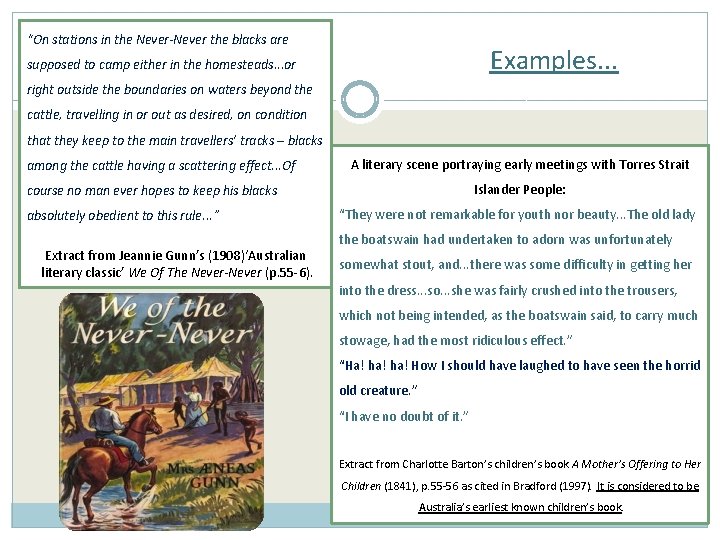
“On stations in the Never-Never the blacks are Examples. . . supposed to camp either in the homesteads. . . or right outside the boundaries on waters beyond the cattle, travelling in or out as desired, on condition that they keep to the main travellers’ tracks – blacks among the cattle having a scattering effect. . . Of A literary scene portraying early meetings with Torres Strait Islander People: course no man ever hopes to keep his blacks absolutely obedient to this rule. . . ” Extract from Jeannie Gunn’s (1908)‘Australian literary classic’ We Of The Never-Never (p. 55 -6). “They were not remarkable for youth nor beauty. . . The old lady the boatswain had undertaken to adorn was unfortunately somewhat stout, and. . . there was some difficulty in getting her into the dress. . . so. . . she was fairly crushed into the trousers, which not being intended, as the boatswain said, to carry much stowage, had the most ridiculous effect. ” “Ha! ha! How I should have laughed to have seen the horrid old creature. ” “I have no doubt of it. ” Extract from Charlotte Barton’s children’s book A Mother’s Offering to Her Children (1841), p. 55 -56 as cited in Bradford (1997). It is considered to be Australia’s earliest known children’s book.
QUESTION! As we can see from these examples, historical portrayals of Aboriginal people in Australian literature were extremely racist, and used highly offensive, derogatory, and discriminatory language to construct Aboriginal people as ‘Other’. Given the nature of these texts, consider the following question: Do you think it is important to study these texts to some extent at school when teaching and/or learning about Indigenous history, culture, literature and issues? If so, why?
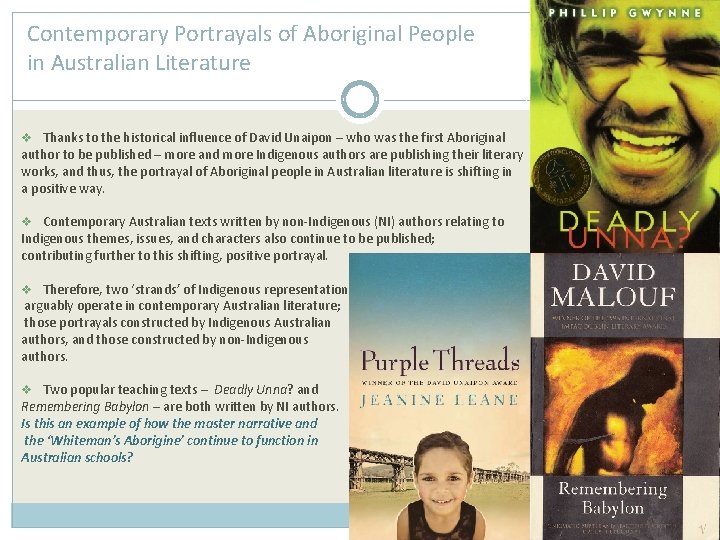
Contemporary Portrayals of Aboriginal People in Australian Literature v Thanks to the historical influence of David Unaipon – who was the first Aboriginal author to be published – more and more Indigenous authors are publishing their literary works, and thus, the portrayal of Aboriginal people in Australian literature is shifting in a positive way. v Contemporary Australian texts written by non-Indigenous (NI) authors relating to Indigenous themes, issues, and characters also continue to be published; contributing further to this shifting, positive portrayal. v Therefore, two ‘strands’ of Indigenous representation arguably operate in contemporary Australian literature; those portrayals constructed by Indigenous Australian authors, and those constructed by non-Indigenous authors. v Two popular teaching texts – Deadly Unna? and Remembering Babylon – are both written by NI authors. Is this an example of how the master narrative and the ‘Whiteman’s Aborigine’ continue to function in Australian schools?
![Contemporary Aboriginal Poetry ‘Mookari’ (meaning Storm) [Extract] – By Dan Davis He here now,](http://slidetodoc.com/presentation_image_h2/3db2e9c06c6f995a5396c4874e96c67e/image-10.jpg "Contemporary Aboriginal Poetry ‘Mookari’ (meaning Storm) [Extract] – By Dan Davis He here now,")
Contemporary Aboriginal Poetry ‘Mookari’ (meaning Storm) [Extract] – By Dan Davis He here now, you kids, look how he lights up the sky. That old fella Mookari, he don't wanna say goodbye. Look how he makes the thunder, roar, so very loud. He make the lightning show its brightness, he feeling really proud. Mookari old man, You're the same every year. I like it when you visit us, but don't get too near. Mookari, Old Man, the name for Real big rain. Looks like the old Man is going now but He'll be back again. He going now, the rain is slowing down. He'll go and water somewhere else, cool off some other town. There he goes, the sky is turning blue, the sun is coming out. But watch out for that old man, he'll come back to us no doubt.

Contemporary Aboriginal Poetry Continued ‘Let Us Not Be Bitter’ By Oodgeroo Noonuccal
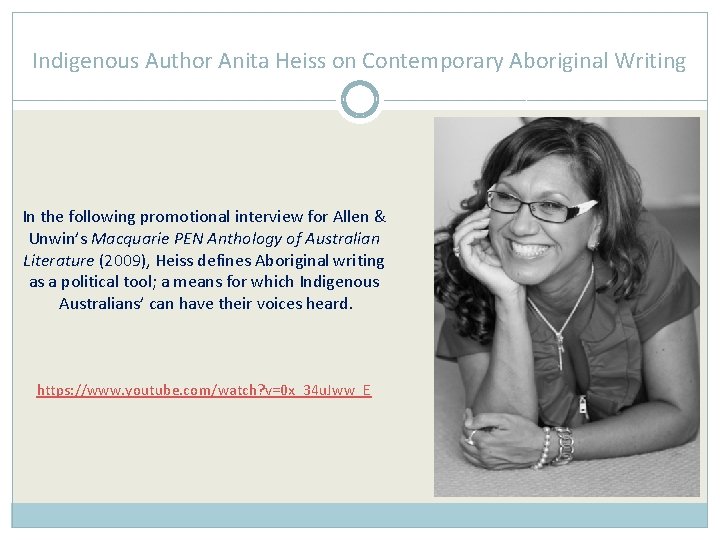
Indigenous Author Anita Heiss on Contemporary Aboriginal Writing In the following promotional interview for Allen & Unwin’s Macquarie PEN Anthology of Australian Literature (2009), Heiss defines Aboriginal writing as a political tool; a means for which Indigenous Australians’ can have their voices heard. https: //www. youtube. com/watch? v=0 x_34 u. Jww_E
QUESTION! “To write about Australia, particularly rural Australia, without mentioning the Aboriginal presence (current or historical) is to distort reality, to perpetuate the terra nullius lie. However, for a non-Aboriginal writer to write about Aboriginal people is to run the risk of ‘appropriating’ Aboriginal experience; speaking on behalf of. . . [and] There’s been too much of that already” (Merrilees, 2007, p. 1 -2). “No white person here understands the aboriginal world enough to write about it” (David Malouf on writing Remembering Babylon as cited in Berne, 1993, para. 8). In light of these two quotes and Anita Heiss’ interview, do you think Non. Indigenous writers can ever be ‘truly’ successful in their attempts at writing novels, poems and other text types that centre around Aboriginal culture, identity, and experience?
Using texts written by Indigenous authors in the classroom v As teachers, one of the ways that we can create culturally safe classrooms for our Aboriginal and Torres Strait Islander students is to include texts written by Indigenous authors into our subject programs – particularly for novel studies in English. v Even more importantly, these texts should not always be studied to address ACARA’s cross- curriculum priority, but rather, on the literary merit and educational value of the text alone. v In doing so, we can expose students to positive and true portrayals of Aboriginal people in Australian literature, as written by contemporary Indigenous authors. In addition, including texts written by Indigenous authors also provides ‘a mirror’ for our Aboriginal and Torres Strait Islander students, and provides such students with positive experiences of self-identification.
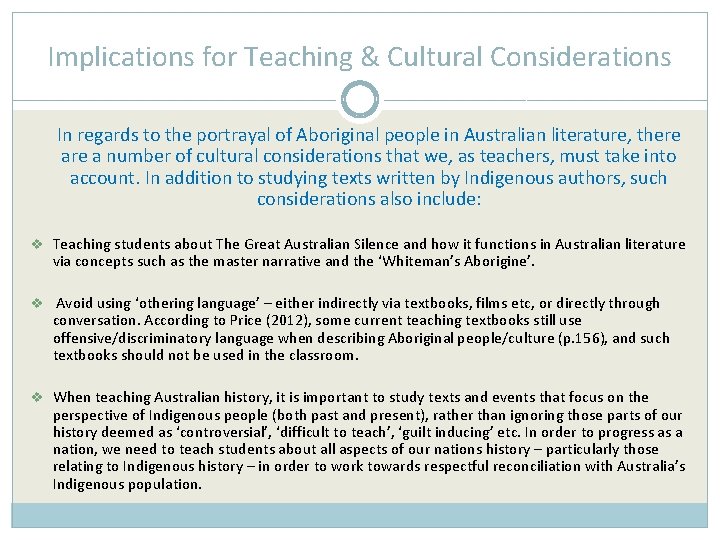
Implications for Teaching & Cultural Considerations In regards to the portrayal of Aboriginal people in Australian literature, there a number of cultural considerations that we, as teachers, must take into account. In addition to studying texts written by Indigenous authors, such considerations also include: v Teaching students about The Great Australian Silence and how it functions in Australian literature via concepts such as the master narrative and the ‘Whiteman’s Aborigine’. v Avoid using ‘othering language’ – either indirectly via textbooks, films etc, or directly through conversation. According to Price (2012), some current teaching textbooks still use offensive/discriminatory language when describing Aboriginal people/culture (p. 156), and such textbooks should not be used in the classroom. v When teaching Australian history, it is important to study texts and events that focus on the perspective of Indigenous people (both past and present), rather than ignoring those parts of our history deemed as ‘controversial’, ‘difficult to teach’, ‘guilt inducing’ etc. In order to progress as a nation, we need to teach students about all aspects of our nations history – particularly those relating to Indigenous history – in order to work towards respectful reconciliation with Australia’s Indigenous population.
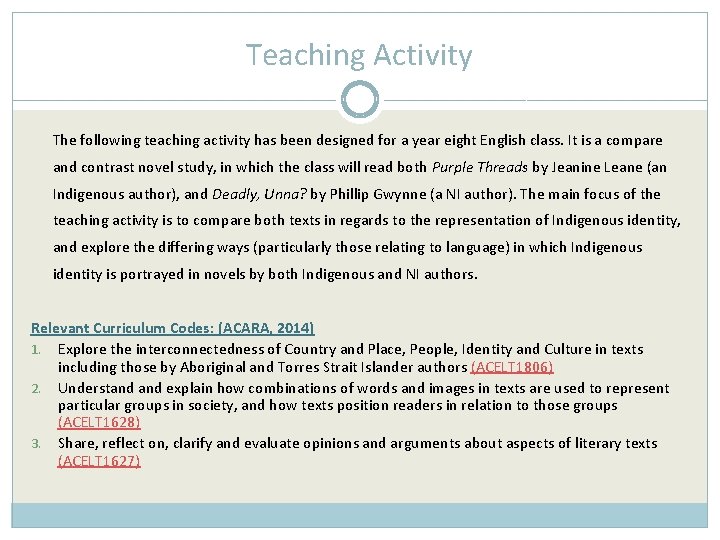
Teaching Activity The following teaching activity has been designed for a year eight English class. It is a compare and contrast novel study, in which the class will read both Purple Threads by Jeanine Leane (an Indigenous author), and Deadly, Unna? by Phillip Gwynne (a NI author). The main focus of the teaching activity is to compare both texts in regards to the representation of Indigenous identity, and explore the differing ways (particularly those relating to language) in which Indigenous identity is portrayed in novels by both Indigenous and NI authors. Relevant Curriculum Codes: (ACARA, 2014) 1. Explore the interconnectedness of Country and Place, People, Identity and Culture in texts including those by Aboriginal and Torres Strait Islander authors (ACELT 1806) 2. Understand explain how combinations of words and images in texts are used to represent particular groups in society, and how texts position readers in relation to those groups (ACELT 1628) 3. Share, reflect on, clarify and evaluate opinions and arguments about aspects of literary texts (ACELT 1627)
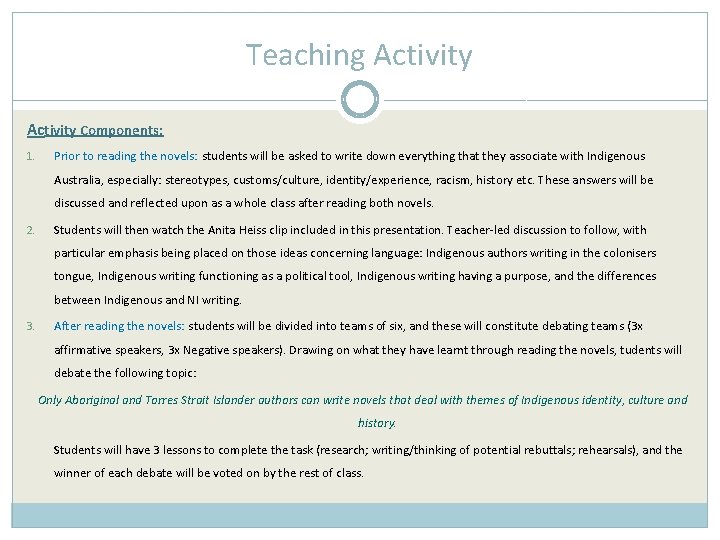
Teaching Activity Components: 1. Prior to reading the novels: students will be asked to write down everything that they associate with Indigenous Australia, especially: stereotypes, customs/culture, identity/experience, racism, history etc. These answers will be discussed and reflected upon as a whole class after reading both novels. 2. Students will then watch the Anita Heiss clip included in this presentation. Teacher-led discussion to follow, with particular emphasis being placed on those ideas concerning language: Indigenous authors writing in the colonisers tongue, Indigenous writing functioning as a political tool, Indigenous writing having a purpose, and the differences between Indigenous and NI writing. 3. After reading the novels: students will be divided into teams of six, and these will constitute debating teams (3 x affirmative speakers, 3 x Negative speakers). Drawing on what they have learnt through reading the novels, tudents will debate the following topic: Only Aboriginal and Torres Strait Islander authors can write novels that deal with themes of Indigenous identity, culture and history. Students will have 3 lessons to complete the task (research; writing/thinking of potential rebuttals; rehearsals), and the winner of each debate will be voted on by the rest of class.
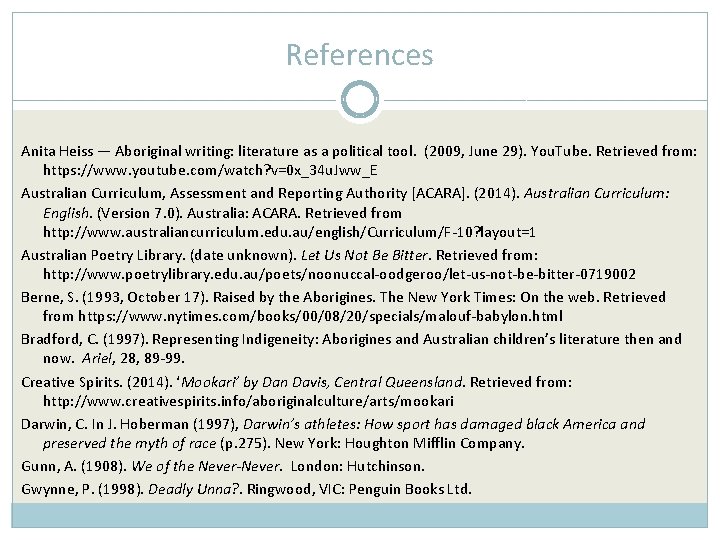
References Anita Heiss — Aboriginal writing: literature as a political tool. (2009, June 29). You. Tube. Retrieved from: https: //www. youtube. com/watch? v=0 x_34 u. Jww_E Australian Curriculum, Assessment and Reporting Authority [ACARA]. (2014). Australian Curriculum: English. (Version 7. 0). Australia: ACARA. Retrieved from http: //www. australiancurriculum. edu. au/english/Curriculum/F-10? layout=1 Australian Poetry Library. (date unknown). Let Us Not Be Bitter. Retrieved from: http: //www. poetrylibrary. edu. au/poets/noonuccal-oodgeroo/let-us-not-be-bitter-0719002 Berne, S. (1993, October 17). Raised by the Aborigines. The New York Times: On the web. Retrieved from https: //www. nytimes. com/books/00/08/20/specials/malouf-babylon. html Bradford, C. (1997). Representing Indigeneity: Aborigines and Australian children’s literature then and now. Ariel, 28, 89 -99. Creative Spirits. (2014). ‘Mookari’ by Dan Davis, Central Queensland. Retrieved from: http: //www. creativespirits. info/aboriginalculture/arts/mookari Darwin, C. In J. Hoberman (1997), Darwin’s athletes: How sport has damaged black America and preserved the myth of race (p. 275). New York: Houghton Mifflin Company. Gunn, A. (1908). We of the Never-Never. London: Hutchinson. Gwynne, P. (1998). Deadly Unna? . Ringwood, VIC: Penguin Books Ltd.
![References Leane, J. (2010). The Whiteman’s Aborigine [Doctoral Thesis]. Retrieved from: https: //opus. lib.](http://slidetodoc.com/presentation_image_h2/3db2e9c06c6f995a5396c4874e96c67e/image-19.jpg "References Leane, J. (2010). The Whiteman’s Aborigine [Doctoral Thesis]. Retrieved from: https: //opus. lib.")
References Leane, J. (2010). The Whiteman’s Aborigine [Doctoral Thesis]. Retrieved from: https: //opus. lib. uts. edu. au/research/bitstream/handle/2100/1247/02 Whole. pdf Leane, J. (2011). Purple Threads. St Lucia, QLD: University of Queensland Press. Mc. Namara, N. (2013). Literary legacy: Unconscious bias. In Proceedings of the third international conference on racisms in the new world order: Realities of culture, colour and identity (pp. 187199). Cairns, QLD: James Cook University. Merrilees, M. (2007). Tiptoeing through the spinifex: White representations of Aboriginal characters. Dot. Lit, 6, 1 -14. Price, K. (2012). Chapter 10: Aboriginal and Torres Strait Islander studies in the classroom. In K. Price, Aboriginal and Torres Strait Islander education: An introduction for the teaching profession (pp. 151 -162). Port Melbourne, VIC: Cambridge UP. Tasmanian Government: Office of Aboriginal Affairs. (2014). Acknowledgement and welcome to country. Retrieved from: http: //www. dpac. tas. gov. au/divisions/executive/protocol_office/acknowledgements_and_welco me_to_country
- Slides: 19