
The Grand Challenges Transformations and Opportunities for Social

- Slides: 45
The Grand Challenges: Transformations and Opportunities for Social Work Leadership Ron Manderscheid, Ph. D Exec Dir, NACBHDD and NARMH Adj Prof, BSPH, JHU © NACBHDD
Time for a Thrilling Ride!
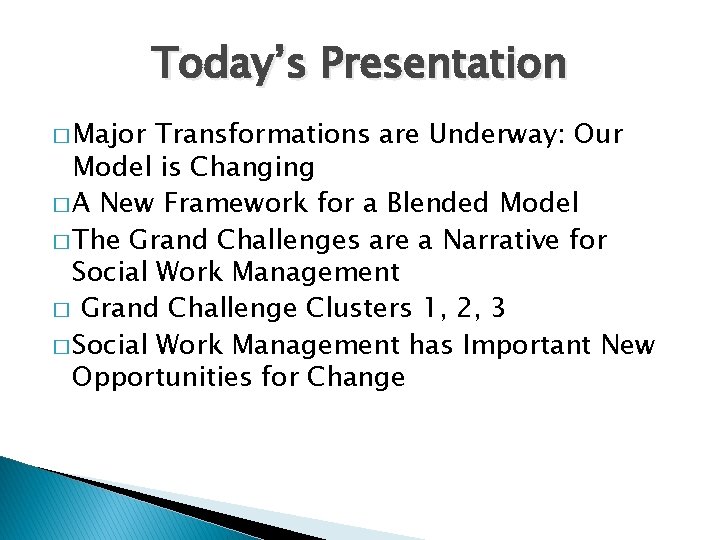
Today’s Presentation � Major Transformations are Underway: Our Model is Changing � A New Framework for a Blended Model � The Grand Challenges are a Narrative for Social Work Management � Grand Challenge Clusters 1, 2, 3 � Social Work Management has Important New Opportunities for Change
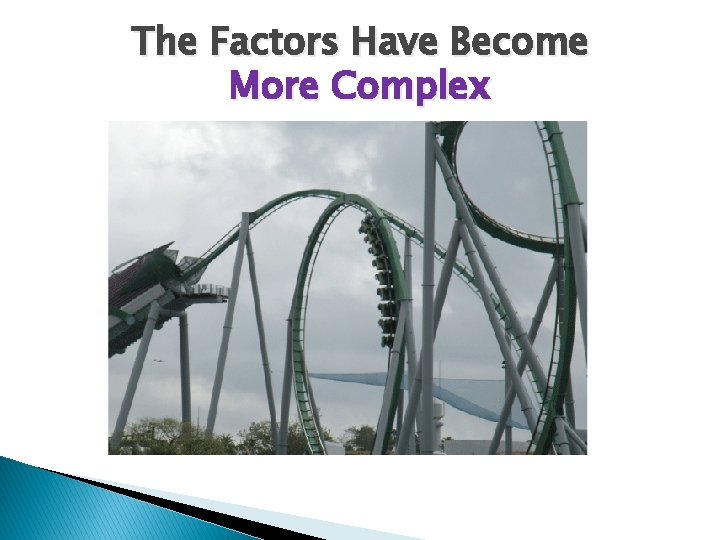
The Factors Have Become More Complex
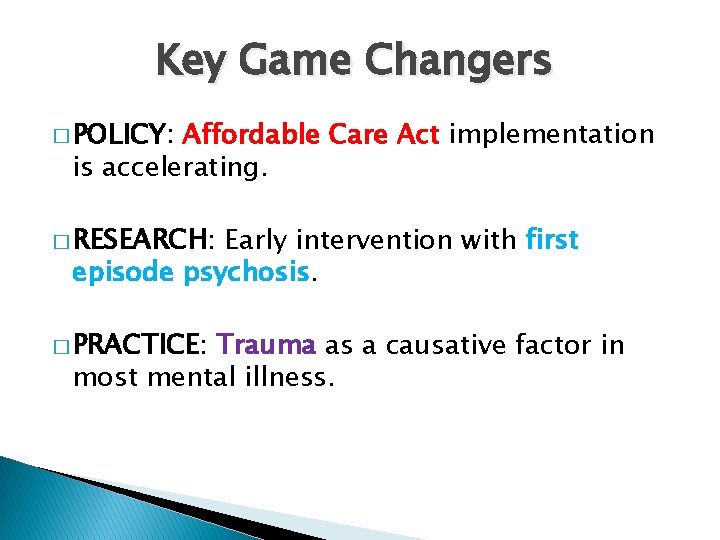
Key Game Changers � POLICY: Affordable Care Act implementation is accelerating. � RESEARCH: Early intervention with first episode psychosis. � PRACTICE: Trauma as a causative factor in most mental illness.
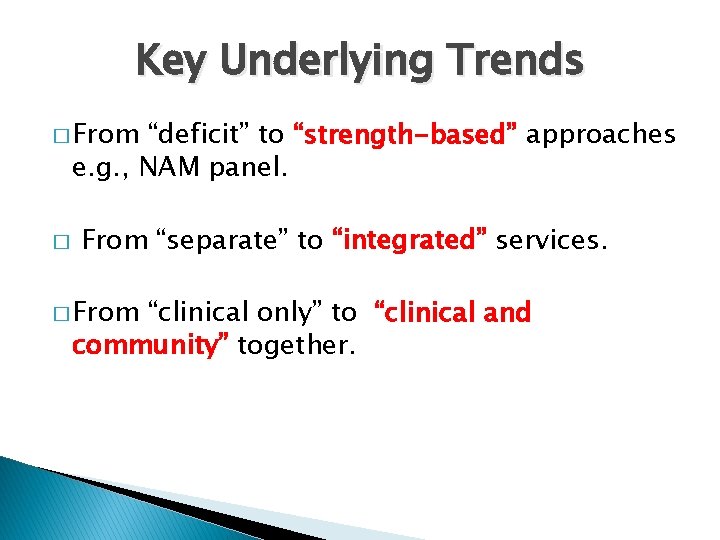
Key Underlying Trends � From “deficit” to “strength-based” approaches e. g. , NAM panel. � From “separate” to “integrated” services. � From “clinical only” to “clinical and community” together.
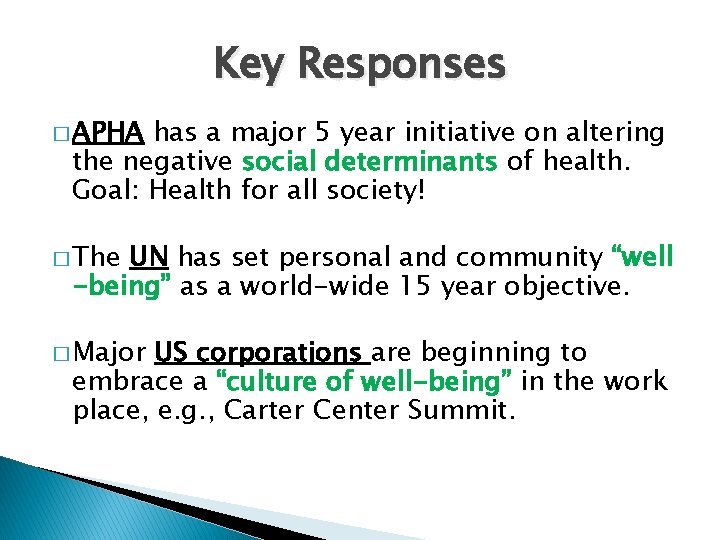
Key Responses � APHA has a major 5 year initiative on altering the negative social determinants of health. Goal: Health for all society! � The UN has set personal and community “well -being” as a world-wide 15 year objective. � Major US corporations are beginning to embrace a “culture of well-being” in the work place, e. g. , Carter Center Summit.
Let’s Begin Our Adventure
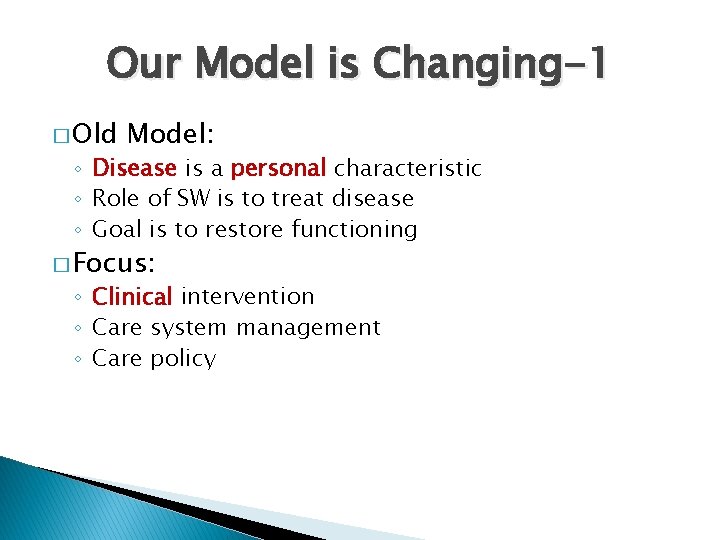
Our Model is Changing-1 � Old Model: ◦ Disease is a personal characteristic ◦ Role of SW is to treat disease ◦ Goal is to restore functioning � Focus: ◦ Clinical intervention ◦ Care system management ◦ Care policy
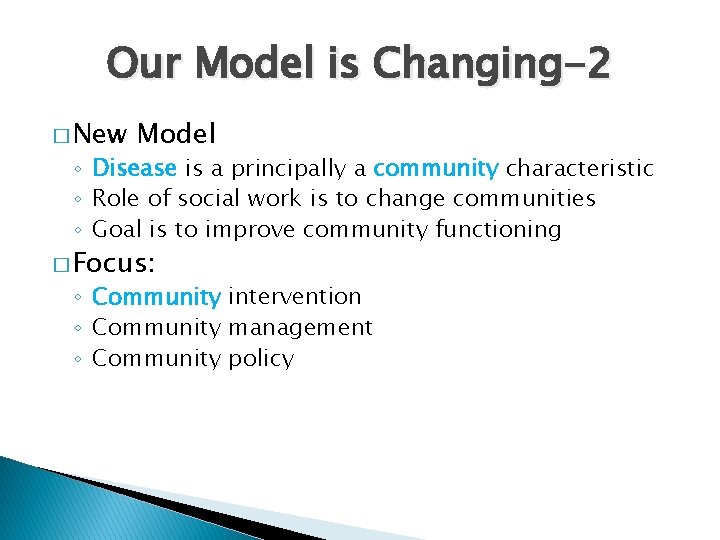
Our Model is Changing-2 � New Model ◦ Disease is a principally a community characteristic ◦ Role of social work is to change communities ◦ Goal is to improve community functioning � Focus: ◦ Community intervention ◦ Community management ◦ Community policy
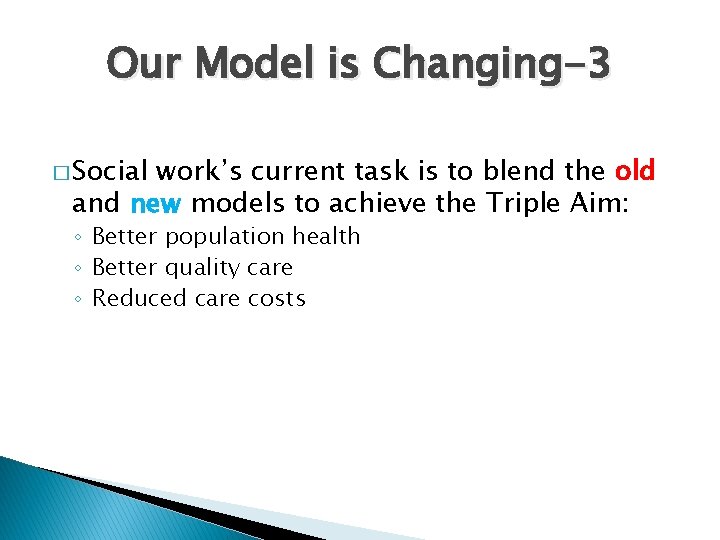
Our Model is Changing-3 � Social work’s current task is to blend the old and new models to achieve the Triple Aim: ◦ Better population health ◦ Better quality care ◦ Reduced care costs
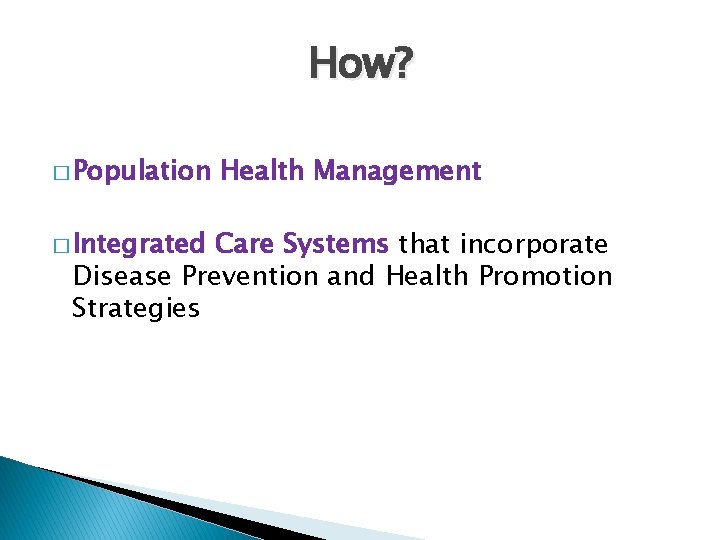
How? � Population � Integrated Health Management Care Systems that incorporate Disease Prevention and Health Promotion Strategies
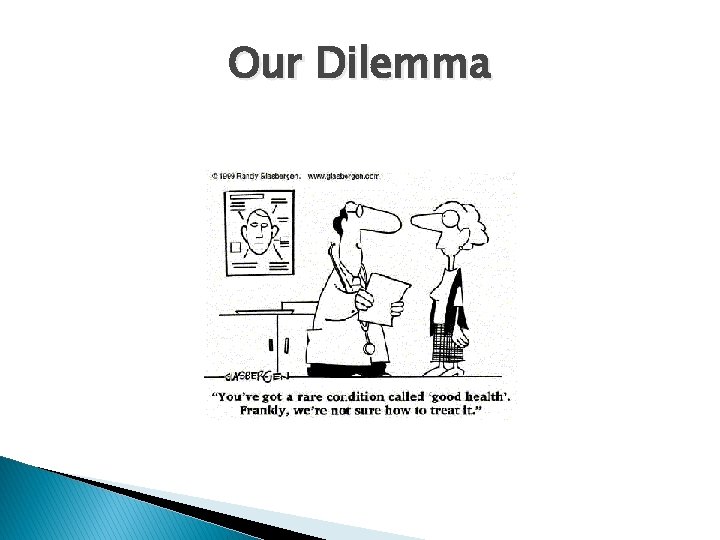
Our Dilemma
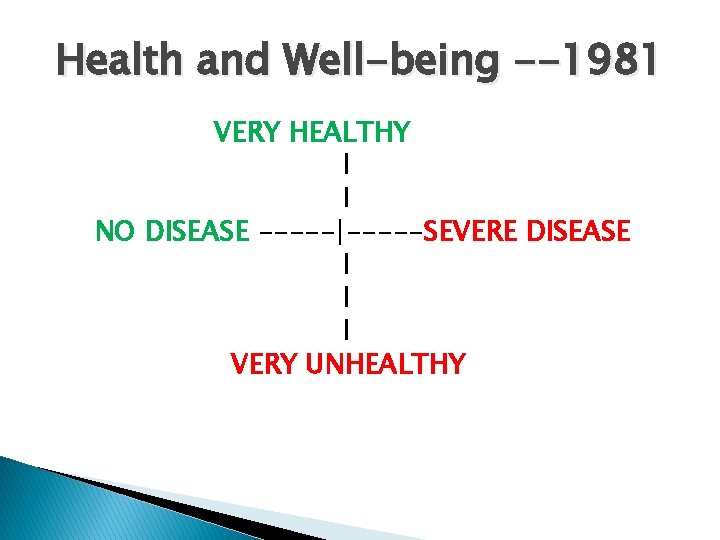
Health and Well-being --1981 VERY HEALTHY l I NO DISEASE -----|-----SEVERE DISEASE l l l VERY UNHEALTHY
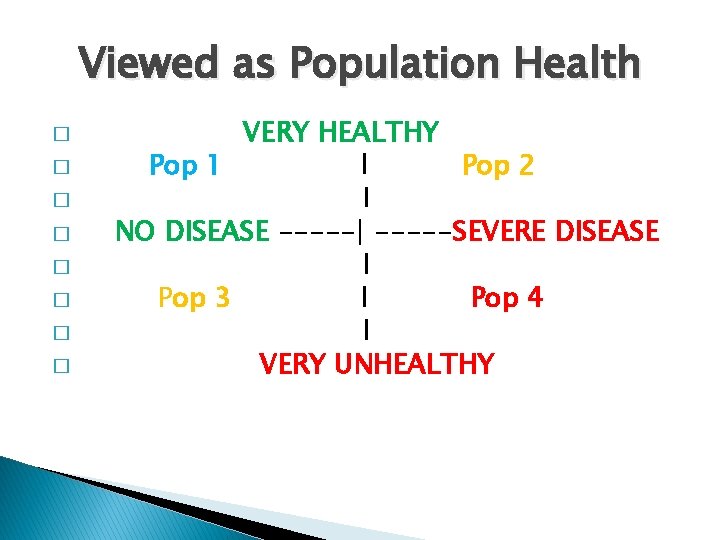
Viewed as Population Health � � � � VERY HEALTHY Pop 1 l Pop 2 I NO DISEASE -----| -----SEVERE DISEASE l Pop 3 l Pop 4 l VERY UNHEALTHY
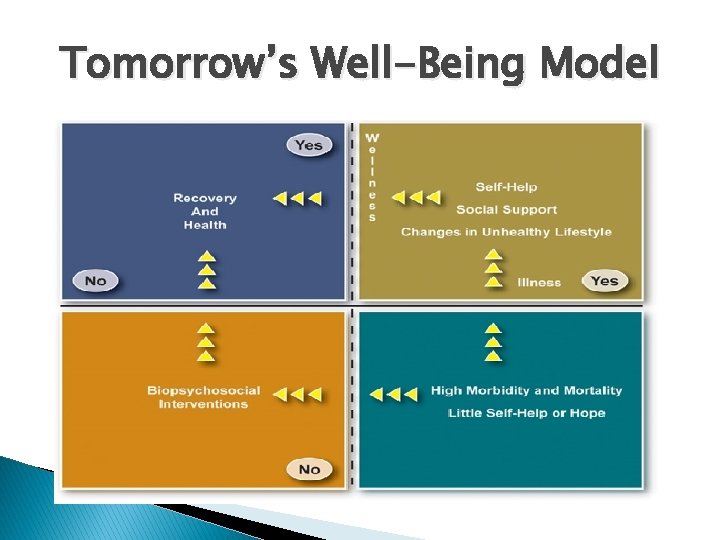
Tomorrow’s Well-Being Model
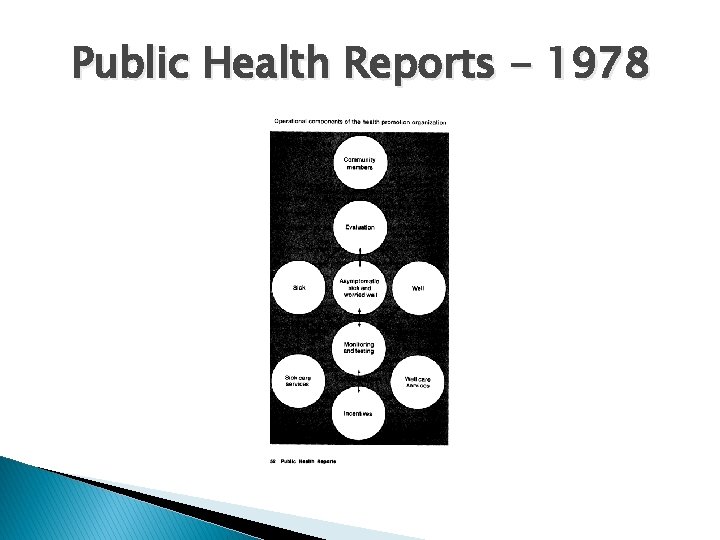
Public Health Reports - 1978
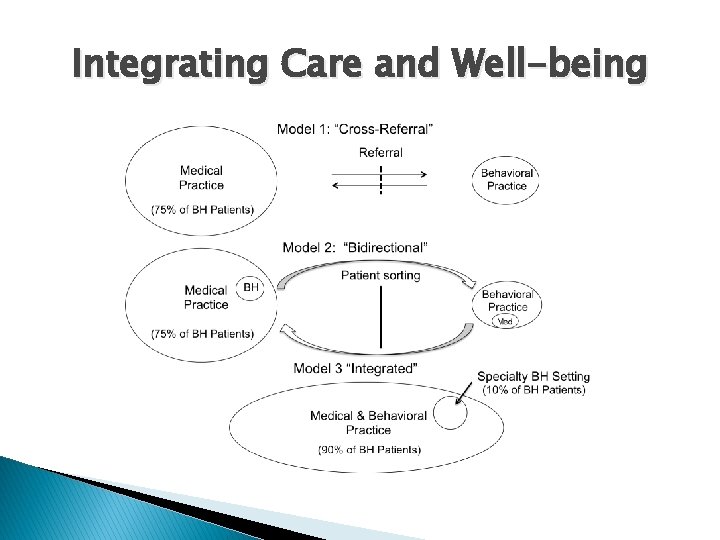
Integrating Care and Well-being
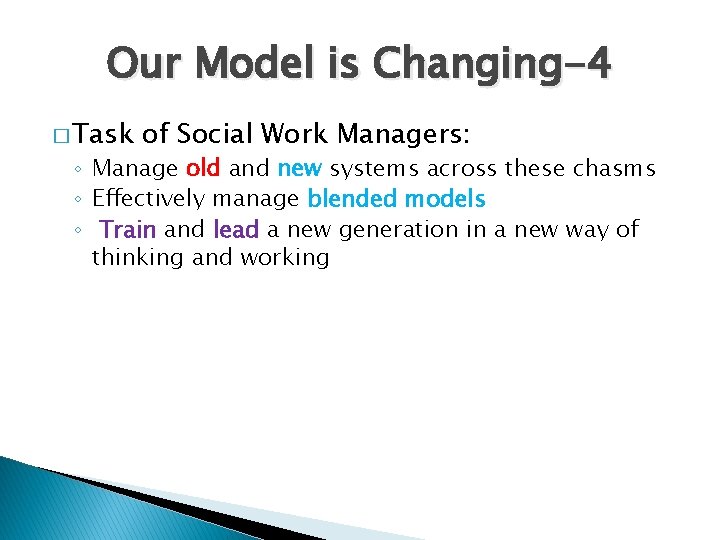
Our Model is Changing-4 � Task of Social Work Managers: ◦ Manage old and new systems across these chasms ◦ Effectively manage blended models ◦ Train and lead a new generation in a new way of thinking and working
Let’s Go!
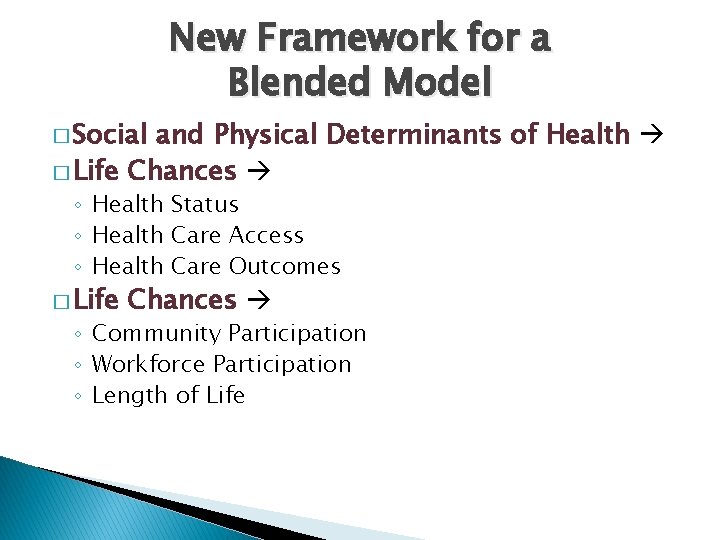
New Framework for a Blended Model � Social and Physical Determinants of Health � Life Chances ◦ Health Status ◦ Health Care Access ◦ Health Care Outcomes � Life Chances ◦ Community Participation ◦ Workforce Participation ◦ Length of Life
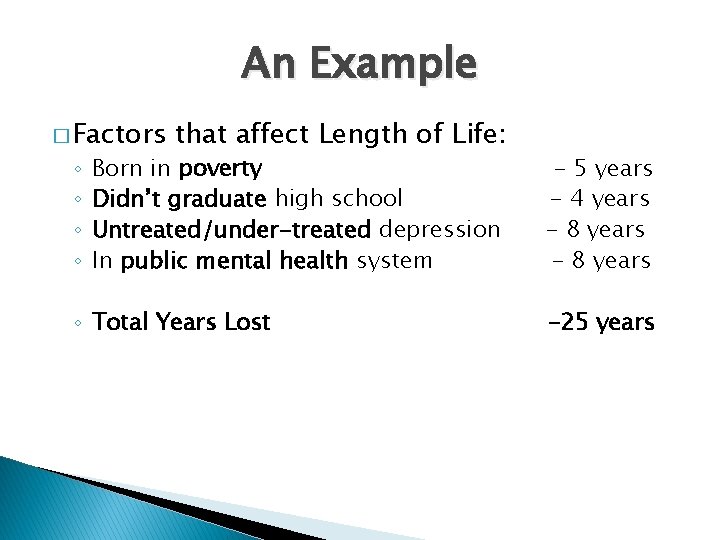
An Example � Factors ◦ ◦ that affect Length of Life: Born in poverty Didn’t graduate high school Untreated/under-treated depression In public mental health system ◦ Total Years Lost - 5 years - 4 years - 8 years -25 years
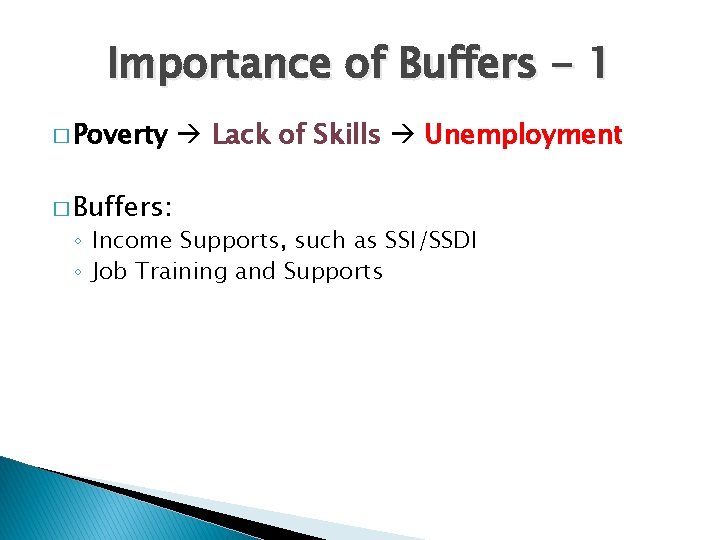
Importance of Buffers - 1 � Poverty � Buffers: Lack of Skills Unemployment ◦ Income Supports, such as SSI/SSDI ◦ Job Training and Supports
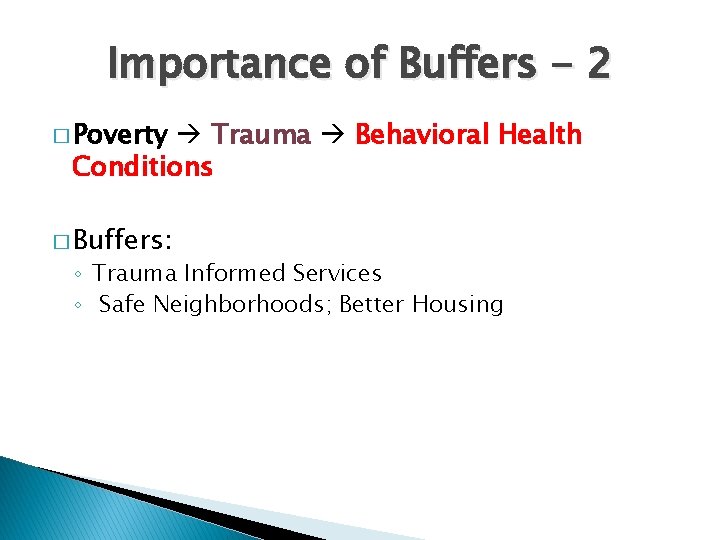
Importance of Buffers - 2 � Poverty Trauma Behavioral Health Conditions � Buffers: ◦ Trauma Informed Services ◦ Safe Neighborhoods; Better Housing
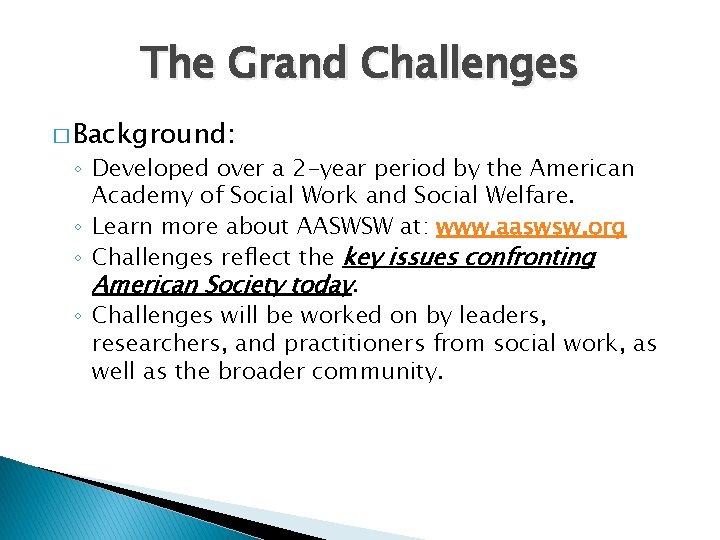
The Grand Challenges � Background: ◦ Developed over a 2 -year period by the American Academy of Social Work and Social Welfare. ◦ Learn more about AASWSW at: www. aaswsw. org ◦ Challenges reflect the key issues confronting American Society today. ◦ Challenges will be worked on by leaders, researchers, and practitioners from social work, as well as the broader community.
Essential Premise Grand Challenges provide a foundational narrative for social work management going forward. � The
What is a foundational narrative? � An intuitively obvious logic that � Leads to a course of action and � Provides a rationale for action
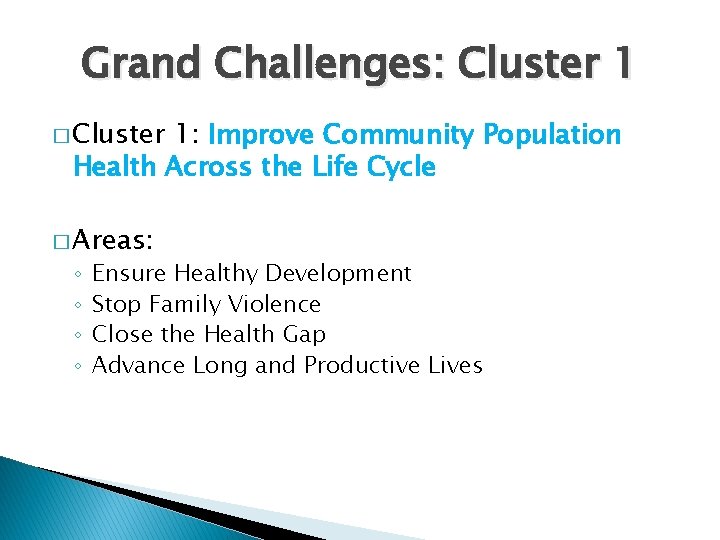
Grand Challenges: Cluster 1 � Cluster 1: Improve Community Population Health Across the Life Cycle � Areas: ◦ ◦ Ensure Healthy Development Stop Family Violence Close the Health Gap Advance Long and Productive Lives
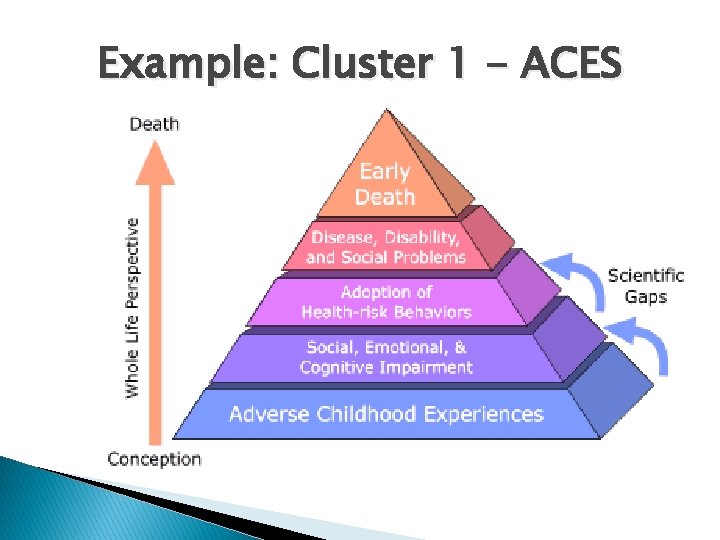
Example: Cluster 1 - ACES
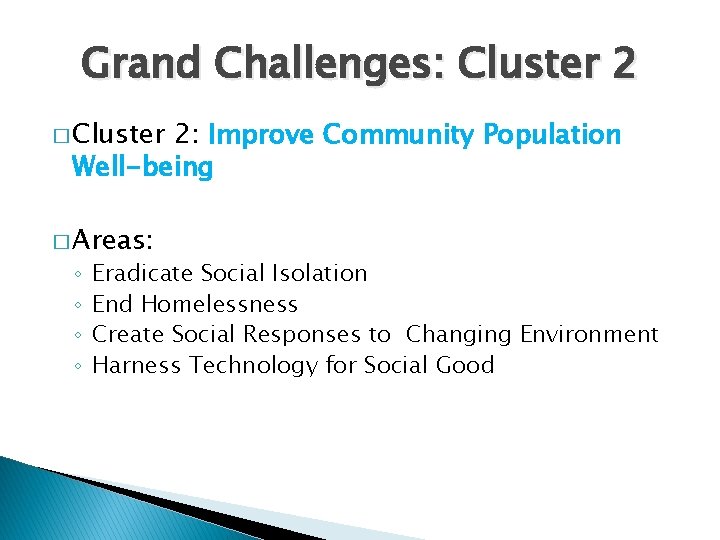
Grand Challenges: Cluster 2 � Cluster 2: Improve Community Population Well-being � Areas: ◦ ◦ Eradicate Social Isolation End Homelessness Create Social Responses to Changing Environment Harness Technology for Social Good
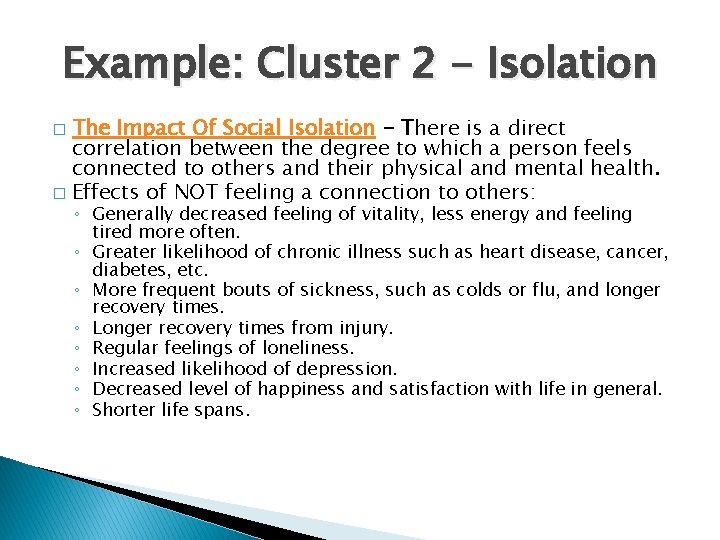
Example: Cluster 2 - Isolation The Impact Of Social Isolation - There is a direct correlation between the degree to which a person feels connected to others and their physical and mental health. � Effects of NOT feeling a connection to others: � ◦ Generally decreased feeling of vitality, less energy and feeling tired more often. ◦ Greater likelihood of chronic illness such as heart disease, cancer, diabetes, etc. ◦ More frequent bouts of sickness, such as colds or flu, and longer recovery times. ◦ Longer recovery times from injury. ◦ Regular feelings of loneliness. ◦ Increased likelihood of depression. ◦ Decreased level of happiness and satisfaction with life in general. ◦ Shorter life spans.
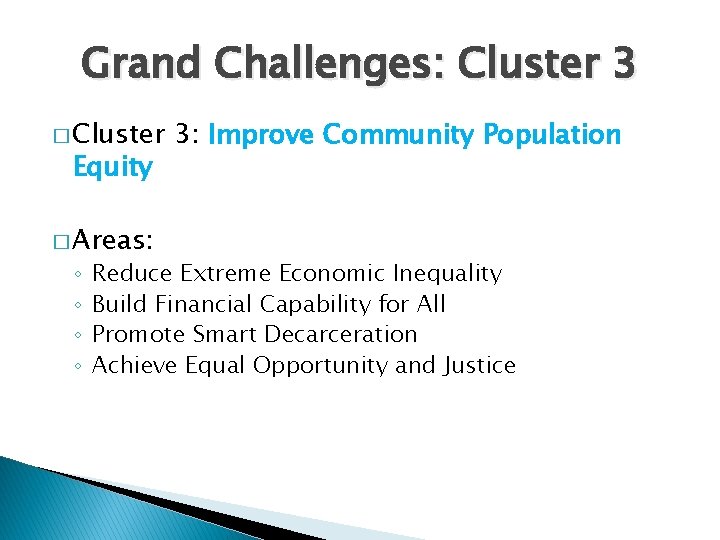
Grand Challenges: Cluster 3 � Cluster Equity � Areas: ◦ ◦ 3: Improve Community Population Reduce Extreme Economic Inequality Build Financial Capability for All Promote Smart Decarceration Achieve Equal Opportunity and Justice
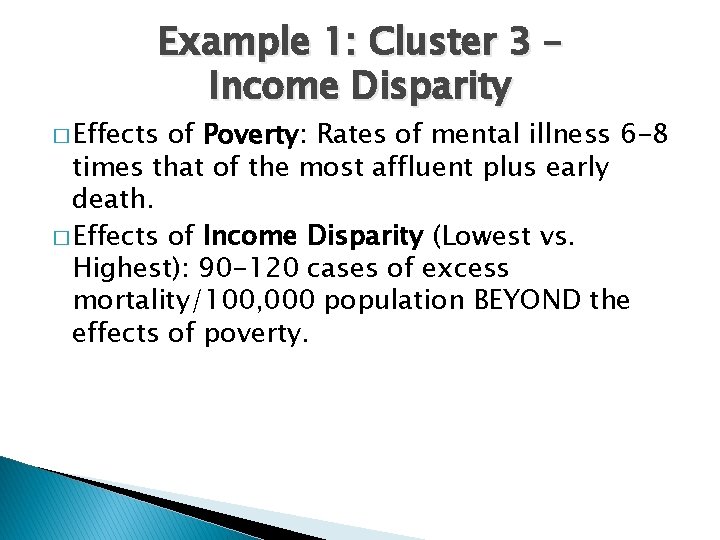
Example 1: Cluster 3 – Income Disparity � Effects of Poverty: Rates of mental illness 6 -8 times that of the most affluent plus early death. � Effects of Income Disparity (Lowest vs. Highest): 90 -120 cases of excess mortality/100, 000 population BEYOND the effects of poverty.
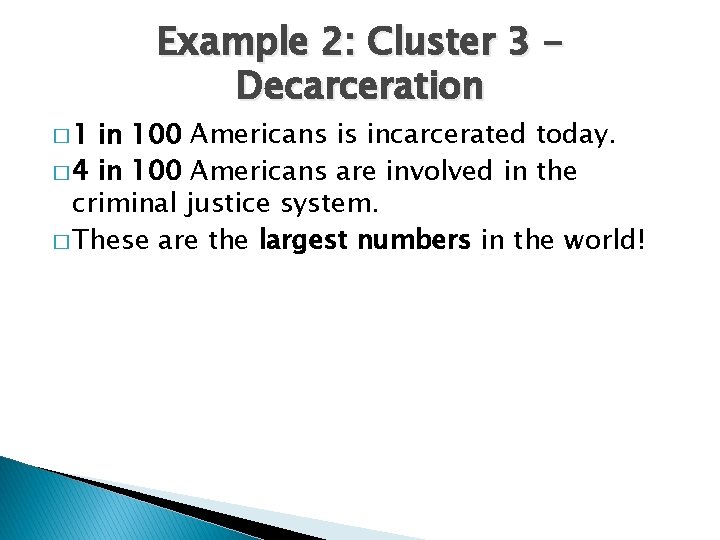
� 1 Example 2: Cluster 3 Decarceration in 100 Americans is incarcerated today. � 4 in 100 Americans are involved in the criminal justice system. � These are the largest numbers in the world!
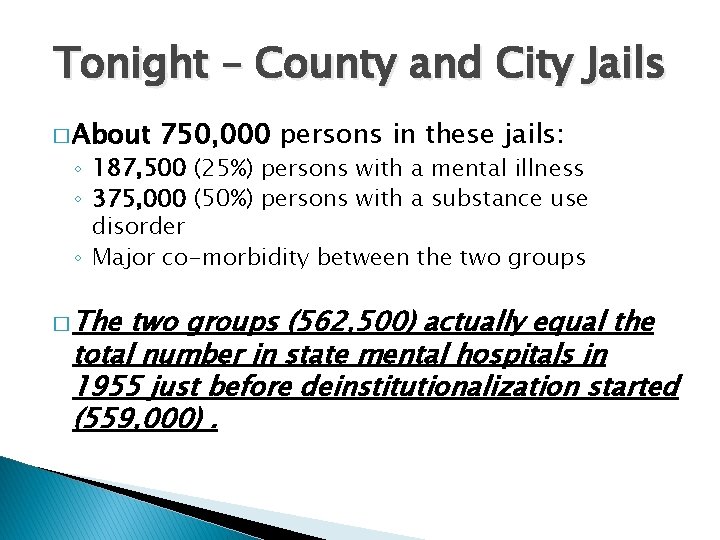
Tonight – County and City Jails � About 750, 000 persons in these jails: ◦ 187, 500 (25%) persons with a mental illness ◦ 375, 000 (50%) persons with a substance use disorder ◦ Major co-morbidity between the two groups � The two groups (562, 500) actually equal the total number in state mental hospitals in 1955 just before deinstitutionalization started (559, 000).
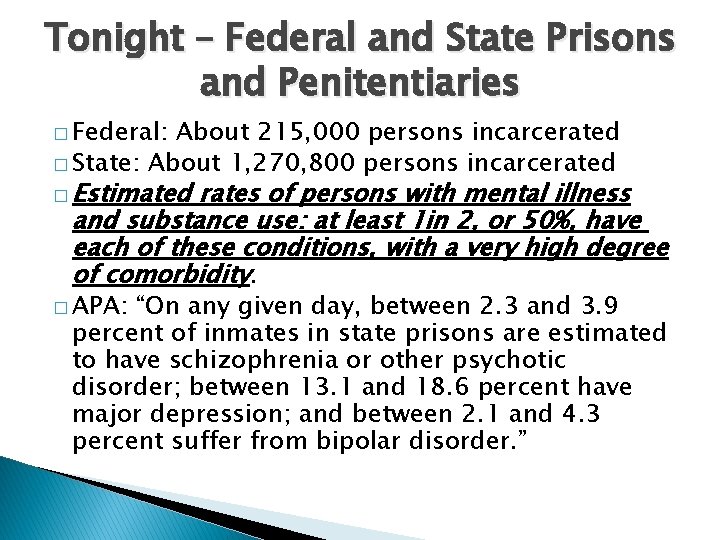
Tonight – Federal and State Prisons and Penitentiaries � Federal: About 215, 000 persons incarcerated � State: About 1, 270, 800 persons incarcerated � Estimated rates of persons with mental illness and substance use: at least 1 in 2, or 50%, have each of these conditions, with a very high degree of comorbidity. � APA: “On any given day, between 2. 3 and 3. 9 percent of inmates in state prisons are estimated to have schizophrenia or other psychotic disorder; between 13. 1 and 18. 6 percent have major depression; and between 2. 1 and 4. 3 percent suffer from bipolar disorder. ”
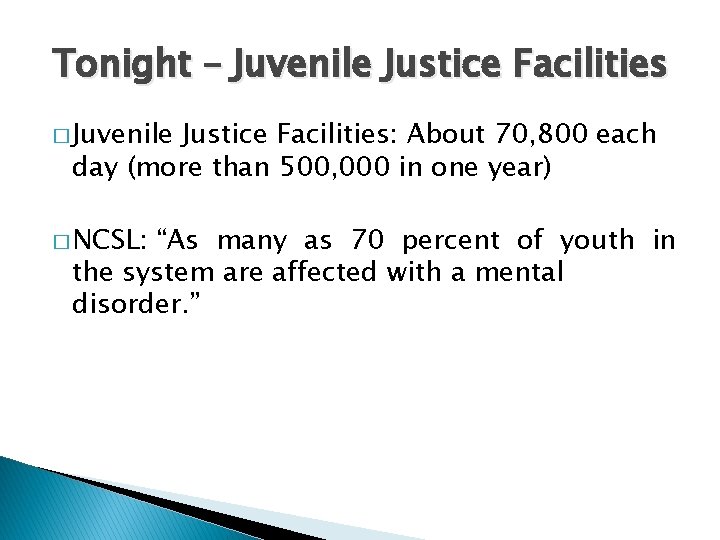
Tonight – Juvenile Justice Facilities � Juvenile Justice Facilities: About 70, 800 each day (more than 500, 000 in one year) � NCSL: “As many as 70 percent of youth in the system are affected with a mental disorder. ”
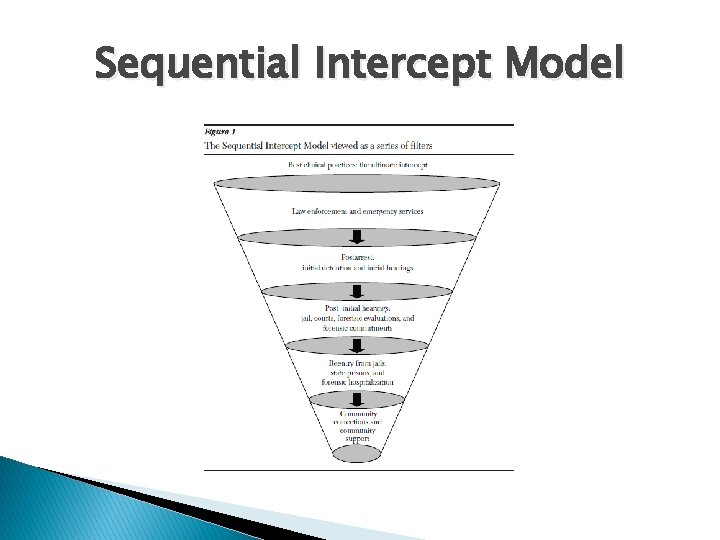
Sequential Intercept Model
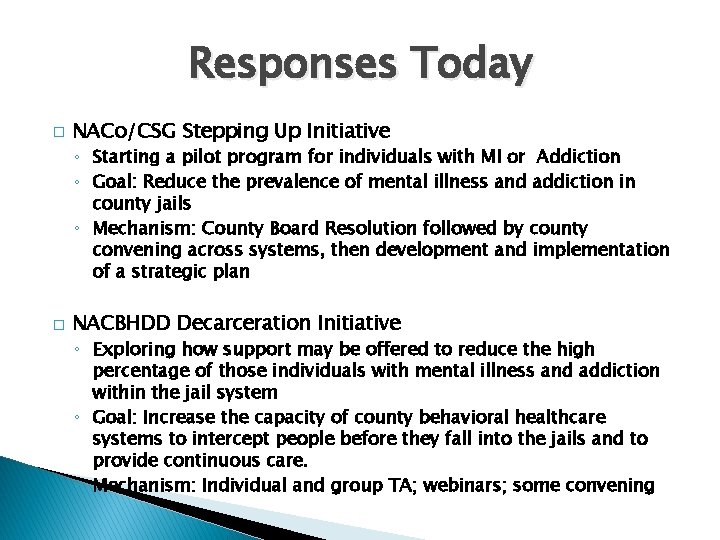
Responses Today � NACo/CSG Stepping Up Initiative ◦ Starting a pilot program for individuals with MI or Addiction ◦ Goal: Reduce the prevalence of mental illness and addiction in county jails ◦ Mechanism: County Board Resolution followed by county convening across systems, then development and implementation of a strategic plan � NACBHDD Decarceration Initiative ◦ Exploring how support may be offered to reduce the high percentage of those individuals with mental illness and addiction within the jail system ◦ Goal: Increase the capacity of county behavioral healthcare systems to intercept people before they fall into the jails and to provide continuous care. ◦ Mechanism: Individual and group TA; webinars; some convening
Grand Challenges � Cluster 1: Improve Community Population Health Across the Life Cycle � Cluster 2: Improve Community Population Well-being � Cluster 3: Improve Community Population Equity
Thus, � The Grand Challenges address: ◦ Good Health ◦ Good Well-being ◦ Good Equity � This foundational narrative is the core agenda of social work management going forward.
How? � The Grand Challenges provide a leadership vision for social work in the future. � The Grand Challenges provide new career trajectories for social work in the future. � The Grand Challenges represent exceptional contributions that social work can make to American society.
So, Which Will It Be?
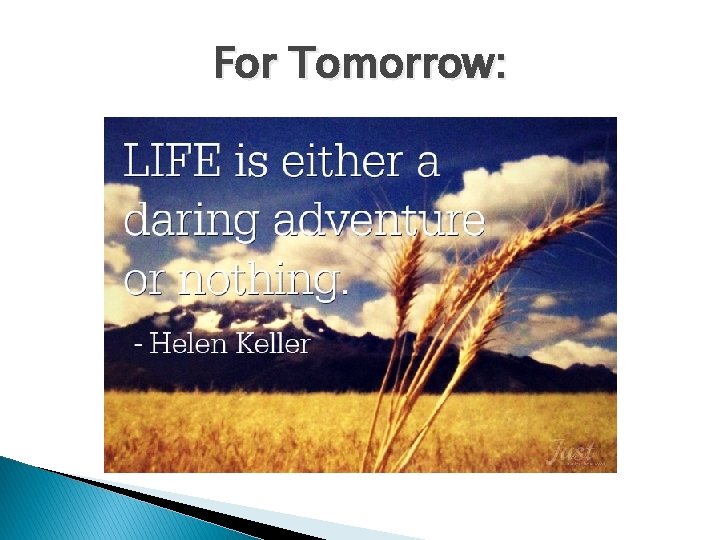
For Tomorrow:
Contact � Ron Manderscheid, Ph. D � Executive Director � NACBHDD – The National Assn of County Behavioral Health and Developmental Disability Directors � NARMH – The National Assn for Rural Mental Health � 25 Massachusetts Avenue, NW, Ste 500 � Washington, DC 20001 -1450 � (V) 202 942 4296 (M) 202 553 1827 � The Only Voice of County and Local Authorities in the Nation’s Capital