
The Grammar of SchoolAge Writing What do we
- Slides: 25
The Grammar of School-Age Writing: What do we Already (Think we Maybe (Don't)) Know? Mark Brenchley
The Grammatical Basis of Writing Development § “Exeter” approach L 1 grammar approached not as an abstract system, but as something deployed in actual pieces of writing § How is grammar actually deployed? § How is it deployed developmentally?
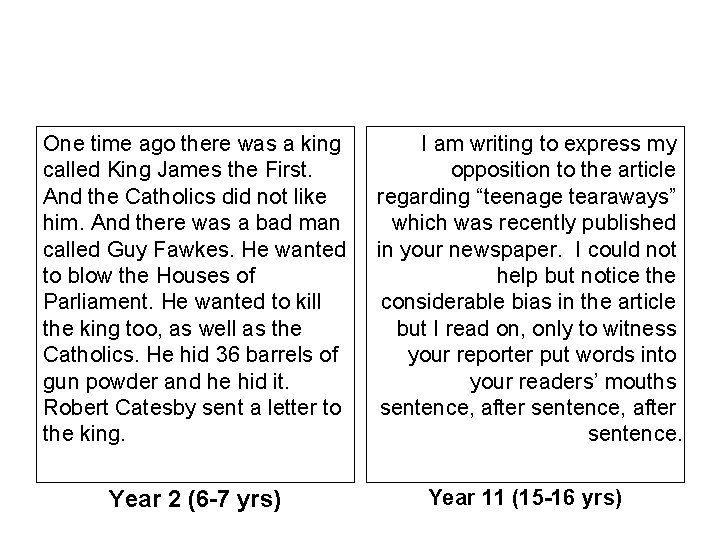
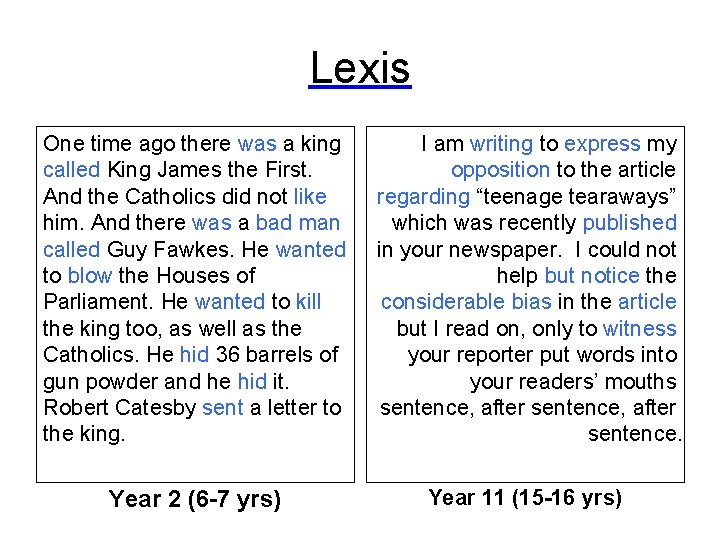
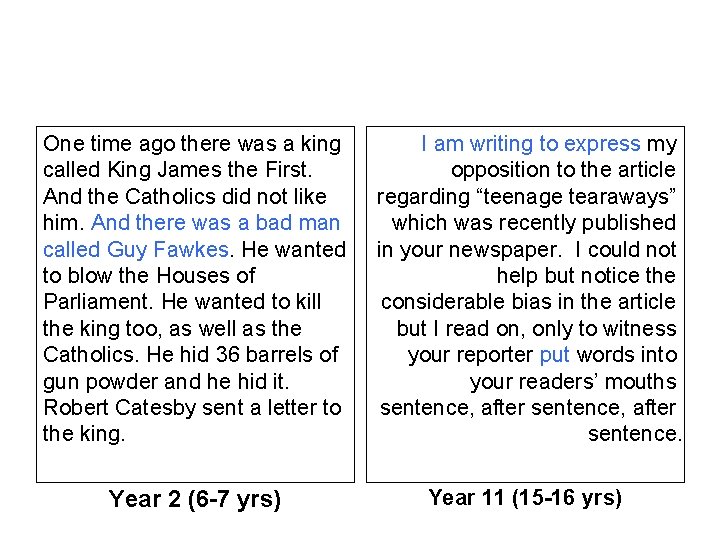
One time ago there was a king called King James the First. And the Catholics did not like him. And there was a bad man called Guy Fawkes. He wanted to blow the Houses of Parliament. He wanted to kill the king too, as well as the Catholics. He hid 36 barrels of gun powder and he hid it. Robert Catesby sent a letter to the king. I am writing to express my opposition to the article regarding “teenage tearaways” which was recently published in your newspaper. I could not help but notice the considerable bias in the article but I read on, only to witness your reporter put words into your readers’ mouths sentence, after sentence. Year 2 (6 -7 yrs) Year 11 (15 -16 yrs)
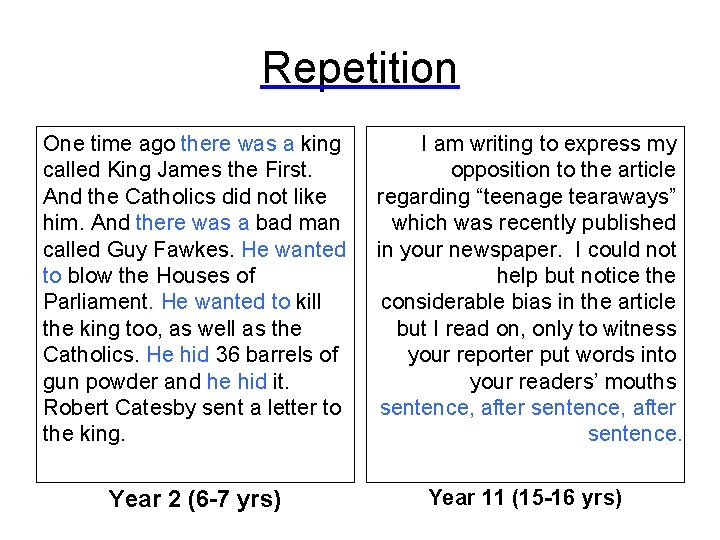
Repetition One time ago there was a king called King James the First. And the Catholics did not like him. And there was a bad man called Guy Fawkes. He wanted to blow the Houses of Parliament. He wanted to kill the king too, as well as the Catholics. He hid 36 barrels of gun powder and he hid it. Robert Catesby sent a letter to the king. I am writing to express my opposition to the article regarding “teenage tearaways” which was recently published in your newspaper. I could not help but notice the considerable bias in the article but I read on, only to witness your reporter put words into your readers’ mouths sentence, after sentence. Year 2 (6 -7 yrs) Year 11 (15 -16 yrs)
Lexis One time ago there was a king called King James the First. And the Catholics did not like him. And there was a bad man called Guy Fawkes. He wanted to blow the Houses of Parliament. He wanted to kill the king too, as well as the Catholics. He hid 36 barrels of gun powder and he hid it. Robert Catesby sent a letter to the king. I am writing to express my opposition to the article regarding “teenage tearaways” which was recently published in your newspaper. I could not help but notice the considerable bias in the article but I read on, only to witness your reporter put words into your readers’ mouths sentence, after sentence. Year 2 (6 -7 yrs) Year 11 (15 -16 yrs)
One time ago there was a king called King James the First. And the Catholics did not like him. And there was a bad man called Guy Fawkes. He wanted to blow the Houses of Parliament. He wanted to kill the king too, as well as the Catholics. He hid 36 barrels of gun powder and he hid it. Robert Catesby sent a letter to the king. I am writing to express my opposition to the article regarding “teenage tearaways” which was recently published in your newspaper. I could not help but notice the considerable bias in the article but I read on, only to witness your reporter put words into your readers’ mouths sentence, after sentence. Year 2 (6 -7 yrs) Year 11 (15 -16 yrs)
Mapping the Terrain § Systematic literature review § 8, 058 initial texts § 468 final texts § 658 “supplementary” texts § Not quite complete but general picture clear § (Not simply that doing a review is a total pain)
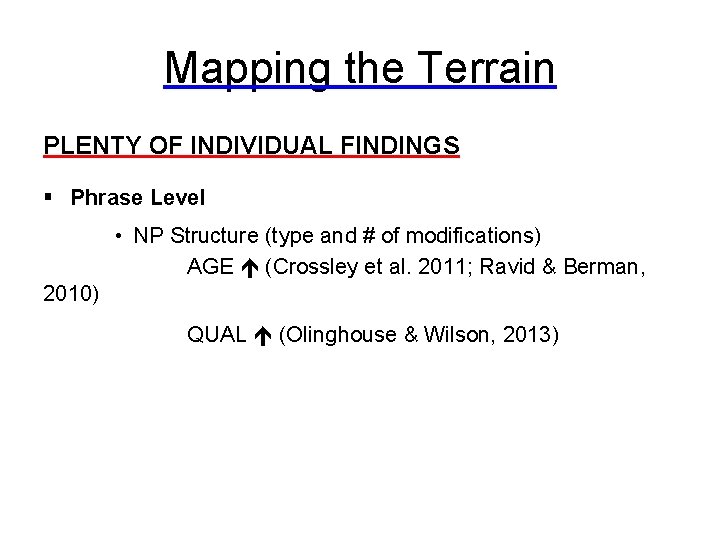
Mapping the Terrain PLENTY OF INDIVIDUAL FINDINGS § Phrase Level • NP Structure (type and # of modifications) AGE (Crossley et al. 2011; Ravid & Berman, 2010) QUAL (Olinghouse & Wilson, 2013)
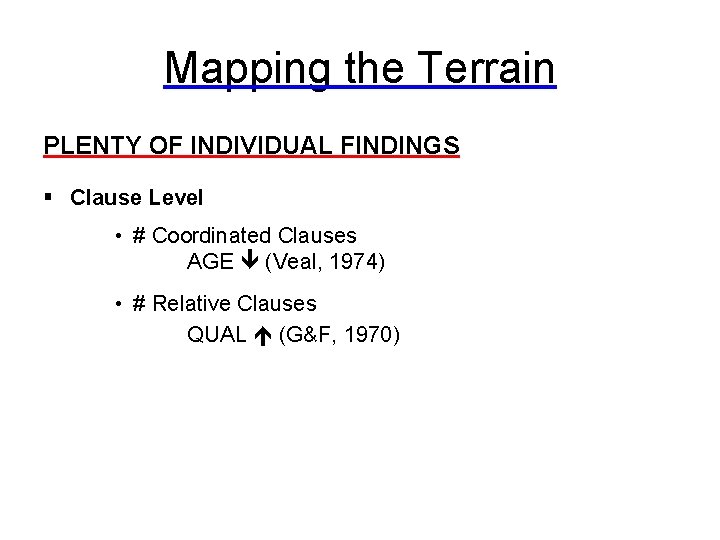
Mapping the Terrain PLENTY OF INDIVIDUAL FINDINGS § Clause Level • # Coordinated Clauses AGE (Veal, 1974) • # Relative Clauses QUAL (G&F, 1970)
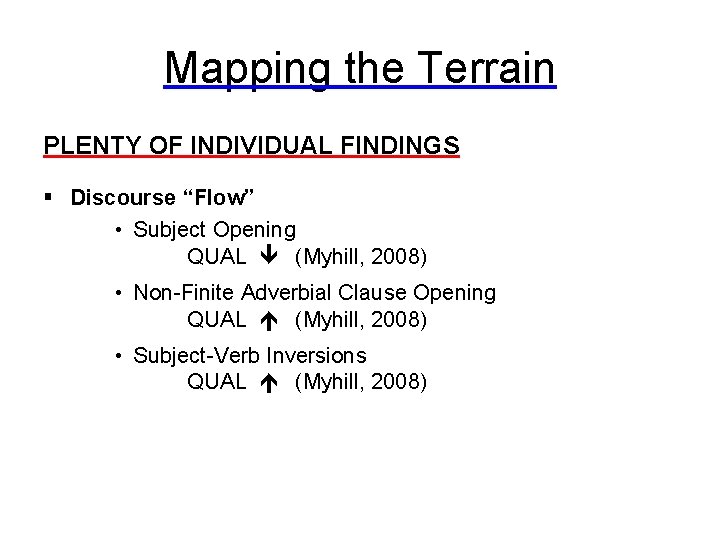
Mapping the Terrain PLENTY OF INDIVIDUAL FINDINGS § Discourse “Flow” • Subject Opening QUAL (Myhill, 2008) • Non-Finite Adverbial Clause Opening QUAL (Myhill, 2008) • Subject-Verb Inversions QUAL (Myhill, 2008)
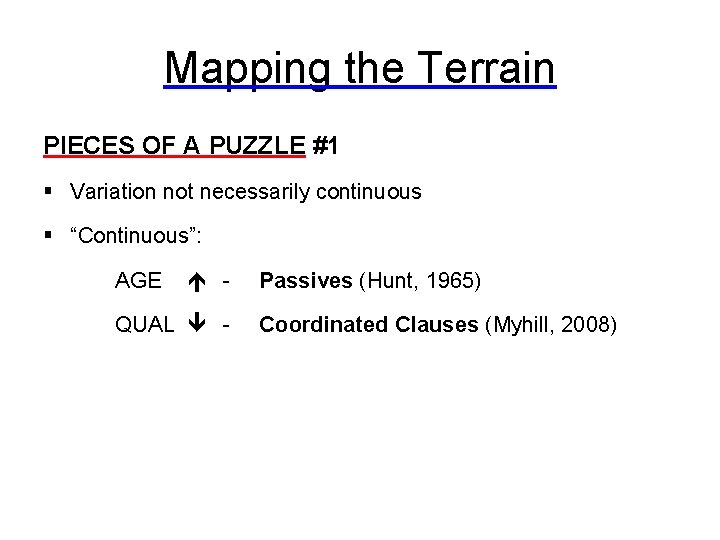
Mapping the Terrain PIECES OF A PUZZLE #1 § Variation not necessarily continuous § “Continuous”: AGE - QUAL - Passives (Hunt, 1965) Coordinated Clauses (Myhill, 2008)
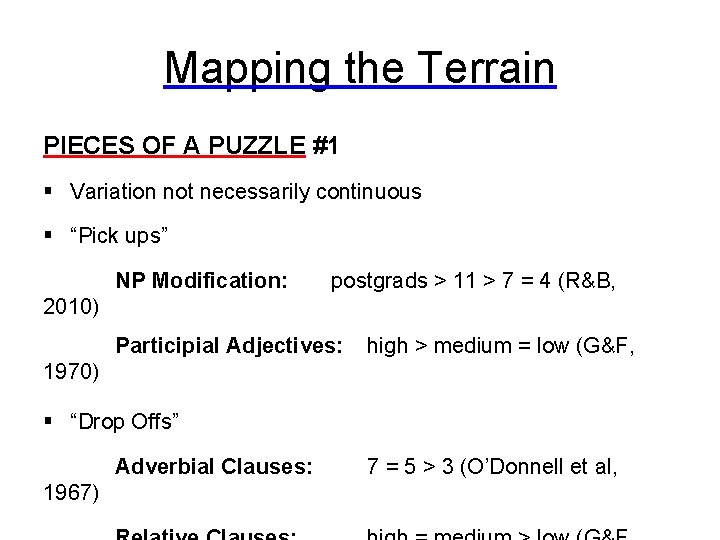
Mapping the Terrain PIECES OF A PUZZLE #1 § Variation not necessarily continuous § “Pick ups” NP Modification: postgrads > 11 > 7 = 4 (R&B, 2010) Participial Adjectives: high > medium = low (G&F, 1970) § “Drop Offs” Adverbial Clauses: 1967) 7 = 5 > 3 (O’Donnell et al,
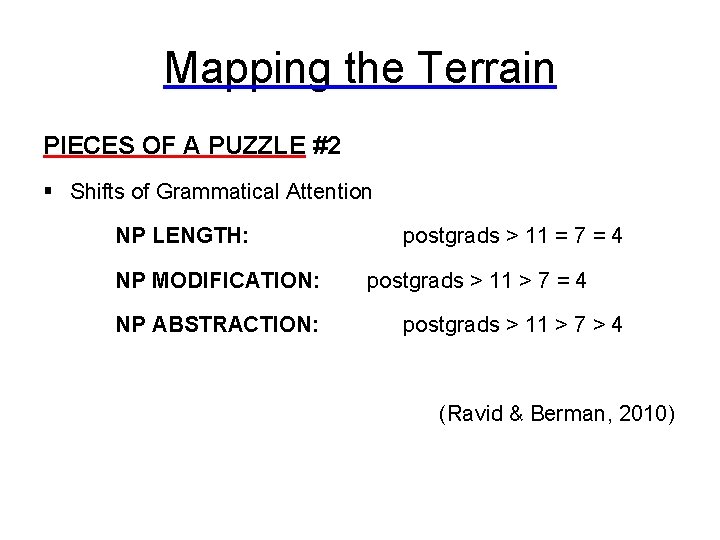
Mapping the Terrain PIECES OF A PUZZLE #2 § Shifts of Grammatical Attention NP LENGTH: NP MODIFICATION: NP ABSTRACTION: postgrads > 11 = 7 = 4 postgrads > 11 > 7 > 4 (Ravid & Berman, 2010)
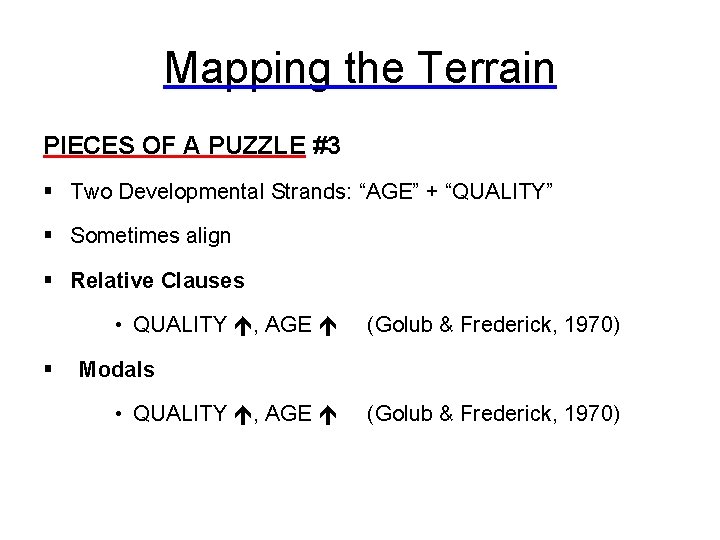
Mapping the Terrain PIECES OF A PUZZLE #3 § Two Developmental Strands: “AGE” + “QUALITY” § Sometimes align § Relative Clauses • QUALITY , AGE § (Golub & Frederick, 1970) Modals • QUALITY , AGE (Golub & Frederick, 1970)
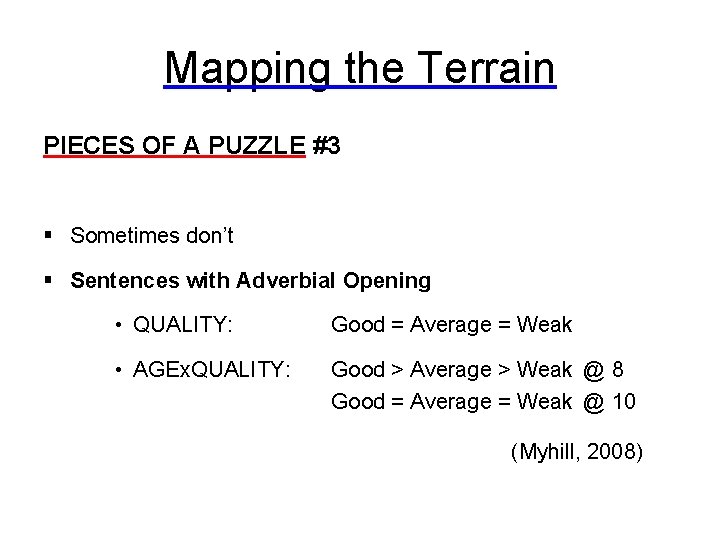
Mapping the Terrain PIECES OF A PUZZLE #3 § Sometimes don’t § Sentences with Adverbial Opening • QUALITY: Good = Average = Weak • AGEx. QUALITY: Good > Average > Weak @ 8 Good = Average = Weak @ 10 (Myhill, 2008)
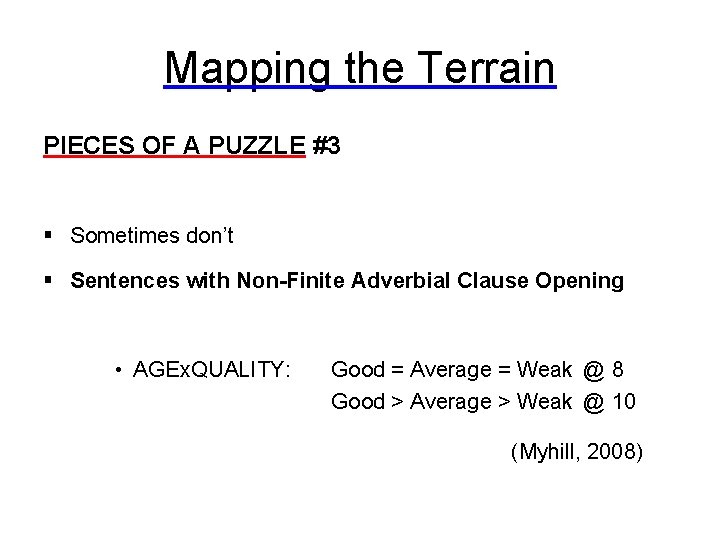
Mapping the Terrain PIECES OF A PUZZLE #3 § Sometimes don’t § Sentences with Non-Finite Adverbial Clause Opening • AGEx. QUALITY: Good = Average = Weak @ 8 Good > Average > Weak @ 10 (Myhill, 2008)
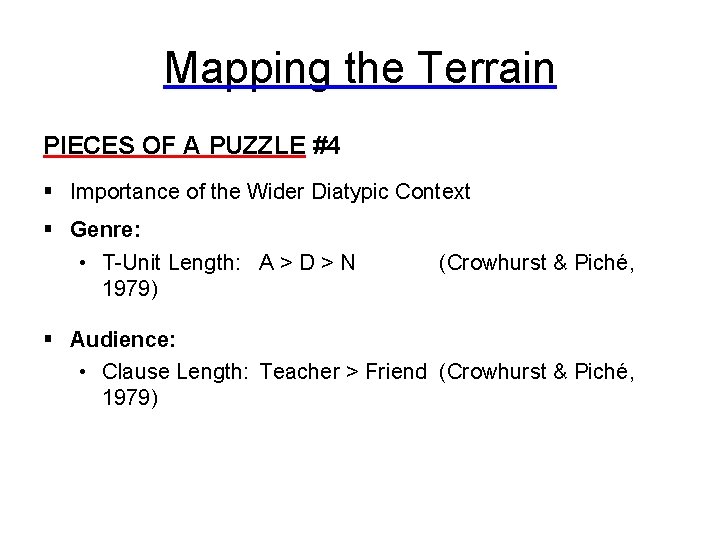
Mapping the Terrain PIECES OF A PUZZLE #4 § Importance of the Wider Diatypic Context § Genre: • T-Unit Length: A > D > N 1979) (Crowhurst & Piché, § Audience: • Clause Length: Teacher > Friend (Crowhurst & Piché, 1979)
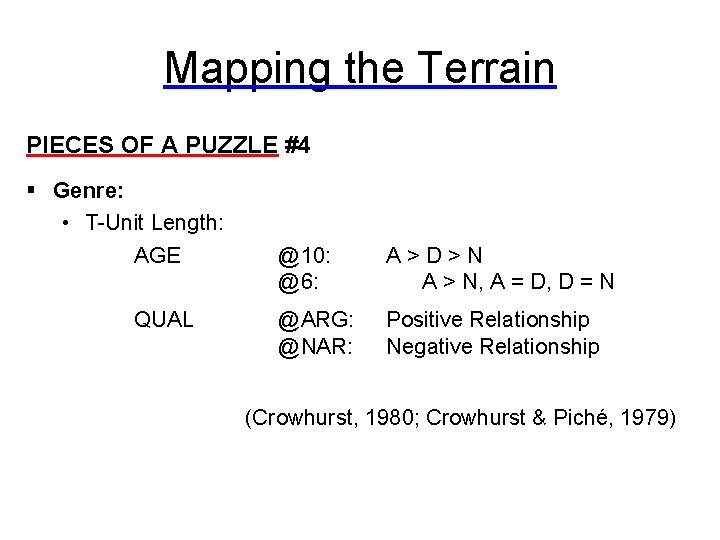
Mapping the Terrain PIECES OF A PUZZLE #4 § Genre: • T-Unit Length: AGE QUAL @10: @6: A>D>N A > N, A = D, D = N @ARG: @NAR: Positive Relationship Negative Relationship (Crowhurst, 1980; Crowhurst & Piché, 1979)
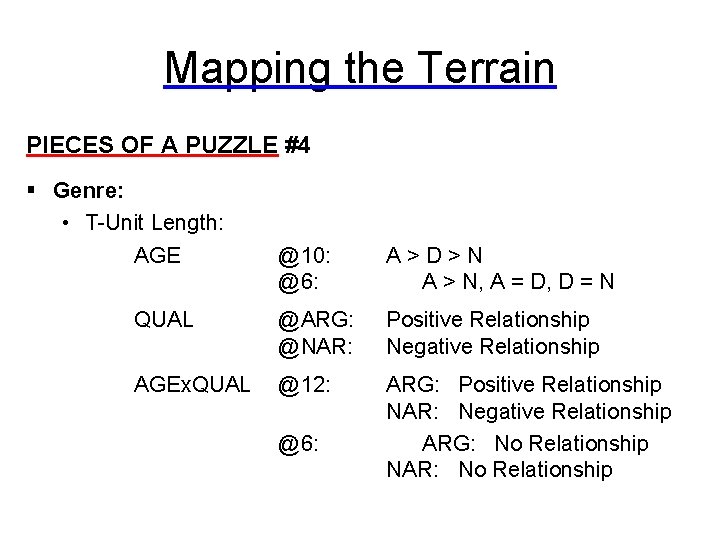
Mapping the Terrain PIECES OF A PUZZLE #4 § Genre: • T-Unit Length: AGE @10: @6: A>D>N A > N, A = D, D = N QUAL @ARG: @NAR: Positive Relationship Negative Relationship AGEx. QUAL @12: ARG: Positive Relationship NAR: Negative Relationship ARG: No Relationship NAR: No Relationship @6:
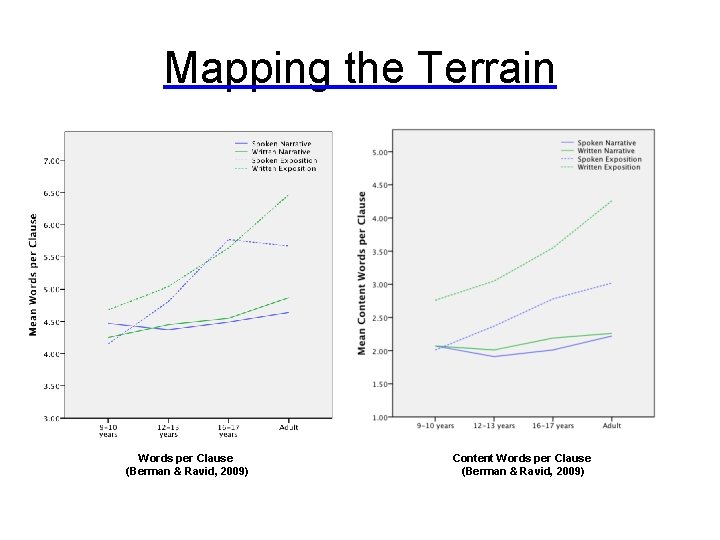
Mapping the Terrain Words per Clause (Berman & Ravid, 2009) Content Words per Clause (Berman & Ravid, 2009)
Mapping the Terrain PIECES OF A PUZZLE #5 § Systematicity? § Not just about individual bits of grammar, but how they are interrelated
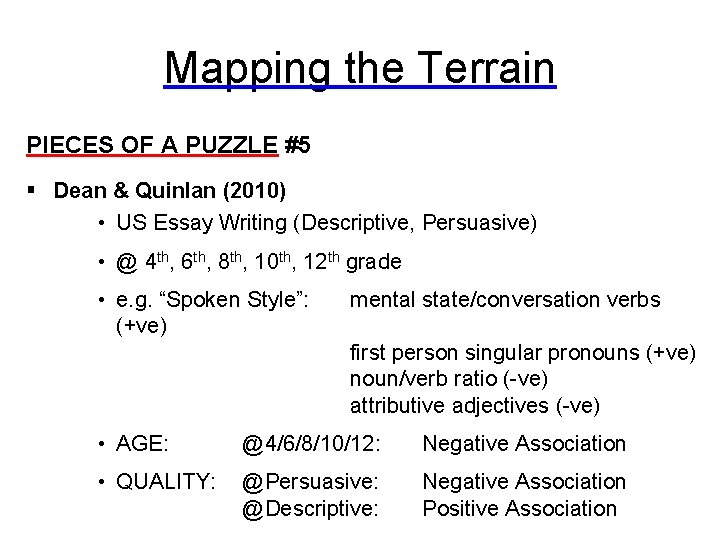
Mapping the Terrain PIECES OF A PUZZLE #5 § Dean & Quinlan (2010) • US Essay Writing (Descriptive, Persuasive) • @ 4 th, 6 th, 8 th, 10 th, 12 th grade • e. g. “Spoken Style”: (+ve) mental state/conversation verbs first person singular pronouns (+ve) noun/verb ratio (-ve) attributive adjectives (-ve) • AGE: @4/6/8/10/12: Negative Association • QUALITY: @Persuasive: @Descriptive: Negative Association Positive Association
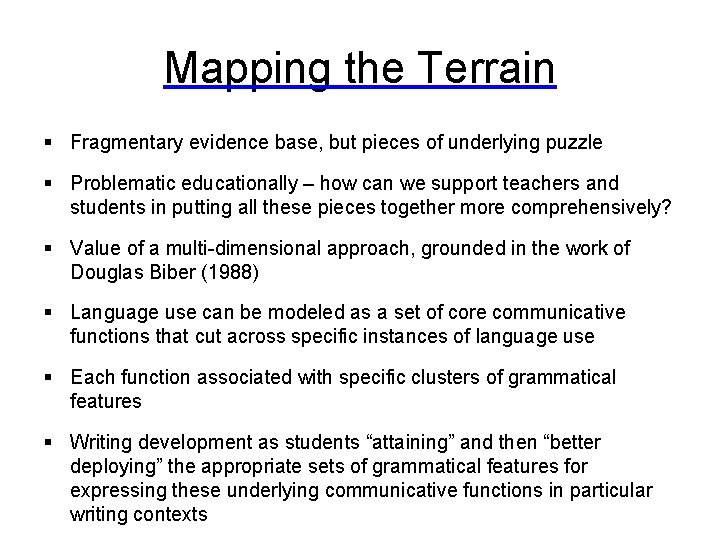
Mapping the Terrain § Fragmentary evidence base, but pieces of underlying puzzle § Problematic educationally – how can we support teachers and students in putting all these pieces together more comprehensively? § Value of a multi-dimensional approach, grounded in the work of Douglas Biber (1988) § Language use can be modeled as a set of core communicative functions that cut across specific instances of language use § Each function associated with specific clusters of grammatical features § Writing development as students “attaining” and then “better deploying” the appropriate sets of grammatical features for expressing these underlying communicative functions in particular writing contexts
References § Berman, R. A. & Ravid, D. (2009). Becoming a Literate Language User: Oral and Written Text Construction across Adolescence. In D. R. Olson & N. Torrance (eds. ) Cambridge Handbook of Literacy (92 -111). Cambridge: Cambridge University Press. § Biber, D. (1988). Variation across speech and writing. Cambridge: Cambridge University Press. § Crossley, S. A. et al. (2011). The development of writing proficiency as a function of grade level: A linguistic analysis. Written Communication 28(3), 282 -311. § Crowhurst, M. (1980). Syntactic complexity and teachers’ quality ratings of narrations and arguments. Research in the Teaching of English 14(3), 223 -213. § Crowhurst, M. & Piché, G. L. (1979). Audience and mode of discourse effects on syntactic complexity in writing at two grade levels. Research in the Teaching of English 13(2), 101 -109. § Dean, P. & Quinlan, T. (2010). What automated analyses of corpora can tell us about students’ writing skills. Journal of Writing Research 2(2), 151 -177. § Golub, L. S. & Frederick, W. C. (1970). An analysis of children's writing under different stimulus conditions. Research in the Teaching of English 4(2), 168 -180.
References § Loban, W. (1976). Language development: Kindergarten through grade twelve. Urbana, IL: NCTE. § Myhill, D. A. (2008). Towards a linguistic model of sentence development in writing. Language and education 22(5), 271 -288. § O’Donnell, R. C. et al. (1967). A transformational analysis of oral and written grammatical structures in the language of children in grades three, five, and seven. The Journal of Educational Research 61(1), 35 -39. § Olinghouse, N. G. & Wilson, W. (2013). The relationship between vocabulary and writing quality in three genres. Reading & Writing 26(1), 45 -65. § Ravid, D. & Berman, R. A. (2010). Developing noun phrase complexity at school: A text- embedded cross-linguistic analysis. First Language 30(1), 3 -26. § Veal, L. R. (1974). Syntactic measures and rated quality in the writing of young children. Studies in Language Education, Report 8. Athens, GA: University of Georgia. § Harpin, W. (1976). The Second 'R': Writing Development in the Junior School. London: Allen & Unwin. § Hunt, K. W. (1965). Grammatical Structures Written at Three Grade Levels. Champaign, IL: NCTE.