
The Grammar of Film RULES OF COMPOSITION Film
- Slides: 22
The Grammar of Film RULES OF COMPOSITION
Film Language: Outline • Basic Concepts: – Three Types of Scenes • Dialogues w/o Action • Actions w/o Dialogue • Dialogues w/ Action – Basic Grammar • The Shot • Movement • Distances – Editing Solutions • • • Types of Editing Visual Punctuation Scene Matching Opposed Glances Center of Interest • Basic Grammar Tools – Close Up – Close Shot – Medium Shot – Full Shot – Long Shot – Cutting Heights – Master Shot – Take – Straight Cut – Optical Cut – Position-Movement-Look – Centering of Interest – Arbiter of Attention – Dominant Group
Film Language: Visual Communication • When film makers realized that a “moving picture” could be more than simple images strung together, they began to invent a new language of visual images. • Film makers began relating certain images with others, creating associations; this new language began to have a grammar or set of rules by which that language could develop. • Like any language, film has its limitations, both inherent in the technology and in the minds of the viewers: just as the average reader does not like a flashy or obscure book, so too does the average viewer not like a flashy or obscure film.
Film Language: Basic Concepts • Film Makers, through experimentation and trial and error, developed some basic concepts that could be used to put their vision onto film. • There are basically three types of scenes: • Dialogues without Action • Actions without Dialogue • Dialogues with Action • Film grammar (rules) must achieve two ends: • Footage shot must be able to be edited into a sequence • Solutions must be at the ready to solve editing problems • Editing Solutions need to control two things: • Distances between the camera(s) and the subject(s) • Motions of the subject(s) and the camera(s).
Film Language: Basic Concepts • Dialogues without Action • Actions without Dialogue • Dialogues with Action
Film Language: Basic Grammatical Tools • As with the basic concepts, Film Makers also developed through experimentation and trial and error some basic grammatical tools that could be used to put their vision onto film. • THE SHOT • Before digital film, the shot was limited to the length of actual celluloid film that could be exposed in the camera without reloading. • The possibilities were four, ten, and thirty-three minutes - today, the available time depends on how much tape, card, or hard-drive space one has. • A shot can be used in full (uninterrupted) or it can be cut up and edited into other shots. • Precise notes on camera positioning and lighting are crucial for reshooting so that the editor can cross-cut images or so that the special effects crew can overlay (matte) a live shot with the needed special effects.
Film Language: Basic Grammatical Tools • MOVEMENT: – There are four possible camera movements that the director can make use of in bringing one’s vision to the screen: • FIXED - the camera can remain unmoving, fixed into position relative to what it will record. • PAN - the camera can sweep horizontally on its axis, capturing images from left to right or right to left. • TILT - the camera can pivot vertically on its axis, capturing images from down to up or up to down. • IN MOTION - the camera can move at various speeds in one of three basic ways: – – – it can be carried by the cameraman either freely or with a steady-cam device to minimize the jumble it can be moved along tracks on a dolly for smooth tracking with action scenes like military charges it can be moved on a vehicle for high speed capture like car chases
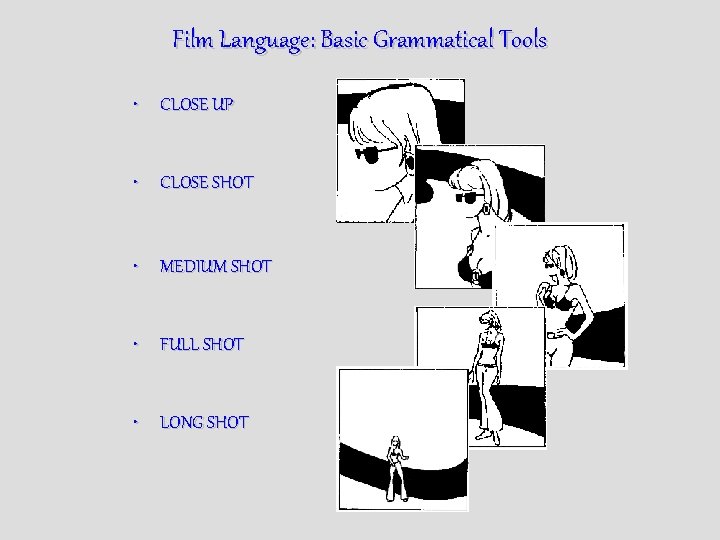
Film Language: Basic Grammatical Tools • DISTANCES: – Although there are hypothetically an infinite number of distances between the camera and its subject, actual practice reveals that there are in fact only five that are significant: CLOSE UP CLOSE SHOT MEDIUM SHOT FULL SHOT LONG SHOT There are no fixed distances for any of these shots, rather they are intended to be general concepts that can be determined in different ways for different subjects - a close shot on a bird will be different than a close shot on a bridge in terms of distance, but the concept is the same.
Film Language: Basic Grammatical Tools • CLOSE UP • CLOSE SHOT • MEDIUM SHOT • FULL SHOT • LONG SHOT
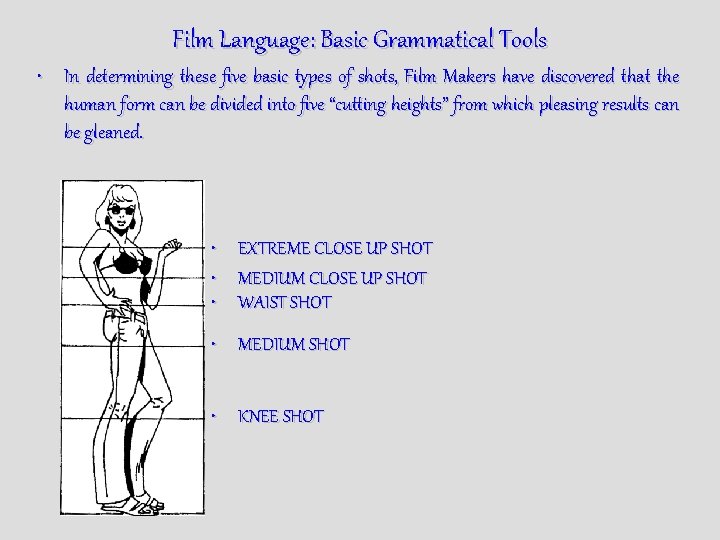
Film Language: Basic Grammatical Tools • In determining these five basic types of shots, Film Makers have discovered that the human form can be divided into five “cutting heights” from which pleasing results can be gleaned. • • • EXTREME CLOSE UP SHOT MEDIUM CLOSE UP SHOT WAIST SHOT • MEDIUM SHOT • KNEE SHOT
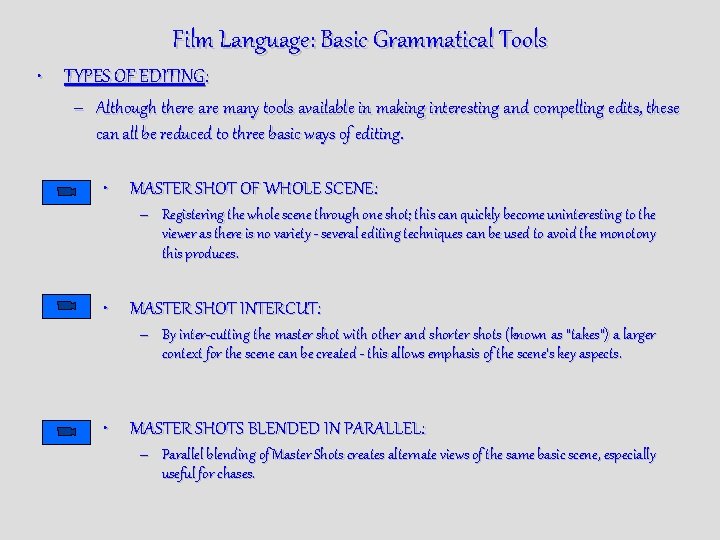
Film Language: Basic Grammatical Tools • TYPES OF EDITING: – Although there are many tools available in making interesting and compelling edits, these can all be reduced to three basic ways of editing. • MASTER SHOT OF WHOLE SCENE: – Registering the whole scene through one shot; this can quickly become uninteresting to the viewer as there is no variety - several editing techniques can be used to avoid the monotony this produces. • MASTER SHOT INTERCUT: – By inter-cutting the master shot with other and shorter shots (known as “takes”) a larger context for the scene can be created - this allows emphasis of the scene’s key aspects. • MASTER SHOTS BLENDED IN PARALLEL: – Parallel blending of Master Shots creates alternate views of the same basic scene, especially useful for chases.
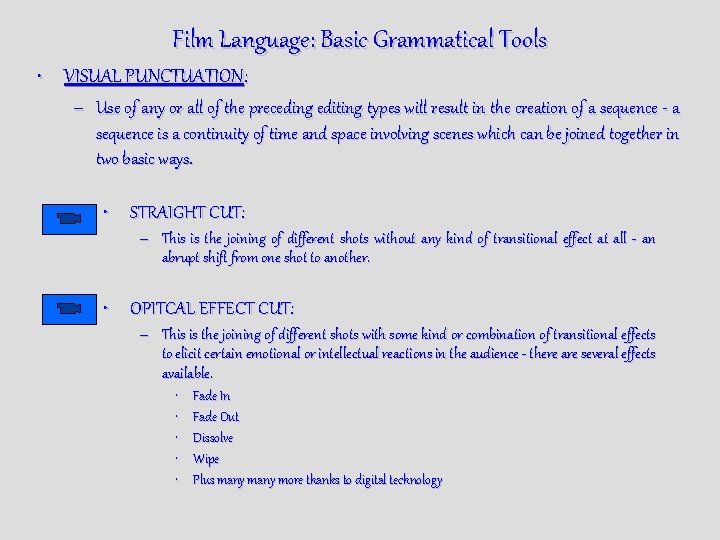
Film Language: Basic Grammatical Tools • VISUAL PUNCTUATION: – Use of any or all of the preceding editing types will result in the creation of a sequence - a sequence is a continuity of time and space involving scenes which can be joined together in two basic ways. • STRAIGHT CUT: – This is the joining of different shots without any kind of transitional effect at all - an abrupt shift from one shot to another. • OPITCAL EFFECT CUT: – This is the joining of different shots with some kind or combination of transitional effects to elicit certain emotional or intellectual reactions in the audience - there are several effects available. • • • Fade In Fade Out Dissolve Wipe Plus many more thanks to digital technology
Film Language: Basic Grammatical Tools • SCENE MATCHING: – Because the movie screen is a finite space, it is important to match scenes during editing to avoid awkward cuts that will distract or confuse the audience. – By maintaining a consistent perspective on the shots, one makes it easier for the audience to focus on the story rather than being forced to make sense of a jumble of images. – Thus, there are three things to consider. • • • Position Movement Look
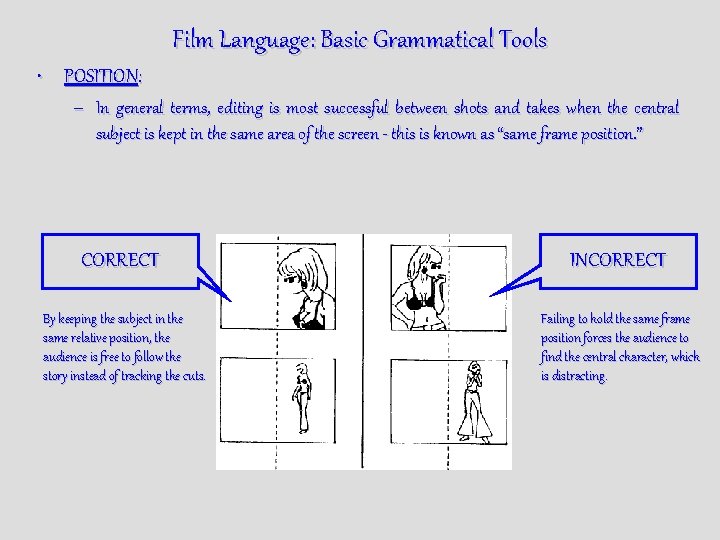
Film Language: Basic Grammatical Tools • POSITION: – In general terms, editing is most successful between shots and takes when the central subject is kept in the same area of the screen - this is known as “same frame position. ” CORRECT INCORRECT By keeping the subject in the same relative position, the audience is free to follow the story instead of tracking the cuts. Failing to hold the same frame position forces the audience to find the central character, which is distracting.
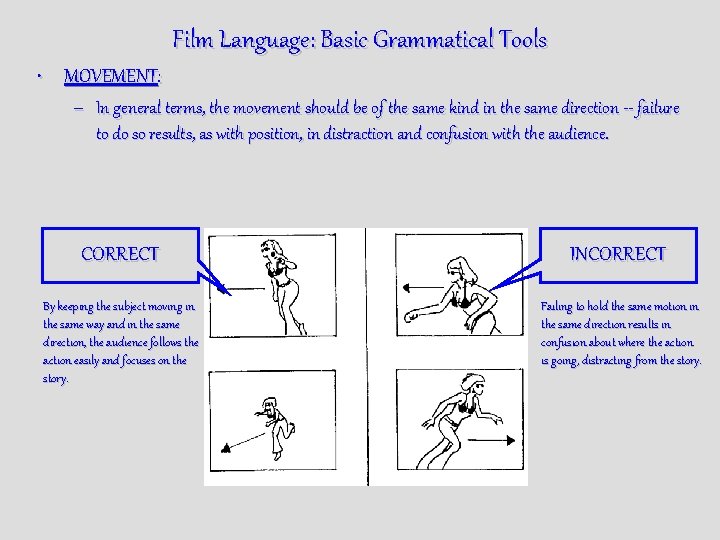
Film Language: Basic Grammatical Tools • MOVEMENT: – In general terms, the movement should be of the same kind in the same direction -- failure to do so results, as with position, in distraction and confusion with the audience. CORRECT INCORRECT By keeping the subject moving in the same way and in the same direction, the audience follows the action easily and focuses on the story. Failing to hold the same motion in the same direction results in confusion about where the action is going, distracting from the story.
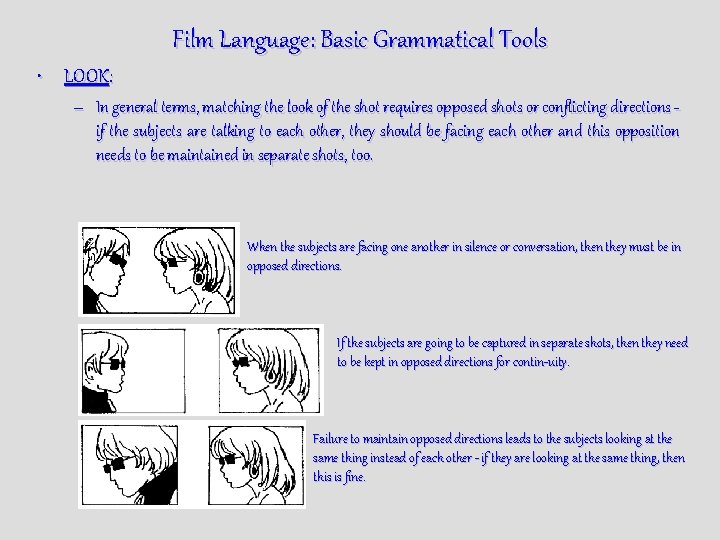
Film Language: Basic Grammatical Tools • LOOK: – In general terms, matching the look of the shot requires opposed shots or conflicting directions if the subjects are talking to each other, they should be facing each other and this opposition needs to be maintained in separate shots, too. When the subjects are facing one another in silence or conversation, then they must be in opposed directions. If the subjects are going to be captured in separate shots, then they need to be kept in opposed directions for contin-uity. Failure to maintain opposed directions leads to the subjects looking at the same thing instead of each other - if they are looking at the same thing, then this is fine.
Film Language: Basic Grammatical Tools • CENTER OF INTEREST: – As we have previously discussed, it is essential for the audience to not feel distracted or confused by the sequencing of shots and inter-cutting of takes. – In each situation, there is a center of interest in the frame which draws the attention of the audience toward it - poor positioning, movement, and look when combined with poor sequencing choices can lead to an unfavorable reaction from one’s audience. – Thus, when shooting dialogue, it is essential to adhere to the basic principle of maintaining the center of interest whether in pairs or groups of three. • Opposing Glances are critical to matching the look in the shot so as not to confuse the audience as to what the center of interest is. • Arbiter of Attention, the subject who instigates interest through conversation and glancing, is critical to shooting a group of three.
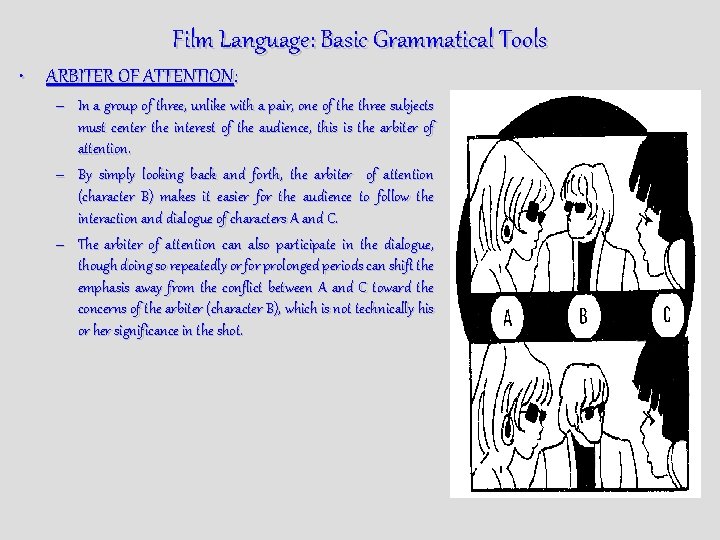
Film Language: Basic Grammatical Tools • ARBITER OF ATTENTION: – In a group of three, unlike with a pair, one of the three subjects must center the interest of the audience, this is the arbiter of attention. – By simply looking back and forth, the arbiter of attention (character B) makes it easier for the audience to follow the interaction and dialogue of characters A and C. – The arbiter of attention can also participate in the dialogue, though doing so repeatedly or for prolonged periods can shift the emphasis away from the conflict between A and C toward the concerns of the arbiter (character B), which is not technically his or her significance in the shot.
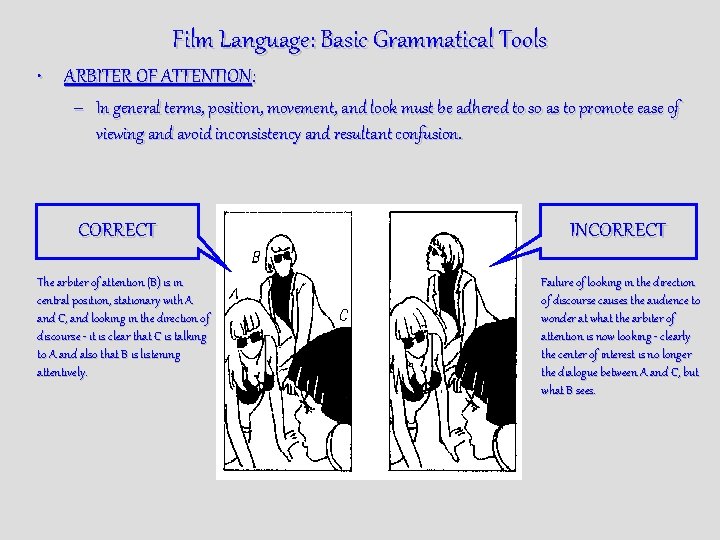
Film Language: Basic Grammatical Tools • ARBITER OF ATTENTION: – In general terms, position, movement, and look must be adhered to so as to promote ease of viewing and avoid inconsistency and resultant confusion. CORRECT The arbiter of attention (B) is in central position, stationary with A and C, and looking in the direction of discourse - it is clear that C is talking to A and also that B is listening attentively. INCORRECT Failure of looking in the direction of discourse causes the audience to wonder at what the arbiter of attention is now looking - clearly the center of interest is no longer the dialogue between A and C, but what B sees.
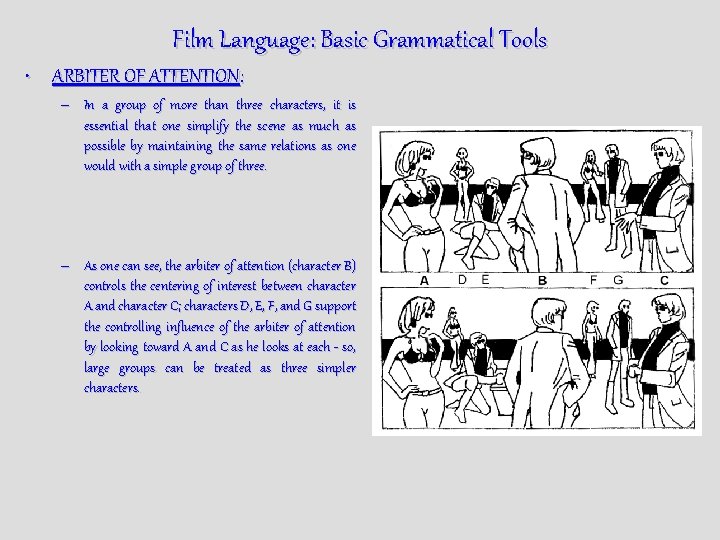
Film Language: Basic Grammatical Tools • ARBITER OF ATTENTION: – In a group of more than three characters, it is essential that one simplify the scene as much as possible by maintaining the same relations as one would with a simple group of three. – As one can see, the arbiter of attention (character B) controls the centering of interest between character A and character C; characters D, E, F, and G support the controlling influence of the arbiter of attention by looking toward A and C as he looks at each - so, large groups can be treated as three simpler characters.
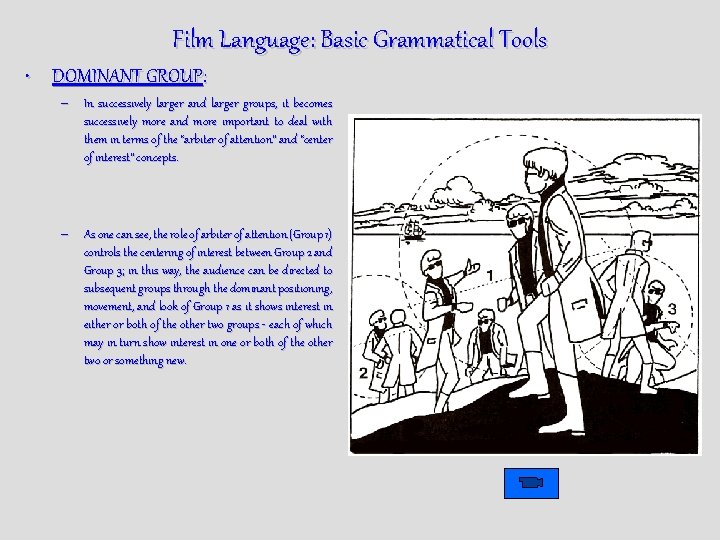
Film Language: Basic Grammatical Tools • DOMINANT GROUP: – In successively larger and larger groups, it becomes successively more and more important to deal with them in terms of the “arbiter of attention” and “center of interest” concepts. – As one can see, the role of arbiter of attention (Group 1) controls the centering of interest between Group 2 and Group 3; in this way, the audience can be directed to subsequent groups through the dominant positioning, movement, and look of Group 1 as it shows interest in either or both of the other two groups - each of which may in turn show interest in one or both of the other two or something new.
The Grammar of Film END OF FIRST LECTURE