
the gradualist point of view Evolution occurs within
- Slides: 34
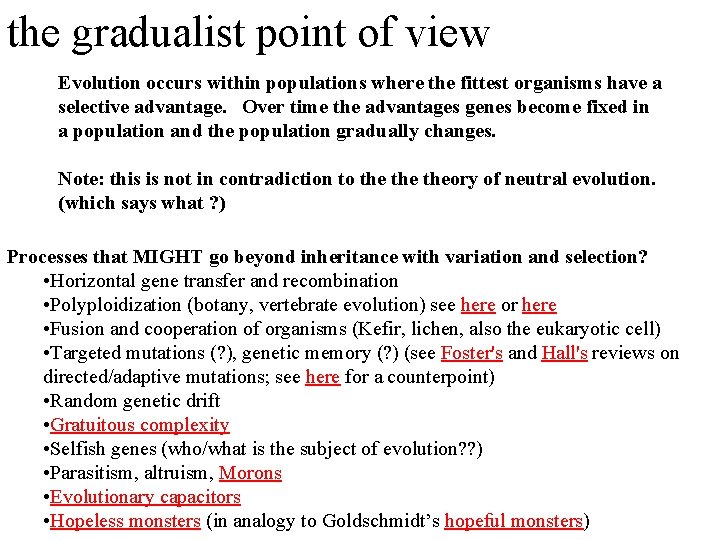
the gradualist point of view Evolution occurs within populations where the fittest organisms have a selective advantage. Over time the advantages genes become fixed in a population and the population gradually changes. Note: this is not in contradiction to the theory of neutral evolution. (which says what ? ) Processes that MIGHT go beyond inheritance with variation and selection? • Horizontal gene transfer and recombination • Polyploidization (botany, vertebrate evolution) see here or here • Fusion and cooperation of organisms (Kefir, lichen, also the eukaryotic cell) • Targeted mutations (? ), genetic memory (? ) (see Foster's and Hall's reviews on directed/adaptive mutations; see here for a counterpoint) • Random genetic drift • Gratuitous complexity • Selfish genes (who/what is the subject of evolution? ? ) • Parasitism, altruism, Morons • Evolutionary capacitors • Hopeless monsters (in analogy to Goldschmidt’s hopeful monsters)
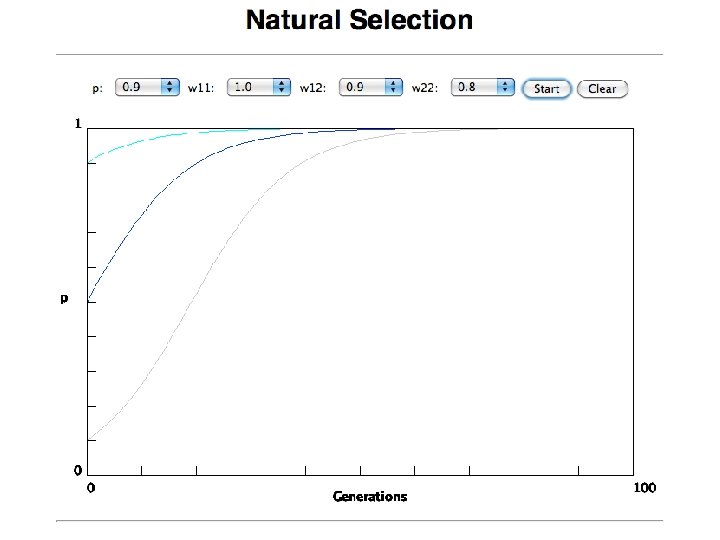
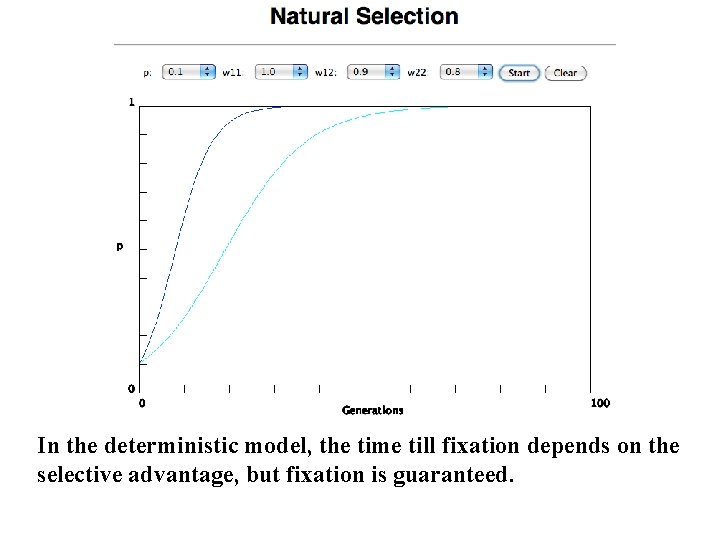
In the deterministic model, the time till fixation depends on the selective advantage, but fixation is guaranteed.
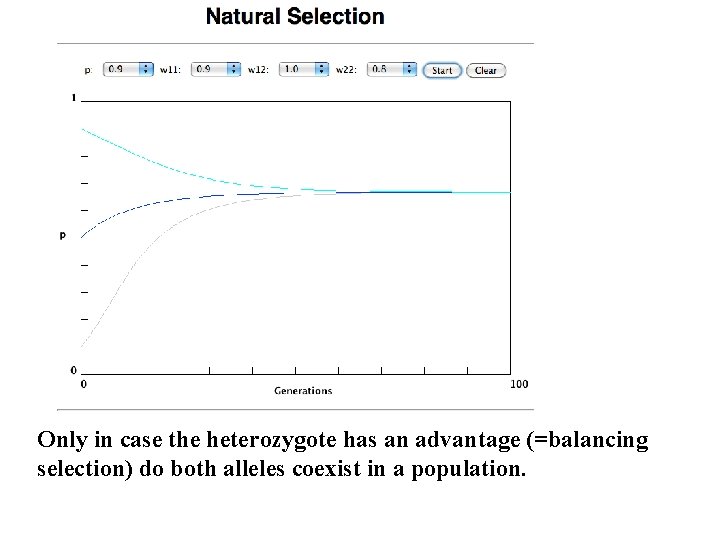
Only in case the heterozygote has an advantage (=balancing selection) do both alleles coexist in a population.
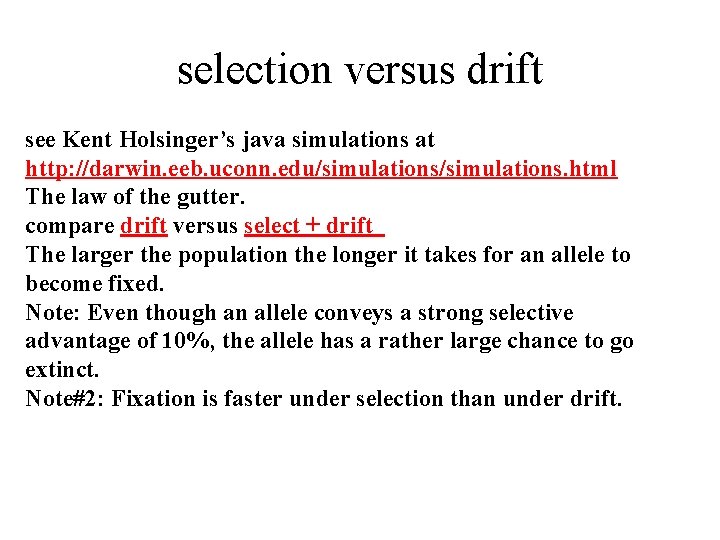
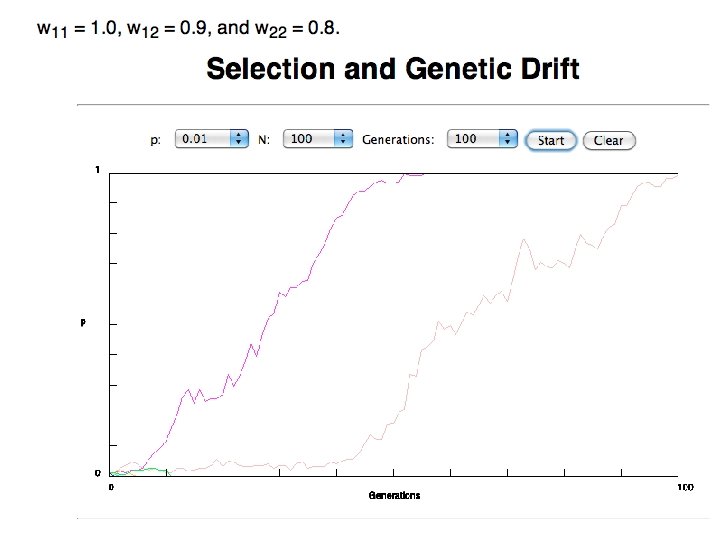
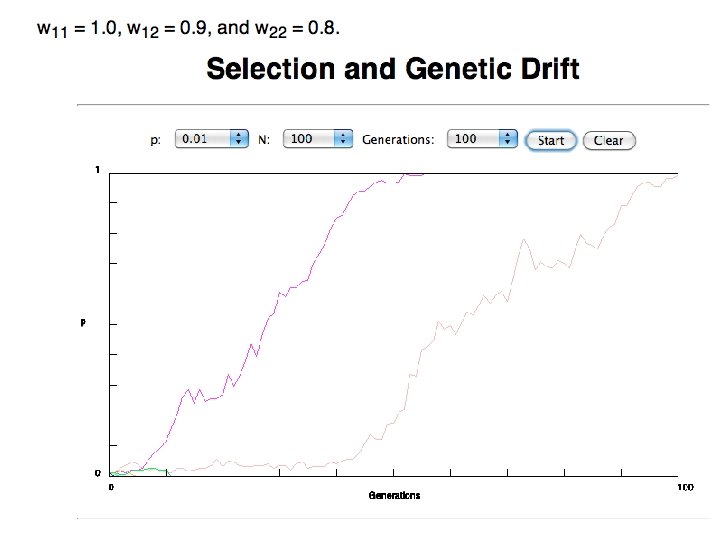
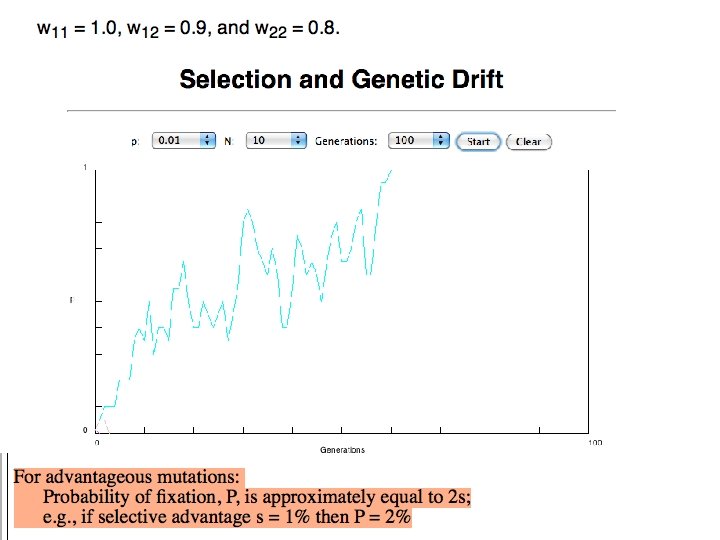
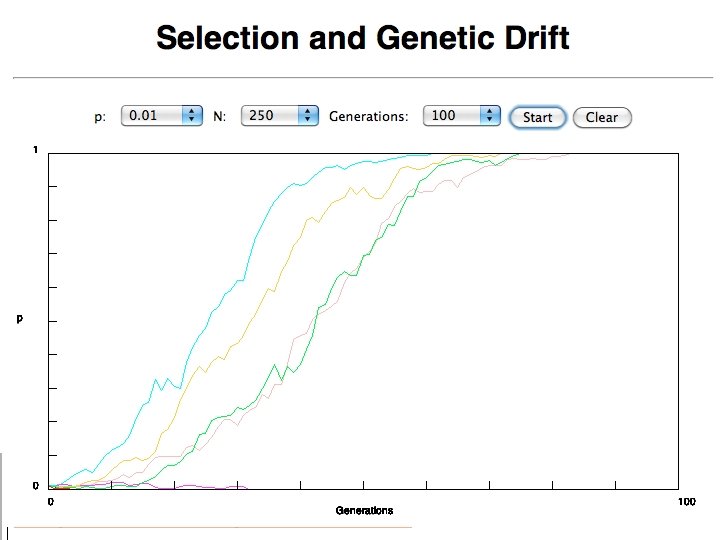
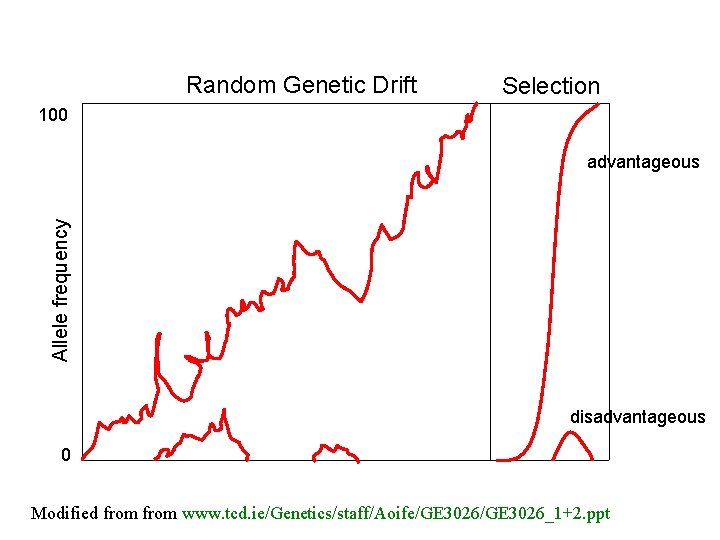
selection versus drift see Kent Holsinger’s java simulations at http: //darwin. eeb. uconn. edu/simulations. html The law of the gutter. compare drift versus select + drift The larger the population the longer it takes for an allele to become fixed. Note: Even though an allele conveys a strong selective advantage of 10%, the allele has a rather large chance to go extinct. Note#2: Fixation is faster under selection than under drift.
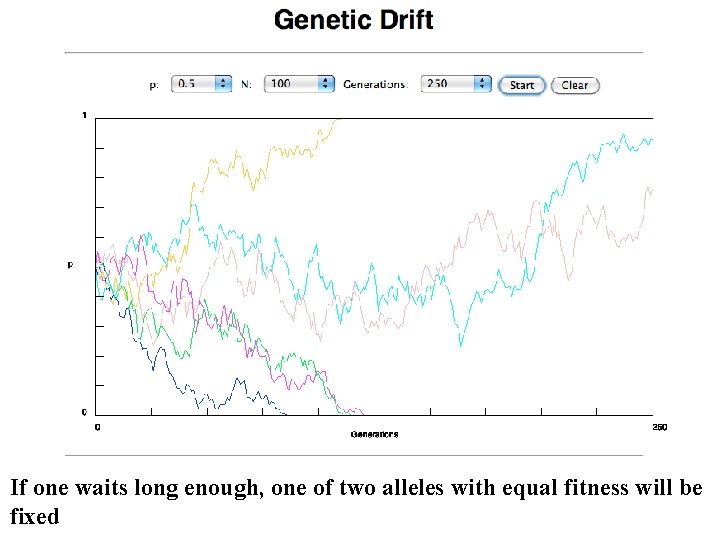
If one waits long enough, one of two alleles with equal fitness will be fixed
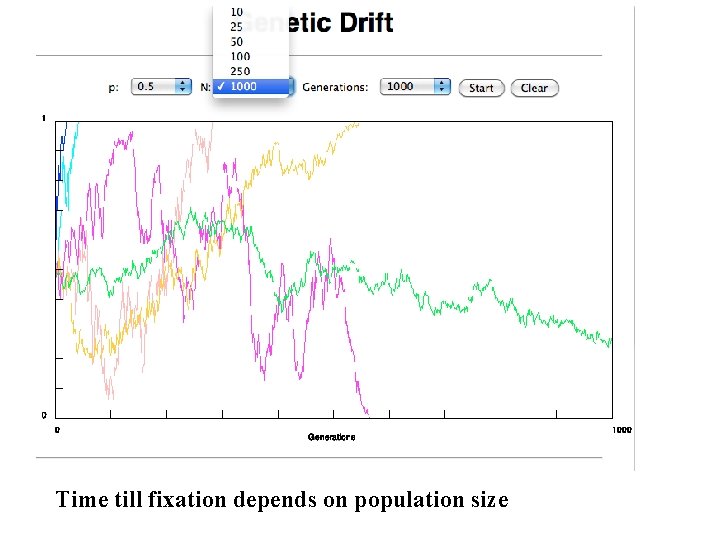
Time till fixation depends on population size
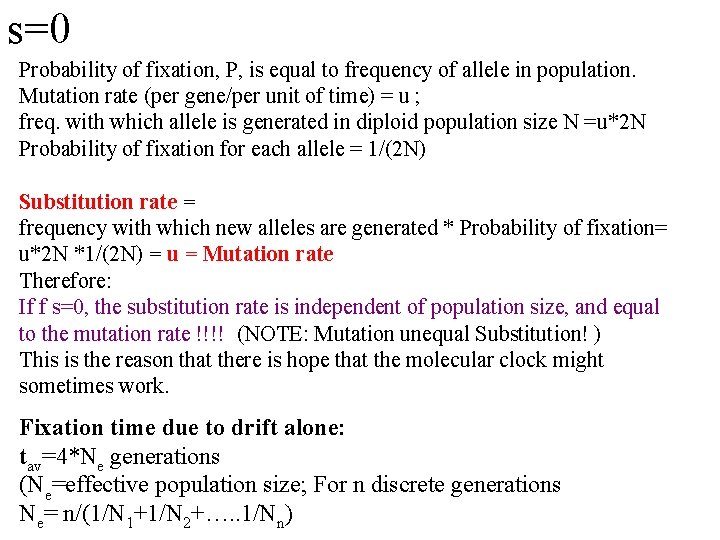
s=0 Probability of fixation, P, is equal to frequency of allele in population. Mutation rate (per gene/per unit of time) = u ; freq. with which allele is generated in diploid population size N =u*2 N Probability of fixation for each allele = 1/(2 N) Substitution rate = frequency with which new alleles are generated * Probability of fixation= u*2 N *1/(2 N) = u = Mutation rate Therefore: If f s=0, the substitution rate is independent of population size, and equal to the mutation rate !!!! (NOTE: Mutation unequal Substitution! ) This is the reason that there is hope that the molecular clock might sometimes work. Fixation time due to drift alone: tav=4*Ne generations (Ne=effective population size; For n discrete generations Ne= n/(1/N 1+1/N 2+…. . 1/Nn)
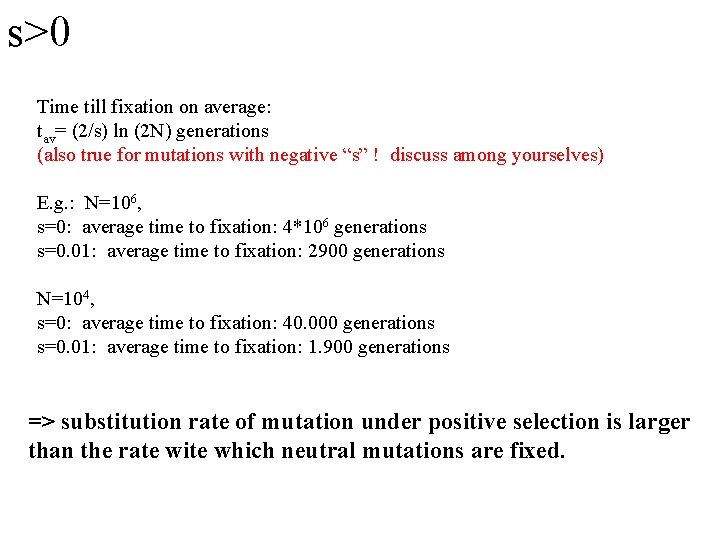
s>0 Time till fixation on average: tav= (2/s) ln (2 N) generations (also true for mutations with negative “s” ! discuss among yourselves) E. g. : N=106, s=0: average time to fixation: 4*106 generations s=0. 01: average time to fixation: 2900 generations N=104, s=0: average time to fixation: 40. 000 generations s=0. 01: average time to fixation: 1. 900 generations => substitution rate of mutation under positive selection is larger than the rate wite which neutral mutations are fixed.
Random Genetic Drift Selection 100 Allele frequency advantageous disadvantageous 0 Modified from www. tcd. ie/Genetics/staff/Aoife/GE 3026_1+2. ppt
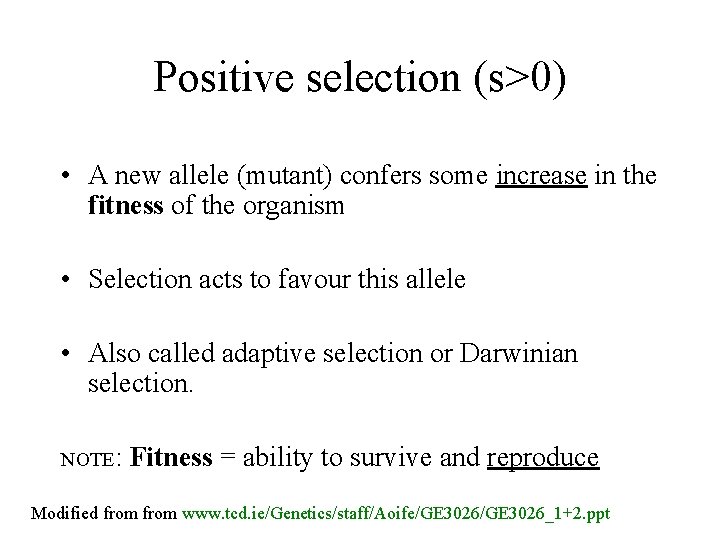
Positive selection (s>0) • A new allele (mutant) confers some increase in the fitness of the organism • Selection acts to favour this allele • Also called adaptive selection or Darwinian selection. NOTE: Fitness = ability to survive and reproduce Modified from www. tcd. ie/Genetics/staff/Aoife/GE 3026_1+2. ppt
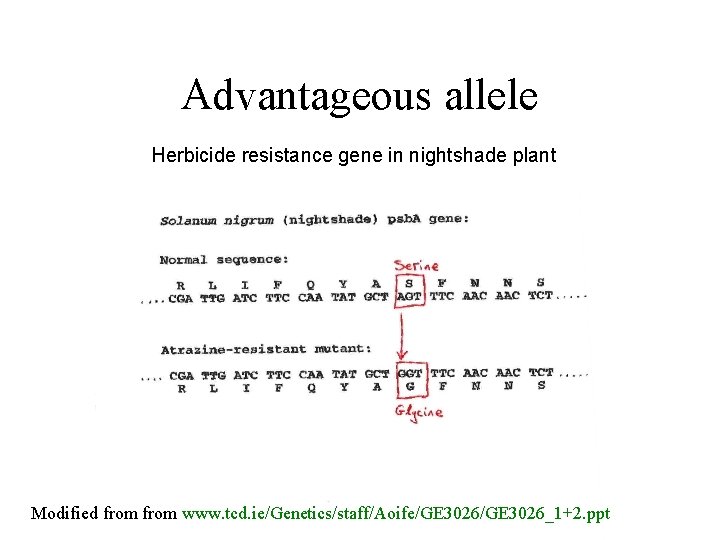
Advantageous allele Herbicide resistance gene in nightshade plant Modified from www. tcd. ie/Genetics/staff/Aoife/GE 3026_1+2. ppt
Negative selection (s<0) • A new allele (mutant) confers some decrease in the fitness of the organism • Selection acts to remove this allele • Also called purifying selection Modified from www. tcd. ie/Genetics/staff/Aoife/GE 3026_1+2. ppt
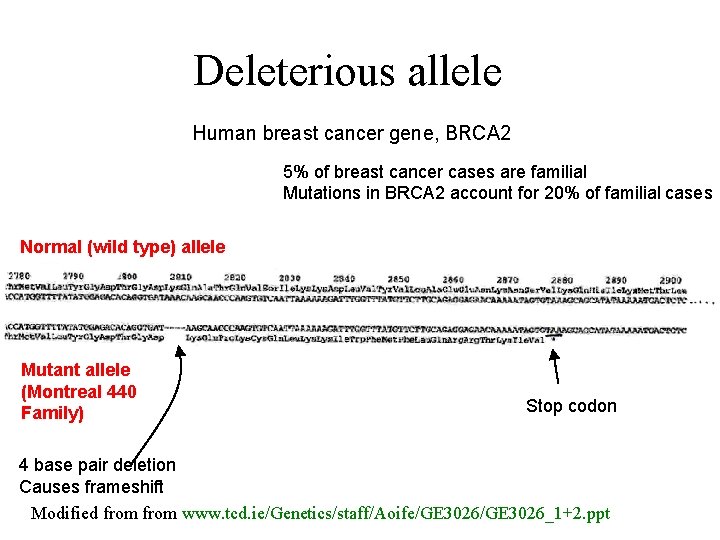
Deleterious allele Human breast cancer gene, BRCA 2 5% of breast cancer cases are familial Mutations in BRCA 2 account for 20% of familial cases Normal (wild type) allele Mutant allele (Montreal 440 Family) Stop codon 4 base pair deletion Causes frameshift Modified from www. tcd. ie/Genetics/staff/Aoife/GE 3026_1+2. ppt
Neutral mutations • Neither advantageous nor disadvantageous • Invisible to selection (no selection) • Frequency subject to ‘drift’ in the population • Random drift – random changes in small populations
Types of Mutation-Substitution • Replacement of one nucleotide by another • Synonymous (Doesn’t change amino acid) – Rate sometimes indicated by Ks – Rate sometimes indicated by ds • Non-Synonymous (Changes Amino Acid) – Rate sometimes indicated by Ka – Rate sometimes indicated by dn (this and the following 4 slides are from mentor. lscf. ucsb. edu/course/ spring/eemb 102/lecture/Lecture 7. ppt)
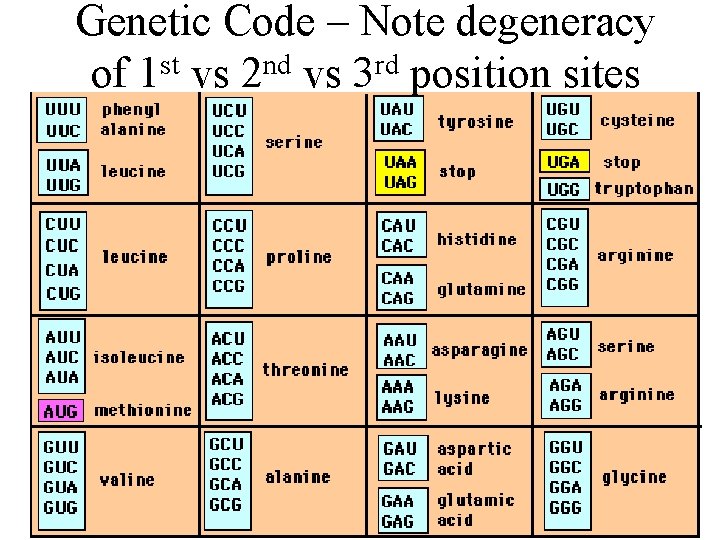
Genetic Code – Note degeneracy of 1 st vs 2 nd vs 3 rd position sites
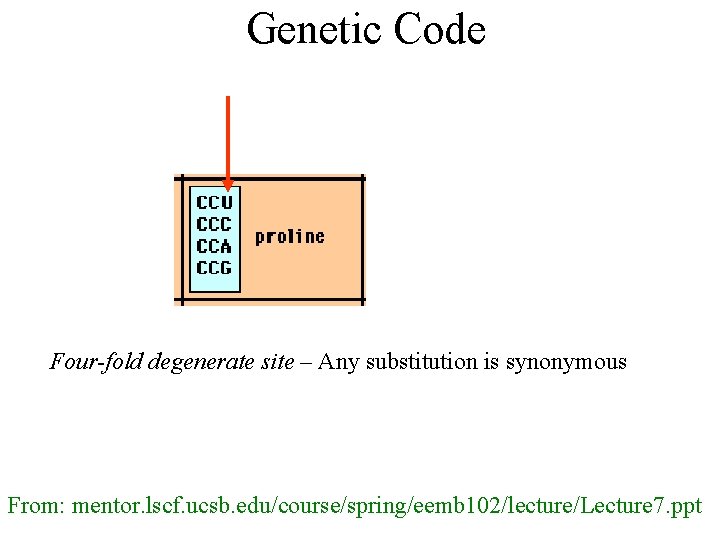
Genetic Code Four-fold degenerate site – Any substitution is synonymous From: mentor. lscf. ucsb. edu/course/spring/eemb 102/lecture/Lecture 7. ppt
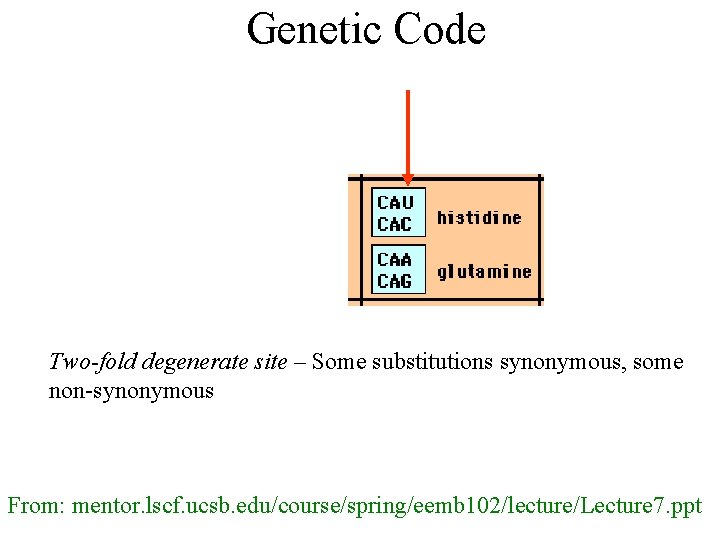
Genetic Code Two-fold degenerate site – Some substitutions synonymous, some non-synonymous From: mentor. lscf. ucsb. edu/course/spring/eemb 102/lecture/Lecture 7. ppt
Measuring Selection on Genes • Null hypothesis = neutral evolution • Under neutral evolution, synonymous changes should accumulate at a rate equal to mutation rate • Under neutral evolution, amino acid substitutions should also accumulate at a rate equal to the mutation rate From: mentor. lscf. ucsb. edu/course/spring/eemb 102/lecture/Lecture 7. ppt
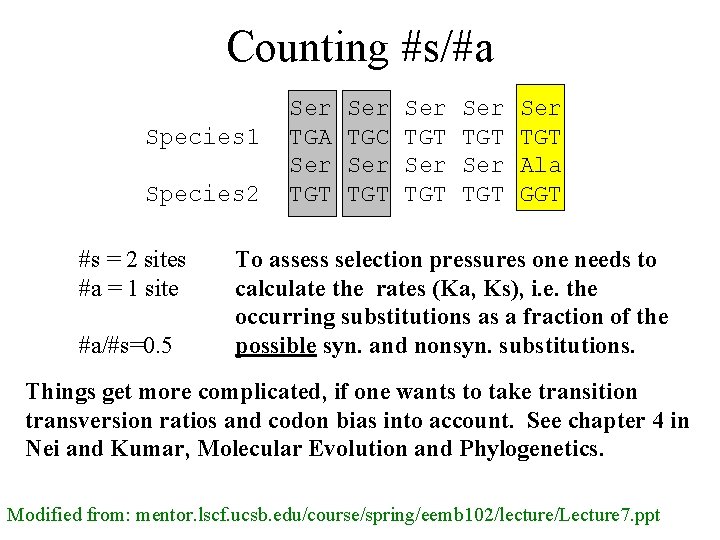
Counting #s/#a Species 1 Species 2 #s = 2 sites #a = 1 site #a/#s=0. 5 Ser TGA Ser TGT Ser TGC Ser TGT Ser TGT Ala GGT To assess selection pressures one needs to calculate the rates (Ka, Ks), i. e. the occurring substitutions as a fraction of the possible syn. and nonsyn. substitutions. Things get more complicated, if one wants to take transition transversion ratios and codon bias into account. See chapter 4 in Nei and Kumar, Molecular Evolution and Phylogenetics. Modified from: mentor. lscf. ucsb. edu/course/spring/eemb 102/lecture/Lecture 7. ppt
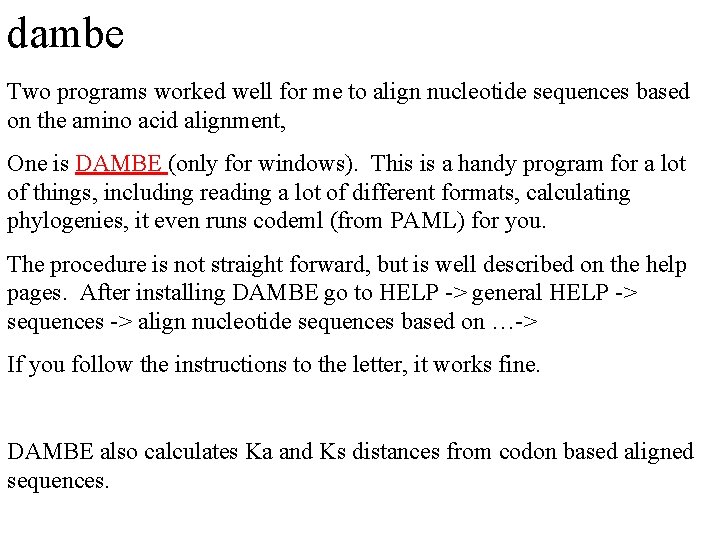
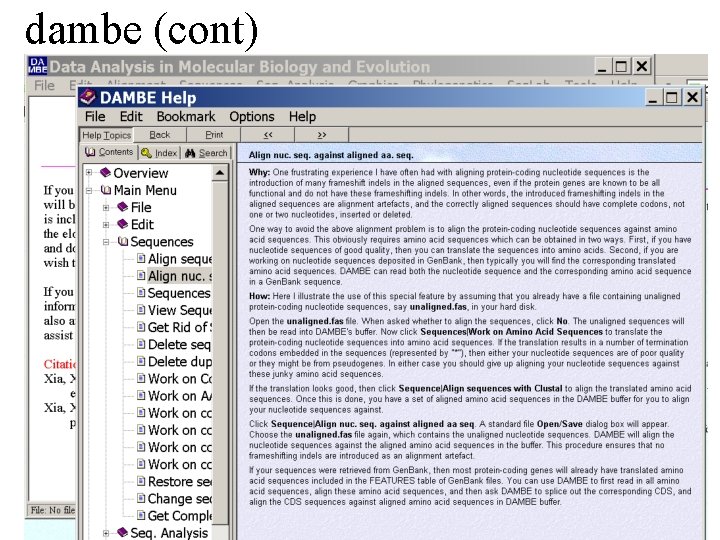
dambe Two programs worked well for me to align nucleotide sequences based on the amino acid alignment, One is DAMBE (only for windows). This is a handy program for a lot of things, including reading a lot of different formats, calculating phylogenies, it even runs codeml (from PAML) for you. The procedure is not straight forward, but is well described on the help pages. After installing DAMBE go to HELP -> general HELP -> sequences -> align nucleotide sequences based on …-> If you follow the instructions to the letter, it works fine. DAMBE also calculates Ka and Ks distances from codon based aligned sequences.
dambe (cont)
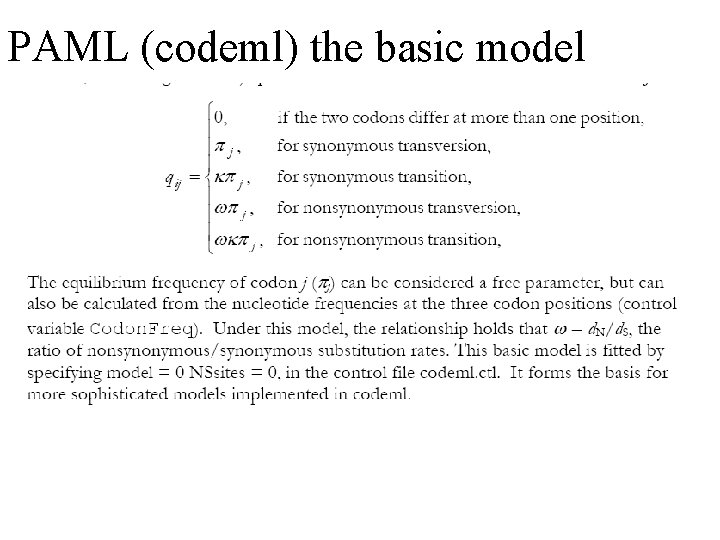
PAML (codeml) the basic model
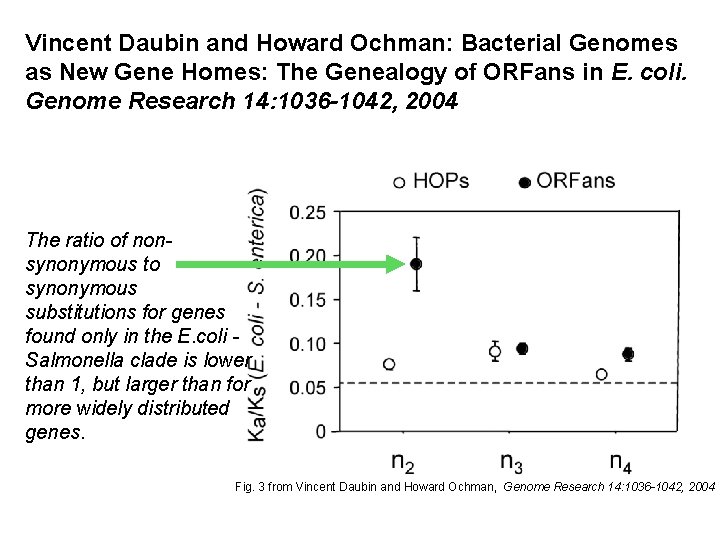
Vincent Daubin and Howard Ochman: Bacterial Genomes as New Gene Homes: The Genealogy of ORFans in E. coli. Genome Research 14: 1036 -1042, 2004 The ratio of nonsynonymous to synonymous substitutions for genes found only in the E. coli Salmonella clade is lower than 1, but larger than for more widely distributed genes. Fig. 3 from Vincent Daubin and Howard Ochman, Genome Research 14: 1036 -1042, 2004
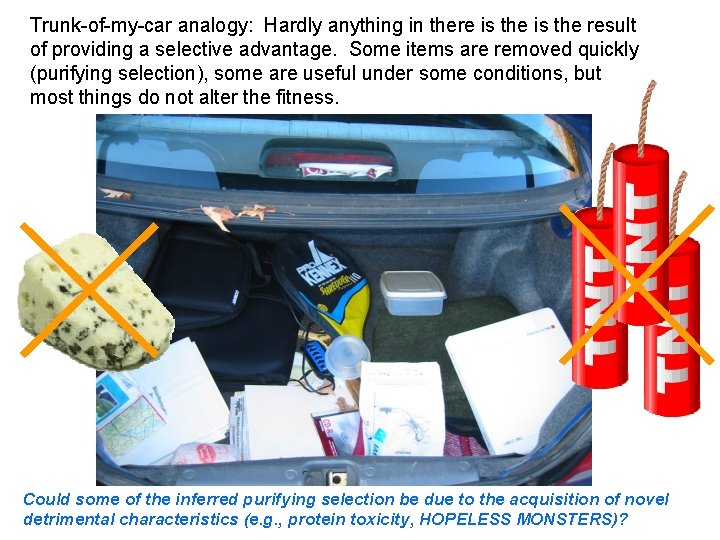
Trunk-of-my-car analogy: Hardly anything in there is the result of providing a selective advantage. Some items are removed quickly (purifying selection), some are useful under some conditions, but most things do not alter the fitness. Could some of the inferred purifying selection be due to the acquisition of novel detrimental characteristics (e. g. , protein toxicity, HOPELESS MONSTERS)?
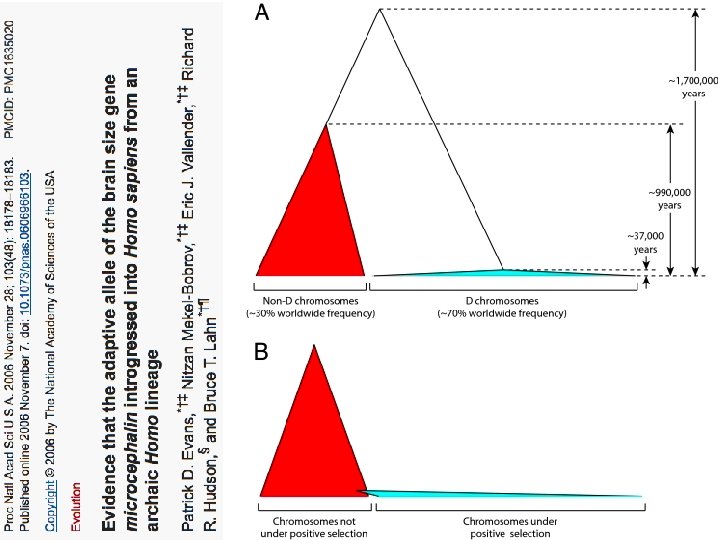
Other ways to detect positive selection Selective sweeps -> fewer alleles present in population (see contributions from Archaic Humans for example) Repeated episodes of positive selection -> high d. N
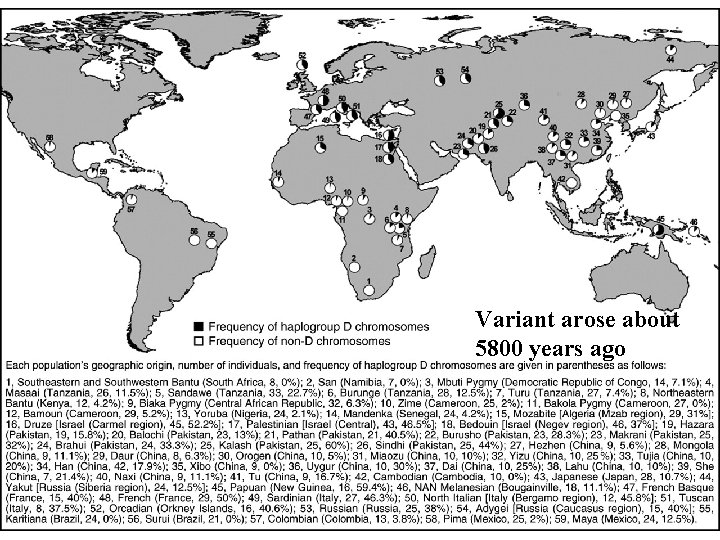
Variant arose about 5800 years ago
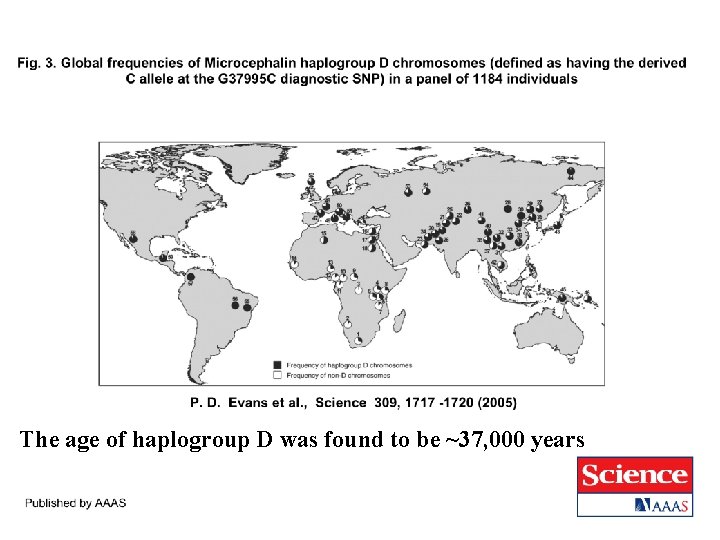
The age of haplogroup D was found to be ~37, 000 years