
The Google File System 1 Design consideration Built
The Google File System 1
Design consideration □ Built from cheap commodity hardware □ Expect large files: 100 MB to many GB □ Support large streaming reads and small random reads □ Support large, sequential file appends □ Support producer-consumer queues for manyway merging and file atomicity □ Sustain high bandwidth by writing data in bulk 2
Interface □Interface resembles standard file system – hierarchical directories and pathnames □Usual operations □ create, delete, open, close, read, and write □Moreover □ Snapshot – Copy □ Record append – Multiple clients to append data to the same file concurrently 3
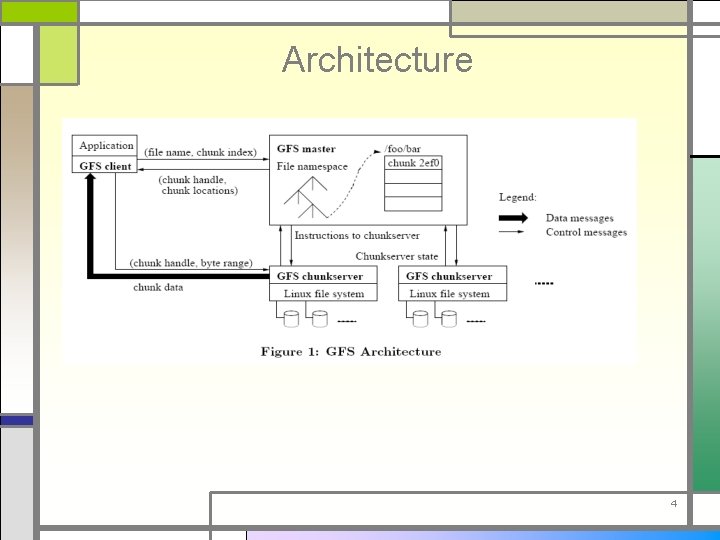
Architecture 4
Chunk Size □ 64 MB □ Much larger than typical file system block sizes □ Advantages from large chunk size □ Reduce interaction between client and master □ Client can perform many operations on a given chunk □Reduces network overhead by keeping persistent TCP connection □ Reduce size of metadata stored on the master □The metadata can reside in memory 5
Metadata (1) □Store three major types □ Namespaces □File and chunk identifier □ Mapping from files to chunks □ Location of each chunk replicas □In-memory data structures □ Metadata is stored in memory □ Periodic scanning entire state is easy and efficient 6
Metadata (2) □ Chunk locations □ Master do not keep a persistent record of chunk locations □ Instead, it simply polls chunkservers at startup and periodically thereafter (heartbeat message) □ Because of chunkserver failures, it is hard to keep persistent record of chunk locations □ Operation log □ Master maintains historical record of critical metadata changes □ Namespace and mapping □ For reliability and consistency, replicate operation log on multiple remote machines 7
Client operations Write(1) □ Some chunkserver is primary for each chunk □ Master grants lease to primary (typically for 60 sec. ) □ Leases renewed using periodic heartbeat messages between master and chunkservers □ Client asks master for primary and secondary replicas for each chunk □ Client sends data to replicas in daisy chain □ Pipelined: each replica forwards as it receives □ Takes advantage of full-duplex Ethernet links 8
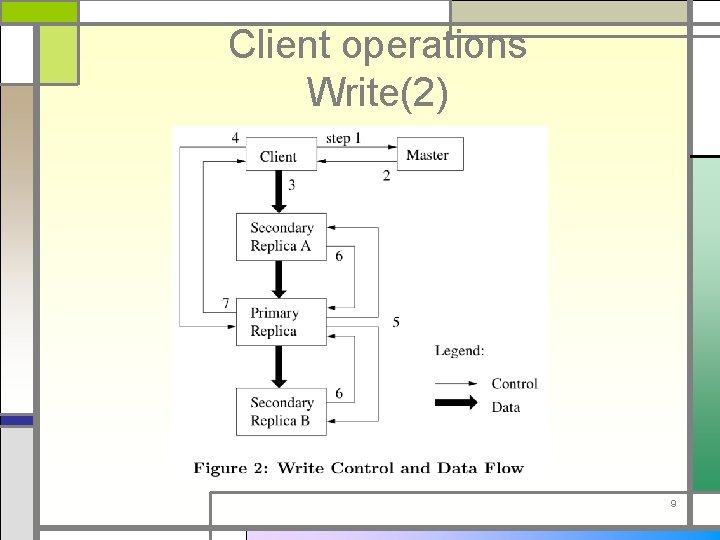
Client operations Write(2) 9
Client operations Write(3) □ All replicas acknowledge data write to client □ Client sends write request to primary □ Primary assigns serial number to write request, providing ordering □ Primary forwards write request with same serial number to secondaries □ Secondaries all reply to primary after completing write □ Primary replies to client 10
Client operations with Server □ Issues control (metadata) requests to master server □ Issues data requests directly to chunkservers □ Caches metadata □ Does no caching of data □ No consistency difficulties among clients □ Streaming reads (read once) and append writes (write once) don’t benefit much from caching at client 11
Decoupling □ Data & flow control are separated □ Use network efficiently- pipeline data linearly along chain of chunkservers □ Goals □ Fully utilize each machine’s network bandwidth □ Avoid network bottlenecks & high-latency □ Pipeline is “carefully chosen” □ Assumes distances determined by IP addresses 12
Atomic Record Appends □ GFS appends data to a file at least once atomically (as a single continuous sequence of bytes) □ Extra logic to implement this behavior □ Primary checks to see if appending data exceeds current chunk boundary □ If so, append new chunk padded out to chunk size and tell client to try again next chunk □ When data fits in chunk, write it and tell replicas to do so at exact same offset □ Primary keeps replicas in sync with itself 13
Master operations Logging □ Master has all metadata information □ Lose it, and you’ve lost the filesystem! □ Master logs all client requests to disk sequentially □ Replicates log entries to remote backup servers □ Only replies to client after log entries safe on disk on self and backups! 14
Master operations What if Master Reboots □ Replays log from disk □ Recovers namespace (directory) information □ Recovers file-to-chunk-ID mapping □ Asks chunkservers which chunks they hold □ Recovers chunk-ID-to-chunkserver mapping □ If chunk server has older chunk, it’s stale □ Chunk server down at lease renewal □ If chunk server has newer chunk, adopt its version number □ Master may have failed while granting lease 15
Master operations Where to put a chunk □It is desirable to put chunk on chunkserver with below-average disk space utilization □Limit the number of recent creations on each chunkserver- avoid heavy write traffic □Spread chunks across multiple racks 16
Master operations Re-replication and Rebalancing l l Re-replication occurs when the number of available chunk replicas falls below a user-defined limit l When can this occur? l Chunkserver becomes unavailable l Corrupted data in a chunk l Disk error l Increased replication limit Rebalancing is done periodically by master l Master examines current replica distribution and moves replicas to even disk space usage l Gradual nature avoids swamping a chunkserver 17
Garbage Collection l l Lazy l Update master log immediately, but… l Do not reclaim resources for a bit (lazy part) l Chunk is first renamed, not removed l Periodic scans remove renamed chunks more than a few days old (user-defined) Orphans l Chunks that exist on chunkservers that the master has no metadata for l Chunkserver can freely delete these 18
Fault Tolerance □Fast Recovery □ Master and Chunkserver are designed to restore their state and restart in seconds □Chunk Replication □ Each chunk is replicated on multiple chunkservers on different racks □ According to user demand, the replication factor can be modified for reliability □Master Replication □ Operation log □ Historical record of critical metadata changes □ Operation log is replicated on multiple machines 19
Conclusion □ GFS is a distributed file system that support large-scale data processing workloads on commodity hardware □ GFS has different points in the design space □ Component failures as the norm □ Optimize for huge files □ GFS provides fault tolerance □ Replicating data □ Fast and automatic recovery □ Chunk replication □ GFS has the simple, centralized master that does not become a bottleneck □ GFS is a successful file system □ An important tool that enables to continue to innovate on Google’s ideas 20
- Slides: 20