
The good society is more than the sum

- Slides: 16
The good society is more than the sum of happiness of its citizens Rob Bijl The Netherlands Institute for Social Research/SCP r. bijl@scp. nl ESAC Workshop Measuring and comparing quality of life within Europe, Brussels, 24 th of January, 2013
Comparison of Qo. L : ‘boring is best’ The Economist , november 2012: The lottery of life – Where to be born in 2013 Which country will provide the best opportunities for a healthy, safe and prosperous life in the years ahead. Qo. L-index links subjective lifesatisfaction surveys to objective determinants of Qo. L across countries. 11 indicators (e. g. income per head, crime, trust in public institutions, health of the family). a. Fixed factors: geography b. Factors that change only slowly over time: demography and 2 many social and cultural characteristics
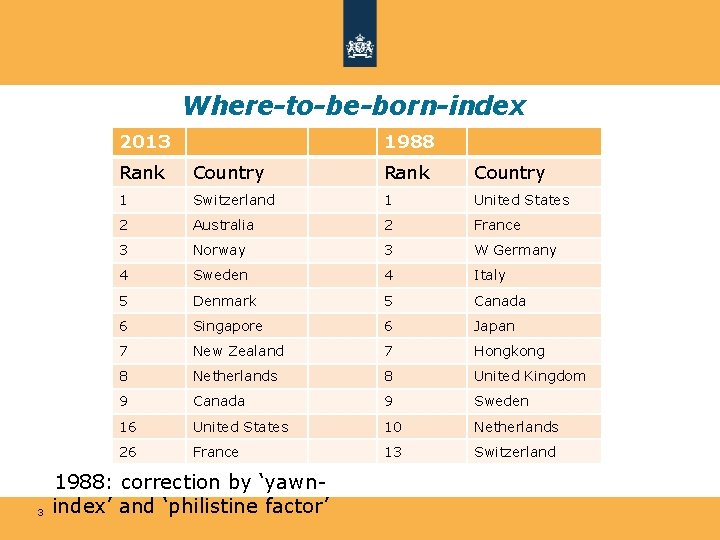
Where-to-be-born-index 2013 3 1988 Rank Country 1 Switzerland 1 United States 2 Australia 2 France 3 Norway 3 W Germany 4 Sweden 4 Italy 5 Denmark 5 Canada 6 Singapore 6 Japan 7 New Zealand 7 Hongkong 8 Netherlands 8 United Kingdom 9 Canada 9 Sweden 16 United States 10 Netherlands 26 France 13 Switzerland 1988: correction by ‘yawnindex’ and ‘philistine factor’
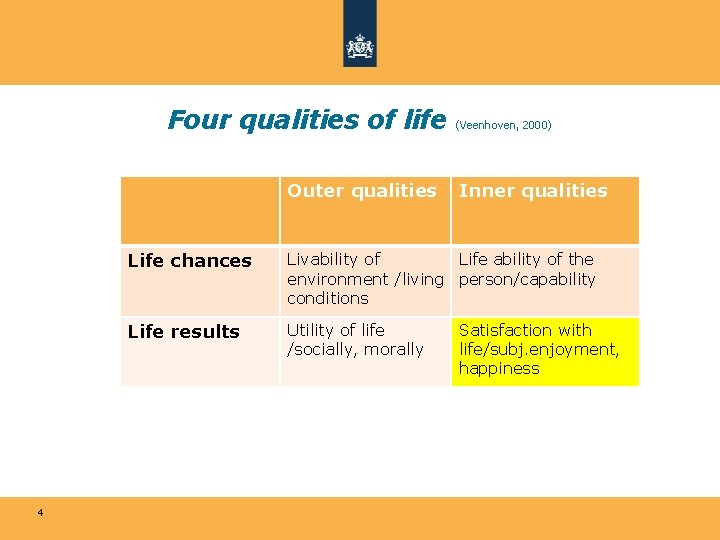
Four qualities of life Outer qualities 4 (Veenhoven, 2000) Inner qualities Life chances Livability of Life ability of the environment /living person/capability conditions Life results Utility of life /socially, morally Satisfaction with life/subj. enjoyment, happiness
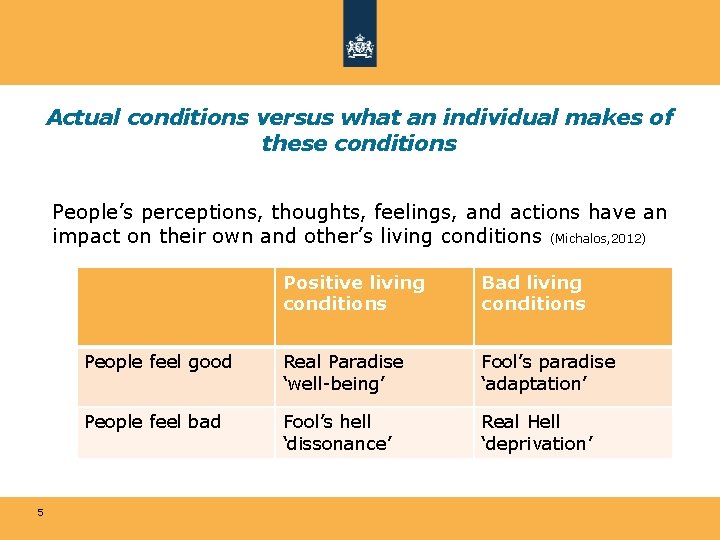
Actual conditions versus what an individual makes of these conditions People’s perceptions, thoughts, feelings, and actions have an impact on their own and other’s living conditions (Michalos, 2012) 5 Positive living conditions Bad living conditions People feel good Real Paradise ‘well-being’ Fool’s paradise ‘adaptation’ People feel bad Fool’s hell ‘dissonance’ Real Hell ‘deprivation’
Policy relevance - Policy makers have to know which conditions lead to the best outcomes - Livability of the environment cannot be summed up meaningfully with life ability of individual citizens - Need to know which abilities connect best to demands of the environment: what is the best ‘fit’ 6 - Need to get insight in the
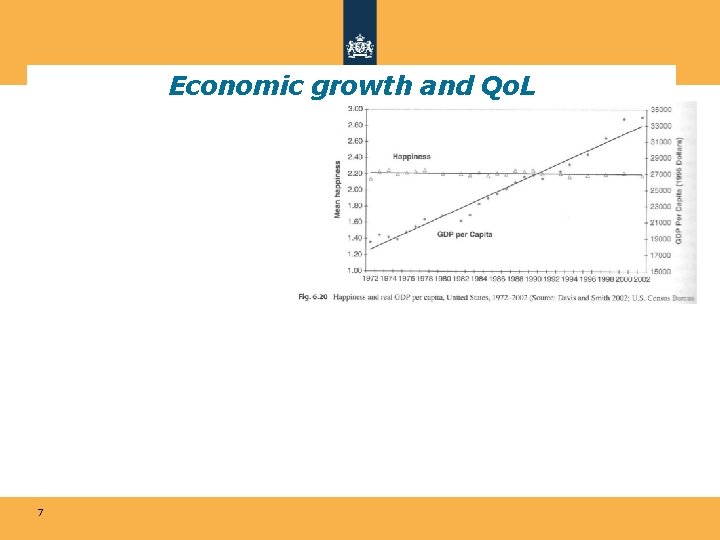
Economic growth and Qo. L 7
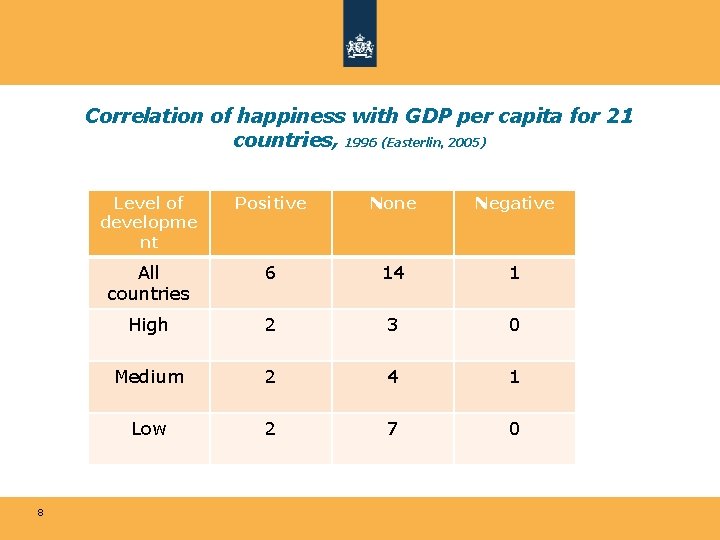
Correlation of happiness with GDP per capita for 21 countries, 1996 (Easterlin, 2005) 8 Level of developme nt Positive None Negative All countries 6 14 1 High 2 3 0 Medium 2 4 1 Low 2 7 0
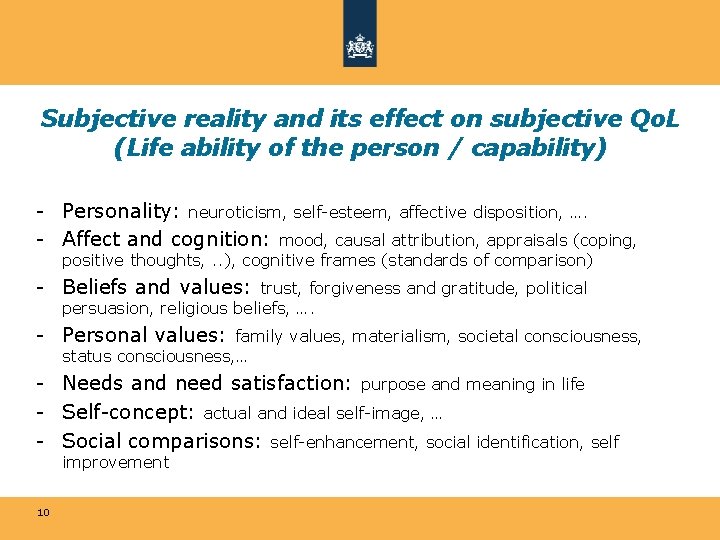
Objective reality and its effect on subjective Qo. L (Livability of environment /living conditions) - Socioeconomic, political, cultural, demographic and other macro factors: econ fluctuations, unemployment, democracy, values, migration - Income and wealth: individual and national level, short and long term - Other demographic factors: age, gender, marital status, family composition, education, ethnicity, religious affiliation - Personal activities: social activities, leisure and recreation, spiritual and community activities, economic activities (shopping) - Genetics, health, biology, the environment, drugs: genetic makeup, physical and mental illness, sleep (problems), body image, seasonal variation (mood) , effect of drugs 9
Subjective reality and its effect on subjective Qo. L (Life ability of the person / capability) - Personality: neuroticism, self-esteem, affective disposition, …. - Affect and cognition: mood, causal attribution, appraisals (coping, positive thoughts, . . ), cognitive frames (standards of comparison) - Beliefs and values: trust, forgiveness and gratitude, political persuasion, religious beliefs, …. - Personal values: family values, materialism, societal consciousness, status consciousness, … - Needs and need satisfaction: purpose and meaning in life - Self-concept: actual and ideal self-image, … - Social comparisons: self-enhancement, social identification, self improvement 10
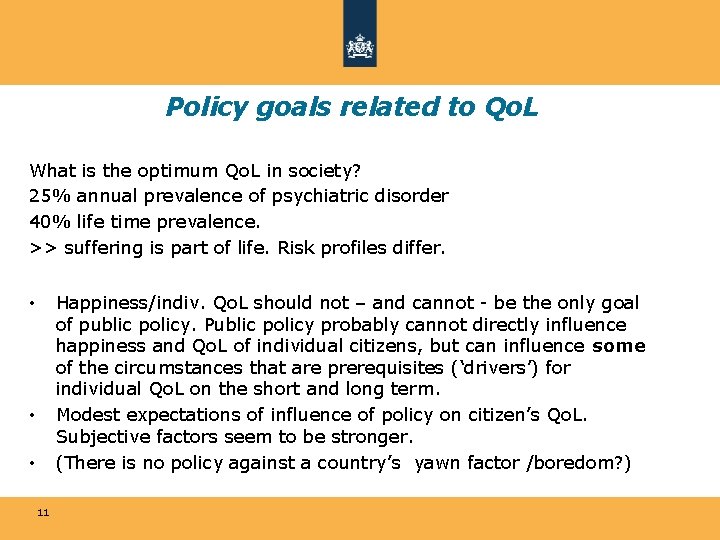
Policy goals related to Qo. L What is the optimum Qo. L in society? 25% annual prevalence of psychiatric disorder 40% life time prevalence. >> suffering is part of life. Risk profiles differ. Happiness/indiv. Qo. L should not – and cannot - be the only goal of public policy. Public policy probably cannot directly influence happiness and Qo. L of individual citizens, but can influence some of the circumstances that are prerequisites (‘drivers’) for individual Qo. L on the short and long term. Modest expectations of influence of policy on citizen’s Qo. L. Subjective factors seem to be stronger. (There is no policy against a country’s yawn factor /boredom? ) • • • 11
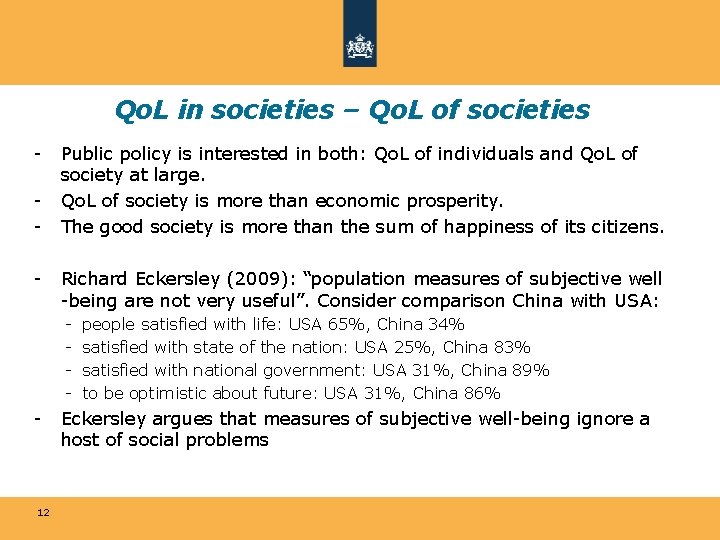
Qo. L in societies – Qo. L of societies - Public policy is interested in both: Qo. L of individuals and Qo. L of society at large. Qo. L of society is more than economic prosperity. The good society is more than the sum of happiness of its citizens. Richard Eckersley (2009): “population measures of subjective well -being are not very useful”. Consider comparison China with USA: - - 12 people satisfied with life: USA 65%, China 34% satisfied with state of the nation: USA 25%, China 83% satisfied with national government: USA 31%, China 89% to be optimistic about future: USA 31%, China 86% Eckersley argues that measures of subjective well-being ignore a host of social problems
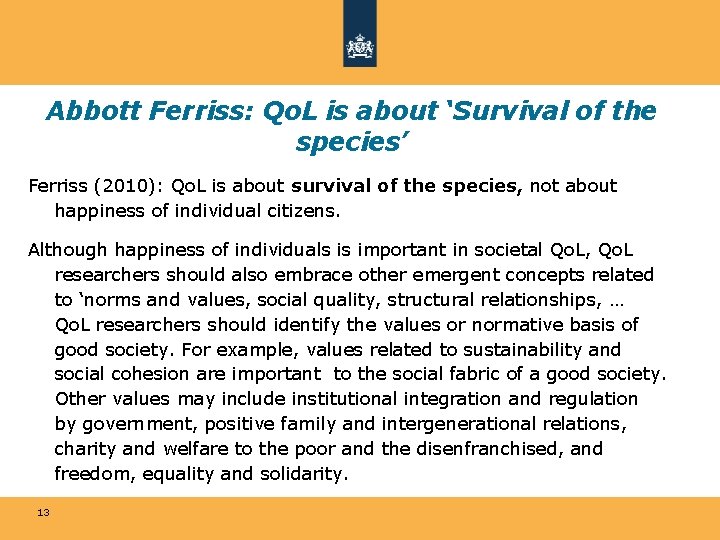
Abbott Ferriss: Qo. L is about ‘Survival of the species’ Ferriss (2010): Qo. L is about survival of the species, not about happiness of individual citizens. Although happiness of individuals is important in societal Qo. L, Qo. L researchers should also embrace other emergent concepts related to ‘norms and values, social quality, structural relationships, … Qo. L researchers should identify the values or normative basis of good society. For example, values related to sustainability and social cohesion are important to the social fabric of a good society. Other values may include institutional integration and regulation by government, positive family and intergenerational relations, charity and welfare to the poor and the disenfranchised, and freedom, equality and solidarity. 13
New thinking? Happiness should not be the only goal of public policy. It should be a major goal among other goals such as fostering human rights, upholding environmental preservation, protecting animal rights, preserving the human species, ensuring the economic well-being of future generations, eradicating political extremism, resolving political conflicts, dismantling the nuclear arsenal, and so on. 14
Consequences of new approach Happiness research is likely to shift the agenda: - Instead of addressing questions such as “How can government stimulate economic growth? ” public policy officials should ask “How does economic growth influence subjective well-being? ”. - Instead of asking “How does income inequality impact economic growth? ” we should ask “Does income inequality influence wellbeing? ” - Instead of asking “How much is productivity reduced by illness? ” we should ask “what illnesses interfere with happiness? ” - …. . In other words, policymakers, who embrace happiness/ Qo. L research are likely/possibly (? ) to pose very different questions guiding their public policy decision-making. 15
1. The good society is more than the sum of happiness of its citizens. 2. Although happiness of individuals is important in societal Qo. L, Qo. L researchers should also embrace other emergent concepts related to norms and values, social quality, social cohesion and structural relationships, which are important to the social fabric of a good society. 3. Policymakers, who embrace happiness/ Qo. L research are likely/possibly (? ) to pose very different questions guiding their public policy decision-making. 16