
The Goal Cultural Competence The Tool the IDI
- Slides: 15
The Goal: Cultural Competence; The Tool: the IDI TCC: ANALEA BRAUBURGER & MELISA ZIEGLER, PH. D. (ABRAUBURGER@TACOMACC. EDU, MZIEGLER@TACOMACC. EDU) IDI EXCERPTS FROM: HTTPS: //IDIINVENTORY. COM/WP-CONTENT/UPLOADS/2016/05/WHY-CONSIDER-THE-IDI. PDF
WHAT’S THE GOAL? Session Outcomes: ◦ Discover the Intercultural Development Inventory (IDI) tool through IDI specific content sharing. ◦ Contemplate moving the equity agenda through cultural competence skills and the IDI. ◦ Analyze IDI application at TCC and contemplate using the tool at your institution.
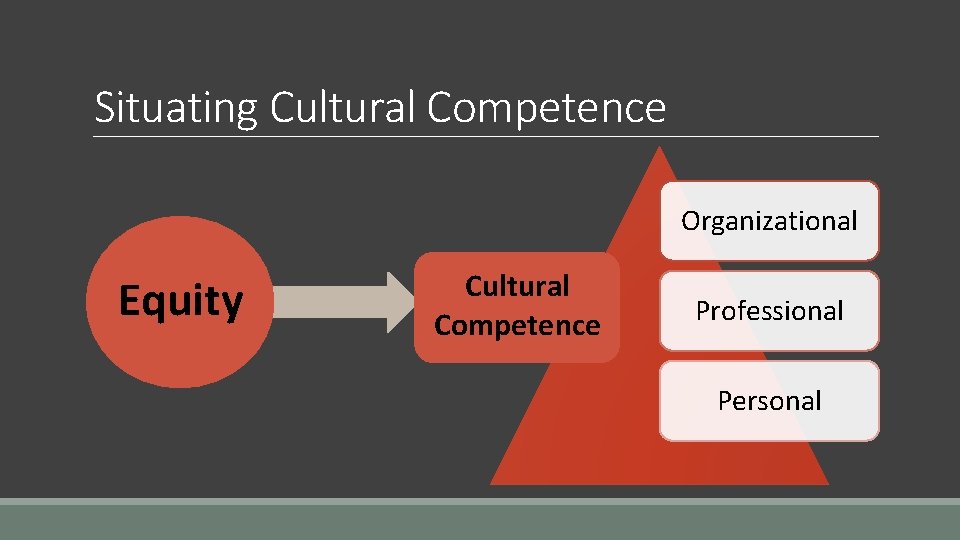
Situating Cultural Competence Organizational Equity Cultural Competence Professional Personal
Your Cultural Competence Toolkit Turn to a neighbor from another institution and discuss: 1. Describe what’s in the toolbox at your college. 2. Together, identify 3 -5 tools a college could use to increase cultural competence. 3. Prepare to briefly share out.
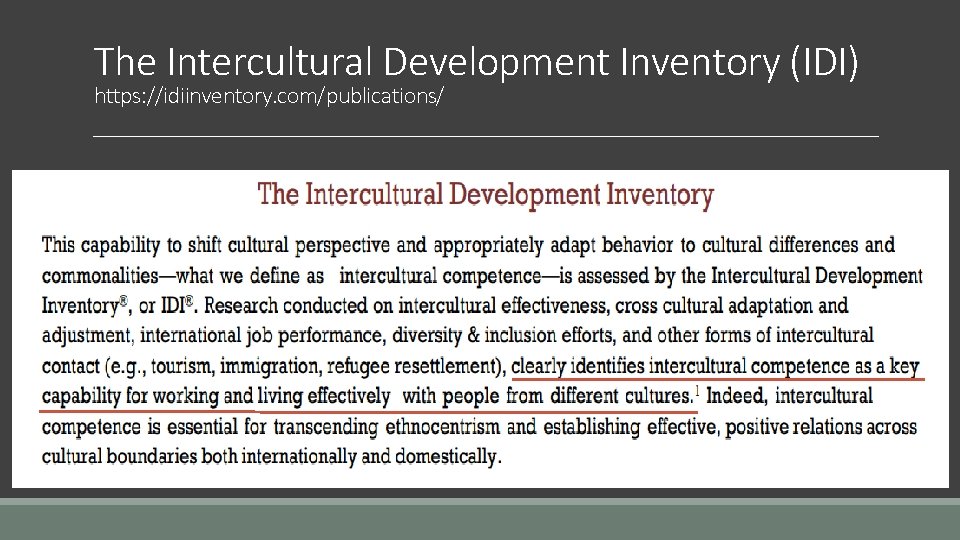
The Intercultural Development Inventory (IDI) https: //idiinventory. com/publications/
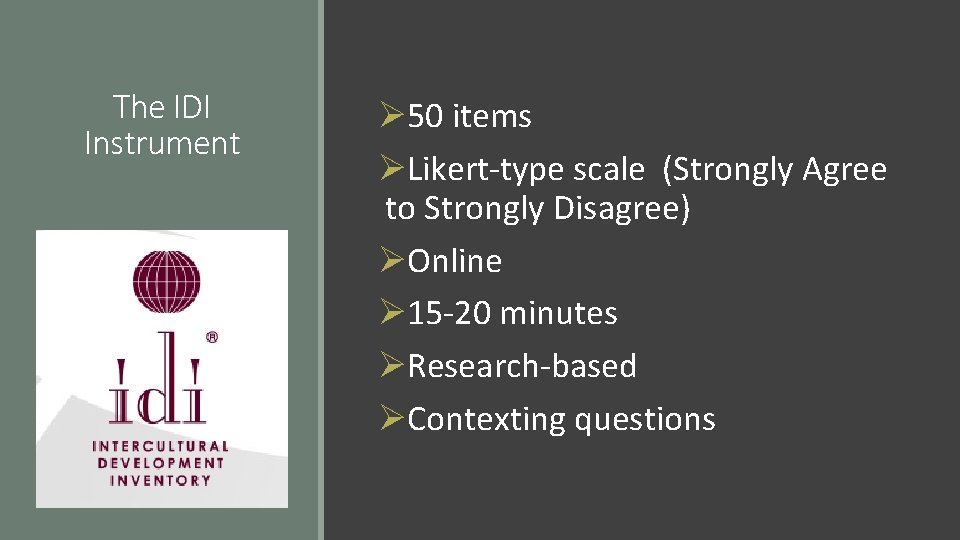
The IDI Instrument Ø 50 items ØLikert-type scale (Strongly Agree to Strongly Disagree) ØOnline Ø 15 -20 minutes ØResearch-based ØContexting questions
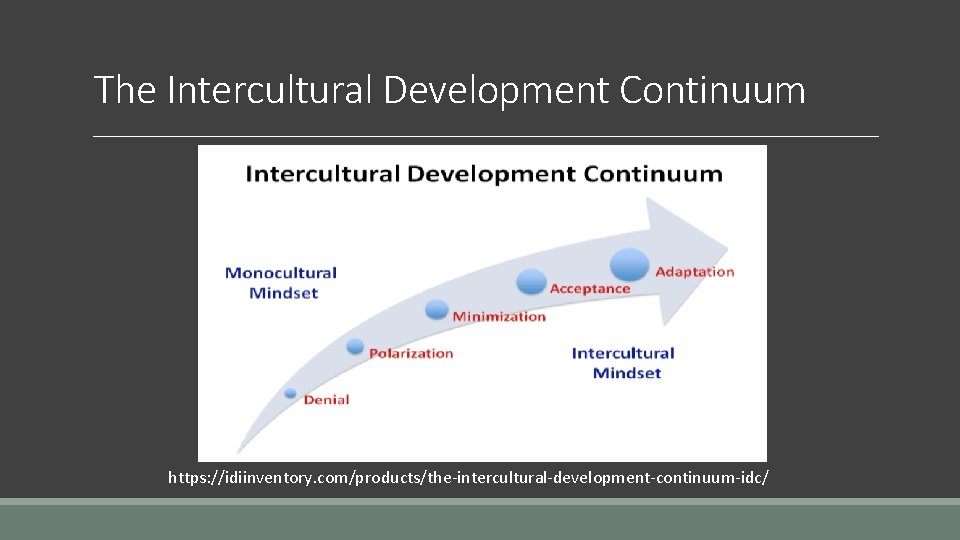
The Intercultural Development Continuum https: //idiinventory. com/products/the-intercultural-development-continuum-idc/
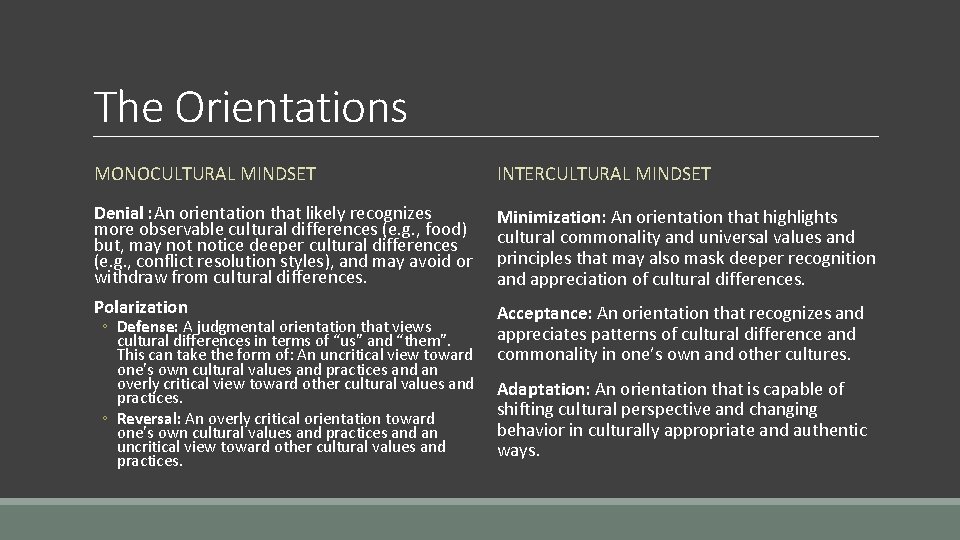
The Orientations MONOCULTURAL MINDSET INTERCULTURAL MINDSET Denial : An orientation that likely recognizes more observable cultural differences (e. g. , food) but, may notice deeper cultural differences (e. g. , conflict resolution styles), and may avoid or withdraw from cultural differences. Minimization: An orientation that highlights cultural commonality and universal values and principles that may also mask deeper recognition and appreciation of cultural differences. Polarization Acceptance: An orientation that recognizes and appreciates patterns of cultural difference and commonality in one’s own and other cultures. ◦ Defense: A judgmental orientation that views cultural differences in terms of “us” and “them”. This can take the form of: An uncritical view toward one’s own cultural values and practices and an overly critical view toward other cultural values and practices. ◦ Reversal: An overly critical orientation toward one’s own cultural values and practices and an uncritical view toward other cultural values and practices. Adaptation: An orientation that is capable of shifting cultural perspective and changing behavior in culturally appropriate and authentic ways.
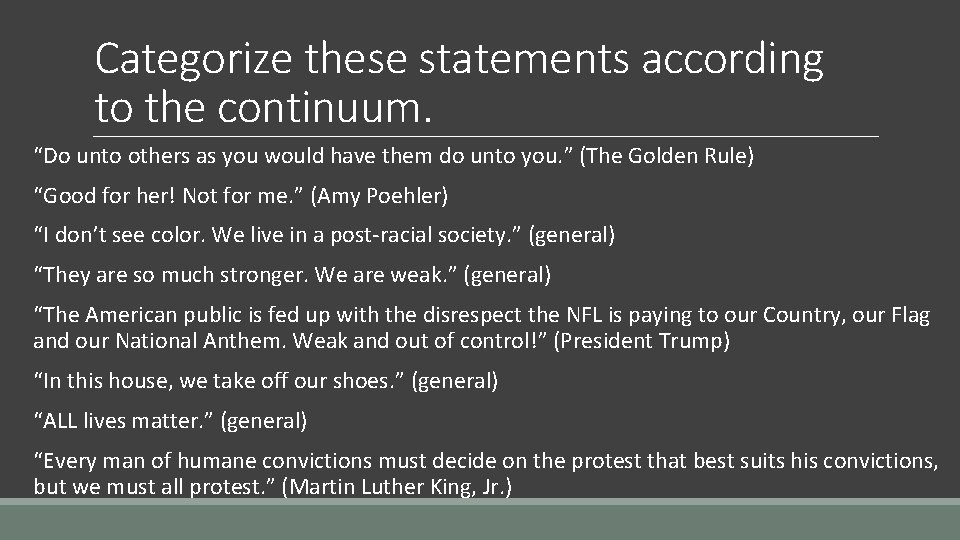
Categorize these statements according to the continuum. “Do unto others as you would have them do unto you. ” (The Golden Rule) “Good for her! Not for me. ” (Amy Poehler) “I don’t see color. We live in a post-racial society. ” (general) “They are so much stronger. We are weak. ” (general) “The American public is fed up with the disrespect the NFL is paying to our Country, our Flag and our National Anthem. Weak and out of control!” (President Trump) “In this house, we take off our shoes. ” (general) “ALL lives matter. ” (general) “Every man of humane convictions must decide on the protest that best suits his convictions, but we must all protest. ” (Martin Luther King, Jr. )
How are the ‘results’ useful? ØCenter discussion around how we interact with others (and ground it in cultural context). ØDevelop a plan for increasing cultural competence (individual and group). ØProvide a learning ground for guided shared practice. ØFocused grace surrounding the development of individuals. ØShared lens for the equity aspect of mission fulfillment.
Your Cultural Competence Toolkit Referring back to the list you generated earlier, discuss how the IDI could fit with the rest of the tools in your toolbox. 1. How could this tool help build Cultural Competence? 2. What questions arise about the IDI as a tool for increasing Cultural Competence?
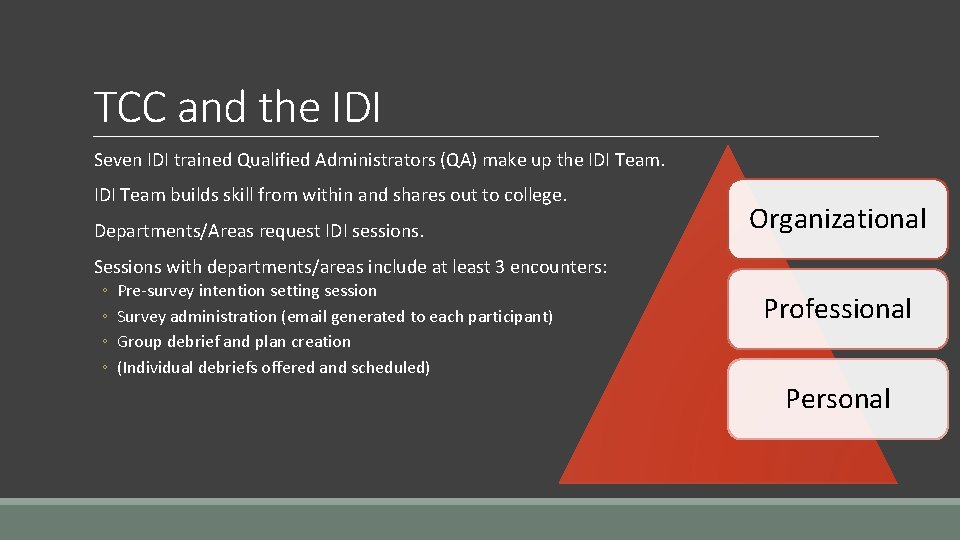
TCC and the IDI Seven IDI trained Qualified Administrators (QA) make up the IDI Team builds skill from within and shares out to college. Departments/Areas request IDI sessions. Organizational Sessions with departments/areas include at least 3 encounters: ◦ ◦ Pre-survey intention setting session Survey administration (email generated to each participant) Group debrief and plan creation (Individual debriefs offered and scheduled) Professional Personal
How will this be useful for me and my college? ØSharing with others that you are working on increasing your own cultural competence increases awareness of the focus on your personal equity agenda. ØDepartments/Areas and entire colleges focusing on cultural competence bring attention to WHY we have international film festivals, guest lectures related to equity, diversity, and inclusion, cultural events on campus, etc. ØDiscussions surrounding cultural competence lead to intention around culturally competent/responsive curriculum and pedagogical practice.
TCC’s Cultural Competence Toolkit ØIDI ØRacism & White Privilege Program Ø 21 -Day Racial Equity Habit Building Challenge ØWhite Caucus ØLumina grant proposal
“If equity is not about the willingness to give up something, what is it about? ” GYASI ROSS