
The Globus Toolkit Description and Applications Review Steve
The Globus Toolkit: Description and Applications Review Steve Tuecke & Ian Foster Argonne National Laboratory The University of Chicago Globus Co-PI: Carl Kesselman, USC/ISI
Overview l The need for Grid services l The Globus toolkit l Globus application case studies – Microtomography: on-line instrumentation – SF-Express and Overflow: distributed supercomputing – CAVERNsoft: collaborative engineering – Nimrod-G: high-throughput computing – ECCE’: problem solving environment l Summary
Creating a Usable Grid : Grid Services (“Middleware”) l Standard grid services that – Provide uniform, high-level access to a wide range of resources (including networks) – Address interdomain issues of security, policy, etc. – Permit application-level management and monitoring of end-to-end performance l Middleware-level and higher-level APIs and tools targeted at application programmers – Map between application and Grid
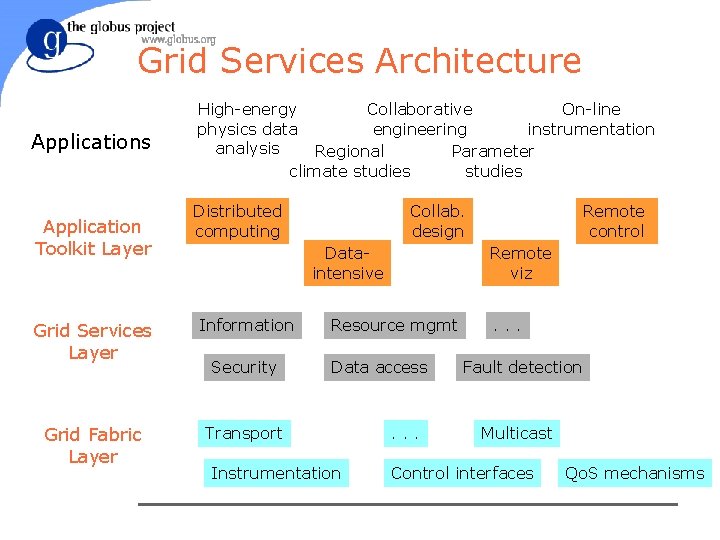
Grid Services Architecture Applications Application Toolkit Layer High-energy Collaborative On-line physics data engineering instrumentation analysis Regional Parameter climate studies Distributed computing Collab. design Dataintensive Grid Services Layer Information Grid Fabric Layer Transport Security Remote viz Resource mgmt Data access Instrumentation Remote control . . . Fault detection Multicast Control interfaces Qo. S mechanisms
The Globus Project: Argonne, USC/ISI, NCSA, Aerospace, NASA Ames, LBNL, others l Basic research in grid-related technologies – Resource management, security, adaptation, etc. l Development of Globus toolkit – Core services for grid-enabled tools & applns l Construction of large grid testbed: GUSTO – Largest grid testbed in terms of sites & apps l Application experiments – Tele-immersion, distributed computing, etc.
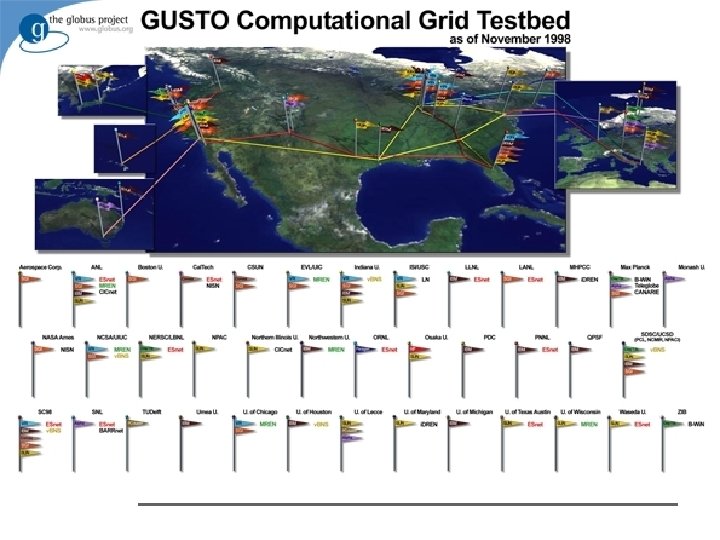
GUSTO Testbed Map
Globus Grid Services l The Globus toolkit provides a range of basic Grid services – Security, information, fault detection, communication, resource management, . . . l These services are simple and orthogonal – Can be used independently, mix and match – Programming model independent l For each there are well-defined APIs l Standards are used extensively – E. g. , LDAP, GSS-API, X. 509, . . .
Grid Services Layer (1) l Grid Security Infrastructure – Single-sign on, run anywhere [if authorized] – PKI, X. 509 certificates – Identity/credential mapping at each resource – Allows programs to act as user for limited period: delegation of rights
Grid Services Layer (2) l Grid Information Service – Currently an LDAP-based directory service – Publish structure and state info, dynamic performance info, software info, etc. – Resource discovery: “find me an X with property Y available at time T” – Auto-configuration: “tell me what I need to know to use A efficiently/securely/. . . ” – Gateways to other data sources required – Example of integrating “middleware” service
Grid Services Layer (3) l Access to remote data (GASS) – Uniform access to diverse storage management systems – Cache management – Integration with SRB, DPSS, HPSS l Communication (Nexus) – Application-level interfaces to comm services – Multiple methods: reliable/unreliable, IP/other, unicast/multicast – Qo. S interfaces
Grid Services Layer (4) l Globus Resource Allocation Manager (GRAM) – Uniform interface to resource management l Globus Arch. for Reservation and Allocation – Co-allocation of compute resources – Immediate and advance reservation of network and computers in prototype form l Fault detection service l Network measurement tools l Code management and distribution infrastructure
Application Toolkit Layer: e. g. l Message Passing Interface – Multi-method communication, specialized l CAVERNsoft – Shared state for collaborative environments l Condor, Nimrod-G – High-throughput computing l Parallel Application Workspace (PAWS) – High-speed parallel transfers for coupled apps
Globus Progress l Selected “Grid Services” are being migrated into the infrastructure – Grid information service – Grid security infrastructure – Grid resource management services l Simultaneously these and other Globus services are being applied to develop – Grid-enabled tools – Grid-enabled applications l An ongoing iterative refinement process
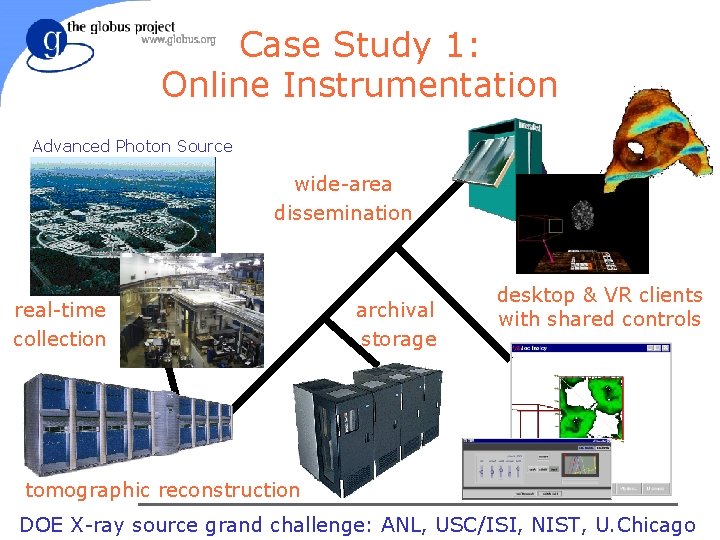
Case Study 1: Online Instrumentation Advanced Photon Source wide-area dissemination real-time collection archival storage desktop & VR clients with shared controls tomographic reconstruction DOE X-ray source grand challenge: ANL, USC/ISI, NIST, U. Chicago
CMT Processing Now
Additional Opportunities l l l End-to-end advance reservation of network, storage, computers Dynamic discovery and allocation of supercomputers, networks, etc. Adaptive determination of display resolution, reconstruction fidelity, etc. Reliable multicast for data, control, video Access control and discovery for collaborative sessions Integration with mass storage systems
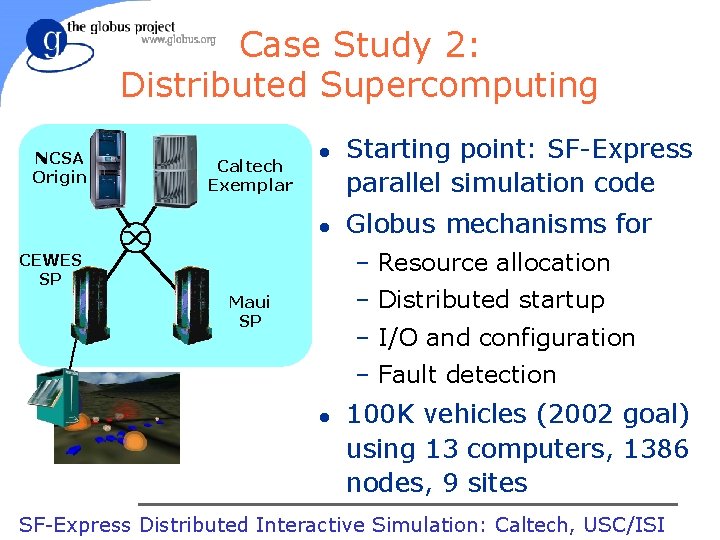
Case Study 2: Distributed Supercomputing NCSA Origin Caltech Exemplar l l Starting point: SF-Express parallel simulation code Globus mechanisms for – Resource allocation CEWES SP – Distributed startup Maui SP – I/O and configuration – Fault detection l 100 K vehicles (2002 goal) using 13 computers, 1386 nodes, 9 sites SF-Express Distributed Interactive Simulation: Caltech, USC/ISI
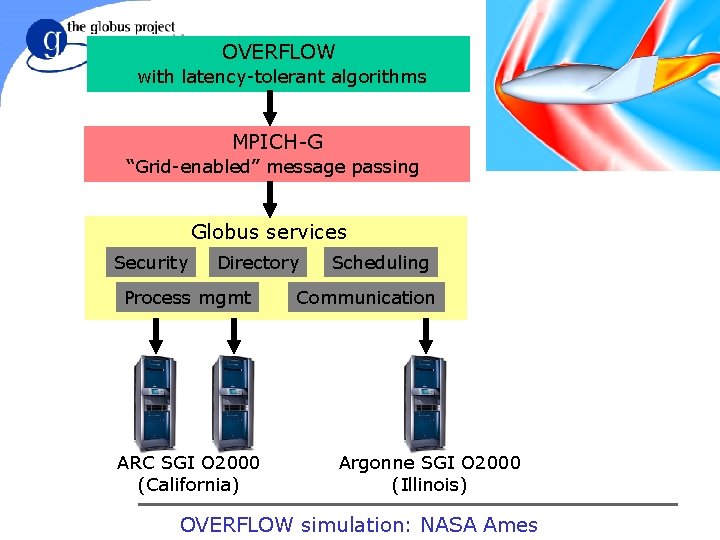
OVERFLOW with latency-tolerant algorithms MPICH-G “Grid-enabled” message passing Globus services Security Directory Process mgmt ARC SGI O 2000 (California) Scheduling Communication Argonne SGI O 2000 (Illinois) OVERFLOW simulation: NASA Ames
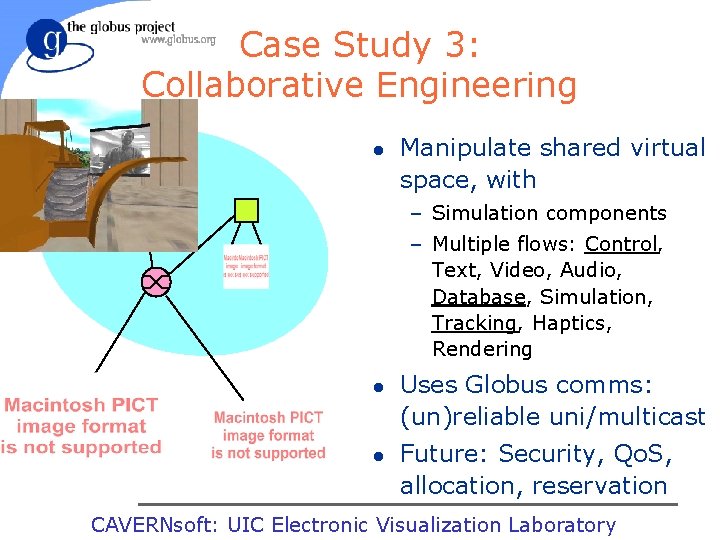
Case Study 3: Collaborative Engineering l Manipulate shared virtual space, with – Simulation components – Multiple flows: Control, Text, Video, Audio, Database, Simulation, Tracking, Haptics, Rendering l l Uses Globus comms: (un)reliable uni/multicast Future: Security, Qo. S, allocation, reservation CAVERNsoft: UIC Electronic Visualization Laboratory
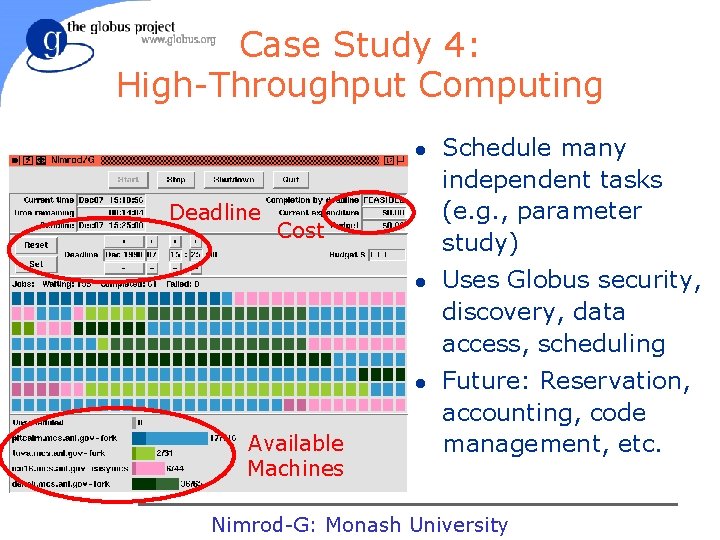
Case Study 4: High-Throughput Computing l Deadline Cost l l Available Machines Schedule many independent tasks (e. g. , parameter study) Uses Globus security, discovery, data access, scheduling Future: Reservation, accounting, code management, etc. Nimrod-G: Monash University
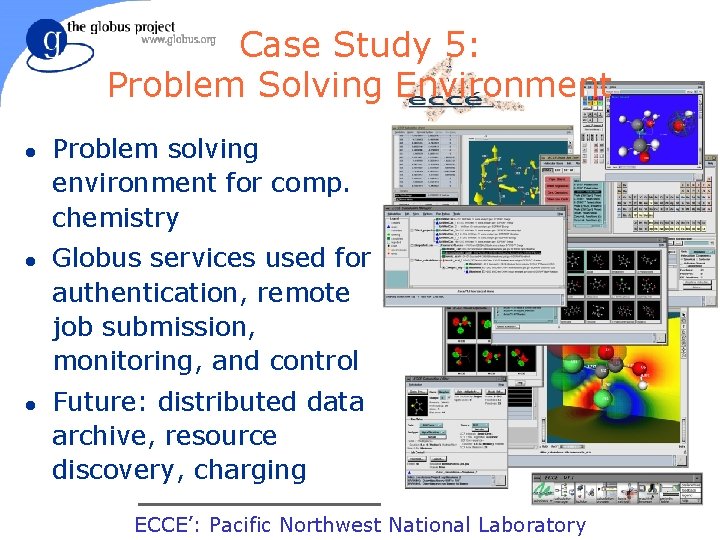
Case Study 5: Problem Solving Environment l l l Problem solving environment for comp. chemistry Globus services used for authentication, remote job submission, monitoring, and control Future: distributed data archive, resource discovery, charging ECCE’: Pacific Northwest National Laboratory
Summary l l Grids require Grid services that make resources accessible and usable and Grid toolkits for application development The Globus project is building essential services and partnering with tool developers Significant success stories in a range of problem classes We’re looking forward to working with applications throughout the community!
- Slides: 22