
The Global War On Terrorism Inside The American

The Global War On Terrorism: Inside The American Response • This lesson provides a brief examination of critical aspects of each the American presidential as their response to terrorism. • Second, this concluding lesson explores the strengths and weaknesses of each of the presidential responses to Al Qaeda and the Islamic State. • Third, this lesson concludes with thoughts on the future of the war on terrorism.
The Global War On Terrorism: Inside The American Response Clinton And The War On Terrorism: • For President Clinton the threat of terrorism was not considered a high priority. • One must remember his mandate as president was to fix the economy. Clinton’s campaign slogan and ultimately his governing agenda was “it’s the economy stupid. ”
The Global War On Terrorism: Inside The American Response • Clinton dramatically reduced the size of U. S. military. • A major legacy is that Al Qaeda could have been defeated during its infancy, but despite a host of Bin. Laden-led attacks on U. S. interests, Clinton refused to launch a major strike against the “The Base. ” • Though Clinton spoke of a war on terrorism, the president never implemented a coherent strategy. Second, Clinton never obtained domestic and international support to conduct a war on terrorism. • Even after an Al Qaeda attack on the USS Cole, Clinton refused to respond. Instead, he believed the threat should be left to the next administration.
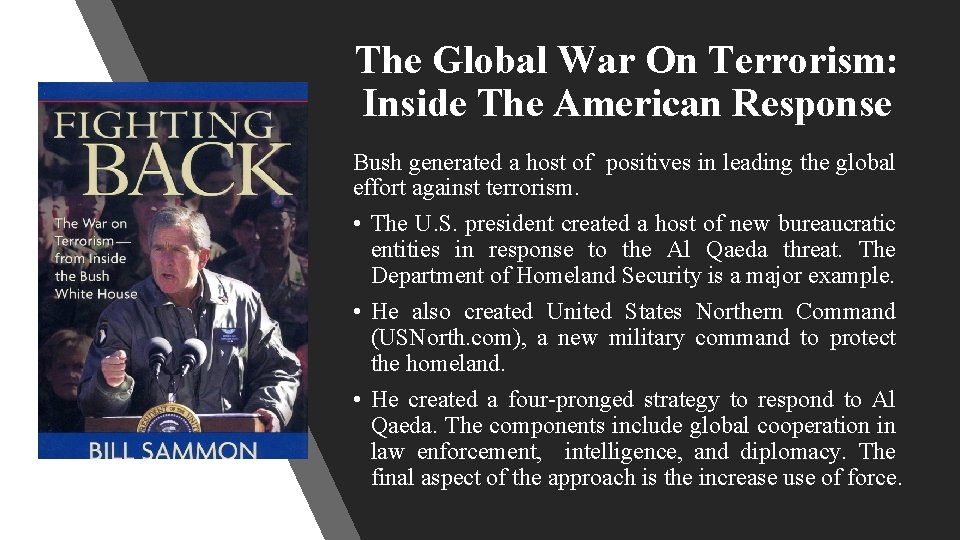
The Global War On Terrorism: Inside The American Response Bush generated a host of positives in leading the global effort against terrorism. • The U. S. president created a host of new bureaucratic entities in response to the Al Qaeda threat. The Department of Homeland Security is a major example. • He also created United States Northern Command (USNorth. com), a new military command to protect the homeland. • He created a four-pronged strategy to respond to Al Qaeda. The components include global cooperation in law enforcement, intelligence, and diplomacy. The final aspect of the approach is the increase use of force.
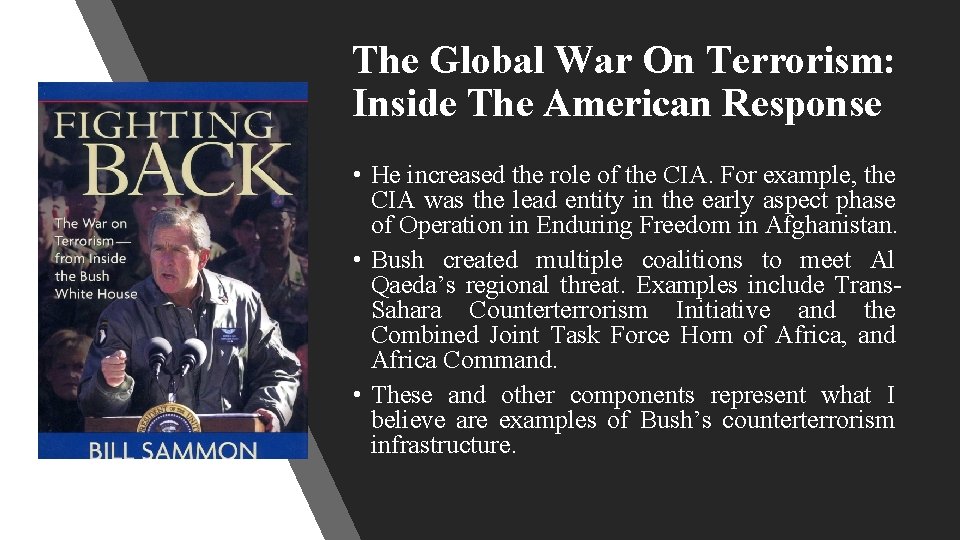
The Global War On Terrorism: Inside The American Response • He increased the role of the CIA. For example, the CIA was the lead entity in the early aspect phase of Operation in Enduring Freedom in Afghanistan. • Bush created multiple coalitions to meet Al Qaeda’s regional threat. Examples include Trans. Sahara Counterterrorism Initiative and the Combined Joint Task Force Horn of Africa, and Africa Command. • These and other components represent what I believe are examples of Bush’s counterterrorism infrastructure.
The Global War On Terrorism: Inside The American Response • Bush made extensive of SOFs. For example, many participated in counterterrorism raids against Al Qaeda and their affiliates. • From another perspective, the SOFs were dispatched to train foreign militaries to deal with the Al Qaeda threat. • Bush made extensive use of the UN in support of the war on terrorism. The UN was used an instrument to
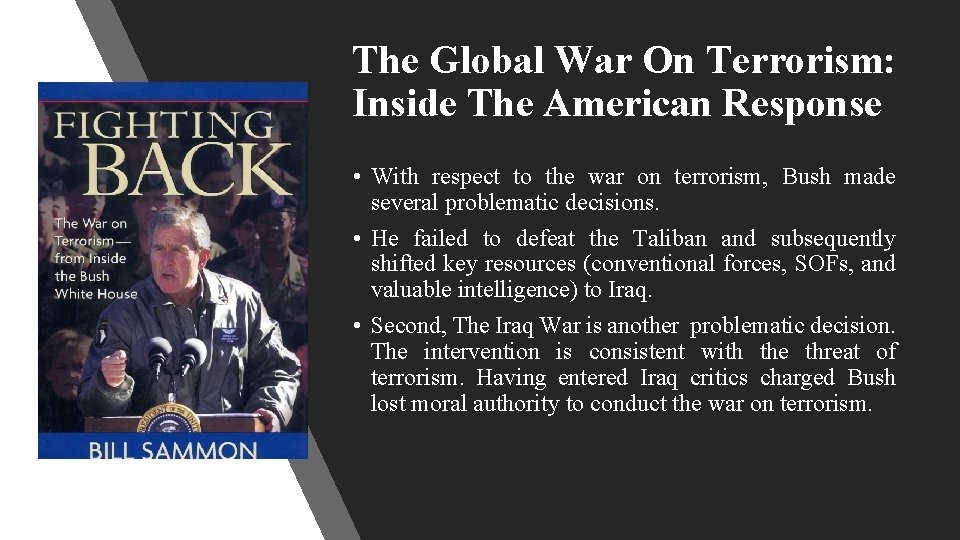
The Global War On Terrorism: Inside The American Response • With respect to the war on terrorism, Bush made several problematic decisions. • He failed to defeat the Taliban and subsequently shifted key resources (conventional forces, SOFs, and valuable intelligence) to Iraq. • Second, The Iraq War is another problematic decision. The intervention is consistent with the threat of terrorism. Having entered Iraq critics charged Bush lost moral authority to conduct the war on terrorism.
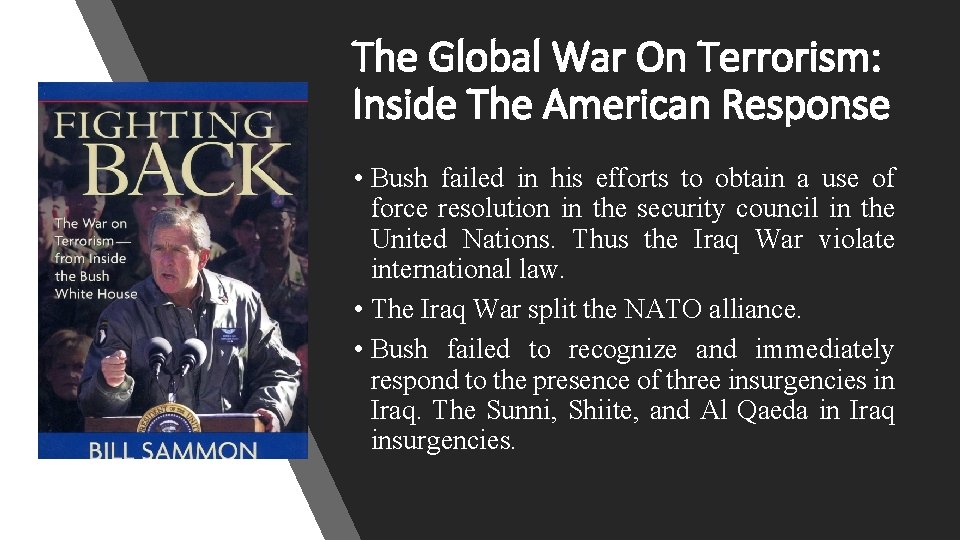
The Global War On Terrorism: Inside The American Response • Bush failed in his efforts to obtain a use of force resolution in the security council in the United Nations. Thus the Iraq War violate international law. • The Iraq War split the NATO alliance. • Bush failed to recognize and immediately respond to the presence of three insurgencies in Iraq. The Sunni, Shiite, and Al Qaeda in Iraq insurgencies.
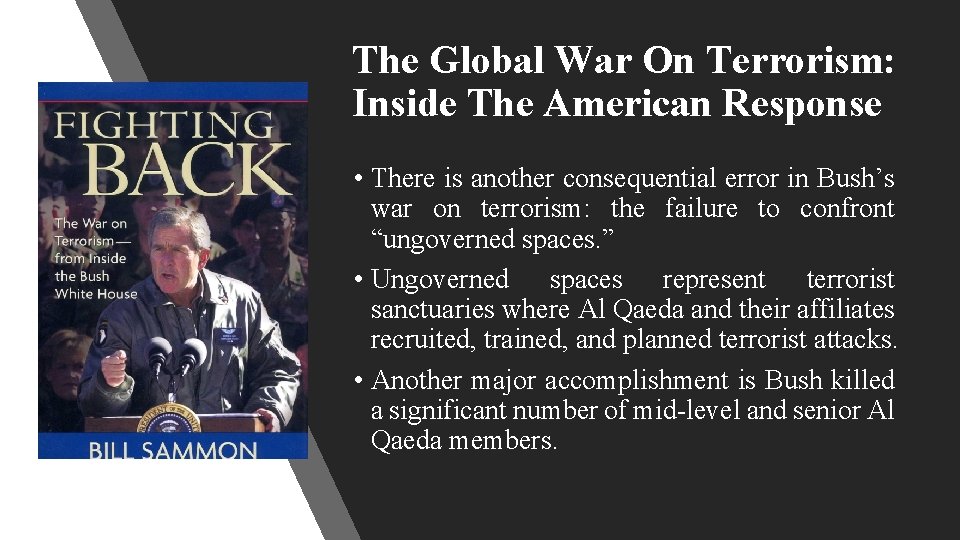
The Global War On Terrorism: Inside The American Response • There is another consequential error in Bush’s war on terrorism: the failure to confront “ungoverned spaces. ” • Ungoverned spaces represent terrorist sanctuaries where Al Qaeda and their affiliates recruited, trained, and planned terrorist attacks. • Another major accomplishment is Bush killed a significant number of mid-level and senior Al Qaeda members.
The Global War On Terrorism: Inside The American Response • President Obama moved swiftly to transform his response to the war on terrorism. • For starters, the president informed the world his administration would no longer use the words “war on terrorism. ” • Obama signed executive orders ending torture (enhanced interrogation techniques) and the closure of GITMO. • Obama attempted to transform how the U. S. military would use force against transnational terrorism. This meant restrictions that undercut U. S. air power and special operations capabilities.
The Global War On Terrorism: Inside The American Response • Though he did not like the use of drones and SOFs, during his initial two years in office, he accelerated the use of CIA drone strikes in Somalia, Yemen, and Afghanistan. • Overall, the drone strikes were highly successful; however, because of the civilian casualties Obama made the decision to curtain drone strikes. • The authorization of the order to kill Osama bin Laden represents a major victory for the president and the prosecution of the war on terrorism.
The Global War On Terrorism: Inside The American Response • After the killing of bin Laden, and subsequent manned and unmanned air strikes and SOFs raids that significantly impacted Al Qaeda’s hierarchy, Obama made the unfortunate decision to launch a campaign that all had been “decimated” and ultimately, they were “defeated. ” • Another critical mistake is “low balling” the threat posed by Islamic State. • This meant Obama failed to defeat ISIS in their infancy. • Taken collectively, Obama’s subsequent anti-ISIS strategy proved insufficient.
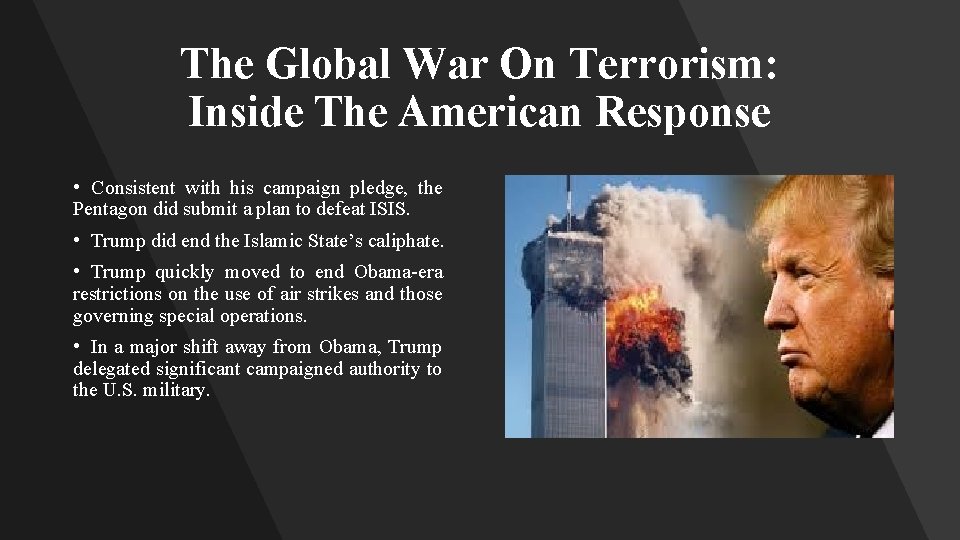
The Global War On Terrorism: Inside The American Response • Consistent with his campaign pledge, the Pentagon did submit a plan to defeat ISIS. • Trump did end the Islamic State’s caliphate. • Trump quickly moved to end Obama-era restrictions on the use of air strikes and those governing special operations. • In a major shift away from Obama, Trump delegated significant campaigned authority to the U. S. military.
The Global War On Terrorism: Inside The American Response • Trump is credited with authorization of killing Islamic State leader Abu al-Baghdadi, Iran’s General Qasem Soleimani, Al Qaeda’s Hamza bin Laden. • He ended the Obama-era aversion to place SOF’s at the frontline in Iraq, Syria, and beyond. • Trump accelerated U. S. operations against AQAP in Yemen, Al Shabab in Somalia. • In addition, the president hammered ISIS affiliates in around the world. • He pushed for joint Afghan and Taliban government in Afghanistan.
The Global War On Terrorism: Inside The American Response • There are critical issues with Trump and the war on terrorism. Most notably, his penchant to announce the withdrawal of U. S. force in Syria. • As is the case with Bush and Obama, Trump and the U. S. military failed to react to and adjust the strategy as the Islamic State shift from terrorists to insurgents. • Another issue is the dilemma of U. S. forces in Africa. The Trump administration’s National Military Strategy (NMS), recognized China and Russia are the dominant threats to the United States. These “state threats” meant that terrorism (a non-state threat) is no longer the top priority. This decision meant the need to move more troops to Asia to confront China and in Europe to deal with Russia. The issue that remains is what about the current status of U. S. troops in Africa?
The Global War On Terrorism: Inside The American Response On Problems/Threats: • The U. S. government has failed to eliminate “ungoverned spaces which allows terrorist groups to thrive. • Al Qaeda and the Islamic State have made extensive use of cyberspace to radicalize recruits and to increase recruitment. • The U. S. failed to reduce Al Qaeda’s sanctuaries around the world. Currently, there are more sanctuaries than prior to September 11, 2001.
The Global War On Terrorism: Inside The American Response • Another significant issue is the absence of continuity by the U. S. in terms of consistent strategies and commitment is critical if the war on terror is to be won. • Intelligence must improve to defeat the next iteration. That is, what is the next major terrorist group on the horizon? What steps are underway to prevent the emergence and maturity of the next threat? • Keep in mind it clear these questions were not addressed during the evolution of Al Qaeda and the Islamic State.
The Global War On Terrorism: Inside The American Response Concluding Thoughts: • There are some interesting results associated with the U. S. -led war on terrorism. • The increasing use of force has occurred under Republican administrations. Similarly, the Department of Defense’s budget increased at higher levels under Republican administrations. • The available information indicates the emerging terror threats [Clinton administration (Al Qaeda) and Obama administration)] should have been defeated during their infancy. Instead, the threats expanded significantly under each administration.
The Global War On Terrorism: Inside The American Response • Though there is evidence the war is being won (end of the ISIS caliphate, reduction of Al Shabab’s hold on territory in Somalia, for example, killing high-number of terrorists around the world), no major terrorist organization has been eliminated around the world. • There is a critical need to restore “constant tactical advantages. ” That is, the U. S. is able to bring to power force to contain terrorism, but nearly ever major threat (Al Qaeda, Islamic State, Taliban) continue to adapt and thus survive.
The Global War On Terrorism: Inside The American Response • Regionally, poor governance and the failure of local troops to deal with local and transnational threats is continues to permit the presence of terrorist sanctuaries and assists with extremist expansion. • With the ongoing failure of local militaries to confront and eradicate threat, one must question if the U. S. and its NATO allies must rethink “the light-footprint strategy. ”
The Global War On Terrorism: Inside The American Response • Though there is evidence the war is being won (end of the ISIS caliphate, reduction of Al Shabab’s hold on territory in Somalia, for example, killing high-number of terrorists around the world), no major terrorist organization has been eliminated around the world. • There is a critical need to restore “constant tactical advantages. ” That is, the U. S. is able to bring to power force to contain terrorism, but nearly ever major threat (Al Qaeda, Islamic State, Taliban) continue to adapt and thus survive.
The Global War On Terrorism: Inside The American Response • There are several certainties associated with the war on terrorism. • The threat of terrorism will persist. Second, the U. S. will adjust their tactics to terrorist trends and in short order terrorist will counter those tactics. In short, a cycle continues to persist. • Third, the long war will proceed for the foreseeable future. • Finally, a great dilemma about the war on terrorism is the failure of the U. S. to define what constitutes victory. Additionally, how long will states, most certainly the developing states, be able to afford the costs of the war on terror.
- Slides: 23