
The Global Satellite Precipitation Constellation Current Status and
The Global Satellite Precipitation Constellation: Current Status and Future Requirements Chris Kidd 1 and many colleagues 1 Earth System Science Interdisciplinary Center, University of Maryland, and NASA/Goddard Space Flight Center, Greenbelt, USA. Tuesday 23 June 2020 8 am EST; noon UTC; 2 pm CEST; 9 pm JST
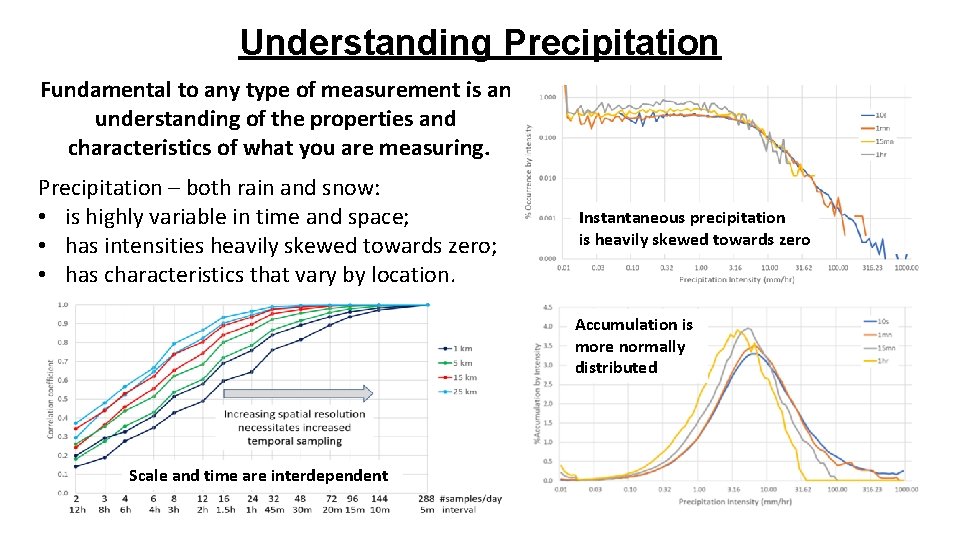
Understanding Precipitation Fundamental to any type of measurement is an understanding of the properties and characteristics of what you are measuring. Precipitation – both rain and snow: • is highly variable in time and space; • has intensities heavily skewed towards zero; • has characteristics that vary by location. Instantaneous precipitation is heavily skewed towards zero Accumulation is more normally distributed Scale and time are interdependent
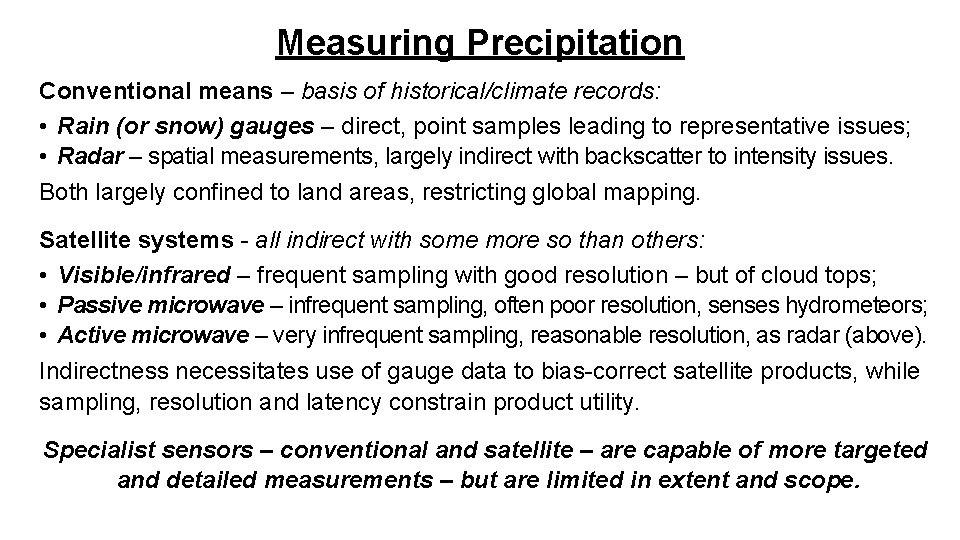
Measuring Precipitation Conventional means – basis of historical/climate records: • Rain (or snow) gauges – direct, point samples leading to representative issues; • Radar – spatial measurements, largely indirect with backscatter to intensity issues. Both largely confined to land areas, restricting global mapping. Satellite systems - all indirect with some more so than others: • Visible/infrared – frequent sampling with good resolution – but of cloud tops; • Passive microwave – infrequent sampling, often poor resolution, senses hydrometeors; • Active microwave – very infrequent sampling, reasonable resolution, as radar (above). Indirectness necessitates use of gauge data to bias-correct satellite products, while sampling, resolution and latency constrain product utility. Specialist sensors – conventional and satellite – are capable of more targeted and detailed measurements – but are limited in extent and scope.
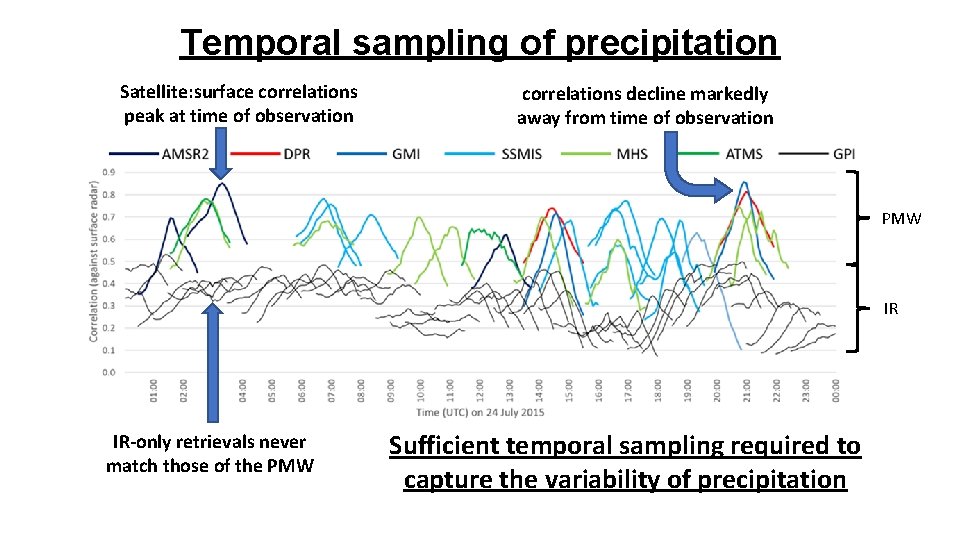
Temporal sampling of precipitation Satellite: surface correlations peak at time of observation correlations decline markedly away from time of observation PMW IR IR-only retrievals never match those of the PMW Sufficient temporal sampling required to capture the variability of precipitation
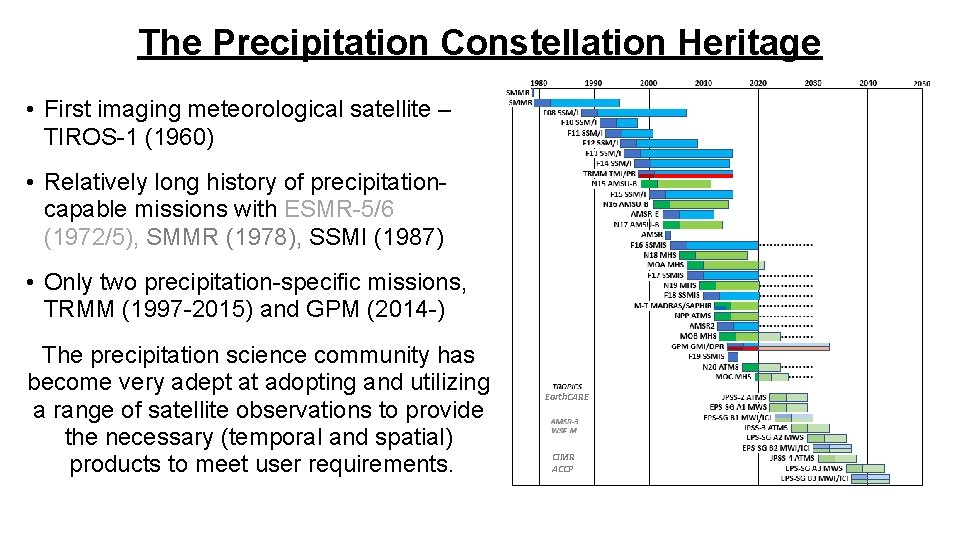
The Precipitation Constellation Heritage • First imaging meteorological satellite – TIROS-1 (1960) • Relatively long history of precipitationcapable missions with ESMR-5/6 (1972/5), SMMR (1978), SSMI (1987) • Only two precipitation-specific missions, TRMM (1997 -2015) and GPM (2014 -) The precipitation science community has become very adept at adopting and utilizing a range of satellite observations to provide the necessary (temporal and spatial) products to meet user requirements. Earth. CARE CIMR ACCP
Sustaining the precipitation constellation • All precipitation measurements (whether terrestrial or spaceborne) require sufficient sampling to properly represent the variations and characteristics of precipitation both spatially and temporally. • For passive microwave observations, 25 -km, 3 -hour is the current goal/standard, but <5 -km, <1 -hour is needed to be commensurate with precipitation characteristics. • A satellite ‘constellation’ is essential to achieve the sampling necessary to map global precipitation: the CEOS Precipitation Virtual Constellation (P-VC) group was set up in 2005 to facilitate/promote this. • The Global Precipitation Measurement (GPM) mission provides a pivotal role in achieving the VC goal: the Core Observatory and international partner satellites are the embodiment of the VC. • Precipitation-capable missions are in a constant state of flux, newer are missions incorporated into the constellation, while older missions expire.

GPM constellation: 2015 -present hrs Temporal sampling by latitude • GPM currently has about 12 precipitation-capable satellites, comprised of passive microwave imagers and sounders as well as a precipitation radar; • Baseline sampling goal is 3 -hourly 90% of the time, but has degraded over last 5 years; • Combined with geostationary IR data allows 30 -min, 10 -km products to be generated.
Evolution of the precipitation constellation New missions are being developed/readied all the time, such as: • TROPICS: constellation of 6 cubesats with PMW sounders - ready (longevity? ); • Earth. CARE: Doppler cloud radar (also light precipitation) – ready (? ) • NOAA/EUMETSAT: JPSS (sounders only) and EPS-SG (resolution? ) - ready; • AMSR-3: continuation of AMSR series (funded – 2023/24 launch planned ); • WSF-M: US Do. D follow-on to the DMSP-series (only two? ); • CIMR: EC Copernicus PMW imaging mission (no channels >37 GHz); • ACCP: implementing recommendation of the Decadal Survey (mapping? ). Ø incorporating these new missions/sensors into current constellation, particularly in terms of long-term measurements and stability, and; Ø providing a framework for future missions that meet the requirements of the scientific and user community.
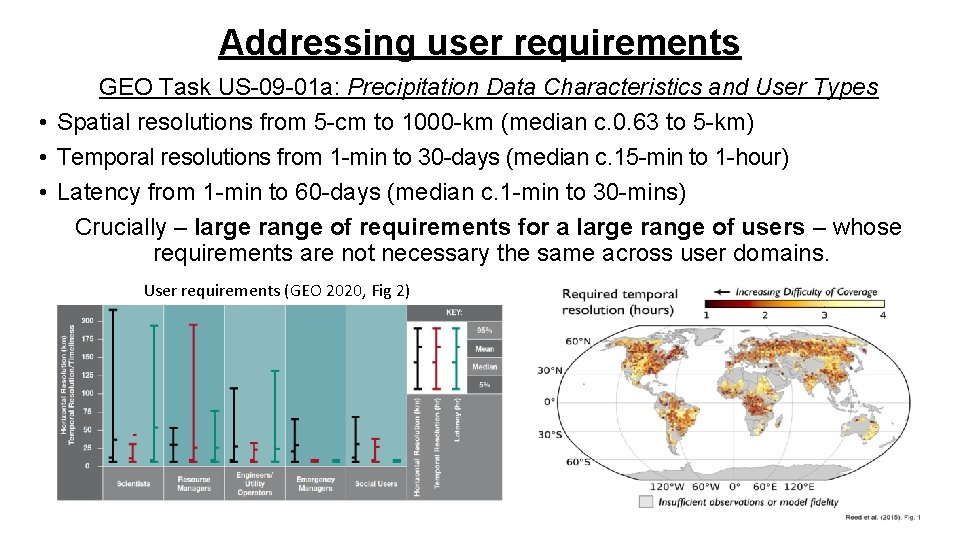
Addressing user requirements GEO Task US-09 -01 a: Precipitation Data Characteristics and User Types • Spatial resolutions from 5 -cm to 1000 -km (median c. 0. 63 to 5 -km) • Temporal resolutions from 1 -min to 30 -days (median c. 15 -min to 1 -hour) • Latency from 1 -min to 60 -days (median c. 1 -min to 30 -mins) Crucially – large range of requirements for a large range of users – whose requirements are not necessary the same across user domains. User requirements (GEO 2020, Fig 2)
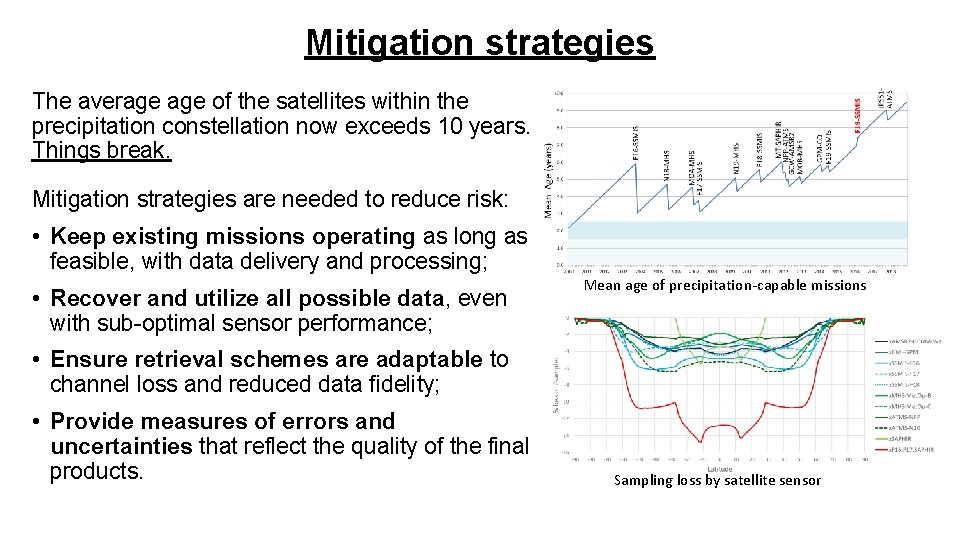
Mitigation strategies The average of the satellites within the precipitation constellation now exceeds 10 years. Things break. Mitigation strategies are needed to reduce risk: • Keep existing missions operating as long as feasible, with data delivery and processing; • Recover and utilize all possible data, even with sub-optimal sensor performance; Mean age of precipitation-capable missions • Ensure retrieval schemes are adaptable to channel loss and reduced data fidelity; • Provide measures of errors and uncertainties that reflect the quality of the final products. Sampling loss by satellite sensor
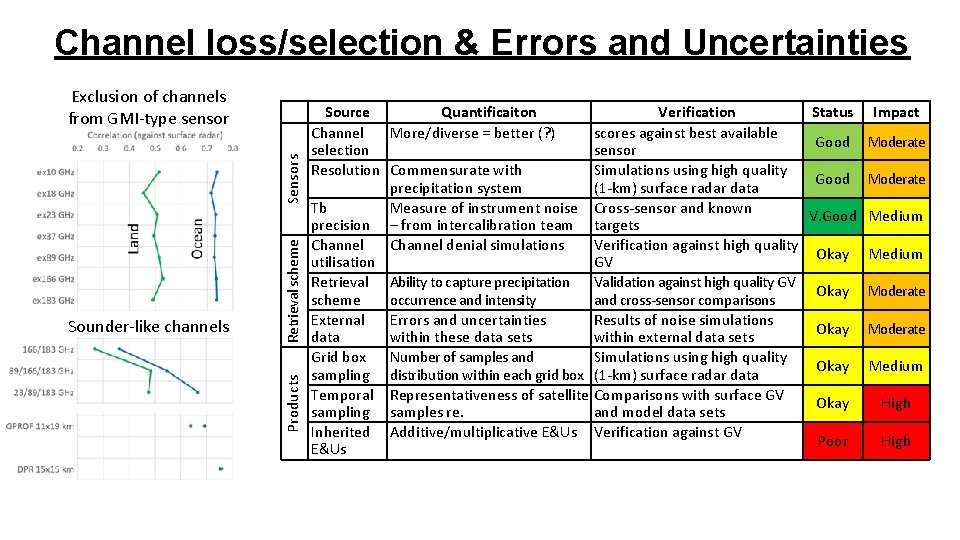
Channel loss/selection & Errors and Uncertainties Products Sounder-like channels Retrieval scheme Sensors Exclusion of channels from GMI-type sensor Source Quantificaiton Verification Status Impact Channel More/diverse = better (? ) scores against best available Good Moderate selection sensor Resolution Commensurate with Simulations using high quality Good Moderate precipitation system (1 -km) surface radar data Tb Measure of instrument noise Cross-sensor and known V. Good Medium precision – from intercalibration team targets Channel denial simulations Verification against high quality Okay Medium utilisation GV Retrieval Ability to capture precipitation Validation against high quality GV Okay Moderate scheme occurrence and intensity and cross-sensor comparisons External Errors and uncertainties Results of noise simulations Okay Moderate data within these data sets within external data sets Grid box Number of samples and Simulations using high quality Okay Medium sampling distribution within each grid box (1 -km) surface radar data Temporal Representativeness of satellite Comparisons with surface GV Okay High sampling samples re. and model data sets Inherited Additive/multiplicative E&Us Verification against GV Poor High E&Us
Conclusions • The measurement of precipitation on a global scale is only possible from satellite sensors; • A constellation of precipitation-capable satellite sensors are essential to achieve the necessary temporal sampling: individual sensors need sufficient spatial resolution to capture the spatial variability; • Sustaining and maintaining the constellation is complex, particularly with new sensors incorporating new technology; • Mitigation strategies can help to maximise the utility of available observations and provide a more robust constellation. The crucial question is how to maintain a (virtual) constellation that meets the requirements of both the user community, while addressing the need to further understand precipitation systems?
• The Global Satellite Precipitation Constellation: Current Status and Future Requirement Chris Kidd (NASA GSFC, University of Maryland) (20 min) • Status and Plan of Japanese Microwave Precipitation-related Missions Misako Kachi and Takuji Kubota (JAXA) (20 min) • Overview of the NASA TROPICS Constellation Mission and Capabilities for Precipitation Sensing William Blackwell (MIT) and Scott Braun (NASA GSFC) (20 min) • The EPS-SG and Copernicus Microwave and Sub-mm Wave Imaging Radiometers Vinia Mattioli and Christophe Accadia (EUMETSAT) (20 min) • Open discussion (40 min)
- Slides: 13