
The Global Observing System for Climate GCOS and
The Global Observing System for Climate GCOS and the need for coordination of terrestrial observations Simon Eggleston GCOS Secretariat
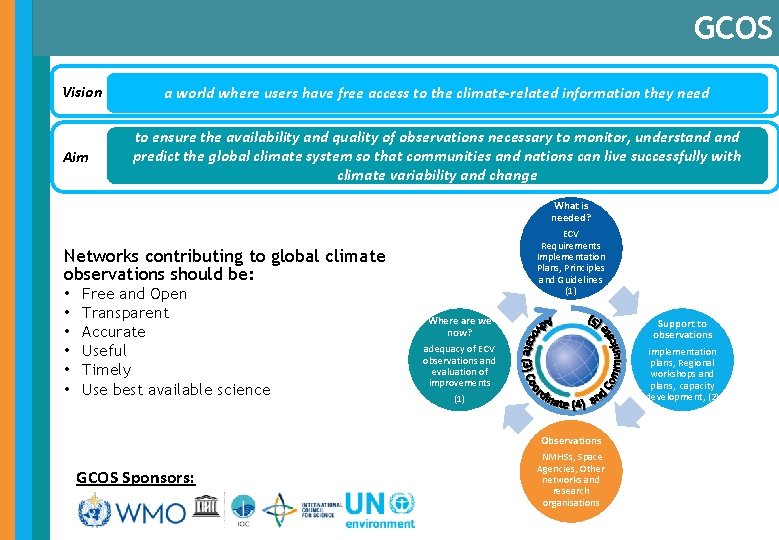
GCOS Vision Aim a world where users have free access to the climate-related information they need to ensure the availability and quality of observations necessary to monitor, understand predict the global climate system so that communities and nations can live successfully with climate variability and change What is needed? ECV Requirements Implementation Plans, Principles and Guidelines (1) Networks contributing to global climate observations should be: • • • Free and Open Transparent Accurate Useful Timely Use best available science GCOS Sponsors: Where are we now? adequacy of ECV observations and evaluation of improvements (1) Support to observations implementation plans, Regional workshops and plans, capacity development, (2) Observations NMHSs, Space Agencies, Other networks and research organisations
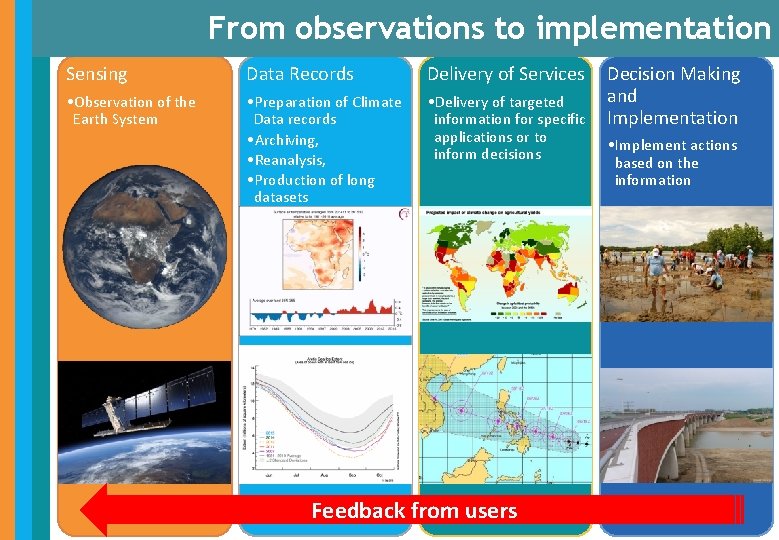
From observations to implementation Sensing Data Records Delivery of Services • Observation of the Earth System • Preparation of Climate Data records • Archiving, • Reanalysis, • Production of long datasets • Delivery of targeted information for specific applications or to inform decisions Feedback from users Decision Making and Implementation • Implement actions based on the information
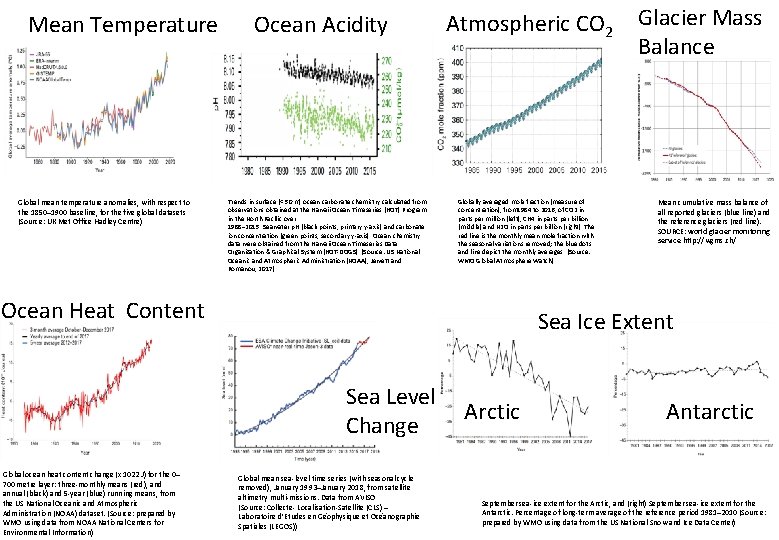
Mean Temperature Global mean temperature anomalies, with respect to the 1850– 1900 baseline, for the five global datasets (Source: UK Met Office Hadley Centre) Ocean Acidity Trends in surface (< 50 m) ocean carbonate chemistry calculated from observations obtained at the Hawaii Ocean Timeseries (HOT) Program in the North Pacific over 1988– 2015. Seawater p. H (black points, primary y-axis) and carbonate ion concentration (green points, secondary y-axis). Ocean chemistry data were obtained from the Hawaii Ocean Timeseries Data Organization & Graphical System (HOT-DOGS). (Source: US National Oceanic and Atmospheric Administration (NOAA), Jewett and Romanou, 2017) Atmospheric CO 2 Globally averaged mole fraction (measure of concentration), from 1984 to 2016, of CO 2 in parts per million (left), CH 4 in parts per billion (middle) and N 2 O in parts per billion (right). The red line is the monthly mean mole fraction with the seasonal variations removed; the blue dots and line depict the monthly averages. (Source: WMO Global Atmosphere Watch) Ocean Heat Content Mean cumulative mass balance of all reported glaciers (blue line) and the reference glaciers (red line). SOURCE: world glacier monitoring service http: //wgms. ch/ Sea Ice Extent Sea Level Change Global ocean heat content change (x 1022 J) for the 0– 700 metre layer: three-monthly means (red), and annual (black) and 5 -year (blue) running means, from the US National Oceanic and Atmospheric Administration (NOAA) dataset. (Source: prepared by WMO using data from NOAA National Centers for Environmental Information) Glacier Mass Balance Global mean sea-level time series (with seasonal cycle removed), January 1993–January 2018, from satellite altimetry multi-missions. Data from AVISO (Source: Collecte- Localisation-Satellite (CLS) – Laboratoire d’Etudes en Géophysique et Océanographie Spatiales (LEGOS)) Arctic Antarctic September sea-ice extent for the Arctic, and (right) September sea-ice extent for the Antarctic. Percentage of long-term average of the reference period 1981– 2010 (Source: prepared by WMO using data from the US National Snow and Ice Data Center)
Why Terrestrial Coordination? • Other, non-climate, reasons for global observations include: • Biodiversity “EBV” • Ecosystem monitoring, e. g. wetlands, Ramsar Convention • Food security: agriculture and fisheries • Coordination can bring efficiency and improvements by • Ensuring one set of observations can meet these multiple needs • Reduce duplication • Allowing efficient use of scarce resources • Setting standards that meet multiple needs will improve data quality • Common data access and metadata standards will allow greater use of data • Exchanging information and experiences • Increase support for cross-domain actions: climate adaptation, SDGs etc. • Global phenomena are interrelated: • Deforestation contributes to climate change and loss of biodiversity and ecosystems • loss of biodiversity and ecosystems exacerbates climate change • Increasing CO 2 concentrations lead to changes in forests and plants, increasing ocean acidification, and changes in fisheries…
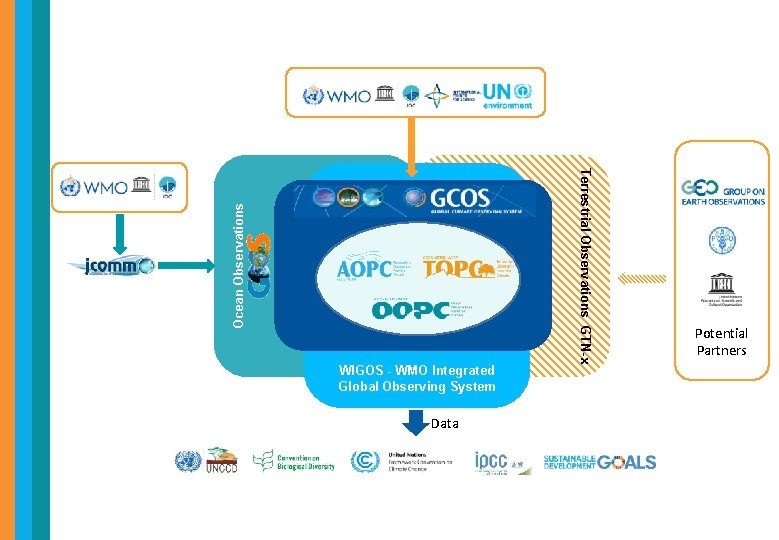
Ocean Observations Data Terrestrial Observations GTN-x WIGOS - WMO Integrated Global Observing System Potential Partners
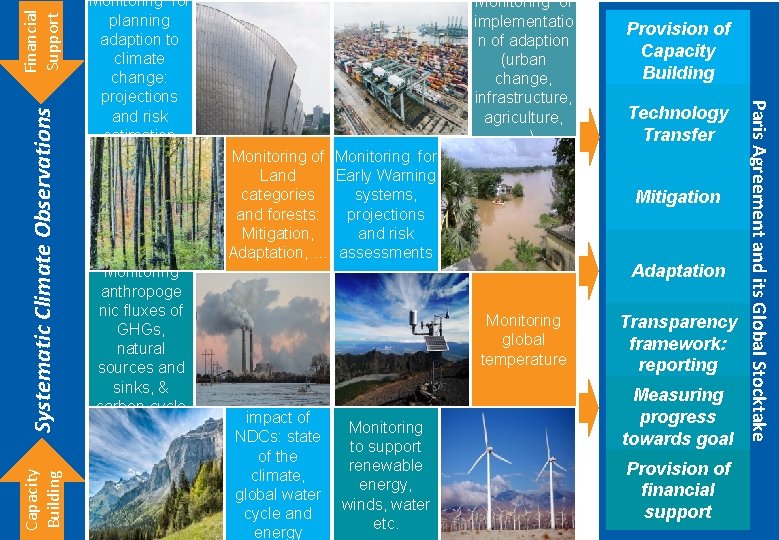
Financial Support Systematic Climate Observations Capacity Building Monitoring of implementatio n of adaption (urban change, infrastructure, agriculture, …) Monitoring of Monitoring for Early Warning Land systems, categories projections and forests: and risk Mitigation, Adaptation, … assessments Monitoring anthropoge nic fluxes of GHGs, natural sources and sinks, & carbon cycle Monitoring to support renewable energy, winds, water etc. Technology Transfer Mitigation Adaptation Monitoring global temperature Overall impact of NDCs: state of the climate, global water cycle and energy Provision of Capacity Building Transparency framework: reporting Measuring progress towards goal Provision of financial support Paris Agreement and its Global Stocktake Monitoring for planning adaption to climate change: projections and risk estimation
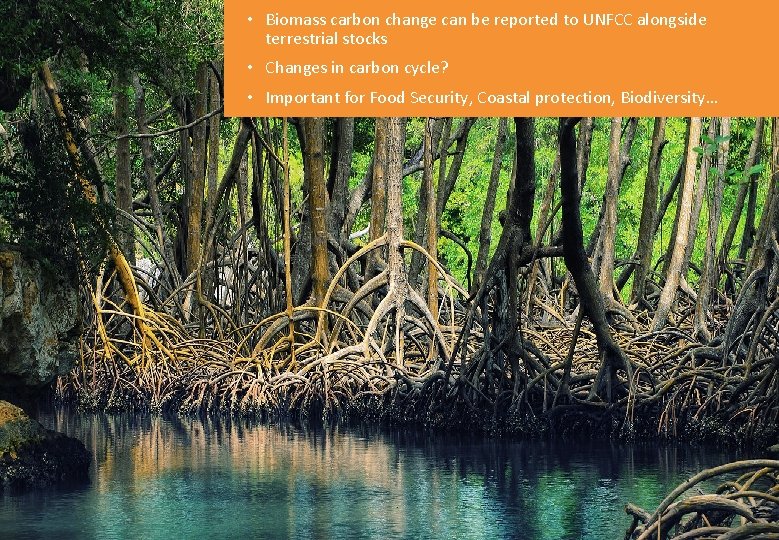
• Biomass carbon change can be reported to UNFCC alongside terrestrial stocks • Changes in carbon cycle? • Important for Food Security, Coastal protection, Biodiversity…
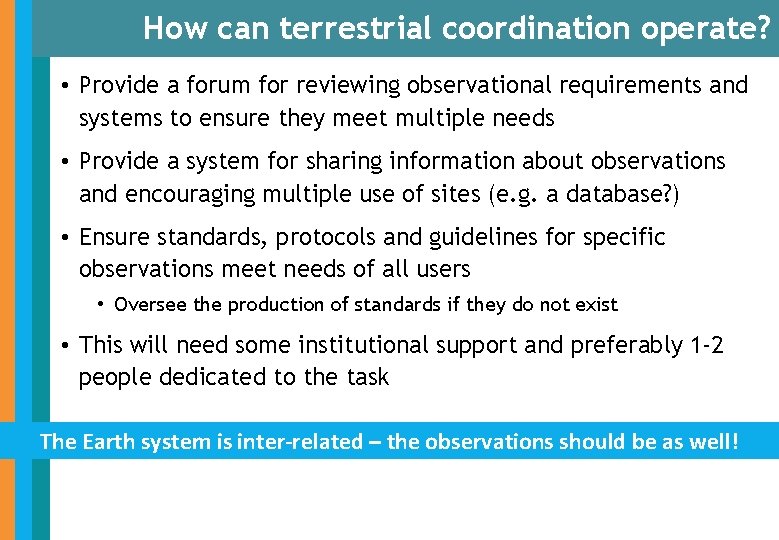
How can terrestrial coordination operate? • Provide a forum for reviewing observational requirements and systems to ensure they meet multiple needs • Provide a system for sharing information about observations and encouraging multiple use of sites (e. g. a database? ) • Ensure standards, protocols and guidelines for specific observations meet needs of all users • Oversee the production of standards if they do not exist • This will need some institutional support and preferably 1 -2 people dedicated to the task The Earth system is inter-related – the observations should be as well!
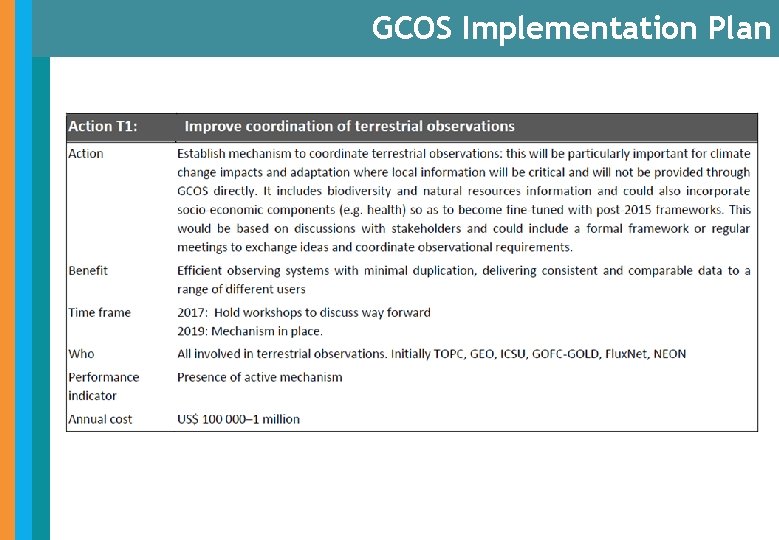
GCOS Implementation Plan
The Global Observing System for Climate Thank you
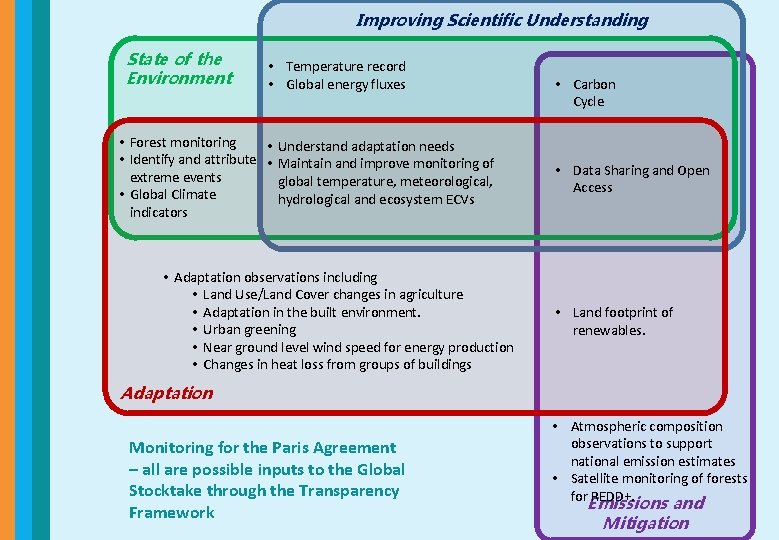
Improving Scientific Understanding State of the Environment • Temperature record • Global energy fluxes • Forest monitoring • Understand adaptation needs • Identify and attribute • Maintain and improve monitoring of extreme events global temperature, meteorological, • Global Climate hydrological and ecosystem ECVs indicators • Adaptation observations including • Land Use/Land Cover changes in agriculture • Adaptation in the built environment. • Urban greening • Near ground level wind speed for energy production • Changes in heat loss from groups of buildings • Carbon Cycle • Data Sharing and Open Access • Land footprint of renewables. Adaptation Monitoring for the Paris Agreement – all are possible inputs to the Global Stocktake through the Transparency Framework • Atmospheric composition observations to support national emission estimates • Satellite monitoring of forests for REDD+. Emissions and Mitigation
- Slides: 12