
The global impact of international migration What role
The global impact of international migration: What role does Asia play? Dr Elin Charles Edwards (ADRI Shanghai University, University of Queensland) Dr Aude Bernard (ADRI Shanghai University, University of Queensland) Dr Francisco Rowe (University of Liverpool, UK) Dr Guy Abel (ADRI Shanghai University) CRICOS code 00025 B

Study background • Popular perception that international migration is increasing over time. • In fact, recent estimates of bilateral global migration flows have demonstrated that the intensity of migration has declined (Abel and Sanders 2015) or been stable since the 1990 s (Azose and Raftery 2019). • Intensity is not the same as impact i. e. the alteration of the spatial distribution of populations. • Research questions: • Has the global impact of migration changed over time? • Are changes in migration impact due to differences in intensity or effectiveness? • What countries are contributing most to global migration impact and how has this shifted over time? • Draws on measures of migration impact developed in the internal migration literature (Bell et al. 2002; Rees et al. 2017) • Migration studies is split into internal and international migration, with different conceptual, theoretical and methodological standpoints (King and Skeldon 2010) CRICOS code 00025 B

Measuring Global Migration Impact (1) • The overall impact of net migration on the pattern of settlement is most captured in the Aggregate Net Migration Rate (ANMR), defined as half the sum of the absolute net migration aggregated across all countries, divided by the population at risk (Bell et al. 2002) • Where Di and Oi are inflows to and outflows from region i and P is the population summed across all countries. The ANMR thus measures the impact of migration on population redistribution: it identifies the net shift of population between countries per hundred persons. CRICOS code 00025 B
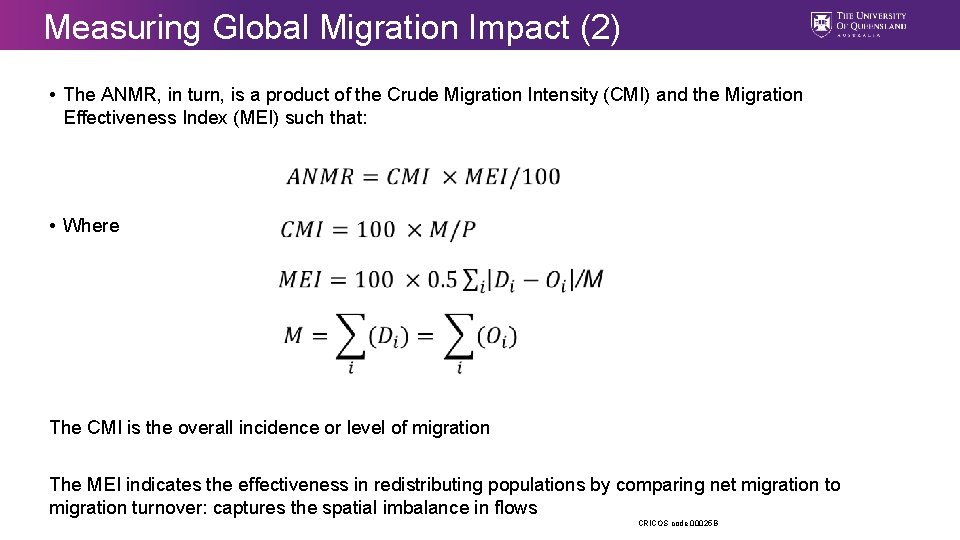
Measuring Global Migration Impact (2) • The ANMR, in turn, is a product of the Crude Migration Intensity (CMI) and the Migration Effectiveness Index (MEI) such that: • Where The CMI is the overall incidence or level of migration The MEI indicates the effectiveness in redistributing populations by comparing net migration to migration turnover: captures the spatial imbalance in flows CRICOS code 00025 B
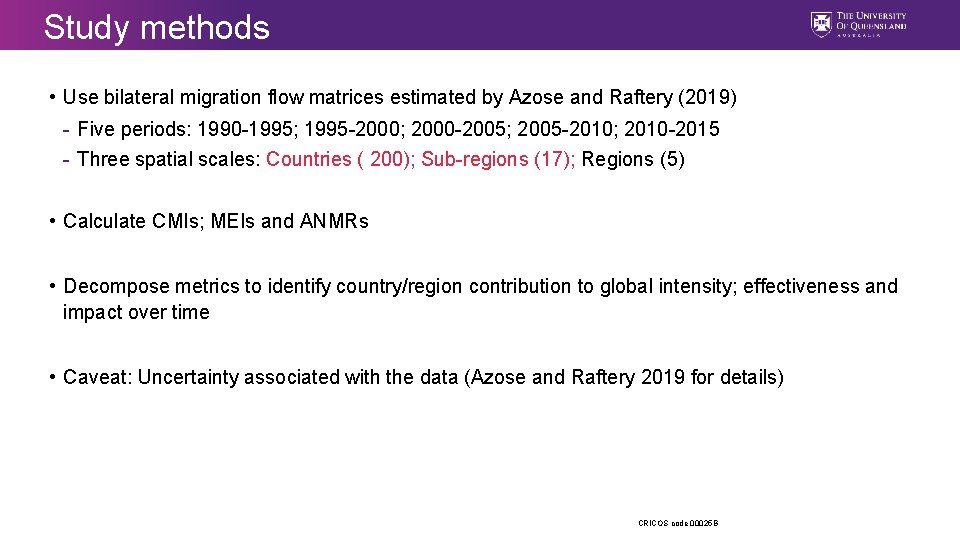
Study methods • Use bilateral migration flow matrices estimated by Azose and Raftery (2019) Five periods: 1990 1995; 1995 2000; 2000 2005; 2005 2010; 2010 2015 Three spatial scales: Countries ( 200); Sub regions (17); Regions (5) • Calculate CMIs; MEIs and ANMRs • Decompose metrics to identify country/region contribution to global intensity; effectiveness and impact over time • Caveat: Uncertainty associated with the data (Azose and Raftery 2019 for details) CRICOS code 00025 B

Migration intensity (CMI) Country Subregion Region 1, 40 1, 30 1, 20 CMI (%) 1, 10 1, 00 0, 90 0, 80 0, 70 0, 60 0, 50 0, 40 1995 2000 2005 2010 2015 Peaks in inter-country intensity occurred in 1990 -1995 and 2010 -2015 Inter-subregion and inter-region intensity peaked in 2005 -10 CRICOS code 00025 B
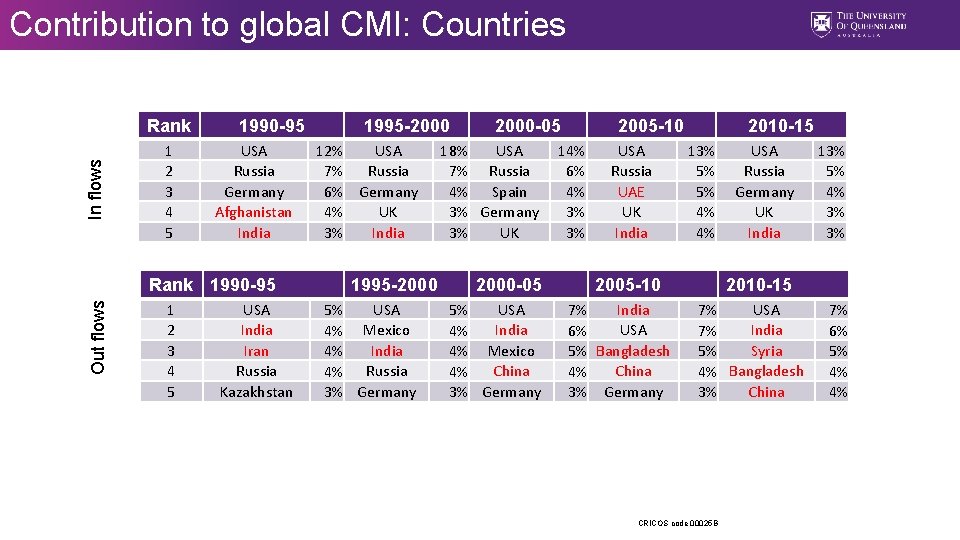
Contribution to global CMI: Countries In flows Rank 1 2 3 4 5 1990 -95 USA Russia Germany Afghanistan India Out flows Rank 1990 -95 1 2 3 4 5 USA India Iran Russia Kazakhstan 1995 -2000 USA 12% Russia 7% 6% Germany UK 4% India 3% 1995 -2000 USA 5% 4% Mexico India 4% 4% Russia 3% Germany 2000 -05 USA 18% 7% Russia 4% Spain 3% Germany UK 3% 2000 -05 USA 5% India 4% 4% Mexico China 4% 3% Germany 2005 -10 14% 6% 4% 3% 3% USA Russia UAE UK India 2010 -15 13% 5% 5% 4% 4% 2005 -10 India 7% USA 6% 5% Bangladesh China 4% 3% Germany USA Russia Germany UK India 13% 5% 4% 3% 3% 2010 -15 USA 7% India 7% Syria 5% 4% Bangladesh China 3% CRICOS code 00025 B 7% 6% 5% 4% 4%
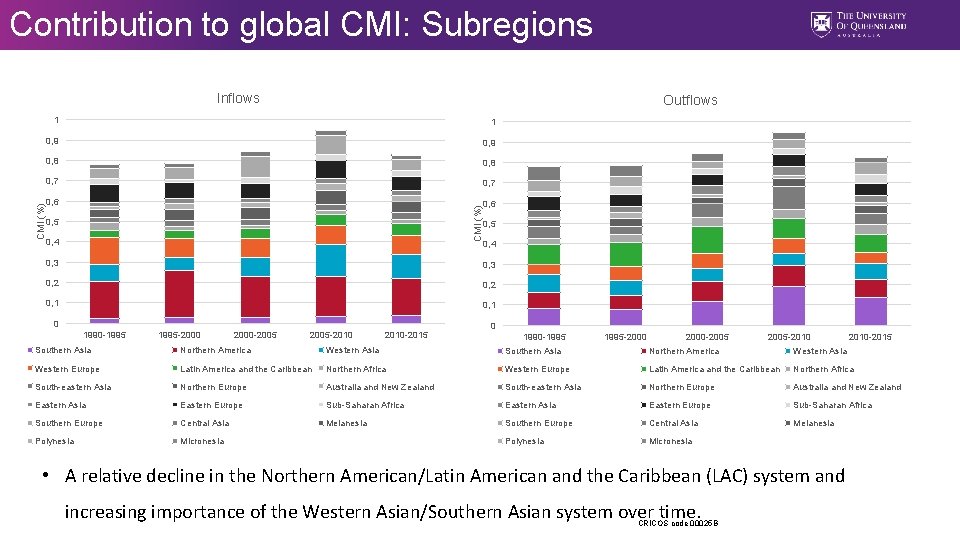
Contribution to global CMI: Subregions Outflows 1 1 0, 9 0, 8 0, 7 0, 6 CMI (%) Inflows 0, 5 0, 4 0, 3 0, 2 0, 1 0 1990 1995 2000 2005 2010 2015 Southern Asia Northern America Western Asia Western Europe Latin America and the Caribbean Northern Africa South eastern Asia Northern Europe Australia and New Zealand Eastern Asia Eastern Europe Sub Saharan Africa Southern Europe Central Asia Melanesia Polynesia Micronesia • A relative decline in the Northern American/Latin American and the Caribbean (LAC) system and increasing importance of the Western Asian/Southern Asian system over time. CRICOS code 00025 B
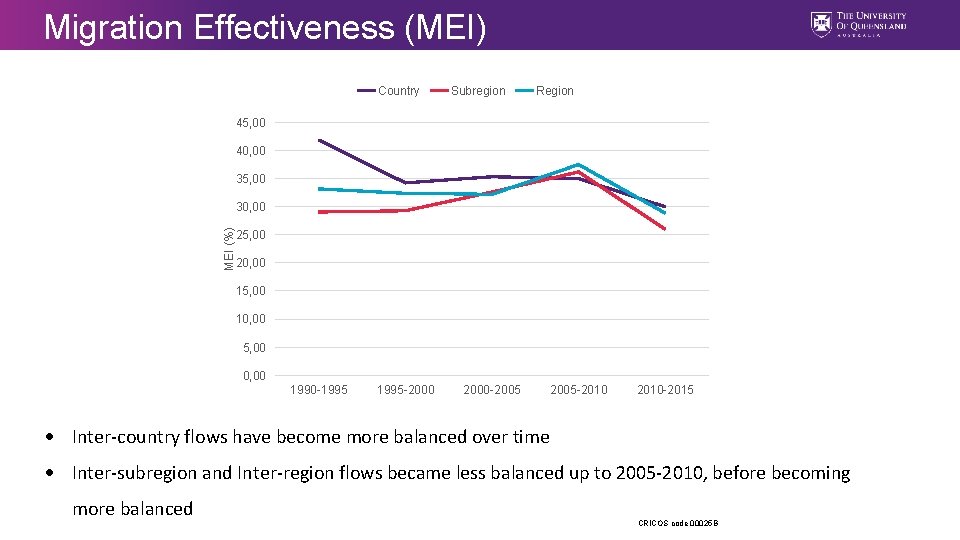
Migration Effectiveness (MEI) Country Subregion Region 45, 00 40, 00 35, 00 MEI (%) 30, 00 25, 00 20, 00 15, 00 10, 00 5, 00 0, 00 1995 2000 2005 2010 2015 Inter-country flows have become more balanced over time Inter-subregion and Inter-region flows became less balanced up to 2005 -2010, before becoming more balanced CRICOS code 00025 B
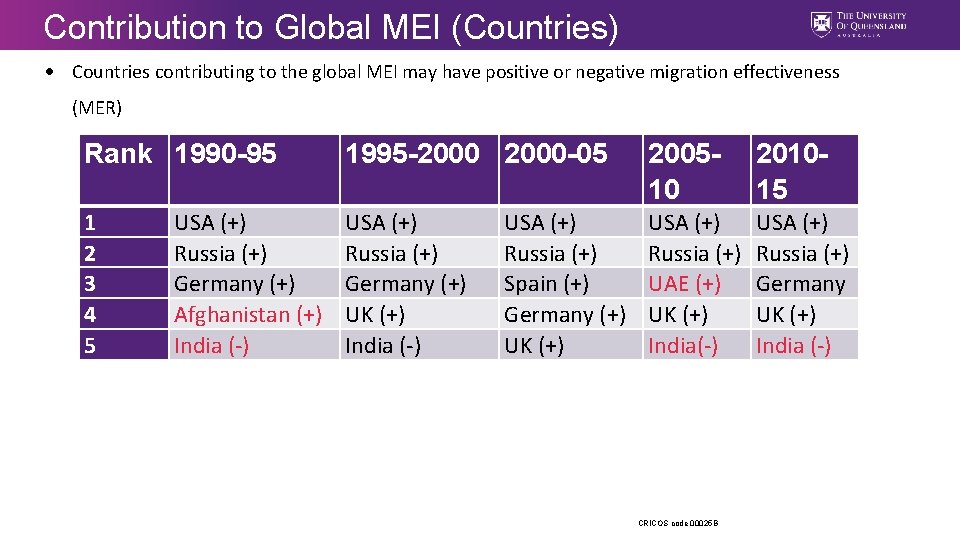
Contribution to Global MEI (Countries) Countries contributing to the global MEI may have positive or negative migration effectiveness (MER) Rank 1990 -95 1995 -2000 -05 200510 201015 1 2 3 4 5 USA (+) Russia (+) Germany (+) UK (+) India (-) USA (+) Russia (+) UAE (+) UK (+) India(-) USA (+) Russia (+) Germany UK (+) India (-) USA (+) Russia (+) Germany (+) Afghanistan (+) India (-) USA (+) Russia (+) Spain (+) Germany (+) UK (+) CRICOS code 00025 B
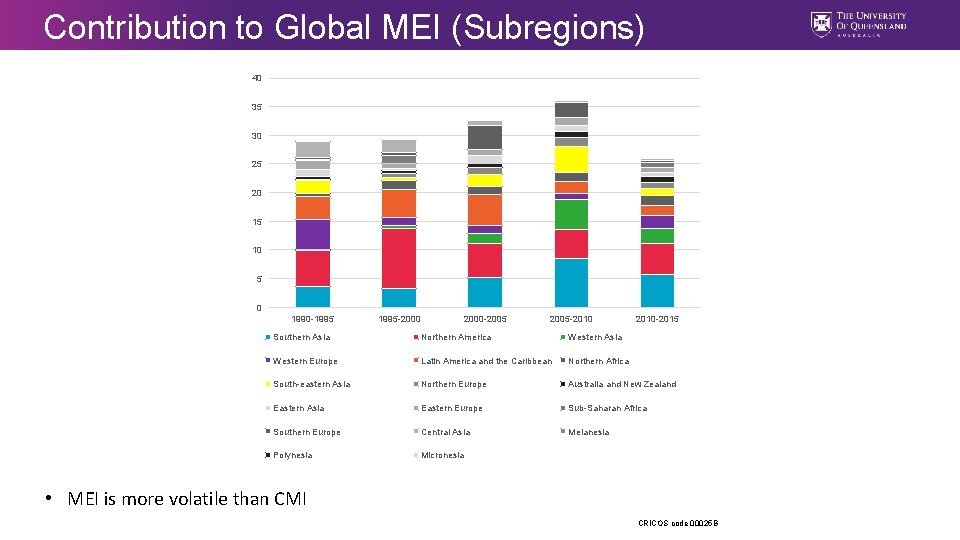
Contribution to Global MEI (Subregions) 40 35 30 25 20 15 10 5 0 1995 2000 2005 2010 2015 Southern Asia Northern America Western Asia Western Europe Latin America and the Caribbean Northern Africa South eastern Asia Northern Europe Australia and New Zealand Eastern Asia Eastern Europe Sub Saharan Africa Southern Europe Central Asia Melanesia Polynesia Micronesia • MEI is more volatile than CMI CRICOS code 00025 B
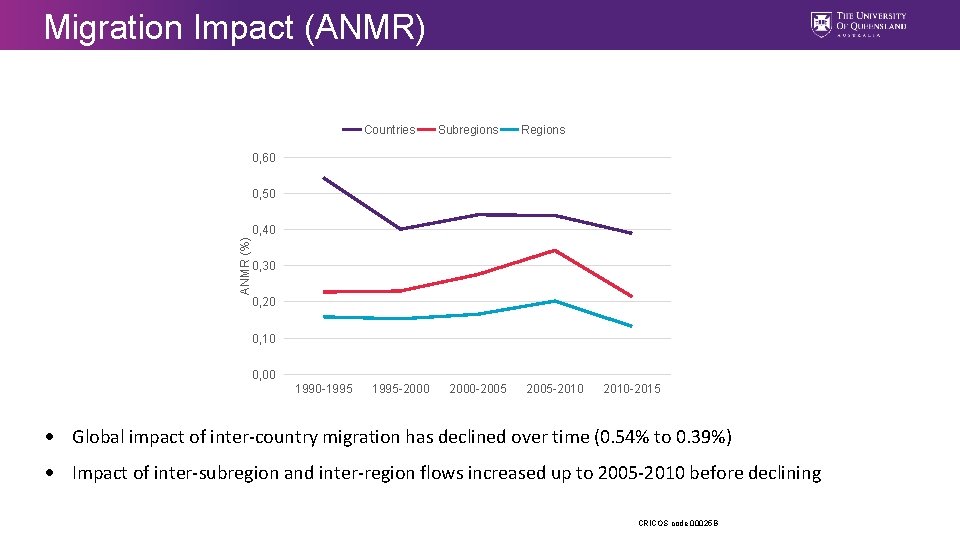
Migration Impact (ANMR) Countries Subregions Regions 0, 60 0, 50 ANMR (%) 0, 40 0, 30 0, 20 0, 10 0, 00 1995 2000 2005 2010 2015 Global impact of inter-country migration has declined over time (0. 54% to 0. 39%) Impact of inter-subregion and inter-region flows increased up to 2005 -2010 before declining CRICOS code 00025 B
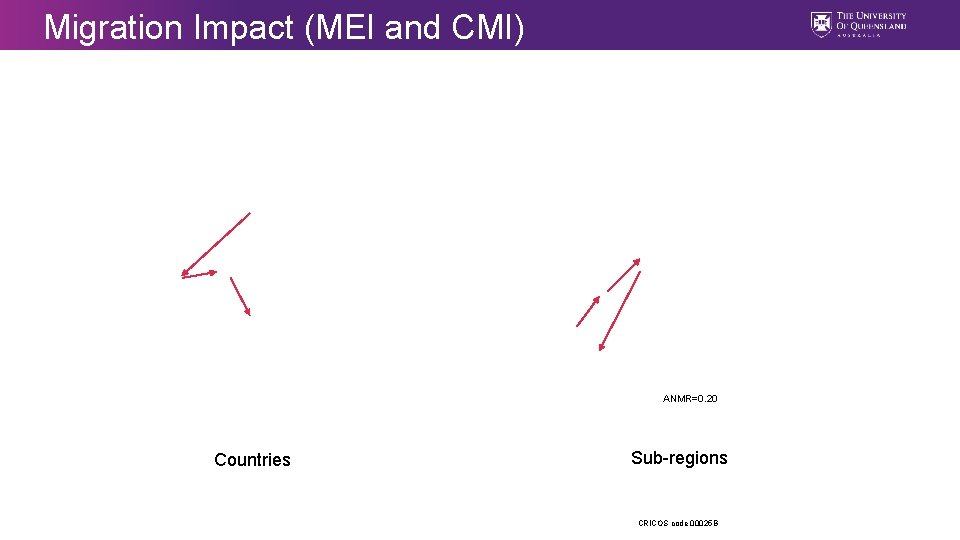
Migration Impact (MEI and CMI) ANMR=0. 20 Countries Sub regions CRICOS code 00025 B
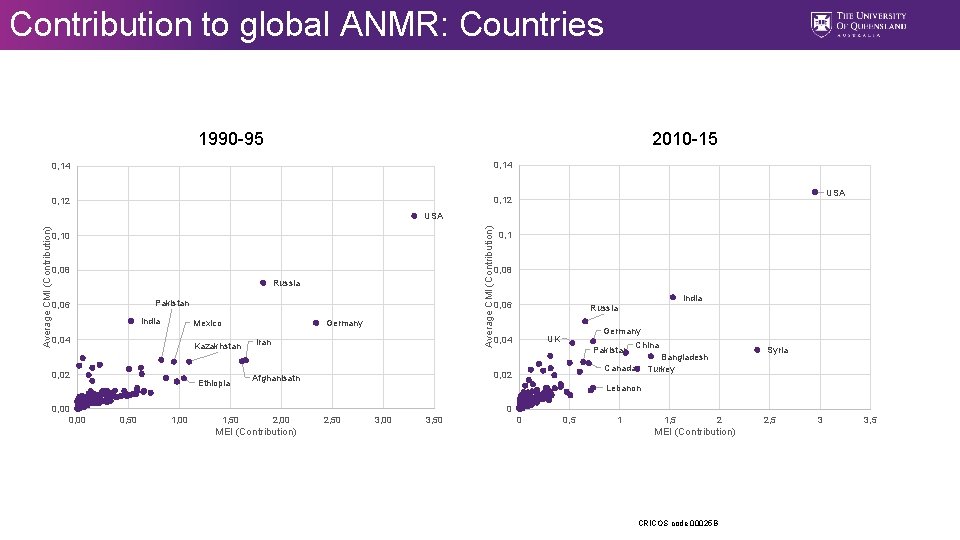
Contribution to global ANMR: Countries 1990 95 2010 15 0, 14 0, 12 USA Average CMI (Contribution) USA 0, 10 0, 08 Russia Pakistan 0, 06 India Mexico 0, 04 Kazakhstan 0, 02 0, 00 Germany Ethiopia Iran 0, 1 0, 08 0, 06 Germany UK 0, 04 Pakistan China Syria Bangladesh Turkey Canada 0, 02 Afghanisatn India Russia Lebanon 0 0, 50 1, 00 1, 50 2, 00 MEI (Contribution) 2, 50 3, 00 3, 50 0 0, 5 1 1, 5 2 MEI (Contribution) CRICOS code 00025 B 2, 5 3 3, 5
Contribution to global ANMR: Sub regions 1990 95 2010 15 CRICOS code 00025 B
Conclusion • Despite stable intensities, global impact of international migration (between countries) has declined since the early 1990 s due to a reduction in migration effectiveness (i. e. flows have become more balanced) Variations in results at different geographies (MAUP): Between subregions/ region, migration impact peaked between 2005 10 • Mix of countries contributing to global impact has changed over time due to shifting intensity and effectiveness USA had the largest impact over the 5 periods due to both high intensity and effectiveness Greater global impact of Asian migration systems in the recent period. • Underlines the sensitivity of global migration system to regional shocks and development of new migration networks • Benefits of applying metrics developed in the internal migration literature to international migration. • Repeat analysis for alternative estimates of international migration. CRICOS code 00025 B

Thank you Dr Elin Charles Edwards| Senior Lecturer School of Earth and Environmental Sciences e. charles edwards@uq. edu. au facebook. com/uniofqld Instagram. com/uniofqld elinched CRICOS code 00025 B
- Slides: 17