
The Global Economic Environment Global Marketing Chapter 2
The Global Economic Environment Global Marketing Chapter 2 1
The World Economy— An Overview • In the early 20 th century economic integration was at 10%; today it is 50% • Ford Fiesta – Ford’s first global car 2 -2 © 2011 Pearson Education, Inc. publishing as Prentice Hall

The World Economy— An Overview • The new realities: – Capital movements have replaced trade as the driving force of the world economy • 2007 world trade: $16. 9 trillion • Annual Forex transactions volume: $ 450 trillion – Productivity has become uncoupled from employment GDP continues to grow even if employment in manufacturing falls 2 -3 © 2011 Pearson Education, Inc. publishing as Prentice Hall
The World Economy— An Overview The new realities, continued: • The world economy, not individual countries, is the dominating factor • Greece and Spain debt crisis and the EU • 75 -year struggle between capitalism and socialism has almost ended – Fall of USSR (key holdouts: Cuba, North Korea, Venezuela) • E-Commerce diminishes the importance of national barriers and forces companies to re-evaluate business models (1 billion Internet users world wide) 2 -4 © 2011 Pearson Education, Inc. publishing as Prentice Hall

The World Economy: The Global Competitiveness Index • http: //www. weforum. org/en/initiatives/gcp/Global%20 Competiti veness%20 Report/index. htm – (check the document for individual country profiles) • World Economic Forum – 12 Pillars of Competitiveness: Quality of Institutions Labor market efficiency Quality of Infrastructure Financial market sophistication Macroeconomic stability Technological Readiness Health and Primary Education Market Size Higher education and training Business sophistication Goods market efficiency Innovation 2 -5 © 2011 Pearson Education, Inc. publishing as Prentice Hall
Weighted Average Index Basic requirements – Key for FACTOR-DRIVEN ECONOMIES • Institutions • Infrastructure • Macroeconomic stability • Health and primary education Efficiency enhancers – Key for EFFICIENCY-DRIVEN ECONOMIES • Higher education and training • Goods market efficiency • Labor market efficiency • Financial market sophistication • Technological readiness • Market size Innovation and sophistication factors – Key for INNOVATION-DRIVEN ECONOMIES • Business sophistication • Innovation 2 -6 © 2011 Pearson Education, Inc. publishing as Prentice Hall
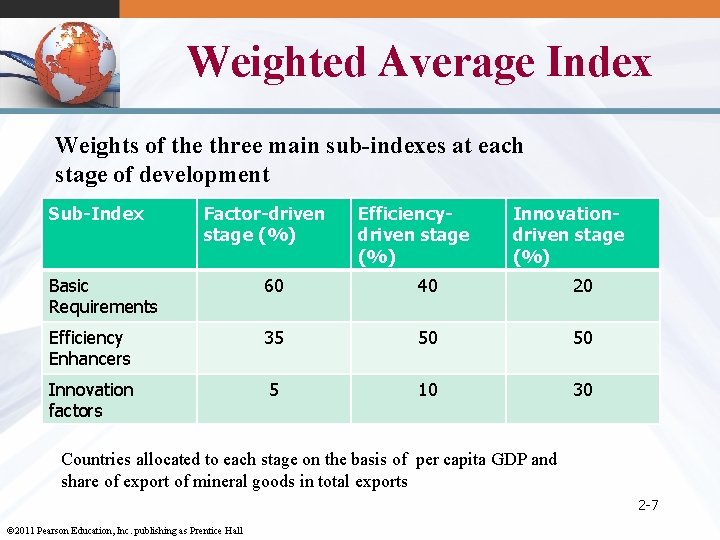
Weighted Average Index Weights of the three main sub-indexes at each stage of development Sub-Index Factor-driven stage (%) Efficiencydriven stage (%) Innovationdriven stage (%) Basic Requirements 60 40 20 Efficiency Enhancers 35 50 50 Innovation factors 5 10 30 Countries allocated to each stage on the basis of per capita GDP and share of export of mineral goods in total exports 2 -7 © 2011 Pearson Education, Inc. publishing as Prentice Hall
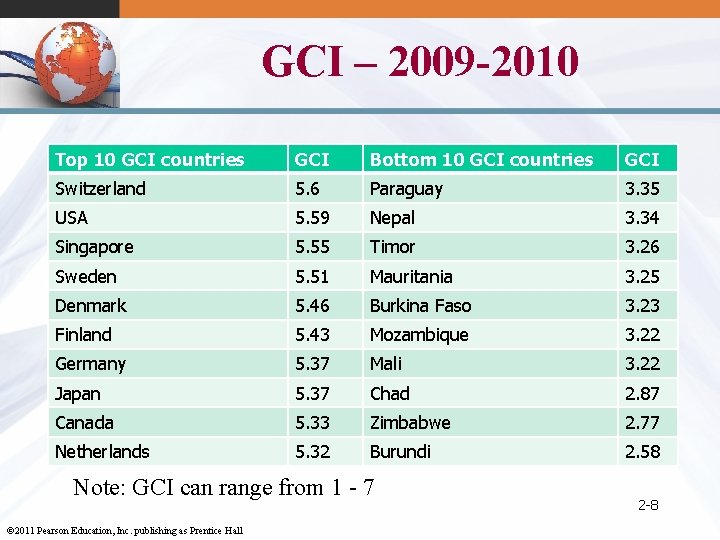
GCI – 2009 -2010 Top 10 GCI countries GCI Bottom 10 GCI countries GCI Switzerland 5. 6 Paraguay 3. 35 USA 5. 59 Nepal 3. 34 Singapore 5. 55 Timor 3. 26 Sweden 5. 51 Mauritania 3. 25 Denmark 5. 46 Burkina Faso 3. 23 Finland 5. 43 Mozambique 3. 22 Germany 5. 37 Mali 3. 22 Japan 5. 37 Chad 2. 87 Canada 5. 33 Zimbabwe 2. 77 Netherlands 5. 32 Burundi 2. 58 Note: GCI can range from 1 - 7 © 2011 Pearson Education, Inc. publishing as Prentice Hall 2 -8
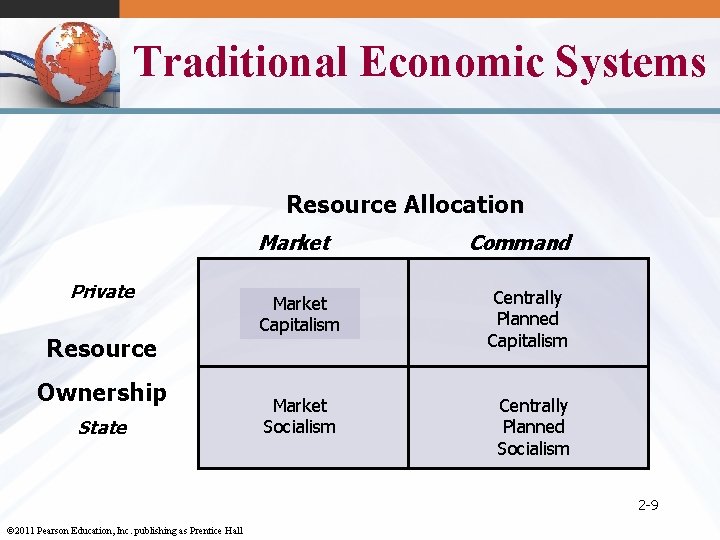
Traditional Economic Systems Resource Allocation Market Private Resource Ownership State Command Market Capitalism Centrally Planned Capitalism Market Socialism Centrally Planned Socialism 2 -9 © 2011 Pearson Education, Inc. publishing as Prentice Hall
Market Capitalism • • Individuals and firms allocate resources Production resources are privately owned Driven by consumers Government’s role is to promote competition among firms and ensure consumer protection • The “free” end of the spectrum – traditionally the US – now seeking to increase govt. control over some activities 2 -10 © 2011 Pearson Education, Inc. publishing as Prentice Hall
Centrally Planned Socialism • The ‘repressed’ end of the spectrum • State holds broad powers to serve the public interest; decides what goods and services are produced and in what quantities • Consumers can spend only what is available • Government owns entire industries and controls distribution • Demand typically exceeds supply • Little reliance on product differentiation, advertising, pricing strategy • Traditionally China, and the former USSR now moving towards some economic freedom 2 -11 © 2011 Pearson Education, Inc. publishing as Prentice Hall
Centrally Planned Capitalism and Market Socialism • In-between systems • CPC – Basically capitalist economies with greater state control on spending – Swedish government controls 2/3 s of all spending; Japan • MS – Basically socialist economies allowing for market allocation – India 2 -12 © 2011 Pearson Education, Inc. publishing as Prentice Hall
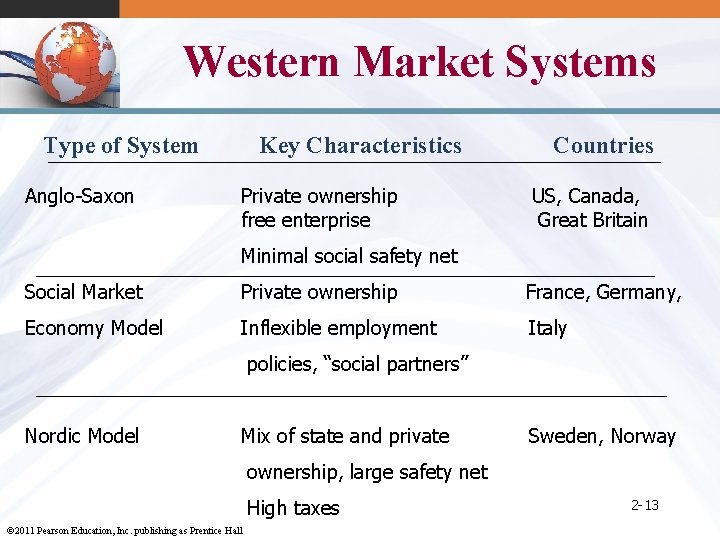
Western Market Systems Type of System Anglo-Saxon Key Characteristics Private ownership free enterprise Countries US, Canada, Great Britain Minimal social safety net Social Market Private ownership France, Germany, Economy Model Inflexible employment Italy policies, “social partners” Nordic Model Mix of state and private Sweden, Norway ownership, large safety net High taxes © 2011 Pearson Education, Inc. publishing as Prentice Hall 2 -13
Economic Freedom – Heritage Foundation, Washington DC • Rankings of economic freedom among countries – “free” “mostly unfree” “repressed” • Variables considered include such things as: – Trade policy (free…restrictive) – Taxation policy (high taxes…low taxes) – Capital flows and foreign investment (freely allowed…restricted) – Banking policy (extensive central bank controls) – Wage and price controls (govt. controls…market determination) – Property rights (private ownership…state ownership) – Black market (size) 2 -14 © 2011 Pearson Education, Inc. publishing as Prentice Hall
Economic Freedom— 2010 Rankings • http: //www. heritage. org/ind ex/Ranking. aspx 2 -15 © 2011 Pearson Education, Inc. publishing as Prentice Hall
Stages of Market Development • The World Bank has defined four categories of development using Gross National Income (GNI) as a base • BEMs, identified 10 years ago, were countries in Central Europe, Latin America, and Asia that were to have rapid economic growth • Today, the focus is on BRIC: Brazil, Russia, India, and China 2 -16 © 2011 Pearson Education, Inc. publishing as Prentice Hall
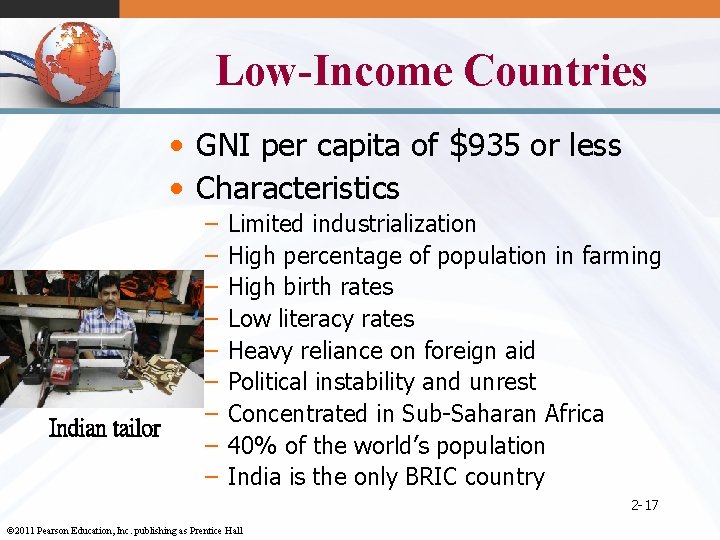
Low-Income Countries • GNI per capita of $935 or less • Characteristics Indian tailor – – – – – Limited industrialization High percentage of population in farming High birth rates Low literacy rates Heavy reliance on foreign aid Political instability and unrest Concentrated in Sub-Saharan Africa 40% of the world’s population India is the only BRIC country 2 -17 © 2011 Pearson Education, Inc. publishing as Prentice Hall
Lower-Middle-Income Countries • GNI per capita: $936 to $3, 705 • Characteristics – Rapidly expanding consumer markets – Cheap labor – Mature, standardized, labor-intensive industries like textiles and toys – China, Indonesia, Thailand • BRIC nation is China 2 -18 © 2011 Pearson Education, Inc. publishing as Prentice Hall

Upper-Middle-Income Countries • GNP per capita: $3, 706 to $11, 455 • Characteristics: – – – Rapidly industrializing, less agricultural employment Increasing urbanization Rising wages High literacy rates and advanced education Lower wage costs than advanced countries • Also called newly industrializing economies (NIEs) • Examples: Brazil, Russia, Malaysia, Chile, Venezuela, Hungary 2 -19 © 2011 Pearson Education, Inc. publishing as Prentice Hall
Marketing Opportunities in LDCs • Characterized by a shortage of goods and services • Long-term opportunities must be nurtured in these countries – Look beyond per capita GNP – Consider the LDCs collectively rather than individually – Consider first mover advantage – Set realistic deadlines 2 -20 © 2011 Pearson Education, Inc. publishing as Prentice Hall
Mistaken Assumptions about LDCs 1. The poor have no money. 2. The poor will not “waste” money on nonessential goods. 3. Entering developing markets is fruitless because goods there are too cheap to make a profit. 4. People in BOP (bottom of the pyramid) countries cannot use technology. 5. Global companies doing business in BOP countries will be seen as exploiting the poor. 2 -21 © 2011 Pearson Education, Inc. publishing as Prentice Hall
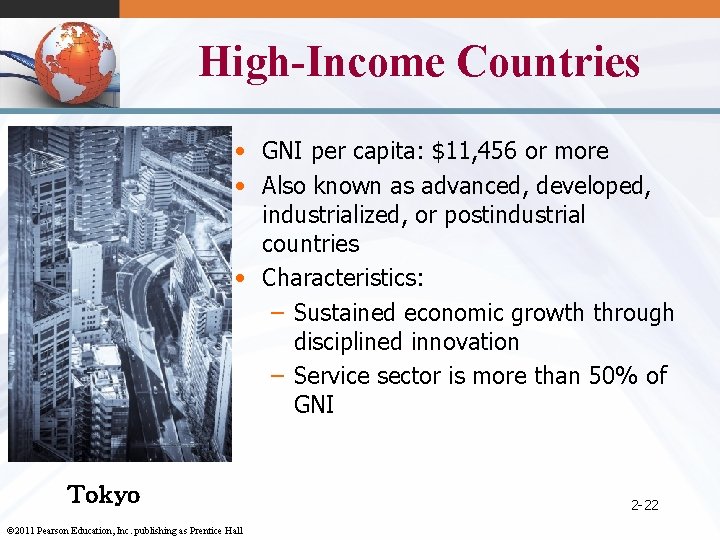
High-Income Countries • GNI per capita: $11, 456 or more • Also known as advanced, developed, industrialized, or postindustrial countries • Characteristics: – Sustained economic growth through disciplined innovation – Service sector is more than 50% of GNI Tokyo © 2011 Pearson Education, Inc. publishing as Prentice Hall 2 -22
High-Income Countries • Characteristics, continued: – Importance of information processing and exchange – Ascendancy of knowledge over capital, intellectual over machine technology, scientists and professionals over engineers and semiskilled workers – Future oriented – Importance of interpersonal relationships 2 -23 © 2011 Pearson Education, Inc. publishing as Prentice Hall
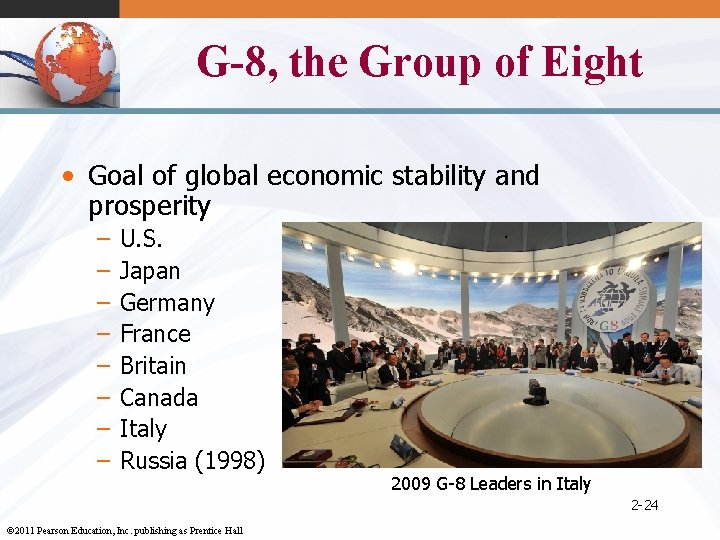
G-8, the Group of Eight • Goal of global economic stability and prosperity – – – – U. S. Japan Germany France Britain Canada Italy Russia (1998) 2009 G-8 Leaders in Italy 2 -24 © 2011 Pearson Education, Inc. publishing as Prentice Hall
OECD, the Organization for Economic Cooperation and Development • • 30 nations Post-WW II European origin Canada, U. S. (1961), Japan (1964) Promotes economic growth and social well-being • Focuses on world trade, global issues, labor market deregulation – Anti-bribery conventions 2 -25 © 2011 Pearson Education, Inc. publishing as Prentice Hall
The Triad • U. S. , Western Europe, and Japan • Represents 75% of world income • Expanded Triad includes all of North America and the Pacific Rim and most of Eastern Europe • Global companies should be equally strong in each part 2 -26 © 2011 Pearson Education, Inc. publishing as Prentice Hall
Product Saturation Levels • The % of potential buyers or households who own a product • India: 20% of people have telephones • Autos: 1 per 43, 000 Chinese; 21 per 100 Poles; 8 per 1, 000 Indians • Computers: 1 PC per 6, 000 Chinese; 11 PCs per Poles; 34 PCs per EU citizen 2 -27 © 2011 Pearson Education, Inc. publishing as Prentice Hall
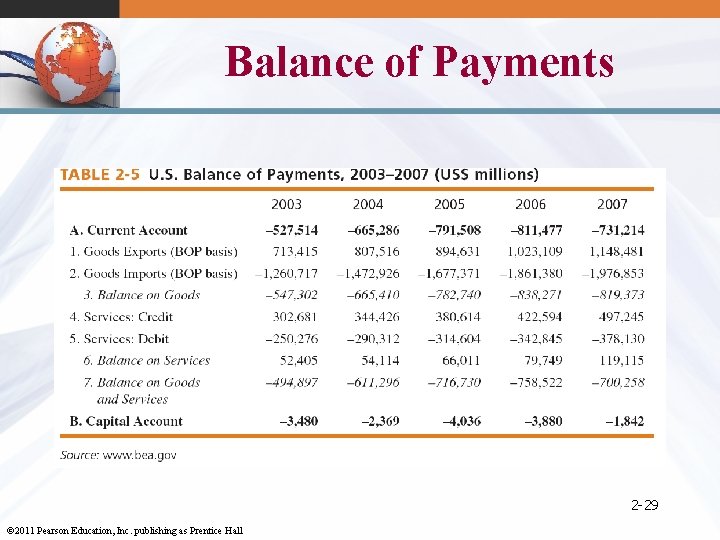
Balance of Payments • Record of all economic transactions between the residents of a country and the rest of the world – Current account–record of all recurring trade in merchandise and services, and humanitarian aid • trade deficit—negative current account • trade surplus—positive current account – Capital account–record of all long-term direct investment, portfolio investment, and capital flows 2 -28 © 2011 Pearson Education, Inc. publishing as Prentice Hall
Balance of Payments 2 -29 © 2011 Pearson Education, Inc. publishing as Prentice Hall
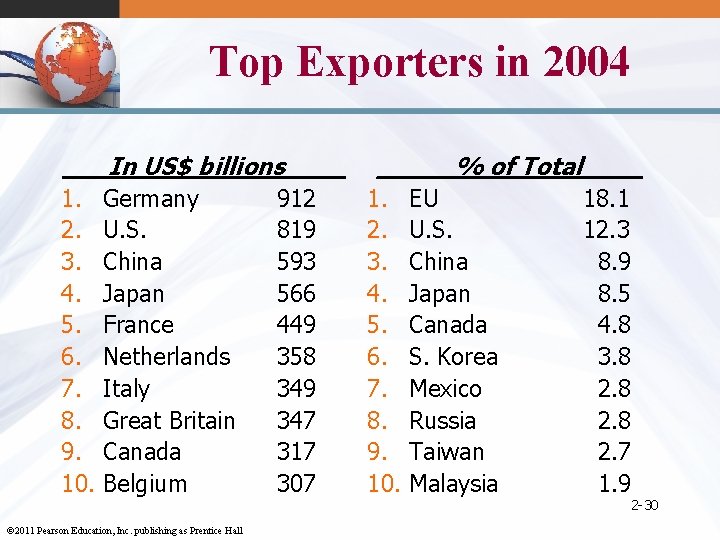
Top Exporters in 2004 ___In US$ billions____ 1. Germany 912 2. U. S. 819 3. China 593 4. Japan 566 5. France 449 6. Netherlands 358 7. Italy 349 8. Great Britain 347 9. Canada 317 10. Belgium 307 © 2011 Pearson Education, Inc. publishing as Prentice Hall _____% of Total____ 1. EU 18. 1 2. U. S. 12. 3 3. China 8. 9 4. Japan 8. 5 5. Canada 4. 8 6. S. Korea 3. 8 7. Mexico 2. 8 8. Russia 2. 8 9. Taiwan 2. 7 10. Malaysia 1. 9 2 -30
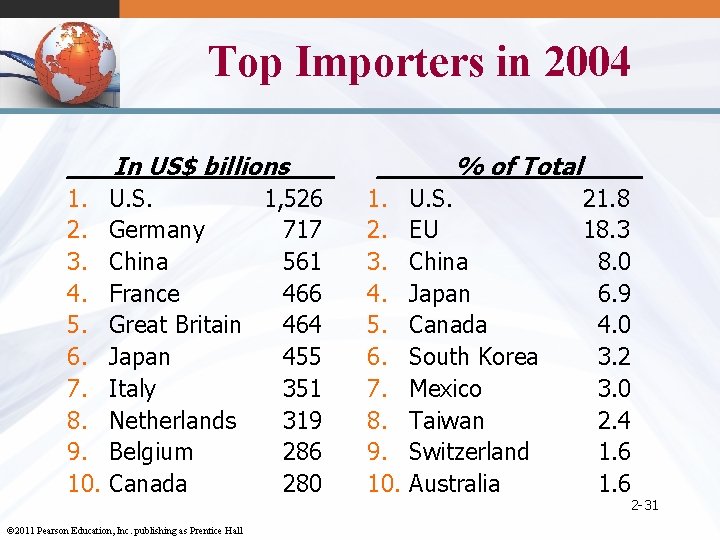
Top Importers in 2004 ___In US$ billions___ 1. U. S. 1, 526 2. Germany 717 3. China 561 4. France 466 5. Great Britain 464 6. Japan 455 7. Italy 351 8. Netherlands 319 9. Belgium 286 10. Canada 280 © 2011 Pearson Education, Inc. publishing as Prentice Hall _____% of Total____ 1. U. S. 21. 8 2. EU 18. 3 3. China 8. 0 4. Japan 6. 9 5. Canada 4. 0 6. South Korea 3. 2 7. Mexico 3. 0 8. Taiwan 2. 4 9. Switzerland 1. 6 10. Australia 1. 6 2 -31
Overview of International Finance • Foreign exchange makes it possible to do business across the boundary of a national currency • Currency of various countries are traded for both immediate (spot) and future (forward) delivery • Currency risk adds turbulence to global commerce 2 -32 © 2011 Pearson Education, Inc. publishing as Prentice Hall
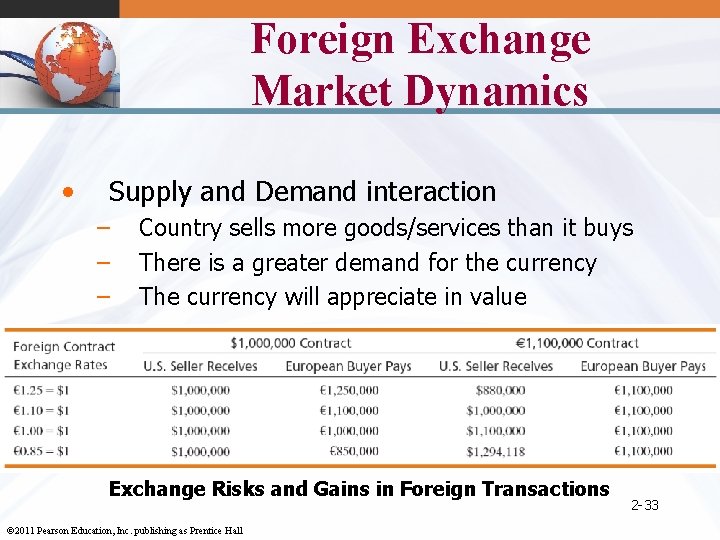
Foreign Exchange Market Dynamics • Supply and Demand interaction – – – Country sells more goods/services than it buys There is a greater demand for the currency The currency will appreciate in value Exchange Risks and Gains in Foreign Transactions © 2011 Pearson Education, Inc. publishing as Prentice Hall 2 -33
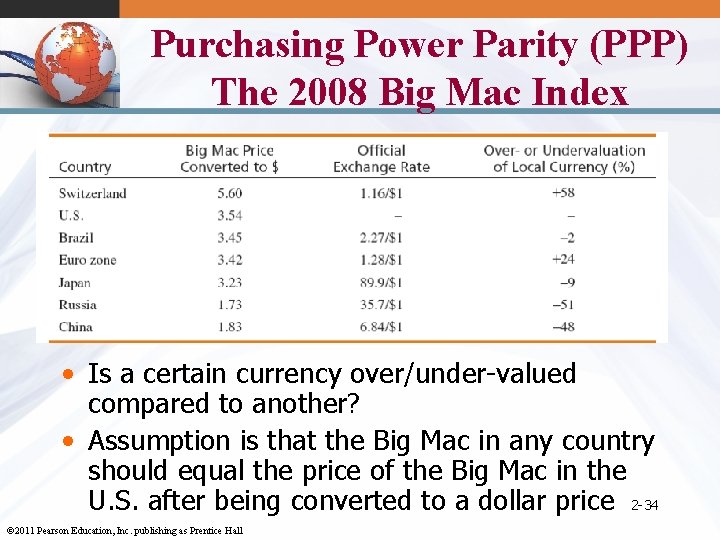
Purchasing Power Parity (PPP) The 2008 Big Mac Index • Is a certain currency over/under-valued compared to another? • Assumption is that the Big Mac in any country should equal the price of the Big Mac in the U. S. after being converted to a dollar price 2 -34 © 2011 Pearson Education, Inc. publishing as Prentice Hall
Managing Economic Exposure • Economic exposure refers to the impact of currency fluctuations on the present value of the company’s future cash flows • Two categories of economic exposure: – Transaction exposure is from sales/purchases – Real operating exposure arises when currency fluctuations, together with price changes, alter a company’s future revenues and costs 2 -35 © 2011 Pearson Education, Inc. publishing as Prentice Hall
Managing Economic Exposure • Numerous techniques and strategies have been developed to reduce exchange rate risk – Hedging involves balancing the risk of loss in one currency with a corresponding gain in another currency – Forward Contracts set the price of the exchange rate at some point in the future to eliminate some risk 2 -36 © 2011 Pearson Education, Inc. publishing as Prentice Hall
- Slides: 36