
THE GLOBAL e MARKETPLACE Quadrem e OTD and
THE GLOBAL e. MARKETPLACE Quadrem: e. OTD and releasing Supply Chain value ECCMA Annual Conference October, 2006
Agenda p A little about Quadrem p Buyer & Supplier Pain points p How have we approached this n Standards – Education, Development, Management n Systems Integration p Some “Requirements” p Benefits and Lessons learned
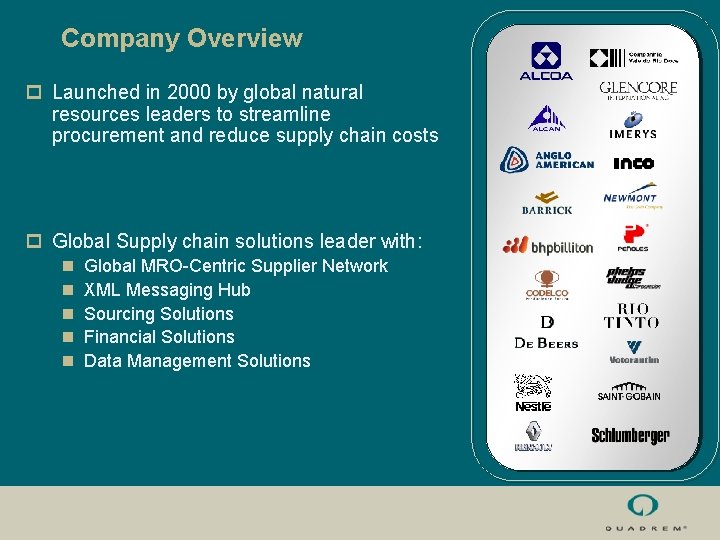
Company Overview p Launched in 2000 by global natural resources leaders to streamline procurement and reduce supply chain costs p Global Supply chain solutions leader with: n n n Global MRO-Centric Supplier Network XML Messaging Hub Sourcing Solutions Financial Solutions Data Management Solutions
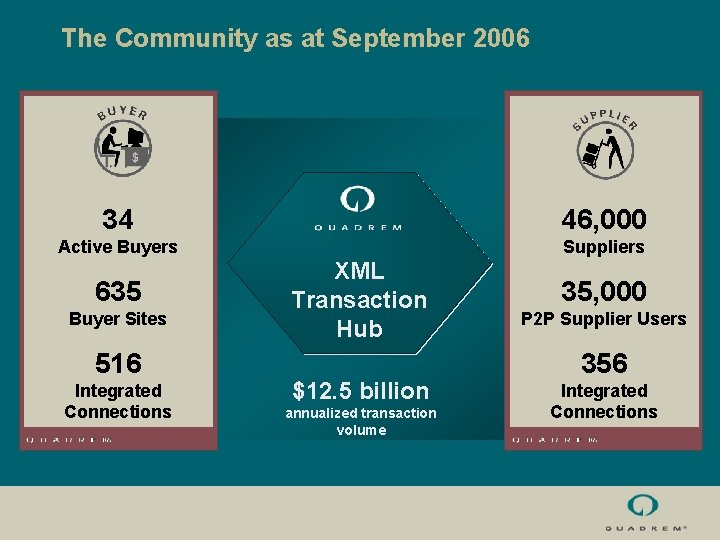
The Community as at September 2006 34 46, 000 Active Buyers Suppliers 635 Buyer Sites 516 Integrated Connections XML Transaction Hub $12. 5 billion annualized transaction volume 35, 000 P 2 P Supplier Users 356 Integrated Connections
Transaction and Throughput Record Throughput 2002 2003 2004 2005 2006 Transactio ns
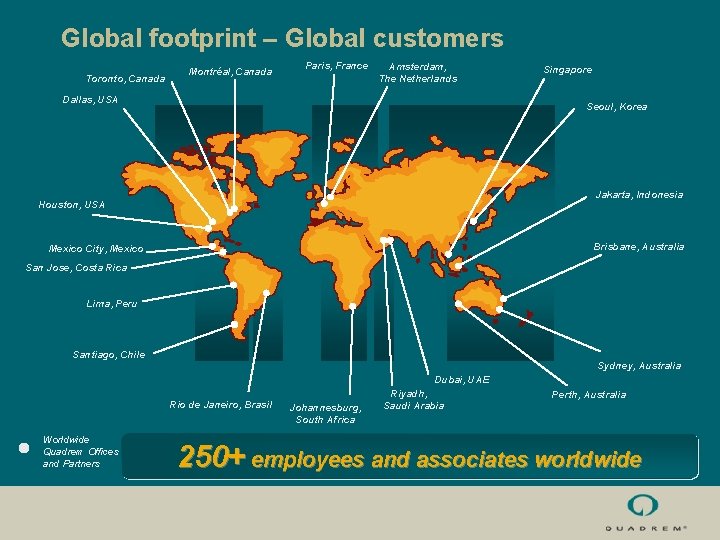
Global footprint – Global customers Toronto, Canada Montréal, Canada Paris, France Amsterdam, The Netherlands Dallas, USA Singapore Seoul, Korea Jakarta, Indonesia Houston, USA Brisbane, Australia Mexico City, Mexico San Jose, Costa Rica Lima, Peru Santiago, Chile Sydney, Australia Dubai, UAE Rio de Janeiro, Brasil Worldwide Quadrem Offices and Partners Johannesburg, South Africa Riyadh, Saudi Arabia Perth, Australia 250+ employees and associates worldwide
Key Strength - MRO Supply p Largest community of industrial MRO suppliers n Assets stand idle without these mission critical suppliers n Leveragability - MRO suppliers cover many industries p Standardized e. OTD industry dictionary for more than 6, 000 MRO categories n Becoming the de facto standard for the mining, minerals and metals industries n Platform for expansion to related industries where technical descriptions are key p 19 business process documents designed for MRO materials and services procurement n Appreciates the criticality of timing and availability of supply n Need for machine to machine integration

Pain Points
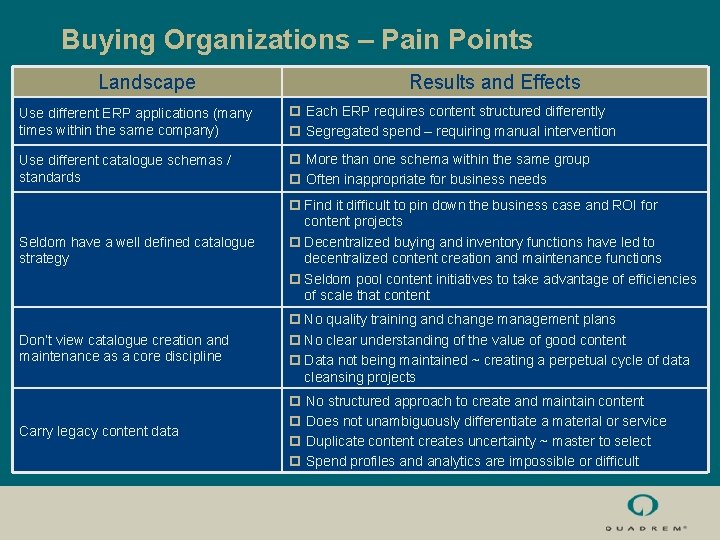
Buying Organizations – Pain Points Landscape Results and Effects Use different ERP applications (many times within the same company) p Each ERP requires content structured differently p Segregated spend – requiring manual intervention Use different catalogue schemas / standards p More than one schema within the same group p Often inappropriate for business needs Seldom have a well defined catalogue strategy p Find it difficult to pin down the business case and ROI for content projects p Decentralized buying and inventory functions have led to decentralized content creation and maintenance functions p Seldom pool content initiatives to take advantage of efficiencies of scale that content Don’t view catalogue creation and maintenance as a core discipline p No quality training and change management plans p No clear understanding of the value of good content p Data not being maintained ~ creating a perpetual cycle of data cleansing projects Carry legacy content data p No structured approach to create and maintain content p Does not unambiguously differentiate a material or service p Duplicate content creates uncertainty ~ master to select p Spend profiles and analytics are impossible or difficult
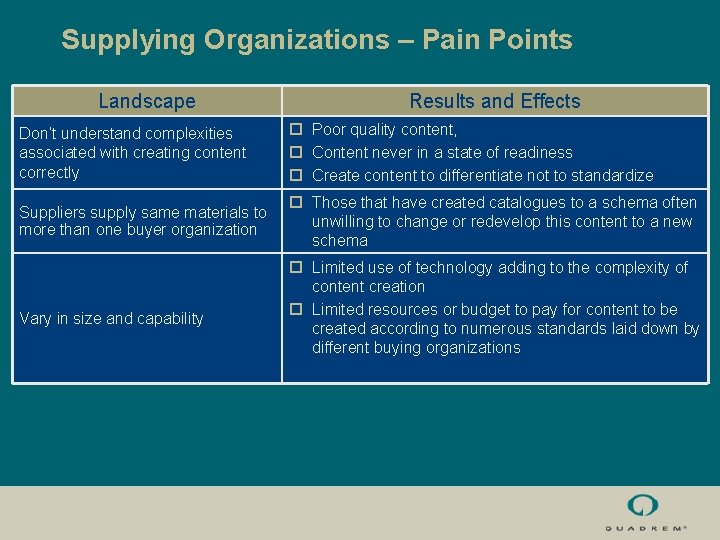
Supplying Organizations – Pain Points Landscape Results and Effects Don’t understand complexities associated with creating content correctly p Poor quality content, p Content never in a state of readiness p Create content to differentiate not to standardize Suppliers supply same materials to more than one buyer organization p Those that have created catalogues to a schema often unwilling to change or redevelop this content to a new schema Vary in size and capability p Limited use of technology adding to the complexity of content creation p Limited resources or budget to pay for content to be created according to numerous standards laid down by different buying organizations
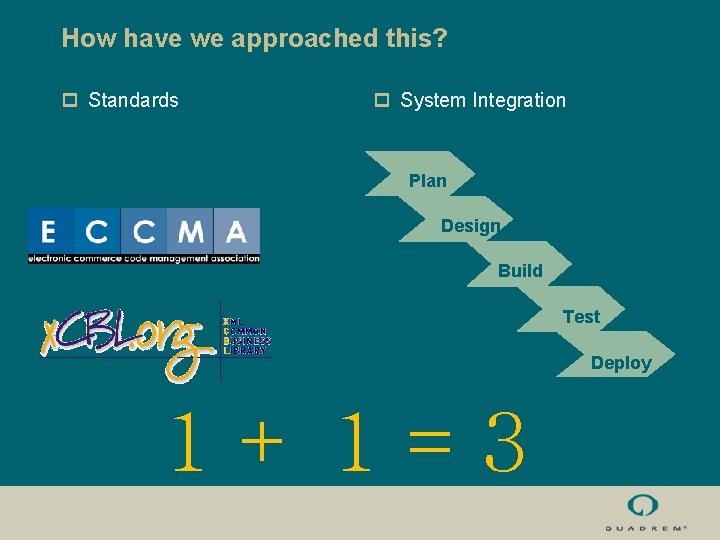
How have we approached this? p Standards p System Integration Plan Design Build Test Deploy 1+1=3
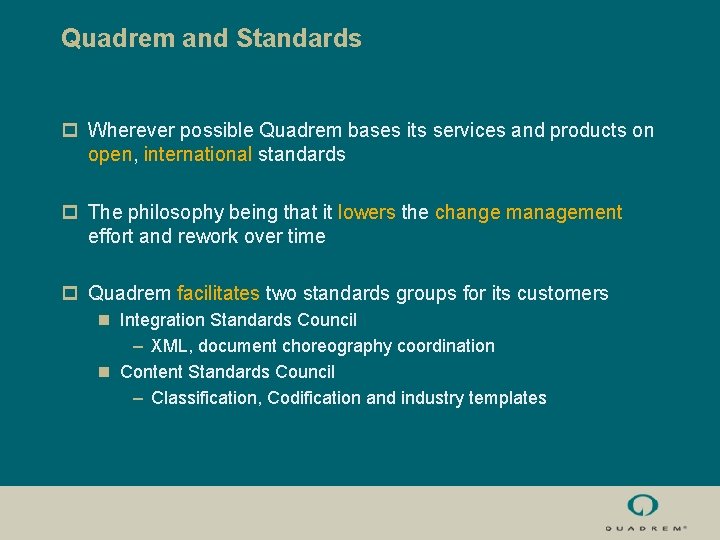
Quadrem and Standards p Wherever possible Quadrem bases its services and products on open, international standards p The philosophy being that it lowers the change management effort and rework over time p Quadrem facilitates two standards groups for its customers n Integration Standards Council – XML, document choreography coordination n Content Standards Council – Classification, Codification and industry templates
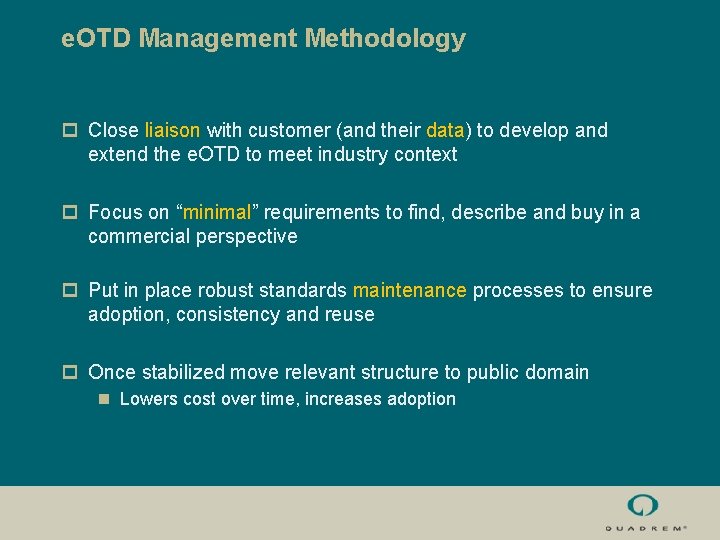
e. OTD Management Methodology p Close liaison with customer (and their data) to develop and extend the e. OTD to meet industry context p Focus on “minimal” requirements to find, describe and buy in a commercial perspective p Put in place robust standards maintenance processes to ensure adoption, consistency and reuse p Once stabilized move relevant structure to public domain n Lowers cost over time, increases adoption
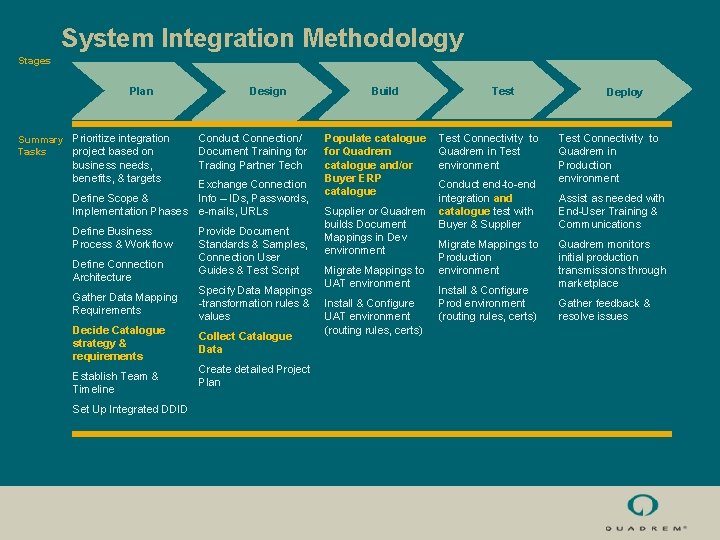
System Integration Methodology Stages Plan Summary Prioritize integration Tasks project based on business needs, benefits, & targets Define Scope & Implementation Phases Define Business Process & Workflow Define Connection Architecture Design Conduct Connection/ Document Training for Trading Partner Tech Exchange Connection Info – IDs, Passwords, e-mails, URLs Provide Document Standards & Samples, Connection User Guides & Test Script Gather Data Mapping Requirements Specify Data Mappings -transformation rules & values Decide Catalogue strategy & requirements Collect Catalogue Data Establish Team & Timeline Set Up Integrated DDID Create detailed Project Plan Build Populate catalogue for Quadrem catalogue and/or Buyer ERP catalogue Supplier or Quadrem builds Document Mappings in Dev environment Migrate Mappings to UAT environment Install & Configure UAT environment (routing rules, certs) Test Connectivity to Quadrem in Test environment Conduct end-to-end integration and catalogue test with Buyer & Supplier Migrate Mappings to Production environment Install & Configure Prod environment (routing rules, certs) Deploy Test Connectivity to Quadrem in Production environment Assist as needed with End-User Training & Communications Quadrem monitors initial production transmissions through marketplace Gather feedback & resolve issues
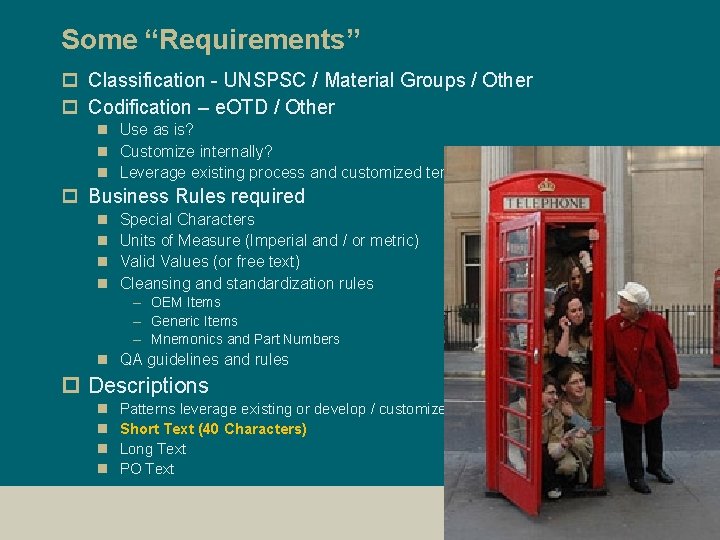
Some “Requirements” p Classification - UNSPSC / Material Groups / Other p Codification – e. OTD / Other n Use as is? n Customize internally? n Leverage existing process and customized templates? (QTAG) p Business Rules required n n Special Characters Units of Measure (Imperial and / or metric) Valid Values (or free text) Cleansing and standardization rules – OEM Items – Generic Items – Mnemonics and Part Numbers n QA guidelines and rules p Descriptions n n Patterns leverage existing or develop / customize internally Short Text (40 Characters) Long Text PO Text
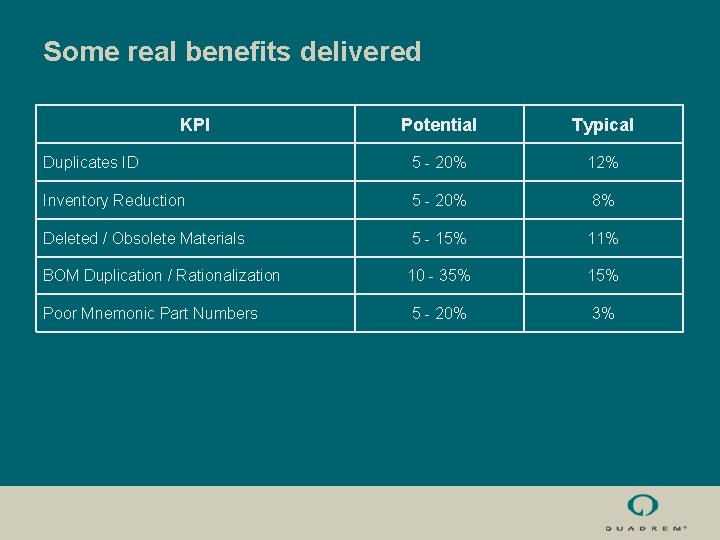
Some real benefits delivered KPI Potential Typical Duplicates ID 5 - 20% 12% Inventory Reduction 5 - 20% 8% Deleted / Obsolete Materials 5 - 15% 11% BOM Duplication / Rationalization 10 - 35% 15% Poor Mnemonic Part Numbers 5 - 20% 3%
Lessons p Get the strategy right, set expectations early and clearly p Pick a standard and stick to it n “All models are wrong some are useful” n e. OTD is useful !!! p Interlocking “systems integration” and “catalogue” standards saves time and plants seeds for long term success p Maintenance is just as important as creation
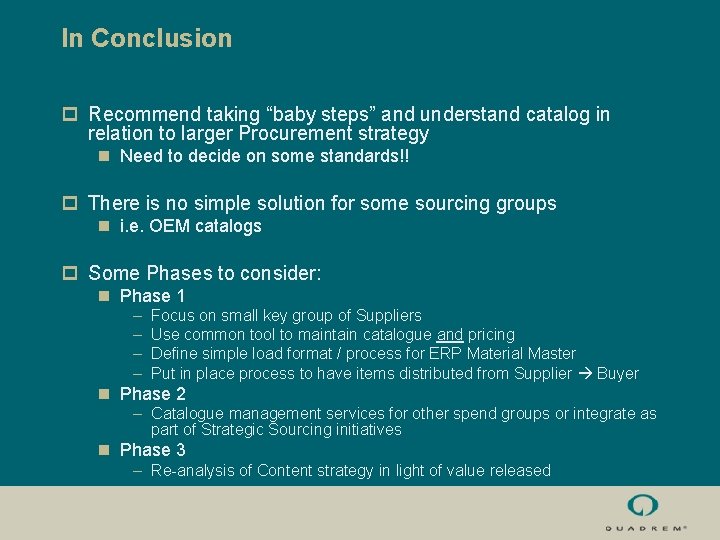
In Conclusion p Recommend taking “baby steps” and understand catalog in relation to larger Procurement strategy n Need to decide on some standards!! p There is no simple solution for some sourcing groups n i. e. OEM catalogs p Some Phases to consider: n Phase 1 – – Focus on small key group of Suppliers Use common tool to maintain catalogue and pricing Define simple load format / process for ERP Material Master Put in place process to have items distributed from Supplier Buyer n Phase 2 – Catalogue management services for other spend groups or integrate as part of Strategic Sourcing initiatives n Phase 3 – Re-analysis of Content strategy in light of value released
THE GLOBAL e. MARKETPLACE Quadrem: e. OTD and releasing Supply Chain value ECCMA Annual Conference October, 2006
- Slides: 19