
The Global Dimension in Social Sciences in Formal
The Global Dimension in Social Sciences in Formal Education
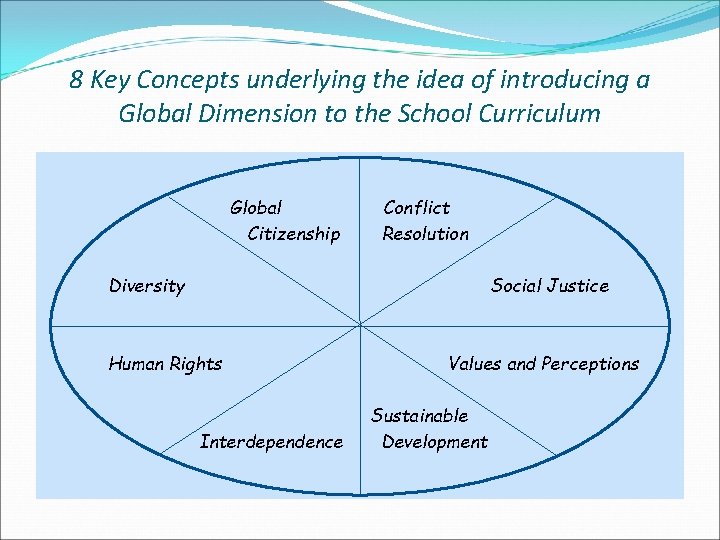
8 Key Concepts underlying the idea of introducing a Global Dimension to the School Curriculum Global Citizenship Conflict Resolution Diversity Social Justice Human Rights Interdependence Values and Perceptions Sustainable Development
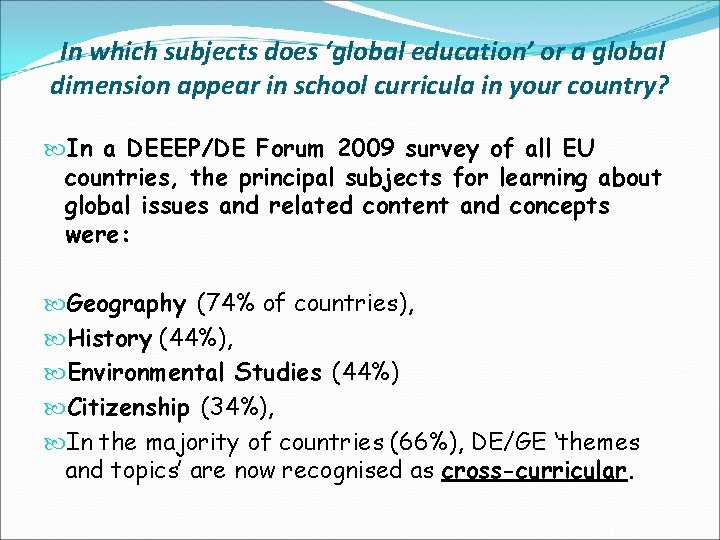
In which subjects does ‘global education’ or a global dimension appear in school curricula in your country? In a DEEEP/DE Forum 2009 survey of all EU countries, the principal subjects for learning about global issues and related content and concepts were: Geography (74% of countries), History (44%), Environmental Studies (44%) Citizenship (34%), In the majority of countries (66%), DE/GE ‘themes and topics’ are now recognised as cross-curricular.
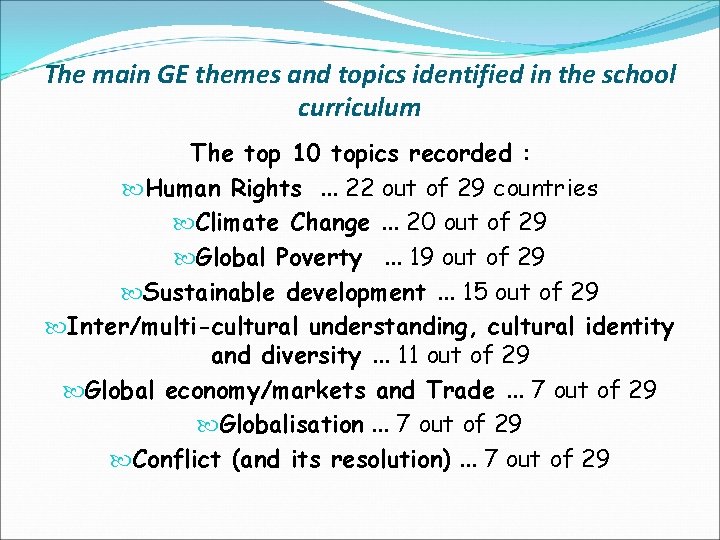
The main GE themes and topics identified in the school curriculum The top 10 topics recorded : Human Rights. . . 22 out of 29 countries Climate Change. . . 20 out of 29 Global Poverty. . . 19 out of 29 Sustainable development. . . 15 out of 29 Inter/multi-cultural understanding, cultural identity and diversity. . . 11 out of 29 Global economy/markets and Trade. . . 7 out of 29 Globalisation. . . 7 out of 29 Conflict (and its resolution). . . 7 out of 29
Social Justice appears to be the least addressed subject among the 8 topics of the Global dimension. Teachers claim that it is the most difficult to teach. Not a term widely used in conversation, in popular media, or in young people’s social networking. An overtly political concept ~ with few GE/DE teaching/learning resources available that focus on Social Justice as a distinct classroom topic.
Challenges and Difficulties for schools and teachers to integrate the global dimension in their work Overstretched curriculum and crowded timetable. Limited levels and quality of initial teacher training , in-service training, and Continuing Professional Development. Lack of sufficient recognition or specific guidance from Ministry of Education or curriculum authorities. Lack of GE learning materials and teaching methodologies. Difficulties implementing an integrated GE approach in education system. Lack of GE content, pedagogy, and curriculum development in teacher training Lack of financial resources available to schools to improve training or resource provision. Lack of or inadequate grants/financial support for either core programme support or project costs.
Official Government recognition of Global Education as a contribution to education policies and strategies for delivering the curriculum In the majority of countries in the EU significant improvements recorded in multi-stakeholder collaboration between non-state actors (NGOs) and government ministries, departments and curriculum authorities. Official (ministerial) approval of DE/GE/ESD perspectives in school projects and in subject curricula – in over 21 countries. Global Dimension/GE/ESD taken into consideration in the definition of new education policies and strategies for delivering the school curriculum – more than 13 countries. GE topics in examination papers strengthens the status of GE in education.
A Major Issue …. to improve the quality and take-up of Global Education “. . . there is a pan-European requirement for systematic reforms in initial teacher training courses and curricula, and provision of high quality in-service training for teachers. The requirement extends to state provision of sufficient levels of resources to train the trainers also, whether from NGOs, specialist education agencies, or from local authority advisory services to the schools sector. “
A reminder of primary stakeholder No. 1
- Slides: 10