
The global commons Getting started Youll need a
The global commons
Getting started You’ll need a notepad on which to make notes as you go along, or you could make notes, paste images, etc. on your device. You can view these slides: • as a slide-show for any animations and to follow links • in ‘normal’ view if you want to add call-outs or extra slides to make notes, paste images, answer questions. © Geographical Association, 2020
The global commons are vast global resources or supranational spaces and can be used by any citizens, states or non-state actors. They are bigger than any one nation, so no-one can exert sovereignty over them. The four global commons recognised in international law are: • the oceans • the atmosphere • Antarctica • space. The remote nature of our global commons and the value of the resources they contain meant that, until recently, they were not worth exploiting. © Geographical Association, 2020
The global commons Activity Watch the global commons video and note down its key message/s. © Geographical Association, 2020
The global commons • Our future is dependent on our joint use of the global commons. • As shared use of the global commons can bring tension and conflict, international governance is key to maintaining stability and security. • A key issue for the management of the global commons is pollution. Greenhouse gas emissions pollute the air and ocean, cause temperatures to rise, affect the global climate system and cause sea levels to rise. • Laws are in place to protect and manage the global commons, and are there to stop development or overexploitation. © Geographical Association, 2020

International law International agreements which protect the global commons include: • United Nations Environment Programme (UNEP) • United Nations Framework Convention on Climate Change (UNFCCC) • Montreal Protocol (limits on ozone depleting substances) • Kyoto Protocol (limits on greenhouse gas emissions) • Antarctic Treaty (1959) • Protocol on Environmental Protection to the Antarctic Treaty (1991) • United Nations Convention on the Law of the Seas (UNCLOS) • International Whaling Commission (IWC) Whaling Moratorium (1982). © Geographical Association, 2020
International law – UNCLOS • The United Nations Convention on the Law of the Seas (UNCLOS) was adopted and signed in 1982. • It is the legal framework for marine and maritime activities. • Article 56 gives sovereign rights for the exploration, exploitation, conservation and management of natural resources in a country’s exclusive economic zone (up to 200 miles from land). • The Southern Ocean is threatened by illegal, unreported and unregulated (IUU) fishing. • The Ross Sea, home to Emperor and Adélie penguins, is the world’s last intact marine ecosystem and is now a Marine Protected Area. 28% is protected solely as a research zone. © Geographical Association, 2020
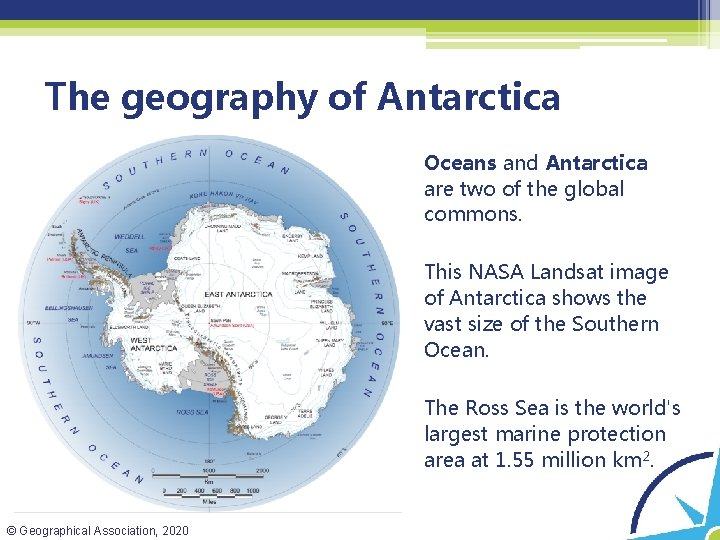
The geography of Antarctica Oceans and Antarctica are two of the global commons. This NASA Landsat image of Antarctica shows the vast size of the Southern Ocean. The Ross Sea is the world's largest marine protection area at 1. 55 million km 2. © Geographical Association, 2020
The geography of Antarctica • Earth’s southernmost continent, most of which is south of the Antarctic Circle (66. 5°S). • The landmass is almost entirely covered in ice. • It is surrounded by the Southern Ocean. • The only continent on Earth with no permanent population. Visiting scientists number 1, 000 in winter and up to 10, 000 in summer. • The continent is a polar desert with annual precipitation below 200 mm and strong winds. Therefore it is a harsh environment. © Geographical Association, 2020 Resource British Antarctic Survey report on loss of seaice. Activity Read the recent British Antarctic Survey report on sea-ice and note the key finding/s.
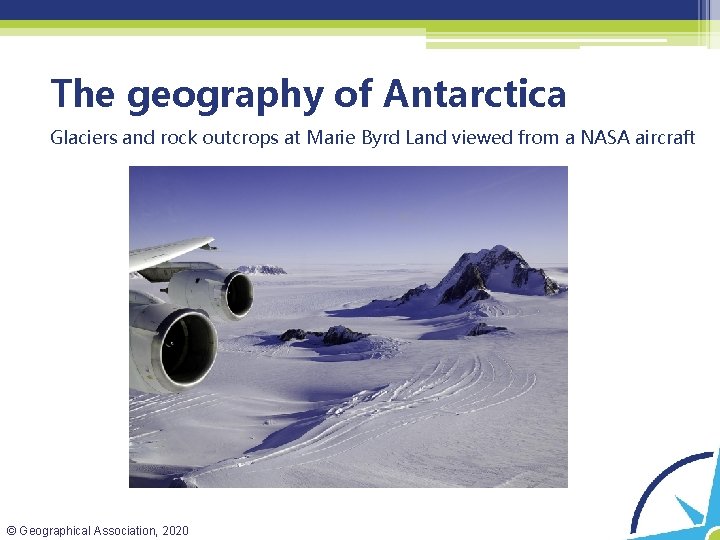
The geography of Antarctica Glaciers and rock outcrops at Marie Byrd Land viewed from a NASA aircraft © Geographical Association, 2020
The importance of Antarctica • Due to its harsh climate and remoteness, Antarctica is one of the last remaining pristine places in the world. • With 98% of the surface covered in ice and snow, Antarctica is a zone of net cooling. • If the Antarctica ice store melts, the global sea level could rise by 60 metres. • Marine protected areas covering 30% of the Southern Ocean help conserve species of whales, seals and fish. • Antarctica is associated with exploration by people such as Shackleton and Scott. © Geographical Association, 2020
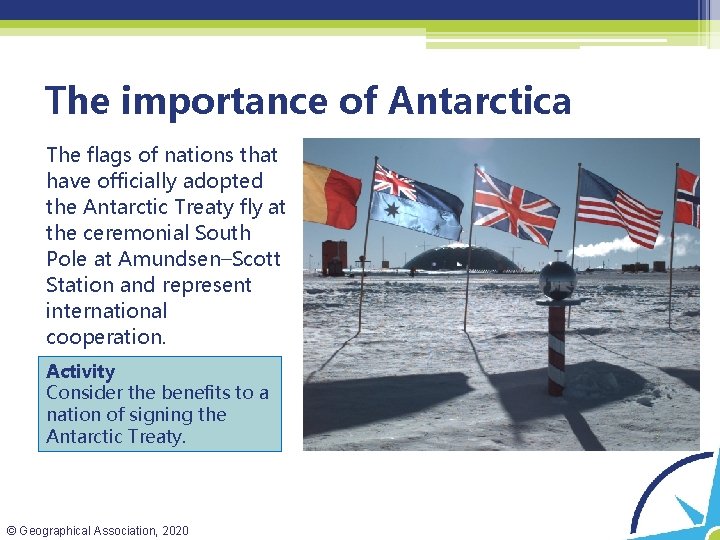
The importance of Antarctica The flags of nations that have officially adopted the Antarctic Treaty fly at the ceremonial South Pole at Amundsen–Scott Station and represent international cooperation. Activity Consider the benefits to a nation of signing the Antarctic Treaty. © Geographical Association, 2020
Threats to Antarctica • Climate change – air temperature has increased by 3°C in the Antarctic Peninsula. • By 1910, commercial whaling reduced whale populations by half. Although banned in 1986, illegal whaling continues. • Commercial fishing for toothfish and krill is increasing. The Southern Ocean is estimated to hold 379 million metric tons of krill. • Scientific research – up to 10, 000 scientists work at 59 research bases. • Most tourists cruise in the Weddell Sea and land on the Antarctic Peninsula. © Geographical Association, 2020
Manging tourism in Antarctica • The first tourist cruise to Antarctica occurred in 1966. Since when, the scale of the industry has increased with 56, 000 visitors in 2018– 2019. • A permit is required for all visitors to Antarctica. • Nearly all visitors arrive by sea from Chile or Argentina, a third arriving from the USA. • Antarctica’s tourist industry is managed by the International Association of Antarctica Tour Operators (IAATO) which has over 100 members. • Cruise ships with more than 500 passengers cannot land tourists while in © Geographical Association, 2020 Resources Discover the World Antarctic holidays IAATO website Activities Explore the holidays available to Antarctica with Discover the World. Describe the impact of tourism on Antarctica. Explain how IAATO manage tourism.
The impact of climate change • The Antarctic Circumpolar Current is warming more rapidly than the world’s oceans. • In February 2020, the highest continental temperature was recorded at Argentina’s Esperanza research station (18. 3°C). • Green algae now covers 1. 9 km 2 of snow in Antarctica. • More plants are colonising the landmass as perennial snow and ice melt. • Antarctic krill numbers are falling due to reduced sea ice cover. • Glaciers and ice shelves are retreating. In 2018, B-46, the world’s largest iceberg broke off from Pine Island Glacier – it is three times the size of Manhattan. © Geographical Association, 2020
The Antarctic Treaty System (ATS) • 12 countries including the UK signed the Antarctic Treaty in 1959. • There are now 54 parties to the agreement. • Management is discussed at an annual consultative meeting; only 29 of the 54 parties have voting rights. • The area protected is all the land ice shelves south of 60°S. • The treaty protects the continent as an environmental and scientific preserve. It bans military activities, weapons testing and mineral mining. • The Protocol on Environmental Protection to the Antarctic Treaty was signed in 1991. It protects the environment and prevents development. © Geographical Association, 2020
The global commons: questions • What are the four global commons (and what do they have in common)? • Why are the global commons under threat? • How can the global commons be protected? • Why is it important to protect the Ross Sea? • How is climate change impacting on Antarctica? • How will changes to Antarctica and the Southern Ocean, as a result of climate change, impact on the rest of the planet? • To what extent is climate change the greatest threat currently facing the global commons? © Geographical Association, 2020
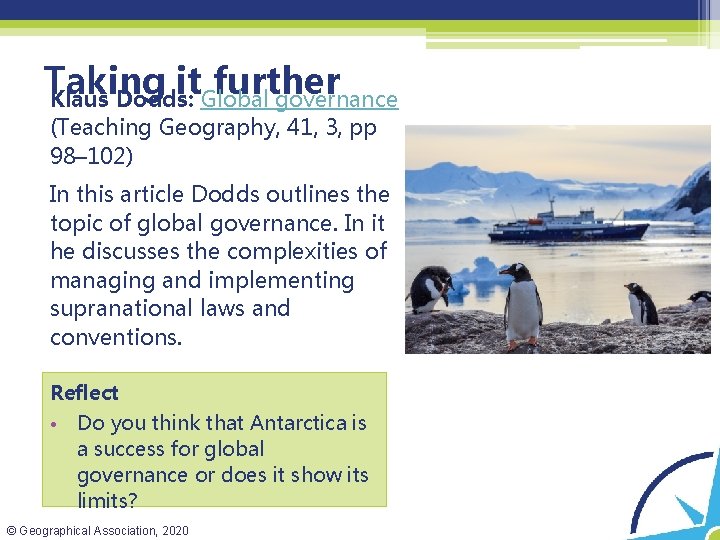
Taking it further Klaus Dodds: Global governance (Teaching Geography, 41, 3, pp 98– 102) In this article Dodds outlines the topic of global governance. In it he discusses the complexities of managing and implementing supranational laws and conventions. Reflect • Do you think that Antarctica is a success for global governance or does it show its limits? © Geographical Association, 2020
Links From the awarding bodies: Topic AQA 3. 2. 1. 5. 1 Antarctica as a global common Eduqas 2. 2. 6 - 10: Global Governance of the Earth’s Oceans Edexcel 3: Globalisation (3. 5 and 3. 6) OCR 2. c. Governing the oceans poses issues for the management of resources. WJEC 3. 2. 6 to 3. 2. 10: Global Governance of the Earth’s Oceans © Geographical Association, 2020 Find out more: • GA journal article bundle – Global systems and global governance • British Antarctic Survey – centre for polar science • Discovering Antarctica Education Resources • NASA interactive ice viewer
Glossary • Global commons: vast global resources or supranational spaces that can be used by any citizens, states or non-state actors • Governance: the task of governing; the idea often includes notions of good governance, such as interaction with civil society • Overexploitation: the harvesting of a natural resource to the point of diminishing returns, e. g. fish stocks in the North Sea. • Supranational: outside or beyond the power or influence of national governments; often an international grouping © Geographical Association, 2020
Acknowledgements This presentation has been written by Dr Emma Rawlings Smith, a former head of secondary geography and now PGCE Geography Tutor at the School of Education, University of Leicester. Figures • Slide 4: https: //www. youtube. com/watch? v=c. Rl 7 zfrjke. Q • • Slide 8: NASA Landsat Image Mosaic of Antarctica team (public domain) http: //lima. nasa. gov/pdf/A 3_overview. pdf https: //en. wikipedia. org/wiki/Antarctica#/media/File: Antarctica. svg Slide 10: Glaciers and rock outcrops in Marie Byrd Land as seen from NASA's DC-8 aircraft (Michael Studinger, 2011, public domain: http: //www. nasa. gov/mission_pages/icebridge/multimedia/fall 11/Marie. Byrd. Land_DS C 0872. html Slide 12: https: //en. wikipedia. org/wiki/Antarctica#/media/File: Amundsen. Scott. Suedpol. Statio n. jpg Slide 18: shutterstock_556606105_Vadim Nefedoff © Geographical Association, 2020
- Slides: 21