
The Global Circuit Intensity Its measurement and variation
The Global Circuit Intensity: Its measurement and variation over the last 50 years Ralph Markson (2007) February 23, 2017 Karly Reimel ATS 780
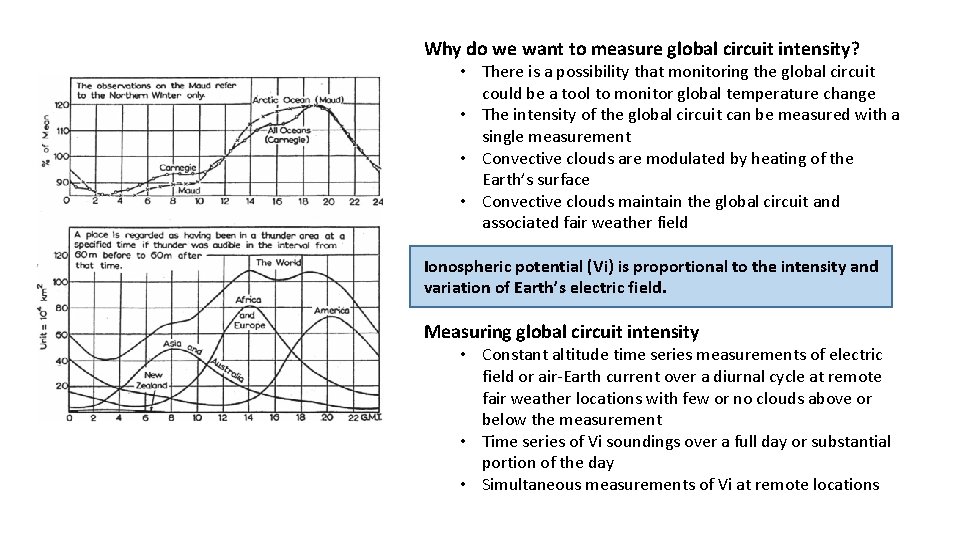
Why do we want to measure global circuit intensity? • There is a possibility that monitoring the global circuit could be a tool to monitor global temperature change • The intensity of the global circuit can be measured with a single measurement • Convective clouds are modulated by heating of the Earth’s surface • Convective clouds maintain the global circuit and associated fair weather field Ionospheric potential (Vi) is proportional to the intensity and variation of Earth’s electric field. Measuring global circuit intensity • Constant altitude time series measurements of electric field or air-Earth current over a diurnal cycle at remote fair weather locations with few or no clouds above or below the measurement • Time series of Vi soundings over a full day or substantial portion of the day • Simultaneous measurements of Vi at remote locations
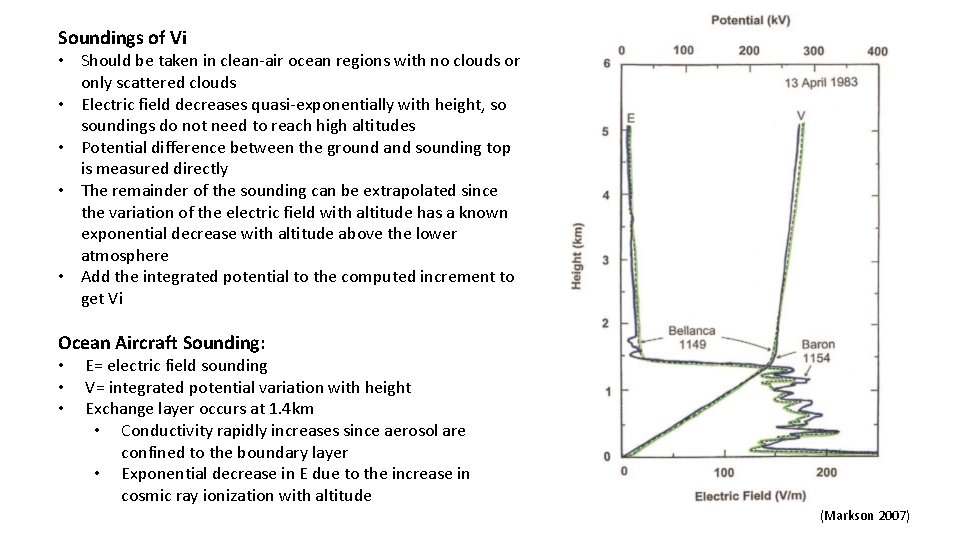
Soundings of Vi • Should be taken in clean-air ocean regions with no clouds or only scattered clouds • Electric field decreases quasi-exponentially with height, so soundings do not need to reach high altitudes • Potential difference between the ground and sounding top is measured directly • The remainder of the sounding can be extrapolated since the variation of the electric field with altitude has a known exponential decrease with altitude above the lower atmosphere • Add the integrated potential to the computed increment to get Vi Ocean Aircraft Sounding: • • • E= electric field sounding V= integrated potential variation with height Exchange layer occurs at 1. 4 km • Conductivity rapidly increases since aerosol are confined to the boundary layer • Exponential decrease in E due to the increase in cosmic ray ionization with altitude (Markson 2007)
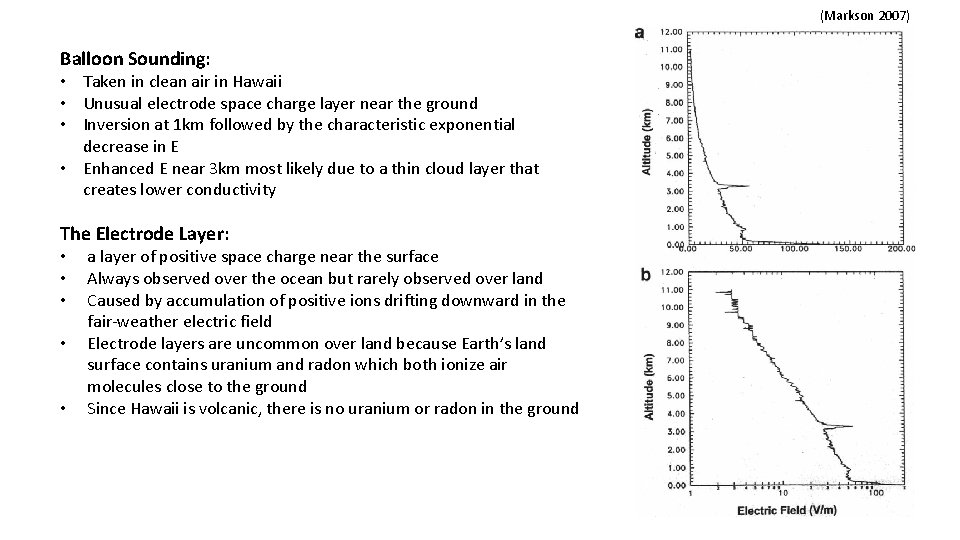
(Markson 2007) Balloon Sounding: • Taken in clean air in Hawaii • Unusual electrode space charge layer near the ground • Inversion at 1 km followed by the characteristic exponential decrease in E • Enhanced E near 3 km most likely due to a thin cloud layer that creates lower conductivity The Electrode Layer: • • • a layer of positive space charge near the surface Always observed over the ocean but rarely observed over land Caused by accumulation of positive ions drifting downward in the fair-weather electric field Electrode layers are uncommon over land because Earth’s land surface contains uranium and radon which both ionize air molecules close to the ground Since Hawaii is volcanic, there is no uranium or radon in the ground
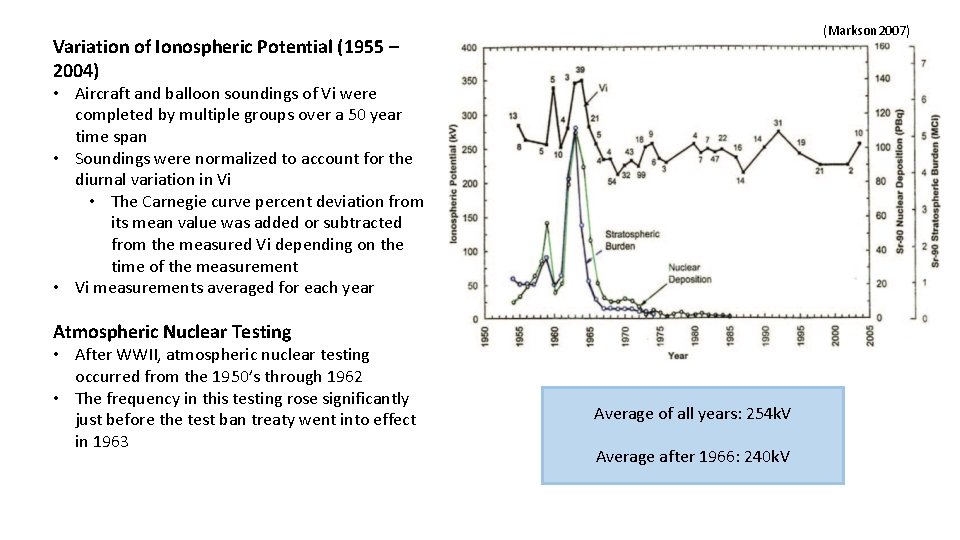
(Markson 2007) Variation of Ionospheric Potential (1955 – 2004) • Aircraft and balloon soundings of Vi were completed by multiple groups over a 50 year time span • Soundings were normalized to account for the diurnal variation in Vi • The Carnegie curve percent deviation from its mean value was added or subtracted from the measured Vi depending on the time of the measurement • Vi measurements averaged for each year Atmospheric Nuclear Testing • After WWII, atmospheric nuclear testing occurred from the 1950’s through 1962 • The frequency in this testing rose significantly just before the test ban treaty went into effect in 1963 Average of all years: 254 k. V Average after 1966: 240 k. V
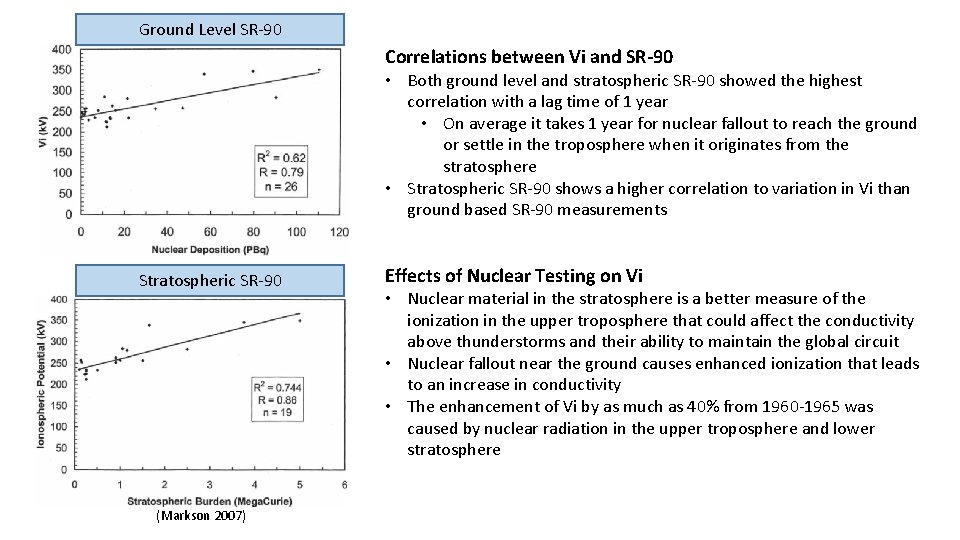
Ground Level SR-90 Correlations between Vi and SR-90 • Both ground level and stratospheric SR-90 showed the highest correlation with a lag time of 1 year • On average it takes 1 year for nuclear fallout to reach the ground or settle in the troposphere when it originates from the stratosphere • Stratospheric SR-90 shows a higher correlation to variation in Vi than ground based SR-90 measurements Stratospheric SR-90 (Markson 2007) Effects of Nuclear Testing on Vi • Nuclear material in the stratosphere is a better measure of the ionization in the upper troposphere that could affect the conductivity above thunderstorms and their ability to maintain the global circuit • Nuclear fallout near the ground causes enhanced ionization that leads to an increase in conductivity • The enhancement of Vi by as much as 40% from 1960 -1965 was caused by nuclear radiation in the upper troposphere and lower stratosphere
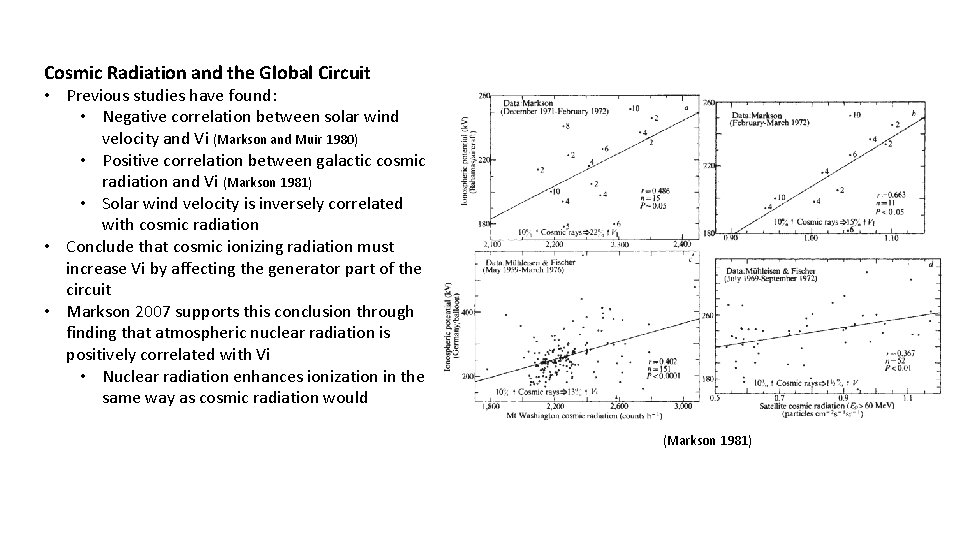
Cosmic Radiation and the Global Circuit • Previous studies have found: • Negative correlation between solar wind velocity and Vi (Markson and Muir 1980) • Positive correlation between galactic cosmic radiation and Vi (Markson 1981) • Solar wind velocity is inversely correlated with cosmic radiation • Conclude that cosmic ionizing radiation must increase Vi by affecting the generator part of the circuit • Markson 2007 supports this conclusion through finding that atmospheric nuclear radiation is positively correlated with Vi • Nuclear radiation enhances ionization in the same way as cosmic radiation would (Markson 1981)
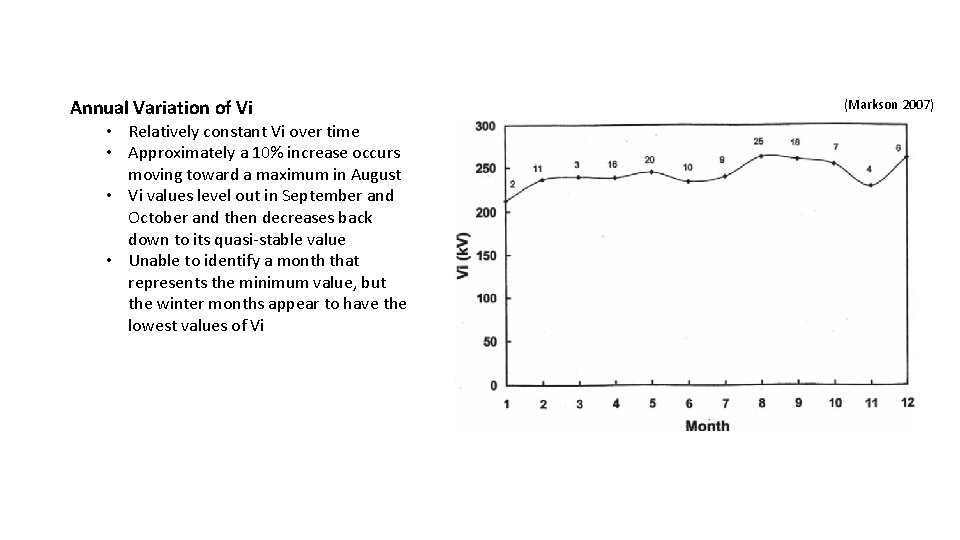
Annual Variation of Vi • Relatively constant Vi over time • Approximately a 10% increase occurs moving toward a maximum in August • Vi values level out in September and October and then decreases back down to its quasi-stable value • Unable to identify a month that represents the minimum value, but the winter months appear to have the lowest values of Vi (Markson 2007)
(Markson 2007)
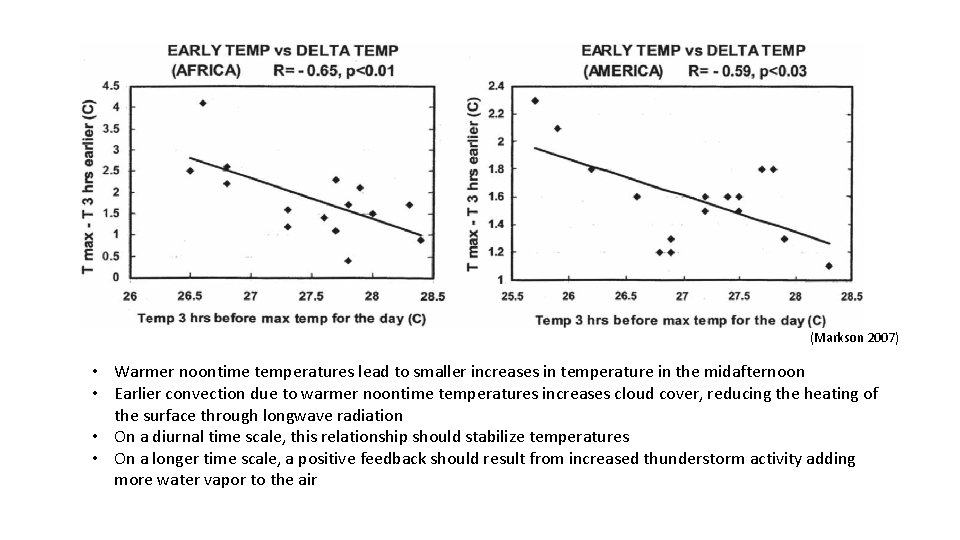
(Markson 2007) • Warmer noontime temperatures lead to smaller increases in temperature in the midafternoon • Earlier convection due to warmer noontime temperatures increases cloud cover, reducing the heating of the surface through longwave radiation • On a diurnal time scale, this relationship should stabilize temperatures • On a longer time scale, a positive feedback should result from increased thunderstorm activity adding more water vapor to the air
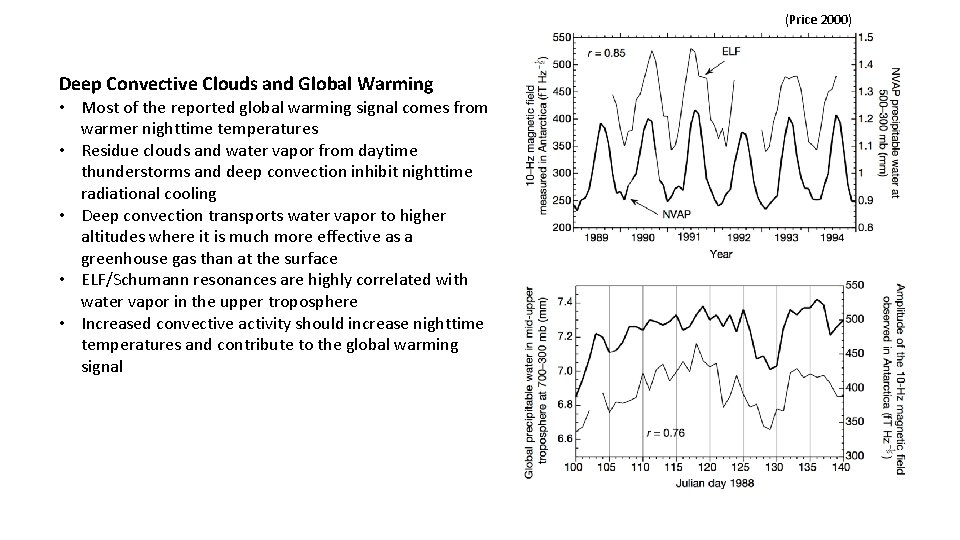
(Price 2000) Deep Convective Clouds and Global Warming • Most of the reported global warming signal comes from warmer nighttime temperatures • Residue clouds and water vapor from daytime thunderstorms and deep convection inhibit nighttime radiational cooling • Deep convection transports water vapor to higher altitudes where it is much more effective as a greenhouse gas than at the surface • ELF/Schumann resonances are highly correlated with water vapor in the upper troposphere • Increased convective activity should increase nighttime temperatures and contribute to the global warming signal
(Markson 2007)
Conclusions: 1. Atmospheric nuclear testing was highly correlated with an increase in global circuit intensity by as much as 40% from 1960 -1964 2. Following the nuclear test period, Vi has remained relatively constant, averaging about 240 k. V 3. Positive correlation between atmospheric nuclear radiation and Vi supports the hypothesis that galactic cosmic radiation modulates the intensity of the global circuit through changing the ionization properties near deep convective clouds 4. The maximum variation of Vi and annual variation observed of lightning occurs in August; the minimum in Vi occurs during Northern Hemisphere winter
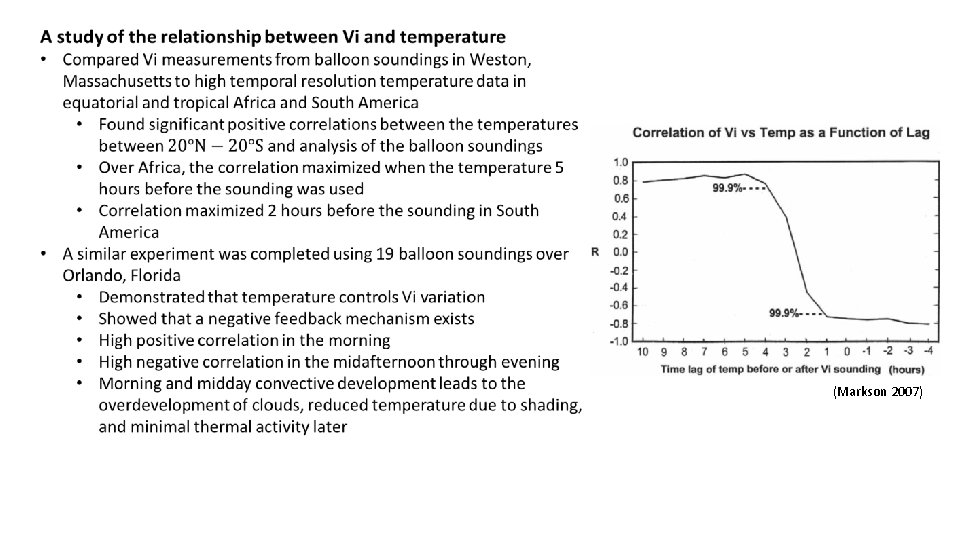
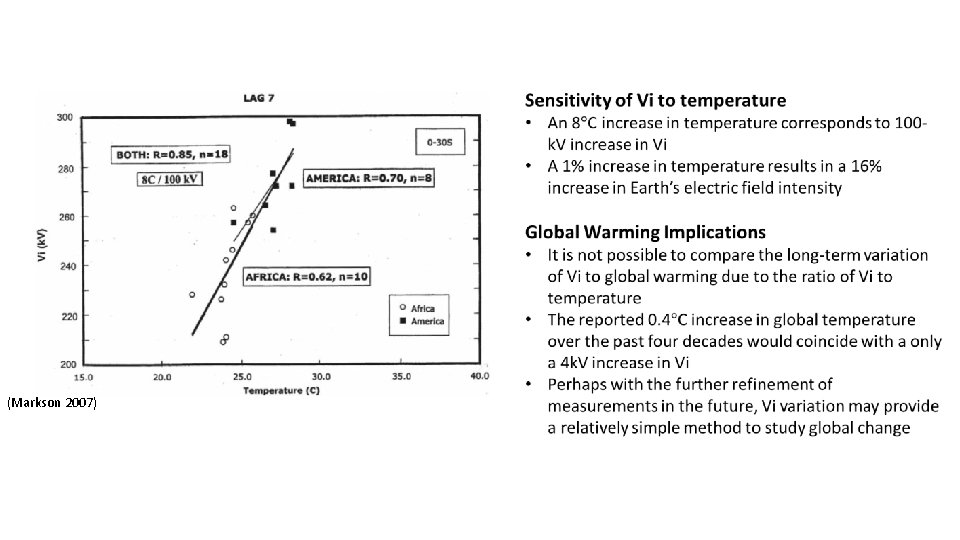
Conclusions: 5. Temperature over Africa and South America are positively correlated with Vi in the morning and negatively correlated in the afternoon– most likely due to enhanced morning convection creating clouds that shield the ground from solar radiation later in the day 6. Convection transports water vapor to the upper troposphere and stratosphere– contributes to global warming signal due to water vapor acting as a greenhouse gas 7. Nocturnal clouds and water vapor from previous day’s convection reduce the rate of radiational cooling at night 8. A 1% change in global temperature leads to a 16% change in Vi– currently the temperature change is too small to notice a variance in Vi, but with further refined measurements, Vi could provide a method to study global change one day
- Slides: 14