
The Global Amphibian Decline Northern Cricket Frog Acris
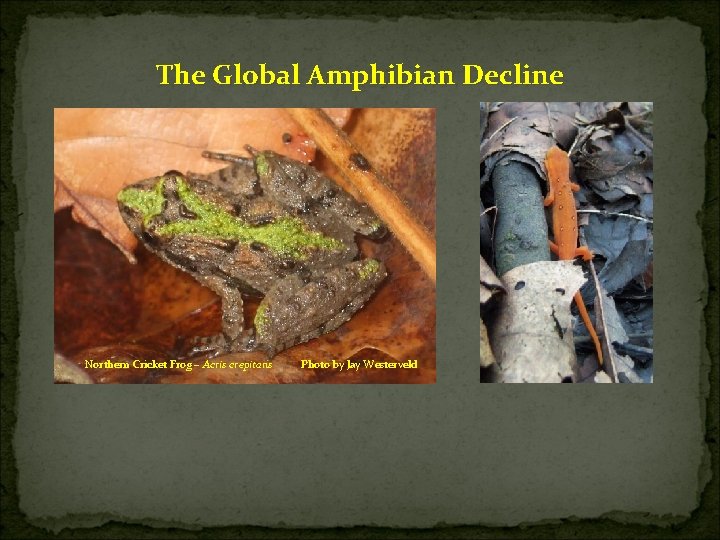
The Global Amphibian Decline Northern Cricket Frog – Acris crepitans Photo by Jay Westerveld
What’s going on? • About 1/3 of the ~6, 000 described amphibian species are seriously threatened; for 1/4 we don’t have enough data to know • Close to 160 amphibian species are believed to have already gone extinct, including 38 known to be extinct, 1 extinct in the wild but surviving in captivity, and 120 not found in recent years and possibly extinct • 42% of all species are declining in population Source: IUCN Red List
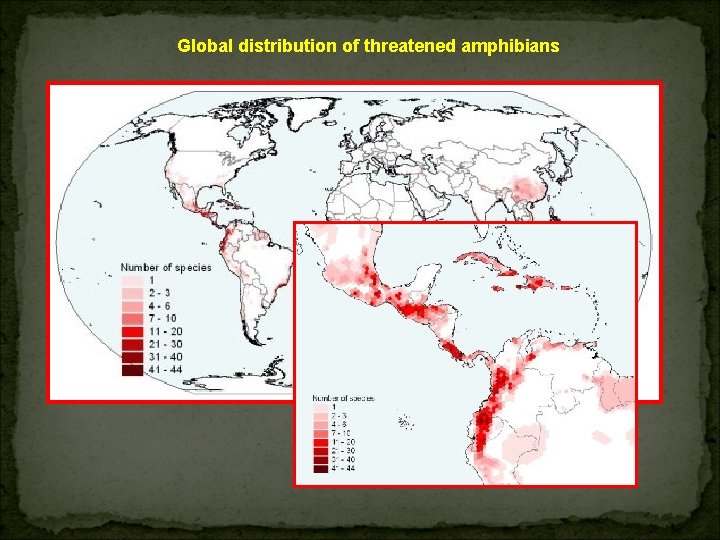
Global distribution of threatened amphibians
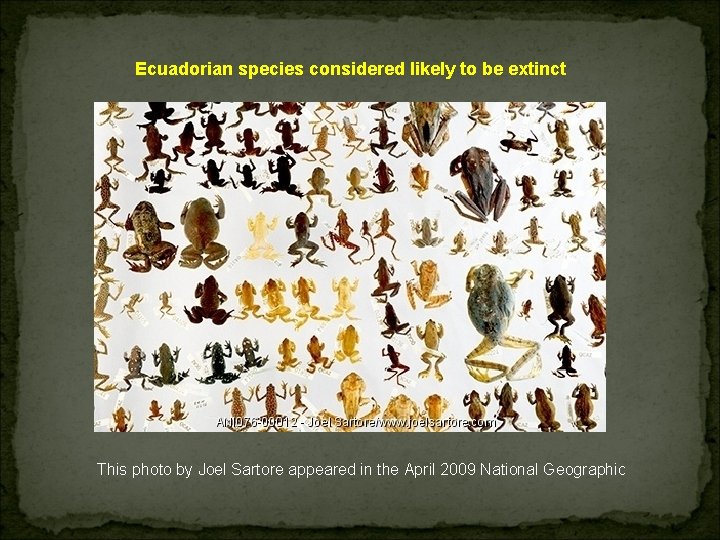
Ecuadorian species considered likely to be extinct This photo by Joel Sartore appeared in the April 2009 National Geographic
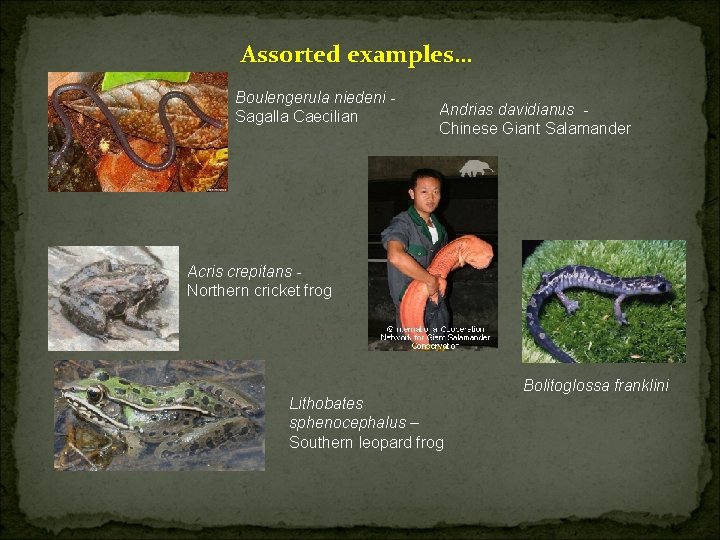
Assorted examples… Boulengerula niedeni Sagalla Caecilian Andrias davidianus Chinese Giant Salamander Acris crepitans Northern cricket frog Bolitoglossa franklini Lithobates sphenocephalus – Southern leopard frog
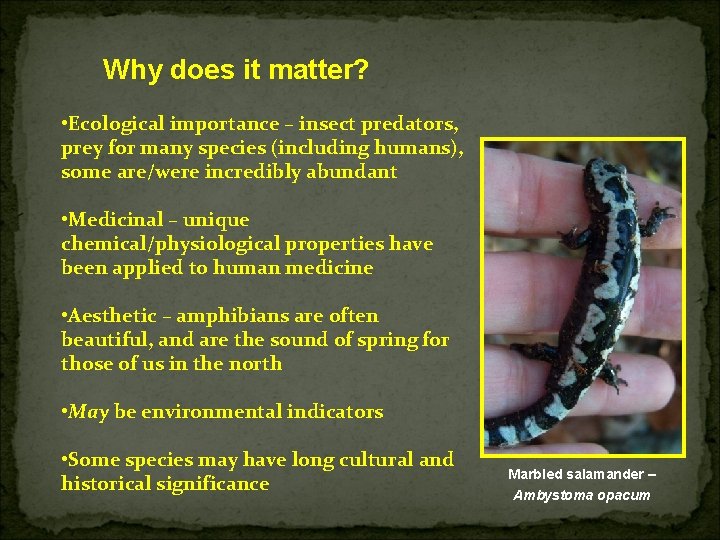
Why does it matter? • Ecological importance – insect predators, prey for many species (including humans), some are/were incredibly abundant • Medicinal – unique chemical/physiological properties have been applied to human medicine • Aesthetic – amphibians are often beautiful, and are the sound of spring for those of us in the north • May be environmental indicators • Some species may have long cultural and historical significance Marbled salamander – Ambystoma opacum
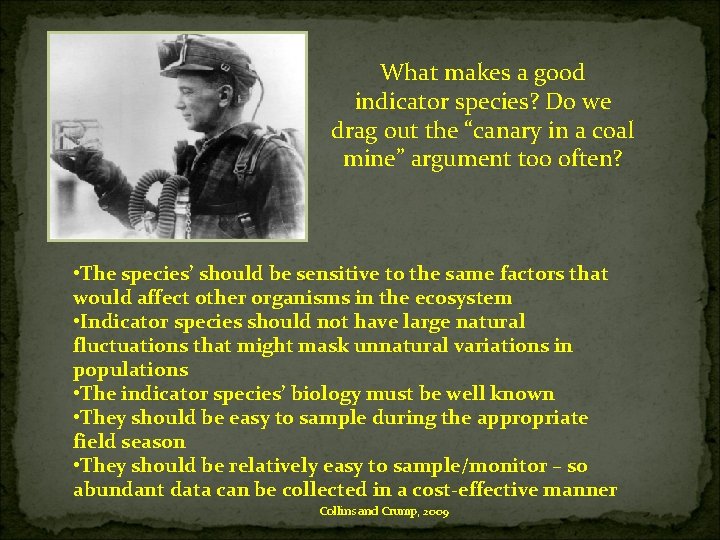
What makes a good indicator species? Do we drag out the “canary in a coal mine” argument too often? • The species’ should be sensitive to the same factors that would affect other organisms in the ecosystem • Indicator species should not have large natural fluctuations that might mask unnatural variations in populations • The indicator species’ biology must be well known • They should be easy to sample during the appropriate field season • They should be relatively easy to sample/monitor – so abundant data can be collected in a cost-effective manner Collins and Crump, 2009
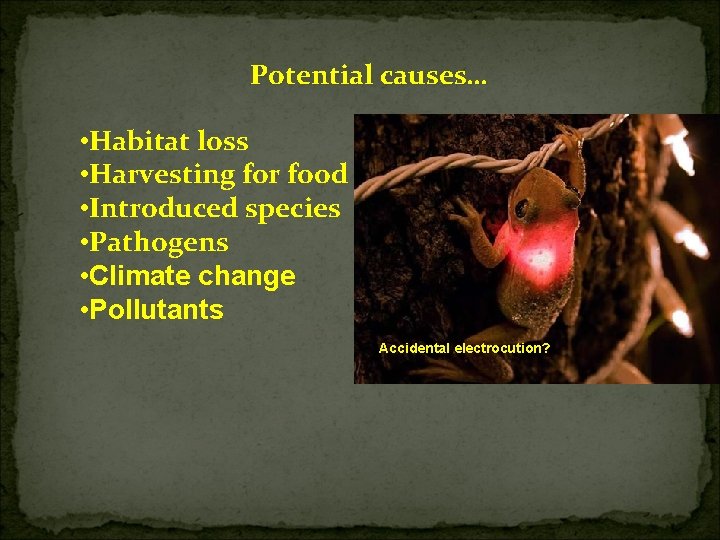
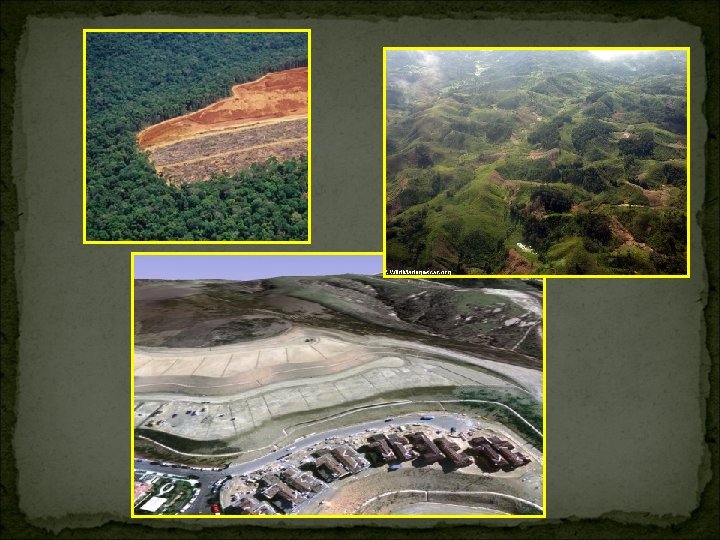
Potential causes… • Habitat loss • Harvesting for food • Introduced species • Pathogens • Climate change • Pollutants Accidental electrocution? Northern red salamander – Pseudotriton ruber
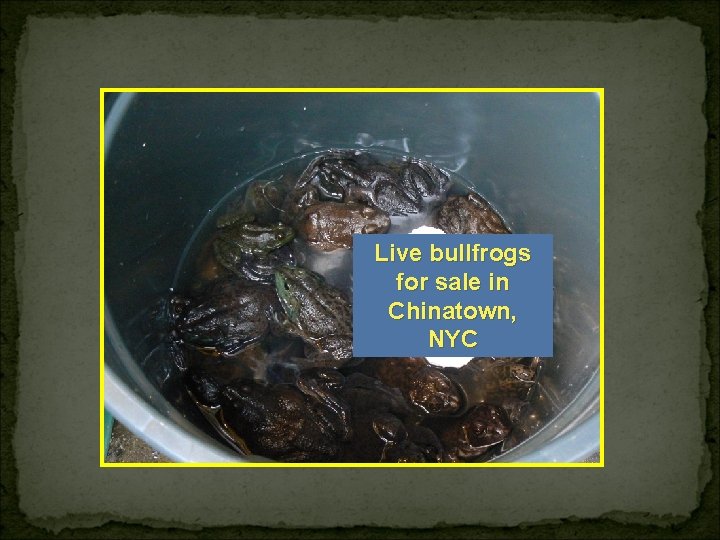
Live bullfrogs for sale in Chinatown, NYC
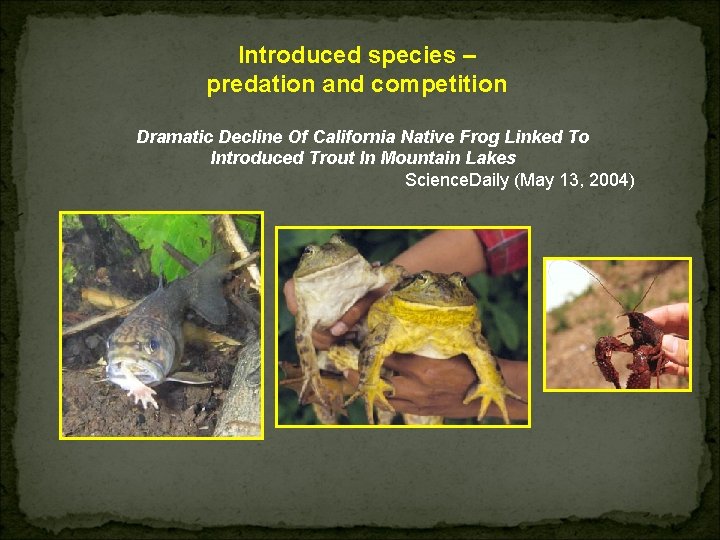
Introduced species – predation and competition Dramatic Decline Of California Native Frog Linked To Introduced Trout In Mountain Lakes Science. Daily (May 13, 2004)
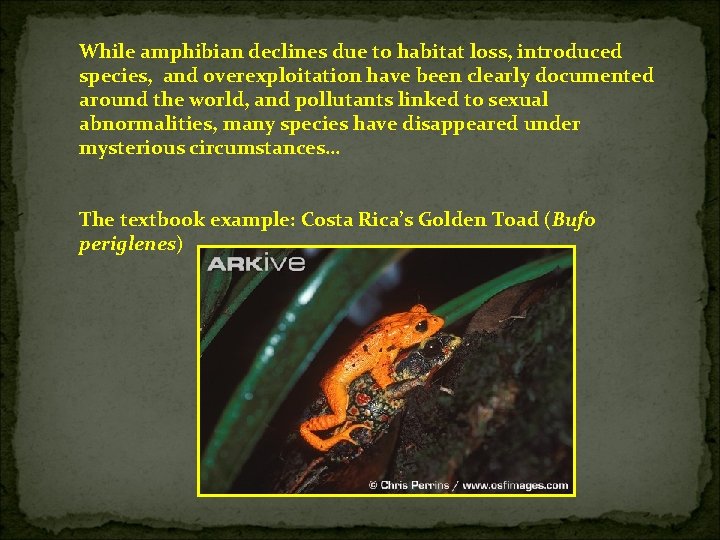
While amphibian declines due to habitat loss, introduced species, and overexploitation have been clearly documented around the world, and pollutants linked to sexual abnormalities, many species have disappeared under mysterious circumstances… The textbook example: Costa Rica’s Golden Toad (Bufo periglenes)
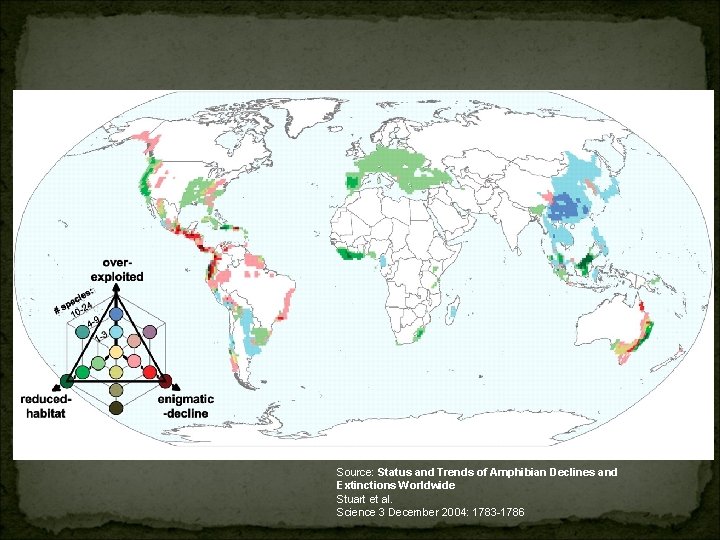
Source: Status and Trends of Amphibian Declines and Extinctions Worldwide Stuart et al. Science 3 December 2004: 1783 -1786
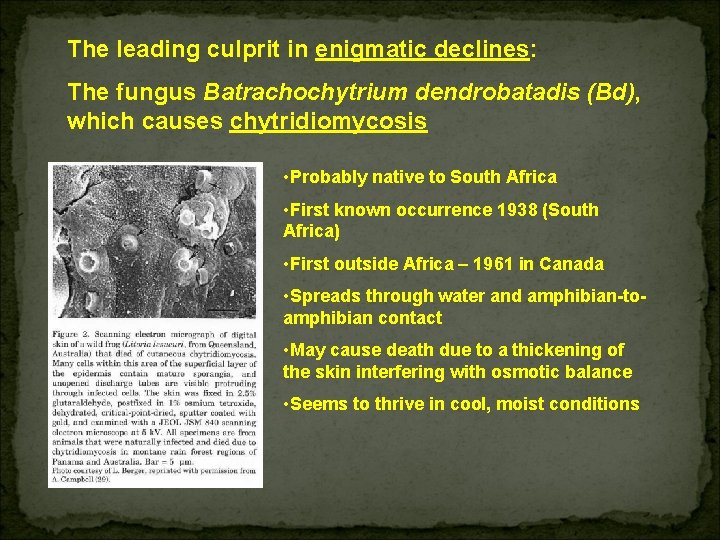
The leading culprit in enigmatic declines: The fungus Batrachochytrium dendrobatadis (Bd), which causes chytridiomycosis • Probably native to South Africa • First known occurrence 1938 (South Africa) • First outside Africa – 1961 in Canada • Spreads through water and amphibian-toamphibian contact • May cause death due to a thickening of the skin interfering with osmotic balance • Seems to thrive in cool, moist conditions
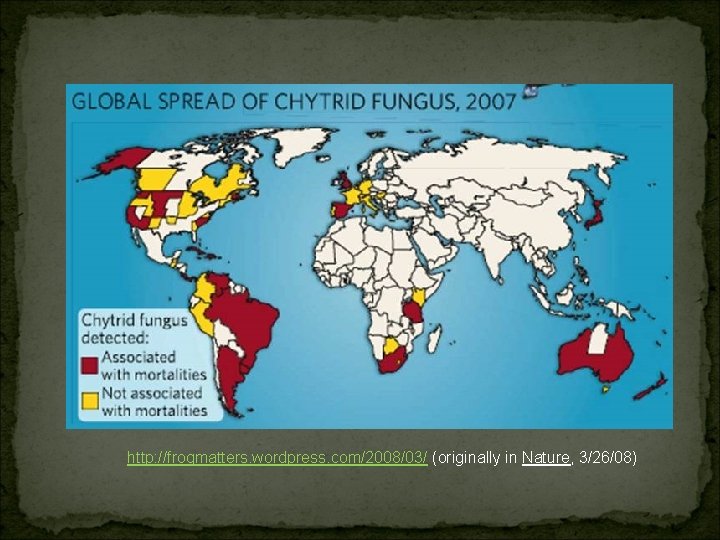
http: //frogmatters. wordpress. com/2008/03/ (originally in Nature, 3/26/08)
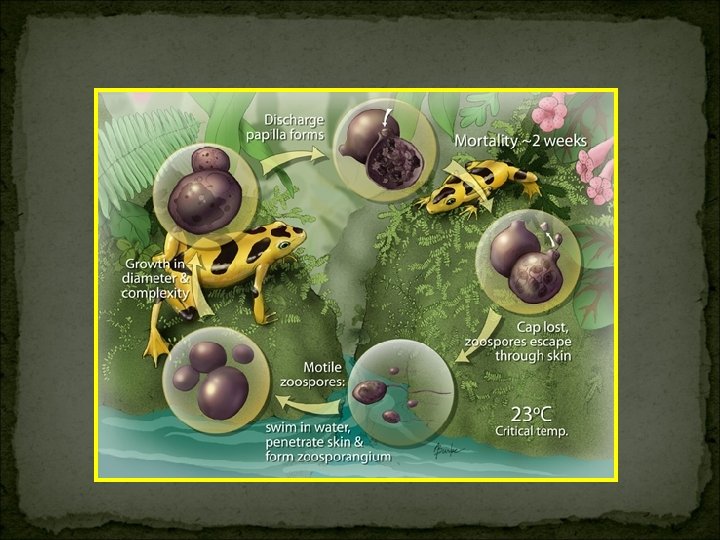
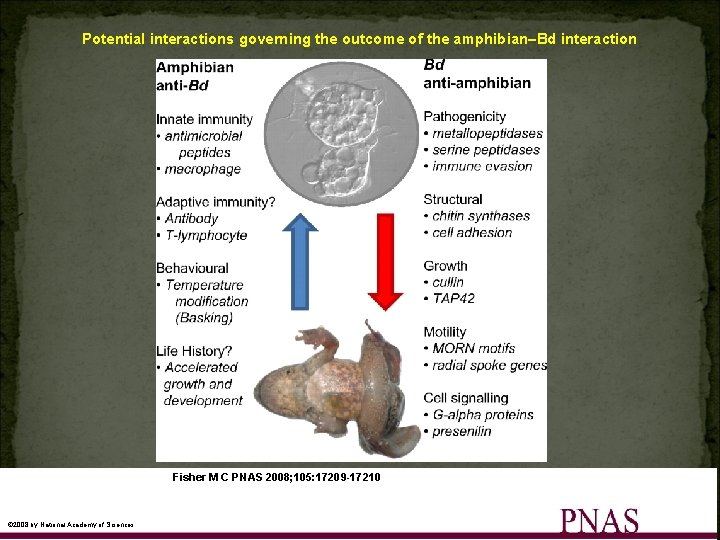
Potential interactions governing the outcome of the amphibian–Bd interaction Fisher M C PNAS 2008; 105: 17209 -17210 © 2008 by National Academy of Sciences
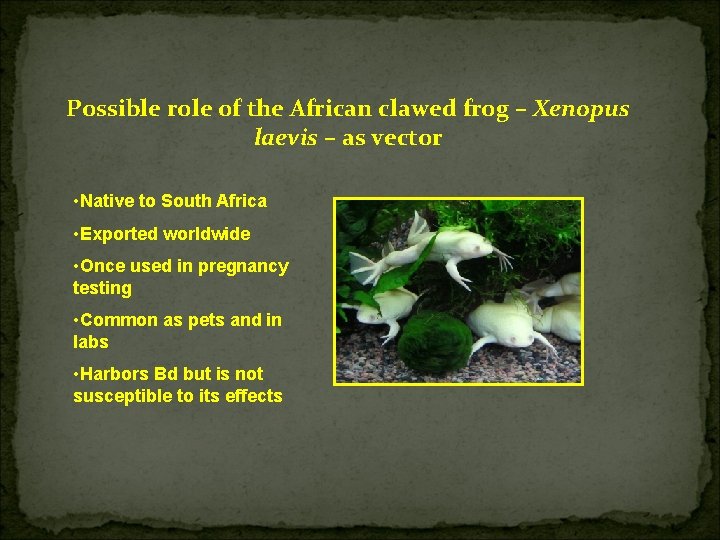
Possible role of the African clawed frog – Xenopus laevis – as vector • Native to South Africa • Exported worldwide • Once used in pregnancy testing • Common as pets and in labs • Harbors Bd but is not susceptible to its effects
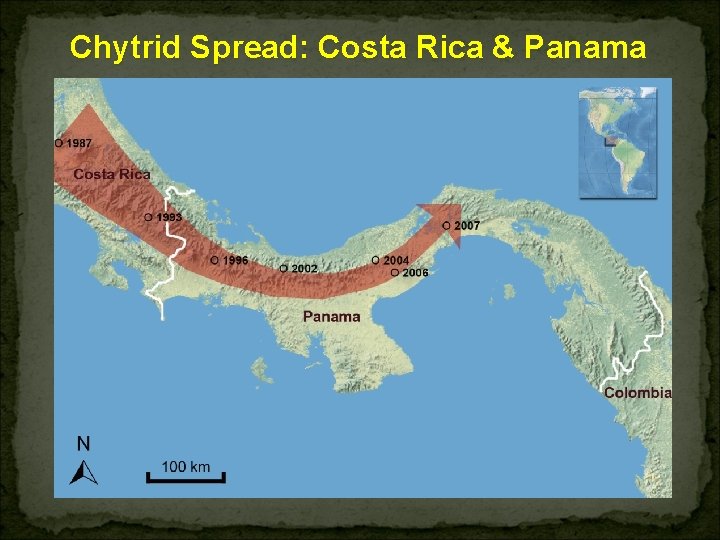
Chytrid Spread: Costa Rica & Panama
Can a disease cause extinction? Three circumstances in which a pathogen can escape density-dependence and outlive its host: • Transmission rate does not depend on density – e. g. sexually transmitted diseases, or those transmitted during aggregations • Species with immunity may act as reservoirs for the pathogen – “Typhoid Mary mechanism” • There may be a reservoir, such as soil or water, in the environment that allows the pathogen to survive long periods with no host Collins and Crump, 2009
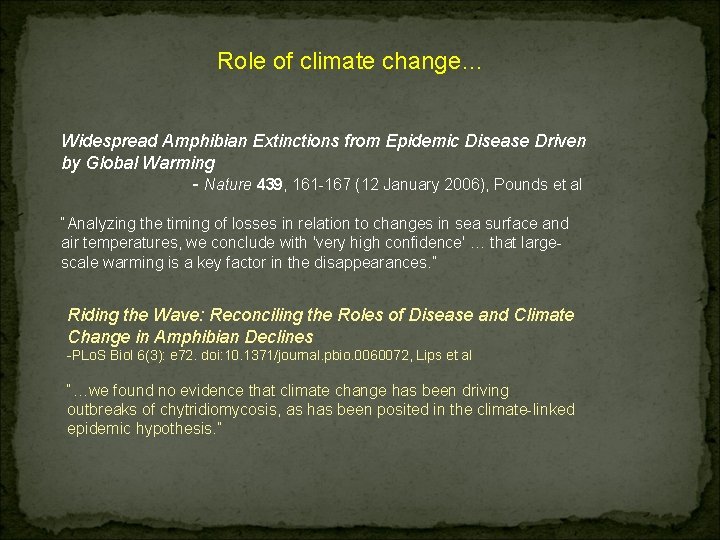
Role of climate change… Widespread Amphibian Extinctions from Epidemic Disease Driven by Global Warming - Nature 439, 161 -167 (12 January 2006), Pounds et al “Analyzing the timing of losses in relation to changes in sea surface and air temperatures, we conclude with 'very high confidence' … that largescale warming is a key factor in the disappearances. ” Riding the Wave: Reconciling the Roles of Disease and Climate Change in Amphibian Declines -PLo. S Biol 6(3): e 72. doi: 10. 1371/journal. pbio. 0060072, Lips et al “…we found no evidence that climate change has been driving outbreaks of chytridiomycosis, as has been posited in the climate-linked epidemic hypothesis. ”
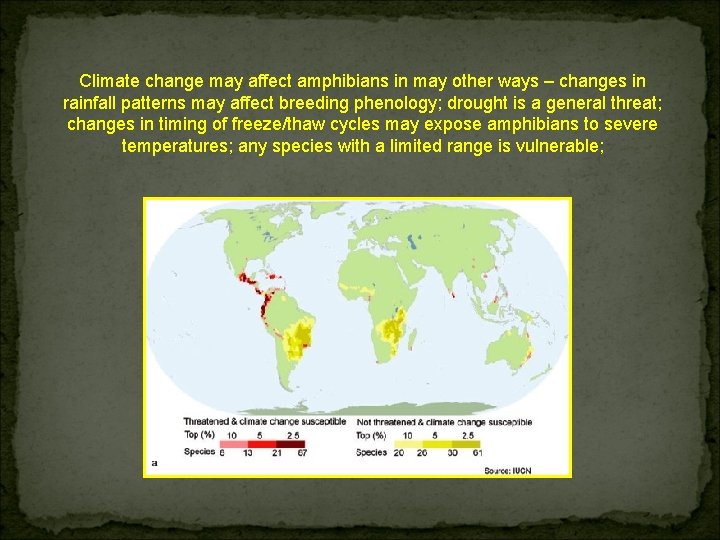
Climate change may affect amphibians in may other ways – changes in rainfall patterns may affect breeding phenology; drought is a general threat; changes in timing of freeze/thaw cycles may expose amphibians to severe temperatures; any species with a limited range is vulnerable;
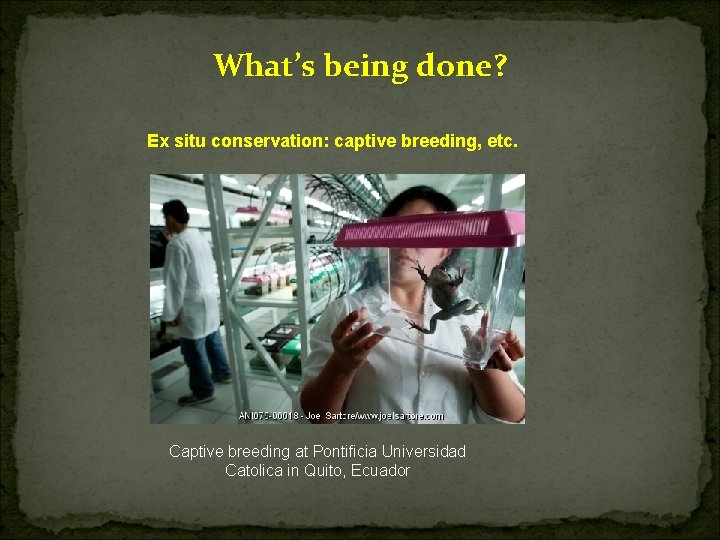
What’s being done? Ex situ conservation: captive breeding, etc. Captive breeding at Pontificia Universidad Catolica in Quito, Ecuador
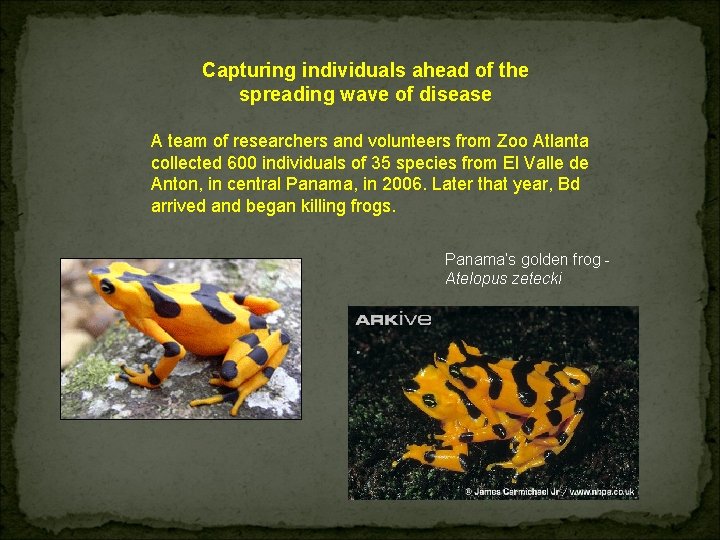
Capturing individuals ahead of the spreading wave of disease A team of researchers and volunteers from Zoo Atlanta collected 600 individuals of 35 species from El Valle de Anton, in central Panama, in 2006. Later that year, Bd arrived and began killing frogs. Panama’s golden frog Atelopus zetecki
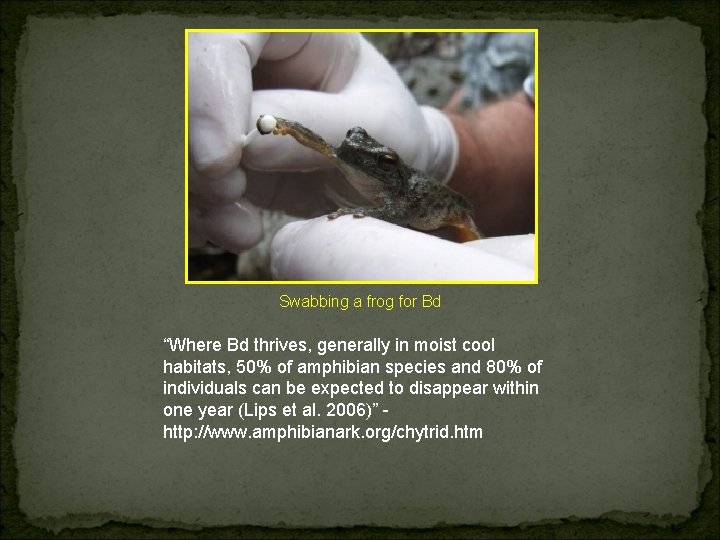
Swabbing a frog for Bd “Where Bd thrives, generally in moist cool habitats, 50% of amphibian species and 80% of individuals can be expected to disappear within one year (Lips et al. 2006)” http: //www. amphibianark. org/chytrid. htm
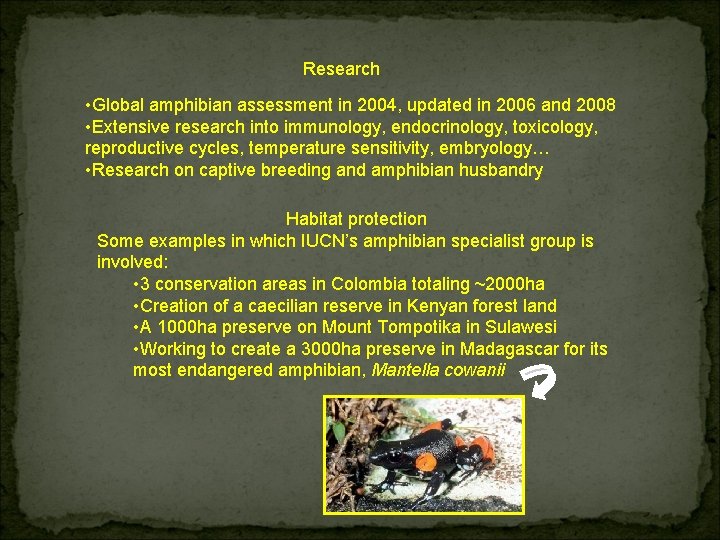
Research • Global amphibian assessment in 2004, updated in 2006 and 2008 • Extensive research into immunology, endocrinology, toxicology, reproductive cycles, temperature sensitivity, embryology… • Research on captive breeding and amphibian husbandry Habitat protection Some examples in which IUCN’s amphibian specialist group is involved: • 3 conservation areas in Colombia totaling ~2000 ha • Creation of a caecilian reserve in Kenyan forest land • A 1000 ha preserve on Mount Tompotika in Sulawesi • Working to create a 3000 ha preserve in Madagascar for its most endangered amphibian, Mantella cowanii
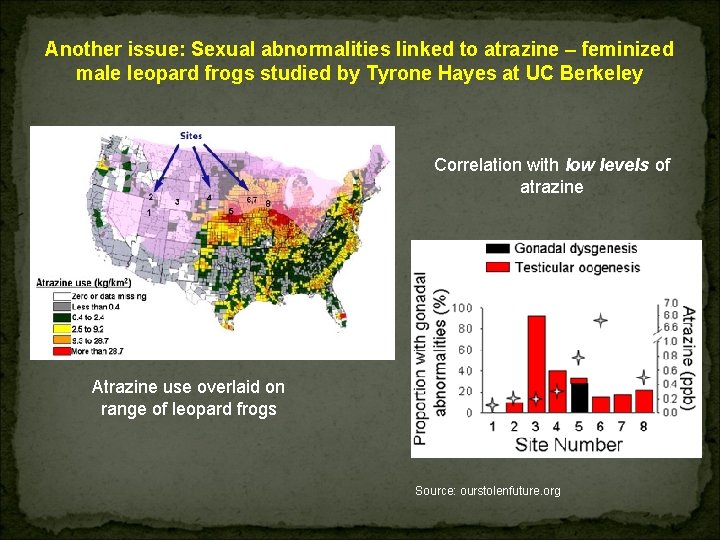
Another issue: Sexual abnormalities linked to atrazine – feminized male leopard frogs studied by Tyrone Hayes at UC Berkeley Correlation with low levels of atrazine Atrazine use overlaid on range of leopard frogs Source: ourstolenfuture. org
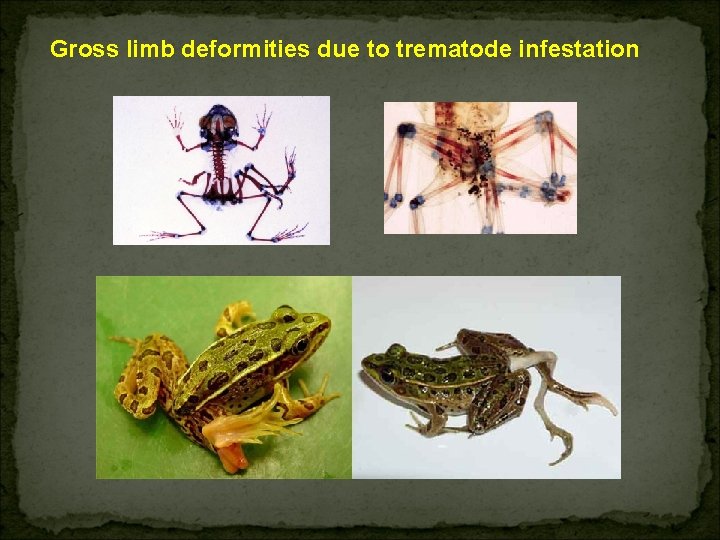
Gross limb deformities due to trematode infestation
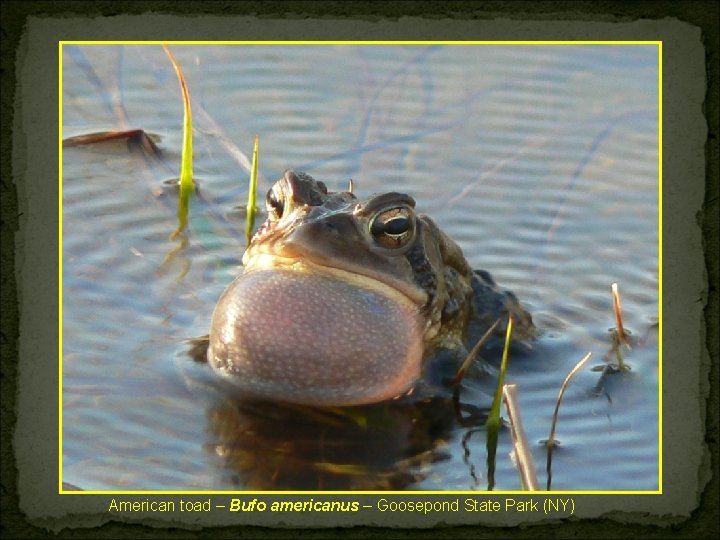
American toad – Bufo americanus – Goosepond State Park (NY)
- Slides: 29