
The Gilded Age and the Progressive Era 1870


- Slides: 34
The Gilded Age and the Progressive Era 1870 s-1910 s
The Gilded Age • Gilded Age: The name for the period 1877– 1900 that suggested the amazing achievements of the period were like a thin gold layer that covered many unresolved political, economic, and social problems. • Era/period during which the United States seemed to prosper (economically, politically, socially), but in reality the U. S. was plagued with many difficulties and problems.
The Gilded Age • From 1870 s-1900, American presidents were relatively ineffectual. • True political influence resided with the party boosters • Some were wealthy businessmen and industrialists • Boosters used their influence to campaign for presidents and secure electoral votes • Presidents were indebted to boosters and had to repay favors • Many pieces of legislation (or lack thereof) were examples of repaying said favors • American presidents had their hands tied and were often unable (or failed) to deal with the demands of the American public. • Examples: improve labor standards and conditions for the working class; address plight of farmers; clear violations of African-Americans civil rights
The Gilded Age • Clear evidence of the weak presidents during the Gilded Age: • From 1876 -1896, no president was ever re-elected to consecutive terms • In presidential elections from 1876 -1892, no president-elect won a majority of the popular vote • Presidents were further hamstrung because of the lingering spoils system. • Spoils system: political patronage; president rewards his close companions and supporters with government positions • Question: What is a potential problem with the spoils system?
The Gilded Age • Spoils system somewhat curtailed after the assassination of Republican president James Garfield (elected in 1880, assassinated in 1881) • Vice-president was Chester A. Arthur • Arthur assumed presidency and approved of civil service reform legislation. • 1883: Pendleton Civil Service Act required that 15 percent of government positions be subject to being staffed by individuals who pass a civil service exam
The Gilded Age • Big business and industries benefited from weak and ineffectual presidents. • In addition to being boosters for presidents, wealthy businessmen and industrialists were boosters for Congressmen and local and state officials • Example of benefit for business and industry: high tariffs. • Tariffs: taxes on imported foreign goods/products • Big business and industry benefited from high tariffs, as tariffs were a disincentive for Americans to buy foreign goods/products. • Americans were more likely to buy goods/products from American big business and industries • Higher tariffs = Greater profits for big business and industries
The Gilded Age • Two Gilded Age presidents did make some effort to reduce tariffs and have fairer business practices in the U. S. • President Arthur created the U. S. Tariff Commission in 1882 to investigate impact of tariffs on the American people. • 1883: tariffs were reduced by a mere 5 percent • President Cleveland, a Democrat, helped create the Interstate Commerce Commission (ICC). • ICC: reviewed railroad prices and ensured that prices would be reasonable for American customers • Unfortunately, the ICC suffered from lack of enforcement power and was not effective in regulating railroad rates
The Gilded Age • After the Arthur and Cleveland presidencies, influential businessmen and industrialists supported Republican Benjamin Harrison for president in 1888. • Boosters helped to secure necessary electoral college votes for Harrison • Harrison ran on a platform of high tariffs • Tariffs would remain high for the next decade • 1890: Sherman Anti-Trust Act • Federal legislation designed to breakup trusts and eliminate monopolies • Not enforced in 1890 s
The Gilded Age • Consequences of Gilded Age politics: • Gross violations of civil rights for African-Americans in the South • Protests, demonstrations, and strikes by American farmers and laborers
The (Un)Reconstructed South • The American South remained impoverished during the Gilded Age • South dependent upon the North • Relied on the North for money and industrial development • Modernization efforts not felt in many areas throughout South • Education was deficient • Social (racial) problems persisted • Black Codes, literacy tests, and poll taxes disenfranchised African-Americans
The (Un)Reconstructed South • Dominant form of employment was sharecropping. • Sharecropping: laborers would work on a landowner’s land in exchange (payment/compensation) for a portion of the crops grown • Many free African-Americans and poor whites worked as sharecroppers • Sharecropping contracts stipulated the responsibilities and obligations of both the land owner and the laborers • Excerpt from an 1866 sharecropping contract: • “The said [landowner] agrees to furnish… all necessary farming utensils to carry… and to give unto said Freedmen whose names appear below one half of all the cotton, corn and wheat that is raised on said place for the year 1866 after all the necessary expenses are deducted out that accrues on said crop. ”
The (Un)Reconstructed South • Excerpts from an 1866 sharecropping contract: • “Outside of the Freedmen’s labor in harvesting, carrying to market and selling the same and the said Freedmen whose names appear below covenant and agrees to and with said [landowner] that for and in consideration of one half of the crop before mentioned that they will plant, cultivate, and raise under the management control and Superintendence of said [landowner], in good faith, a cotton, corn, and oat crop under his management for the year 1866. ” • “We [the Freedmen] furthermore bind ourselves that we will obey the orders of said Ross in all things in carrying out and managing said crop for said year and be docked for disobedience. ”
The (Un)Reconstructed South • Question: based on the previous excerpts, what is a potential danger of the sharecropping system? • If there is this potential danger, then why would African-Americans subject themselves to sharecropping? • Question: since sharecropping was clearly problematic, why was it allowed in the South?
Jim Crow Laws and Plessy vs. Ferguson • Jim Crow laws implemented throughout southern states during 1870 s and 1880 s • Jim Crow laws: allowed for segregated facilities for blacks and whites • E. g. , all-black train cars and all white train cars • Segregated facilities were justified because they were to be “separate, but equal” • However, segregated facilities were clearly unequal • Jim Crow laws directly violated the Fourteenth Amendment • Jim Crow laws upheld after the infamous Supreme Court case Plessy vs. Ferguson
Jim Crow Laws and Plessy vs. Ferguson • Plessy vs. Ferguson (1896): Supreme Court declared “separate but equal” facilities not illegal and, therefore, not a violation of the Fourteenth Amendment • Plessy vs. Ferguson legalized racial segregation in the South • African-Americans in the South essentially left to fend for themselves • Southern segregation would persist until the 1960 s
The Gilded Age: Farmers’ Response • Farmers faced several hardships during the Gilded Age. • • • Expensive tools, equipment, and supplies High-interest loans and defaulting Overproduction and reduced profits High railroad rates High tariffs: farmers were consumers of foreign goods/products • Farmers began to organize in order to affect change. • Similar to labor union organization in chapter 18 • Farmer’s Alliance formed in mid-1880 s. • Union of over 2. 5 million farmers • Many of the Alliance’s demands were not met
The Gilded Age: Farmers’ Response • Populist party created in the wake of lackluster government response • Populist party (people’s party) created by the Farmer’s Alliance • Goal: elected representatives to government so as to affect change/push Farmer’s Alliance agenda through • Populist platform: • Government regulation of railroads • Lower tariffs • Creation of a federal income tax • Populist party enjoyed some success. • State legislators, a governor, and some Congressmen elected to office from the Populist party • Even had candidates in presidential elections in 1890 s and 1900 s
The Gilded Age: The Depression of 1893 • Populist party gained further membership after a major economic depression. • Depression of 1893 was worst depression in American history. • Until the Great Depression • Cause: years of speculation in railroad industry. • Rise of the railroad industry gave false impression that the industry would continue to grow • Businesses, other industries, and banks heavily invested in railroads • Once railroad industry began to decline, some investors pulled their investments resulting in a precipitous economic decline
The Gilded Age: The Depression of 1893 • Business and industry failures resulted in high unemployment. • From 1893 to 1894, unemployment increased from 3 percent to 19 percent • As many as 3 million Americans unemployed by 1895 • Question: To whom or what did the American people turn for help/assistance?
The Gilded Age: The Depression of 1893 • “Immediately following the economic downturn, people sought relief through their elected federal government. Just as quickly, they learned what farmers had been taught in the preceding decades: A weak, inefficient government interested solely in patronage and the spoils system in order to maintain its power was in no position to help the American people face this challenge. The federal government had little in place to support those looking for work or to provide direct aid to those in need. Of course, to be fair, the government had seldom faced these questions before. Americans had to look elsewhere. ” (Pg. 593 U. S. History) • Question: Where did some Americans turn to?
Presidential Election of 1896 • Many working-class Americans joined the Populist party • By 1896, Populist party grew to seriously contend in the presidential election. • Democratic party nominated William Jennings Bryan for president. • Proposed currency reform and was sympathetic to the plight of farmers • Populist party also endorsed Bryan for president • Republican party nominated William Mc. Kinley • Promoted a stable economic policy and the preservation of the gold standard as the basis of American currency
Presidential Election of 1896 • Mc. Kinley won the election. • First president elect during Gilded Age to receive a majority of the popular vote • Election of 1896 had highest voter turnout in American history to that point • Nearly 80 percent of eligible voters • Populist party declined after 1896 • Economy rebounded at the end of the decade • War with Spain in 1898 increased demand for agricultural products, resulting in higher profits and greater purchasing power for farmers
The Progressive Era • Recall definition of the Gilded Age: The name for the period 1877– 1900 that suggested the amazing achievements of the period were like a thin gold layer that covered many unresolved political, economic, and social problems. • Era/period during which the United States seemed to prosper (economically, politically, socially), but in reality the U. S. was plagued with many difficulties and problems. • The Progressive Era a period when several attempts were made to address the unresolved issues of the Gilded Age.
The Progressive Era • Progressivism a series of social justice movements during the late 1800 s and early 1900 s • Response to inequality, inequities, and oppression caused by industrialization and urbanization and the federal government’s failure to pass legislation. • Uniqueness of Progressivism: • Not one single or unified movement • A series of movements throughout the U. S. • Progressive movements began at the grassroots level
The Progressive Era • Many Progressive movements began as responses to journalistic exposés of the problems plaguing America. • Journalists known as muckrakers. • Muckraker Jacob Riis famously documented, both in print and in photos, the living conditions of poor working class Americans in New York in his famous work How the Other Half Lives. • Other muckrakers exposed other problems in America: • • Poor working conditions and standards for the working class Child and female labor Poor food quality Racial discrimination
The Progressive Era • The works and publications of muckrakers resonated with many white, middle class Americans. • Especially true of middle class women • Recall that the middle class was a growing group of professionals who valued/emphasized education and training. • Middle class had enough earning/spending power to afford college education to improve their opportunities and lives • Included middle class women • Many middle class men and women believed that the less fortunate should have a chance to improve their lives and opportunities. • Many Progressives were from the middle class
The Progressive Era • Similar to labor and farmers’ unions, Progressives believed that government action was necessary for change. • However, the weak and ineffectual government during the Gilded Age did not give Progressives much confidence that the government could adequately respond • Progressives believed that the people should exert more control in government. • With the people exercising more control in government, the government would better able to address the problems in America • Similar to the Populist party
The Progressive Era • Progressives successfully pushed for the following policies: • Direct primary • A series of legislative and election reforms • Direct primary: process by which the people directly vote for their party’s representative for president. • Prior to direct primaries, only party delegates at conventions could vote for the party’s representative for president
The Progressive Era • Legislative and election reforms: • Legislative initiative: allowed the voting public to place proposals on the ballot • Referendum: voters can put an existing law on an upcoming ballot to either affirm it or reject it • Recall election: the voting public can petition and vote to have a public official removed from office • Passage of the Seventeenth Amendment: voters directly voted for Senators • Prior to Seventeenth Amendment, Senators were selected by state legislatures
The Progressive Era • Progressive led crusades against child and female labor. • Progressives helped to create the National Child Labor Committee (NCLC) • Created in 1904 • Pushed for outright ban of child labor in industries • In 1912, NCLC instrumental in the creation of the U. S. Children’s Bureau. • A federal agency that investigated and proposed solutions for the general welfare of children
The Progressive Era • Progressive reformers made several efforts to improve working conditions for women, but first real progress made only after a terrible tragedy. • 1911: fire engulfed a garment industry in New York. • Several female garment workers were trapped on the eighth floor • Doors were deliberately blockaded by management to keep union organizers out of the industry • 146 women died, either from the blaze, trampling and blunt-force trauma, or leaping to their death • Tragedy was highly publicized and put pressure on the government to pass work place safety laws and standards.
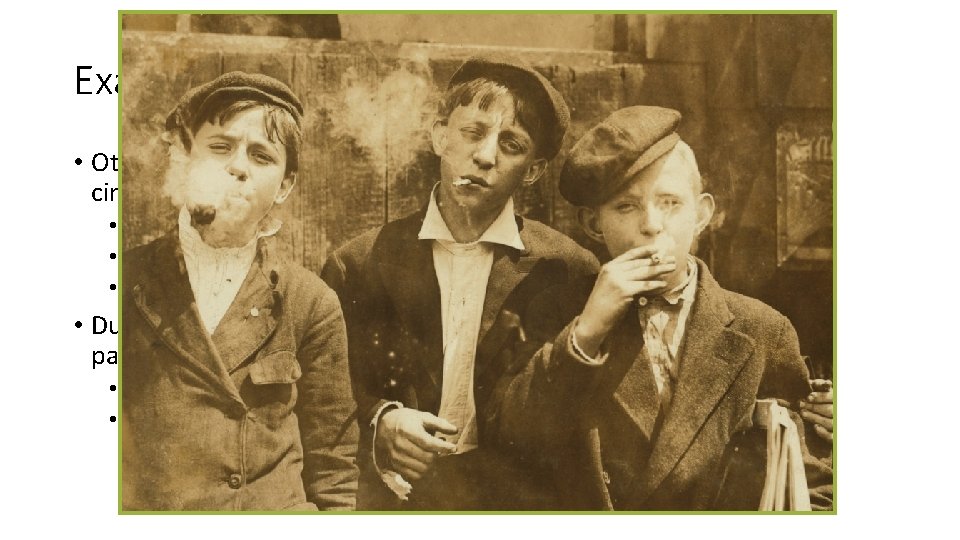
Examples of Progressive Reform Efforts • Other targets of progressive movement were saloons, brothels, & cinemas • Moral vices • Set bad/poor examples for the youth • Opposition to cinemas because films contained suggestive themes • Due, in part, to progressive efforts, Eighteenth Amendment was passed • Prohibited possession, importation, and sale of alcohol • Prohibition would be in effect from 1919 to 1933
The Progressive Era • Other efforts were taken to improve the lives of women, efforts to achieve true political equality for women. • Female suffrage • Movement for female suffrage dates back to the 1848 Seneca Falls convention. • Female reformers issued the Declaration of Sentiments calling for female suffrage • Passage of the Fifteenth Amendment during Reconstruction resulted in a greater demand for female suffrage.
The Progressive Era • American expansion West actually contributed to female suffrage. • In 1900, some new western states gave women the right to vote in state and local elections • A means to attract a greater number of female migrants • 1890: creation of the National American Women’s Suffrage Association (NAWSA) • NAWSA pushed for federal legislation (a constitutional amendment) guaranteeing women the right to vote • Success was not immediate, but by 1920 efforts finally paid off with the passage of the Nineteenth Amendment. • “The right of citizens of the United States to vote shall not be denied or abridged by the United States or by any State on account of sex. ”