
The Giant Radio Array for Neutrino Detection Expected

- Slides: 27
The Giant Radio Array for Neutrino Detection Expected sensitivity to cosmic neutrinos: a preliminary estimate
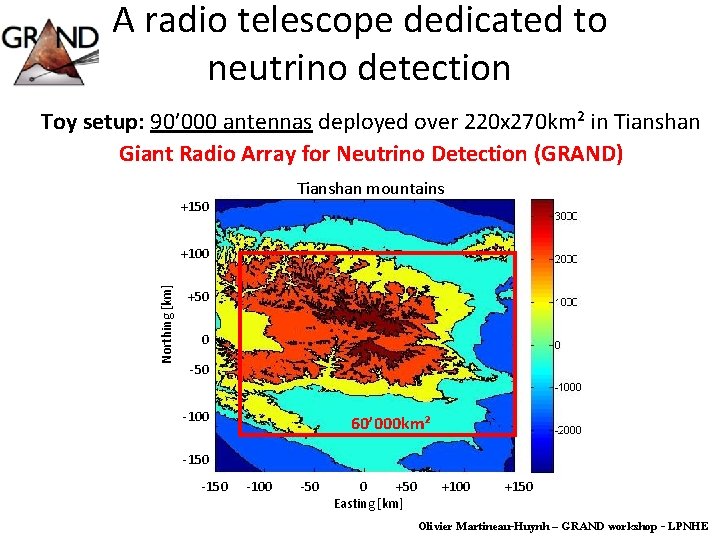
A radio telescope dedicated to neutrino detection Toy setup: 90’ 000 antennas deployed over 220 x 270 km² in Tianshan Giant Radio Array for Neutrino Detection (GRAND) Tianshan mountains +150 Northing [km] +100 +50 0 -50 -100 60’ 000 km² -150 -100 -50 0 +50 Easting [km] +100 +150 Olivier Martineau-Huynh – GRAND workshop - LPNHE
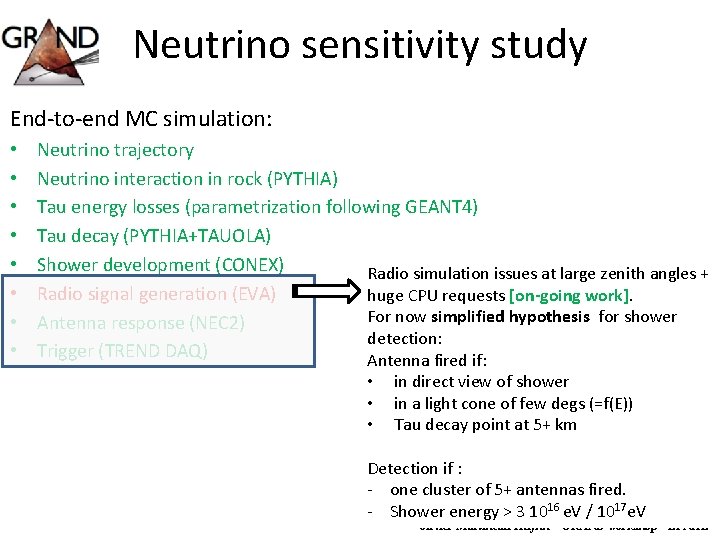
Neutrino sensitivity study End-to-end MC simulation: • • Neutrino trajectory Neutrino interaction in rock (PYTHIA) Tau energy losses (parametrization following GEANT 4) Tau decay (PYTHIA+TAUOLA) Shower development (CONEX) Radio simulation issues at large zenith angles + Radio signal generation (EVA) huge CPU requests [on-going work]. For now simplified hypothesis for shower Antenna response (NEC 2) detection: Trigger (TREND DAQ) Antenna fired if: • • • in direct view of shower in a light cone of few degs (=f(E)) Tau decay point at 5+ km Detection if : - one cluster of 5+ antennas fired. - Shower energy > 3 1016 e. V / 1017 e. V Olivier Martineau-Huynh – GRAND workshop - LPNHE
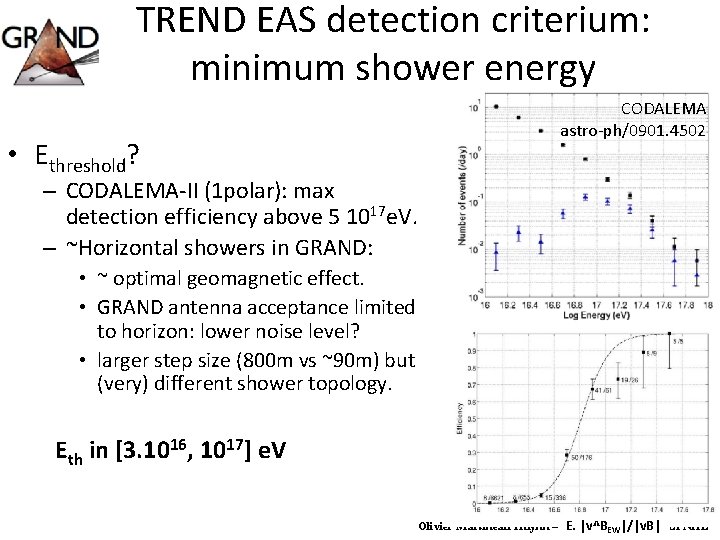
TREND EAS detection criterium: minimum shower energy • Ethreshold? CODALEMA astro-ph/0901. 4502 – CODALEMA-II (1 polar): max detection efficiency above 5 1017 e. V. – ~Horizontal showers in GRAND: • ~ optimal geomagnetic effect. • GRAND antenna acceptance limited to horizon: lower noise level? • larger step size (800 m vs ~90 m) but (very) different shower topology. Eth in [3. 1016, 1017] e. V Olivier Martineau-Huynh – GRAND workshop E. |v^BEW |/|v. B|- LPNHE
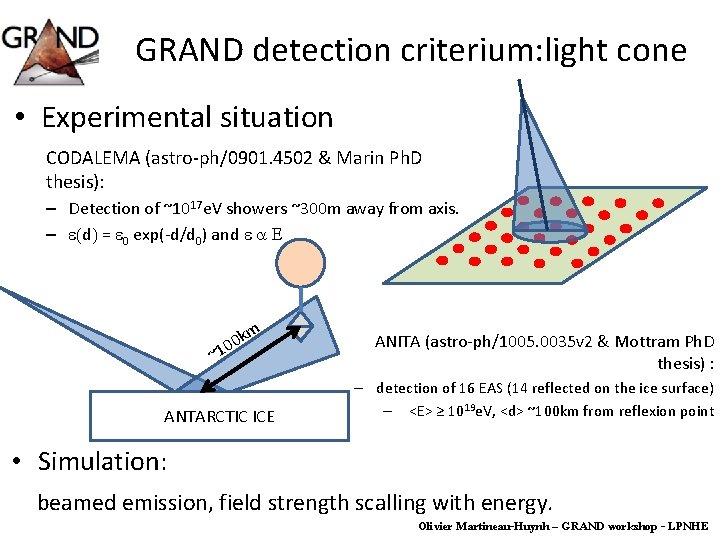
GRAND detection criterium: light cone • Experimental situation CODALEMA (astro-ph/0901. 4502 & Marin Ph. D thesis): – Detection of ~1017 e. V showers ~300 m away from axis. – e(d) = e 0 exp(-d/d 0) and e a E m 0 k 0 ~1 ANTARCTIC ICE ANITA (astro-ph/1005. 0035 v 2 & Mottram Ph. D thesis) : – detection of 16 EAS (14 reflected on the ice surface) – <E> ≥ 1019 e. V, <d> ~100 km from reflexion point • Simulation: beamed emission, field strength scalling with energy. Olivier Martineau-Huynh – GRAND workshop - LPNHE
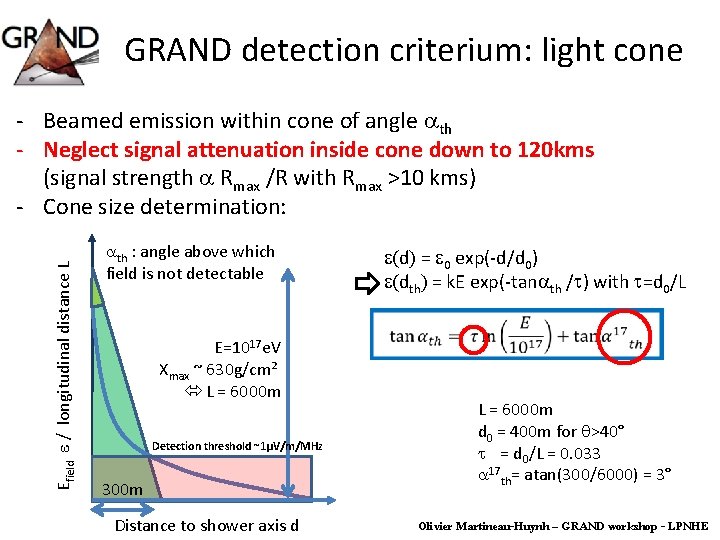
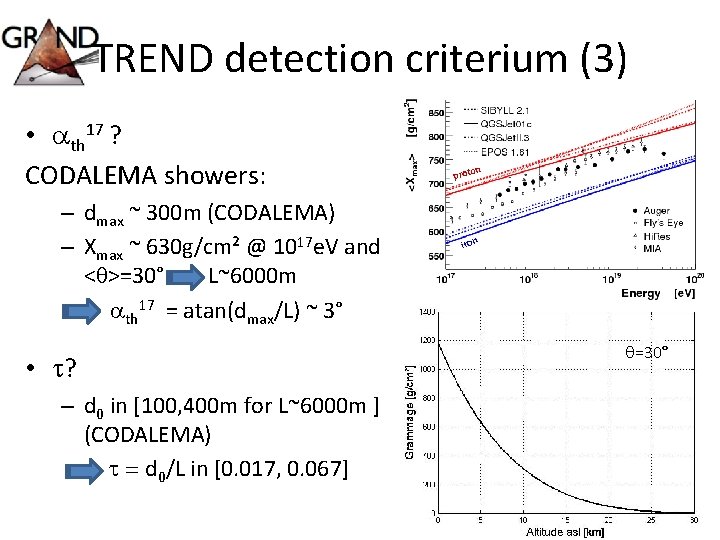
GRAND detection criterium: light cone Efield e / longitudinal distance L - Beamed emission within cone of angle ath - Neglect signal attenuation inside cone down to 120 kms (signal strength a Rmax /R with Rmax >10 kms) - Cone size determination: ath : angle above which field is not detectable E=1017 e. V Xmax ~ 630 g/cm² L = 6000 m Detection threshold ~1µV/m/MHz 300 m Distance to shower axis d e(d) = e 0 exp(-d/d 0) e(dth) = k. E exp(-tanath /t) with t=d 0/L L = 6000 m d 0 = 400 m for q>40° t = d 0/L = 0. 033 a 17 th= atan(300/6000) = 3° Olivier Martineau-Huynh – GRAND workshop - LPNHE
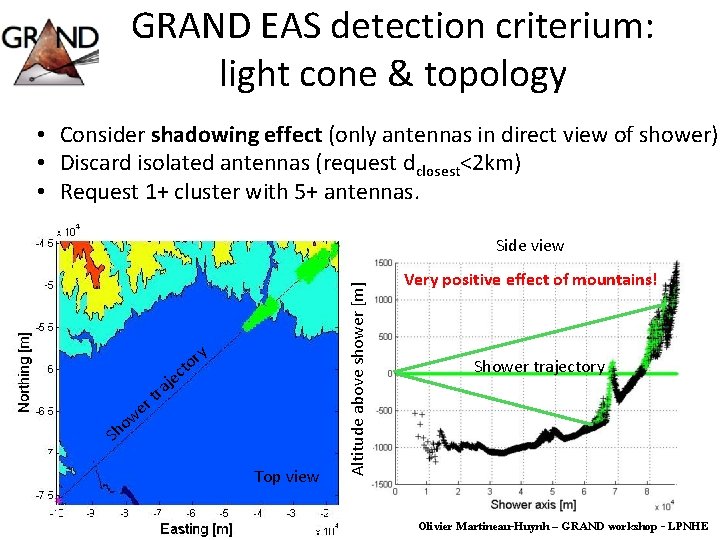
GRAND EAS detection criterium: light cone & topology • Consider shadowing effect (only antennas in direct view of shower) • Discard isolated antennas (request dclosest<2 km) • Request 1+ cluster with 5+ antennas. er w o Sh c e j tra y r to Top view Altitude above shower [m] Side view Very positive effect of mountains! Shower trajectory Olivier Martineau-Huynh – GRAND workshop - LPNHE
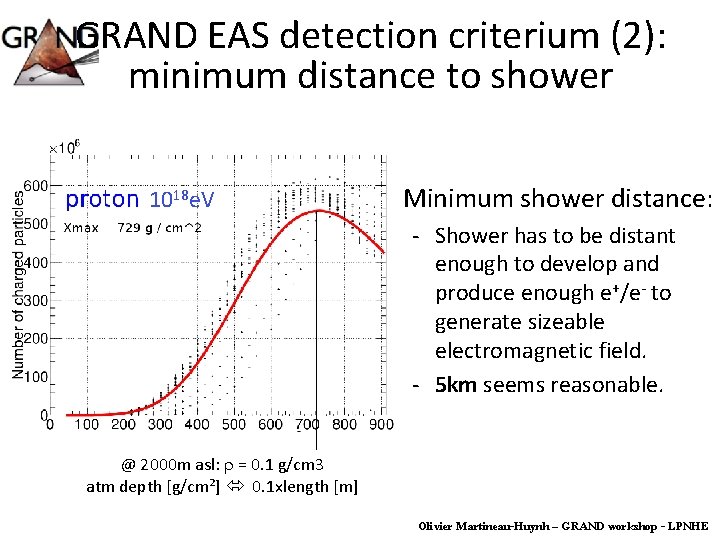
GRAND EAS detection criterium (2): minimum distance to shower 1018 e. V • Minimum shower distance: - Shower has to be distant enough to develop and produce enough e+/e- to generate sizeable electromagnetic field. - 5 km seems reasonable. @ 2000 m asl: r = 0. 1 g/cm 3 atm depth [g/cm²] 0. 1 xlength [m] Olivier Martineau-Huynh – GRAND workshop - LPNHE
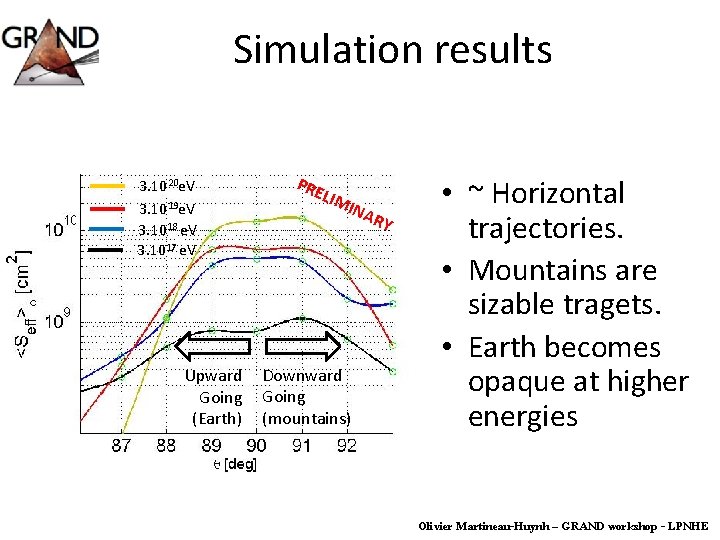
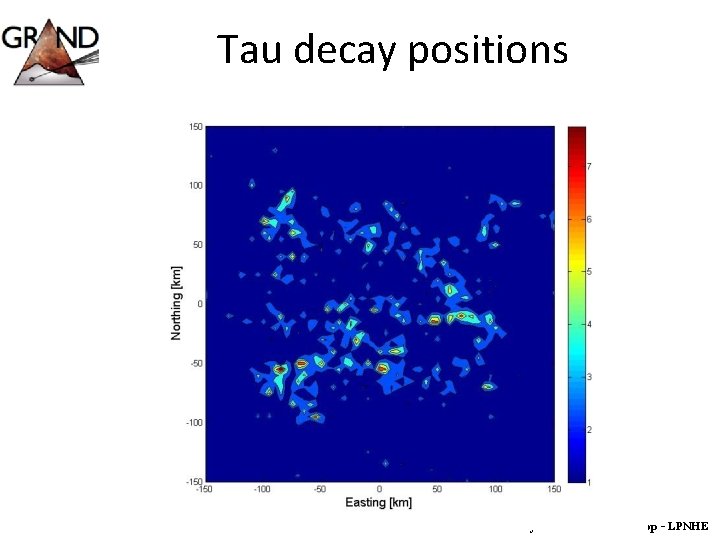
Simulation results 3. 1020 e. V 3. 1019 e. V 3. 1018 e. V 3. 1017 e. V Upward Going (Earth) PRE LIM INA RY Downward Going (mountains) • ~ Horizontal trajectories. • Mountains are sizable tragets. • Earth becomes opaque at higher energies Olivier Martineau-Huynh – GRAND workshop - LPNHE
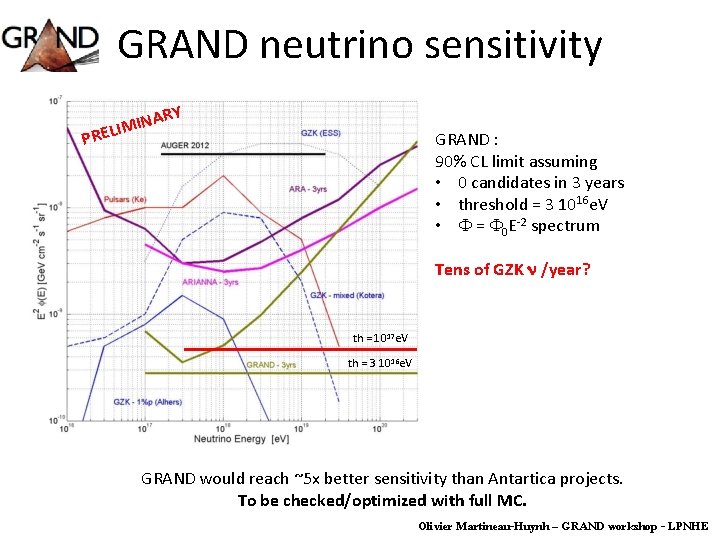
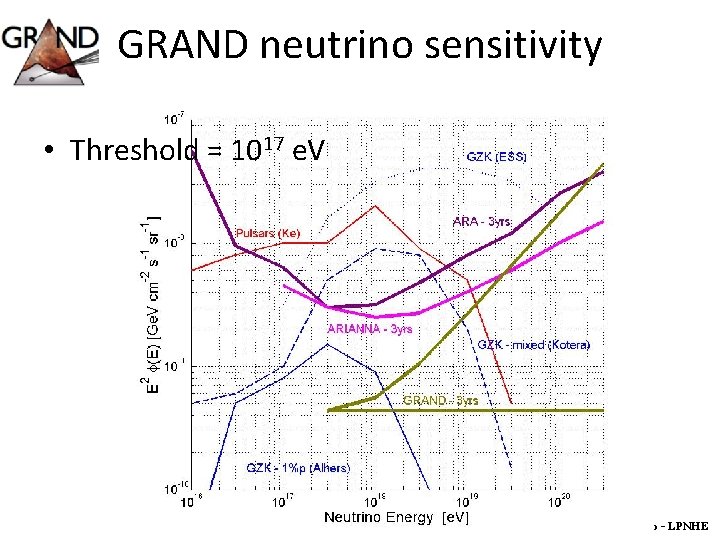
GRAND neutrino sensitivity Y P NAR I M I REL GRAND : 90% CL limit assuming • 0 candidates in 3 years • threshold = 3 1016 e. V • F = F 0 E-2 spectrum Tens of GZK n /year? th = 1017 e. V th = 3 1016 e. V GRAND would reach ~5 x better sensitivity than Antartica projects. To be checked/optimized with full MC. Olivier Martineau-Huynh – GRAND workshop - LPNHE
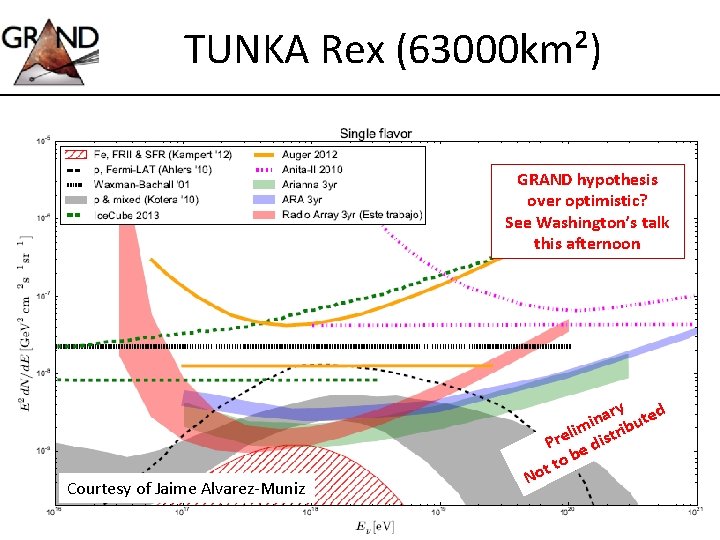
TUNKA Rex (63000 km²) GRAND hypothesis over optimistic? See Washington’s talk this afternoon Courtesy of Jaime Alvarez-Muniz ary uted n i lim istrib e r P ed b to t o N Olivier Martineau-Huynh – GRAND workshop - LPNHE
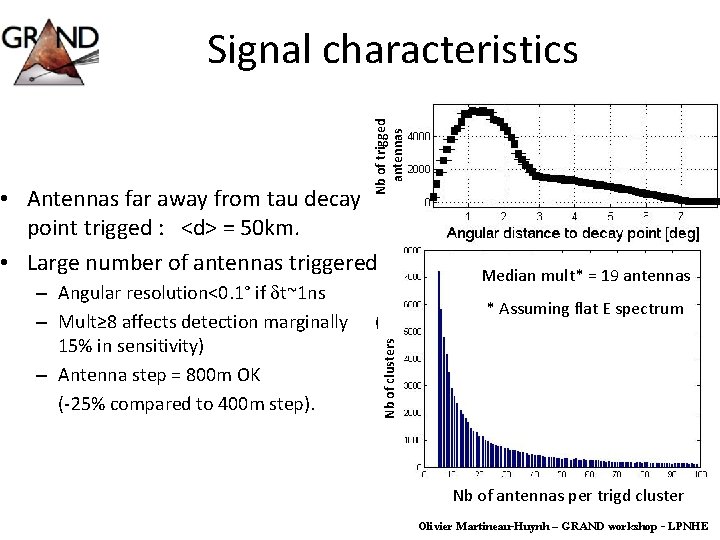
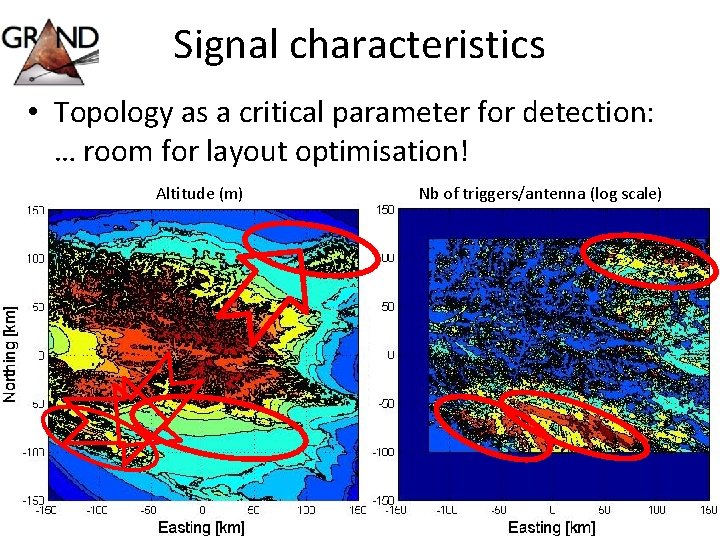
Nb of trigged antennas Signal characteristics • Antennas far away from tau decay point trigged : <d> = 50 km. • Large number of antennas triggered: (- * Assuming flat E spectrum Nb of clusters – Angular resolution<0. 1° if dt~1 ns – Mult≥ 8 affects detection marginally 15% in sensitivity) – Antenna step = 800 m OK (-25% compared to 400 m step). Median mult* = 19 antennas Nb of antennas per trigd cluster Olivier Martineau-Huynh – GRAND workshop - LPNHE
Signal characteristics • Topology as a critical parameter for detection: … room for layout optimisation! Altitude (m) Nb of triggers/antenna (log scale) Olivier Martineau-Huynh – GRAND workshop - LPNHE
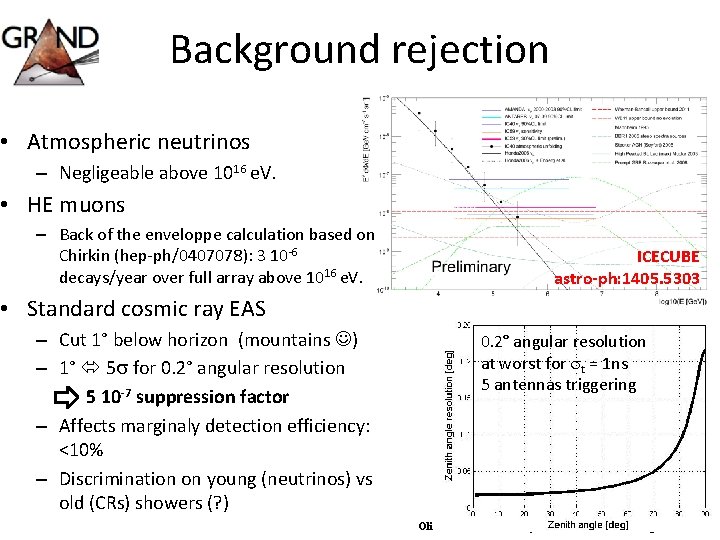
Background rejection • Atmospheric neutrinos – Negligeable above 1016 e. V. • HE muons – Back of the enveloppe calculation based on Chirkin (hep-ph/0407078): 3 10 -6 decays/year over full array above 1016 e. V. ICECUBE astro-ph: 1405. 5303 • Standard cosmic ray EAS – Cut 1° below horizon (mountains ) – 1° 5 s for 0. 2° angular resolution 5 10 -7 suppression factor – Affects marginaly detection efficiency: <10% – Discrimination on young (neutrinos) vs old (CRs) showers (? ) 0. 2° angular resolution at worst for st = 1 ns 5 antennas triggering Olivier Martineau-Huynh – GRAND workshop - LPNHE
Terrestrial background (see TREND 50 talk Tuesday) • All radio projects (AERA, CODALEMA, TREND 50…) exhibit large trigger rates, even in remote areas. • Terrestrial origin: HV, train, planes, thunderstorms… • Trig rate is orders of magnitudes larger than expected neutrino rate. Rejecting this terrestrial background is a (the? ) major challenge for the GRAND project. Olivier Martineau-Huynh – GRAND workshop - LPNHE
Conclusion • VERY rough estimate of GRAND sensitivity based on realistic (but possibly too optimistic) hypothesis. • Sensitivity limit at least competitive with Antarctica projects • Mountains could be big help (target, detection & background rejection). • Terrestrial background a major issue in any case. Olivier Martineau-Huynh – GRAND workshop - LPNHE
Backup Olivier Martineau-Huynh – GRAND workshop - LPNHE
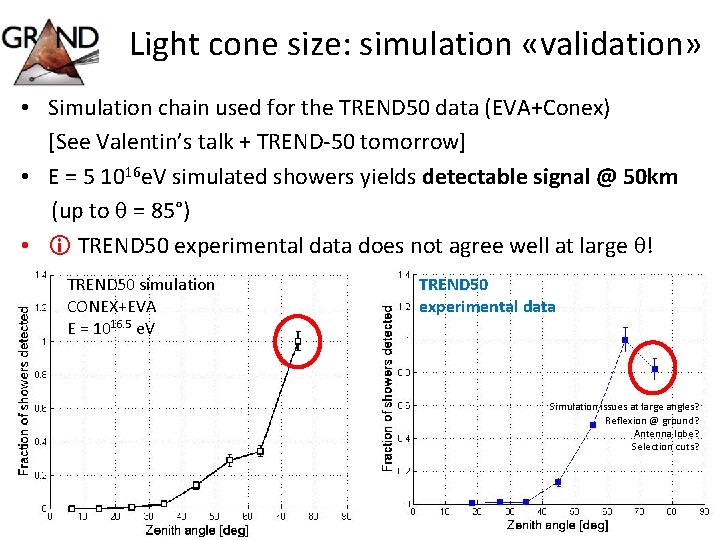
Light cone size: simulation «validation» • Simulation chain used for the TREND 50 data (EVA+Conex) [See Valentin’s talk + TREND-50 tomorrow] • E = 5 1016 e. V simulated showers yields detectable signal @ 50 km (up to q = 85°) • TREND 50 experimental data does not agree well at large q! TREND 50 simulation CONEX+EVA E = 1016. 5 e. V TREND 50 experimental data Simulation issues at large angles? Reflexion @ ground? Antenna lobe? Selection cuts? Olivier Martineau-Huynh – GRAND workshop - LPNHE
GRAND neutrino sensitivity • Threshold = 1017 e. V Olivier Martineau-Huynh – GRAND workshop - LPNHE
Olivier Martineau-Huynh – GRAND workshop - LPNHE
Olivier Martineau-Huynh – GRAND workshop - LPNHE
TREND detection criterium (3) • ath 17 ? CODALEMA showers: – dmax ~ 300 m (CODALEMA) – Xmax ~ 630 g/cm² @ 1017 e. V and <q>=30° L~6000 m ath 17 = atan(dmax/L) ~ 3° • t? q=30° – d 0 in [100, 400 m for L~6000 m ] (CODALEMA) t = d 0/L in [0. 017, 0. 067] Olivier Martineau-Huynh – GRAND workshop - LPNHE
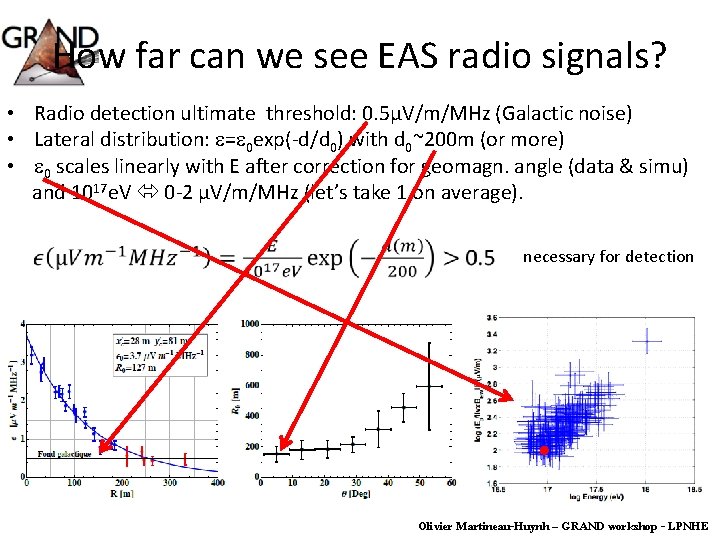
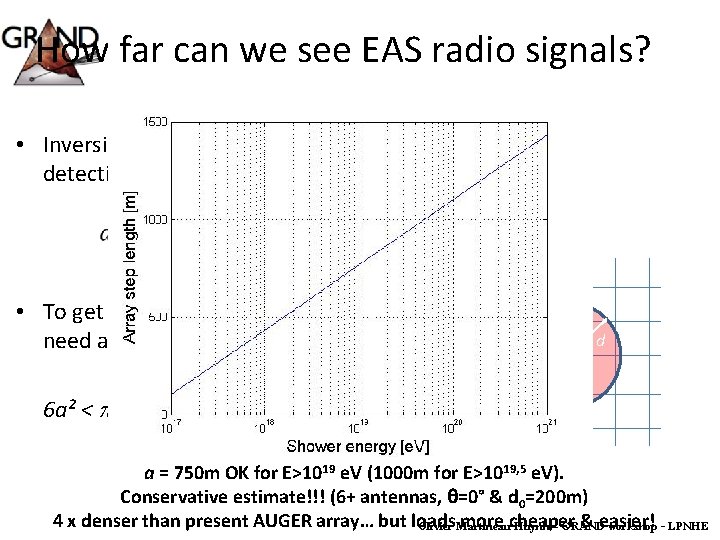
How far can we see EAS radio signals? • Radio detection ultimate threshold: 0. 5µV/m/MHz (Galactic noise) • Lateral distribution: e=e 0 exp(-d/d 0) with d 0~200 m (or more) • e 0 scales linearly with E after correction for geomagn. angle (data & simu) and 1017 e. V 0 -2 µV/m/MHz (let’s take 1 on average). necessary for detection CODALEMA data, V. Marin Ph. D (2013 SUBATECH) Olivier Martineau-Huynh – GRAND workshop - LPNHE
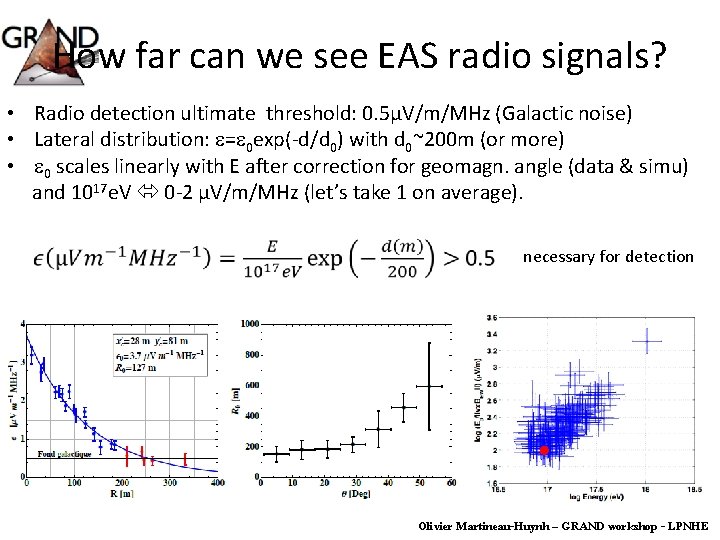
How far can we see EAS radio signals? • Radio detection ultimate threshold: 0. 5µV/m/MHz (Galactic noise) • Lateral distribution: e=e 0 exp(-d/d 0) with d 0~200 m (or more) • e 0 scales linearly with E after correction for geomagn. angle (data & simu) and 1017 e. V 0 -2 µV/m/MHz (let’s take 1 on average). necessary for detection CODALEMA data, V. Marin Ph. D (2013 SUBATECH) Olivier Martineau-Huynh – GRAND workshop - LPNHE
How far can we see EAS radio signals? • Inversion gives max distance allowed for detection: a • To get 6+ antennas with this condition, we need an array step length a such that : d 6 a² < pd² a = 750 m OK for E>1019 e. V (1000 m for E>1019, 5 e. V). Conservative estimate!!! (6+ antennas, q=0° & d 0=200 m) 4 x denser than present AUGER array… but loads more cheaper & easier! Olivier Martineau-Huynh – GRAND workshop - LPNHE
Olivier Martineau-Huynh – GRAND workshop - LPNHE
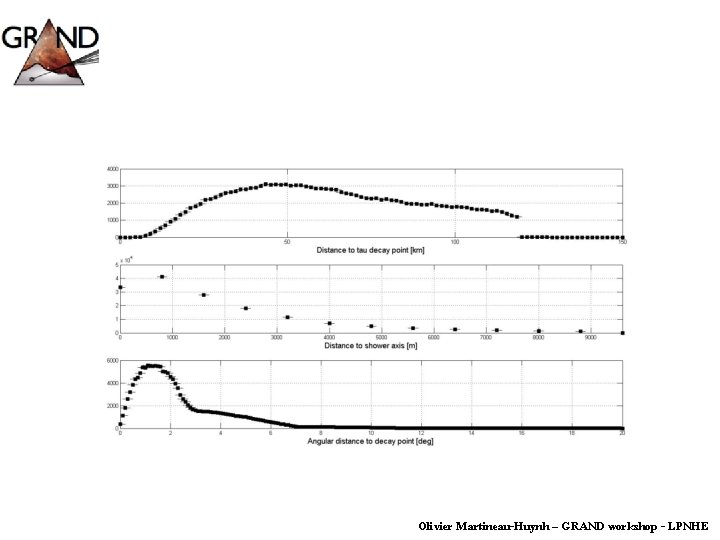
Tau decay positions Olivier Martineau-Huynh – GRAND workshop - LPNHE