
The geriatric oneday hospital of the university centrum

- Slides: 35
The geriatric one-day hospital of the university centrum in Liège, Belgium Dr Sophie Gillain, MD in charge of clinical activities in the geriatric daily clinic Christel Menozzi, Senior Head Nurse
Working plan • Legislative aspects of geriatric care (GC) in Belgium • Financial aspects of the geriatric one-day hospital • Every day organisation • Our activity • Guided visit and questions
Working plan • Legislative aspects of geriatric care (GC) in Belgium • Financial aspects of the geriatric one-day hospital • Every day organisation • Our activity • Guided visit and questions
Legislative aspects of geriatric care in Belgium • Since january 2007, Geriatric plan of care (GPC) – Each general hospital must have a GPC § Or be associated with an other hospital including these plan
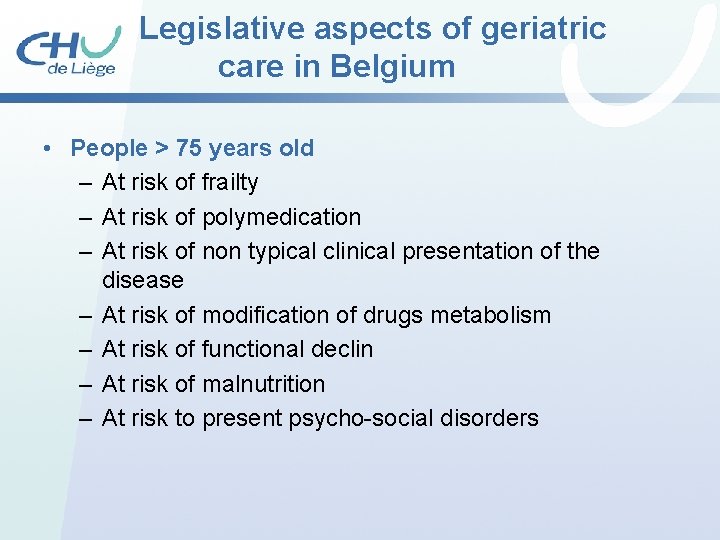
Legislative aspects of geriatric care in Belgium • People > 75 years old – At risk of frailty – At risk of polymedication – At risk of non typical clinical presentation of the disease – At risk of modification of drugs metabolism – At risk of functional declin – At risk of malnutrition – At risk to present psycho-social disorders
Legislative aspects of geriatric care in Belgium • Each people ≥ 75 years old, hospitalized have to be assess to these risk – role of the geriatric mobile team • Older assessed as at risk have to benefit of the GPC
Legislative aspects of geriatric care in Belgium • Main goals of GPC – Adapted care – Best way to prevent functional decline – Best way to carry out rehabilitation as higher is possible – Best plan of care after leaving geriatric department – Follow up – Discussion and plan with other caregivers § GP, Family members, Nursing homes, …
Legislative aspects of geriatric care in Belgium • Main tools to do that 1. Acute geriatric ward 2. Geriatric consultation 3. Mobile geriatric team in the hospital 4. Mobile geriatric team beyong the hospital § Relation with GP, Nursing homes, Neuropsychiatric center 5. Geriatric one-day hospital 6. Multidisciplinary approach by organise by caregivers
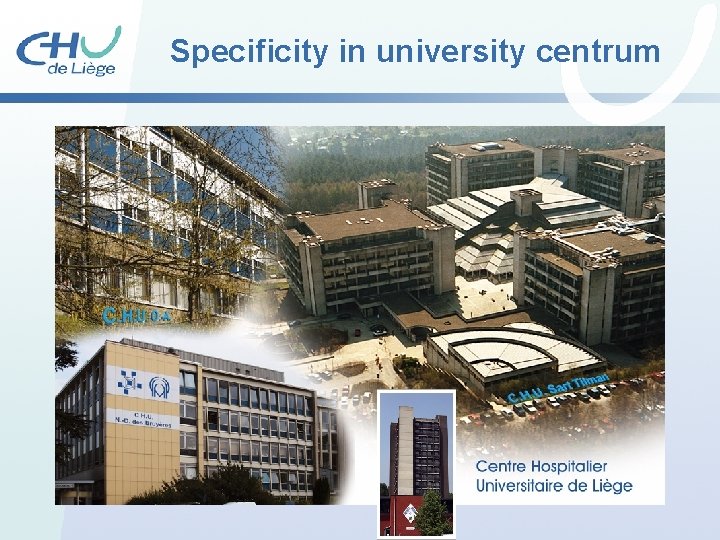
Specificity in university centrum
Legislative aspects of geriatric care in Belgium • Caregivers of the multidisciplinary approach – Geriatrician (6 years more than general medicine) – Geriatric nurse – Physiotherapist – Psychologist – Ergotherapist – Nutritionist – Speech therapist – Social worker
Legislative aspects of geriatric care in Belgium • Obligation concerning organisation § Assume all different functions – Acute geriatric care unit, one day hospital, mobile team § Information transmission – To other specialists, GP, patients and families § Multidisciplinary meeting / week / function – Find a adpated consensus for each patient
Legislative aspects of geriatric care in Belgium Obligation concerning specialized caregivers in the different functions of the GPC
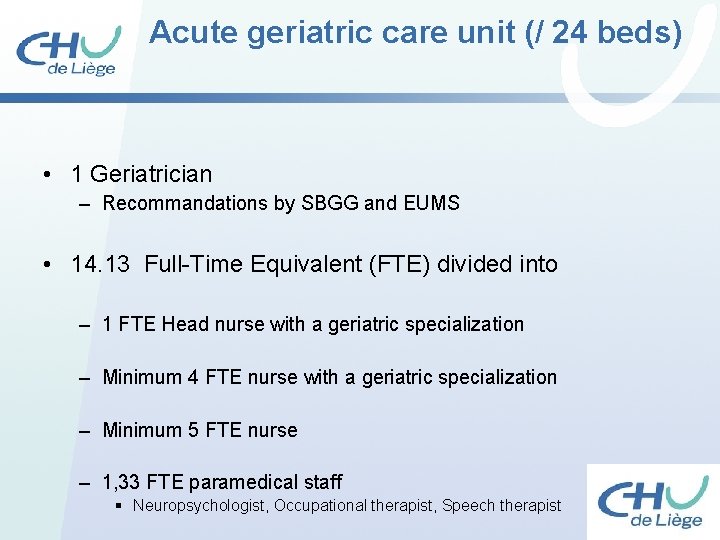
Acute geriatric care unit (/ 24 beds) • 1 Geriatrician – Recommandations by SBGG and EUMS • 14. 13 Full-Time Equivalent (FTE) divided into – 1 FTE Head nurse with a geriatric specialization – Minimum 4 FTE nurse with a geriatric specialization – Minimum 5 FTE nurse – 1, 33 FTE paramedical staff § Neuropsychologist, Occupational therapist, Speech therapist
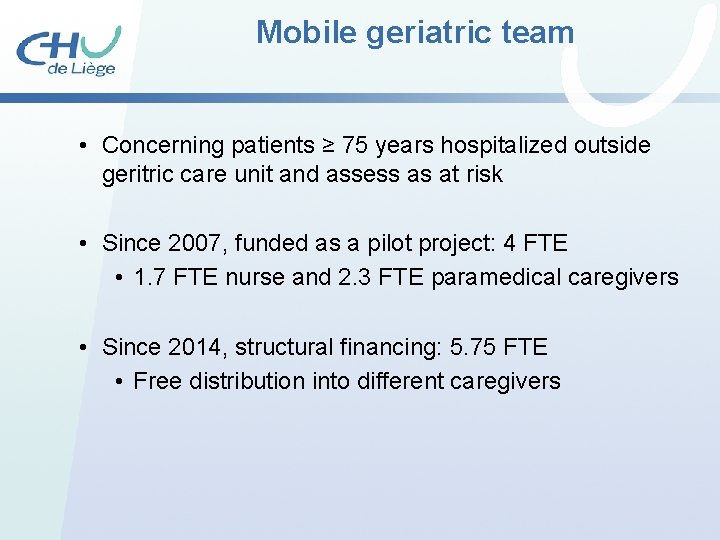
Mobile geriatric team • Concerning patients ≥ 75 years hospitalized outside geritric care unit and assess as at risk • Since 2007, funded as a pilot project: 4 FTE • 1. 7 FTE nurse and 2. 3 FTE paramedical caregivers • Since 2014, structural financing: 5. 75 FTE • Free distribution into different caregivers
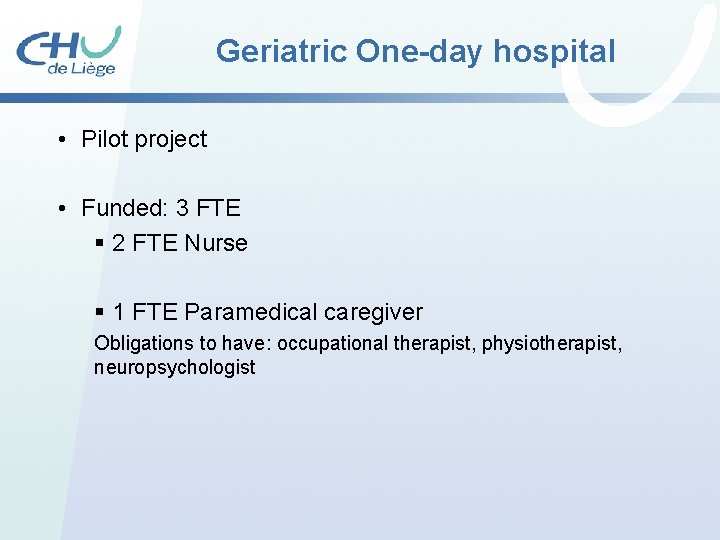
Geriatric One-day hospital • Pilot project • Funded: 3 FTE § 2 FTE Nurse § 1 FTE Paramedical caregiver Obligations to have: occupational therapist, physiotherapist, neuropsychologist
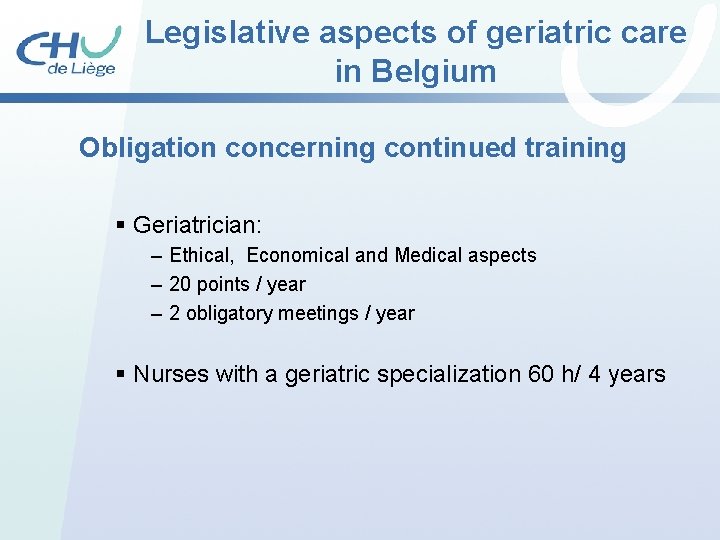
Legislative aspects of geriatric care in Belgium Obligation concerning continued training § Geriatrician: – Ethical, Economical and Medical aspects – 20 points / year – 2 obligatory meetings / year § Nurses with a geriatric specialization 60 h/ 4 years
Working plan • Legislative aspects of geriatric care (GC) in Belgium • Financial aspects of the geriatric one-day hospital • Every day organisation • Our activity • Guided visit and questions
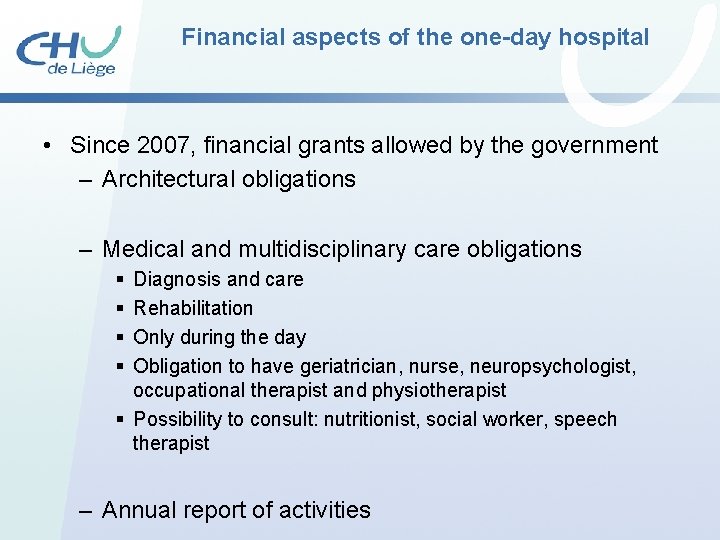
Financial aspects of the one-day hospital • Since 2007, financial grants allowed by the government – Architectural obligations – Medical and multidisciplinary care obligations § § Diagnosis and care Rehabilitation Only during the day Obligation to have geriatrician, nurse, neuropsychologist, occupational therapist and physiotherapist § Possibility to consult: nutritionist, social worker, speech therapist – Annual report of activities
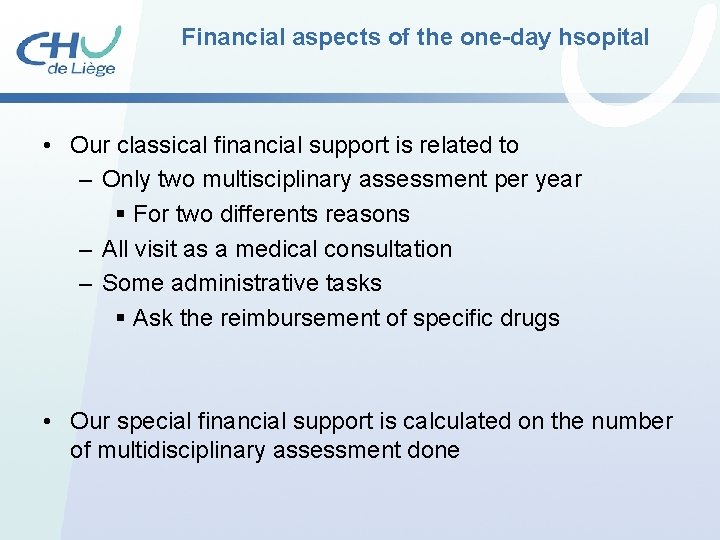
Financial aspects of the one-day hsopital • Our classical financial support is related to – Only two multisciplinary assessment per year § For two differents reasons – All visit as a medical consultation – Some administrative tasks § Ask the reimbursement of specific drugs • Our special financial support is calculated on the number of multidisciplinary assessment done
Working plan • Legislative aspects of geriatric care (GC) in Belgium • Financial aspects of the geriatric one-day hospital • Every day organisation • Our activity • Guided visit and questions
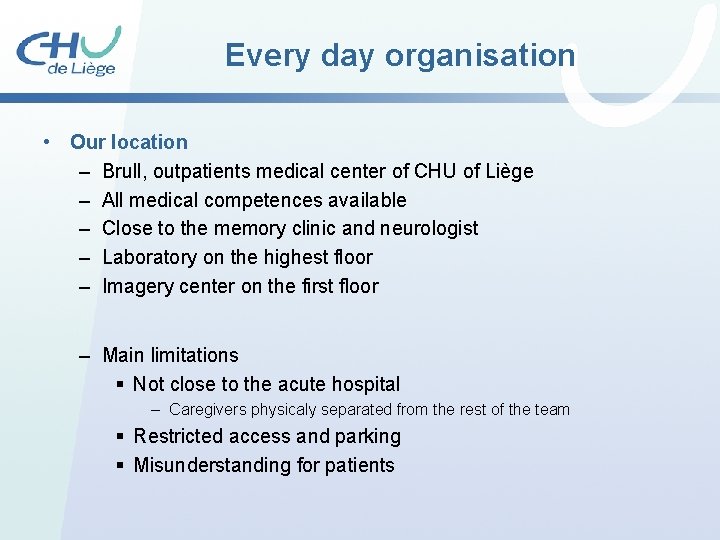
Every day organisation • Our location – Brull, outpatients medical center of CHU of Liège – All medical competences available – Close to the memory clinic and neurologist – Laboratory on the highest floor – Imagery center on the first floor – Main limitations § Not close to the acute hospital – Caregivers physicaly separated from the rest of the team § Restricted access and parking § Misunderstanding for patients
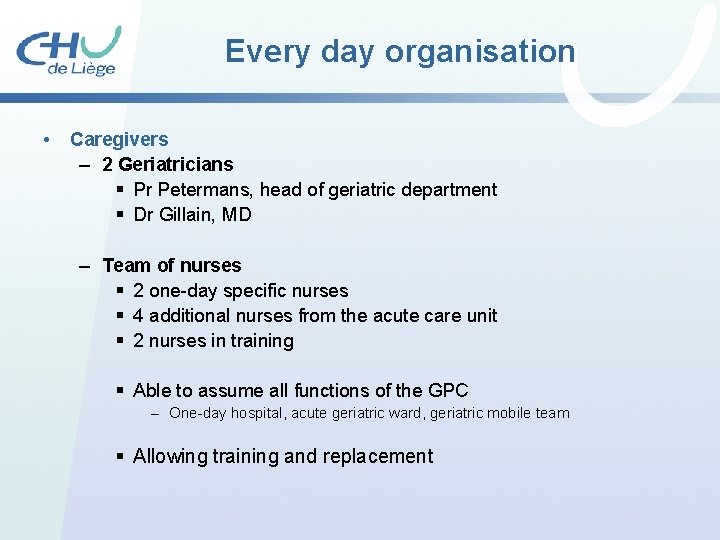
Every day organisation • Caregivers – 2 Geriatricians § Pr Petermans, head of geriatric department § Dr Gillain, MD – Team of nurses § 2 one-day specific nurses § 4 additional nurses from the acute care unit § 2 nurses in training § Able to assume all functions of the GPC – One-day hospital, acute geriatric ward, geriatric mobile team § Allowing training and replacement
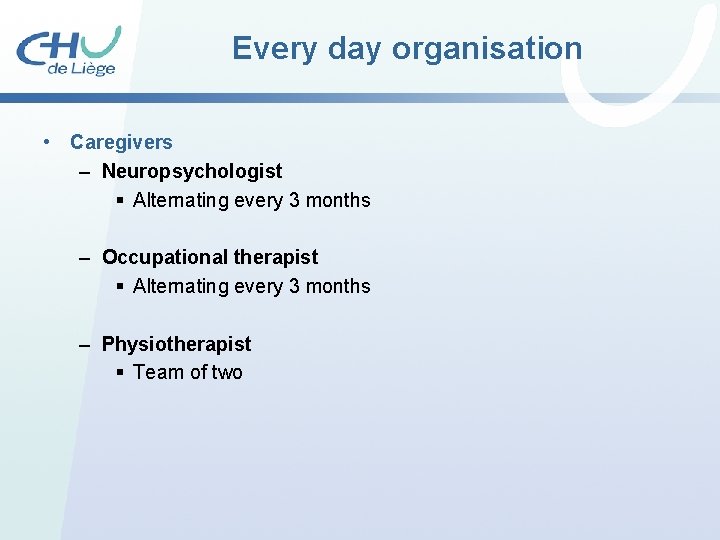
Every day organisation • Caregivers – Neuropsychologist § Alternating every 3 months – Occupational therapist § Alternating every 3 months – Physiotherapist § Team of two
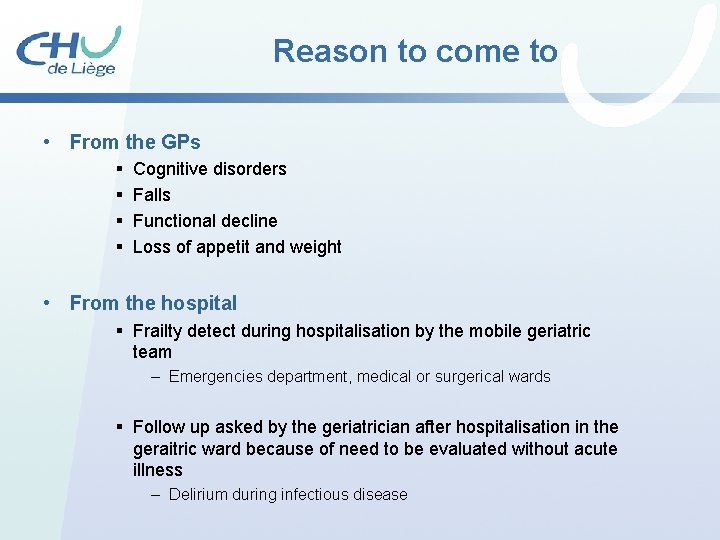
Reason to come to • From the GPs § § Cognitive disorders Falls Functional decline Loss of appetit and weight • From the hospital § Frailty detect during hospitalisation by the mobile geriatric team – Emergencies department, medical or surgerical wards § Follow up asked by the geriatrician after hospitalisation in the geraitric ward because of need to be evaluated without acute illness – Delirium during infectious disease
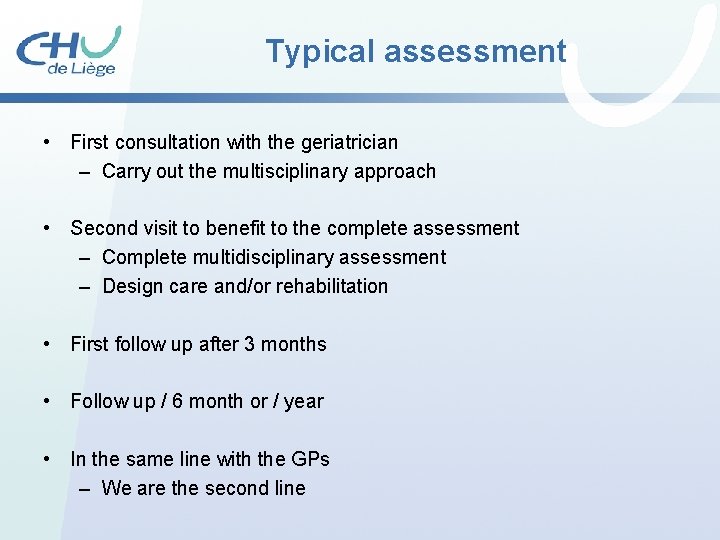
Typical assessment • First consultation with the geriatrician – Carry out the multisciplinary approach • Second visit to benefit to the complete assessment – Complete multidisciplinary assessment – Design care and/or rehabilitation • First follow up after 3 months • Follow up / 6 month or / year • In the same line with the GPs – We are the second line
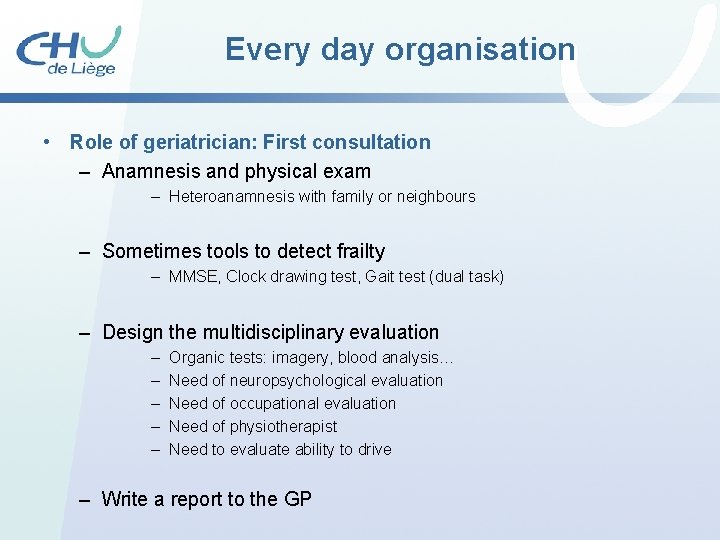
Every day organisation • Role of geriatrician: First consultation – Anamnesis and physical exam – Heteroanamnesis with family or neighbours – Sometimes tools to detect frailty – MMSE, Clock drawing test, Gait test (dual task) – Design the multidisciplinary evaluation – – – Organic tests: imagery, blood analysis… Need of neuropsychological evaluation Need of occupational evaluation Need of physiotherapist Need to evaluate ability to drive – Write a report to the GP
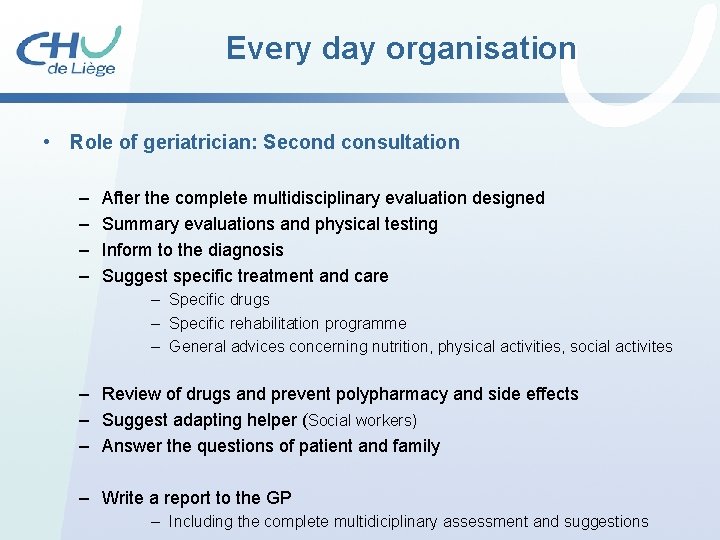
Every day organisation • Role of geriatrician: Second consultation – – After the complete multidisciplinary evaluation designed Summary evaluations and physical testing Inform to the diagnosis Suggest specific treatment and care – Specific drugs – Specific rehabilitation programme – General advices concerning nutrition, physical activities, social activites – Review of drugs and prevent polypharmacy and side effects – Suggest adapting helper (Social workers) – Answer the questions of patient and family – Write a report to the GP – Including the complete multidiciplinary assessment and suggestions
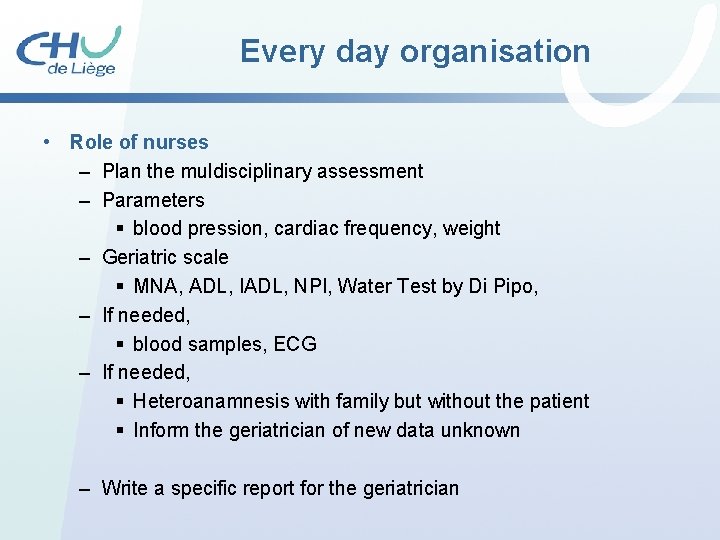
Every day organisation • Role of nurses – Plan the muldisciplinary assessment – Parameters § blood pression, cardiac frequency, weight – Geriatric scale § MNA, ADL, IADL, NPI, Water Test by Di Pipo, – If needed, § blood samples, ECG – If needed, § Heteroanamnesis with family but without the patient § Inform the geriatrician of new data unknown – Write a specific report for the geriatrician
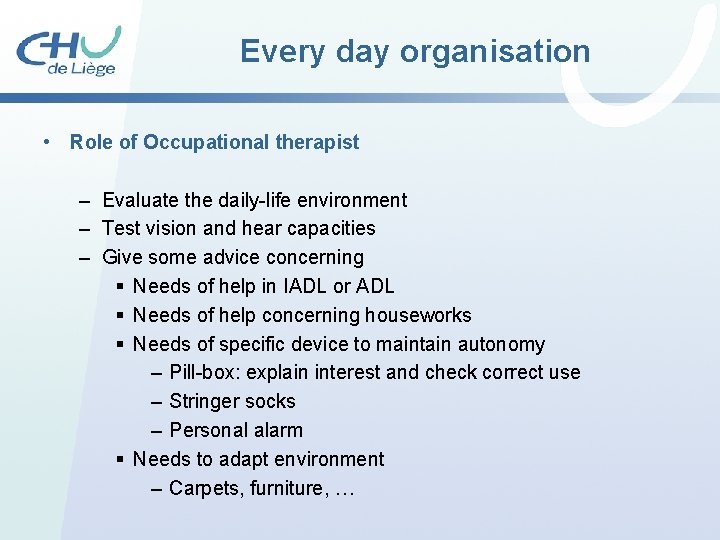
Every day organisation • Role of Occupational therapist – Evaluate the daily-life environment – Test vision and hear capacities – Give some advice concerning § Needs of help in IADL or ADL § Needs of help concerning houseworks § Needs of specific device to maintain autonomy – Pill-box: explain interest and check correct use – Stringer socks – Personal alarm § Needs to adapt environment – Carpets, furniture, …
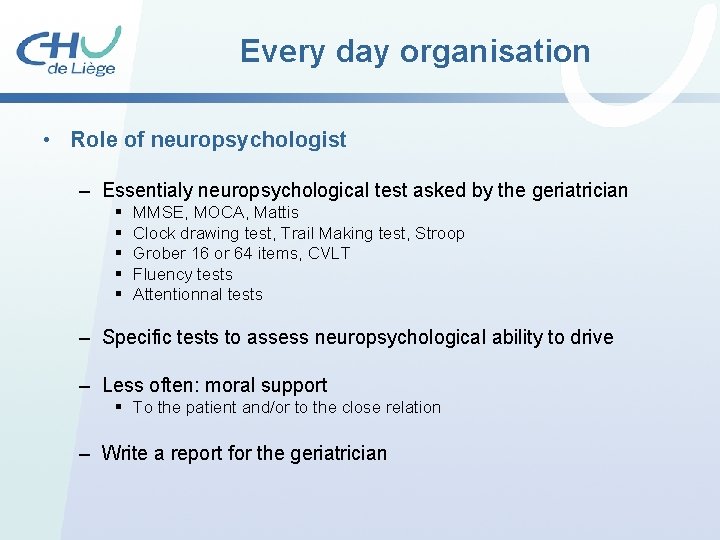
Every day organisation • Role of neuropsychologist – Essentialy neuropsychological test asked by the geriatrician § § § MMSE, MOCA, Mattis Clock drawing test, Trail Making test, Stroop Grober 16 or 64 items, CVLT Fluency tests Attentionnal tests – Specific tests to assess neuropsychological ability to drive – Less often: moral support § To the patient and/or to the close relation – Write a report for the geriatrician
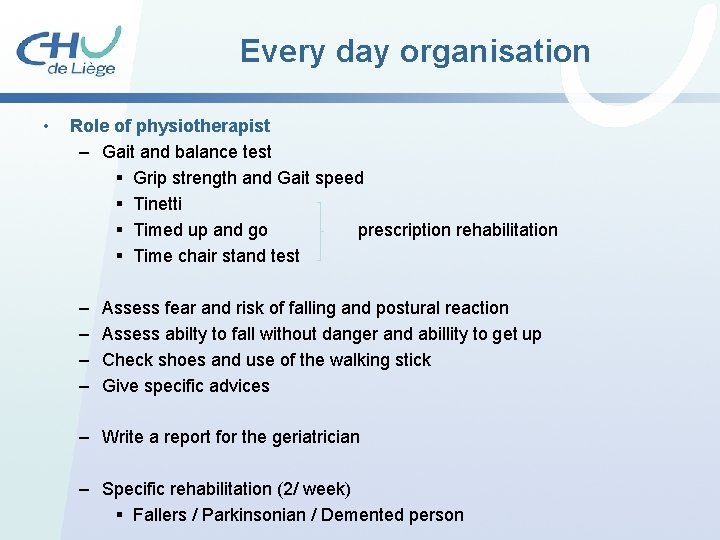
Every day organisation • Role of physiotherapist – Gait and balance test § Grip strength and Gait speed § Tinetti § Timed up and go prescription rehabilitation § Time chair stand test – – Assess fear and risk of falling and postural reaction Assess abilty to fall without danger and abillity to get up Check shoes and use of the walking stick Give specific advices – Write a report for the geriatrician – Specific rehabilitation (2/ week) § Fallers / Parkinsonian / Demented person
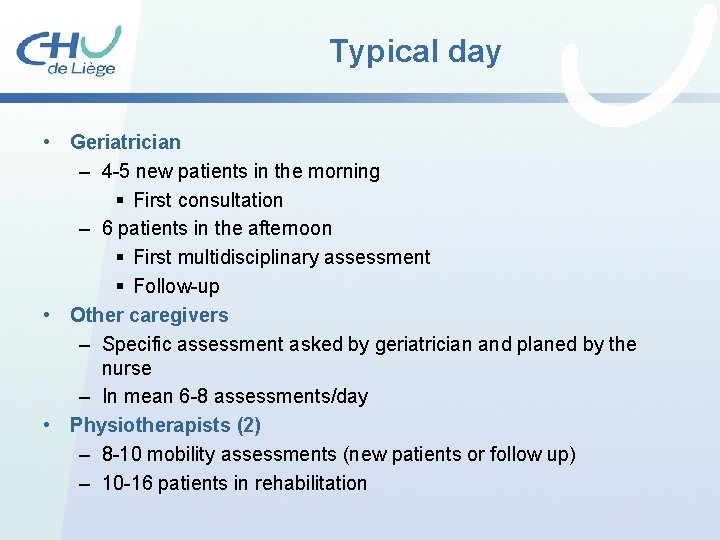
Typical day • Geriatrician – 4 -5 new patients in the morning § First consultation – 6 patients in the afternoon § First multidisciplinary assessment § Follow-up • Other caregivers – Specific assessment asked by geriatrician and planed by the nurse – In mean 6 -8 assessments/day • Physiotherapists (2) – 8 -10 mobility assessments (new patients or follow up) – 10 -16 patients in rehabilitation
Working plan • Legislative aspects of geriatric care (GC) in Belgium • Financial aspects of the geriatric one-day hospital • Every day organisation • Our activity • Guided visit and questions
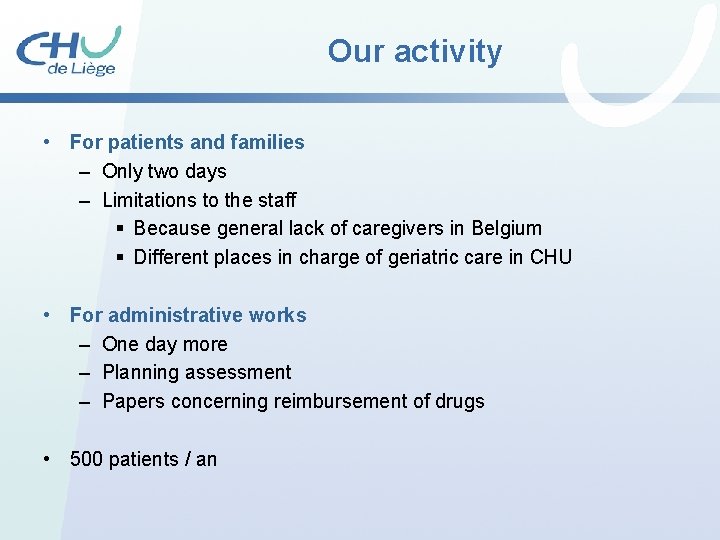
Our activity • For patients and families – Only two days – Limitations to the staff § Because general lack of caregivers in Belgium § Different places in charge of geriatric care in CHU • For administrative works – One day more – Planning assessment – Papers concerning reimbursement of drugs • 500 patients / an
Thanks for coming and Please feel free to ask your questions !