
The Geometric Optics of Image Formation Graphical Ray
- Slides: 21
The Geometric Optics of Image Formation Graphical Ray Tracing Imaging Science Fundamentals Chester F. Carlson Center for Imaging Science
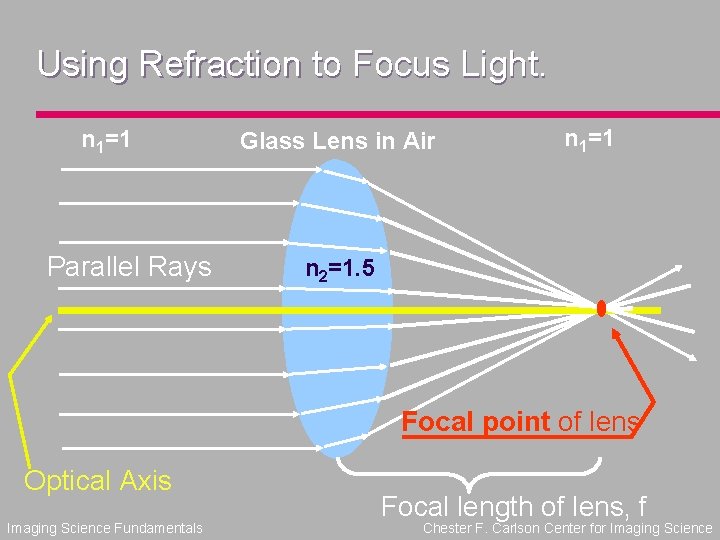
Using Refraction to Focus Light. n 1=1 Parallel Rays Glass Lens in Air n 1=1 n 2=1. 5 Focal point of lens Optical Axis Imaging Science Fundamentals Focal length of lens, f Chester F. Carlson Center for Imaging Science
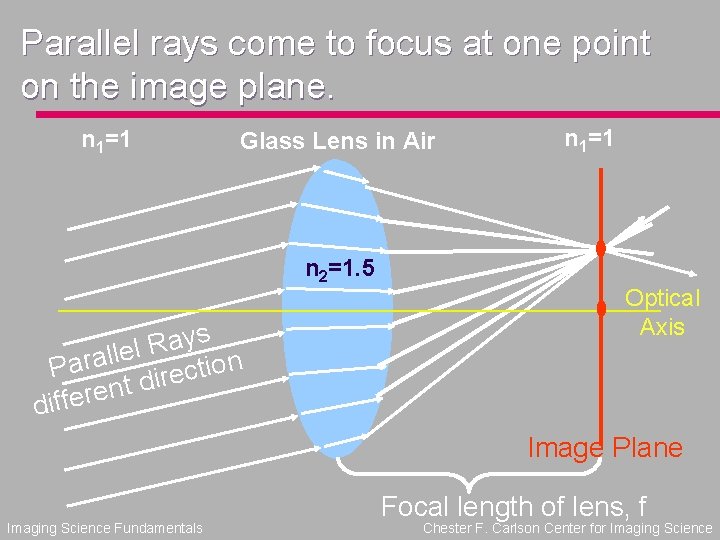
Parallel rays come to focus at one point on the image plane. n 1=1 Glass Lens in Air n 2=1. 5 ys a R l le l a r n a o i P t c re i d t n e r e f f i d n 1=1 Optical Axis Image Plane Imaging Science Fundamentals Focal length of lens, f Chester F. Carlson Center for Imaging Science
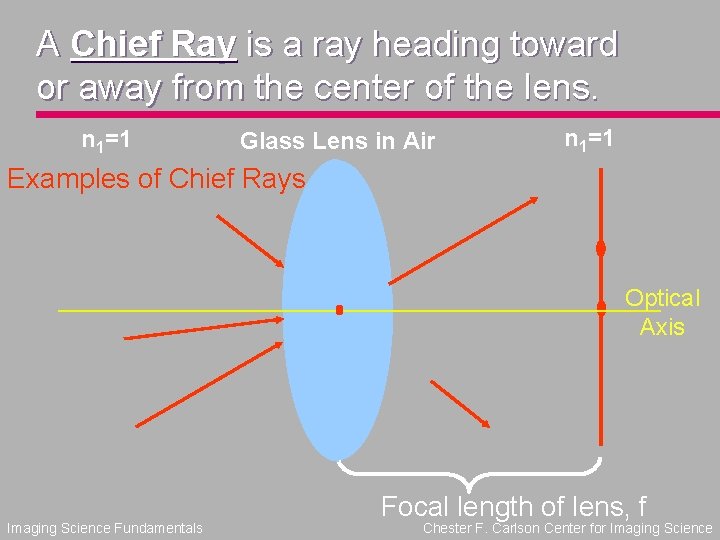
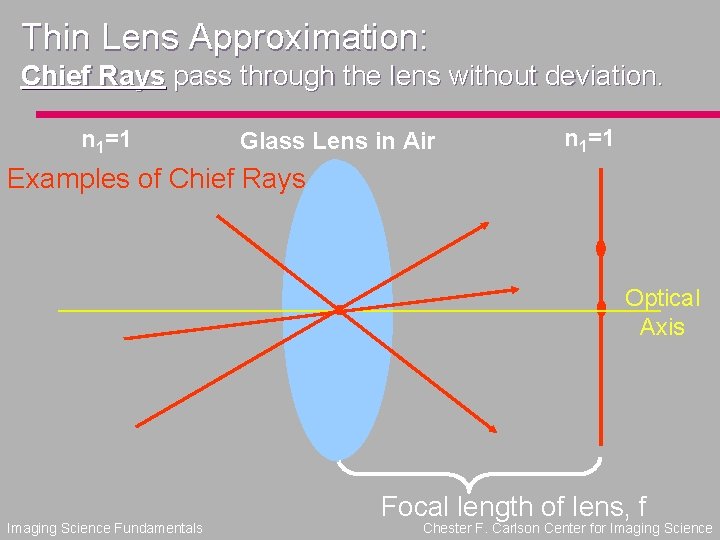
A Chief Ray is a ray heading toward or away from the center of the lens. n 1=1 Glass Lens in Air n 1=1 Examples of Chief Rays n 2=1. 5 Imaging Science Fundamentals Optical Axis Focal length of lens, f Chester F. Carlson Center for Imaging Science
Thin Lens Approximation: Chief Rays pass through the lens without deviation. n 1=1 Glass Lens in Air n 1=1 Examples of Chief Rays n 2=1. 5 Imaging Science Fundamentals Optical Axis Focal length of lens, f Chester F. Carlson Center for Imaging Science
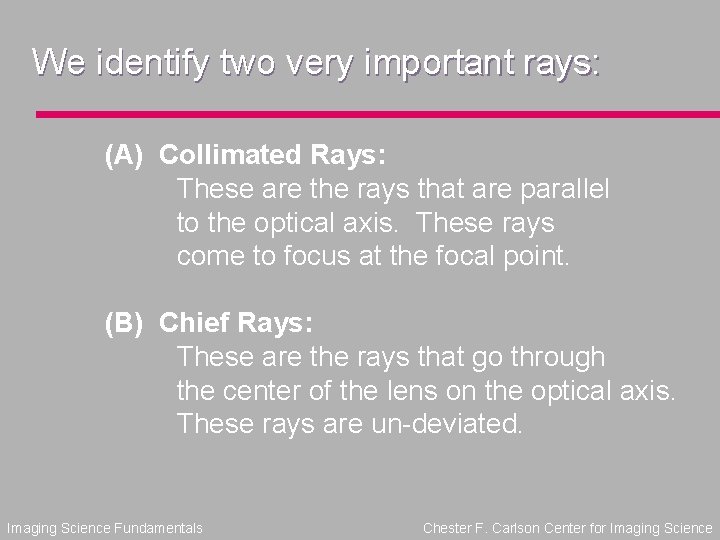
We identify two very important rays: (A) Collimated Rays: These are the rays that are parallel to the optical axis. These rays come to focus at the focal point. (B) Chief Rays: These are the rays that go through the center of the lens on the optical axis. These rays are un-deviated. Imaging Science Fundamentals Chester F. Carlson Center for Imaging Science
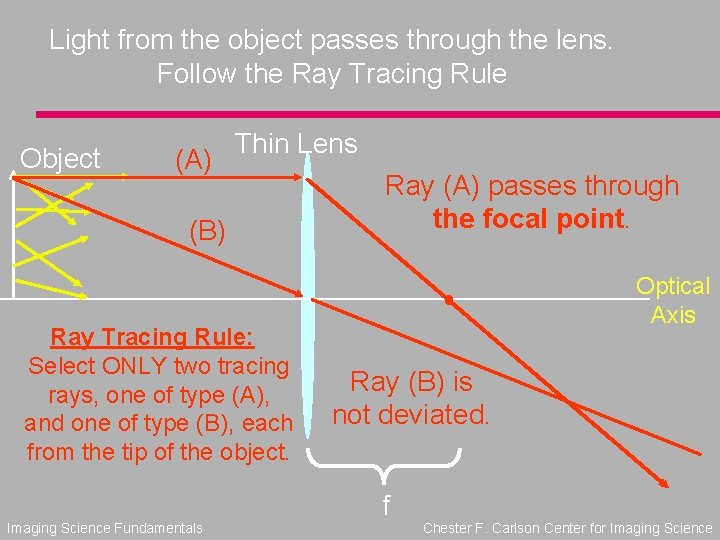
Light from the object passes through the lens. Follow the Ray Tracing Rule Object (A) Thin Lens (B) Ray Tracing Rule: Select ONLY two tracing rays, one of type (A), and one of type (B), each from the tip of the object. Imaging Science Fundamentals Ray (A) passes through the focal point. Optical Axis Ray (B) is not deviated. f Chester F. Carlson Center for Imaging Science
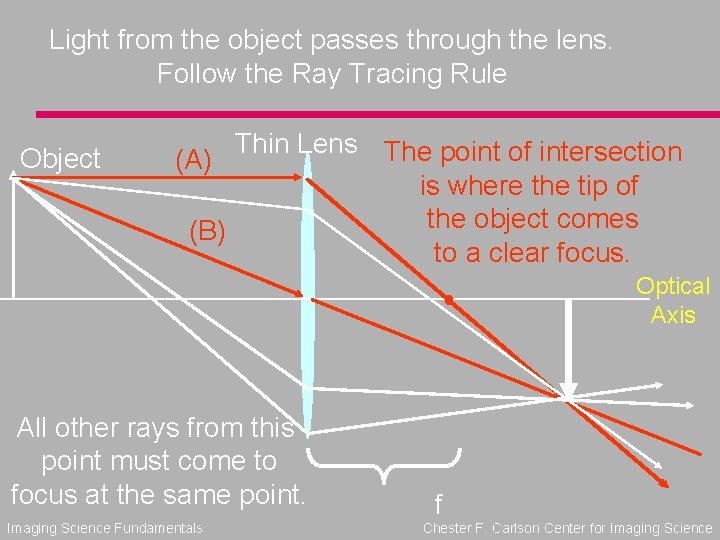
Light from the object passes through the lens. Follow the Ray Tracing Rule Object Thin Lens The point of intersection (A) is where the tip of the object comes (B) to a clear focus. Optical Axis All other rays from this point must come to focus at the same point. Imaging Science Fundamentals f Chester F. Carlson Center for Imaging Science
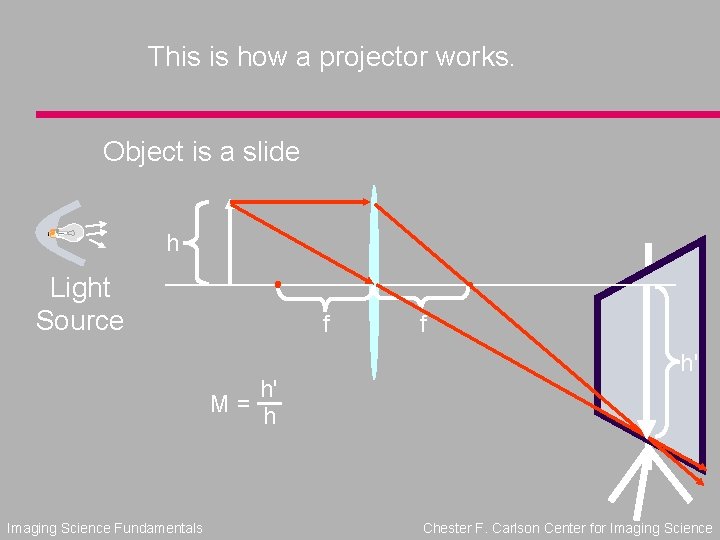
This is how a projector works. Object is a slide h Light Source f M= Imaging Science Fundamentals h' h f h' Chester F. Carlson Center for Imaging Science
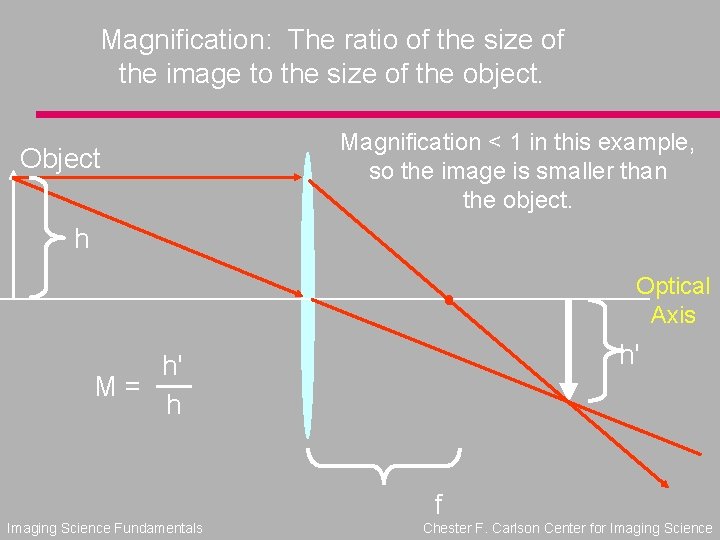
Magnification: The ratio of the size of the image to the size of the object. Object Magnification < 1 in this example, so the image is smaller than the object. h Optical Axis h' h' M= h f Imaging Science Fundamentals Chester F. Carlson Center for Imaging Science
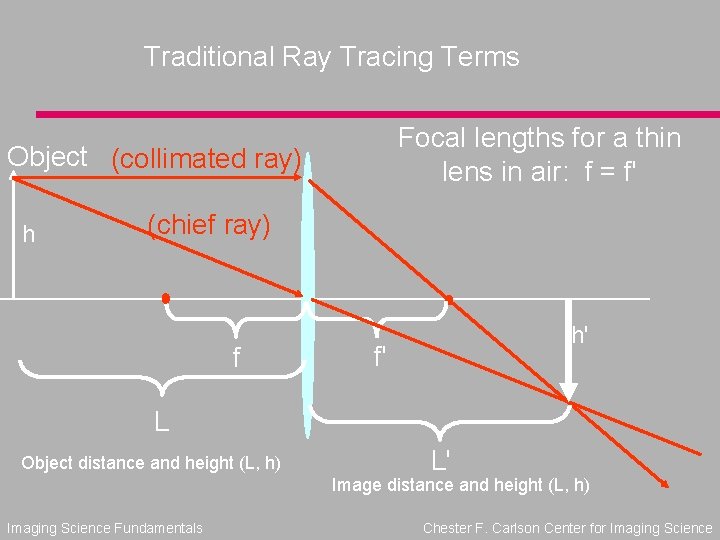
Traditional Ray Tracing Terms Focal lengths for a thin lens in air: f = f' Object (collimated ray) h (chief ray) f h' f' L Object distance and height (L, h) L' Image distance and height (L, h) Imaging Science Fundamentals Chester F. Carlson Center for Imaging Science
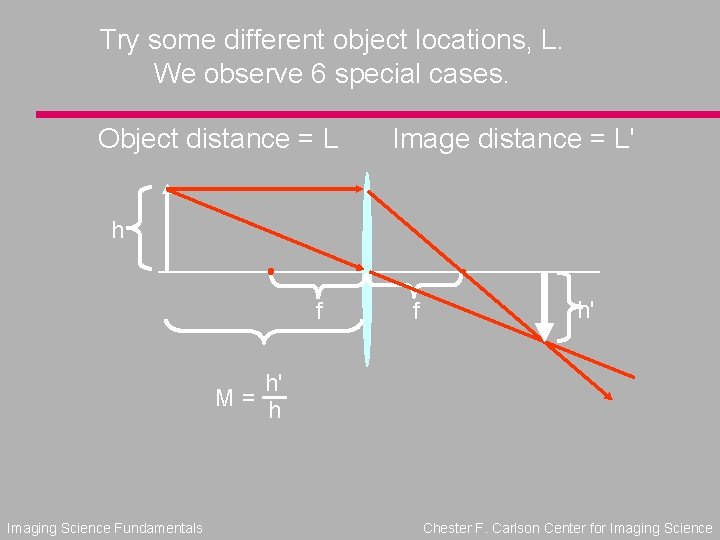
Try some different object locations, L. We observe 6 special cases. Object distance = L Image distance = L' h f f h' h' M= h Imaging Science Fundamentals Chester F. Carlson Center for Imaging Science
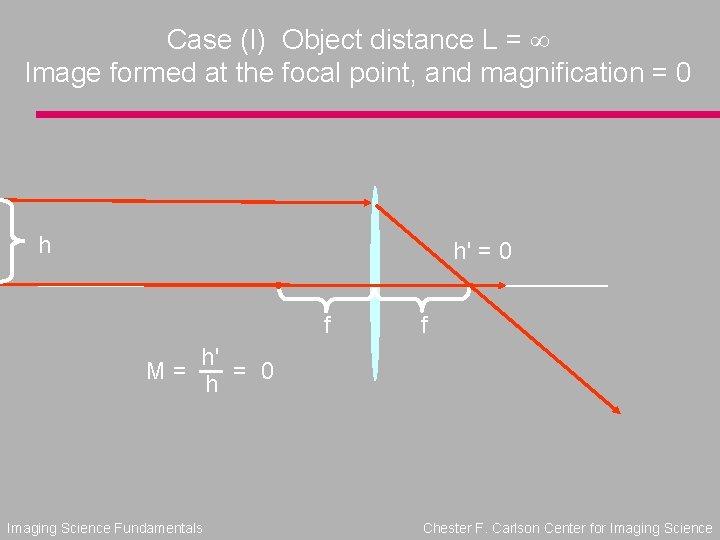
Case (I) Object distance L = Image formed at the focal point, and magnification = 0 h h' = 0 f M= f h' = 0 h Imaging Science Fundamentals Chester F. Carlson Center for Imaging Science
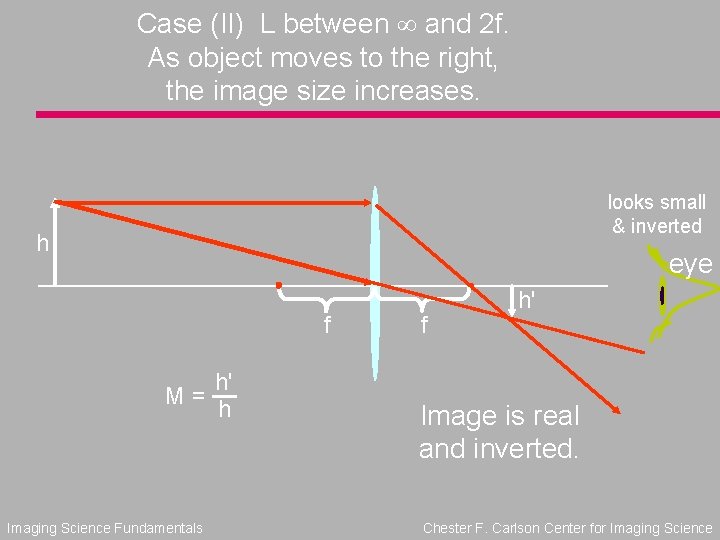
Case (II) L between and 2 f. As object moves to the right, the image size increases. looks small & inverted h eye f h' M= h Imaging Science Fundamentals f h' Image is real and inverted. Chester F. Carlson Center for Imaging Science
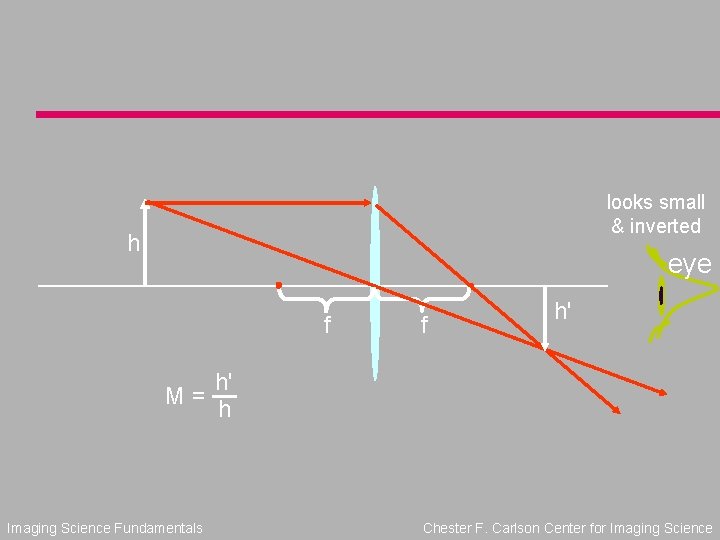
looks small & inverted h eye f f h' h' M= h Imaging Science Fundamentals Chester F. Carlson Center for Imaging Science
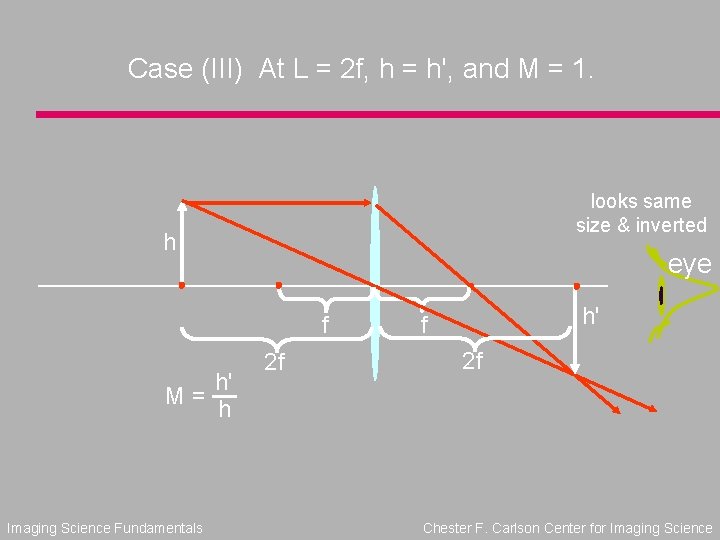
Case (III) At L = 2 f, h = h', and M = 1. looks same size & inverted h eye f h' M= h Imaging Science Fundamentals 2 f h' f 2 f Chester F. Carlson Center for Imaging Science
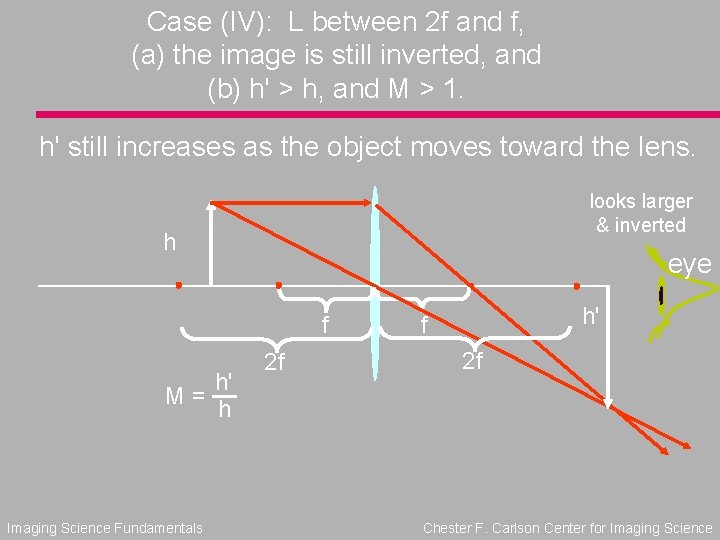
Case (IV): L between 2 f and f, (a) the image is still inverted, and (b) h' > h, and M > 1. h' still increases as the object moves toward the lens. looks larger & inverted h eye f h' M= h Imaging Science Fundamentals 2 f h' f 2 f Chester F. Carlson Center for Imaging Science
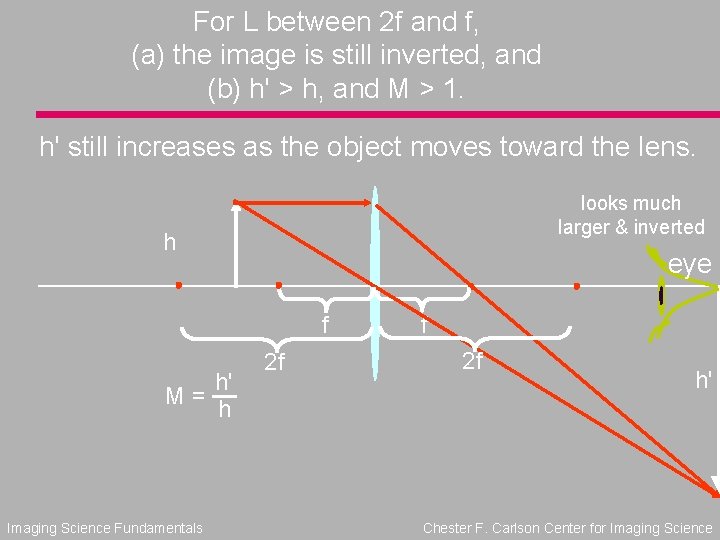
For L between 2 f and f, (a) the image is still inverted, and (b) h' > h, and M > 1. h' still increases as the object moves toward the lens. looks much larger & inverted h eye f h' M= h Imaging Science Fundamentals 2 f f 2 f h' Chester F. Carlson Center for Imaging Science
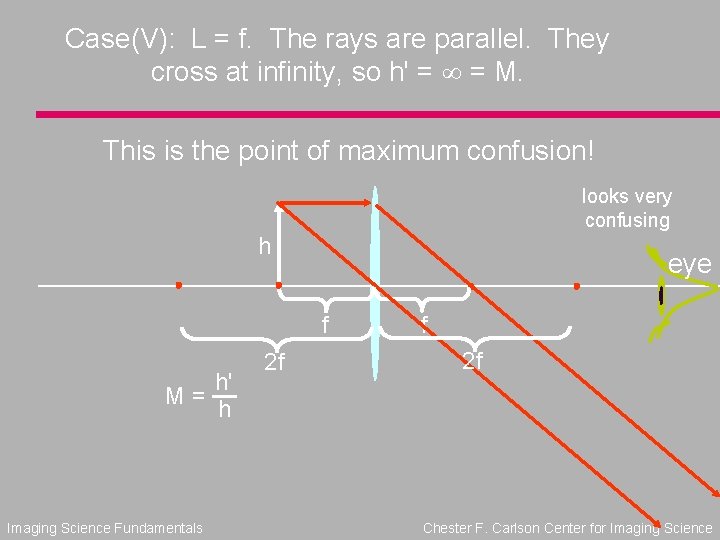
Case(V): L = f. The rays are parallel. They cross at infinity, so h' = = M. This is the point of maximum confusion! looks very confusing h eye f h' M= h Imaging Science Fundamentals 2 f f 2 f Chester F. Carlson Center for Imaging Science
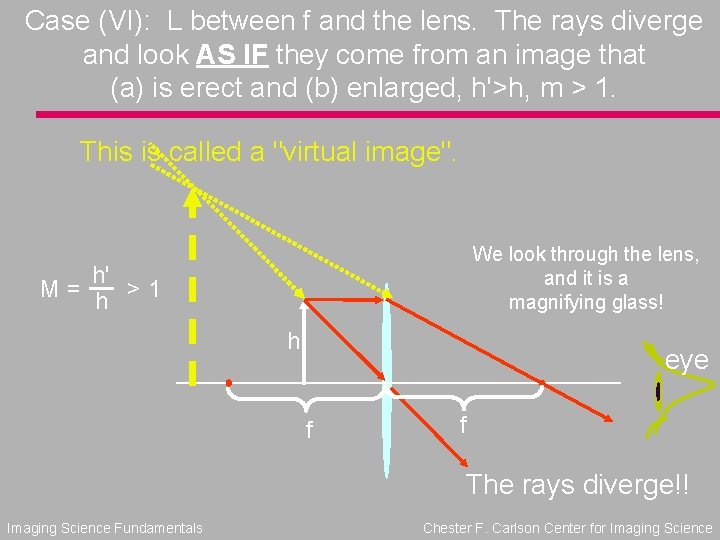
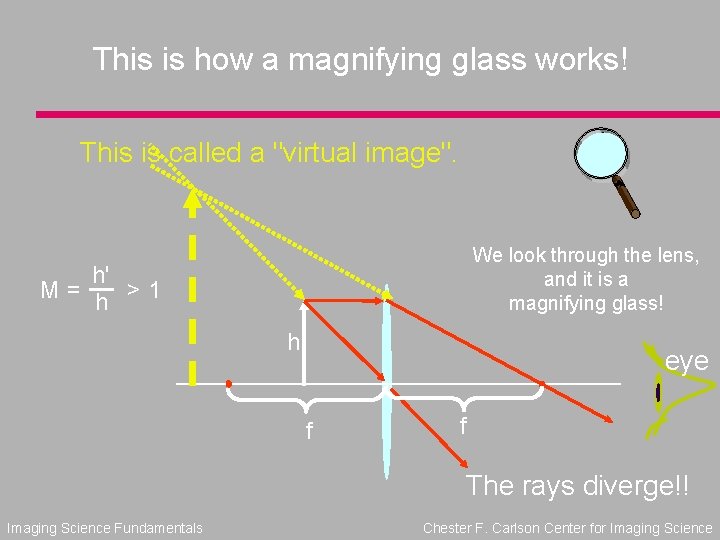
Case (VI): L between f and the lens. The rays diverge and look AS IF they come from an image that (a) is erect and (b) enlarged, h'>h, m > 1. This is called a "virtual image". We look through the lens, and it is a magnifying glass! h' M= >1 h h eye f f The rays diverge!! Imaging Science Fundamentals Chester F. Carlson Center for Imaging Science
This is how a magnifying glass works! This is called a "virtual image". We look through the lens, and it is a magnifying glass! h' M= >1 h h eye f f The rays diverge!! Imaging Science Fundamentals Chester F. Carlson Center for Imaging Science