
The Geometric Distribution Consider the following situations Flip

The Geometric Distribution

Consider the following situations: • Flip a coin until you get a head. • Roll a die until you get a 3. • In basketball, attempt a three-point shot until you make a basket.

Notice… • All of these situations involve counting the number of trials until an event of interest happens. • The possible values of the number of trials is an infinite set because it is theoretically possible to proceed indefinitely without ever obtaining a success.
The Geometric Setting • Each observation falls into one of just two categories, which for convenience we call “success” or “failure. ” • The probability of a success, call it p, is the same for each observation. • The observations are all independent. • The variable of interest is the number of trials required to obtain the first success.
Example • An experiment consists of rolling a single die. The event of interest is rolling a 3; this event is called a success. The random variable is defined as X = the number of trials until a 3 occurs. Is this a geometric setting?
Example • Suppose you repeatedly draw cards without replacement from a deck of 52 cards until you draw an ace. There are two categories of interest: ace = success; not ace = failure. Is this a geometric setting?
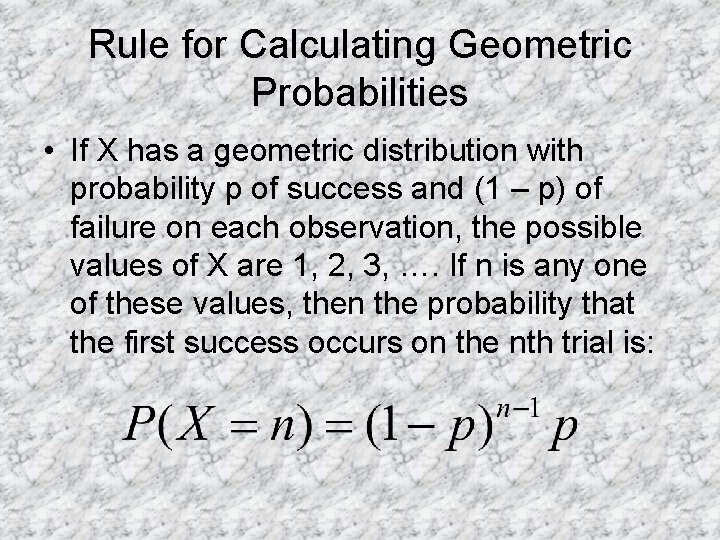
Rule for Calculating Geometric Probabilities • If X has a geometric distribution with probability p of success and (1 – p) of failure on each observation, the possible values of X are 1, 2, 3, …. If n is any one of these values, then the probability that the first success occurs on the nth trial is:
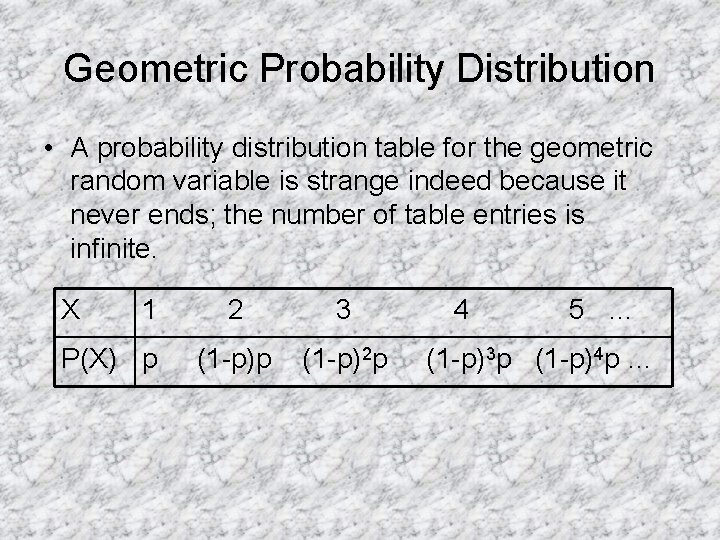
Geometric Probability Distribution • A probability distribution table for the geometric random variable is strange indeed because it never ends; the number of table entries is infinite. X 1 P(X) p 2 3 (1 -p)p (1 -p)2 p 4 5 … (1 -p)3 p (1 -p)4 p …
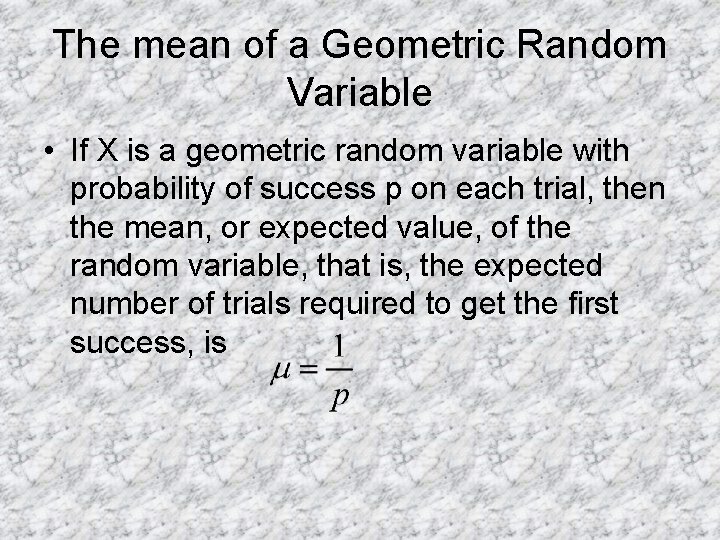
The mean of a Geometric Random Variable • If X is a geometric random variable with probability of success p on each trial, then the mean, or expected value, of the random variable, that is, the expected number of trials required to get the first success, is
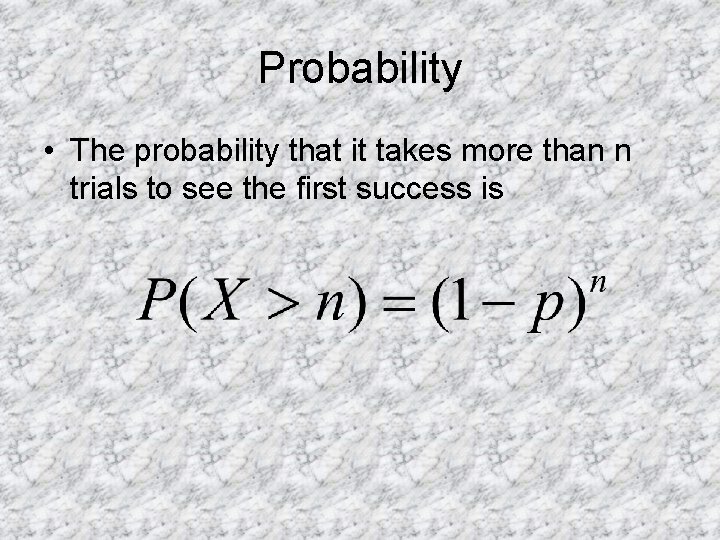
Probability • The probability that it takes more than n trials to see the first success is
- Slides: 10