
The Geography of the Tennessee Valley The Tennessee




- Slides: 27
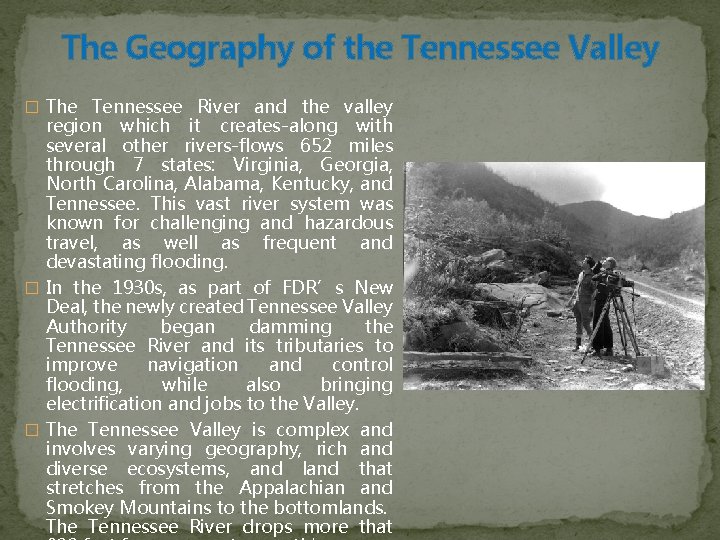
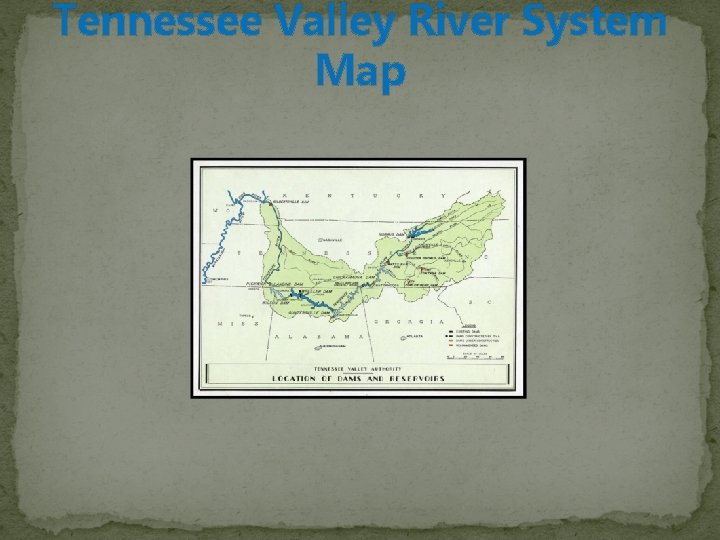
The Geography of the Tennessee Valley � The Tennessee River and the valley region which it creates-along with several other rivers-flows 652 miles through 7 states: Virginia, Georgia, North Carolina, Alabama, Kentucky, and Tennessee. This vast river system was known for challenging and hazardous travel, as well as frequent and devastating flooding. � In the 1930 s, as part of FDR’s New Deal, the newly created Tennessee Valley Authority began damming the Tennessee River and its tributaries to improve navigation and control flooding, while also bringing electrification and jobs to the Valley. � The Tennessee Valley is complex and involves varying geography, rich and diverse ecosystems, and land that stretches from the Appalachian and Smokey Mountains to the bottomlands. The Tennessee River drops more that
Tennessee Valley River System Map
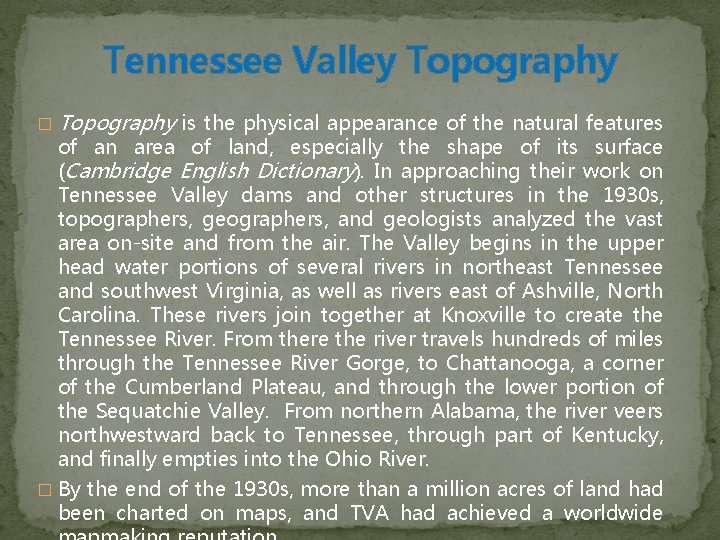
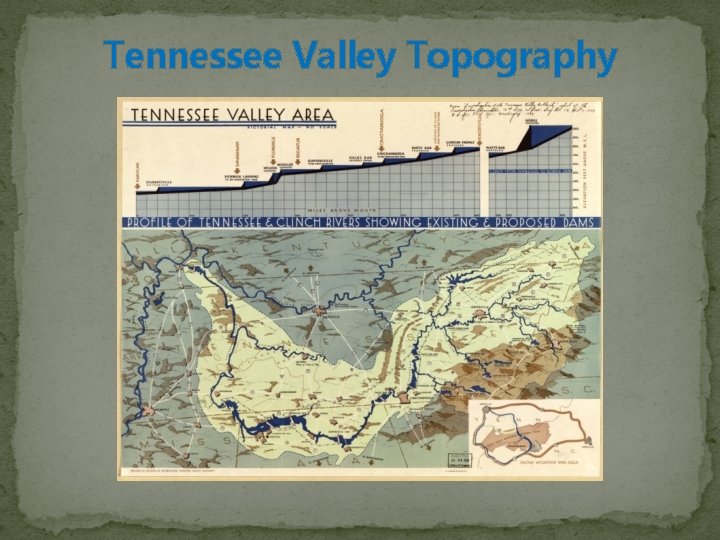
Tennessee Valley Topography � Topography is the physical appearance of the natural features of an area of land, especially the shape of its surface (Cambridge English Dictionary). In approaching their work on Tennessee Valley dams and other structures in the 1930 s, topographers, geographers, and geologists analyzed the vast area on-site and from the air. The Valley begins in the upper head water portions of several rivers in northeast Tennessee and southwest Virginia, as well as rivers east of Ashville, North Carolina. These rivers join together at Knoxville to create the Tennessee River. From there the river travels hundreds of miles through the Tennessee River Gorge, to Chattanooga, a corner of the Cumberland Plateau, and through the lower portion of the Sequatchie Valley. From northern Alabama, the river veers northwestward back to Tennessee, through part of Kentucky, and finally empties into the Ohio River. � By the end of the 1930 s, more than a million acres of land had been charted on maps, and TVA had achieved a worldwide
Tennessee Valley Topography
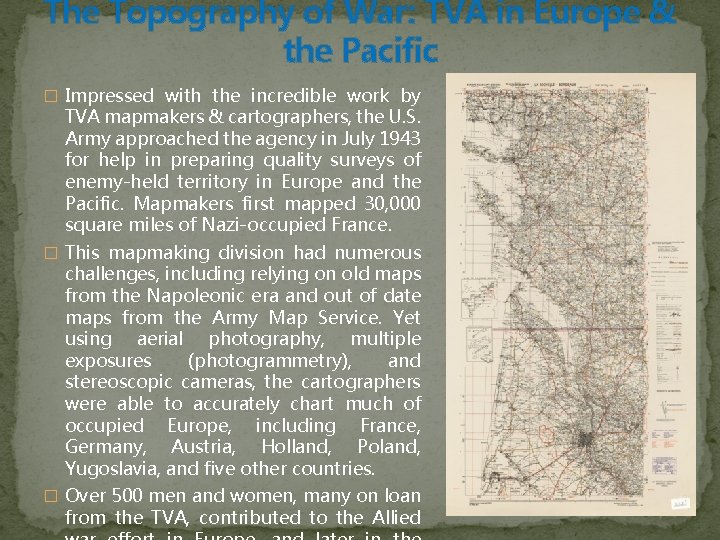
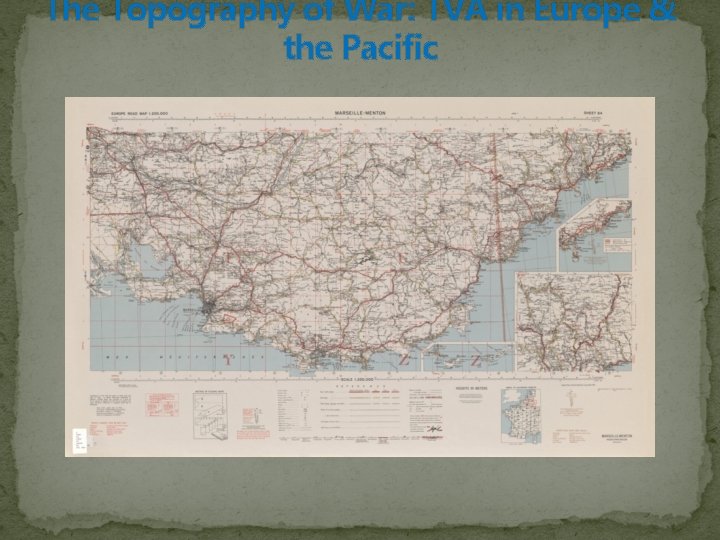
The Topography of War: TVA in Europe & the Pacific � Impressed with the incredible work by TVA mapmakers & cartographers, the U. S. Army approached the agency in July 1943 for help in preparing quality surveys of enemy-held territory in Europe and the Pacific. Mapmakers first mapped 30, 000 square miles of Nazi-occupied France. � This mapmaking division had numerous challenges, including relying on old maps from the Napoleonic era and out of date maps from the Army Map Service. Yet using aerial photography, multiple exposures (photogrammetry), and stereoscopic cameras, the cartographers were able to accurately chart much of occupied Europe, including France, Germany, Austria, Holland, Poland, Yugoslavia, and five other countries. � Over 500 men and women, many on loan from the TVA, contributed to the Allied
The Topography of War: TVA in Europe & the Pacific
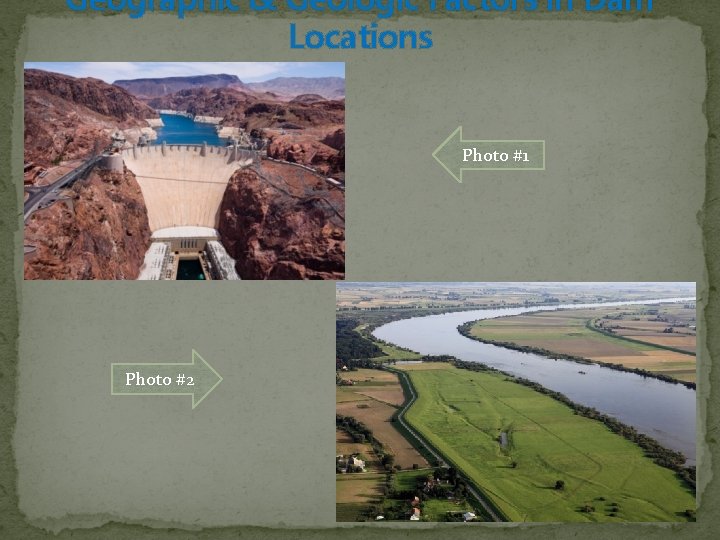
Geographic & Geologic Factors in Dam Locations �The TVA was faced with a monumental task in its complex and extensive plan to build 30 dams over many decades, including: 1) Where are the best sites to support a dam structure? 2) What factors and reasons are involved in the site selection, such as displacement of people, flooding farmlands and towns, access to the site (such as the creation of buildings & roads), the geologic composition of rock foundations at the site, shape of the river valley, and annual rainfall?
Geographic & Geologic Factors in Dam Locations Photo #1 Photo #2 #2
The Geography of Flooding in the Tennessee Valley � Tennessee Valley Authority Act (1933), an Act of Congress: …to improve navigation in the Tennessee River and to control the destructive flood waters in the Tennessee River…” The primary purpose of the creation of the TVA was to provide a solution to the long-term flooding problems along the Tennessee River and its tributaries. Flooding in the river valley had occurred consistently over thousands of years. Beginning in the late 1700 s, settlers moved into the area, and soon numerous towns and cities, farms, and industries were at risk from the frequent flooding of the Tennessee River and its tributaries. Dam fever and a strong desire to control flooding led to the establishment of the TVA in 1933. The first dam, Norris Dam, was built in 1936.
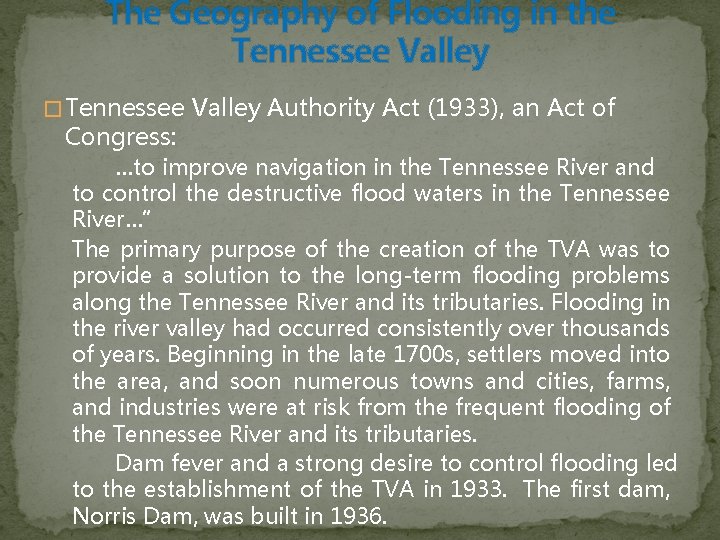
The Geography of Flooding in the Tennessee Valley � Flooding plagued the lives of millions in the Tennessee Valley for generations. Notable floods were the disastrous floods of Knoxville and Chattanooga, Tennessee in early March 1867. In both cities key bridges were destroyed and hundreds lost their lives. Yet it wasn’t until 1933 that the federal government took serious measures to control the frequent flooding. Chattanooga Flood 1867 (l-r): View of city from Lookout Mt; Military Bridge
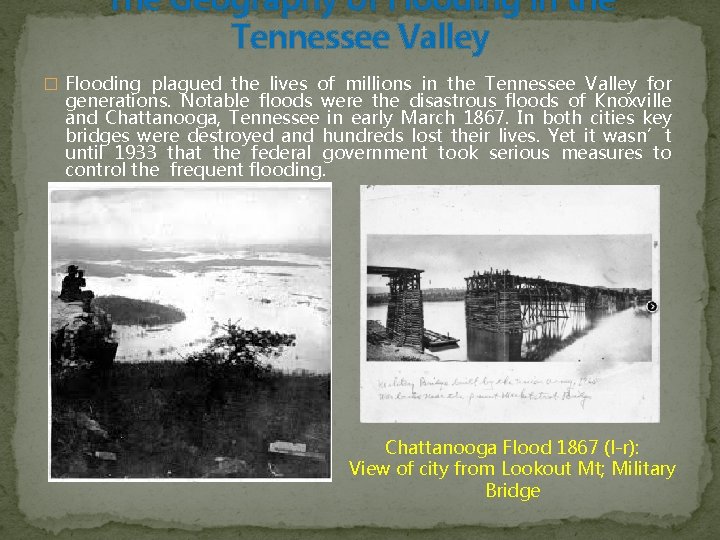
The Geography of Soil Depletion & Restoration � Settlers in the late 1700 s Farmer plows depleted soil on his fields in 1930 s cleared forest lands and planted cotton, tobacco, corn; they also raised hogs and other livestock. But the constant planting of the same crops for generations exhausted and depleted soil nutrition. And farmers planted on hillsides in up & down rows, which washed crops away in heavy rains. � By the time the TVA was created in 1933, more than a million acres of topsoil had disappeared! The dry clay soil could no longer support crops, and agriculture was failing in
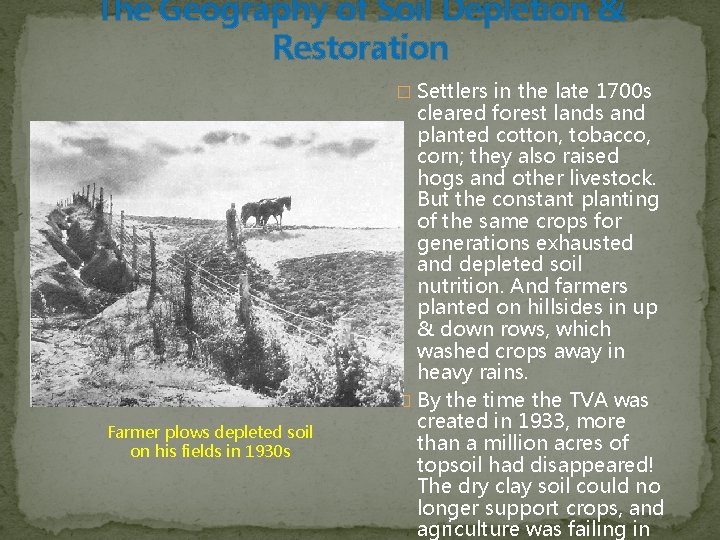
The Geography of Soil Depletion & Restoration: Erosion � The TVA coordinated efforts with other government agencies to fight soil erosion and improve soil restoration and conservation. For example, the Civilian Conservation Corps (CCC) planted thousands of trees, made ditches and dams to channel water, and taught farmers how to terrace the land to preserve the soil. The Agricultural Adjustment Administration also helped with terracing, as well as planting windbreaks.
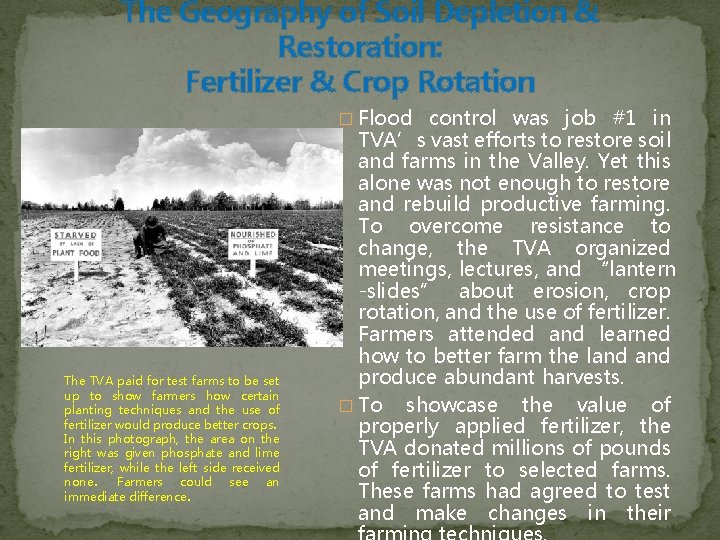
The Geography of Soil Depletion & Restoration: Fertilizer & Crop Rotation � Flood control was job #1 in The TVA paid for test farms to be set up to show farmers how certain planting techniques and the use of fertilizer would produce better crops. In this photograph, the area on the right was given phosphate and lime fertilizer, while the left side received none. Farmers could see an immediate difference. TVA’s vast efforts to restore soil and farms in the Valley. Yet this alone was not enough to restore and rebuild productive farming. To overcome resistance to change, the TVA organized meetings, lectures, and “lantern -slides” about erosion, crop rotation, and the use of fertilizer. Farmers attended and learned how to better farm the land produce abundant harvests. � To showcase the value of properly applied fertilizer, the TVA donated millions of pounds of fertilizer to selected farms. These farms had agreed to test and make changes in their
The Geography of Soil Depletion & Restoration: Fertilizer & Crop Rotation � For many generations, most farmers in the Tennessee Valley- and most of the South-had planted the same crops on their lands. Due to a lack of scientific knowledge and adherence to traditional practices, farmers were not aware of the negative effects on the soil. Nutrients were depleted and not replenished. Fertilizer could help in many ways, but a new idea for farmers was crop rotation! This farming practice involves planting different types of crops in one location sequentially. This practice reduces soil erosion, increases soil fertility, and increases crop yield. � Nature itself can be a farmer’s best friend in restoring nutrition-depleted soils. The TVA worked with scientists and other agencies to help farmers plant such crops as various grasses, clover, alfalfa, peas, vetch, and legumes. Crops were “rotated” every two-three years, and as the soils’ nutrients were replenished, this allowed the planting of regular “cash crops”, such as cotton, soybeans, oats, wheat, corn, or barley.
The Geography of Soil Depletion & Restoration: Crop Rotation https: //www. youtube. com/watch? v=m. Jw. Or-pe_I 8
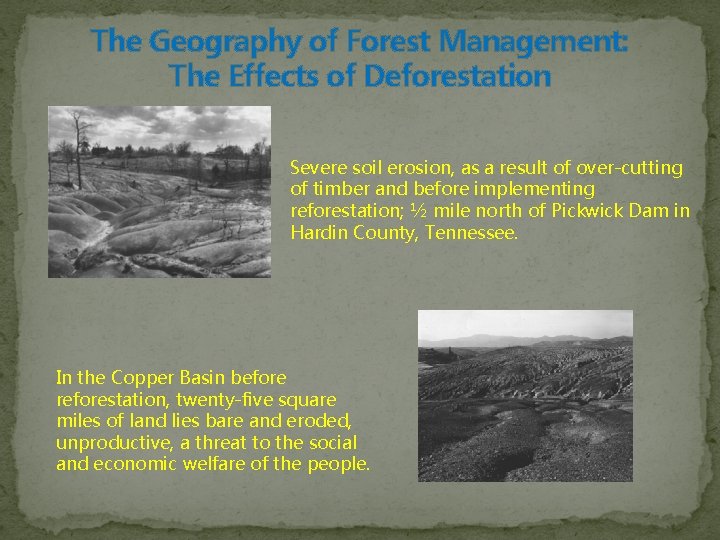
The Geography of Forest Management: The Effects of Deforestation Severe soil erosion, as a result of over-cutting of timber and before implementing reforestation; ½ mile north of Pickwick Dam in Hardin County, Tennessee. In the Copper Basin before reforestation, twenty-five square miles of land lies bare and eroded, unproductive, a threat to the social and economic welfare of the people.
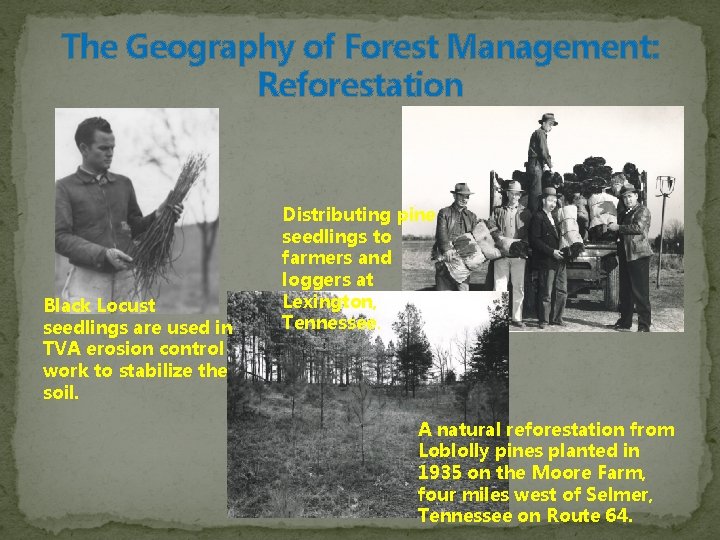
The Geography of Forest Management: Reforestation Black Locust seedlings are used in TVA erosion control work to stabilize the soil. Distributing pine seedlings to farmers and loggers at Lexington, Tennessee. A natural reforestation from Loblolly pines planted in 1935 on the Moore Farm, four miles west of Selmer, Tennessee on Route 64.
The Geography of Forest Management: Reforestation � Through generations of farming, flooding, large-scale cutting of trees, and vast erosion, millions of acres of Tennessee Valley forests and timber disappeared. Because there were no programs to replace & replant trees, much land was rendered unusable. Until the Tennessee Valley Authority was created in 1933. Within a short time, the TVA initiated large-scale reforestation programs, using the Civilian Conservation Corps, as well as local farmers. Within a few years more than half of the Tennessee Valley was returned to forest land. � Today the Forest Division of TVA continues to work closely with landowners to ensure continuous reforestation. Reforestation controls and greatly reduces soil erosion, improves wildlife habitats, helps create clean and abundant water, absorbs carbon dioxide, and creates new forest wood products. � TVA also works with numerous private organizations to assist in the extensive replanting of forests in the Tennessee Valley.
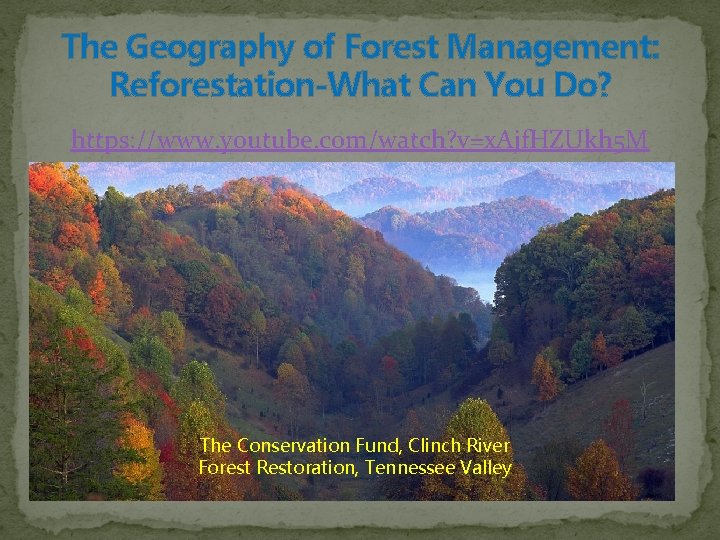
The Geography of Forest Management: Reforestation-What Can You Do? https: //www. youtube. com/watch? v=x. Ajf. HZUkh 5 M The Conservation Fund, Clinch River Forest Restoration, Tennessee Valley
The Geography of the Tennessee Valley � The Tennessee River is one of the most important rivers in America. � � Much of the identity of the lands of the Tennessee River Valley has been defined and shaped by the geography of the area, with its large and complex river watershed, landforms, forests, farmlands, geology, and climate. For centuries, this vast area was both a blessing and a curse, with rivers that offered a plentiful water supply for transportation, development of towns and cities, industries, and nearby farmlands with rich river soils. Yet the rivers also carried with them the risk of frequent flooding, bringing both human loss and property damage. With the advent of President Franklin Roosevelt’s New Deal in 1933, the Tennessee Valley Authority was quickly created. In no time detailed plans were implemented to build an organized system of dams to greatly reduce flooding, reclaim land lost over centuries from erosion and soil depletion, expand industry, and reforest thousands of square miles. Beside the geographic recognition-and intention-of the TVA’s bold project, many positive benefits have accrued, including parklands, public space for recreation, improved water supply, better agriculture, and even complex cartography (which even assisted the WW 2 in Europe and the Pacific). Geographic knowledge of this area is a critical step to improving the
References Arc. GIS Online. https: //www. arcgis. com/apps/Map. Journal/index. html? appid=5 ee 257701 ef 84 fb 1 be 2 bc 60 c 150 b 8688 “The Great Flood of Chattanooga”. Army Map Service. Tennessee Valley Authority (TVA) https: //www. tva. com/about-tva/our-history/tva-heritage/thetopography-of-war “The Topography of War”. Artman, J. O. Division of Forestry Relations, TVA. http: //www. fao. org/3/x 5361 e 02. htm “Forest development in the Tennessee Valley”. Becue, Jean-Pierre. https: //www. barrages-cfbr. eu/Back. Up/Info/documentation/texte/pb 2002/anglais/pb 2002 -c 1 p 17. pdf “Choice of site and type of dam”. Billington, David P. and Donald C. Jackson, Martin V. Melosi. Bureau of Reclamation, U. S. Department of the Interior. (2005). “The History of Large Federal Dams: Planning, Design, and Construction in the Era of Big Dams”. Boyce, Ronald Reed. The Geographical Review. (January 2004). “Geographers and the Tennessee Valley Authority”. Chattanooga Times Free Press Archives. https: //www. timesfreepress. com/galleries/albums/3268/#images-19 (March, 2017). “ 150 years ago this week: Chattanooga's great flood”. Currents of Change https: //www. currentsofchange. net/ Drumwright, William Wade. University of Tennessee Knoxville. (May 2005). https: //trace. tennessee. edu/cgi/viewcontent. cgi? referer=https: //www. google. com/&httpsredir=1&article=6024&contex t=utk_graddiss “A River for War, a Watershed to Change: The Tennessee Valley Authority During World War II”. Harvard University. https: //hist 1952. omeka. fas. harvard. edu/items/show/195 (1952). “Mapping History”.
References (cont. ) Jamal, Haseeb. https: //www. aboutcivil. org/dams-site-selection (September 21, 2018). “Site Selection for Dams-Factors affecting Dam Site Selection”. NASA Stem Engagement. https: //www. nasa. gov/stem-ed-resources/floods-iquest. html ‘Floods IQuest”. . National Archives & Records Administration, Atlanta and Washington, D. C. National Park Service, Department of the Interior. (January 2009). “Historic Resources of the Tennessee Valley Authority Hydroelectric System, 1933 -1979”. Neely, Jack. https: //www. visitknoxville. com/blog/post/when-the-creeks-rose-floods-in-knoxville-history/ (September 5. 2017). “When the Creeks Rose: Floods in Knoxville History”. Online Highways. https: //www. u-s-history. com/pages/h 1653. html (2021). “Tennessee Valley Authority (TVA)”. [Online Video] ag. Ph. D https: //www. youtube. com/watch? v=m. Jw. Or-pe_I 8 (September 13. 2020). “Farm Basics #1171 Crop Rotation”. [Online Video] History Channel. https: //www. history. com/topics/great-depression/tennessee-valley-authority-naturespower-harnessed-video “Tennessee Valley Authority-Nature’s Power Harnessed”. [Online Video] National Archives https: //www. youtube. com/watch? v=Xv 0 d. PCIl 7 io (March 14, 2016). “Tennessee Valley”. [Online Video] Nature Conservancy https: //www. youtube. com/watch? v=x. Ajf. HZUkh 5 M (December 20, 2013). “Improved Forest Management Clinch Valley, VA”. Perry-Castañeda Library Map Collections, The University of Texas Archives. “Europe Road Maps”. http: //legacy. lib. utexas. edu/maps/ams/europe_road/
References (cont. ) Prentice-Hall, Inc. http: //www. wwp. org/User. Files/Server_10640642/File/bugge/Chapter%2024/Tennesseevalleyessayandquestions. PDF “Geography in History: Taming the Tennessee River”. Tennessee River Valley Geotourism. https: //tennesseerivervalleygeotourism. org/entries/tennessee-valleyhistory/7 eaf 1 e 97 -9 b 6 a-45 f 4 -bed 1 -28 b 726 b 391 cc “Tennessee Valley History”. Tennessee State Library & Archives. Tennessee State Museum. http: //www. tn 4 me. org/article. cfm/a_id/79/minor_id/20/major_id/8/era_id/7 “Conserving the Land”. Tennessee Valley Authority Archives. U. S. Geological Survey, Department of the Interior. (2017). “Prehistoric Floods on the Tennessee River. Assessing the Use of Stratigraphic Records of Past Floods for Improved Flood Frequency Analysis”. U. S. History Scene. https: //ushistoryscene. com/article/tennessee-valley-authority-act-1933/ “Tennessee Valley Authority Act (1933)”.