
The Geography of Language Three Major Cultural Traits


- Slides: 37
The Geography of Language
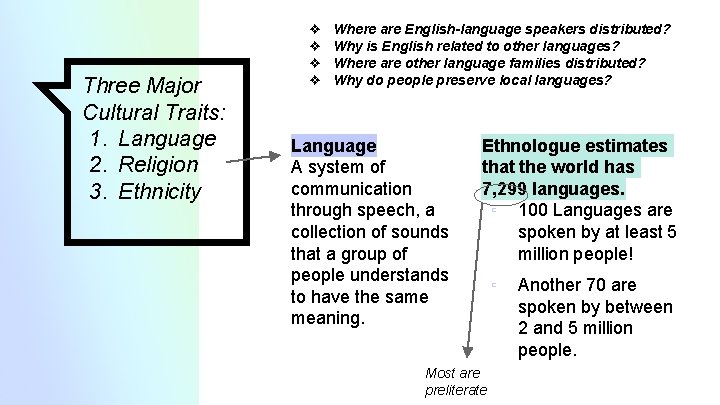
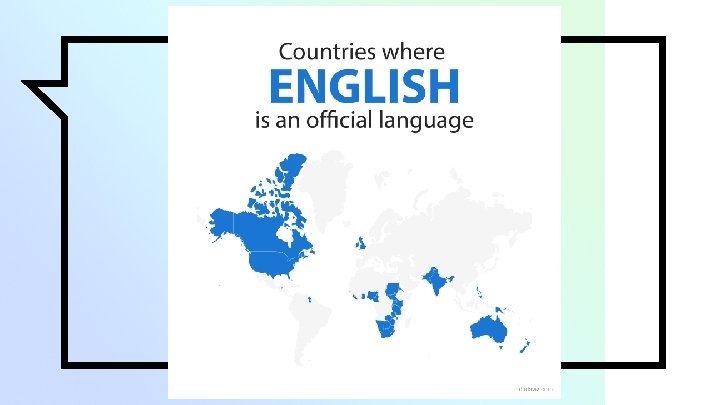
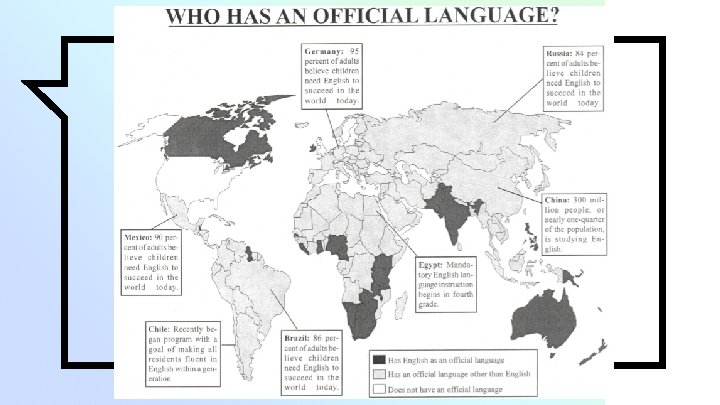
Three Major Cultural Traits: 1. Language 2. Religion 3. Ethnicity ❖ ❖ Where are English-language speakers distributed? Why is English related to other languages? Where are other language families distributed? Why do people preserve local languages? Language A system of communication through speech, a collection of sounds that a group of people understands to have the same meaning. Ethnologue estimates that the world has 7, 299 languages. ▫ 100 Languages are spoken by at least 5 million people! Most are preliterate ▫ Another 70 are spoken by between 2 and 5 million people.
Without language, culture cannot be passed on! Many languages also have a literary tradition: A system of written communications. Preliterate → no system of writing
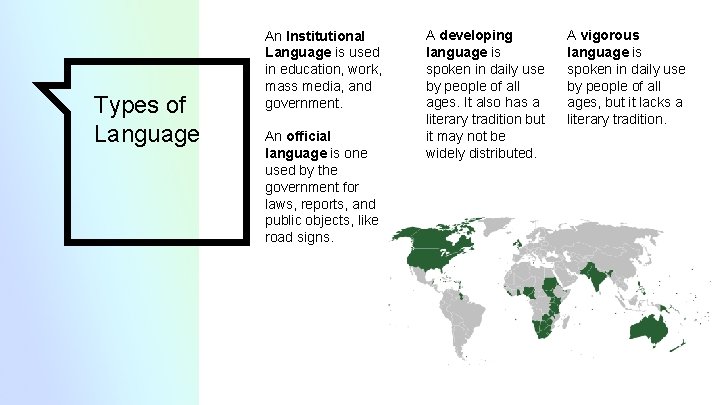
Types of Language An Institutional Language is used in education, work, mass media, and government. An official language is one used by the government for laws, reports, and public objects, like road signs. A developing language is spoken in daily use by people of all ages. It also has a literary tradition but it may not be widely distributed. A vigorous language is spoken in daily use by people of all ages, but it lacks a literary tradition.
Language Classification How do we classify language and measure relationships between languages?
▫ Language Family ◦ Branch ■ Group ● Dialect To understand this classification, let’s use English as our example…
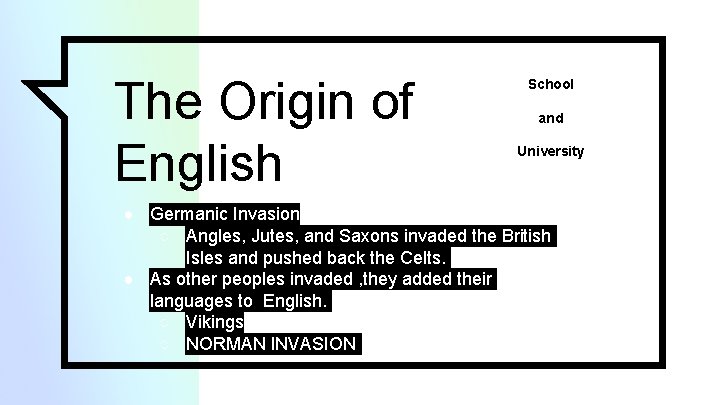
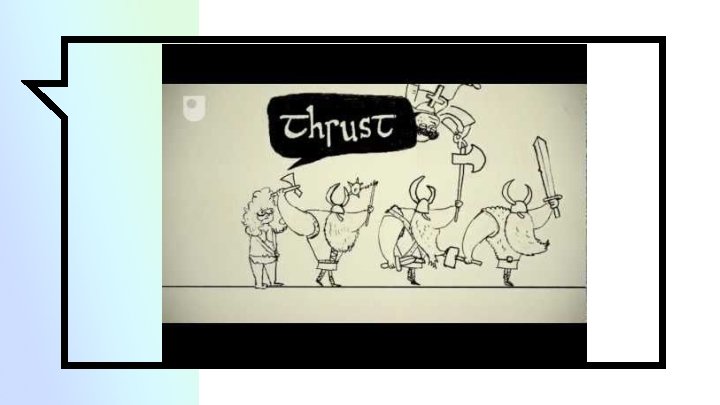
The Origin of English School and University ● Germanic Invasion ○ Angles, Jutes, and Saxons invaded the British Isles and pushed back the Celts. ● As other peoples invaded , they added their languages to English. ○ Vikings ○ NORMAN INVASION
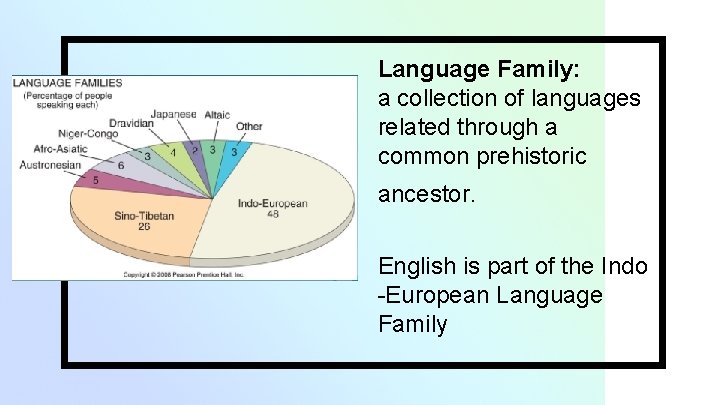
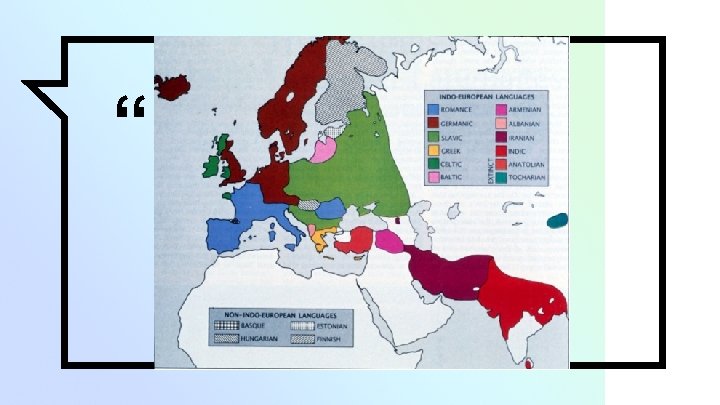
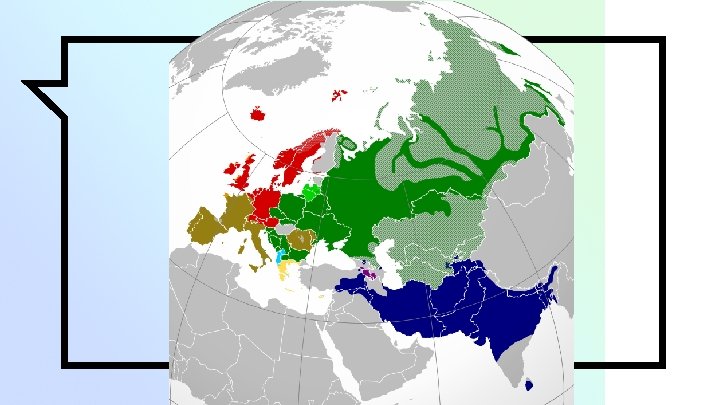
“ Language Family: a collection of languages related through a common prehistoric ancestor. English is part of the Indo -European Language Family
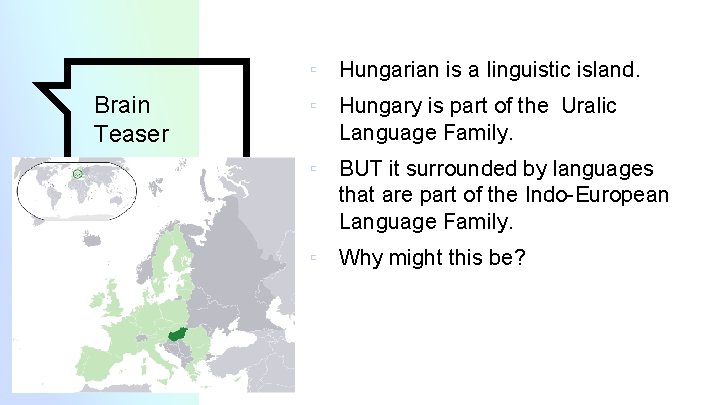
▫ Hungarian is a linguistic island. Brain Teaser ▫ Hungary is part of the Uralic Language Family. ▫ BUT it surrounded by languages that are part of the Indo-European Language Family. ▫ Why might this be?
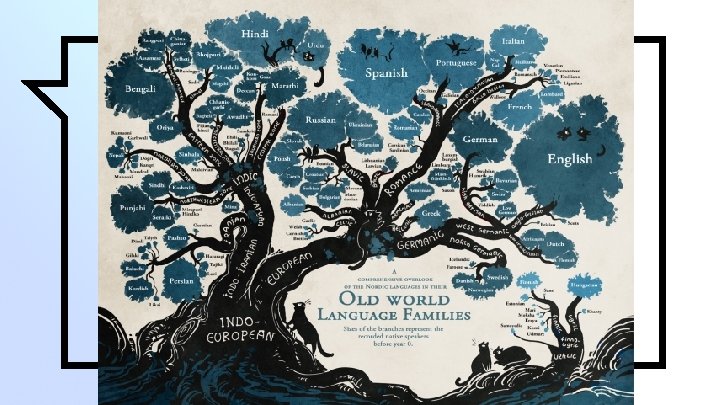
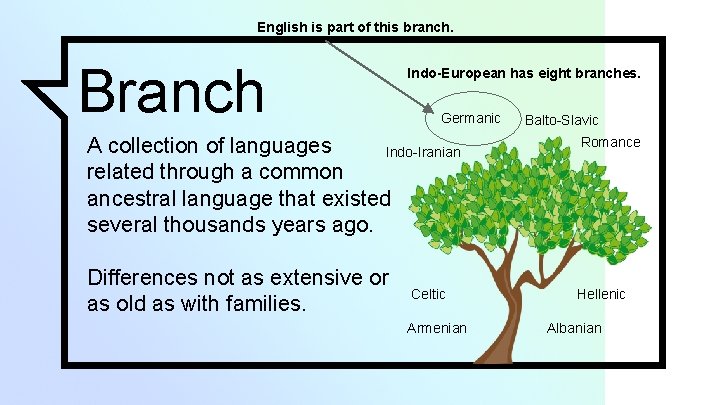
English is part of this branch. Branch Indo-European has eight branches. Germanic A collection of languages Indo-Iranian related through a common ancestral language that existed several thousands years ago. Differences not as extensive or as old as with families. Celtic Armenian Balto-Slavic Romance Hellenic Albanian
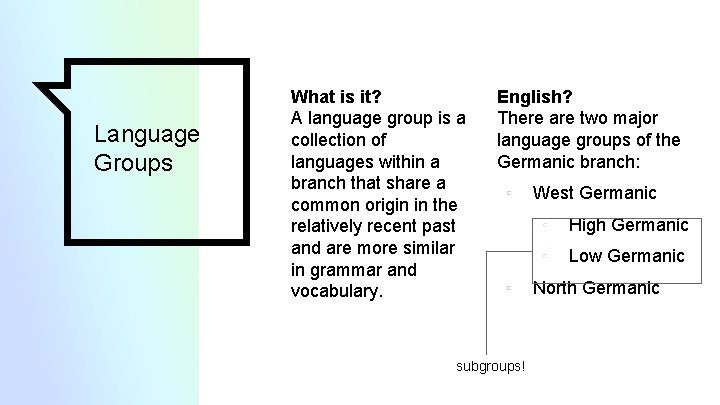
Language Groups What is it? A language group is a collection of languages within a branch that share a common origin in the relatively recent past and are more similar in grammar and vocabulary. English? There are two major language groups of the Germanic branch: ▫ ▫ subgroups! West Germanic ◦ High Germanic ◦ Low Germanic North Germanic
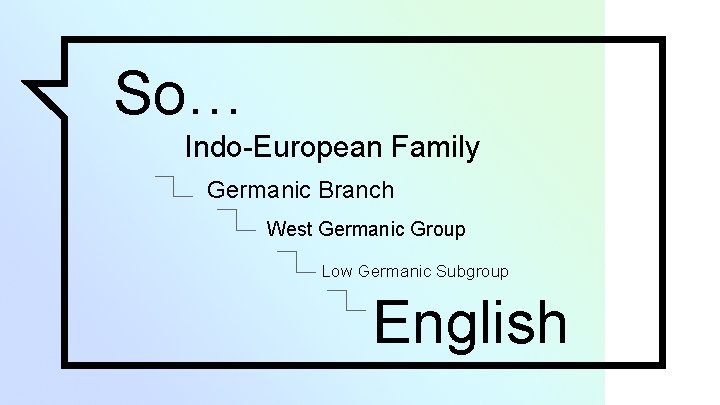
So… Indo-European Family Germanic Branch West Germanic Group Low Germanic Subgroup English
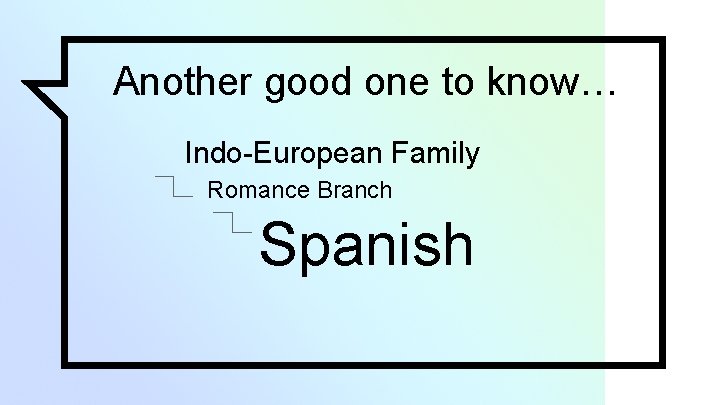
Another good one to know… Indo-European Family Romance Branch Spanish
Dialects A Dialect Is a regional variation of a language distinguished by distinctive vocabulary, spelling, and pronunciation. Usually occurs because of the migration of a language. Ex. English to North America…
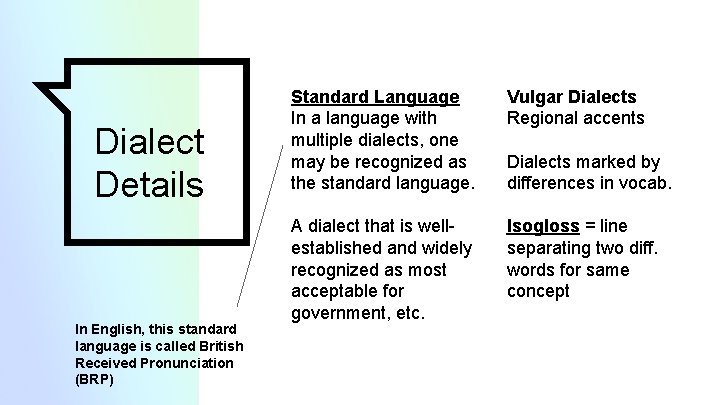
Dialect Details In English, this standard language is called British Received Pronunciation (BRP) Standard Language In a language with multiple dialects, one may be recognized as the standard language. Vulgar Dialects Regional accents A dialect that is wellestablished and widely recognized as most acceptable for government, etc. Isogloss = line separating two diff. words for same concept Dialects marked by differences in vocab.
“ Super Fun and Wonderful Regional Dialect Quiz!
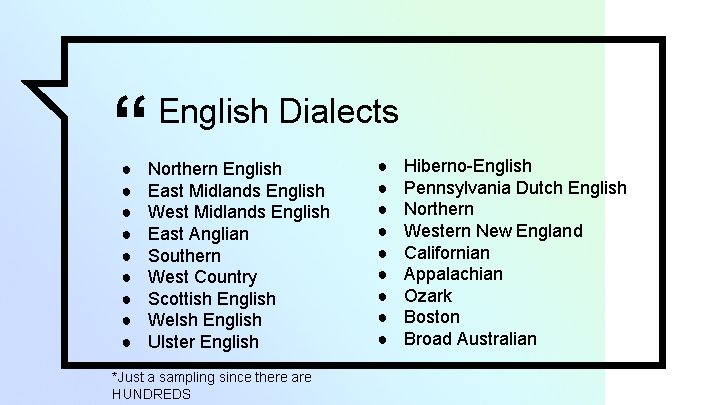
“ ● ● ● ● ● English Dialects Northern English East Midlands English West Midlands English East Anglian Southern West Country Scottish English Welsh English Ulster English *Just a sampling since there are HUNDREDS ● ● ● ● ● Hiberno-English Pennsylvania Dutch English Northern Western New England Californian Appalachian Ozark Boston Broad Australian
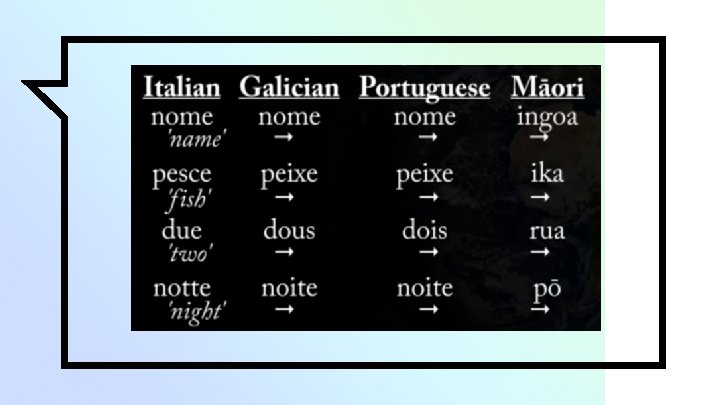
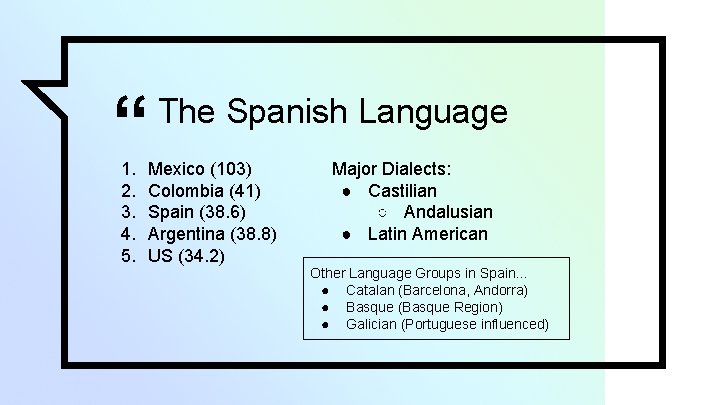
“ 1. 2. 3. 4. 5. The Spanish Language Mexico (103) Colombia (41) Spain (38. 6) Argentina (38. 8) US (34. 2) Major Dialects: ● Castilian ○ Andalusian ● Latin American Other Language Groups in Spain… ● Catalan (Barcelona, Andorra) ● Basque (Basque Region) ● Galician (Portuguese influenced)
“ If two dialects become “mutually unintelligible” and two separate languages emerge. . . → “language divergence”
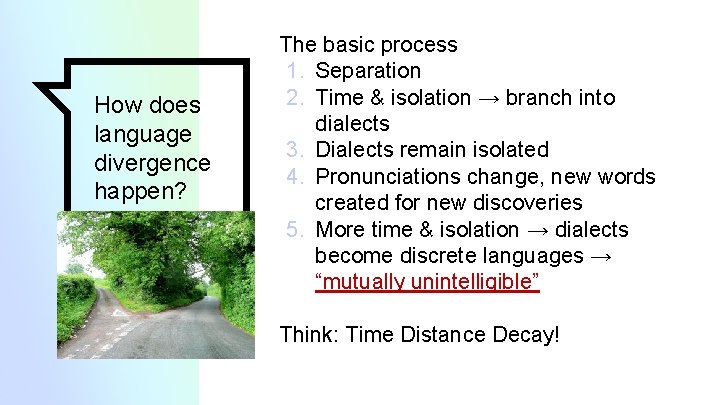
How does language divergence happen? The basic process 1. Separation 2. Time & isolation → branch into dialects 3. Dialects remain isolated 4. Pronunciations change, new words created for new discoveries 5. More time & isolation → dialects become discrete languages → “mutually unintelligible” Think: Time Distance Decay!
More Important Concepts Related to Language. . .
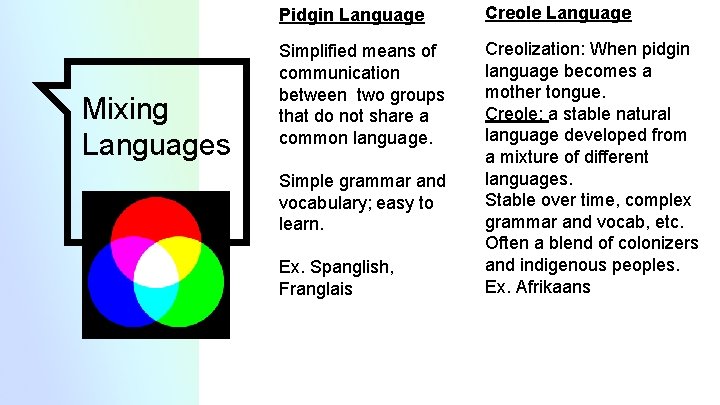
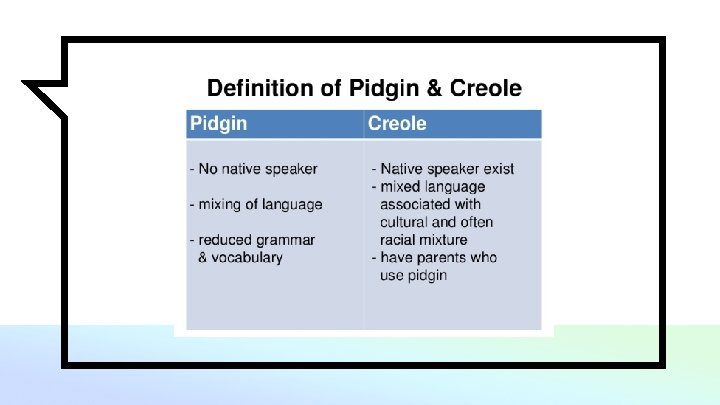
Mixing Languages Pidgin Language Creole Language Simplified means of communication between two groups that do not share a common language. Creolization: When pidgin language becomes a mother tongue. Creole: a stable natural language developed from a mixture of different languages. Stable over time, complex grammar and vocab, etc. Often a blend of colonizers and indigenous peoples. Ex. Afrikaans Simple grammar and vocabulary; easy to learn. Ex. Spanglish, Franglais
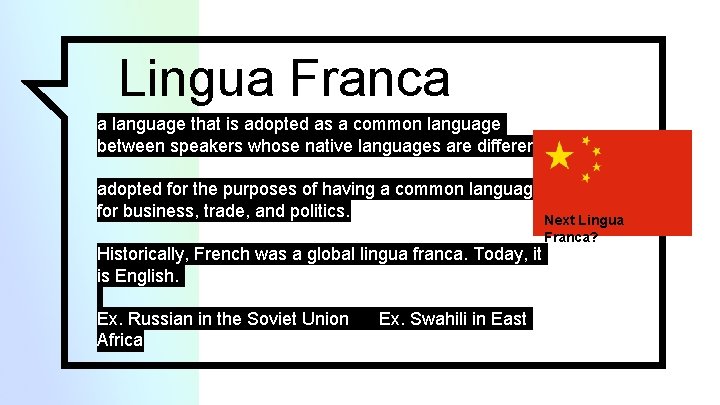
Lingua Franca a language that is adopted as a common language between speakers whose native languages are different. adopted for the purposes of having a common language for business, trade, and politics. Next Lingua Historically, French was a global lingua franca. Today, it is English. Ex. Russian in the Soviet Union Africa Ex. Swahili in East Franca?
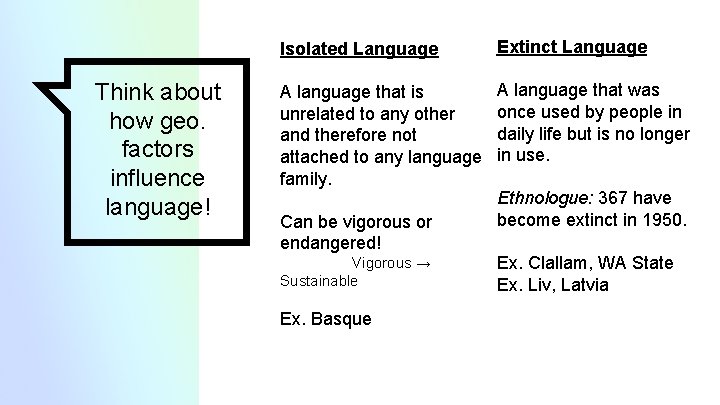
Think about how geo. factors influence language! Isolated Language Extinct Language A language that is unrelated to any other and therefore not attached to any language family. A language that was once used by people in daily life but is no longer in use. Can be vigorous or endangered! Vigorous → Sustainable Ex. Basque Ethnologue: 367 have become extinct in 1950. Ex. Clallam, WA State Ex. Liv, Latvia