
The Geography of Asia is the largest continent
- Slides: 7
The Geography of Asia is the largest continent in the world in terms of both land area and population. It covers around 17 million square miles and is home to over four billion individuals. Asia is divided into 48/49 countries.
The 3 largest countries in Asia The Largest Countries In Asia in terms of land area are : • Russia - 6. 6 million square miles. (with 11 time zones!) • China - 3. 7 million square miles. (5 time zones) • India – 1. 24 million square miles. For comparison, Slovakia is 18, 932 square miles. The UK is 93, 638 square miles and England alone is only 50, 352 square miles. So Russia is 349 times bigger than Slovakia. • Russia, Turkey, Kazakhstan, Azerbaijan and Georgia are Trans-continental. (Europe to Asia)
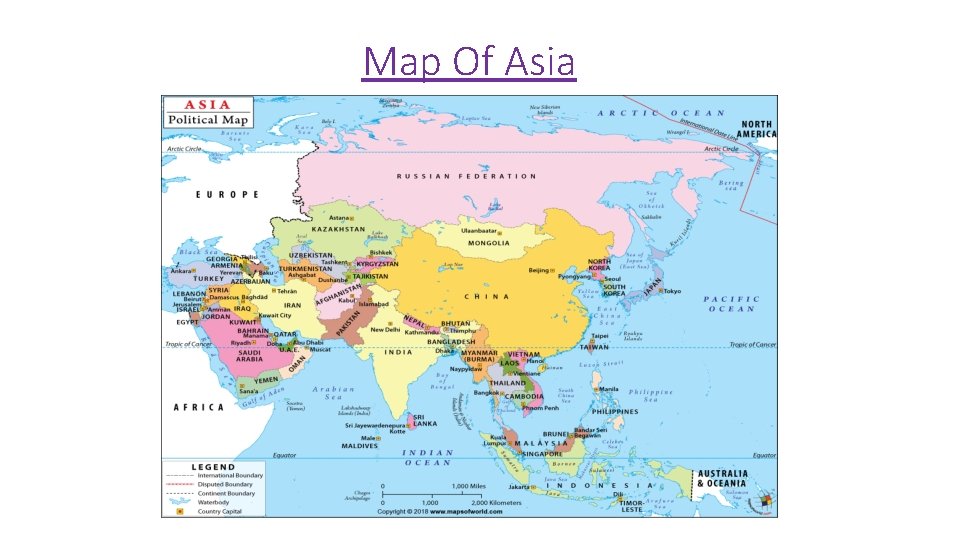
Map Of Asia
Asia Exports, Imports and Agriculture • China, Japan and South Korea are major exporters of automobiles, industrial equipment and heavy machinery. • Singapore, China, Japan, South Korea, Taiwan, and Malaysia are major exporters of semiconductors and electronic products. • Major crops are wheat, maize, rice, cotton, soybeans, sweet potato, as well as citrus and some temperate fruits. Livestock are important, particularly cattle, pigs and poultry.
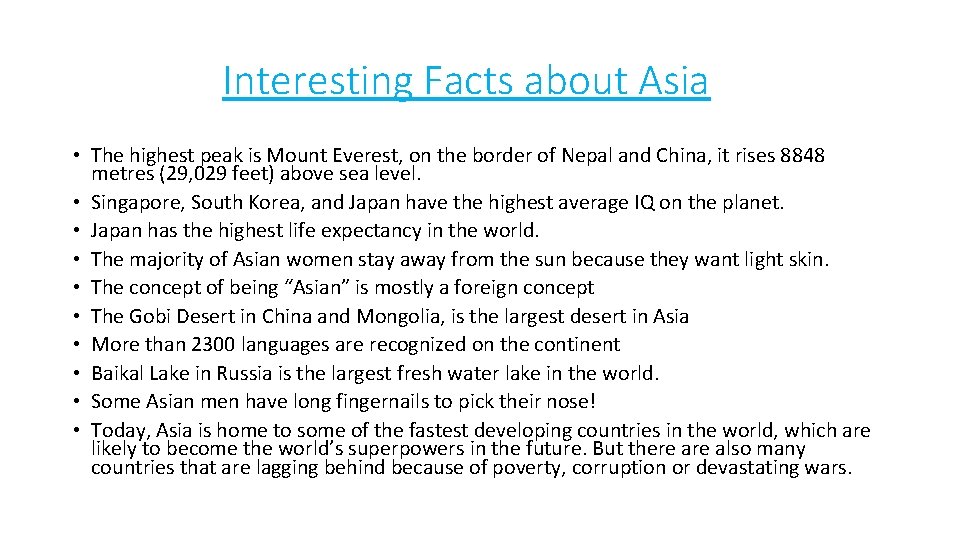
Interesting Facts about Asia • The highest peak is Mount Everest, on the border of Nepal and China, it rises 8848 metres (29, 029 feet) above sea level. • Singapore, South Korea, and Japan have the highest average IQ on the planet. • Japan has the highest life expectancy in the world. • The majority of Asian women stay away from the sun because they want light skin. • The concept of being “Asian” is mostly a foreign concept • The Gobi Desert in China and Mongolia, is the largest desert in Asia • More than 2300 languages are recognized on the continent • Baikal Lake in Russia is the largest fresh water lake in the world. • Some Asian men have long fingernails to pick their nose! • Today, Asia is home to some of the fastest developing countries in the world, which are likely to become the world’s superpowers in the future. But there also many countries that are lagging behind because of poverty, corruption or devastating wars.
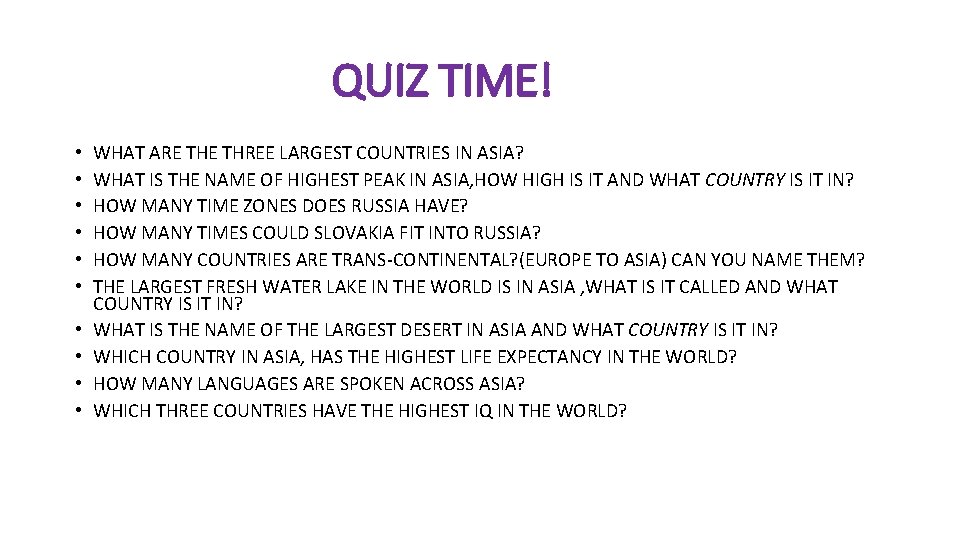
QUIZ TIME! • • • WHAT ARE THREE LARGEST COUNTRIES IN ASIA? WHAT IS THE NAME OF HIGHEST PEAK IN ASIA, HOW HIGH IS IT AND WHAT COUNTRY IS IT IN? HOW MANY TIME ZONES DOES RUSSIA HAVE? HOW MANY TIMES COULD SLOVAKIA FIT INTO RUSSIA? HOW MANY COUNTRIES ARE TRANS-CONTINENTAL? (EUROPE TO ASIA) CAN YOU NAME THEM? THE LARGEST FRESH WATER LAKE IN THE WORLD IS IN ASIA , WHAT IS IT CALLED AND WHAT COUNTRY IS IT IN? WHAT IS THE NAME OF THE LARGEST DESERT IN ASIA AND WHAT COUNTRY IS IT IN? WHICH COUNTRY IN ASIA, HAS THE HIGHEST LIFE EXPECTANCY IN THE WORLD? HOW MANY LANGUAGES ARE SPOKEN ACROSS ASIA? WHICH THREE COUNTRIES HAVE THE HIGHEST IQ IN THE WORLD?
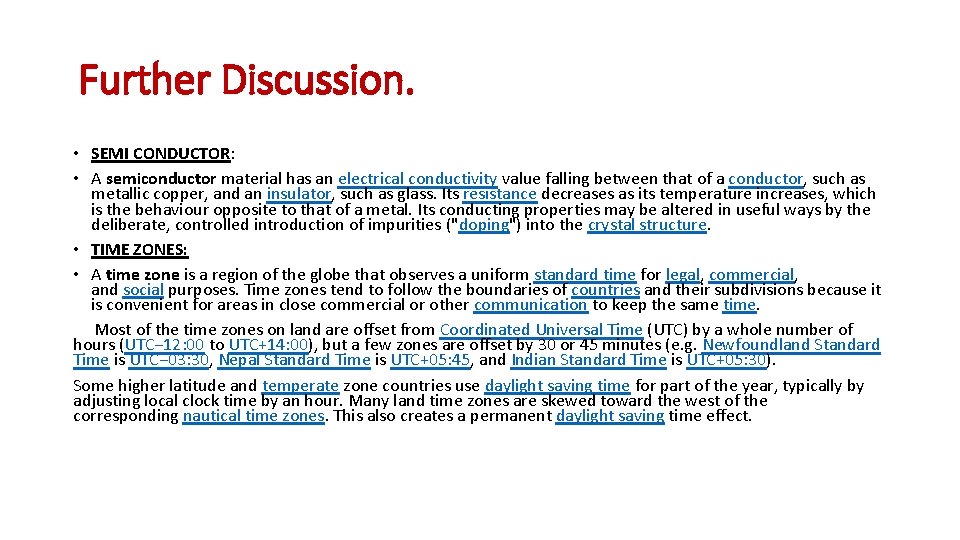
Further Discussion. • SEMI CONDUCTOR: • A semiconductor material has an electrical conductivity value falling between that of a conductor, such as metallic copper, and an insulator, such as glass. Its resistance decreases as its temperature increases, which is the behaviour opposite to that of a metal. Its conducting properties may be altered in useful ways by the deliberate, controlled introduction of impurities ("doping") into the crystal structure. • TIME ZONES: • A time zone is a region of the globe that observes a uniform standard time for legal, commercial, and social purposes. Time zones tend to follow the boundaries of countries and their subdivisions because it is convenient for areas in close commercial or other communication to keep the same time. Most of the time zones on land are offset from Coordinated Universal Time (UTC) by a whole number of hours (UTC− 12: 00 to UTC+14: 00), but a few zones are offset by 30 or 45 minutes (e. g. Newfoundland Standard Time is UTC− 03: 30, Nepal Standard Time is UTC+05: 45, and Indian Standard Time is UTC+05: 30). Some higher latitude and temperate zone countries use daylight saving time for part of the year, typically by adjusting local clock time by an hour. Many land time zones are skewed toward the west of the corresponding nautical time zones. This also creates a permanent daylight saving time effect.