
THE GEOGRAPHICAL FRAMEWORK The geography of a land
- Slides: 7
THE GEOGRAPHICAL FRAMEWORK
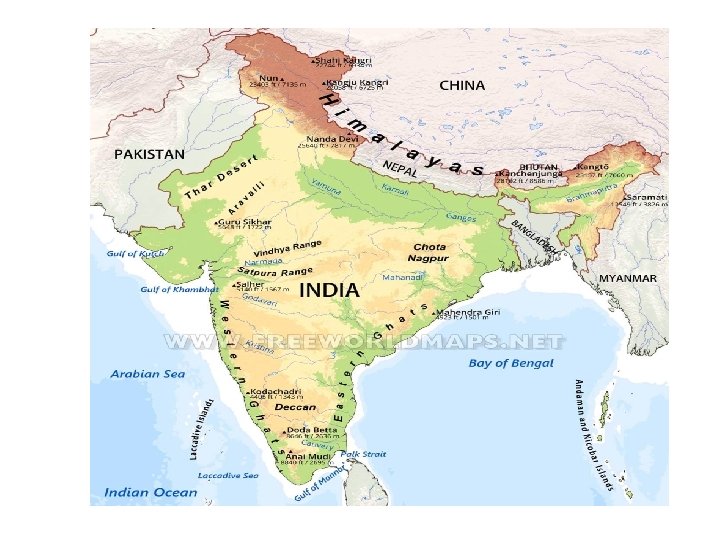
• The geography of a land often has a powerful impact on its history. • Geography influenced the location of early settlements around the world. All the early civilisations, namely those of Egypt, Mesopotamia, the Indus and China were located in and around river valleys. • The history of the Indian subcontinent has also been influenced by the physical features of the land.
THE HIMALAYAS • The Himalaya stretch across the north of India. • It acted as a barrier against invading forces from the north. However , people have travelled in and out of India freely through low -lying points, called passes, along the north – western portions of the Himalayas. • While many of these people were traders and travellers, invaders have also entered India through these passes.
THE OCEANS AND SEAS • The seas that surround India on three sides have protected peninsular India from attacks. • The long coastline with its natural ports and harbours has also encouraged trade, for thousands of years, with distant lands like Rome, Mesopotamia( Present day Iraq) Egypt and South-East Asia. • The kingdoms of South India were able to develop strong navies and establish overseas colonies in South-East Asia and Sri Lanka.
THE NORTHERN PLAINS • The northern plains , lying between the Indus and the Ganga rivers, is a vast expanse of fertile land. • The fertile nature of the plains encouraged the growth of agriculture. • This in turn , led to the establishment of many powerful kingdoms and empires, like those of the Mauryas and the Guptas.
THE DECCAN PLATEAU • The Deccan Plateau is separated from northern India by the Satpura and Vindhya mountain ranges. • This isolation enabled the growth of several regional kingdoms here, like those of the Cholas, the Chalukyas and the Rashtrakutas.