
The Genetics of Color Blindness The Genetics of
The Genetics of Color. Blindness The Genetics of Color-Blindness Dr. Rick Hershberger • http: //www. rickhershberger. com 1
The Genetics of Color. Blindness Outline • How our Eyes See Colors • Defects in Human Color Vision • A Gene for Red-Green Color Blindness • Inheritance • X-Linkage • Pedigree Analysis - Testing my Daughter’s Prom Date? 2

The Genetics of Color. Blindness Anatomy of an Eyeball 3
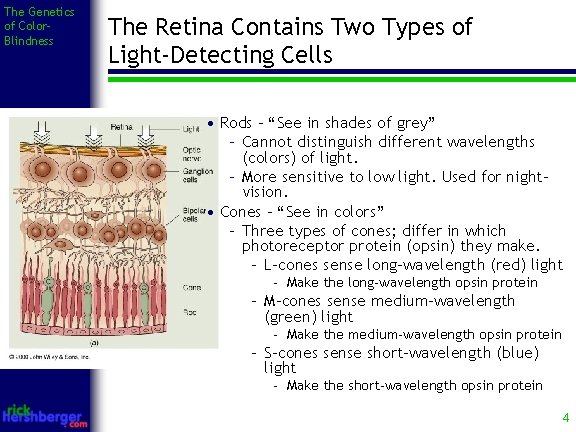
The Genetics of Color. Blindness The Retina Contains Two Types of Light-Detecting Cells • Rods – “See in shades of grey” - Cannot distinguish different wavelengths (colors) of light. - More sensitive to low light. Used for nightvision. • Cones – “See in colors” - Three types of cones; differ in which photoreceptor protein (opsin) they make. - L-cones sense long-wavelength (red) light - Make the long-wavelength opsin protein - M-cones sense medium-wavelength (green) light - Make the medium-wavelength opsin protein - S-cones sense short-wavelength (blue) light - Make the short-wavelength opsin protein 4
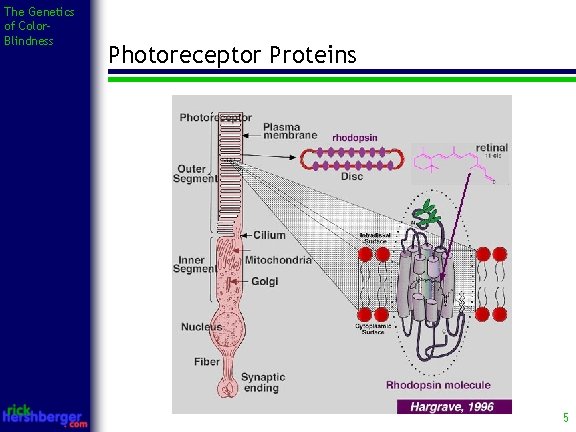
The Genetics of Color. Blindness Photoreceptor Proteins 5
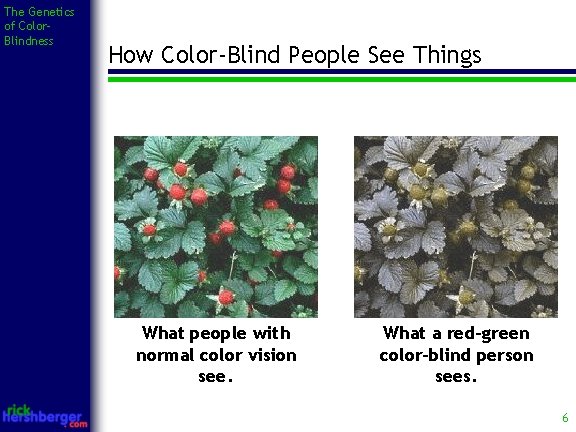
The Genetics of Color. Blindness How Color-Blind People See Things What people with normal color vision see. What a red-green color-blind person sees. 6
The Genetics of Color. Blindness Types of Color Vision Deficiencies • Trichromacy (“three-color vision”) - Normal Color Vision • Anomalous Trichromacy (“unusual three-color vision”) - See all three primary colors. - One color is seen weakly - Protanomaly (L-cone defect) red-weak - Deuteranomaly (M-cone defect) green-weak - Tritanomaly (S-cone defect) blue-weak • Dichromacy (“two-color vision”) - See only two of the three primary colors - One type of cone is totally absent or nonfunctional. - Protanopia (L-cone absent) - Deuteranopia (M-cone absent) - Tritanopia (S-cone absent) • Rod Monochromacy (no cones at all) (“no-color vision”) - Sees no colors, only shades of gray. 7
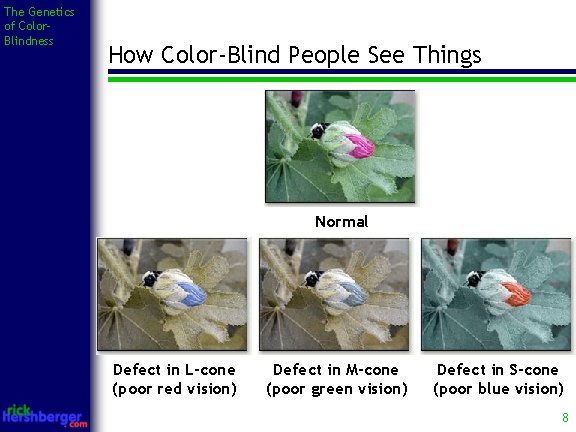
The Genetics of Color. Blindness How Color-Blind People See Things Normal Defect in L-cone (poor red vision) Defect in M-cone (poor green vision) Defect in S-cone (poor blue vision) 8
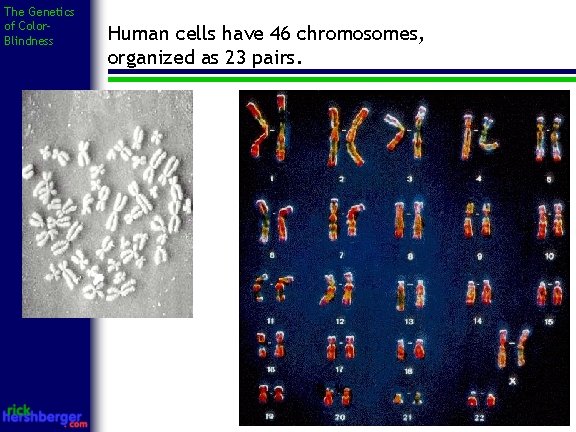
The Genetics of Color. Blindness Human cells have 46 chromosomes, organized as 23 pairs. 9
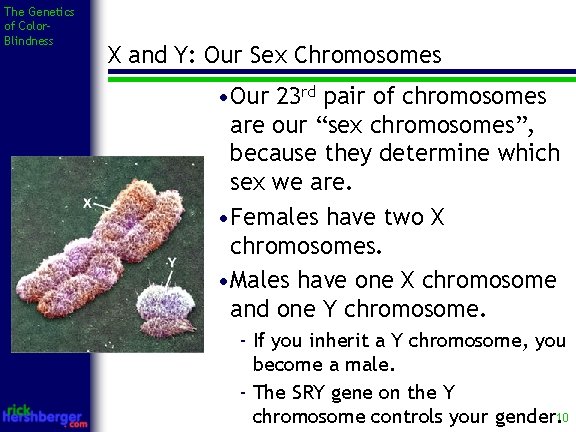
The Genetics of Color. Blindness X and Y: Our Sex Chromosomes • Our 23 rd pair of chromosomes are our “sex chromosomes”, because they determine which sex we are. • Females have two X chromosomes. • Males have one X chromosome and one Y chromosome. - If you inherit a Y chromosome, you become a male. - The SRY gene on the Y chromosome controls your gender. 10
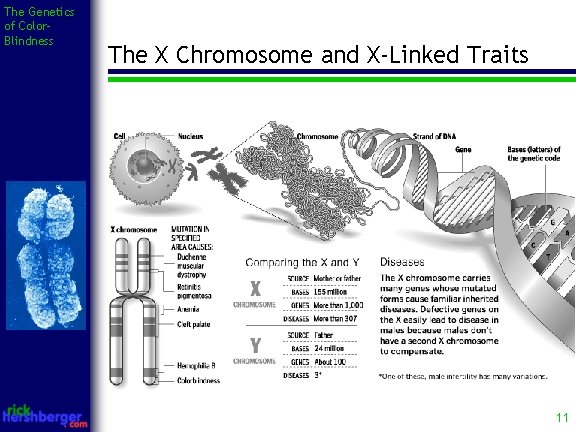
The Genetics of Color. Blindness The X Chromosome and X-Linked Traits 11
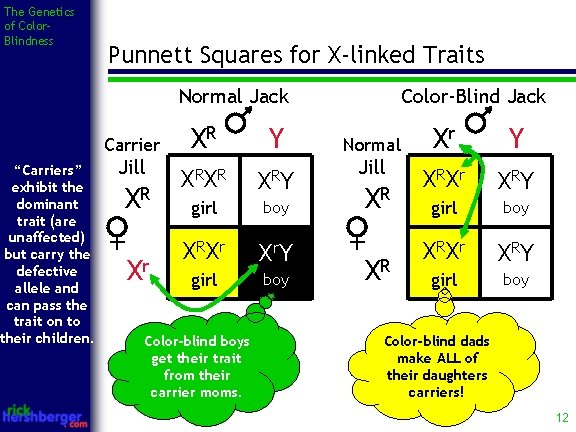
The Genetics of Color. Blindness Punnett Squares for X-linked Traits Normal Jack Carrier “Carriers” exhibit the dominant trait (are unaffected) but carry the defective allele and can pass the trait on to their children. Jill XR Xr XR Y X RX R X RY girl boy X RX r X r. Y girl boy Color-blind boys get their trait from their carrier moms. Color-Blind Jack Normal Jill XR XR Xr Y X RX r X RY girl boy Color-blind dads make ALL of their daughters carriers! 12
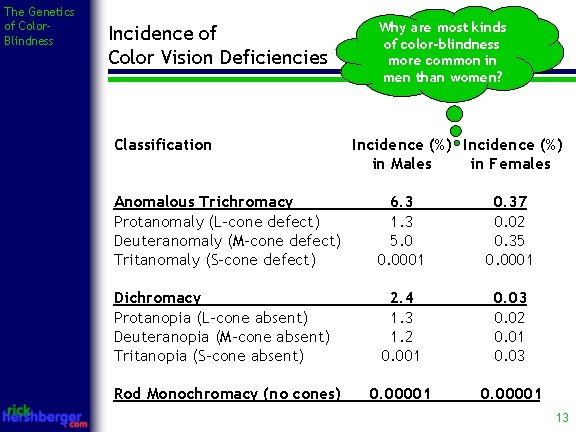
The Genetics of Color. Blindness Incidence of Color Vision Deficiencies Classification Why are most kinds of color-blindness more common in men than women? Incidence (%) in Males in Females Anomalous Trichromacy Protanomaly (L-cone defect) Deuteranomaly (M-cone defect) Tritanomaly (S-cone defect) 6. 3 1. 3 5. 0 0. 0001 0. 37 0. 02 0. 35 0. 0001 Dichromacy Protanopia (L-cone absent) Deuteranopia (M-cone absent) Tritanopia (S-cone absent) 2. 4 1. 3 1. 2 0. 001 0. 03 0. 02 0. 01 0. 03 0. 00001 Rod Monochromacy (no cones) 13
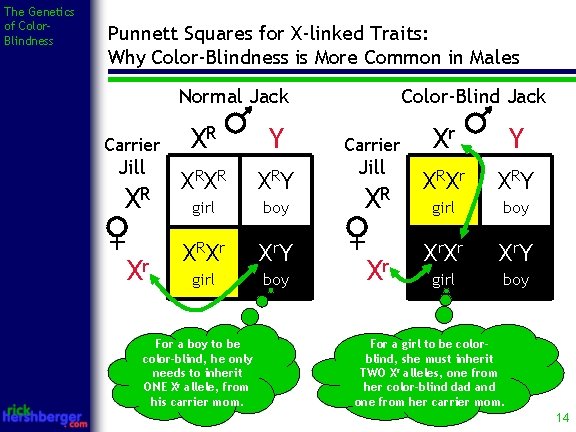
The Genetics of Color. Blindness Punnett Squares for X-linked Traits: Why Color-Blindness is More Common in Males Normal Jack Carrier Jill XR Xr XR Y X RX R X RY girl boy X RX r X r. Y girl boy For a boy to be color-blind, he only needs to inherit ONE Xr allele, from his carrier mom. Color-Blind Jack Carrier Jill XR Xr Xr Y X RX r X RY girl boy X r. Y girl boy For a girl to be colorblind, she must inherit TWO Xr alleles, one from her color-blind dad and one from her carrier mom. 14
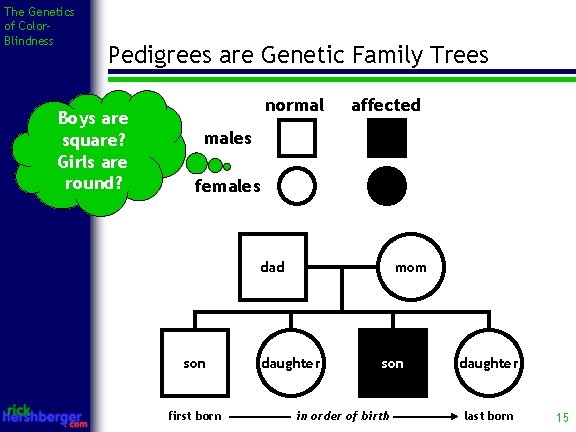
The Genetics of Color. Blindness Pedigrees are Genetic Family Trees Boys are square? Girls are round? normal affected males females dad son first born mom daughter son in order of birth daughter last born 15
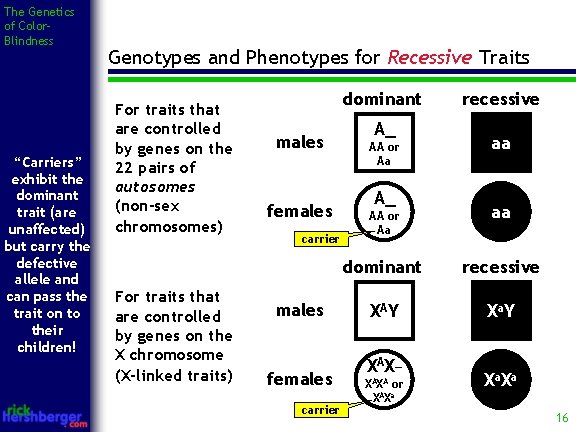
The Genetics of Color. Blindness “Carriers” exhibit the dominant trait (are unaffected) but carry the defective allele and can pass the trait on to their children! Genotypes and Phenotypes for Recessive Traits For traits that are controlled by genes on the 22 pairs of autosomes (non-sex chromosomes) For traits that are controlled by genes on the X chromosome (X-linked traits) dominant males females carrier A_ AA or Aa recessive aa aa dominant recessive XAY Xa. Y XAX_ XAXA or XAXa Xa. Xa 16
The Genetics of Color. Blindness Professor Hershberger’s Rules for Interpreting Pedigrees • Step 1: Match a genotype to each phenotype. - If the individual exhibits the recessive phenotype, he/she is aa (or Xa. Xa for an X-linked trait) - If the individual exhibits the dominant phenotype, he/she is A_ (or XA_ for an X-linked trait). • Step 2: Where possible, track alleles (genes) UP the pedigree, from child to parent. - Because children get one allele from each parent. • Step 3: Where possible, track alleles (genes) DOWN the pedigree, from parent to child. - Because each parent gives one of his/her alleles to each child. 17
The Genetics of Color. Blindness You are the Genetic Counselor. Gretchen is a carrier for red-green colorblindness. How will Gretchen’s choice of husband affect whether children will be color-blind? 18
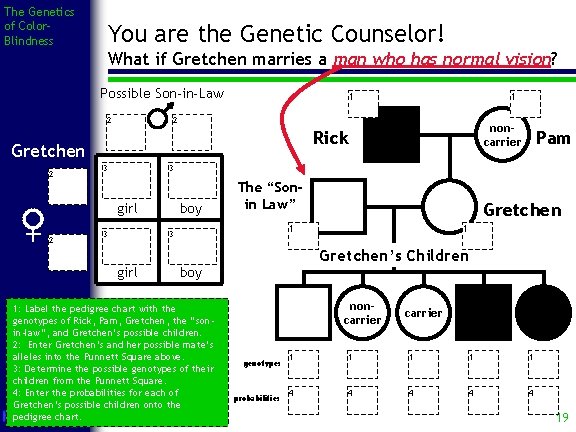
The Genetics of Color. Blindness You are the Genetic Counselor! What if Gretchen marries a man who has normal vision? Possible Son-in-Law 2 1 2 3 Pam 3 girl 2 noncarrier Rick Gretchen 2 1 3 boy The “Sonin Law” 1 3 girl Gretchen’s Children boy 1: Label the pedigree chart with the genotypes of Rick, Pam, Gretchen, the “sonin-law”, and Gretchen’s possible children. 2: Enter Gretchen’s and her possible mate’s alleles into the Punnett Square above. 3: Determine the possible genotypes of their children from the Punnett Square. 4: Enter the probabilities for each of Gretchen’s possible children onto the pedigree chart. 1 noncarrier genotypes probabilities carrier 1 1 1 4 4 4 19
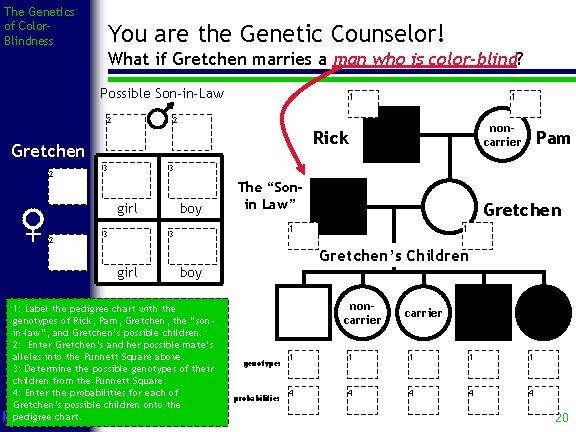
The Genetics of Color. Blindness You are the Genetic Counselor! What if Gretchen marries a man who is color-blind? Possible Son-in-Law 2 1 2 3 Pam 3 girl 2 noncarrier Rick Gretchen 2 1 3 boy The “Sonin Law” 1 3 girl Gretchen’s Children boy 1: Label the pedigree chart with the genotypes of Rick, Pam, Gretchen, the “sonin-law”, and Gretchen’s possible children. 2: Enter Gretchen’s and her possible mate’s alleles into the Punnett Square above. 3: Determine the possible genotypes of their children from the Punnett Square. 4: Enter the probabilities for each of Gretchen’s possible children onto the pedigree chart. 1 noncarrier genotypes probabilities carrier 1 1 1 4 4 4 20
The Genetics of Color. Blindness The Answers What happens if Gretchen marries a man who has normal vision? 21
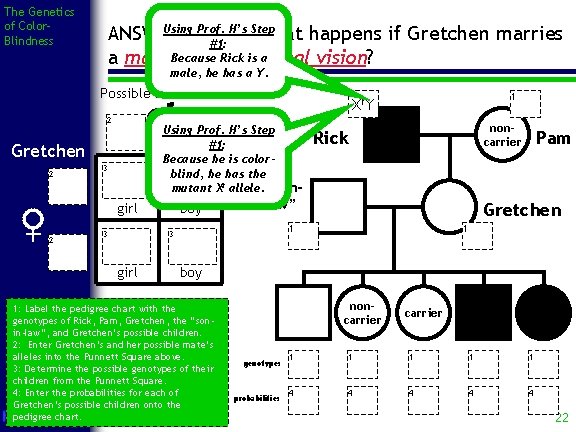
The Genetics of Color. Blindness Using Prof. H’s Step ANSWER: Here’s what happens if Gretchen marries #1: Becausehas Rick normal is a a man who vision? male, he has a Y. Possible Son-in-Law 2 2 3 girl 2 1 XYY Using Prof. H’s Step #1: Because he is color 3 blind, he has the mutant Xr allele. The “Son- Gretchen 2 1 r 3 boy in Law” Pam Gretchen 1 3 girl noncarrier Rick 1 boy 1: Label the pedigree chart with the genotypes of Rick, Pam, Gretchen, the “sonin-law”, and Gretchen’s possible children. 2: Enter Gretchen’s and her possible mate’s alleles into the Punnett Square above. 3: Determine the possible genotypes of their children from the Punnett Square. 4: Enter the probabilities for each of Gretchen’s possible children onto the pedigree chart. noncarrier genotypes probabilities carrier 1 1 1 4 4 4 22
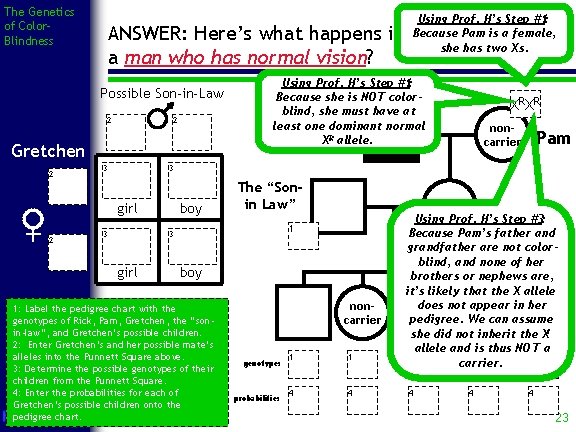
The Genetics of Color. Blindness Using Prof. H’s Step #1: Because Pam is a female, she has two Xs. ANSWER: Here’s what happens if Gretchen marries a man who has normal vision? Possible Son-in-Law 2 2 Gretchen 2 3 1 RRX XXXX XR noncarrier Pam 3 girl 2 Using Prof. H’s Step #1: Because she is NOT color. Xr. Yhave at blind, she must least one dominant normal Rick XR allele. 3 boy The “Sonin Law” 1 3 girl Gretchen boy 1: Label the pedigree chart with the genotypes of Rick, Pam, Gretchen, the “sonin-law”, and Gretchen’s possible children. 2: Enter Gretchen’s and her possible mate’s alleles into the Punnett Square above. 3: Determine the possible genotypes of their children from the Punnett Square. 4: Enter the probabilities for each of Gretchen’s possible children onto the pedigree chart. noncarrier genotypes probabilities 1 1 4 4 Using Prof. H’s Step #3: 1 Because Pam’s father and grandfather are not colorblind, and none of her brothers or nephews are, it’s likely that the Xr allele does not appear in her carrier pedigree. We can assume she did not inherit the Xr allele and is thus NOT a 1 1 1 carrier. 4 4 4 23
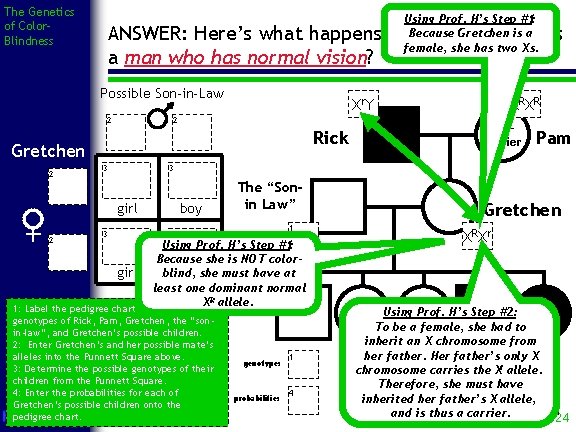
The Genetics of Color. Blindness Using Prof. H’s Step #1: Because Gretchen is a female, she has two Xs. ANSWER: Here’s what happens if Gretchen marries a man who has normal vision? Possible Son-in-Law 2 Xr Y 2 Rick Gretchen 2 3 3 noncarrier Pam 3 girl 2 XRXR boy The “Sonin Law” 1 3 Using Prof. H’s Step #1: Because she is NOT colorgirl boyshe must have at blind, least one dominant normal XR allele. 1: Label the pedigree chart with the genotypes of Rick, Pam, Gretchen, the “sonin-law”, and Gretchen’s possible children. 2: Enter Gretchen’s and her possible mate’s alleles into the Punnett Square above. 3: Determine the possible genotypes of their children from the Punnett Square. 4: Enter the probabilities for each of Gretchen’s possible children onto the pedigree chart. genotypes probabilities 1 4 Gretchen 1 RR r XXXXXX non. Using Prof. H’s Step #2: carrier To be a female, she had to inherit an X chromosome from Her father’s only 1 X 1 her father. 1 1 r chromosome carries the X allele. Therefore, she must have 4 4 inherited her father’s Xr allele, and is thus a carrier. 24
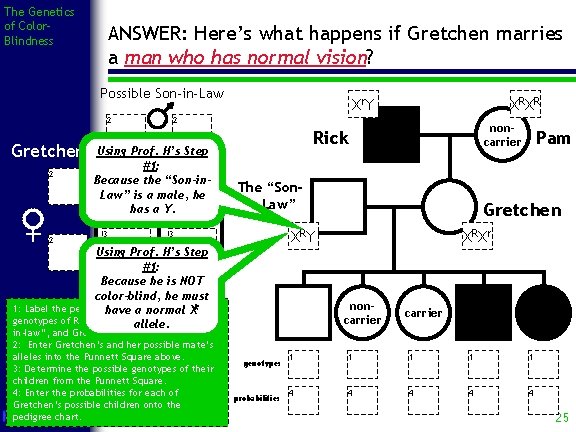
The Genetics of Color. Blindness ANSWER: Here’s what happens if Gretchen marries a man who has normal vision? Possible Son-in-Law 2 Gretchen 2 2 XRXR 2 Using Prof. H’s Step #1: 3 3 Because the “Son-in. Law” is a male, he girl has a Y. boy 3 Xr Y The “Sonin Law” 1 RR r XYY Using Prof. H’s Step girl #1: boy Because he is NOT color-blind, he must 1: Label the pedigreehave chartawith the XR normal genotypes of Rick, Pam, Gretchen, allele. the “son- XXXXXX noncarrier genotypes probabilities Pam Gretchen 1 R 3 in-law”, and Gretchen’s possible children. 2: Enter Gretchen’s and her possible mate’s alleles into the Punnett Square above. 3: Determine the possible genotypes of their children from the Punnett Square. 4: Enter the probabilities for each of Gretchen’s possible children onto the pedigree chart. noncarrier Rick carrier 1 1 1 4 4 4 25
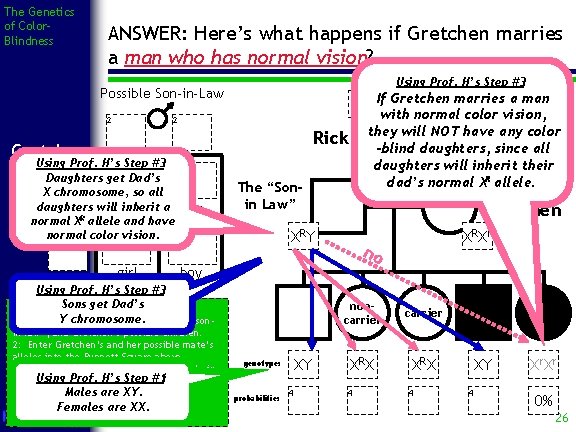
The Genetics of Color. Blindness ANSWER: Here’s what happens if Gretchen marries a man who has normal vision? Using Prof. H’s Step #3: Possible Son-in-Law 2 Xr. Y If Gretchen marries a XRman XR with normal color vision, they will NOT havenonany color carrier Pam -blind daughters, since all daughters will inherit their dad’s normal XR allele. 2 Rick Gretchen Using Prof. H’s Step #3: 3 3 2 Daughters get Dad’s X chromosome, so all daughters willgirl inherit a boy R normal X allele and have 3 normal color vision. 3 2 girl The “Sonin Law” Gretchen 1 R XYY in-law”, and Gretchen’s possible children. 2: Enter Gretchen’s and her possible mate’s alleles into the Punnett Square above. 3: Determine the possible genotypes of their Using H’s Step #1: children from. Prof. the Punnett Square. 4: Enter the. Males probabilities for each of are XY. Gretchen’s. Females possible children onto the are XX. pedigree chart. noncarrier genotypes probabilities 1 4 XY XXXXXX no boy Using Prof. H’s Step #3: Sons get Dad’s 1: Label the pedigree chart with the Y chromosome. genotypes of Rick, Pam, Gretchen, the “son- 1 RR r carrier 1 RX XXX 1 4 4 4 XY 1 r Xr XXX 4 0% 26
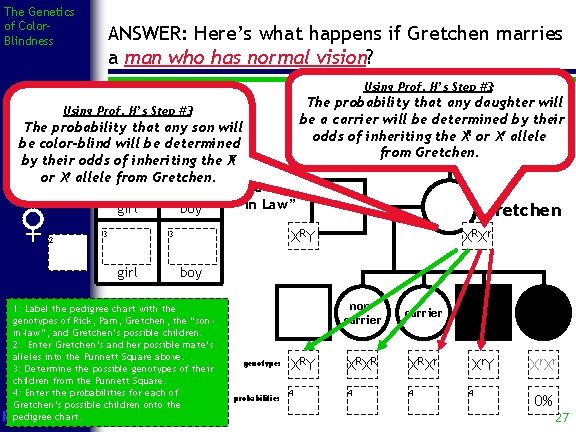
The Genetics of Color. Blindness ANSWER: Here’s what happens if Gretchen marries a man who has normal vision? Using Prof. H’s Step #3: Possible Son-in-Law The probability that any daughter Xr Y XRXRwill be a carrier will be determined by their nonodds Xr allele Rickof inheriting the XR orcarrier Pam from Gretchen. Using Prof. H’s Step #3: 2 2 The probability that any son will be color-blind will be determined Gretchen by their odds of inheriting the XR 3 3 or 2 Xr allele from Gretchen. The “Sonin Law” girl boy 2 3 1 RR r XYY 3 girl Gretchen XXXXXX boy 1: Label the pedigree chart with the genotypes of Rick, Pam, Gretchen, the “sonin-law”, and Gretchen’s possible children. 2: Enter Gretchen’s and her possible mate’s alleles into the Punnett Square above. 3: Determine the possible genotypes of their children from the Punnett Square. 4: Enter the probabilities for each of Gretchen’s possible children onto the pedigree chart. genotypes probabilities noncarrier RY XXRRXXR XXRRXXr 4 4 4 r. Y XXY 4 1 r Xr XXX 4 0% 27
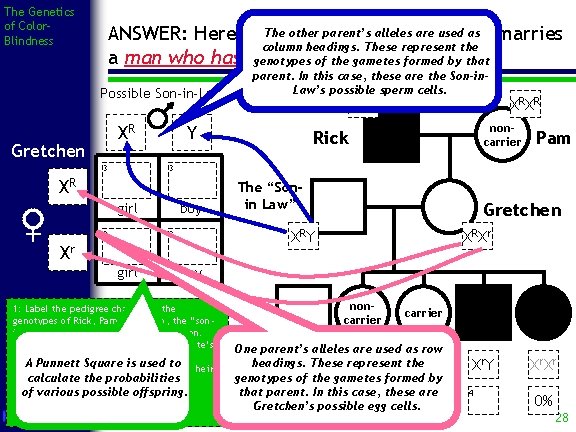
The Genetics of Color. Blindness The other parent’s alleles are used as marries ANSWER: Here’s what happens if Gretchen column headings. These represent the a man who has normal vision? genotypes of the gametes formed by that Possible Son-in-Law 2 Gretchen 2 XR 3 2 Xr Y Y XRXR noncarrier Rick Pam 3 XR girl 2 parent. In this case, these are the Son-in. Law’s possible sperm cells. 3 boy Gretchen 1 RR r XYY 3 Xr girl The “Sonin Law” XXXXXX boy 1: Label the pedigree chart with the genotypes of Rick, Pam, Gretchen, the “sonin-law”, and Gretchen’s possible children. 2: Enter Gretchen’s and her possible mate’s alleles into the Punnett Square above. A Punnettthe. Square used toof their 3: Determine possibleisgenotypes calculate the probabilities children from the Punnett Square. 4: of Enter the probabilities each of various possiblefor offspring. Gretchen’s possible children onto the pedigree chart. noncarrier One parent’s alleles are used as row RY genotypes headings. These X represent the XXY XRRXXR XXRRXXr genotypes of the gametes formed by 4 4 are that parent. In this 4 case, these probabilities Gretchen’s possible egg cells. r. Y XXY 4 1 r Xr XXX 4 0% 28
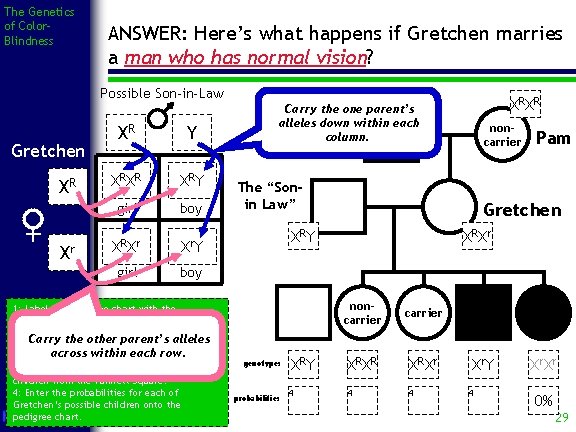
The Genetics of Color. Blindness ANSWER: Here’s what happens if Gretchen marries a man who has normal vision? Possible Son-in-Law 2 Gretchen 2 3 XR XR XXRRXR 2 3 girl 2 3 Xr XXRRXr girl Y XRYY boy 3 X Yparent’s Carry the one alleles down within each column. Rick XRXR r noncarrier The “Sonin Law” Gretchen 1 RR r XYY Xr. YY Pam XXXXXX boy 1: Label the pedigree chart with the genotypes of Rick, Pam, Gretchen, the “sonin-law”, and Gretchen’s possible children. Carry the other parent’s alleles 2: Enter Gretchen’s and her possible mate’s across within. Square eachabove. row. alleles into the Punnett 3: Determine the possible genotypes of their children from the Punnett Square. 4: Enter the probabilities for each of Gretchen’s possible children onto the pedigree chart. genotypes probabilities noncarrier RY XXRRXXR XXRRXXr 4 4 4 r. Y XXY 4 1 r Xr XXX 4 0% 29
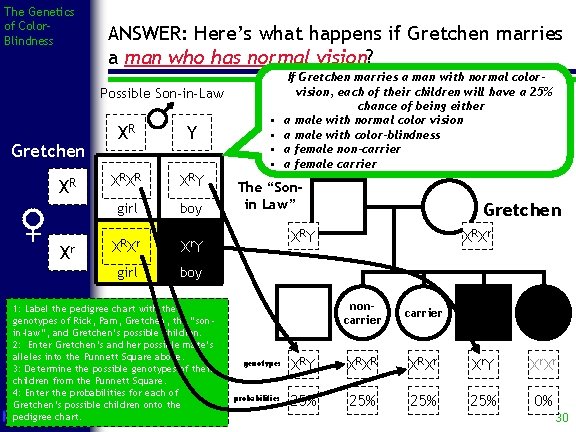
The Genetics of Color. Blindness ANSWER: Here’s what happens if Gretchen marries a man who has normal vision? Possible Son-in-Law 2 Gretchen 2 3 XR XR XXRRXR 2 3 girl 2 3 Xr XXRRXr girl Y XRYY boy 3 • • If Gretchen marries a man with normal colorvision, each of their children will have a 25% r. Y Xchance XRXR of being either a male with normal color vision nona male with color-blindness Rick carrier Pam a female non-carrier a female carrier The “Sonin Law” Gretchen 1 RR r XYY Xr. YY XXXXXX boy 1: Label the pedigree chart with the genotypes of Rick, Pam, Gretchen, the “sonin-law”, and Gretchen’s possible children. 2: Enter Gretchen’s and her possible mate’s alleles into the Punnett Square above. 3: Determine the possible genotypes of their children from the Punnett Square. 4: Enter the probabilities for each of Gretchen’s possible children onto the pedigree chart. genotypes probabilities noncarrier RY XXRRXXR XXRRXXr 4 4 4 25% 25% r. Y XXY 4 25% 1 r Xr XXX 4 0% 30
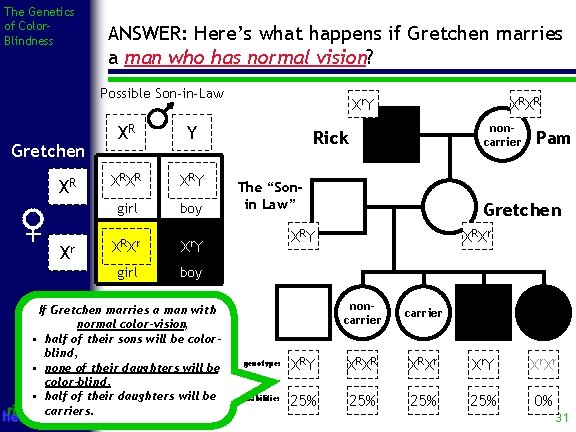
The Genetics of Color. Blindness ANSWER: Here’s what happens if Gretchen marries a man who has normal vision? Possible Son-in-Law 2 Gretchen 2 3 XR XR XXRRXR 2 3 girl 2 3 Xr XXRRXr girl Y XRYY boy 3 Xr Y XRXR noncarrier Rick The “Sonin Law” Gretchen 1 RR r XYY Xr. YY Pam XXXXXX boy If Gretchen marries a man with normal color-vision, • half of their sons will be colorblind, • none of their daughters will be color-blind, • half of their daughters will be carriers. genotypes probabilities noncarrier RY XXRRXXR XXRRXXr 4 4 4 25% 25% r. Y XXY 4 25% 1 r Xr XXX 4 0% 31
The Genetics of Color. Blindness The Answers What happens if Gretchen marries a man who is red-green color-blind? 32
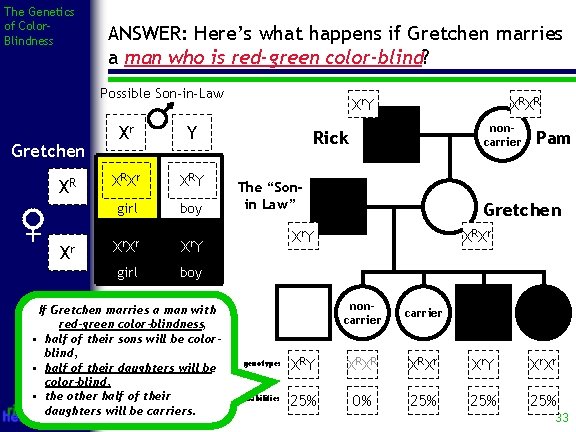
The Genetics of Color. Blindness ANSWER: Here’s what happens if Gretchen marries a man who is red-green color-blind? Possible Son-in-Law 2 Gretchen 2 3 XR Xr XXRRXr 2 3 girl 2 3 Xr Xr. RXr girl Y XRYY boy 3 Xr Y XRXR noncarrier Rick The “Sonin Law” Gretchen 1 r 1 RR r XYY Xr. YY Pam XXXXXX boy If Gretchen marries a man with red-green color-blindness, • half of their sons will be colorblind, • half of their daughters will be color-blind, • the other half of their daughters will be carriers. genotypes probabilities noncarrier RY XXRRXXR XXRRXXr 4 4 4 25% 0% 25% r. Y XXY 4 25% 1 r Xr XXX 4 25% 33
The Genetics of Color. Blindness How will Gretchen’s choice of husband affect whether children will be color-blind? 34
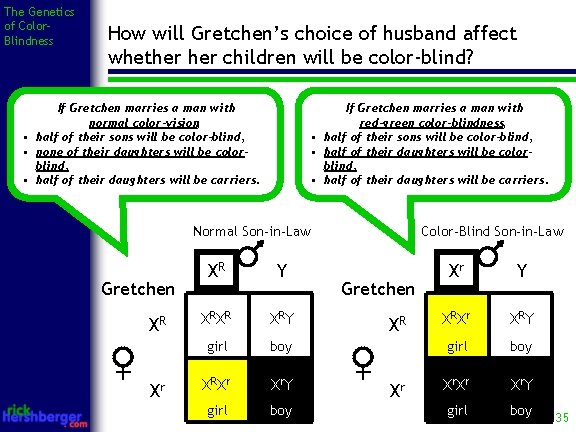
The Genetics of Color. Blindness How will Gretchen’s choice of husband affect whether children will be color-blind? If Gretchen marries a man with normal color-vision, • half of their sons will be color-blind, • none of their daughters will be colorblind, • half of their daughters will be carriers. If Gretchen marries a man with red-green color-blindness, • half of their sons will be color-blind, • half of their daughters will be colorblind, • half of their daughters will be carriers. Normal Son-in-Law 2 Gretchen XR Xr XR Y XRXR XRY girl boy XRXr Xr Y girl boy Color-Blind Son-in-Law 2 Gretchen XR Xr Xr Y XRXr XRY girl boy Xr Xr Xr Y girl boy 35
- Slides: 35