
THE GENETIC BASIS OF CANCER 11 15 Cancer
THE GENETIC BASIS OF CANCER 11. 15 Cancer results from mutations in genes that control cell division • Cancer cells, which divide uncontrollably – Result from mutations in genes whose protein products affect the cell cycle Copyright © 2005 Pearson Education, Inc. Publishing as Benjamin Cummings
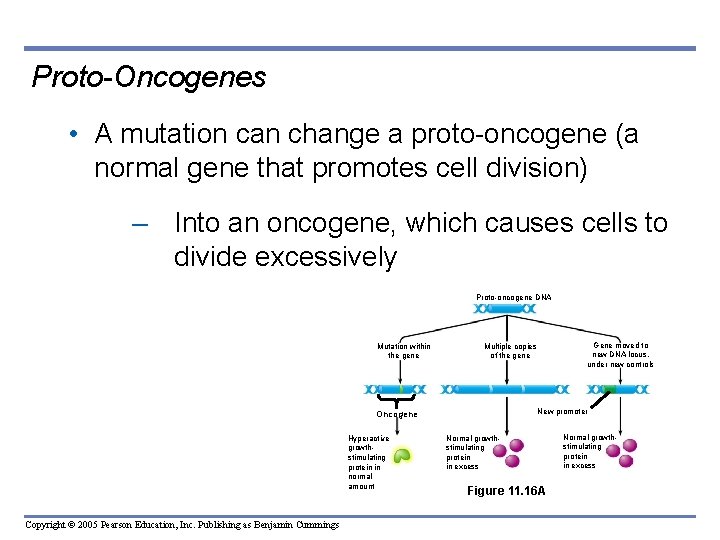
Proto-Oncogenes • A mutation can change a proto-oncogene (a normal gene that promotes cell division) – Into an oncogene, which causes cells to divide excessively Proto-oncogene DNA Mutation within the gene New promoter Oncogene Hyperactive growthstimulating protein in normal amount Copyright © 2005 Pearson Education, Inc. Publishing as Benjamin Cummings Gene moved to new DNA locus, under new controls Multiple copies of the gene Normal growthstimulating protein in excess Figure 11. 16 A Normal growthstimulating protein in excess
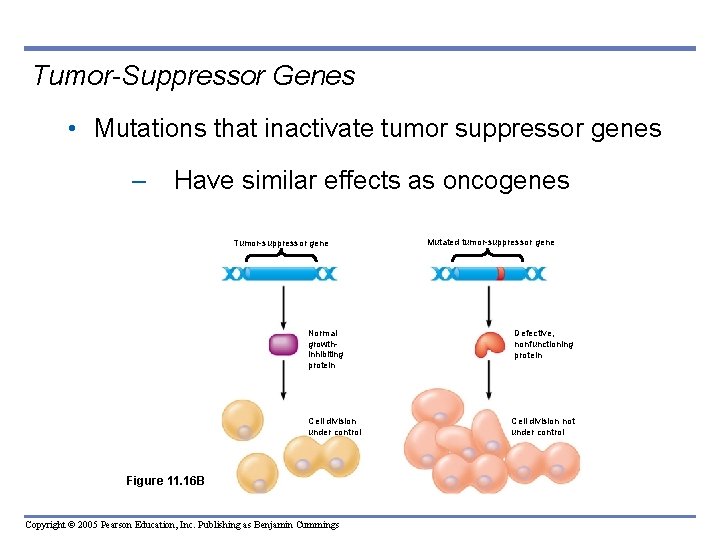
Tumor-Suppressor Genes • Mutations that inactivate tumor suppressor genes – Have similar effects as oncogenes Tumor-suppressor gene Normal growthinhibiting protein Cell division under control Figure 11. 16 B Copyright © 2005 Pearson Education, Inc. Publishing as Benjamin Cummings Mutated tumor-suppressor gene Defective, nonfunctioning protein Cell division not under control
11. 17 Oncogene proteins and faulty tumorsuppressor proteins can interfere with normal signal transduction pathways Copyright © 2005 Pearson Education, Inc. Publishing as Benjamin Cummings
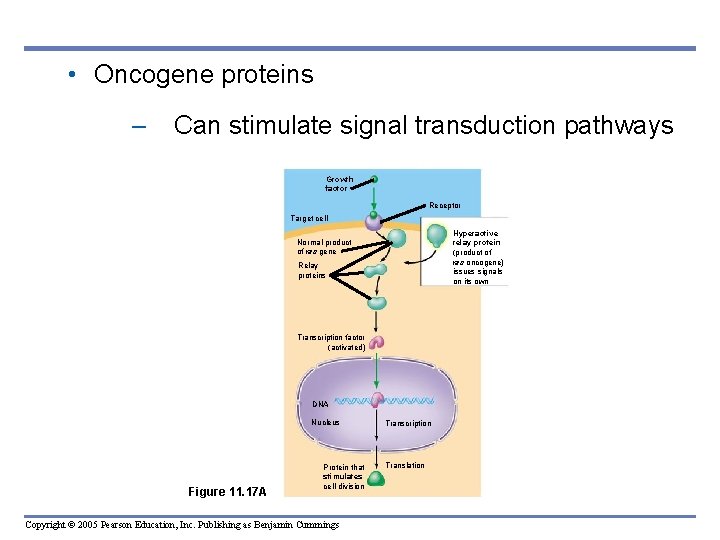
• Oncogene proteins – Can stimulate signal transduction pathways Growth factor Receptor Target cell Hyperactive relay protein (product of ras oncogene) issues signals on its own Normal product of ras gene Relay proteins Transcription factor (activated) DNA Nucleus Figure 11. 17 A Protein that stimulates cell division Copyright © 2005 Pearson Education, Inc. Publishing as Benjamin Cummings Transcription Translation
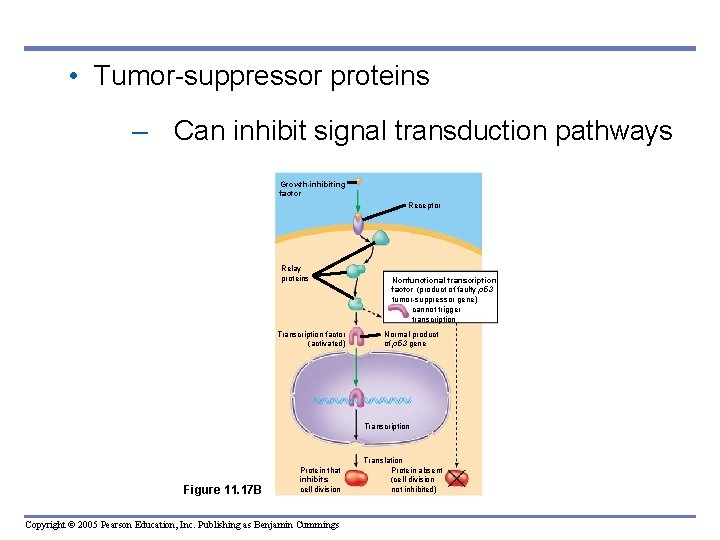
• Tumor-suppressor proteins – Can inhibit signal transduction pathways Growth-inhibiting factor Receptor Relay proteins Transcription factor (activated) Nonfunctional transcription factor (product of faulty p 53 tumor-suppressor gene) cannot trigger transcription Normal product of p 53 gene Transcription Figure 11. 17 B Protein that inhibits cell division Copyright © 2005 Pearson Education, Inc. Publishing as Benjamin Cummings Translation Protein absent (cell division not inhibited)
11. 18 Multiple genetic changes underlie the development of cancer • Cancers result from a series of genetic changes in a cell lineage Copyright © 2005 Pearson Education, Inc. Publishing as Benjamin Cummings
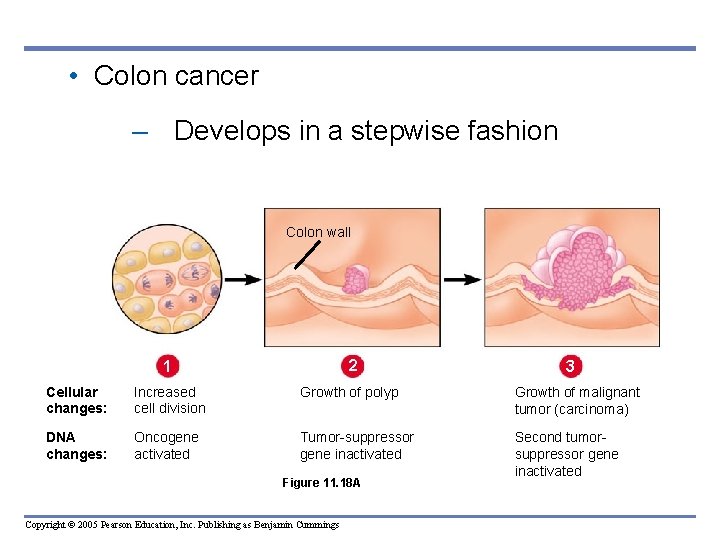
• Colon cancer – Develops in a stepwise fashion Colon wall 1 2 Cellular changes: Increased cell division Growth of polyp Growth of malignant tumor (carcinoma) DNA changes: Oncogene activated Tumor-suppressor gene inactivated Second tumorsuppressor gene inactivated Figure 11. 18 A Copyright © 2005 Pearson Education, Inc. Publishing as Benjamin Cummings 3
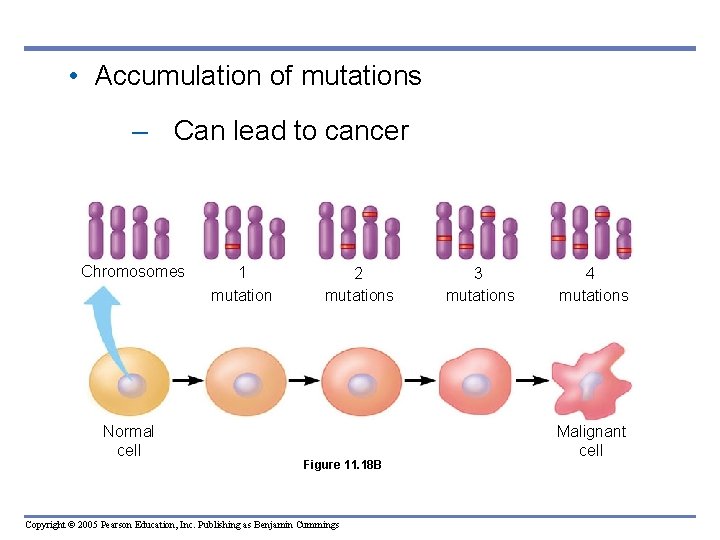
• Accumulation of mutations – Can lead to cancer Chromosomes Normal cell 1 mutation 2 mutations Figure 11. 18 B Copyright © 2005 Pearson Education, Inc. Publishing as Benjamin Cummings 3 mutations 4 mutations Malignant cell
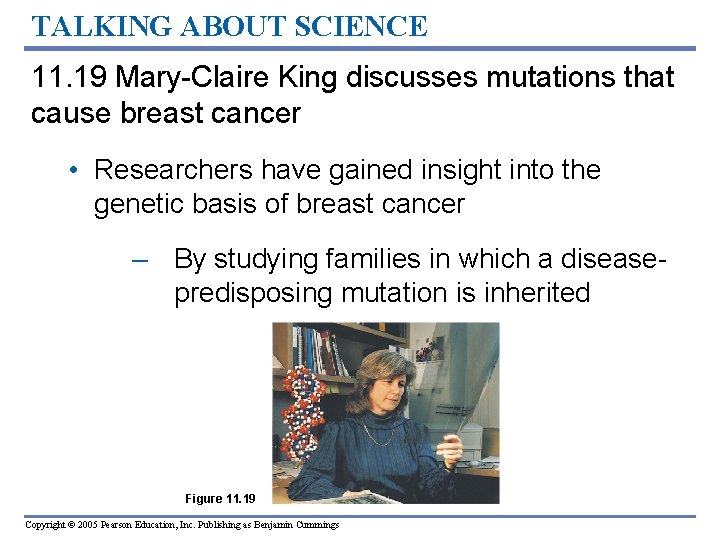
TALKING ABOUT SCIENCE 11. 19 Mary-Claire King discusses mutations that cause breast cancer • Researchers have gained insight into the genetic basis of breast cancer – By studying families in which a diseasepredisposing mutation is inherited Figure 11. 19 Copyright © 2005 Pearson Education, Inc. Publishing as Benjamin Cummings
CONNECTION 11. 20 Avoiding carcinogens can reduce the risk of cancer • Reducing exposure to carcinogens (which induce cancer-causing mutations) – And making other lifestyle choices can help reduce cancer risk Copyright © 2005 Pearson Education, Inc. Publishing as Benjamin Cummings
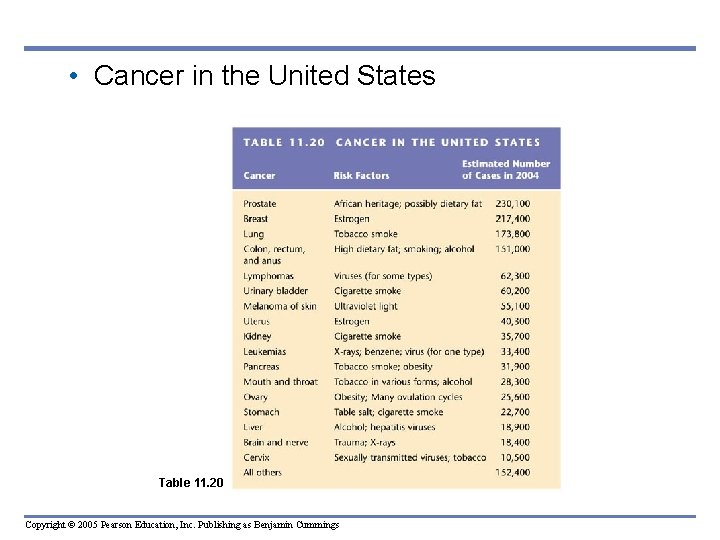
• Cancer in the United States Table 11. 20 Copyright © 2005 Pearson Education, Inc. Publishing as Benjamin Cummings
- Slides: 12