
The Generation of Ultrashort Laser Pulses The importance





- Slides: 67
The Generation of Ultrashort Laser Pulses The importance of bandwidth More than just a light bulb Laser modes and mode-locking Making shorter and shorter pulses Pulse-pumping Q-switching and distributed-feedback lasers Passive mode-locking and the saturable absorber Kerr-lensing and Ti: Sapphire Active mode-locking Other mode-locking techniques Limiting factors Commercial lasers
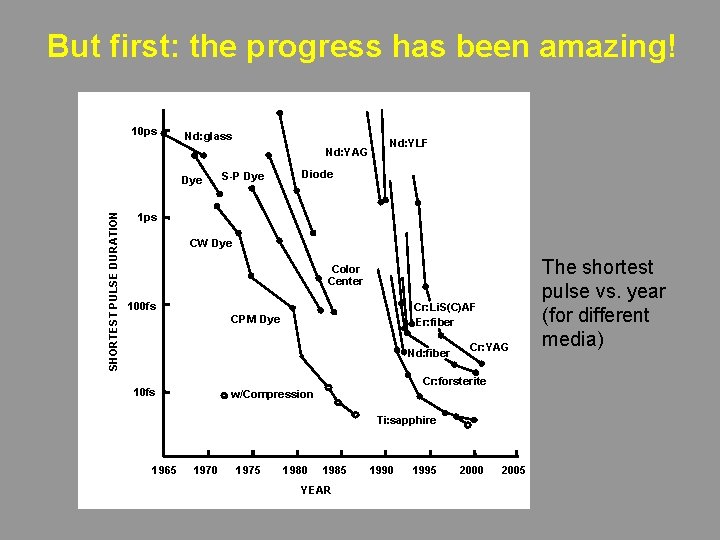
But first: the progress has been amazing! 10 ps Nd: glass Nd: YAG SHORTEST PULSE DURATION Dye S-P Dye Nd: YLF Diode 1 ps CW Dye Color Center 100 fs Cr: Li. S(C)AF Er: fiber CP M Dye Nd: fiber Cr: YAG Cr: forsterite 10 fs w/Compression Ti: sapphire 1965 1970 1975 1980 1985 YEAR 1990 1995 2000 2005 The shortest pulse vs. year (for different media)
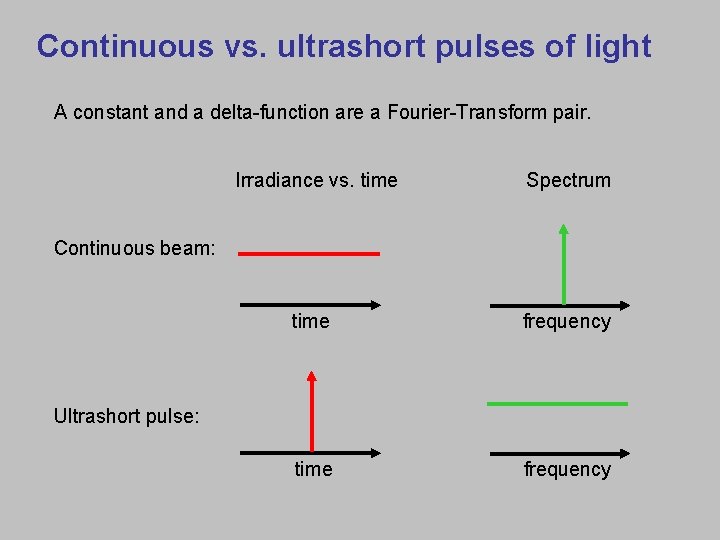
Continuous vs. ultrashort pulses of light A constant and a delta-function are a Fourier-Transform pair. Irradiance vs. time Spectrum time frequency Continuous beam: Ultrashort pulse:
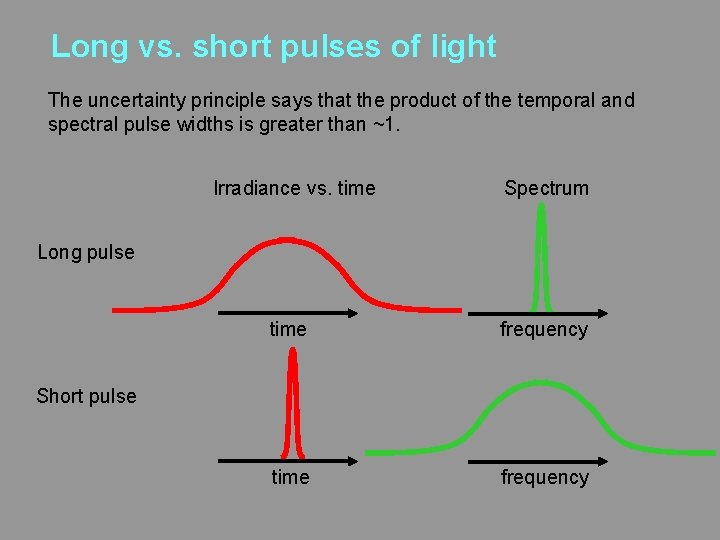
Long vs. short pulses of light The uncertainty principle says that the product of the temporal and spectral pulse widths is greater than ~1. Irradiance vs. time Spectrum time frequency Long pulse Short pulse
For many years, dyes have been the broadband media that have generated ultrashort laser pulses.
Ultrafast solid-state laser media have recently replaced dyes in most labs. Laser power Solid-state laser media have broad bandwidths and are convenient.
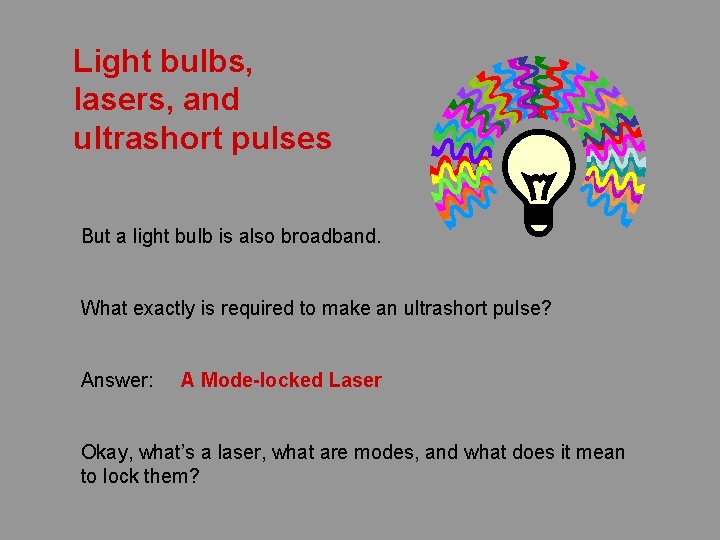
Light bulbs, lasers, and ultrashort pulses But a light bulb is also broadband. What exactly is required to make an ultrashort pulse? Answer: A Mode-locked Laser Okay, what’s a laser, what are modes, and what does it mean to lock them?
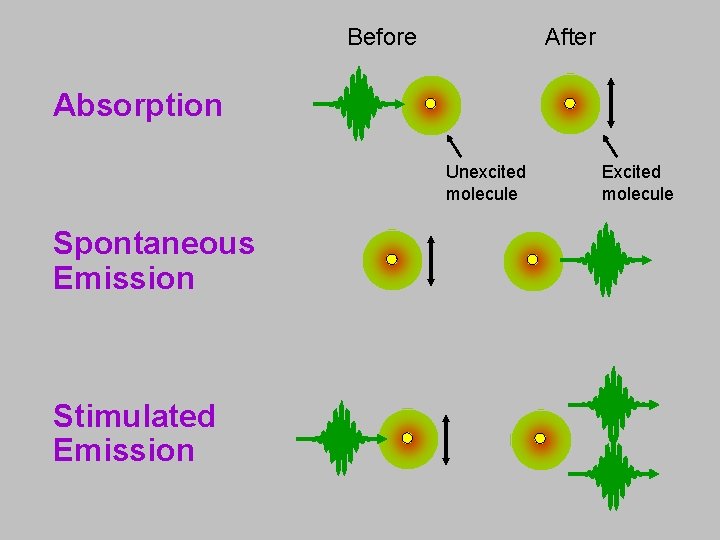
Before After Absorption Unexcited molecule Spontaneous Emission Stimulated Emission Excited molecule
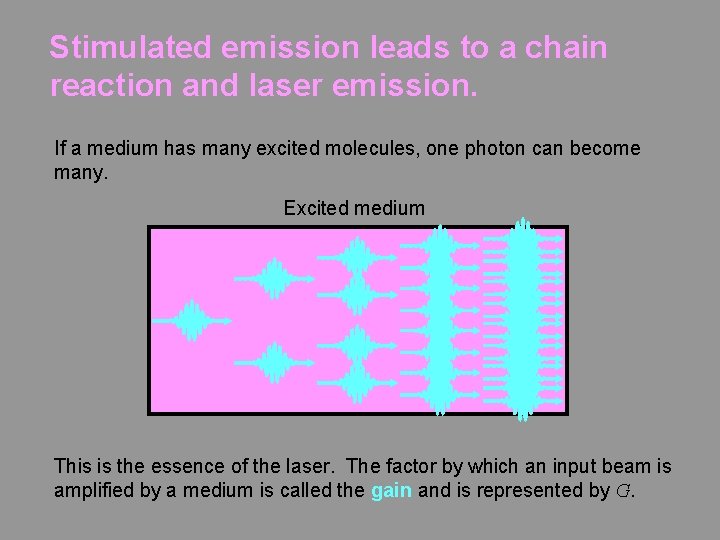
Stimulated emission leads to a chain reaction and laser emission. If a medium has many excited molecules, one photon can become many. Excited medium This is the essence of the laser. The factor by which an input beam is amplified by a medium is called the gain and is represented by G.
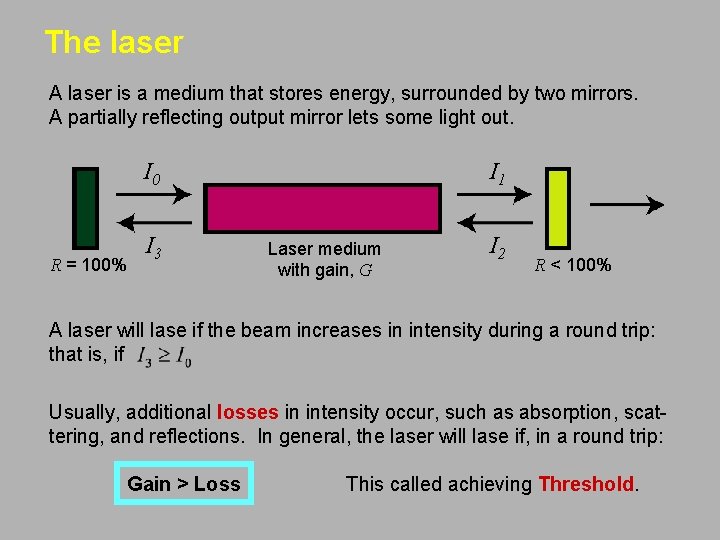
The laser A laser is a medium that stores energy, surrounded by two mirrors. A partially reflecting output mirror lets some light out. I 0 R = 100% I 3 I 1 Laser medium with gain, G I 2 R < 100% A laser will lase if the beam increases in intensity during a round trip: that is, if Usually, additional losses in intensity occur, such as absorption, scattering, and reflections. In general, the laser will lase if, in a round trip: Gain > Loss This called achieving Threshold.
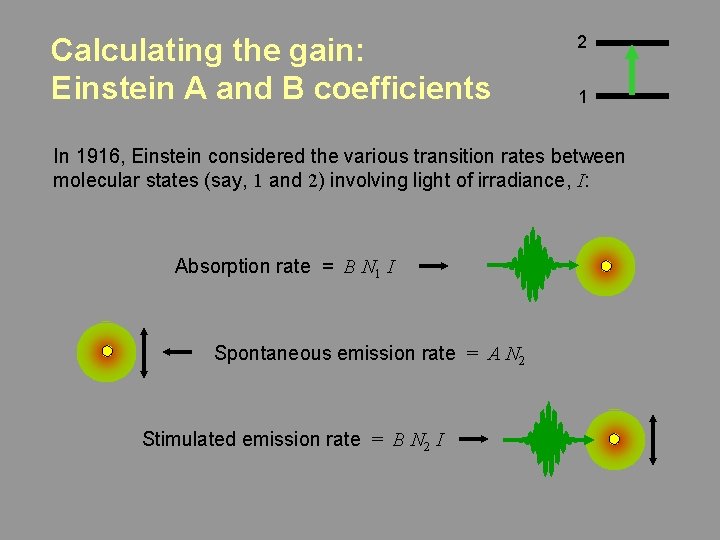
Calculating the gain: Einstein A and B coefficients 2 1 In 1916, Einstein considered the various transition rates between molecular states (say, 1 and 2) involving light of irradiance, I: Absorption rate = B N 1 I Spontaneous emission rate = A N 2 Stimulated emission rate = B N 2 I
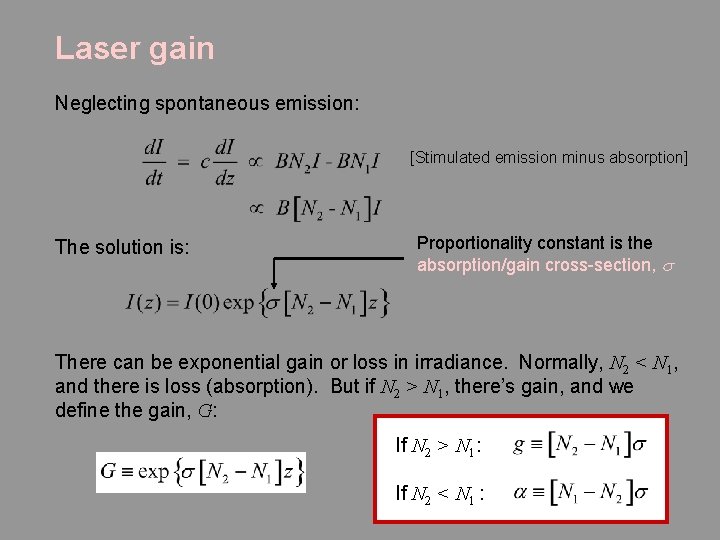
Laser gain Neglecting spontaneous emission: [Stimulated emission minus absorption] The solution is: Proportionality constant is the absorption/gain cross-section, s There can be exponential gain or loss in irradiance. Normally, N 2 < N 1, and there is loss (absorption). But if N 2 > N 1, there’s gain, and we define the gain, G: If N 2 > N 1: If N 2 < N 1 :
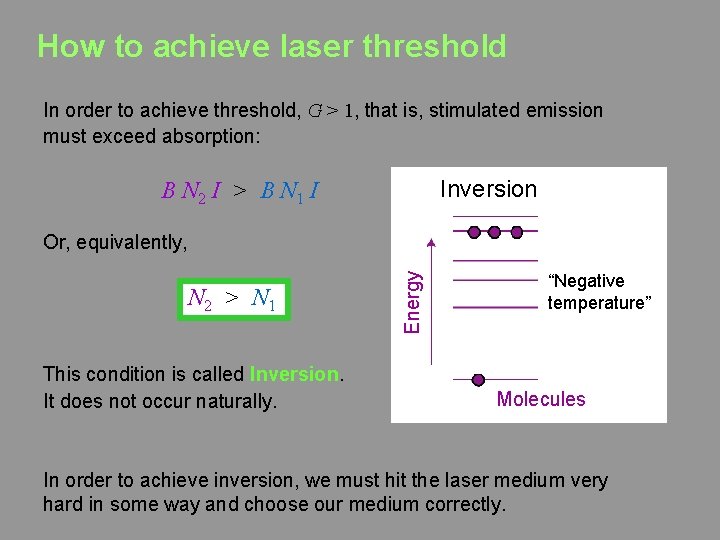
How to achieve laser threshold In order to achieve threshold, G > 1, that is, stimulated emission must exceed absorption: Inversion B N 2 I > B N 1 I N 2 > N 1 This condition is called Inversion. It does not occur naturally. Energy Or, equivalently, “Negative temperature” Molecules In order to achieve inversion, we must hit the laser medium very hard in some way and choose our medium correctly.
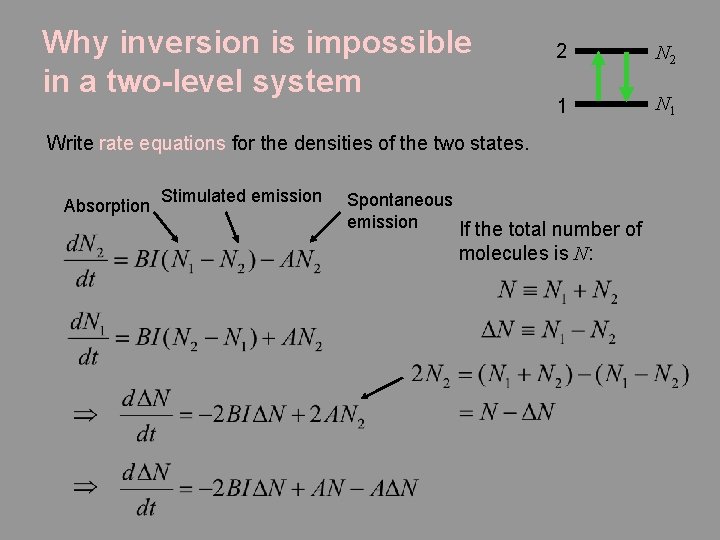
Why inversion is impossible in a two-level system 2 N 2 1 N 1 Write rate equations for the densities of the two states. Absorption Stimulated emission Spontaneous emission If the total number of molecules is N:
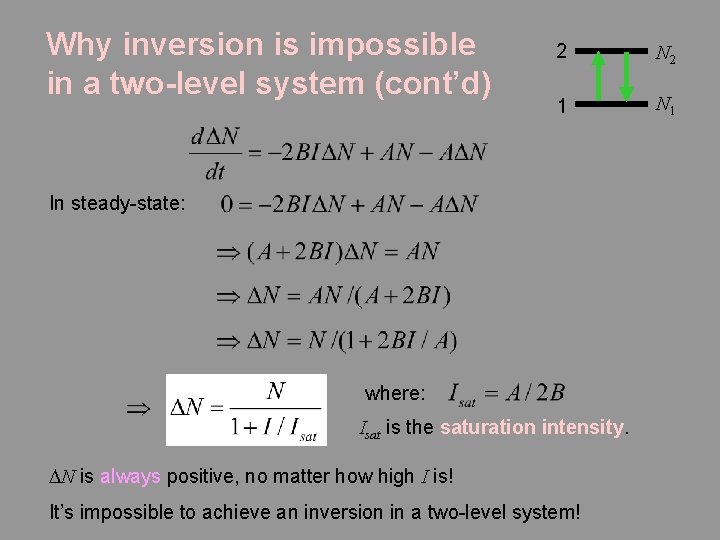
Why inversion is impossible in a two-level system (cont’d) 2 N 2 1 N 1 In steady-state: where: Isat is the saturation intensity. DN is always positive, no matter how high I is! It’s impossible to achieve an inversion in a two-level system!
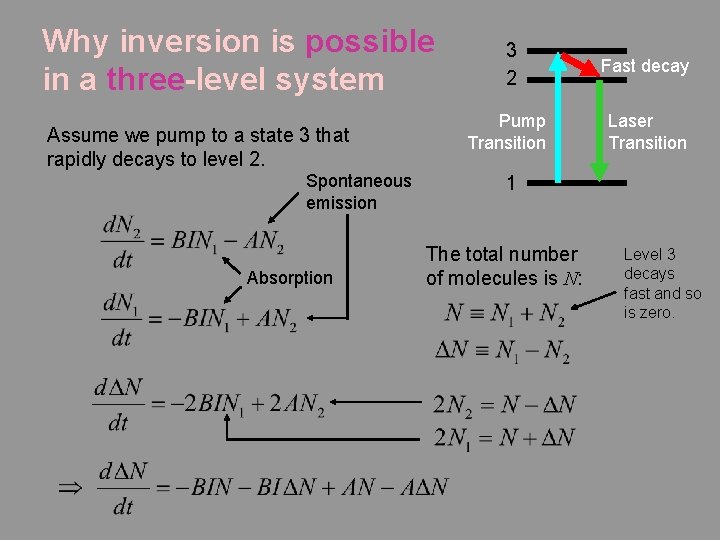
Why inversion is possible in a three-level system Assume we pump to a state 3 that rapidly decays to level 2. Spontaneous emission Absorption 3 2 Fast decay Pump Transition Laser Transition 1 The total number of molecules is N: Level 3 decays fast and so is zero.
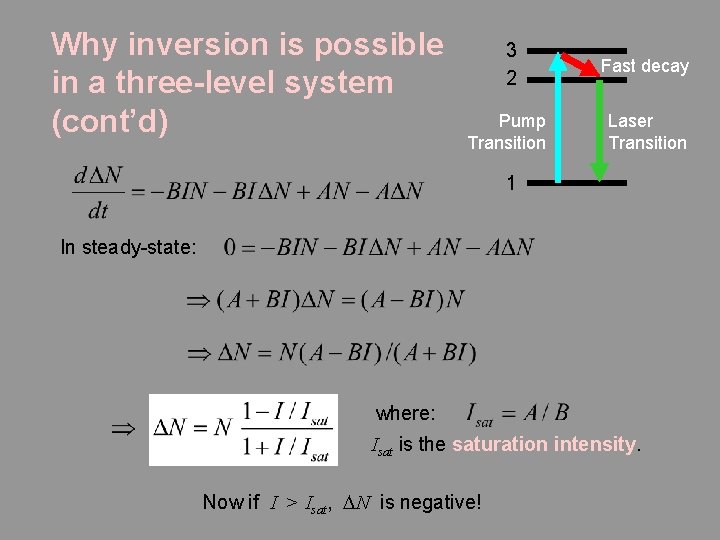
Why inversion is possible in a three-level system (cont’d) 3 2 Fast decay Pump Transition Laser Transition 1 In steady-state: where: Isat is the saturation intensity. Now if I > Isat, DN is negative!
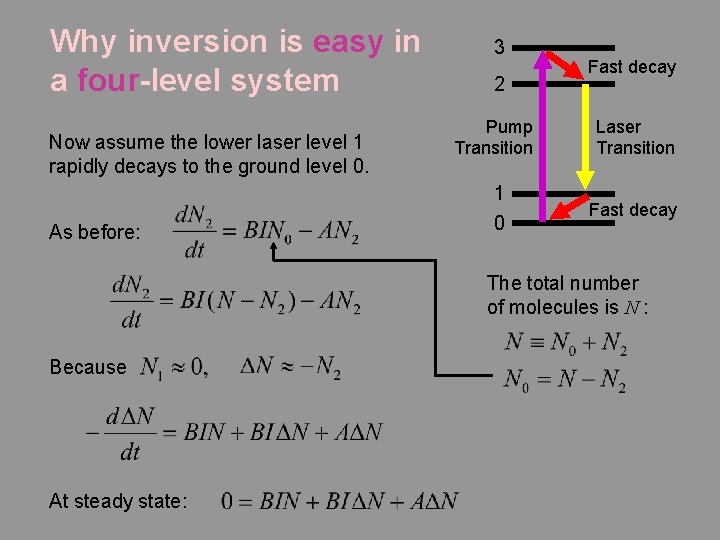
Why inversion is easy in a four-level system Now assume the lower laser level 1 rapidly decays to the ground level 0. As before: 3 2 Pump Transition 1 0 Fast decay Laser Transition Fast decay The total number of molecules is N : Because At steady state:
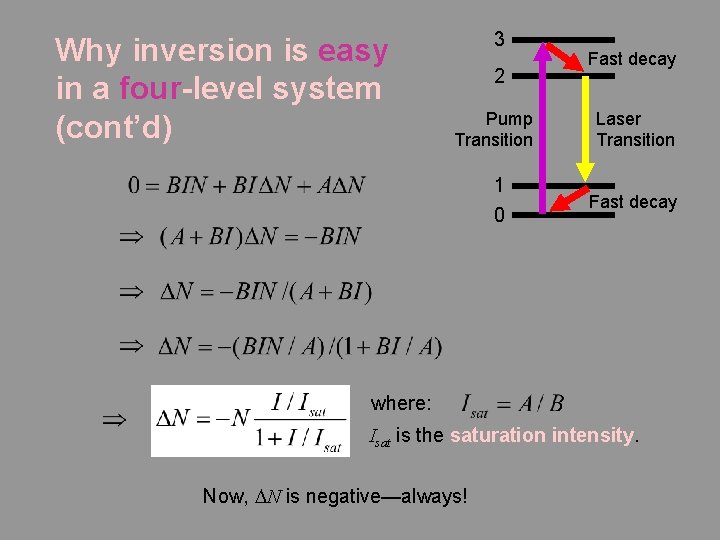
Why inversion is easy in a four-level system (cont’d) 3 2 Pump Transition 1 0 Fast decay Laser Transition Fast decay where: Isat is the saturation intensity. Now, DN is negative—always!
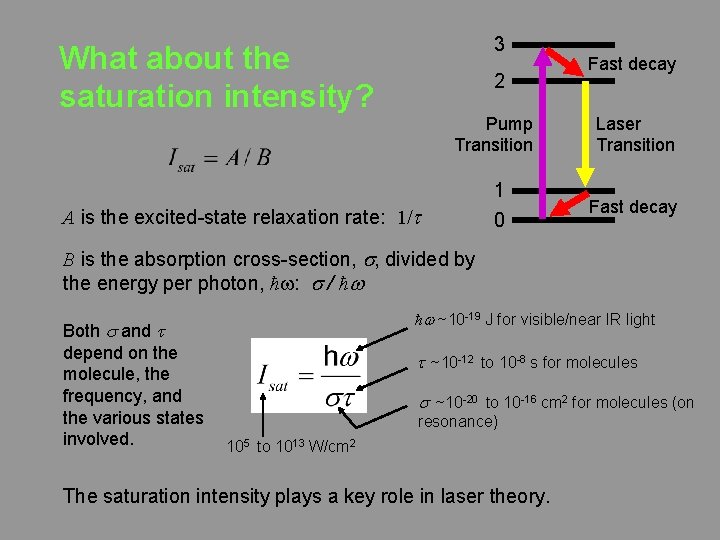
3 What about the saturation intensity? 2 Pump Transition A is the excited-state relaxation rate: 1/t 1 0 Fast decay Laser Transition Fast decay B is the absorption cross-section, s, divided by the energy per photon, ħw: s / ħw Both s and t depend on the molecule, the frequency, and the various states involved. ħw ~10 -19 J for visible/near IR light t ~10 -12 to 10 -8 s for molecules s ~10 -20 to 10 -16 cm 2 for molecules (on resonance) 105 to 1013 W/cm 2 The saturation intensity plays a key role in laser theory.
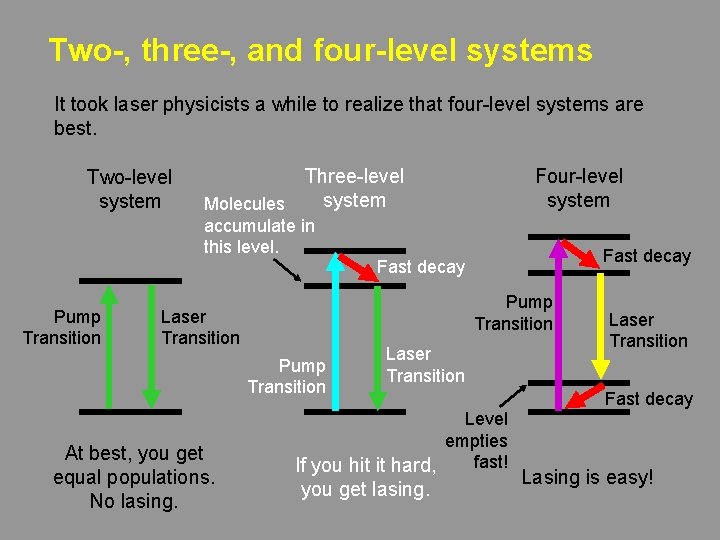
Two-, three-, and four-level systems It took laser physicists a while to realize that four-level systems are best. Two-level system accumulate in this level. Pump Transition Four-level system Three-level system Molecules Pump Transition Laser Transition Pump Transition At best, you get equal populations. No lasing. Fast decay Laser Transition Level empties fast! If you hit it hard, you get lasing. Laser Transition Fast decay Lasing is easy!
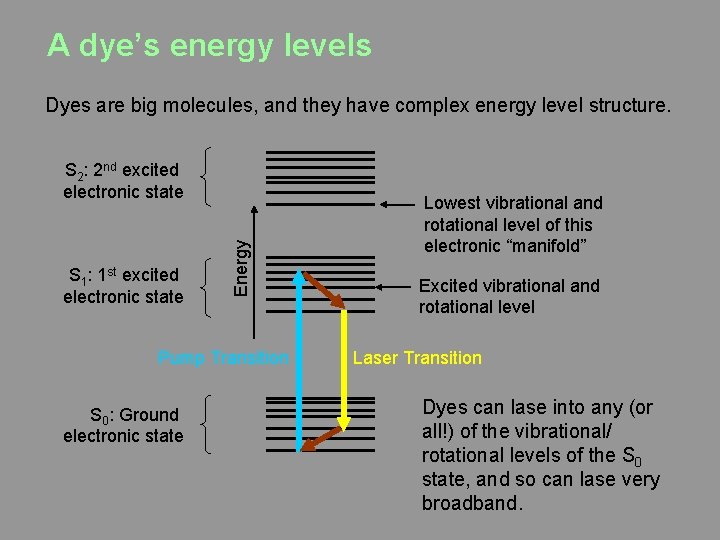
A dye’s energy levels Dyes are big molecules, and they have complex energy level structure. S 1: 1 st excited electronic state Energy S 2: 2 nd excited electronic state Pump Transition S 0: Ground electronic state Lowest vibrational and rotational level of this electronic “manifold” Excited vibrational and rotational level Laser Transition Dyes can lase into any (or all!) of the vibrational/ rotational levels of the S 0 state, and so can lase very broadband.
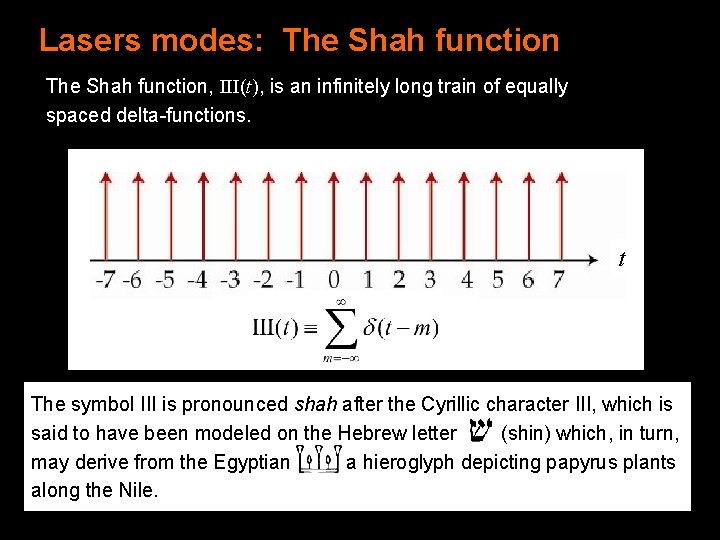
Lasers modes: The Shah function, III(t), is an infinitely long train of equally spaced delta-functions. t The symbol III is pronounced shah after the Cyrillic character III, which is said to have been modeled on the Hebrew letter (shin) which, in turn, may derive from the Egyptian a hieroglyph depicting papyrus plants along the Nile.
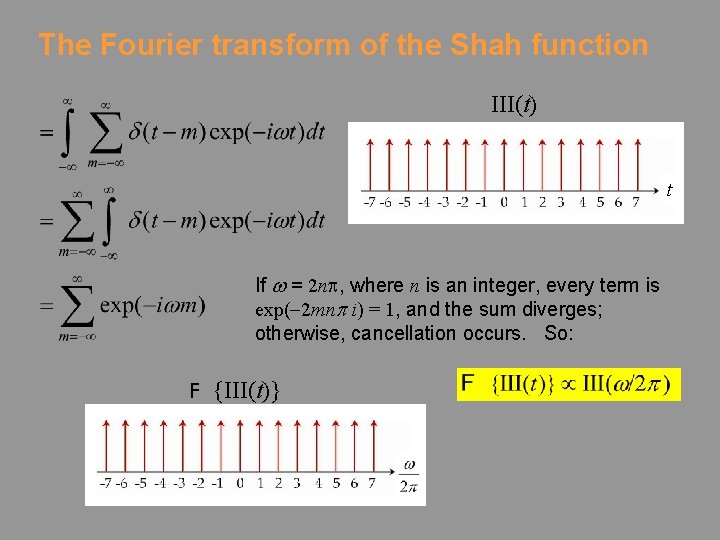
The Fourier transform of the Shah function III(t) t If w = 2 np, where n is an integer, every term is exp(-2 mnp i) = 1, and the sum diverges; otherwise, cancellation occurs. So: F {III(t)}
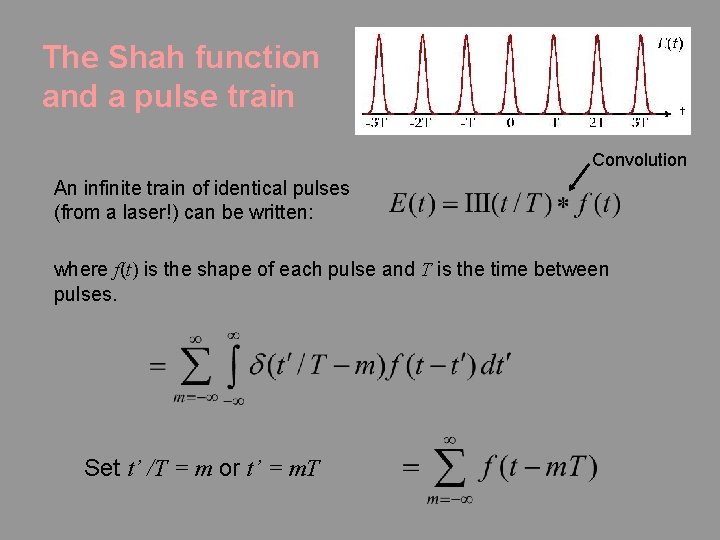
The Shah function and a pulse train Convolution An infinite train of identical pulses (from a laser!) can be written: where f(t) is the shape of each pulse and T is the time between pulses. Set t’ /T = m or t’ = m. T
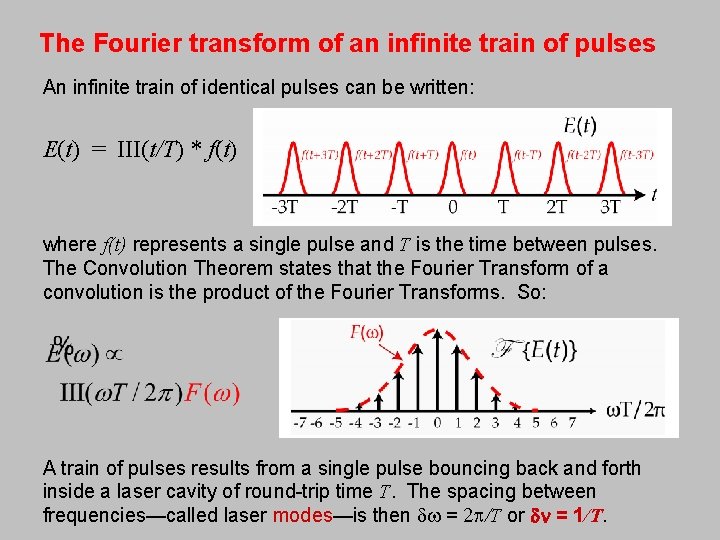
The Fourier transform of an infinite train of pulses An infinite train of identical pulses can be written: E(t) = III(t/T) * f(t) where f(t) represents a single pulse and T is the time between pulses. The Convolution Theorem states that the Fourier Transform of a convolution is the product of the Fourier Transforms. So: A train of pulses results from a single pulse bouncing back and forth inside a laser cavity of round-trip time T. The spacing between frequencies—called laser modes—is then dw = 2 p/T or dn = 1/T.
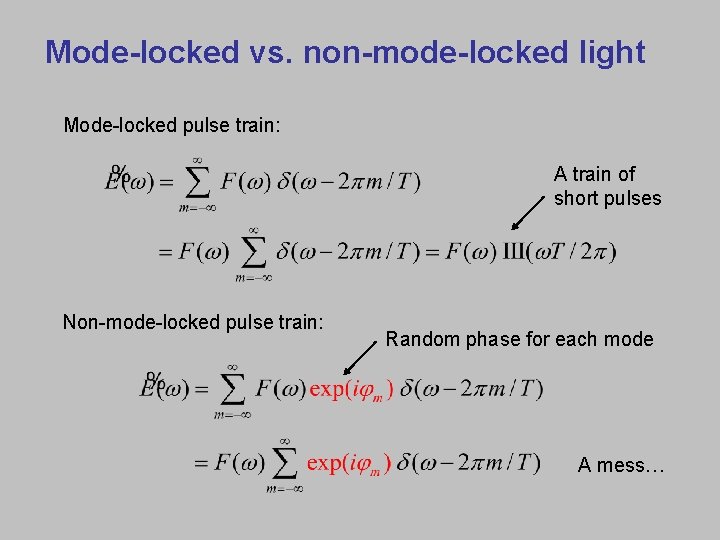
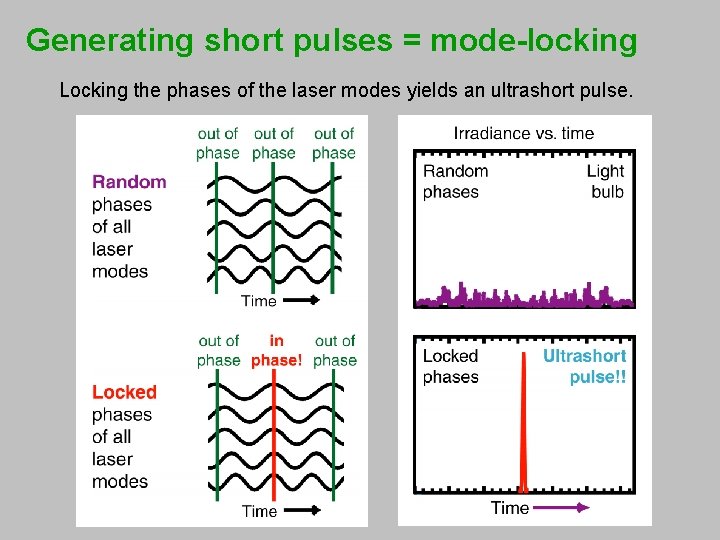
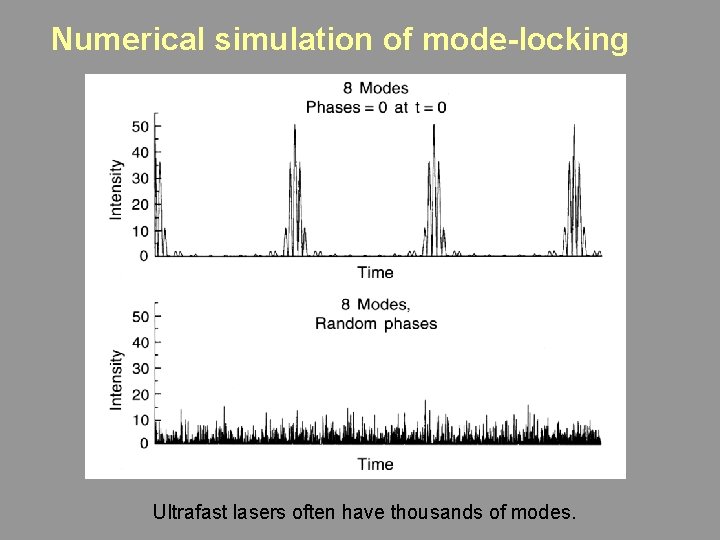
Mode-locked vs. non-mode-locked light Mode-locked pulse train: A train of short pulses Non-mode-locked pulse train: Random phase for each mode A mess…
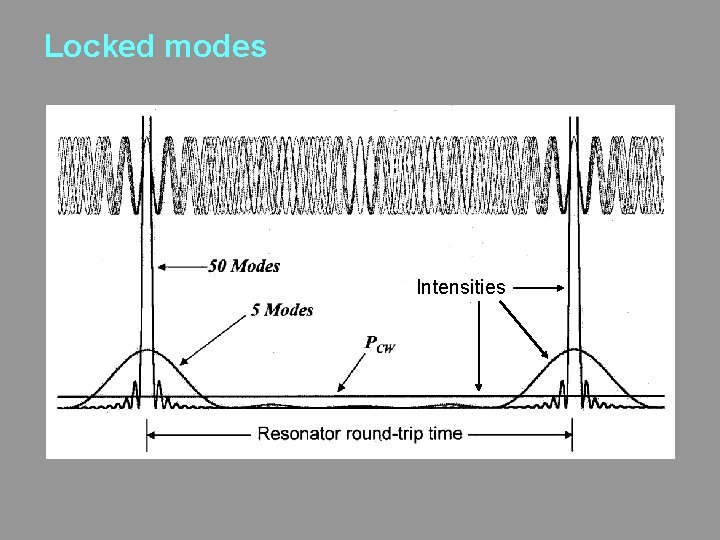
Generating short pulses = mode-locking Locking the phases of the laser modes yields an ultrashort pulse.
Locked modes Intensities
Numerical simulation of mode-locking Ultrafast lasers often have thousands of modes.
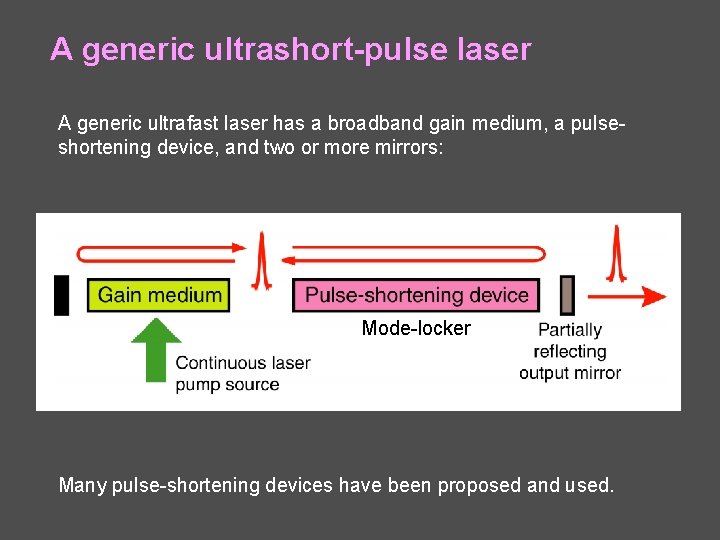
A generic ultrashort-pulse laser A generic ultrafast laser has a broadband gain medium, a pulseshortening device, and two or more mirrors: Mode-locker Many pulse-shortening devices have been proposed and used.
Pulsed Pumping a laser medium with a short-pulse flash lamp yields a short pulse. Flash lamp pulses as short as ~1 µs exist. Unfortunately, this yields a pulse as long as the excited-state lifetime of the laser medium, which can be considerably longer than the pump pulse. Since solid-state laser media have lifetimes in the microsecond range, it yields pulses microseconds to milliseconds long. Long and potentially complex pulse
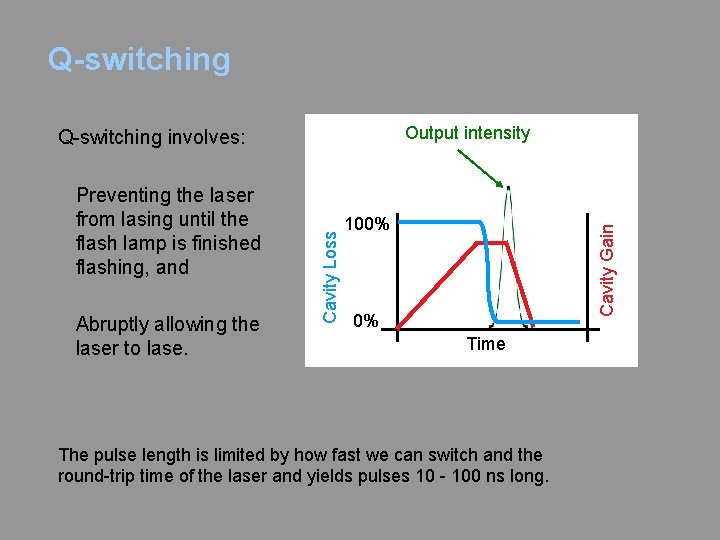
Q-switching Output intensity Abruptly allowing the laser to lase. 100% Cavity Gain Preventing the laser from lasing until the flash lamp is finished flashing, and Cavity Loss Q-switching involves: 0% Time The pulse length is limited by how fast we can switch and the round-trip time of the laser and yields pulses 10 - 100 ns long.
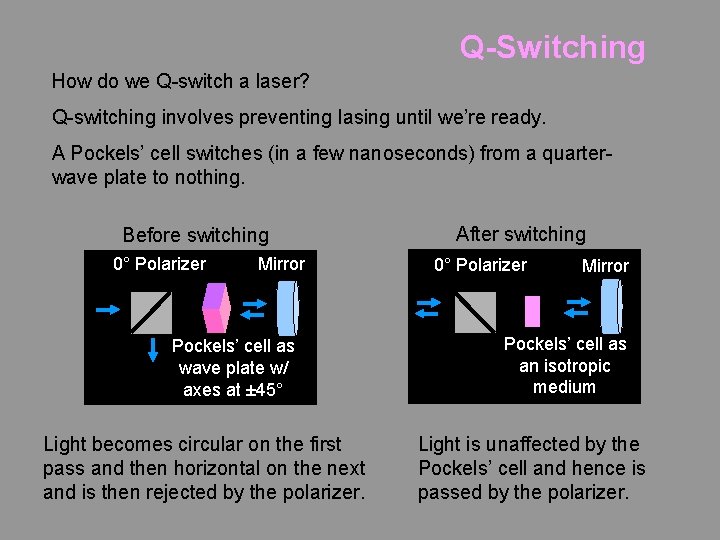
Q-Switching How do we Q-switch a laser? Q-switching involves preventing lasing until we’re ready. A Pockels’ cell switches (in a few nanoseconds) from a quarterwave plate to nothing. Before switching 0° Polarizer Mirror Pockels’ cell as wave plate w/ axes at ± 45° Light becomes circular on the first pass and then horizontal on the next and is then rejected by the polarizer. After switching 0° Polarizer Mirror Pockels’ cell as an isotropic medium Light is unaffected by the Pockels’ cell and hence is passed by the polarizer.
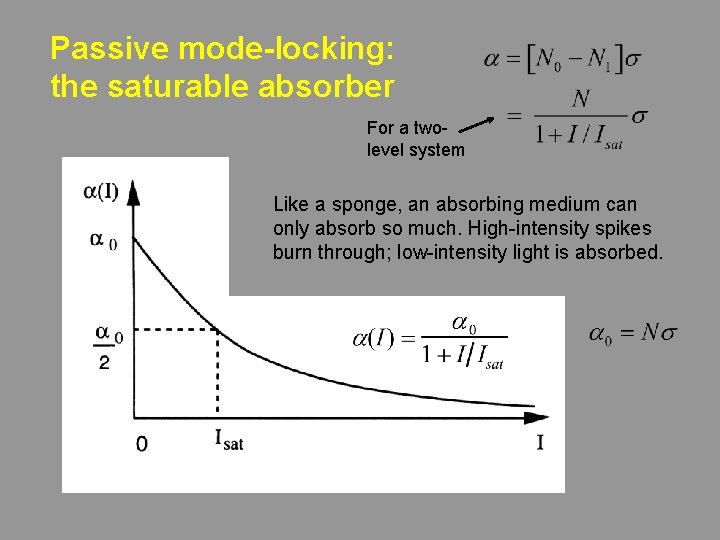
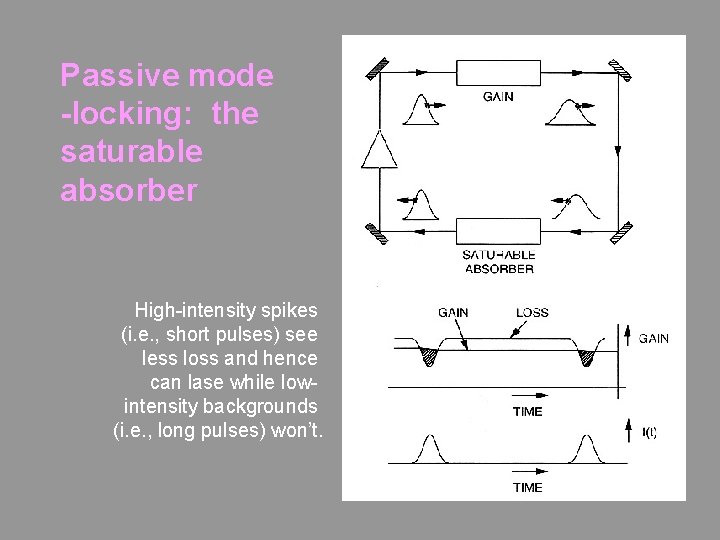
Passive mode-locking: the saturable absorber For a twolevel system Like a sponge, an absorbing medium can only absorb so much. High-intensity spikes burn through; low-intensity light is absorbed.
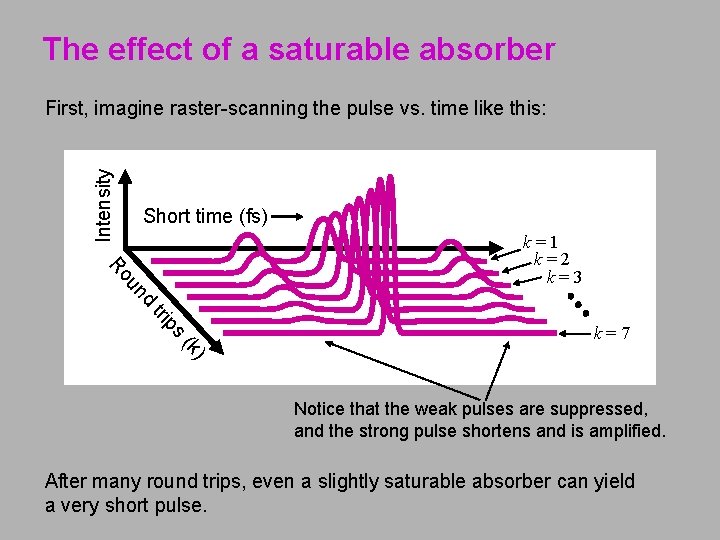
The effect of a saturable absorber Intensity First, imagine raster-scanning the pulse vs. time like this: Short time (fs) d un Ro k=1 k=2 k=3 ps tri k=7 ) (k Notice that the weak pulses are suppressed, and the strong pulse shortens and is amplified. After many round trips, even a slightly saturable absorber can yield a very short pulse.
Passive mode -locking: the saturable absorber High-intensity spikes (i. e. , short pulses) see less loss and hence can lase while lowintensity backgrounds (i. e. , long pulses) won’t.
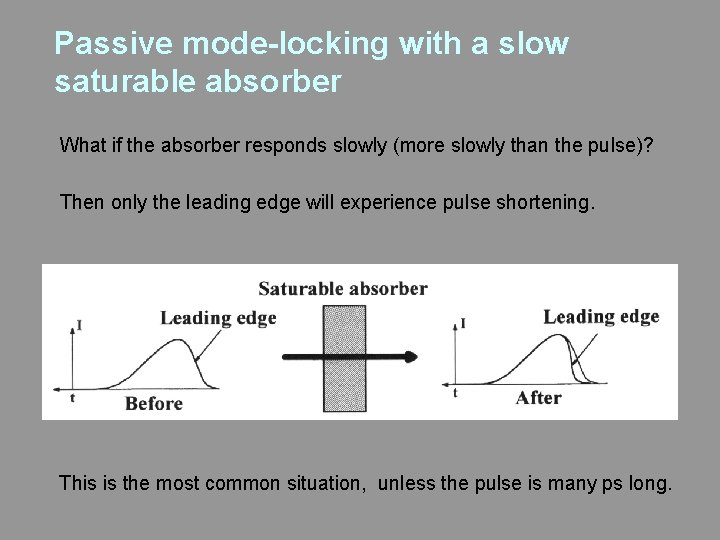
Passive mode-locking with a slow saturable absorber What if the absorber responds slowly (more slowly than the pulse)? Then only the leading edge will experience pulse shortening. This is the most common situation, unless the pulse is many ps long.
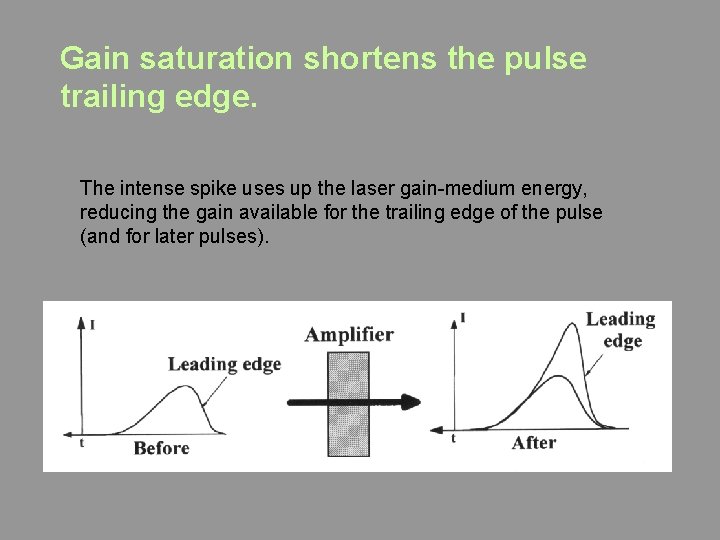
Gain saturation shortens the pulse trailing edge. The intense spike uses up the laser gain-medium energy, reducing the gain available for the trailing edge of the pulse (and for later pulses).
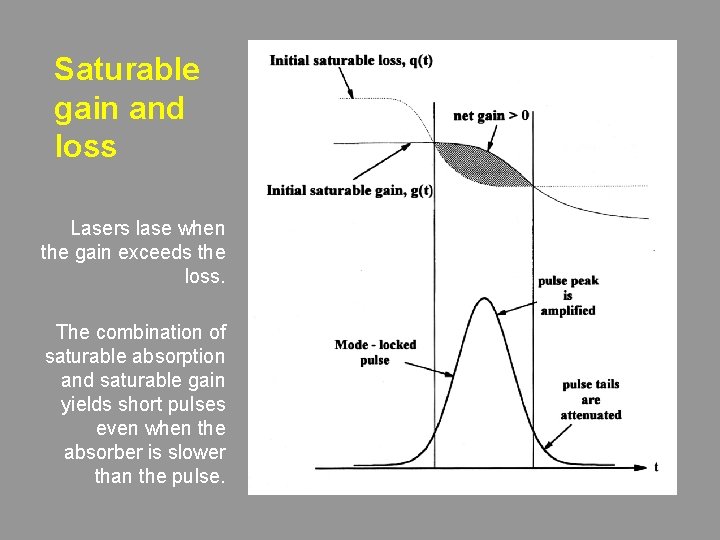
Saturable gain and loss Lasers lase when the gain exceeds the loss. The combination of saturable absorption and saturable gain yields short pulses even when the absorber is slower than the pulse.
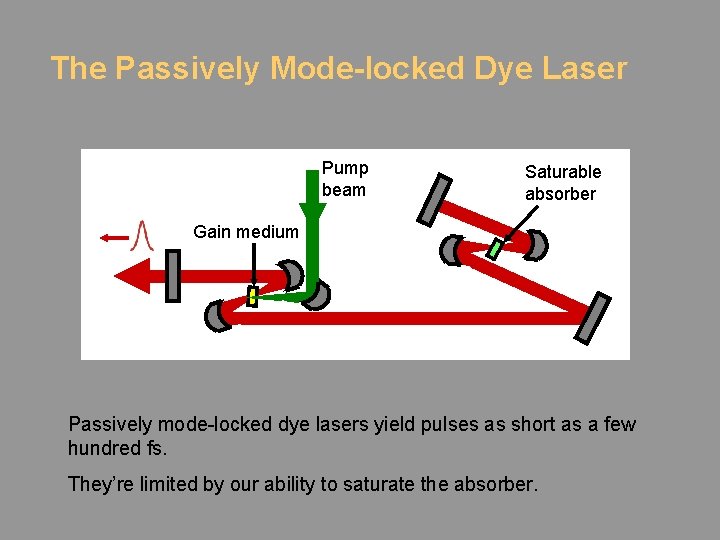
The Passively Mode-locked Dye Laser Pump beam Saturable absorber Gain medium Passively mode-locked dye lasers yield pulses as short as a few hundred fs. They’re limited by our ability to saturate the absorber.
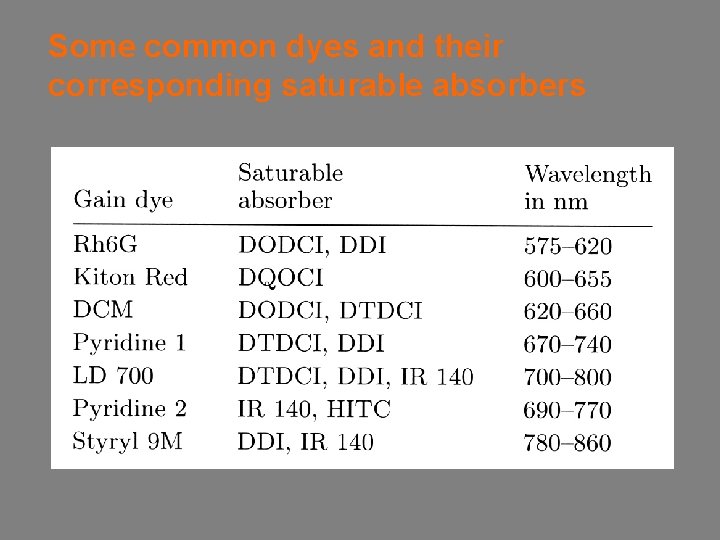
Some common dyes and their corresponding saturable absorbers
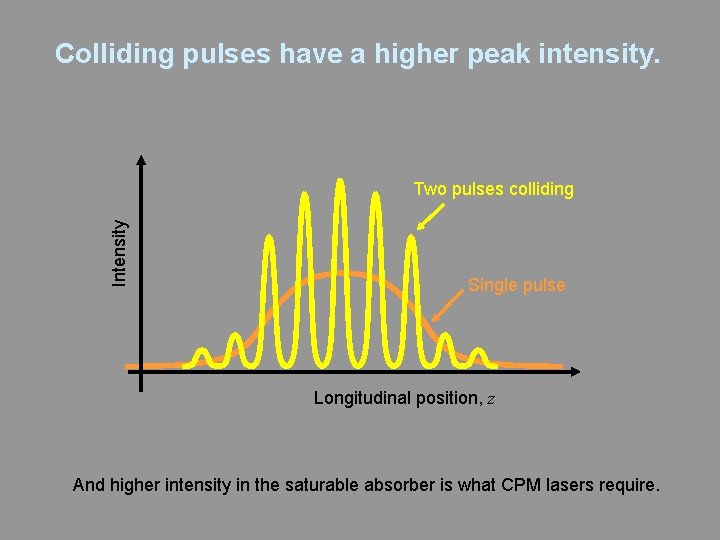
Colliding pulses have a higher peak intensity. Intensity Two pulses colliding Single pulse Longitudinal position, z And higher intensity in the saturable absorber is what CPM lasers require.
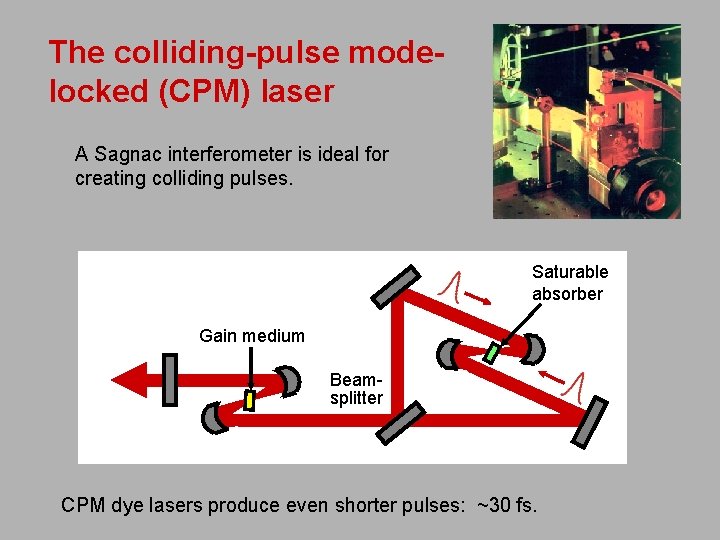
The colliding-pulse modelocked (CPM) laser A Sagnac interferometer is ideal for creating colliding pulses. Saturable absorber Gain medium Beamsplitter CPM dye lasers produce even shorter pulses: ~30 fs.
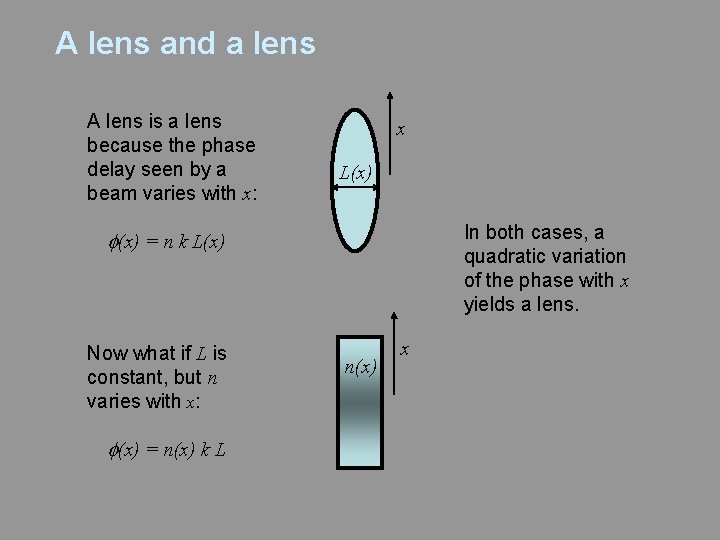
A lens and a lens A lens is a lens because the phase delay seen by a beam varies with x: x L(x) In both cases, a quadratic variation of the phase with x yields a lens. f(x) = n k L(x) Now what if L is constant, but n varies with x: f(x) = n(x) k L n(x) x
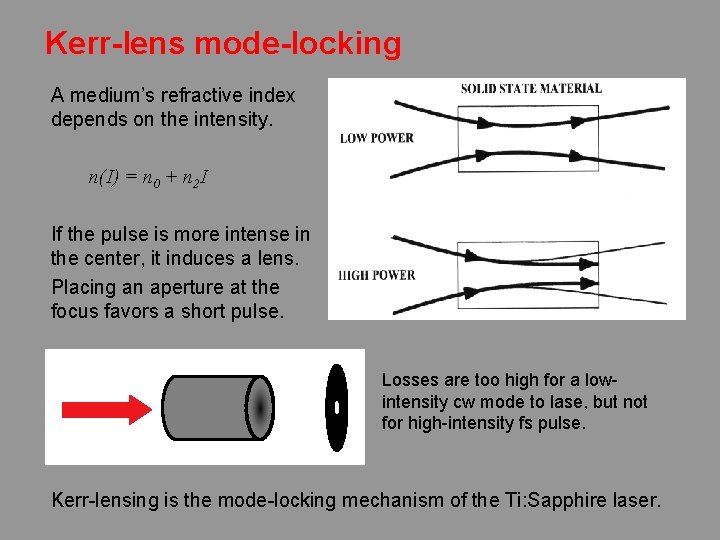
Kerr-lens mode-locking A medium’s refractive index depends on the intensity. n(I) = n 0 + n 2 I If the pulse is more intense in the center, it induces a lens. Placing an aperture at the focus favors a short pulse. Losses are too high for a lowintensity cw mode to lase, but not for high-intensity fs pulse. Kerr-lensing is the mode-locking mechanism of the Ti: Sapphire laser.
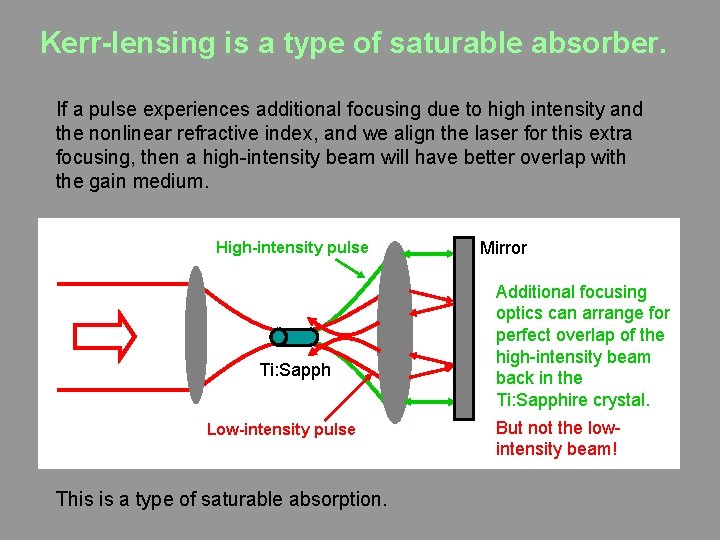
Kerr-lensing is a type of saturable absorber. If a pulse experiences additional focusing due to high intensity and the nonlinear refractive index, and we align the laser for this extra focusing, then a high-intensity beam will have better overlap with the gain medium. High-intensity pulse Ti: Sapph Low-intensity pulse This is a type of saturable absorption. Mirror Additional focusing optics can arrange for perfect overlap of the high-intensity beam back in the Ti: Sapphire crystal. But not the lowintensity beam!
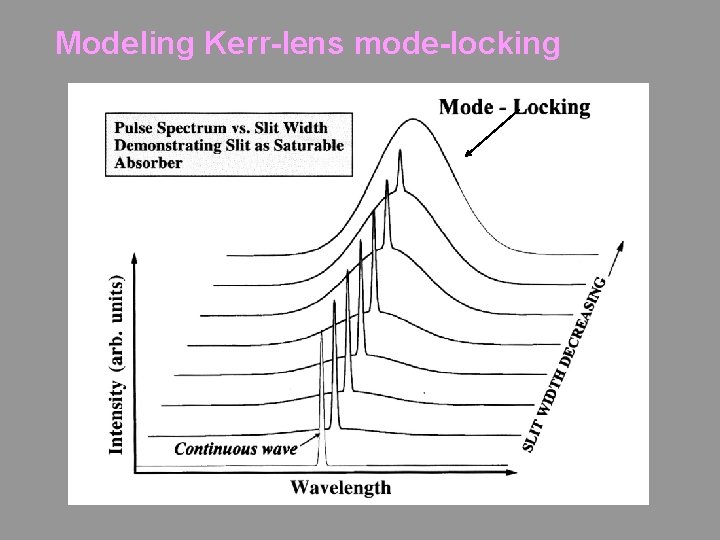
Modeling Kerr-lens mode-locking
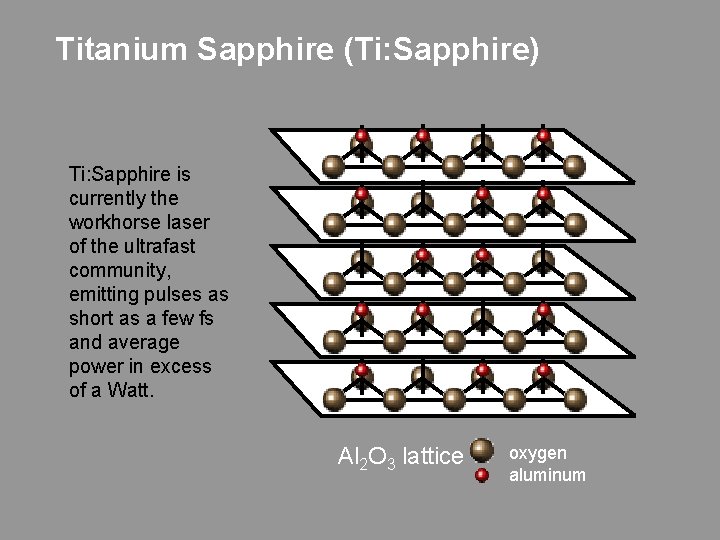
Titanium Sapphire (Ti: Sapphire) Ti: Sapphire is currently the workhorse laser of the ultrafast community, emitting pulses as short as a few fs and average power in excess of a Watt. Al 2 O 3 lattice oxygen aluminum
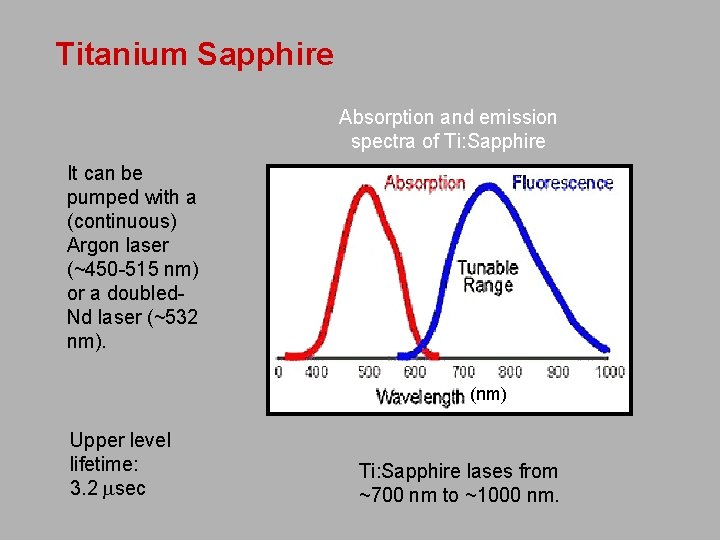
Titanium Sapphire Absorption and emission spectra of Ti: Sapphire It can be pumped with a (continuous) Argon laser (~450 -515 nm) or a doubled. Nd laser (~532 nm). (nm) Upper level lifetime: 3. 2 msec Ti: Sapphire lases from ~700 nm to ~1000 nm.
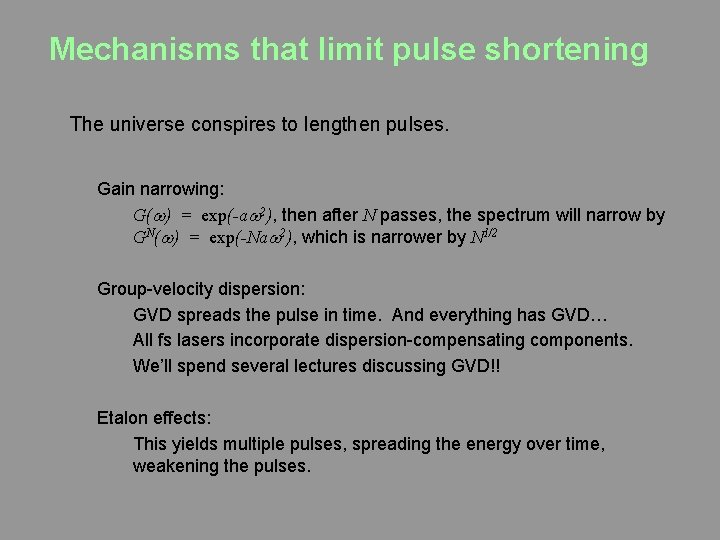
Mechanisms that limit pulse shortening The universe conspires to lengthen pulses. Gain narrowing: G(w) = exp(-aw 2), then after N passes, the spectrum will narrow by GN(w) = exp(-Naw 2), which is narrower by N 1/2 Group-velocity dispersion: GVD spreads the pulse in time. And everything has GVD… All fs lasers incorporate dispersion-compensating components. We’ll spend several lectures discussing GVD!! Etalon effects: This yields multiple pulses, spreading the energy over time, weakening the pulses.
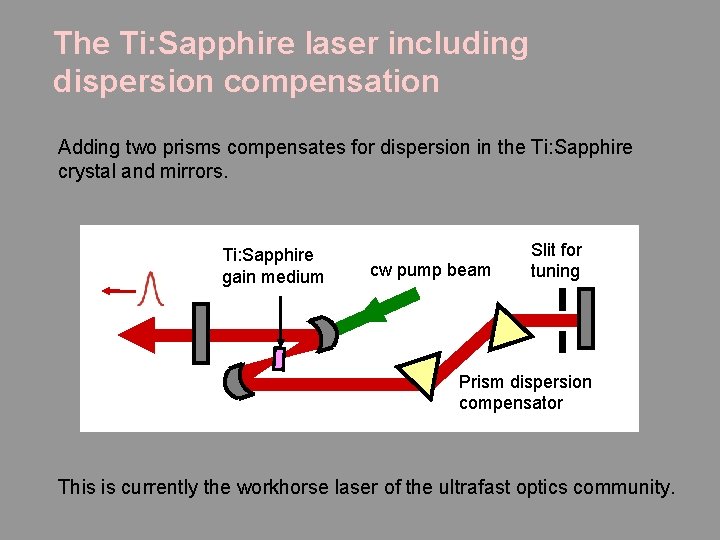
The Ti: Sapphire laser including dispersion compensation Adding two prisms compensates for dispersion in the Ti: Sapphire crystal and mirrors. Ti: Sapphire gain medium cw pump beam Slit for tuning Prism dispersion compensator This is currently the workhorse laser of the ultrafast optics community.
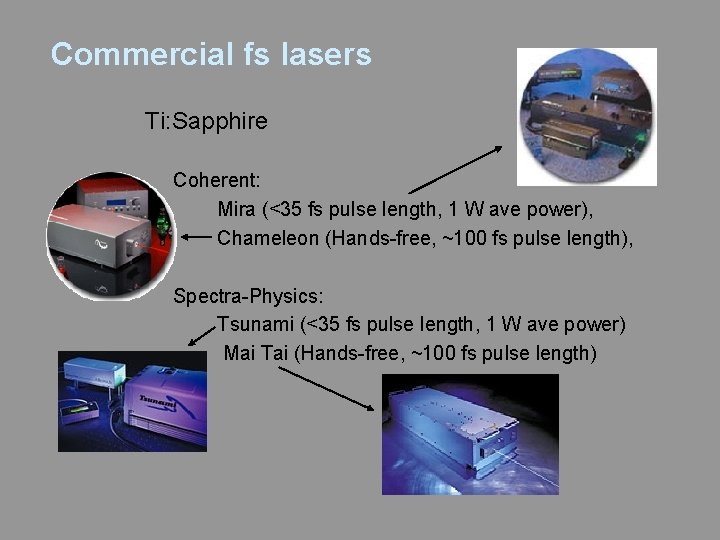
Commercial fs lasers Ti: Sapphire Coherent: Mira (<35 fs pulse length, 1 W ave power), Chameleon (Hands-free, ~100 fs pulse length), Spectra-Physics: Tsunami (<35 fs pulse length, 1 W ave power) Mai Tai (Hands-free, ~100 fs pulse length)
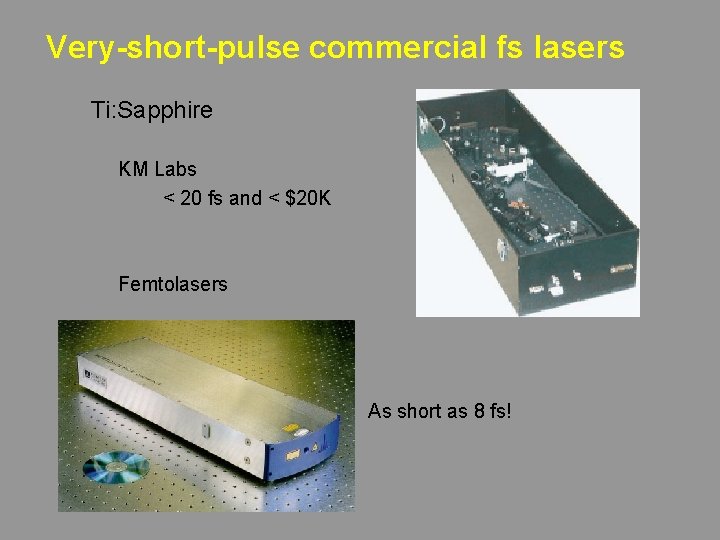
Very-short-pulse commercial fs lasers Ti: Sapphire KM Labs < 20 fs and < $20 K Femtolasers As short as 8 fs!
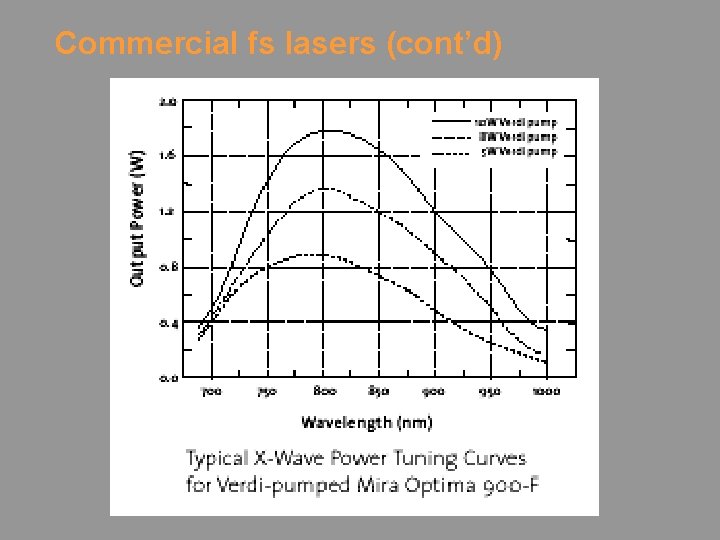
Commercial fs lasers (cont’d)
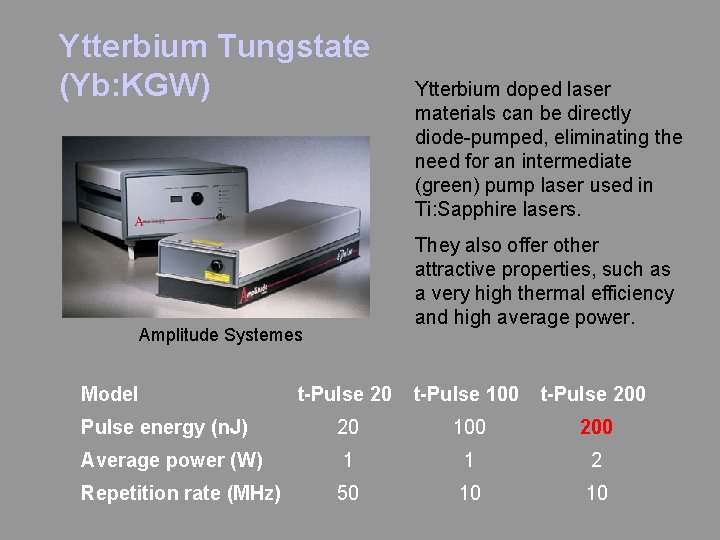
Ytterbium Tungstate (Yb: KGW) They also offer other attractive properties, such as a very high thermal efficiency and high average power. Amplitude Systemes Model Ytterbium doped laser materials can be directly diode-pumped, eliminating the need for an intermediate (green) pump laser used in Ti: Sapphire lasers. t-Pulse 20 t-Pulse 100 t-Pulse 200 Pulse energy (n. J) 20 100 200 Average power (W) 1 1 2 Repetition rate (MHz) 50 10 10
Active mode-locking Any amplitude modulator can preferentially induce losses for times other than that of the intended pulse peak. This produces short pulses. It can be used to start a Ti: Sapphire laser mode-locking.
Gain switching Modulating the gain rapidly is essentially the same as active mode-locking. This method is a common one for mode-locking semiconductor lasers.
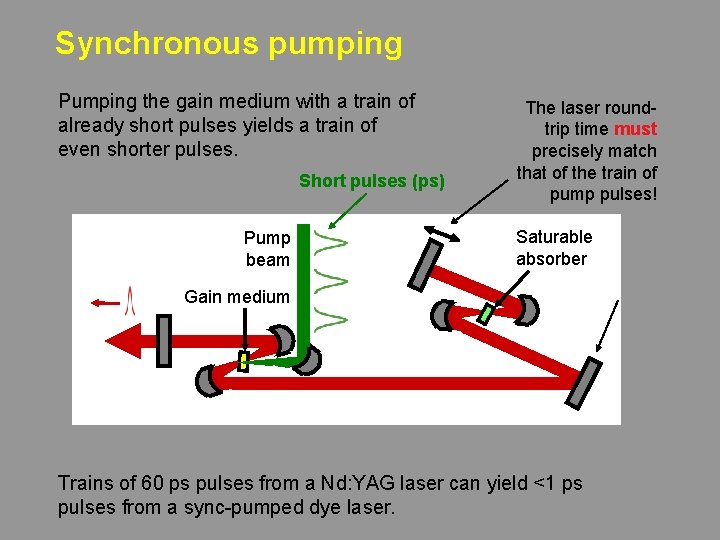
Synchronous pumping Pumping the gain medium with a train of already short pulses yields a train of even shorter pulses. Short pulses (ps) Pump beam The laser roundtrip time must precisely match that of the train of pump pulses! Saturable absorber Gain medium Trains of 60 ps pulses from a Nd: YAG laser can yield <1 ps pulses from a sync-pumped dye laser.
Hybrid mode-locking is any type of mode-locking incorporating two or more techniques simultaneously. Sync-pumping and passive mode-locking Active and passive mode-locking However, using two lousy methods together doesn’t really work all that much better than one good method.
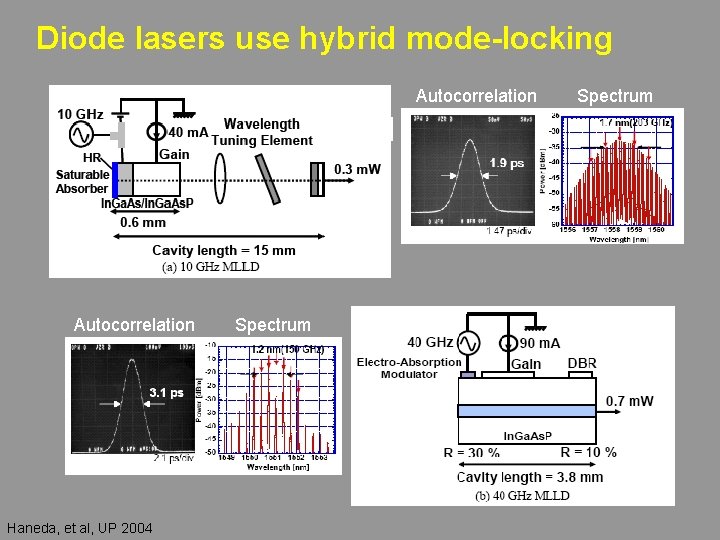
Diode lasers use hybrid mode-locking Autocorrelation Haneda, et al, UP 2004 Spectrum
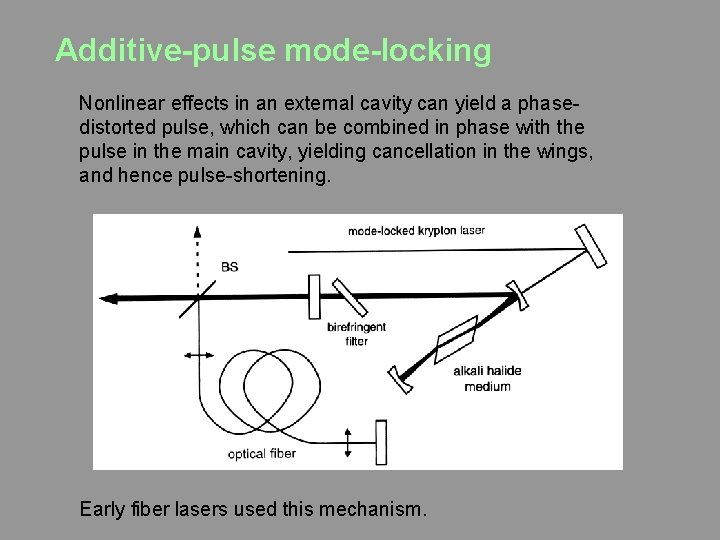
Additive-pulse mode-locking Nonlinear effects in an external cavity can yield a phasedistorted pulse, which can be combined in phase with the pulse in the main cavity, yielding cancellation in the wings, and hence pulse-shortening. Early fiber lasers used this mechanism.
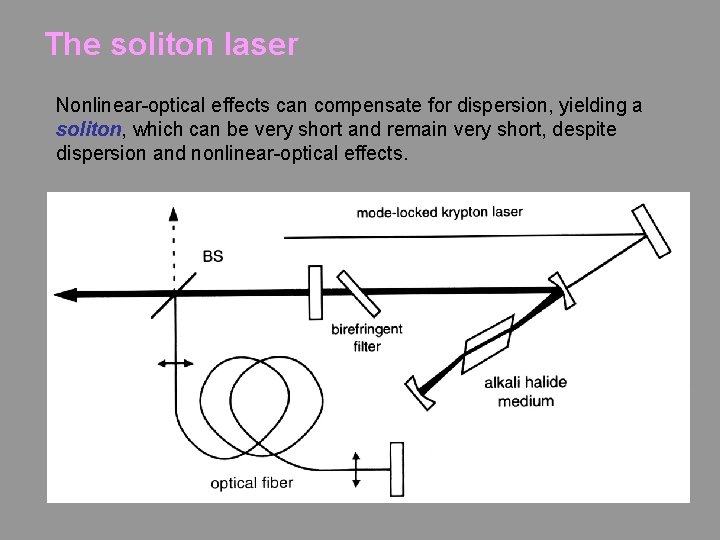
The soliton laser Nonlinear-optical effects can compensate for dispersion, yielding a soliton, which can be very short and remain very short, despite dispersion and nonlinear-optical effects.
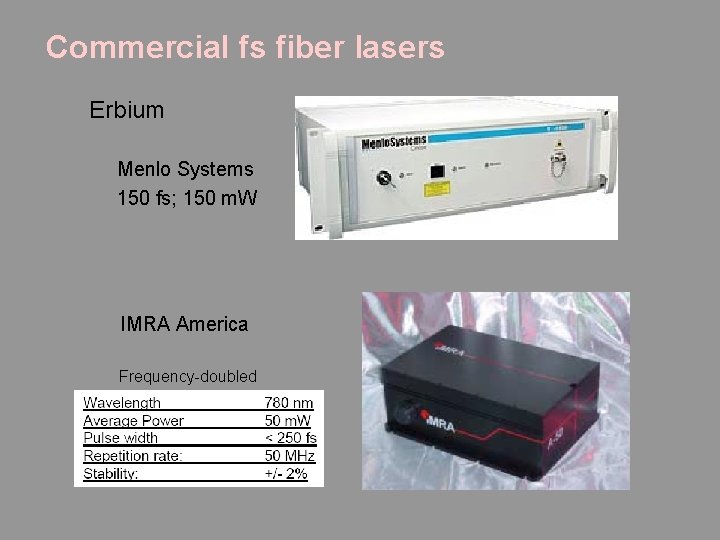
Commercial fs fiber lasers Erbium Menlo Systems 150 fs; 150 m. W IMRA America Frequency-doubled
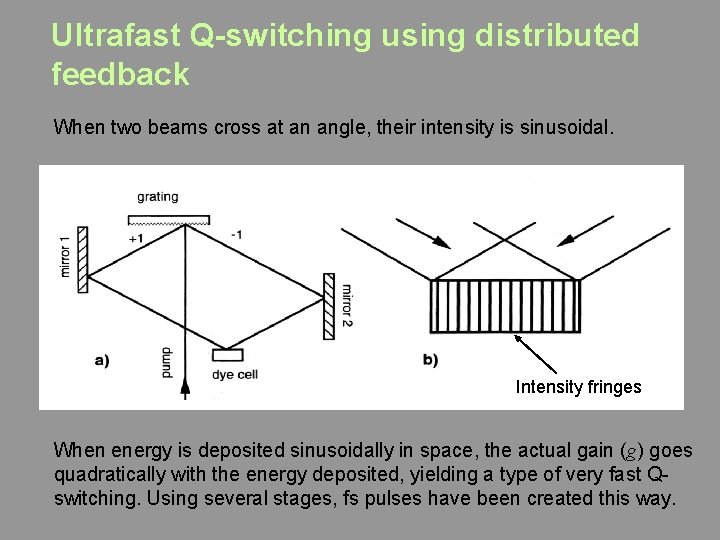
Ultrafast Q-switching using distributed feedback When two beams cross at an angle, their intensity is sinusoidal. Intensity fringes When energy is deposited sinusoidally in space, the actual gain (g) goes quadratically with the energy deposited, yielding a type of very fast Qswitching. Using several stages, fs pulses have been created this way.
Traveling-wave excitation
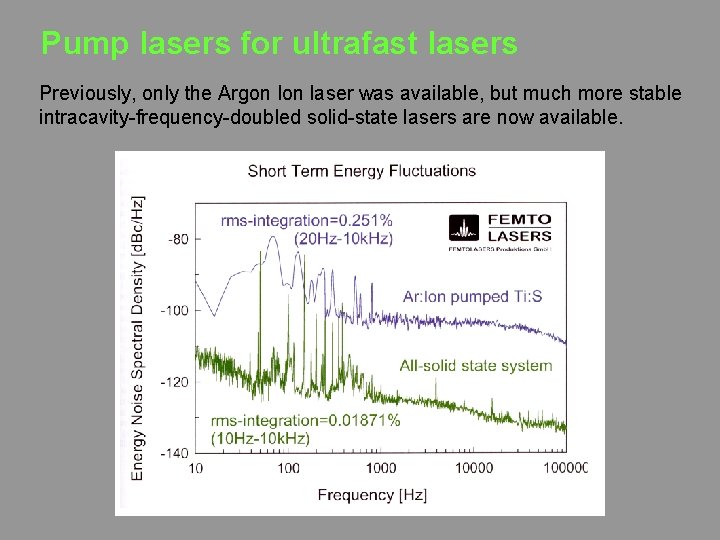
Pump lasers for ultrafast lasers Previously, only the Argon Ion laser was available, but much more stable intracavity-frequency-doubled solid-state lasers are now available.