
The General American Dialect An Introduction What is
- Slides: 13
The General American Dialect An Introduction
What is Gen. Am? - Network English, Standard American English - Few native speakers, usually acquired. - Minor differences in realization depending on speaker. - Regionally intermediate, different from the regional accents of both the Southern states, the midwest and the US Northeast - One of the 2 globally preferred dialects of English, next to RP.
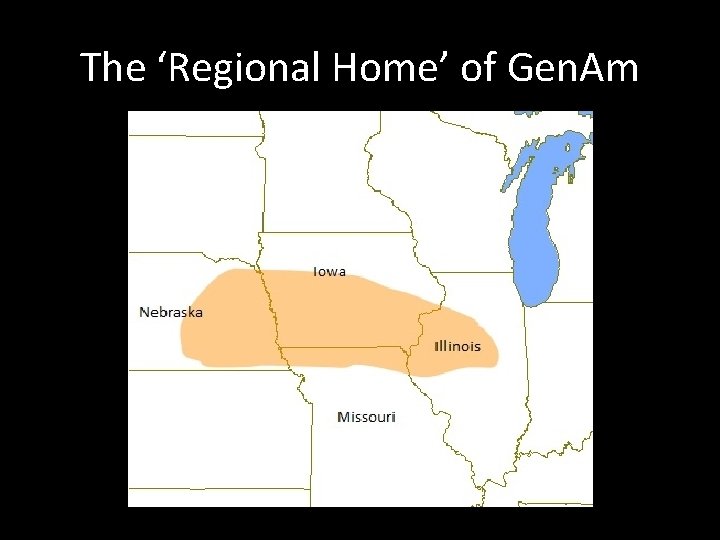
The ‘Regional Home’ of Gen. Am
History • Prior to WWII, a variety based on RP considered standard for stage and screen in anglophone North America • 1944 John Kenyon & Thomas Knott – Pronouncing Dictionary Of American English – set the standard for Gen. Am pronunciation. • 1940’s -Mid-Atlantic English – halfway between RP and Gen. Am, used on stage and in films.
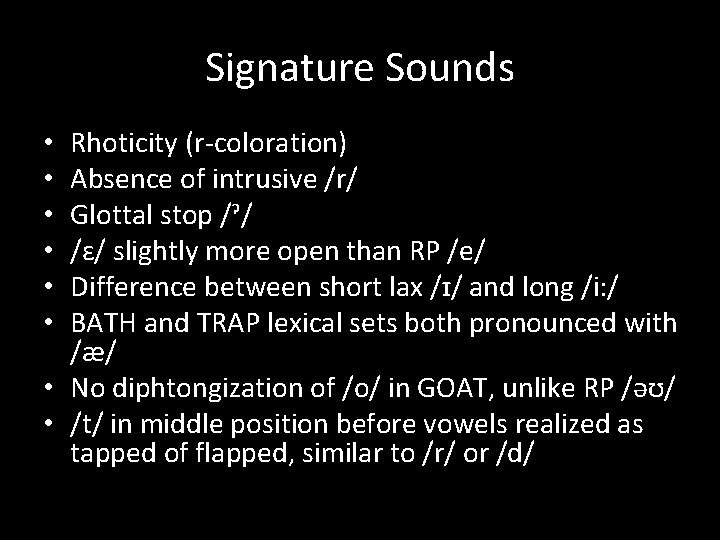
Signature Sounds Rhoticity (r-coloration) Absence of intrusive /r/ Glottal stop /ˀ/ /ɛ/ slightly more open than RP /e/ Difference between short lax /ɪ/ and long /i: / BATH and TRAP lexical sets both pronounced with /æ/ • No diphtongization of /o/ in GOAT, unlike RP /əʊ/ • /t/ in middle position before vowels realized as tapped of flapped, similar to /r/ or /d/ • • •
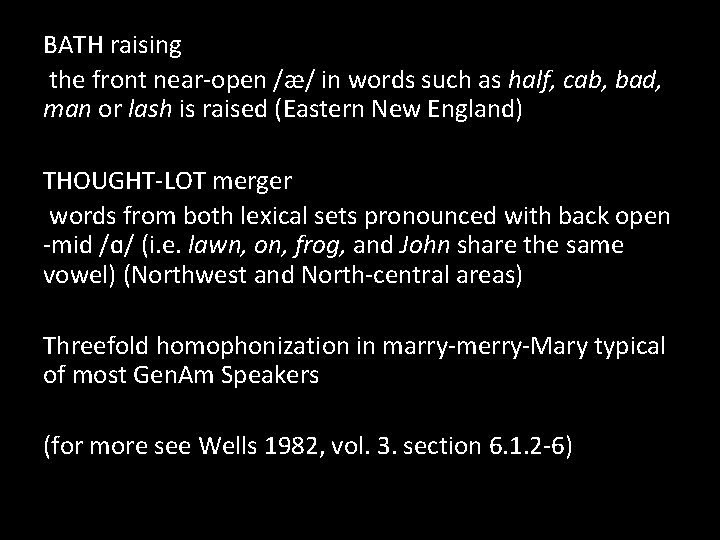
BATH raising the front near-open /æ/ in words such as half, cab, bad, man or lash is raised (Eastern New England) THOUGHT-LOT merger words from both lexical sets pronounced with back open -mid /ɑ/ (i. e. lawn, on, frog, and John share the same vowel) (Northwest and North-central areas) Threefold homophonization in marry-merry-Mary typical of most Gen. Am Speakers (for more see Wells 1982, vol. 3. section 6. 1. 2 -6)
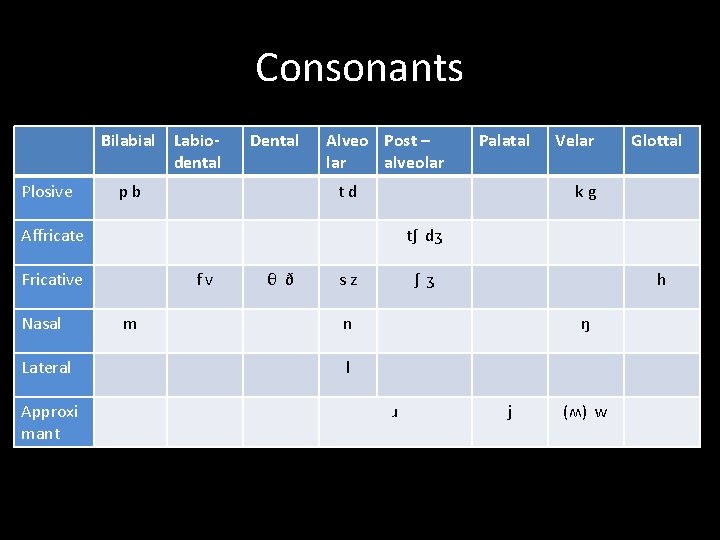
Consonants Bilabial Labiodental Plosive Dental p b Alveo Post – lar alveolar t d Approxi mant Glottal tʃ dʒ Fricative Lateral Velar k g Affricate Nasal Palatal f v m θ ð s z ʃ ʒ h n ŋ l ɹ j (ʍ) w
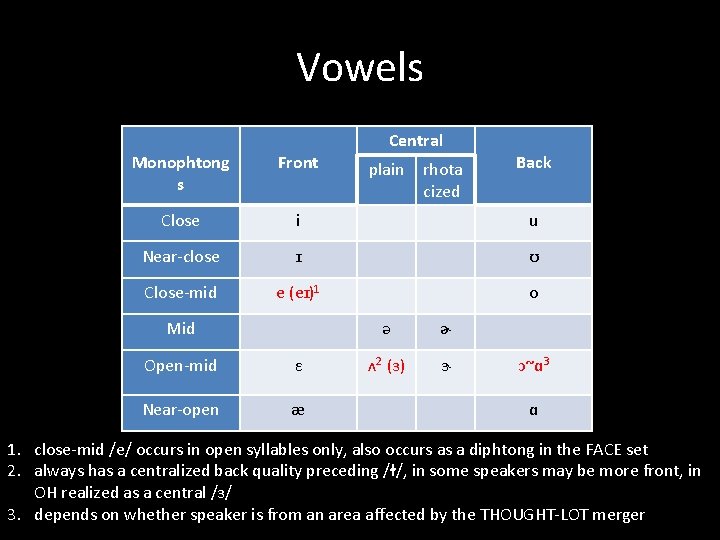
Vowels Central Monophtong s Front Close i u Near-close ɪ ʊ Close-mid e (eɪ)1 o Mid Open-mid ɛ Near-open æ plain rhota cized ə ɚ ʌ2 (ɜ) ɝ Back ɔ~ɑ 3 ɑ 1. close-mid /e/ occurs in open syllables only, also occurs as a diphtong in the FACE set 2. always has a centralized back quality preceding /ɫ/, in some speakers may be more front, in OH realized as a central /ɜ/ 3. depends on whether speaker is from an area affected by the THOUGHT-LOT merger
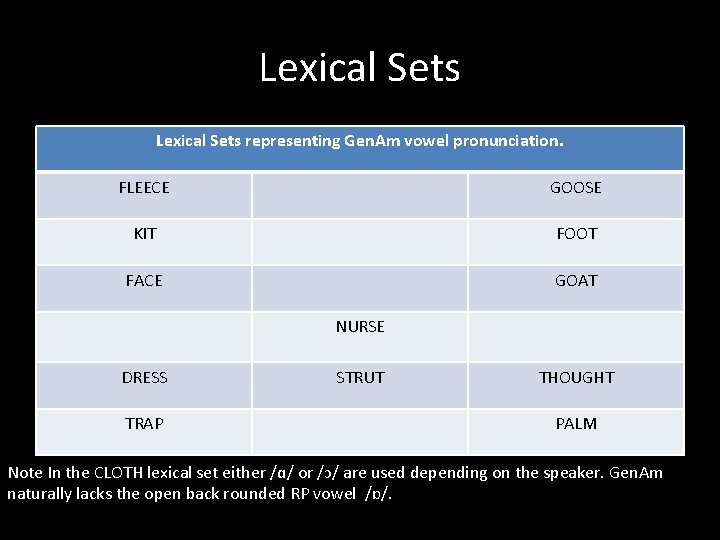
Lexical Sets representing Gen. Am vowel pronunciation. FLEECE GOOSE KIT FOOT FACE GOAT NURSE DRESS TRAP STRUT THOUGHT PALM Note In the CLOTH lexical set either /ɑ/ or /ɔ/ are used depending on the speaker. Gen. Am naturally lacks the open back rounded RP vowel /ɒ/.
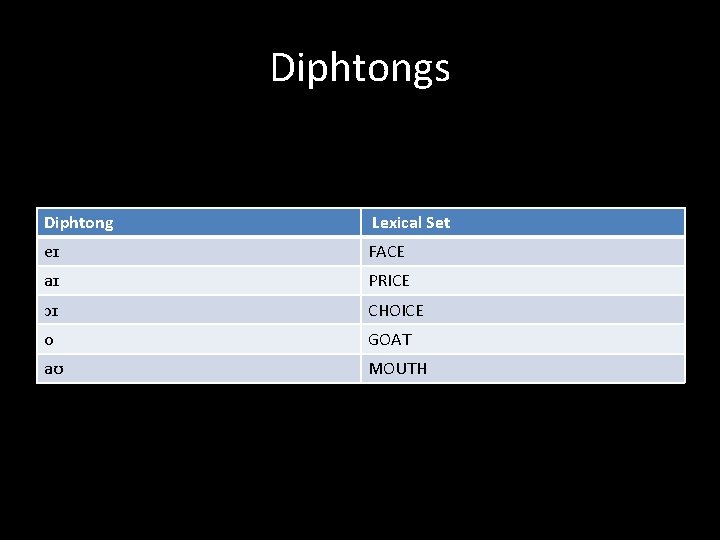
Diphtongs Diphtong Lexical Set eɪ FACE aɪ PRICE ɔɪ CHOICE o GOAT aʊ MOUTH
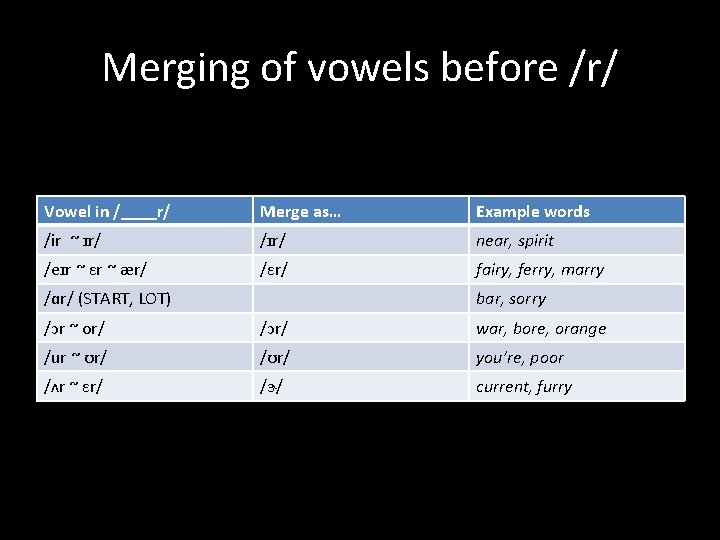
Merging of vowels before /r/ Vowel in /____r/ Merge as… Example words /ir ~ ɪr/ /ɪr/ near, spirit /eɪr ~ ɛr ~ ær/ /ɛr/ fairy, ferry, marry /ɑr/ (START, LOT) bar, sorry /ɔr ~ or/ /ɔr/ war, bore, orange /ur ~ ʊr/ /ʊr/ you’re, poor /ʌr ~ ɛr/ /ɝ/ current, furry
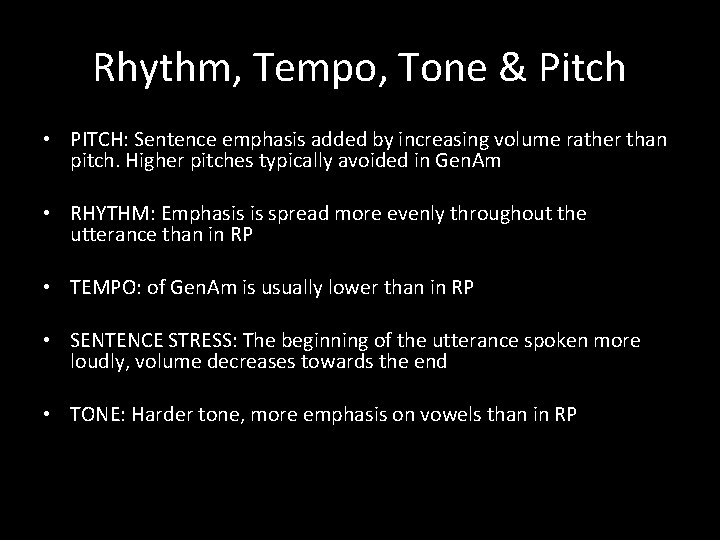
Rhythm, Tempo, Tone & Pitch • PITCH: Sentence emphasis added by increasing volume rather than pitch. Higher pitches typically avoided in Gen. Am • RHYTHM: Emphasis is spread more evenly throughout the utterance than in RP • TEMPO: of Gen. Am is usually lower than in RP • SENTENCE STRESS: The beginning of the utterance spoken more loudly, volume decreases towards the end • TONE: Harder tone, more emphasis on vowels than in RP
References Meier, P. Accents for Stage and Screen Wells, J. C. Accents of English, vol. 3 The Telsur Project by William Labov et al. http: //www. ling. upenn. edu/phono_atlas/home. html