
THE GENE What information does the gene possess
- Slides: 19
THE GENE What information does the gene possess? © 2016 Paul Billiet ODWS
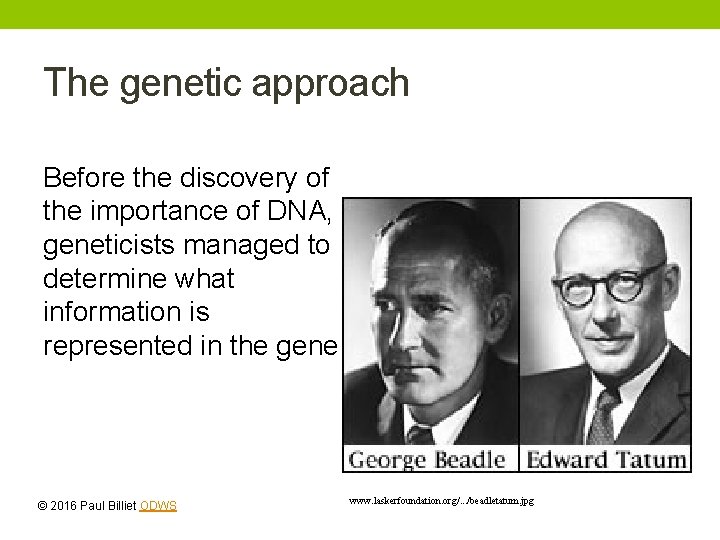
The genetic approach Before the discovery of the importance of DNA, geneticists managed to determine what information is represented in the gene © 2016 Paul Billiet ODWS www. laskerfoundation. org/. . . /beadletatum. jpg
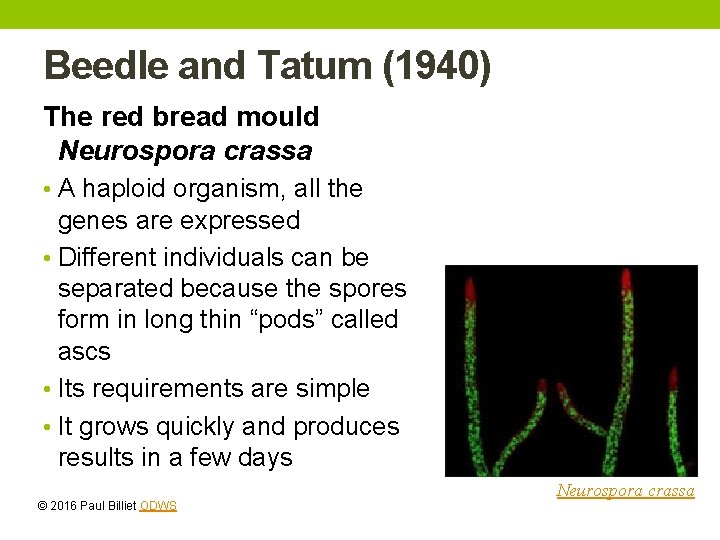
Beedle and Tatum (1940) The red bread mould Neurospora crassa • A haploid organism, all the genes are expressed • Different individuals can be separated because the spores form in long thin “pods” called ascs • Its requirements are simple • It grows quickly and produces results in a few days © 2016 Paul Billiet ODWS Neurospora crassa
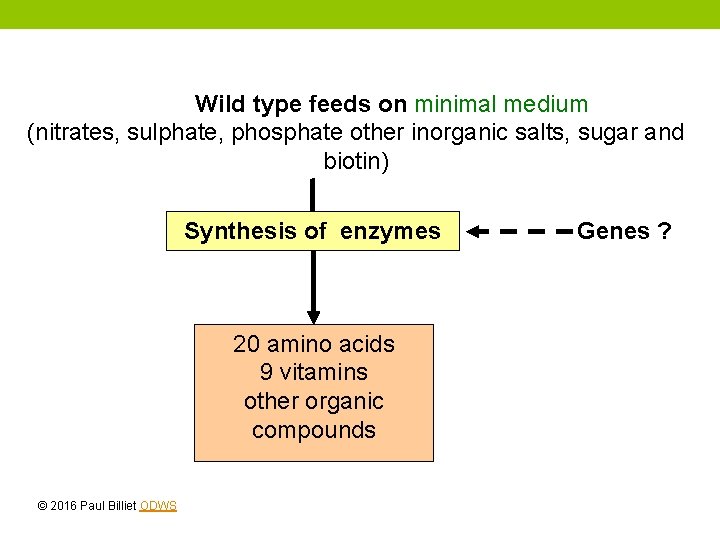
Wild type feeds on minimal medium (nitrates, sulphate, phosphate other inorganic salts, sugar and biotin) Synthesis of enzymes 20 amino acids 9 vitamins other organic compounds © 2016 Paul Billiet ODWS Genes ?
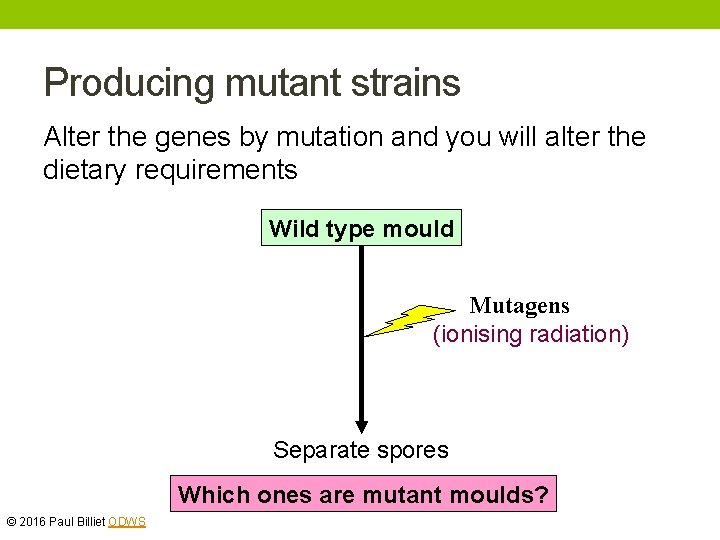
Producing mutant strains Alter the genes by mutation and you will alter the dietary requirements Wild type mould Mutagens (ionising radiation) Separate spores Which ones are mutant moulds? © 2016 Paul Billiet ODWS
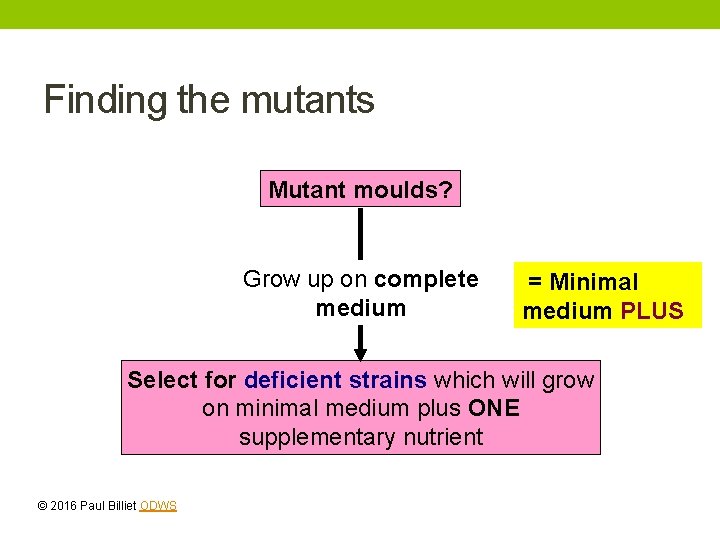
Finding the mutants Mutant moulds? Grow up on complete medium = Minimal medium PLUS Select for deficient strains which will grow on minimal medium plus ONE supplementary nutrient © 2016 Paul Billiet ODWS
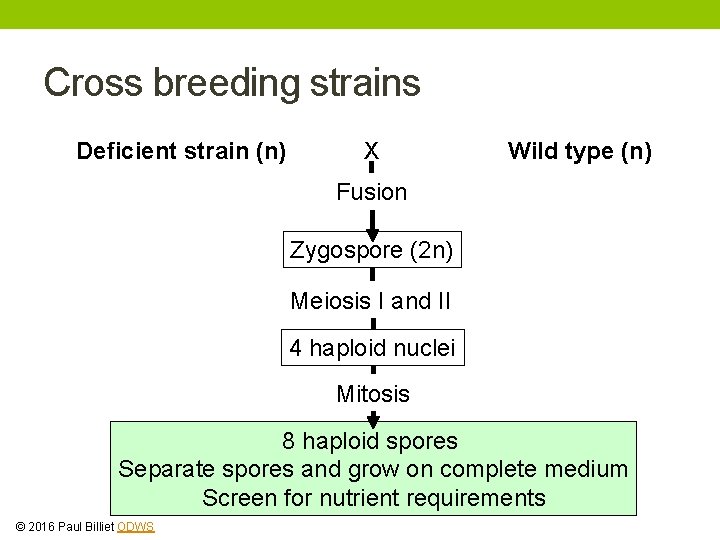
Cross breeding strains Deficient strain (n) X Wild type (n) Fusion Zygospore (2 n) Meiosis I and II 4 haploid nuclei Mitosis 8 haploid spores Separate spores and grow on complete medium Screen for nutrient requirements © 2016 Paul Billiet ODWS
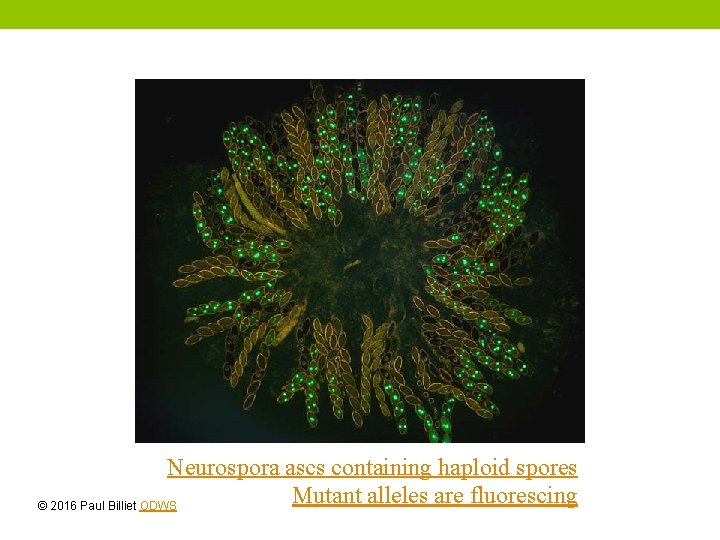
Neurospora ascs containing haploid spores Mutant alleles are fluorescing © 2016 Paul Billiet ODWS
Results • Four of the daughter spores gave rise to colonies that are like the deficient parent and four give colonies that are like the wild type parent • The condition is hereditary • It is caused by the mutation of a single gene © 2016 Paul Billiet ODWS
Conclusion • Enzymes are needed by this mould to synthesise vitamins and amino acids • The production of these compounds is affected by mutation (damaged genetic material) • The inheritance pattern of these defective enzymes is the same as that of single genes Therefore ONE GENE corresponds to ONE ENZYME
Generalising • Enzymes are all proteins…. • but not all proteins are enzymes • Proteins are all affected by mutations in the same way Therefore ONE GENE corresponds to ONE PROTEIN © 2016 Paul Billiet ODWS
More precisely…. • • Some proteins are made of subunits (quaternary structure) e. g. Haemoglobin = 4 subunits (2 x α and 2 x β) Each subunit is independently affected by mutations Therefore ONE GENE corresponds to ONE POLYPEPTIDE © 2016 Paul Billiet ODWS
That’s not all… • The hypothesis was established by 1962 there was still another refinement when gene expression was worked out • Genes are transcribed to make RNA molecules • m. RNA molecules are translated into polypeptides but… • not all RNA is m. RNA, genes are also transcribed into t. RNA molecules and r. RNA molecules • t. RNA and r. RNA are not translated (though they are used in the translation process) So a gene does not necessarily correspond to a polypeptide at all
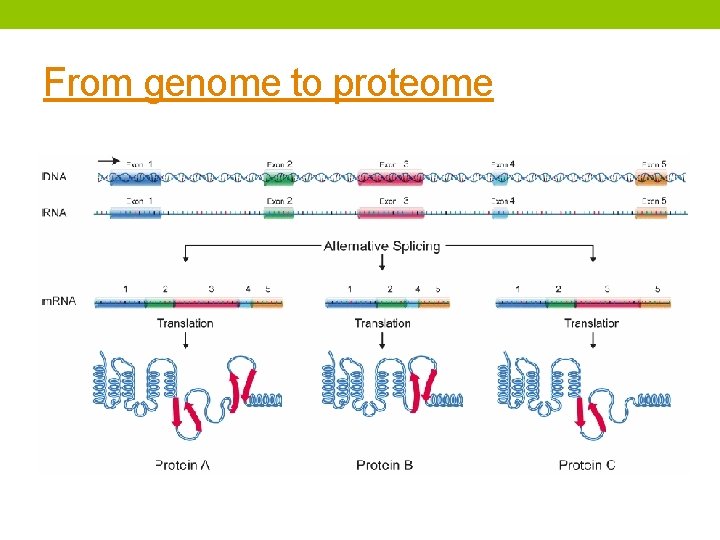
It gets better (or worse!)… • Immunoglobulins (antibodies) are made of a polypeptide with two domains (constant C and variable V) • Two genes are needed to construct the polypeptide of an immunoglobulin, one for each domain • The gene for the variable part is transcribed as pre. RNA • This pre-RNA is then spliced in different places by spliceosomes to take out introns • Different introns can be cut out to make different immunoglobulins from the same pre-RNA (alternative splicing) So a single gene can code for more than one protein © 2016 Paul Billiet ODWS
So what is a gene? • It contains information • That may code for a protein • Or part of protein • Or more than one protein • Or RNA that does not translate into a protein • The smallest physical unit of heredity encoding a molecular cell product (Penguin Dictionary of Biology). © 2016 Paul Billiet ODWS
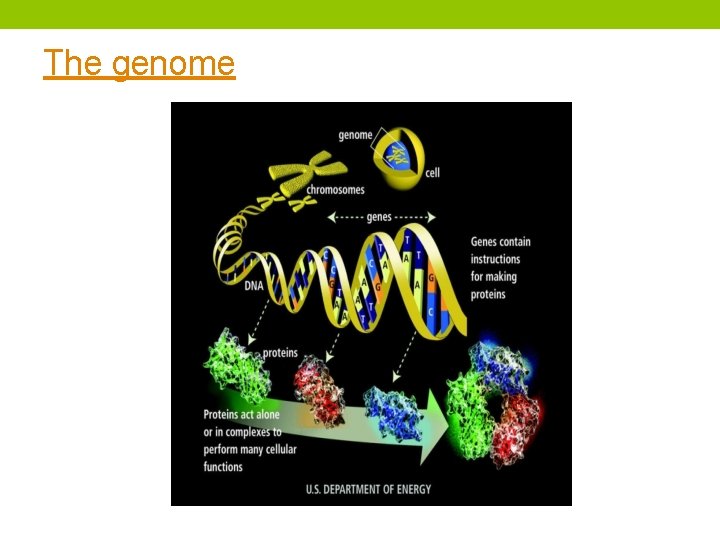
The genome
The proteome • Total set of proteins expressed by a cell, tissue or organ • Information to construct a protein lies in genes • Proteome ≠ genome • Proteome > total genes in genome © 2016 Paul Billiet ODWS
From genome to proteome
Proteomics • Study of the structure and function of proteins • Human Proteome Project (HPP) • Proteome and cancer research © 2016 Paul Billiet ODWS