
The GEANT based Monte Carlo and the Simulations
The GEANT based Monte Carlo, and the “Simulations for KM 3 Ne. T Technical Design” Report A progress report Work at Erlangen, NIKHEF*, “Demokritos”, NESTOR, … By A. Kappes, T. Eberl, C. Kopper, G. Stavropoulos, D. Lenis, C. Markou, K. Tzamarioudaki, A. Psallidas, P. Koojman, A. C. Assis-Jesus, and others … Presented by P. Rapidis
a Work done by Erlangen, Nikhef, NESTOR, and Demokritos people, already described to a large extent by A. Kappes Some of it was coordinated during a working meeting held at Erlangen 3 weeks ago • Use spectra of muons and neutrino-induced muons from various (existing generators) and use (1) GEANT 4 for Cherenkov light (and not only) generation, (2) add a flexible XML based adjustable detector geometry, (3) do pattern recognition and event reconstruction. • GEANT was never meant to be a production tool – a validation check mostly. It just takes too long (timing is a problem - approx 2 hours for 10 -100 Te. V muon) thus a long run will be prohibitive. • Work on Sirene (some debugging and comparisons w/ Geant 4) Sirene is supposed to be a fast muon propagation and Cherenkov light generation software. Work of P. Koojman and others from the Netherlands … “ There is quite good agreement with the Geant simulations but there are some x x x detailed differences in the timing of the shower hits. We are working on that. It x x runs up to 10**6 Te. V, and takes about 10 mins on a single modern CPU (3 G), x x reducing by a factor of 2 for every factor of 10 in energy, per event “
• Porting reconstruction (Chameleon) to KM 3 Tray (The Fitter was already ported by C. Kopper, the rest - pattern recognition -- is done by D. Lenis, work in progress) • Effort to install Km 3 tray on "D"'s cluster (continues to fail, thanks to the Greek Army that has taken our system expert away from us or 45 days) (140 cpus) • Considering porting KM 3 Ne. T tray to the GRID environment. • Started test runs of g 4 sim on Lyon cluster w/ JP's files (in progress) (looong) • Scripts to make plots for the above when it will be ready (in progress, w/ A. Psallidas) • Submission of minor patches to the km 3 tray project (reading of. bz 2 files) • Significant amount of time went into learning the tray (we are newcomers) Objective : contribute to the studies to be presented at the March-April meeting.
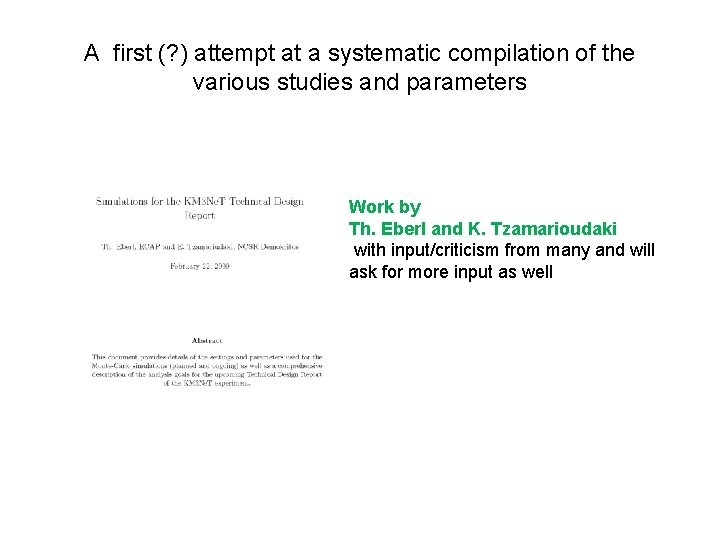
A first (? ) attempt at a systematic compilation of the various studies and parameters Work by Th. Eberl and K. Tzamarioudaki with input/criticism from many and will ask for more input as well
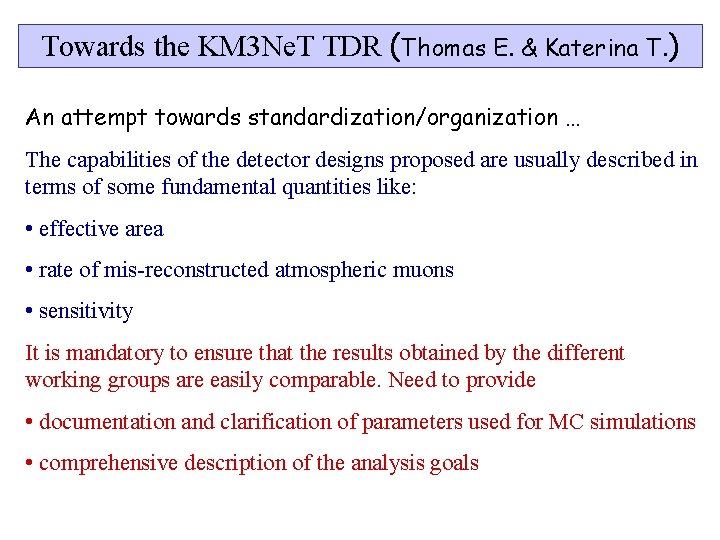
Towards the KM 3 Ne. T TDR (Thomas E. & Katerina T. ) An attempt towards standardization/organization … The capabilities of the detector designs proposed are usually described in terms of some fundamental quantities like: • effective area • rate of mis-reconstructed atmospheric muons • sensitivity It is mandatory to ensure that the results obtained by the different working groups are easily comparable. Need to provide • documentation and clarification of parameters used for MC simulations • comprehensive description of the analysis goals
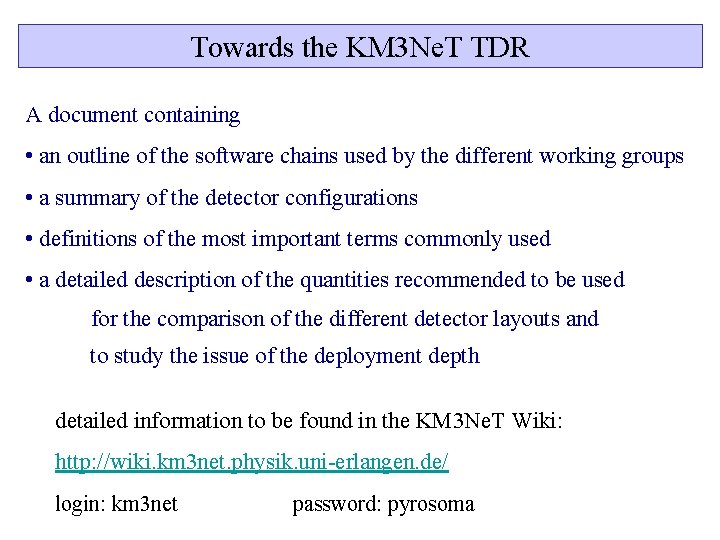
Towards the KM 3 Ne. T TDR A document containing • an outline of the software chains used by the different working groups • a summary of the detector configurations • definitions of the most important terms commonly used • a detailed description of the quantities recommended to be used for the comparison of the different detector layouts and to study the issue of the deployment depth detailed information to be found in the KM 3 Ne. T Wiki: http: //wiki. km 3 net. physik. uni-erlangen. de/ login: km 3 net password: pyrosoma
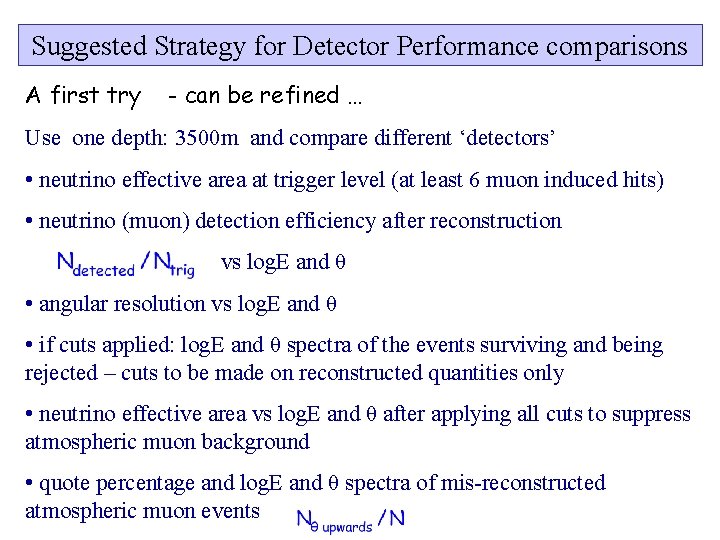
Suggested Strategy for Detector Performance comparisons A first try - can be refined … Use one depth: 3500 m and compare different ‘detectors’ • neutrino effective area at trigger level (at least 6 muon induced hits) • neutrino (muon) detection efficiency after reconstruction vs log. E and θ • angular resolution vs log. E and θ • if cuts applied: log. E and θ spectra of the events surviving and being rejected – cuts to be made on reconstructed quantities only • neutrino effective area vs log. E and θ after applying all cuts to suppress atmospheric muon background • quote percentage and log. E and θ spectra of mis-reconstructed atmospheric muon events
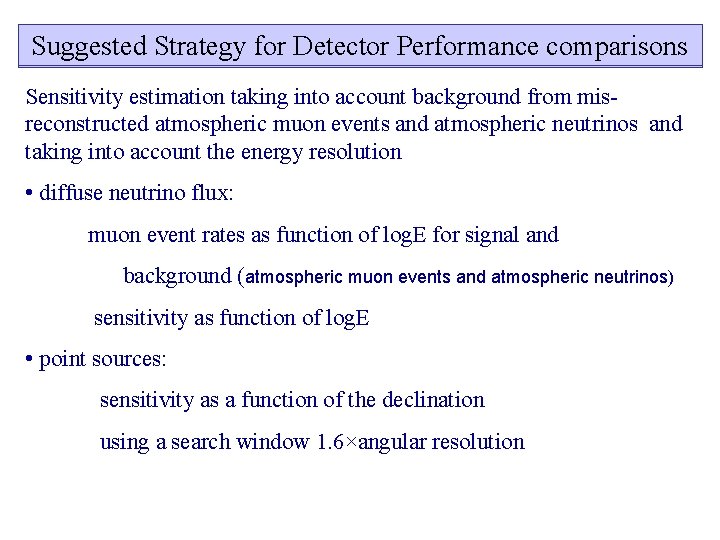
Suggested Detector Strategy for Detector Performance comparisons Sensitivity estimation taking into account background from misreconstructed atmospheric muon events and atmospheric neutrinos and taking into account the energy resolution • diffuse neutrino flux: muon event rates as function of log. E for signal and background (atmospheric muon events and atmospheric neutrinos) sensitivity as function of log. E • point sources: sensitivity as a function of the declination using a search window 1. 6×angular resolution
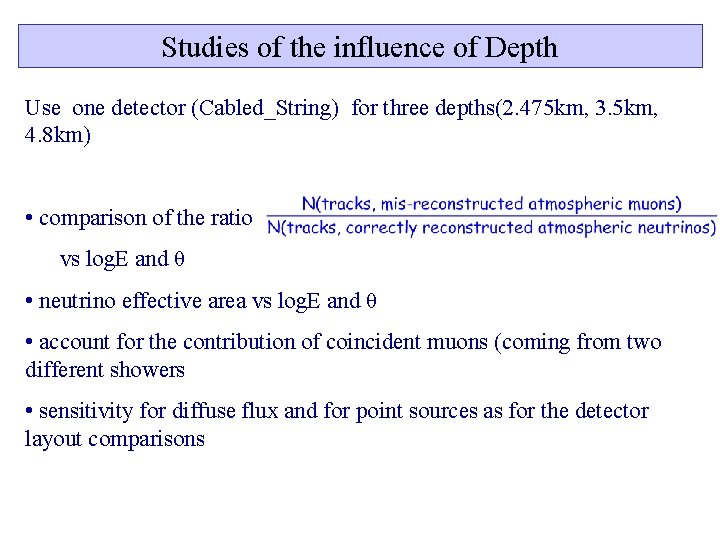
Studies of the influence of Depth Use one detector (Cabled_String) for three depths(2. 475 km, 3. 5 km, 4. 8 km) • comparison of the ratio vs log. E and θ • neutrino effective area vs log. E and θ • account for the contribution of coincident muons (coming from two different showers • sensitivity for diffuse flux and for point sources as for the detector layout comparisons

Don’t Miss it ! Register NOW ! A great event ! Couldn’t be better ! An experience of a lifetime http: //www. inp. demokritos. gr/~km 3 net/
- Slides: 10